
Twee: When Whimsy Became a Whole Personality

Table of Contents
Twee gets treated more like a punchline than a movement.
The word comes from British slang for "sweet." For a long time it was an insult, accusing someone of being too precious to take seriously. Twee culture took the word back and argued that softness and childlike delight are not the same as weakness.
Twee enjoys mix tapes, hand-drawn illustrations, tea, and small animals. It’s not Cottagecore, which depends on rural fantasy, nor Coquette which is exaggerated femininity. Twee just likes what it likes.
Twee enjoys mix tapes, hand-drawn illustrations, tea, and small animals. It’s not Cottagecore, which depends on rural fantasy, nor Coquette which is exaggerated femininity. Twee just believes that whimsy is a discipline and the ballet flat is a moral choice. Think Zooey Deschanel between 2007 and 2013, every Etsy seller circa 2010, the entire cast of Amélie, and Alexa Chung's tenth-anniversary editorial spread.
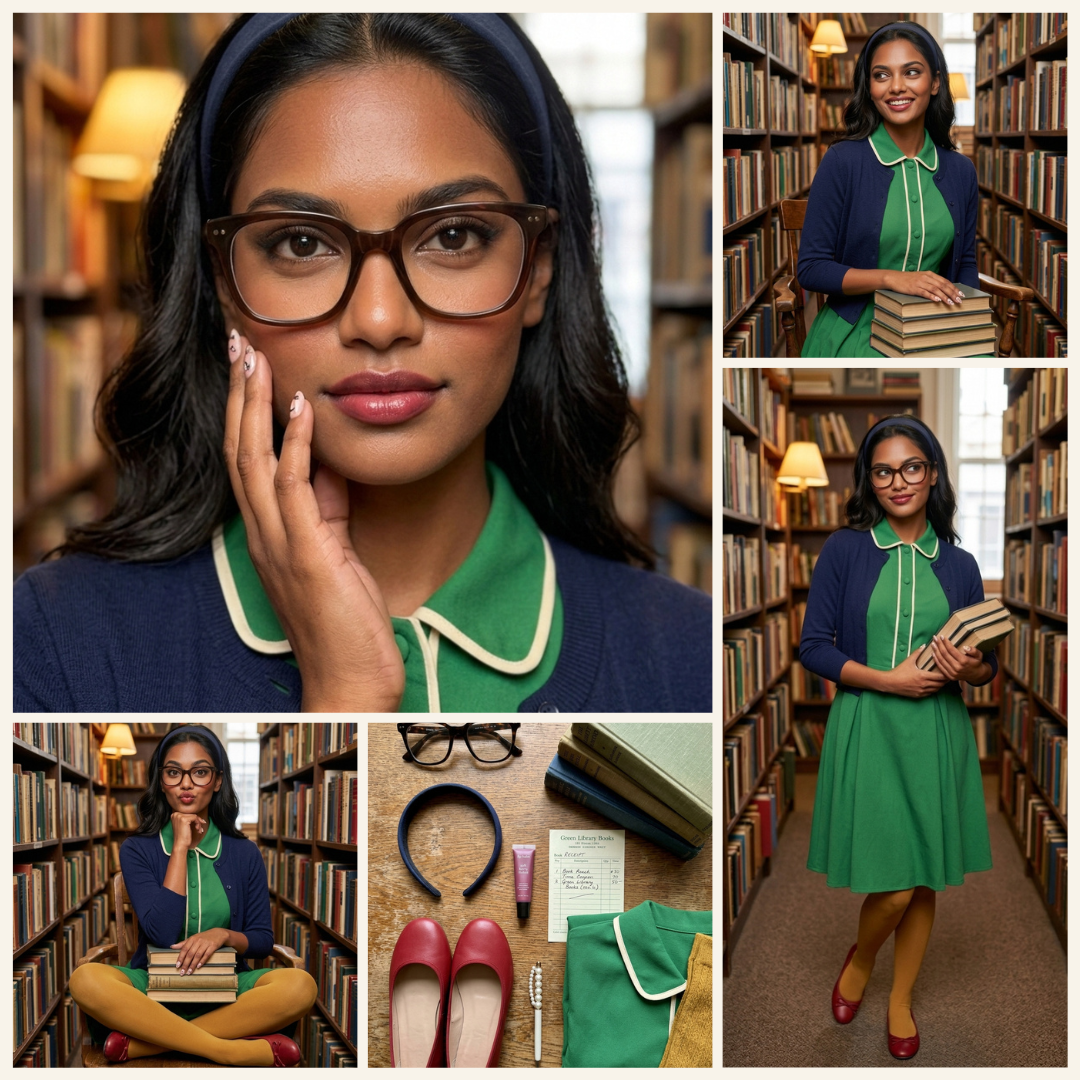
Twee shares real DNA with Librarian Chic. Both love a good cardigan and treat glasses and books as style objects. However, Librarian Chic is a bit severe and intelligence as an aesthetic. Twee is warmer and less guarded.
Right now twee is having a moment again. A strain some corners of TikTok are calling "Whimsy Twee" has circulated since late 2024 bringing brighter palettes, heavier pattern-mixing, and more nostalgia signaling layered onto the original template. That timing is landing right as the fashion industry pulls back hard from years of neural palettes, in what trend writers have started calling the Great Un-Beiging.
Twee was never going to lead a maximalist backlash on its own, but it benefits from the same fatigue.
The Twee Promise
What It Sells:
Whimsy as a lifestyle
Adulthood softened by childlike wonder
The manic pixie dream girl escape hatch
A wardrobe made of narrative props
The status of being genuinely delighted
What You Get:
Actually charming clothing
People asking if you play the ukulele (you might)
A serious relationship with vintage stores
Membership in the "still owns a film camera" society
Also: never wondering how to dress for a picnic
-
Twee is a fashion aesthetic built on sincerity. It embraces cardigans, peter pan collars, and thrifted pieces.
The word comes from British slang for "sweet," originally used as an insult before being reclaimed by the culture it described.
The Cultural DNA of Twee
A Brief History of Aggressive Whimsy
1960s: The mod-adjacent original — Jean Shrimpton, Twiggy, the Peter Pan collar's first modern moment
1980s: Indie pop invents the sonic register (Belle & Sebastian's precursors, the C86 tape)
1996: Belle & Sebastian releases If You're Feeling Sinister, the movement's soundtrack
2001: Amélie releases and gives the aesthetic its cinematic Bible
2007: Juno arrives, the hamburger phone enters the canon
2007–2013: Zooey Deschanel becomes the walking mood board (500 Days of Summer, New Girl)
2010–2013: Tumblr peaks, Etsy explodes, everyone owns a bird brooch
2014: Marc Spitz publishes Twee: The Gentle Revolution, the movement gets its name in print
2015–2019: Backlash arrives, "cheugy" enters the discourse, Twee retreats
2023: TikTok rediscovers coquette, which is Twee's younger cousin in a hair bow
2024–2026: Twee’s proper return with the ballet flat resurgence, the ribbon renaissance, and Chappell Roan's theatrical whimsy.
The Cultural Catalysts
Why It's Returning Now:
Coquette exhaustion (bows can only do so much on their own)
Post-quiet-luxury appetite for narrative and color
Nostalgia for the pre-algorithm internet
The ballet flat as the shoe of the moment
General cultural fatigue with performed toughness
Wes Anderson's Asteroid City and The Phoenician Scheme keeping the visual grammar current
The Media Blueprint:
Amélie (2001): The cinematic foundation — red, green, cardigans, the whole grammar
Juno (2007): The North American translation
500 Days of Summer (2009): The peak Zooey document
Moonrise Kingdom (2012): The Wes Anderson thesis statement
The Grand Budapest Hotel (2014): The color-story climax
New Girl (2011–2018): The televised commitment
Belle & Sebastian's entire catalog: The sonic requirement
Every Etsy homepage from 2008–2013: The commercial expression
Style Icons:
Zooey Deschanel: The defining face
Alexa Chung: The British-Twee elevated version
Audrey Tautou (as Amélie): The foundational fictional icon
Taylor Swift (Fearless-era): The country-Twee crossover
Kirsten Dunst (early 2000s): The soft-Twee dialect
Michelle Williams (indie-film-era): The melancholy-Twee variant
Chappell Roan (current): The theatrical-Twee revival
The History of Twee: From Post-Punk Rebellion to TikTok Revival
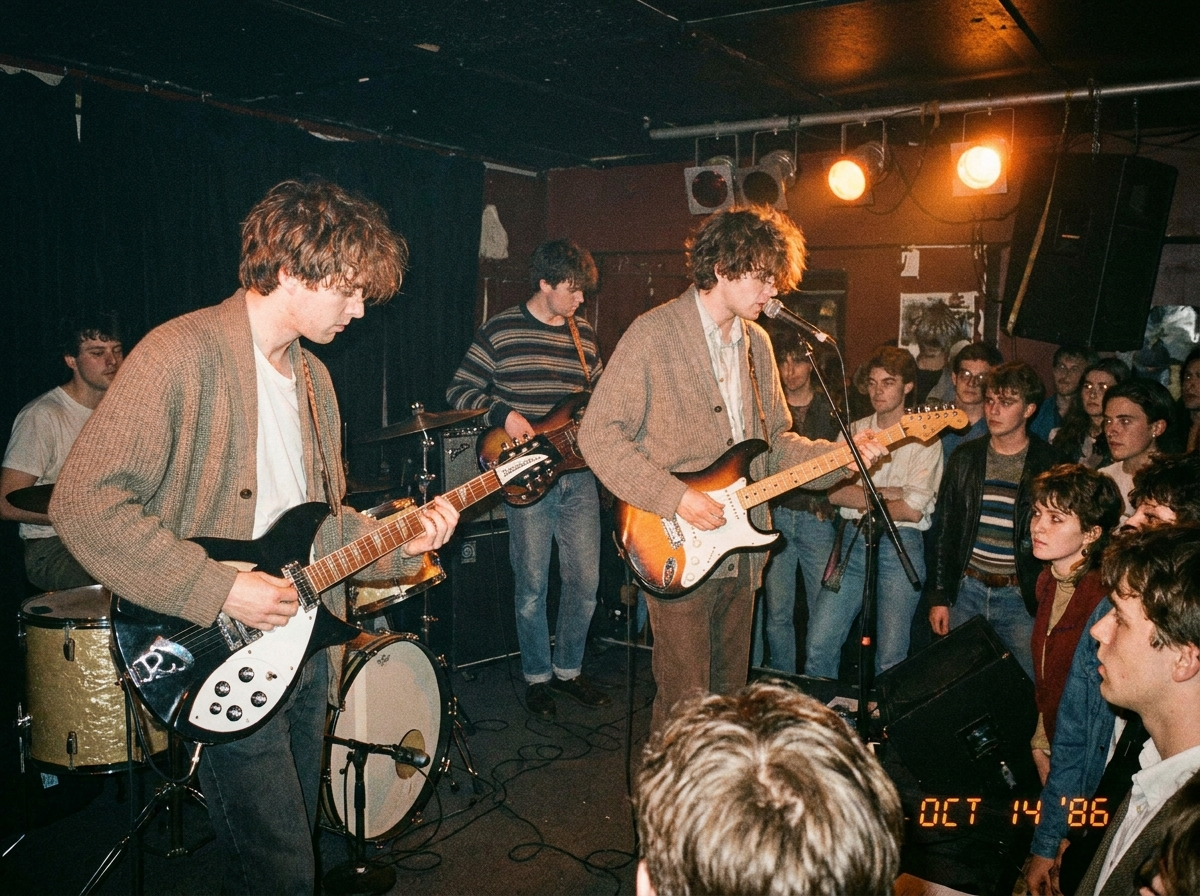
Vintage 1980s indie band with jangle pop instruments, twee pop origins
Long before it was an aesthetic, “twee” was a music genre.
By the mid-1980s, post-punk music had gotten way more grumpy and aggressive than anyone wanted. Twee was the ultimate "no thank you" with cheerful guitars, knitted cardigans, and songs about puppy love. Out of this cuteness rebellion came Twee Pop, a vibe where being uncool was cool. The genre's foundational moment was NME's 1986 C86 cassette compilation, which brought together bands like the Pastels and the Shop Assistants; and, shortly after, Talulah Gosh and the Field Mice.
In 2014, Marc Spitz wrote a book called Twee: The Gentle Revolution in Music, Books, Television, Fashion and Film, which called it the “most powerful youth movement since punk and hip-hop. Naturally, the book was published right after twee's big moment, proving once again that we only name trends once corporations have already packaged and sold them back to us.
Fashion critics trace the visual vocabulary to the 1950s-1970s which covers mod culture, mini skirts, and schoolgirl tailoring. Another contribution was Japanese kawaii culture whose pinafore dresses and dressing-up-box collections popularized Twee on the runway and cited Hello Kitty and anime like Sailor Moon as influences.
Mainstream Peak and 2010s Decline
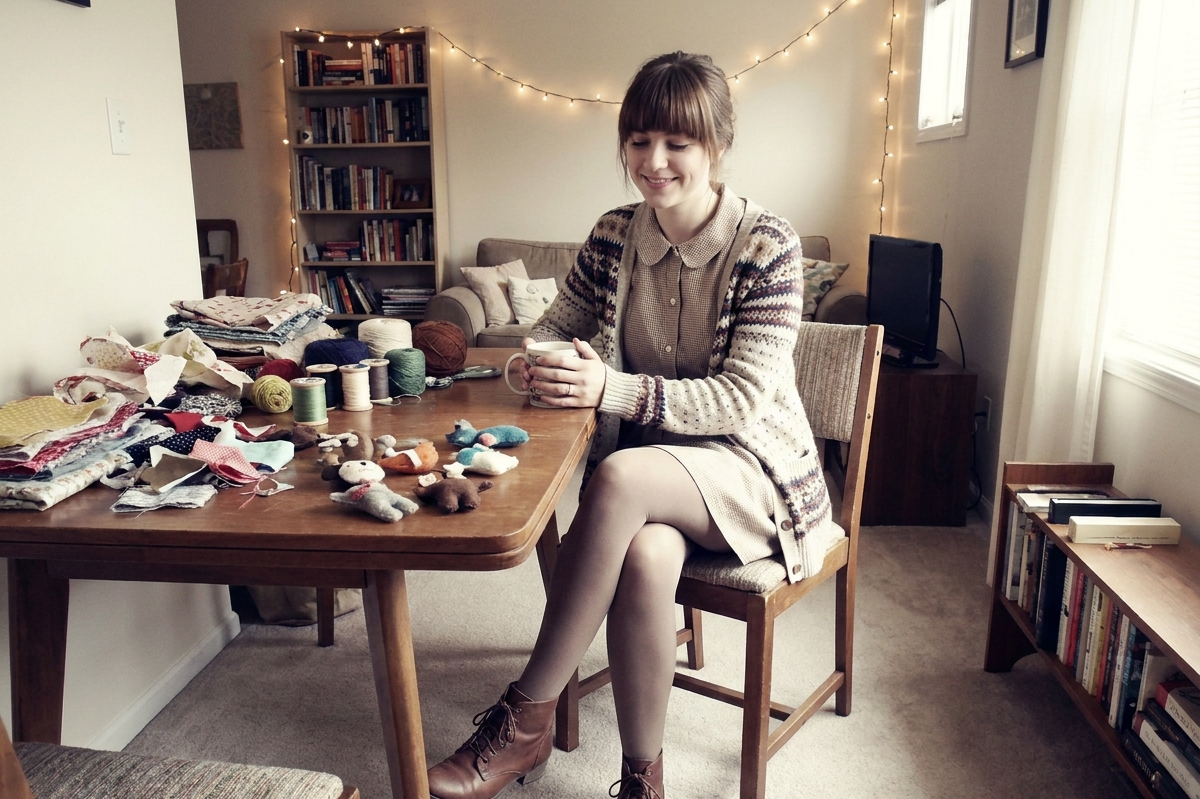
2010s Etsy handmade aesthetic, Tumblr-era twee fashion nostalgia
Twee crossed fully into the mainstream in the late 2000s and early 2010s.
Twee’s Golden Age lasted from about 2005 to 2015, where we had Zooey Deschanel’s quirky New Girl character, Etsy becoming a goldmine for handmade mustache jewelry, and Tumblr serving as a digital museum for vintage sadness. Wes Anderson’s pastel-saturated films like The Royal Tenenbaums and TheGrand Budapest Hotel became shorthand for Twee’s storybook image.
Mall retailers like Urban Outfitters mass-produced twee-adjacent clothing and home decor. Miu Miu and Markus Lupfer — nicknamed the "king of the kitten-embellished knit" — brought the look to runways, and costume designers even dressed Doctor Who's Clara Oswald in stereotypically twee outfits.
But that same commercial ubiquity became the aesthetic's undoing. Because twee's core appeal was quirky individuality, its adoption by big-box retailers contradicted the ethos, and the style faded in tandem with the broader decline of hipster culture.
Instead of dying, twee just hibernated.
The 2020s TikTok Revival
Twee resurfaced around 2022 on TikTok and Tumblr among Gen Z, arriving alongside a parallel revival of "indie sleaze" nostalgia for the 2000s and 2010s. Vogue noted the trend recalled "mod culture and classic shapes of the 1960s and 1970s," with little dresses, berets, and button-downs driving renewed interest, while Pitchfork observed that on TikTok, the tag had loosened to mean "anything feminine or vaguely melancholy". Twee pop music itself saw a parallel resurgence, including a new "laptop twee" microgenre coined by the Canadian collective friends.
Around late 2024, a mutant version sprouted on TikTok under the name "Whimsy Twee"—which is basically the original look but with brighter colors, chaotic pattern-mixing, and more nostalgia. The main Twee hashtag has racked up about 2.3 million posts, offering a dizzying mix of "look at this vintage 2010 outfit" and kids trying to make the cardigan cool again.
Where original twee was "dorky and charmingly low-key," this newer wave is "eager and unashamed, the antithesis of nonchalant cool". Designer Sandy Liang became the current era's central figure, translating childlike nostalgia — bows, ribbons, cropped silhouettes — into a bankable aesthetic that Essence credits, alongside J. Crew and Lisa Says Gah, with monetizing nostalgia for younger shoppers. Liang's influence has spawned a cottage industry of adjacent labels, including Sister Jane, Atelier Tulpe, Par Moi, and Foundry Mews.
The timing of this comeback is perfect. For the last few years, the fashion police pushed "quiet luxury"—meaning endless beige trench coats, zero logos, and looking like a very wealthy, very depressed minimalist. Trend writers are now calling our escape from this era the "Great Un-Beiging." Twee is the perfect escape hatch.
After a decade of being told that cool = boring, a style that celebrates wearing your heart on your sleeve is a welcome relief.
-
Twee originated in the 1980s as a reaction against post-punk's harshness, giving rise to the Twee Pop music genre.
The aesthetic was formally codified by Marc Spitz's 2014 book Twee, peaked commercially in the 2000s–2010s alongside Etsy and Tumblr culture, declined with the fall of hipsterism, and resurfaced on TikTok in late 2024 as "Whimsy Twee."
Defining the Look: Twee’s Visual Vocabulary
Twee fashion is modest, vintage-inspired silhouettes finished with one charming detail. Instead of full maximalism, Twee practices restrait with one charming, unique detail.
In a nutshell, signature pieces include:
Peter Pan collars on blouses, dresses, and knitwear
A-line and tea-length dresses in vintage prints
Cardigans, cropped knits, and button-up sweaters
Opaque tights, knee socks, and prim flats like Mary Janes, oxfords, or loafers
Novelty prints — polka dots, gingham, small florals, plaid — plus bows, berets, headbands, and satchels
Color Philosophy: The Palette of Delight
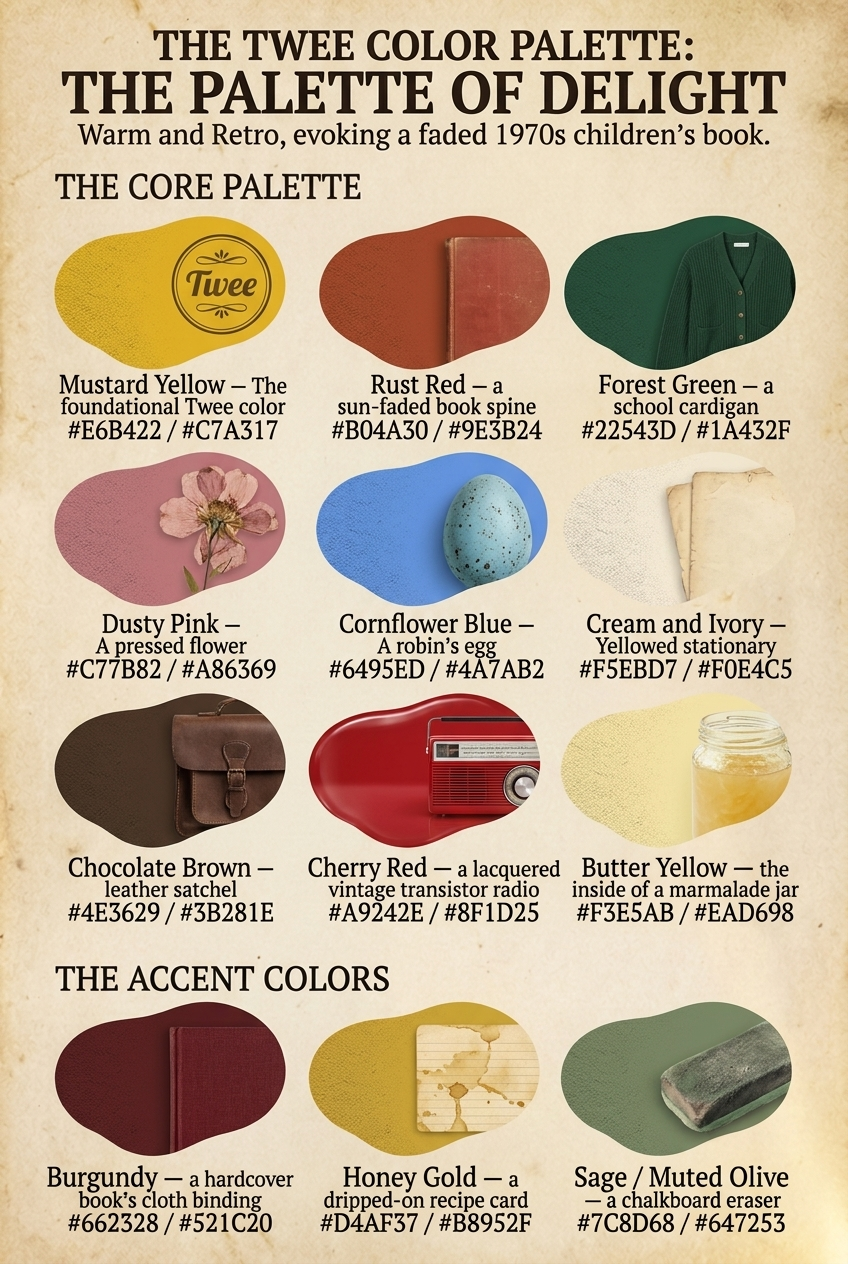
The color story is warm and retro: mustard yellow, forest green, burgundy, cream, rust, and navy, evoking a faded 1970s children's book. Stylist Dina Scherer describes the palette as feminine and "a little retro."
The Approach:
Mustard yellow: The foundational Twee color
Rust red: The Amélie signature
Forest green: The cardigan default
Dusty pink: The soft-Twee anchor
Cornflower blue: The dress standard
Cream and ivory: The tights and blouse background
Chocolate brown: The grounded neutral
Cherry red: The lipstick-and-shoe accent
Accent Colors:
Butter Yellow: The inside of a marmalade jar
Burgundy: A hardcover book’s binding
Sage Green: An old classroom eraser
The Anti-Palette (What Twee Isn't):
All black (that's an entirely different worldview)
Neon anything (that's Y2K)
Fluorescent brights (that's dopamine dressing)
Cold minimalist neutrals (that's the opposite mood)
Pattern Protocol: Absence Is Not an Option
The Twee Pattern Hierarchy:
Small florals (ditsy prints): The foundational pattern
Polka dots: The universal charm signifier
Peter Pan collars in contrast color: Pattern-by-implication
Gingham: The picnic commitment
Novelty prints (fruit, animals, celestial): The advanced move
Stripes (Breton, thin): The French-Twee endorsement
Fair Isle and Nordic knits: The winter dialect
Hearts and stars: The genuinely committed level
Texture Treasury
Cotton (lightweight, floral-printed): The dress fabric
Wool cardigan knit: The layer default
Corduroy (fine-wale, colorful): The trouser and skirt
Tweed (soft, mid-century): The blazer and skirt suit
Grosgrain ribbon: The finishing texture
Velvet (crushed or panne): The special-occasion nod
Cotton lace (trim, not full): The collar and cuff detail
Wool tights (opaque, colored): The Prada-adjacent leg
Faux fur (collar-sized only): The vintage-coat accent
Ballet-flat leather (soft, worn): The shoe texture
Pattern Mixing: When Twee Gets Complicated
The mistake in Twee pattern mixing is treating it as reckless. It isn't. Twee has been mixing patterns since 2001, and the rules are gentler than they look.
The Reliable Rules:
Scale contrast is the friend: A ditsy floral dress under a large-check coat reads harmoniously; matching scales fight
One color must repeat: Rust in the floral, rust in the tights, and the whole outfit clicks together
The cardigan can be a solid palette-cleanser: Between a patterned dress and patterned tights, a solid cardigan lets the eye rest
Small floral + polka dot + stripe is possible: But only if one dominant color threads through all three
Texture is pattern in Twee: Corduroy against tweed against a knit reads as visual variety without graphic clash
The Genuinely Twee Move:
Novelty print + a solid + a subtle stripe: The cherry-print blouse, the mustard cardigan, the thin-stripe skirt — a fluent Twee outfit
Character costume completeness: Every element considered, none accidental
The Capsule Wardrobe
A big part of Twee's original appeal was that the clothes look found and worn-in. That makes it one of the best fits for a resale first approach. The exceptions are the same ones that hold across your other pillars — tights and base-layer knits are worth buying new for fit and hygiene reasons, period.
Outerwear: The Coat as a Character
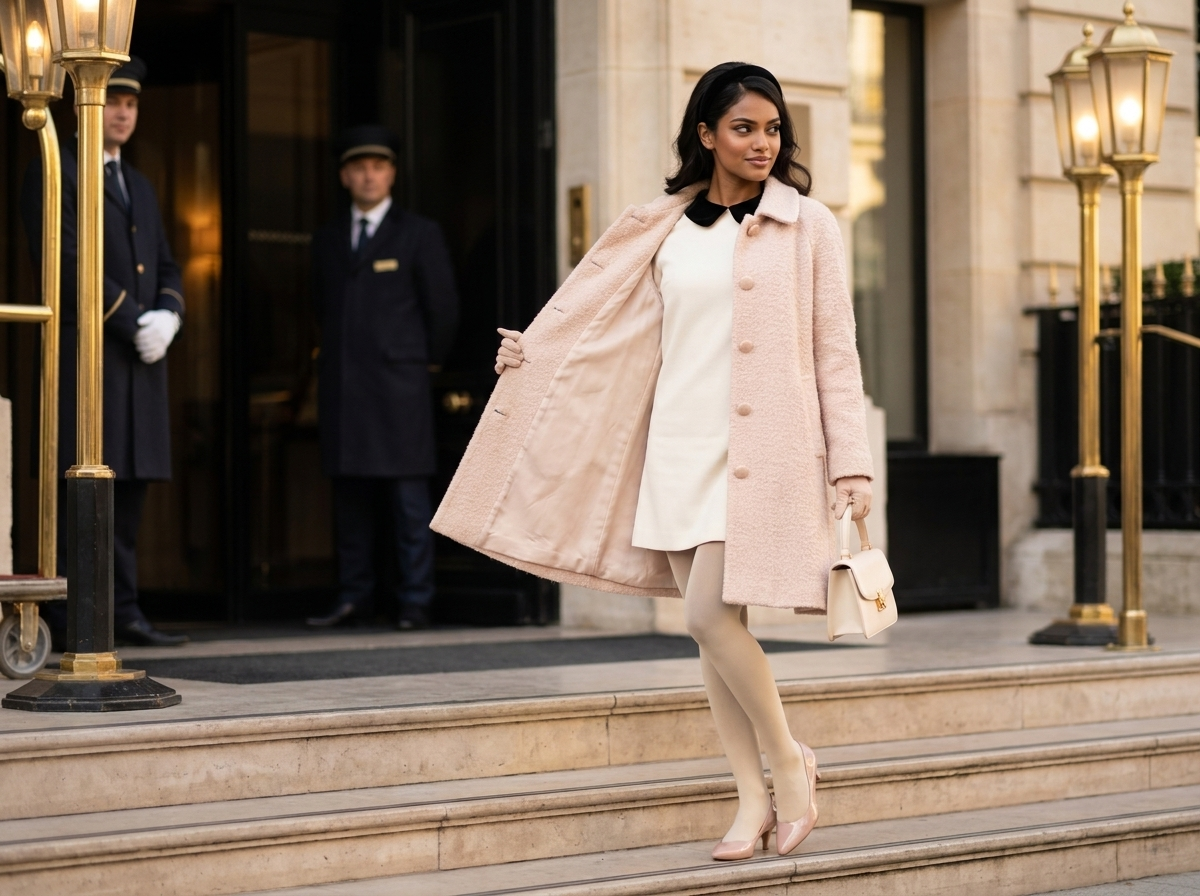
Coats and Jackets:
The red wool peacoat: The Amélie grail
The vintage swing coat (1960s): The archive centerpiece
The mustard trench: The Zooey commitment
The fur-collared wool coat (vintage or faux): The elevated dialect
The Chelsea-collared coat: The Peter Pan crossover
The tweed blazer as outerwear: The transitional option
The cropped cardigan-as-jacket: The soft version
Styling Strategy:
Colors resolutely characterful — never black
Belted at the waist whenever possible
Contrast buttons a plus
Vintage or vintage-inspired always
Should look like it was found rather than bought
Ideally paired with a bicycle
Tops: The Blouse-Forward Foundation

Blouses and Shirts:
Peter Pan collar blouse (white or cream): The foundational piece
Pussy-bow blouse: The romantic dialect
Ruffled blouse (Victorian-adjacent): The advanced move
Sailor collar top: The nautical-Twee variant
Ditsy-floral button-up: The everyday commitment
Contrast-collar top: The Miu Miu-adjacent
Cropped puff-sleeve blouse: The 60s revival
Knitwear:
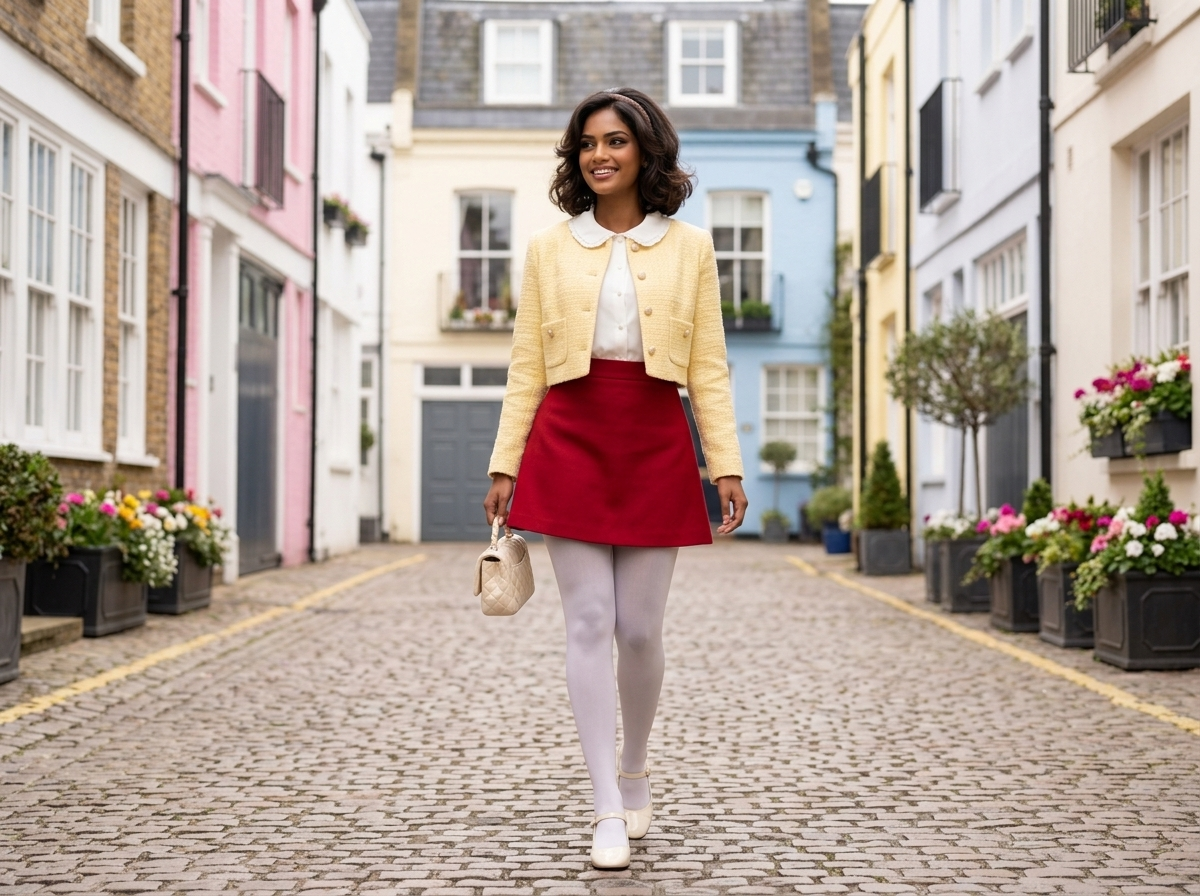
Cropped cardigan (buttoned all the way): The Twee signature garment
Fair Isle sweater: The winter dialect
Cable-knit vest (cropped): The layer piece
Novelty-motif sweater (cherries, hearts, animals): The commitment level
Turtleneck (thin, tucked into a pinafore): The advanced layer
The Cardigan: The Load-Bearing Twee Garment
The Cardigan Protocol:
Cropped, buttoned all the way up: The Zooey template
In an unexpected color: Mustard, rust, forest, dusty pink
With decorative buttons (pearl, floral, novelty): The detail work
Sleeves pushed to the elbow: The styling default
Over a Peter Pan collar or contrast collar: The layering thesis
Vintage before new whenever possible: The authenticity move
Why It Works:
Softens every silhouette underneath it
Reads as inherited even when new
Cheap to source secondhand
Layers over everything Twee owns
The single garment that most identifies the aesthetic
Bottoms: The Skirt-Forward Reality
Skirts:
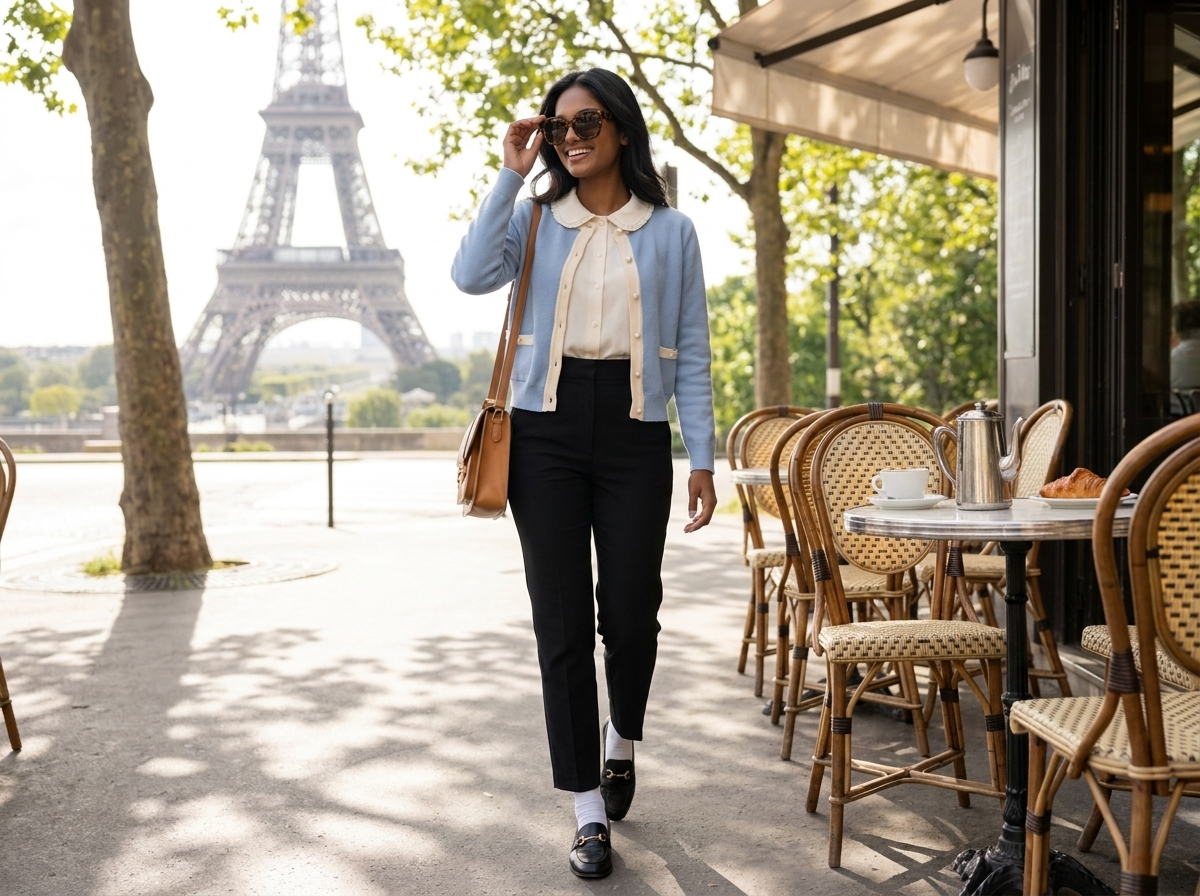
A-line mini skirt (60s-cut): The foundational silhouette
Pleated midi (wool, plaid): The schoolgirl-adjacent
Circle skirt (with pockets): The rockabilly-Twee crossover
Pinafore dress (worn over a blouse): The full commitment
Corduroy mini (rust or mustard): The autumnal move
Denim skirt (A-line, not tight): The everyday version
Velvet skirt (special-occasion): The advanced piece
Trousers:
High-waisted cropped trousers: The Alexa Chung dialect
Corduroy wide-leg (colored): The winter option
Cigarette pant (ankle length): The 60s-Twee move
Overalls (cropped, cuffed): The Etsy-era commitment
Never jeans without narrative: The rule
The Twee Dress: The Foundational Object
One-Piece Solutions:
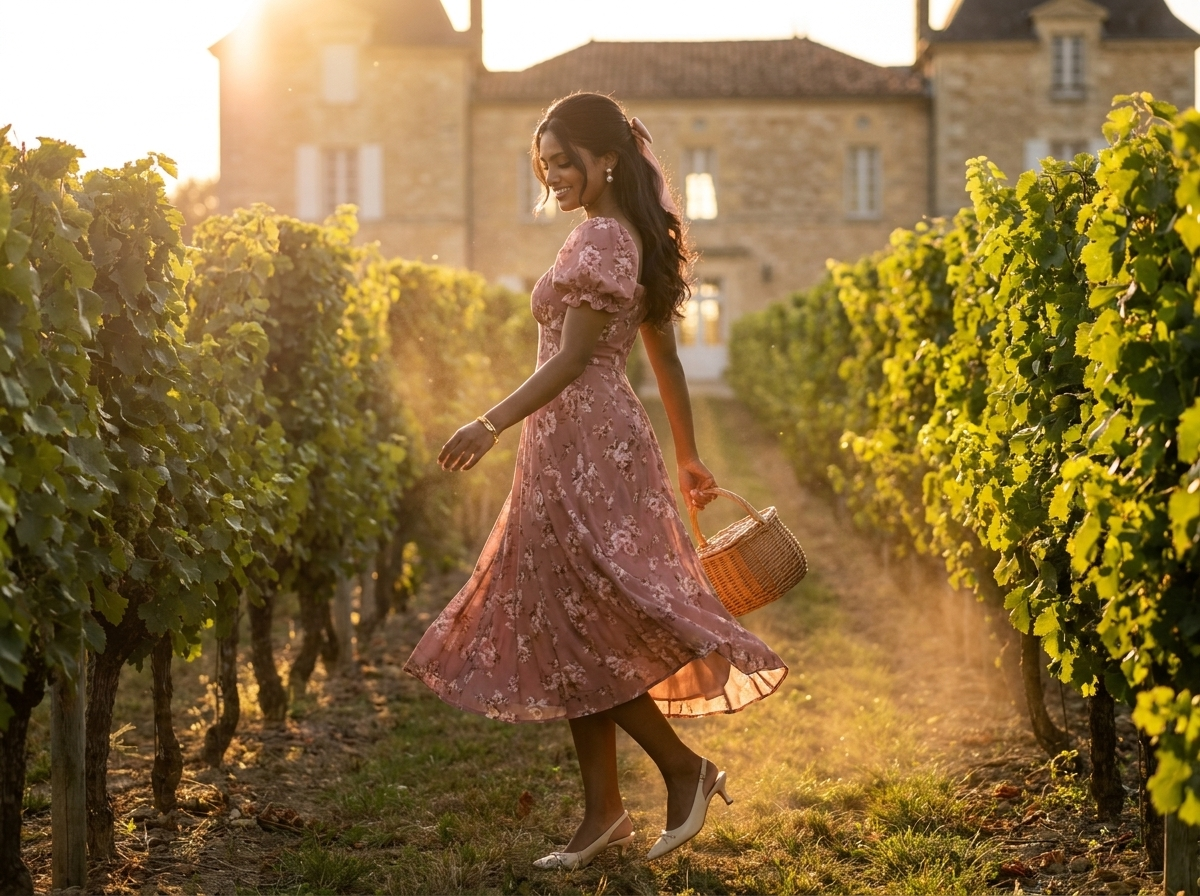
The tea dress (small floral, midi, buttons): The universal go-to
The pinafore (over a blouse): The advanced layer
The shift dress (60s-cut, colorful): The mod-Twee variant
The peter-pan-collared minidress: The Zooey standard
The prairie dress (dusty pink or cream): The soft-Twee dialect
The gingham sundress: The summer commitment
The velvet party dress: The special-occasion move
Styling Strategy:
Always with tights (colored, textured, or opaque)
Always with a cardigan or blazer layered on top
Always with flat or low-heeled shoes
Never sleek, never body-conscious
Should photograph well in a field of wildflowers
The Footwear Situation: Where Twee Actually Lives
The Ballet Flat Hierarchy
Repetto Cendrillon: The Parisian grail
Chanel two-tone flats (vintage): The archive dig
Sam Edelman Felicia: The accessible version
French Sole basic flat: The value commitment
Margaux Demi: The elevated modern
The Row Elin (aspirational): The quiet-luxury crossover
The Broader Shoe Vocabulary
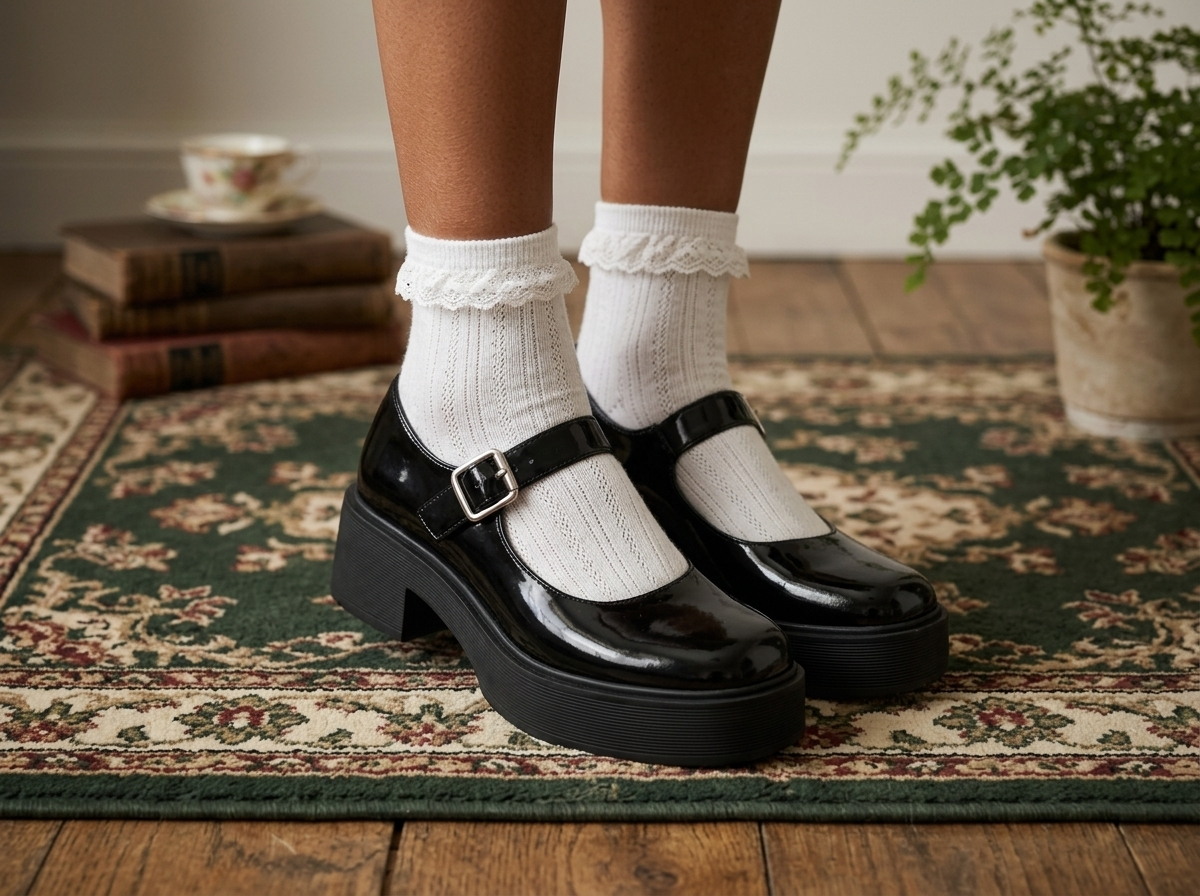
Mary Janes (buckle, low heel): The universal option
Oxford lace-ups (two-tone or spectator): The academic-Twee
T-strap heels (low, vintage): The special-occasion
Loafers (chunky or classic): The preppy-Twee crossover
Ankle boots (Chelsea, brown leather): The winter default
Kitten-heel slingbacks: The advanced dialect
Saddle shoes: The full 60s commitment
Bass Weejun penny loafers (vintage): The heritage move
The Shoe Philosophy
The Rules:
No sneakers
No stilettos
No platforms above two inches
Colors: cream, chocolate, cherry red, black patent, spectator two-tone
Worn-in preferred, freshly polished acceptable
Should be dance-able in
Accessories: The Details That Do All the Work
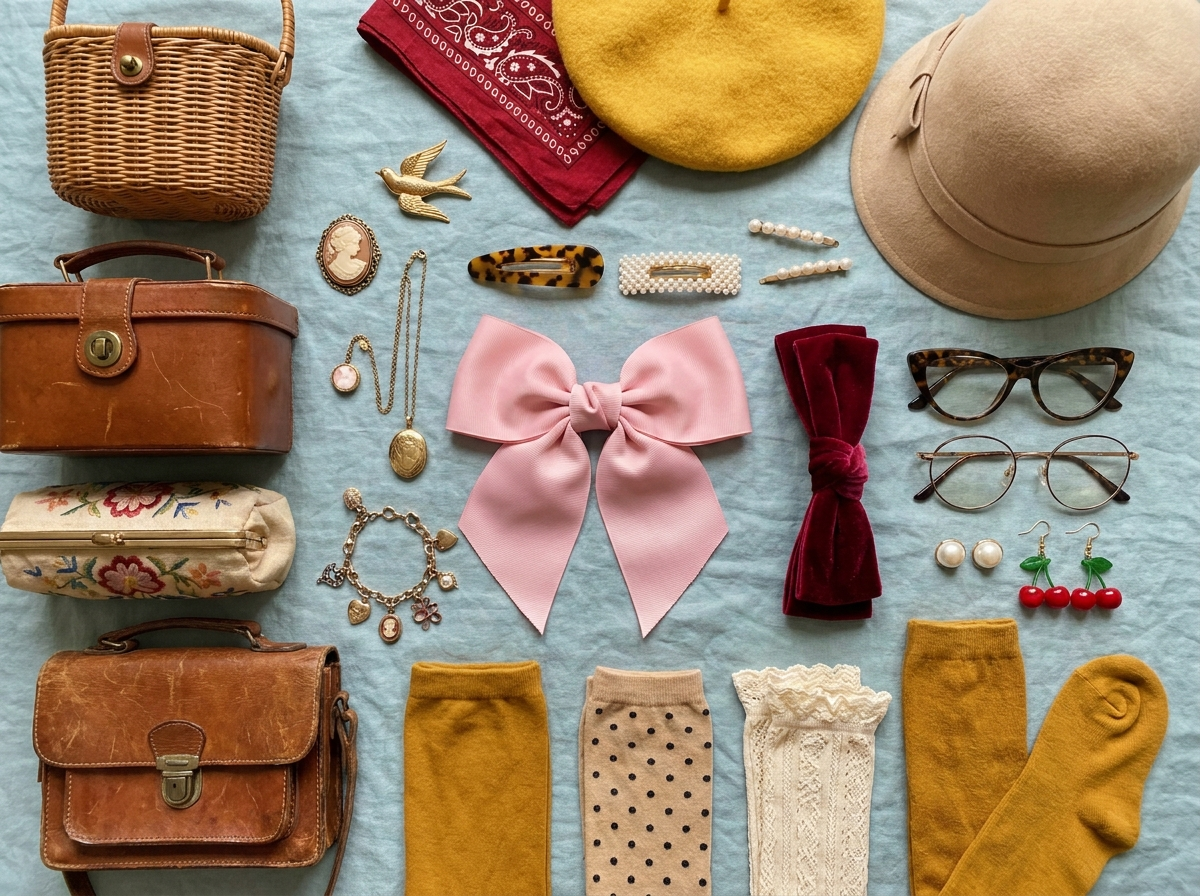
The Hair Accessory Question
Grosgrain ribbon bow (large, at the crown): The universal signature
Velvet headband: The Blair Waldorf crossover
Barrettes (tortoiseshell, pearl, novelty): The everyday detail
Bandana (folded, tied at the base of the neck): The rockabilly-Twee
Beret (wool, colored): The French-Twee commitment
Cloche hat (vintage): The archive move
Wide-brim floppy hat: The summer dialect
Flower crown (real or fabric): The advanced move (proceed carefully)
The Bag Territory
The Carry Culture:
Small structured top-handle bag: The Amélie standard
Wicker basket bag: The summer commitment
Vintage box bag (60s): The archive centerpiece
Chloé Paddington (vintage): The 2000s-Twee grail
Longchamp Le Pliage: The functional crossover
Embroidered pouch: The Etsy-era commitment
Bicycle basket (yes, actually): The advanced authentic
Book satchel (leather, worn): The academic-Twee
Jewelry: Layered and Narrative
The Approach:
Bird brooch (the single most Twee object): The commitment level
Cameo brooch: The Victorian-adjacent
Locket necklace: The narrative piece
Charm bracelet: The layered story
Pearl studs or drop earrings: The classic
Novelty earrings (cherries, cats, tiny flowers): The advanced move
Vintage watch (leather strap, small face): The wrist commitment
Multiple thin gold chains: The layered soft version
The Glasses Question
Eyewear Territory:
Cat-eye frames (tortoiseshell): The universal signal
Round wire frames (John Lennon-adjacent): The soft-Twee
Oversized 60s frames: The mod-Twee commitment
Vintage frames actually vintage: The archive move
Reading glasses on a chain: The advanced move
The prop trap: Non-prescription frames read as costume — proceed only with real prescriptions
The Tights Situation
The Leg Commitment:
Opaque colored tights (mustard, rust, forest, cranberry): The foundational
Polka-dot tights: The commitment level
Fishnet tights (fine gauge, under a modest hem): The advanced dialect
Cable-knit tights: The winter texture play
Lace-trim knee socks: The under-the-mary-jane option
Never bare legs in a Twee outfit: The rule (which makes it great for fall/winter)
Where to Shop
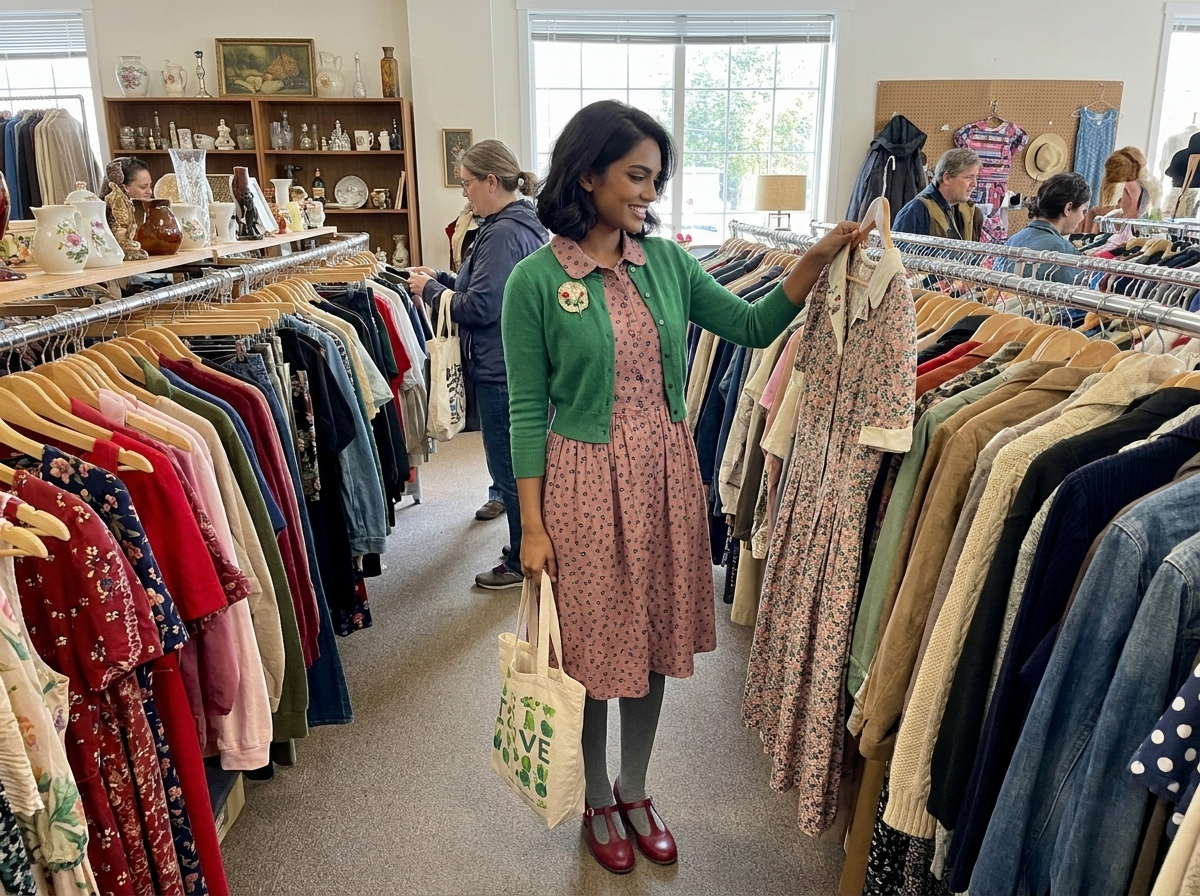
For twee dressing, the best strategy is not to look for one “twee brand.” Build a wardrobe from well-made vintage-inspired basics—cardigans, collared blouses, skirts, tights, Mary Janes—then add one playful print, accessory, or novelty detail. That produces the bookish, slightly offbeat look without relying on Pinterest listings that often lead to ultra-fast-fashion sellers, counterfeits, or unreliable Amazon resellers.
Below is a quality-first shopping map at investment, mid-tier, and accessible price levels. These tiers describe typical full-price positioning rather than guarantees: always inspect fabric composition, care instructions, garment measurements, and retailer return policies before buying.
Investment Tier
Twee investment pieces should be things you'll wear for a decade. The whimsy is in the styling, not the price tag.
Repetto: The ballet flat pilgrimage — worth every euro
Miu Miu (vintage-cut): The Peter Pan collar dresses hold value
Marc Jacobs (2005–2012 archive): The peak Twee runway years
Chloé (Paddington era): The 2000s-Twee grail
Fendi Baguette (vintage): The small-bag investment
Erdem: The elevated floral dress
The Vampire's Wife (still relevant): The romantic-Twee upgrade
Sandy Liang
Best for: contemporary, downtown-inflected twee—bows, school-uniform references, odd-cute accessories, fitted cardigans, short skirts, quilted jackets, and deliberately childlike details.
Sandy Liang is perhaps the clearest luxury-to-contemporary bridge between original 2010s twee and the current “whimsy” revival. The brand’s nostalgic, childlike codes have had broad influence on 2020s fashion, but it is not a one-for-one recreation of Zooey Deschanel-era twee. Expect a sharper, more fashion-forward version: less “indie bookstore clerk,” more “eccentric art-school uniform.” Current retailer listings show accessories around $100 and ready-to-wear well into the several-hundred-dollar range; the official store likewise lists pieces from under $100 to roughly $395 and above, depending on category.nordstrom+1
Smart way to buy it:
Prioritize a cardigan, special skirt, jacket, or shoe over logo-heavy novelty pieces.
Check resale first through authenticated or buyer-protected platforms; Sandy Liang’s older collections often have especially strong twee potential.
Treat this as a statement layer, not a complete wardrobe. One Sandy Liang bow or jacket can animate thrifted wool skirts and a plain cotton blouse.
Mid-Range (Where Twee Lives)
Twee is a mid-market and vintage aesthetic at heart. The best pieces are affordable.
Anthropologie: The prairie-Twee anchor — dresses, cardigans, whimsical everything
Boden: The Peter Pan collars, the ditsy florals, the sensible cuts
& Other Stories: The elevated European version
Sézane: The French-Twee mid-market
Rouje: The Jeanne Damas French-girl-Twee
HVN: The novelty-print silk dresses
Batsheva: The prairie-Twee upgraded
Doen: The soft-focus prairie commitment
Free People (curated carefully): The bohemian-Twee crossover
Sézane
Best for: polished, adult twee; cardigans, blouses, textured knits, tailored coats, leather bags, and shoes that prevent a nostalgic outfit from feeling costume-like.
Sézane is more French-preppy than overtly whimsical, but it is a powerful investment source for the “grown-up foundation” of a twee wardrobe: a great cardigan in a saturated color, a blouse with a refined collar, a wool coat, a leather satchel, or gently retro loafers. The brand is B Corp certified, and its own sustainability information highlights materials such as organic cotton, linen, and Oeko-Tex-certified textiles.sezane+1
What makes it useful: Pair a Sézane knit or coat with a less expensive printed skirt, opaque tights, and Mary Janes. That contrast creates twee as an outfit language rather than a novelty costume.
Watch-outs: Do not assume every item is a forever garment merely because it is priced above high street. Read the fiber label. Favor wool, cotton, linen, silk, and substantial denim over high-polyester blends if longevity is the goal.
Sister Jane
Best for: the fastest route to overt twee—scalloped collars, puff sleeves, jacquard dresses, appliqué, bows, matching sets, rich texture, and novelty prints.
Sister Jane is a useful source for “one-piece outfit” items: a dress, blouse, or skirt that needs little styling beyond tights and sensible shoes. ASOS describes the brand as whimsical and eclectic with a vintage twist, and its current selection includes dresses and tailored occasion wear with prominent decorative details.
How to shop it well:
Choose one statement item per outfit.
Check close-up fabric photos; decorative polyester can be charming but doesn’t have the long-term feel of cotton, wool, linen, or substantial viscose.
Use it for a birthday dinner, gallery day, seasonal editorial shoot, or statement blouse—not necessarily for all your everyday basics.
Big Bud Press
Best for: colorful, sturdy foundations that take twee away from excessive fragility—work pants, jumpsuits, T-shirts, and layering pieces in saturated color.
Big Bud Press is not traditionally twee in silhouette, but it is excellent for the current, more graphic “Whimsy Twee” branch: red trousers with a Peter Pan-collar blouse, cobalt work pants with a striped cardigan, or brightly colored overalls with a vintage brooch. The company says it designs and makes goods in Los Angeles, uses locally or domestically sourced materials, and uses predominantly cotton fabrics, including a 9-ounce U.S.-woven cotton twill for its work pants.
Why it earns mid-tier status: It is an investment in construction and repeat wear, but the pants and jumpsuits work across aesthetics. A forest-green pair of trousers can serve twee, French-girl, dark academia, or casual workwear depending on styling.
Lucy & Yak
Best for: playful dungarees, colorful trousers, printed layers, and an approachable, comfortable version of twee.
Lucy & Yak makes sense for a reader who wants the aesthetic’s joy and color but dislikes its most prim or restrictive side. The brand identifies itself as an independent ethical UK label and emphasizes organic cotton, while its sustainability materials state a goal of using sustainable fabrics and maintaining transparent processes. Good On You notes that its final production stage is audited and that it uses GOTS-certified organic cotton, while also noting that the company does not publicly disclose every element of its supply-chain auditing.
ModCloth
Best for: accessible-to-mid-priced dresses, novelty blouses, retro prints, work-friendly silhouettes, and broad sizing.
ModCloth remains a logical twee source because its inventory is built around vintage-inspired dresses and playful prints. Its dedicated vintage-dress selection runs from XS through 4X and includes mini, midi, and maxi silhouettes; current listings include dresses around $119 at full price.
Best buys: cotton or linen-blend dresses, collared blouses, skirts with pockets, and print pieces that can be worn with ordinary cardigans and shoes.
Be selective: ModCloth is a retailer rather than a single uniform manufacturing standard. Fabric content and construction vary by piece. Do not buy solely because the cut looks twee in a product photograph.
Unique Vintage
Best for: size-inclusive, unabashedly retro dresses, novelty prints, special-event dressing, and a more 1950s/1960s-forward interpretation.
Unique Vintage is a strong choice when the desired result is visibly retro rather than subtly French or contemporary. Its dress section is explicitly organized around “timeless elegance” and retro charm, and Nordstrom carries its plus-size styles, providing an additional retailer route with familiar shipping and returns infrastructure.
What to buy: a gingham dress, a strawberry or cherry print, a structured skirt, or a holiday-themed novelty item. For an everyday twee wardrobe, use one such piece at a time and pair it with plain shoes and a wool cardigan.
Accessible (Where You Should Actually Shop)
Twee is a vintage-first aesthetic. The best Twee wardrobe is 60% secondhand.
Etsy (vintage sellers): The foundational source
Depop: The younger vintage market
eBay (vintage 1960s): The archival grail
The RealReal: The designer-vintage upgrade
Local vintage stores: The tactile requirement
Estate sales: The advanced move
Antique malls (for accessories): The bird brooch source
The Exceptions:
Tights: Always new — hygiene, fit, and the pattern work depends on them fresh
Ballet flats: Consider new (the sole matters) unless the vintage pair is unworn
True vintage and specialist vintage sellers
Best for: authentic 1960s–1970s inspiration, unusual collars, wool skirts, real novelty knits, leather bags, and items that will not appear in every TikTok cart.
Vintage is arguably the best “investment” recommendation because it serves twee’s anti-uniform impulse. Contemporary brands can reproduce a 1960s mod line or a 1970s color palette; but not the same patina, construction logic, or specificity of an original garment.
Look for:
1960s shift dresses and A-line skirts.
Wool or lambswool cardigans with interesting buttons.
Cotton blouses with pointed or rounded collars.
Leather satchels and structured top-handle bags.
Pendleton-style plaid skirts, corduroy pinafores, and novelty knits.
Deadstock tights, hair accessories, and costume jewelry only after checking condition.
A vintage shop such as Olive & Quince centers colorful, size-inclusive, pre-owned vintage with personality, which points toward a broader principle: choose sellers that provide measurements, condition notes, fiber content where known, and multiple garment photos.
Useful search terms include:
“Peter Pan collar blouse cotton”
“1960s mod A-line dress”
“wool cardigan novelty buttons”
“corduroy pinafore dress”
“plaid wool skirt”
“leather school satchel”
“Mary Jane leather shoes”
“vintage knit vest floral”
“1960s shift dress”
“Sister Jane,” “ModCloth,” or “Sézane” plus your size
Investment Strategy
Splurge On:
One perfect pair of Repetto ballet flats
A vintage red wool coat that fits
Two Peter Pan collar blouses that fit correctly (crucial)
A structured small vintage bag
One perfect cropped cardigan in a signature color
Save On:
Cardigans (thrift them, always)
Dresses (vintage or Boden)
Tights (new but cheap — Hue, Wolford for splurge)
Hair accessories (grosgrain ribbon by the yard)
Novelty jewelry (Etsy, cheap and abundant)
What to avoid on Pinterest and Amazon
Pinterest pins frequently collapse discovery, affiliate marketing, and visual search into one image. That is exactly why twee looks are vulnerable to misleading product pathways: the aesthetic depends on small decorative details that photograph well and are easy to reproduce cheaply.
Use these checks before linking or buying:
Trace the seller. Click beyond the pin. A real brand should have an identifiable official site, contact information, a return policy, sizing details, fabric composition, and original product photography.
Reverse-search a suspicious image. If one photo leads to Shein, Temu, Amazon marketplace listings, AliExpress, and a supposedly independent boutique, assume the listing may be a drop-shipped or copied design until proven otherwise.
Read the fiber label. Polyester is not automatically bad, especially for an occasion dress, but a $12 “vintage” dress with no composition, no lining information, and generic dimensions is rarely a long-term purchase.
Use reviews for fit, not proof of ethics. Customer photos can help with length, opacity, and proportions; they cannot independently verify supply-chain claims or design ownership.
Avoid Amazon listings with incoherent brand names. Amazon can be useful for basics such as tights, socks, shoe-care supplies, and known labels sold directly by the brand or a trusted retailer. It is less dependable for highly specific “twee dress” discoveries.
Check whether a retailer has copied imagery or text. Oddly translated descriptions, inconsistent size charts, and photos that appear in multiple storefronts are warning signs.
A stronger way to build the wardrobe
Rather than buying “a twee outfit,” start with suggest a 5-10 capsule you can expand gradually:
Peter pan collar blouse, white or cream — the anchor piece; works alone for Classic Twee, layers under everything else
Fine-gauge cardigan, cream or navy — the workhorse layer; buttoned for Classic Twee, open over a graphic tee for Tweemo
Breton striped top — doubles as French Twee's core piece and a base layer for Mod Twee under a shift dress
A-line skirt, knee length, solid color — neutral enough to read Classic, French, or Mod depending on what's on top
Opaque tights, navy and black — two pairs minimum; the hygiene exception, buy new
Mary Jane flats — the single most cross-dialect shoe in the whole aesthetic; works with all seven, honestly
Floral or ditsy-print midi dress — Cottage Twee's anchor, but layers under a cardigan for Classic Twee too
Beret — inexpensive, instantly signals French Twee, low commitment for someone testing the dialect out
Tortoiseshell glasses (readers or non-prescription frames) — ties the whole capsule together as a single recognizable silhouette
One statement hair accessory (fabric bow or ribbon) — the cheapest way to nudge any of the above from Classic into Whimsy Twee territory for a day
Someone could build this whole ten-piece set from Accessible-tier resale pieces alone and still get a legible, dialect-flexible twee wardrobe without buying a single new item beyond the tights.
Beauty: The Face That Believes in Whimsy
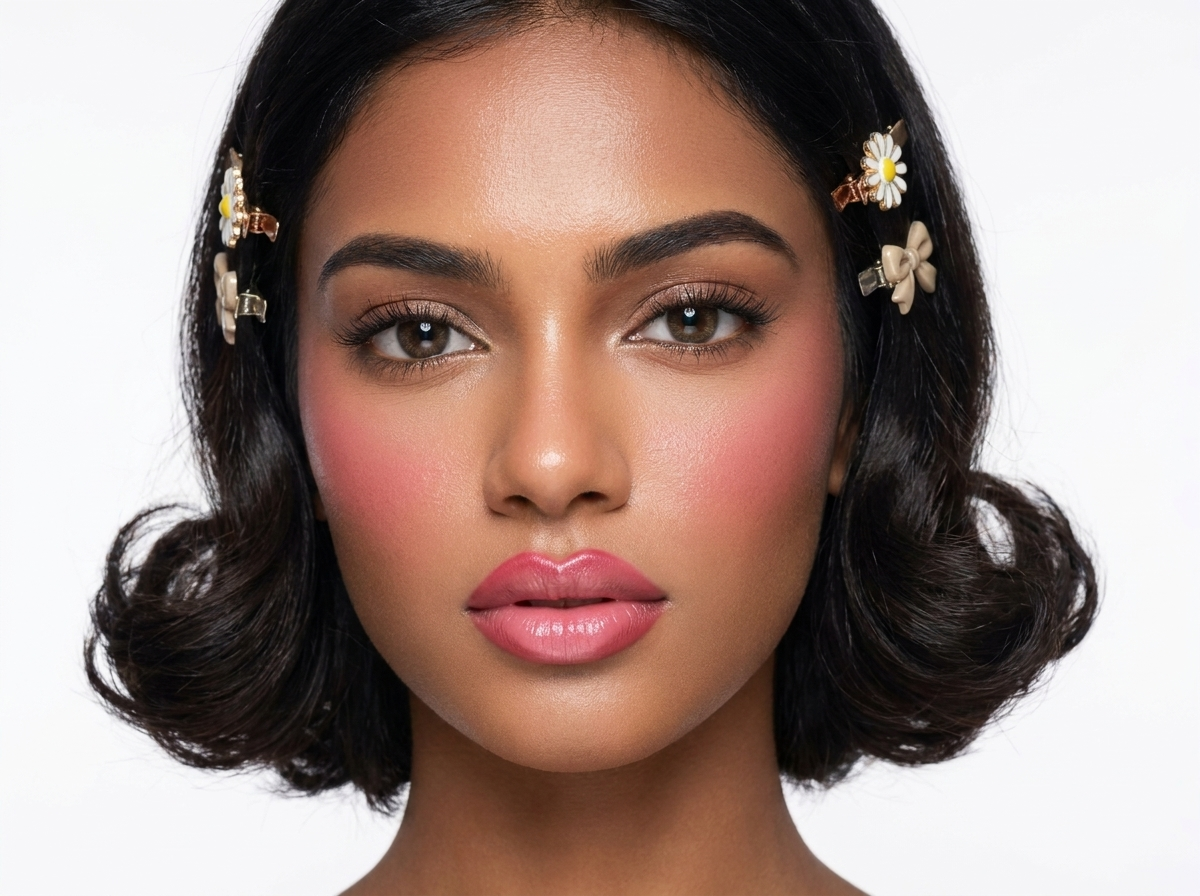
Twee makeup’s goal to look like you got a good night's sleep and remembered to be delighted about something before noon. That's a harder brief than it sounds, because "looks effortless" makeup is often the hardest kind.
The Philosophy:
Dewy skin: The foundational finish
Cream blush on the apples: The universal signature
A red or berry lip: The Amélie commitment
Winged liner (soft, brown or black): The 60s dialect
Groomed brows (natural shape): The default
Freckles emphasized rather than covered: The advanced move
Hair: The Considered Whimsy
Cuts and Styles:
The blunt fringe (short or full): The universal signal
The bob (chin-length): The Amélie foundation
The long waves with fringe: The Zooey template
Two low pigtails (with ribbon): The advanced commitment
The half-up with a bow: The everyday move
Braids (loose, side-swept): The soft dialect
The chignon low with a ribbon: The special-occasion
Style Statements:
Ribbons and grosgrain bows welcome and encouraged
Curling iron for waves, not glamour
Air-dried texture with product
Hair should look styled but not sleek
One "signature accessory" per outfit
Nails: Short and Colored
The Approach:
Short and rounded: The foundational shape
Cherry red polish: The signature move
Dusty pink or dusty blue: The soft-Twee palette
Milky white: The modern crossover
A single accent nail (heart, flower, star): The advanced move
Never long, never square, never chrome: The rule
Twee Sub-aesthetics
"Twee" as a single catch-all term flattens a fairly wide emotional range, from gentle nostalgia to something darker at the edges.
Classic Twee
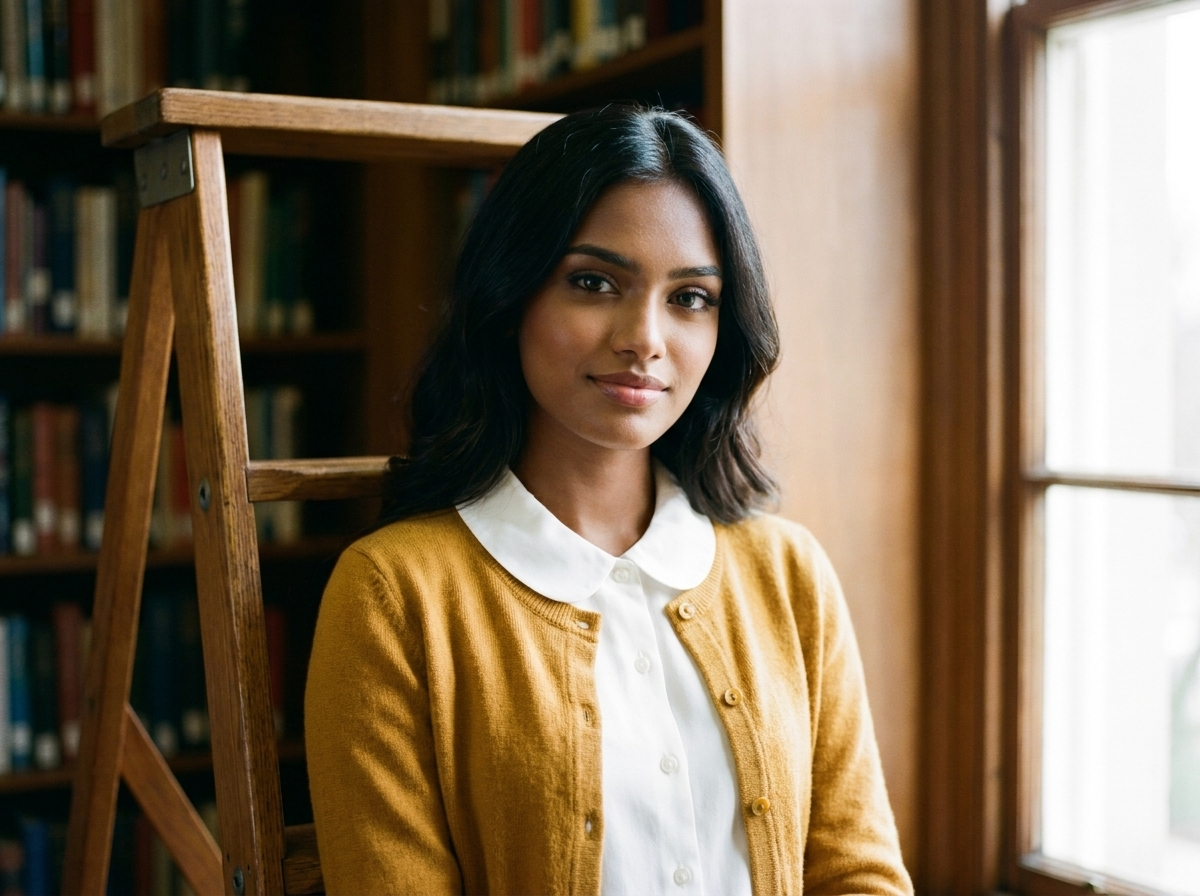
This is the original version that peaked alongside Etsy and Tumblr in the late 2000s and early 2010s and that most people still imagine when they hear the word. Peter pan collars, cardigans buttoned to the top, tights under everything, round glasses, or anything else that looks handmade or secondhand. Zooey Deschanel didn't invent this look, but popularized it to the point that "adorkable" briefly entered the cultural vocabulary. Classic Twee is relaxed yet a little formal in its own way. It dresses like someone who irons things.
Color Palette
Cream, dove grey, dusty pastels as the base
Bright saturated accents — cherry red, mustard, kelly green
Polka dots as a color unit, not just a pattern
Muted florals, never large-scale
Metallics avoided almost entirely
Wardrobe Specifics
Peter pan collar blouse (the defining piece)
Fitted cardigan, buttoned to the top
A-line skirt, knee length, structured
Colorful opaque tights (patterned or solid, never sheer)
Wide-rim glasses, round or cat-eye
Fabric headband or bow
Vintage-style shirt dress
Cropped cotton cardigan for layering
Styling Approach
Layer, don't strip down — cardigan over blouse over collar
Everything intentionally a little precious
Mixing prints within the same color family
Accessories skew handmade or thrifted over new
Hair soft and imperfect — waves, not sleek
Jewelry small, often vintage brooches
Shoes
Mary Jane flats
Ballet flats
Round-toe ankle boots
Saddle shoes
Makeup
Dewy, barely-there base — skin should look like skin
Soft flush on the apples of the cheeks, cream blush preferred
Winged liner, thin and slightly imperfect rather than precise
Mascara only, no false lashes
Tinted lip balm or a soft berry stain
Brows kept natural, unfilled or lightly groomed
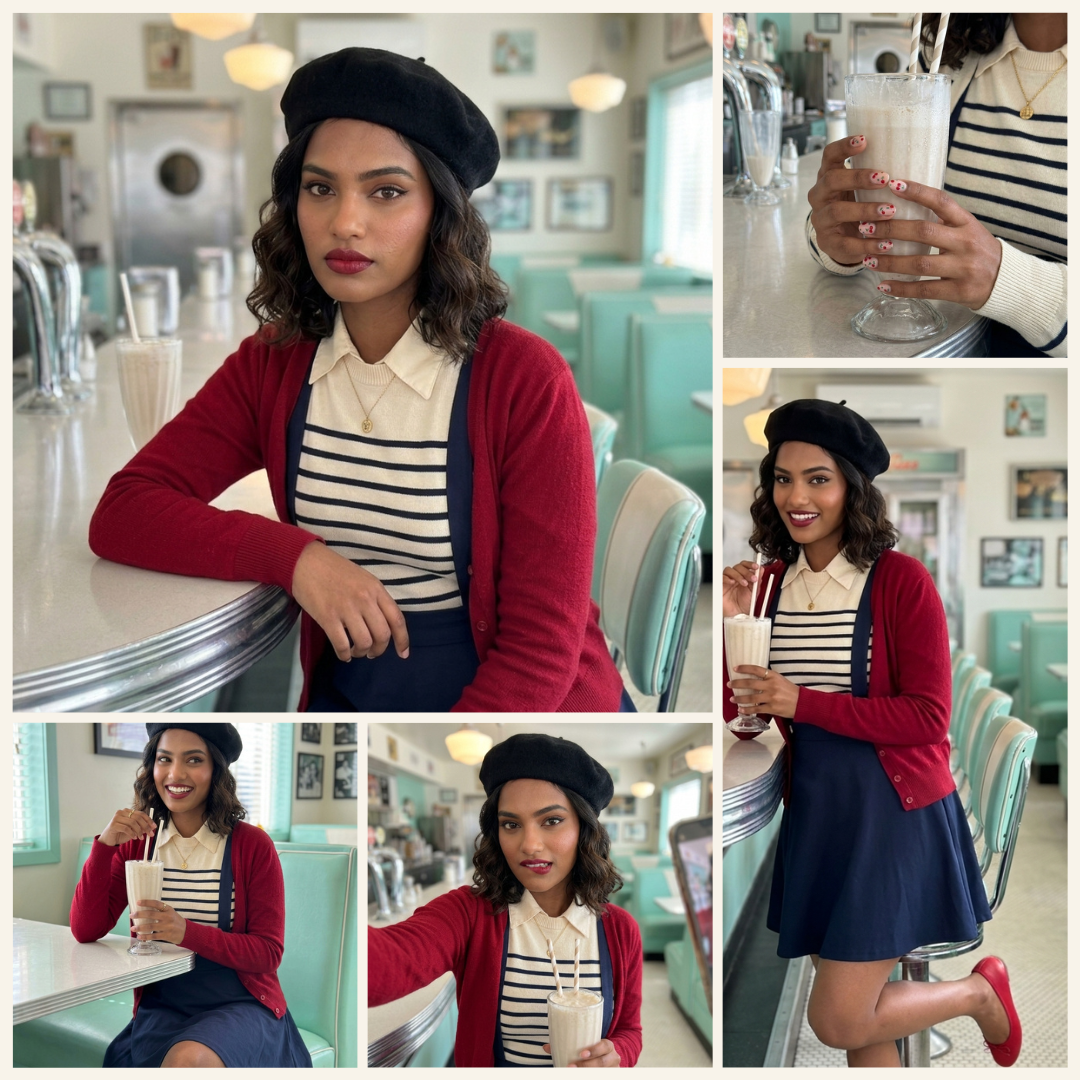
French Twee
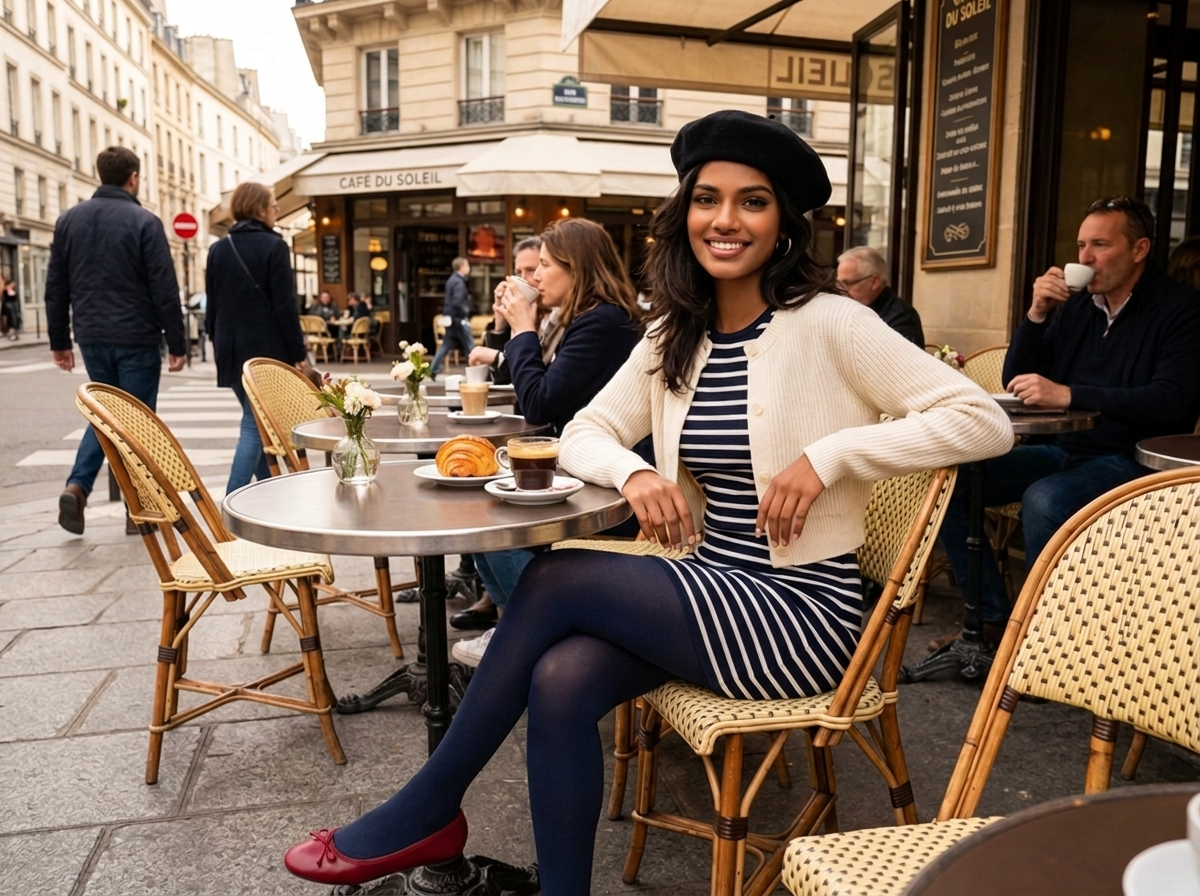
This is the dialect that got Twee's Parisian reputation started in the first place. Where Classic Twee borrows loosely from a general vintage, French Twee borrows specifics like striped Breton tops, ballet flats, and berets. It's Twee filtered through tourist romanticism. Less "dress like a French woman dresses" and more "dress like the fantasy France." That's the key distinction from your French Girl embraces the philosophy of effortlessness and restraint. French Twee is curated, sweet, and a little performative about its Francophilia, closer to a mood board style rules.
Color Palette
Navy and white as the base (Breton stripe territory)
Red as the singular bold accent
Black used sparingly, for a beret or flats only
Cream in place of stark white when softness is wanted
Gold kept minimal, never costume-heavy
Wardrobe Specifics
Breton striped top (the anchor piece)
Beret
Full or A-line skirt, knee length
Trench coat, belted
Neck scarf, tied loosely
Cropped cardigan over the striped top
Styling Approach
Curated-casual, every piece chosen for its "Paris" signal
Stripes are load-bearing; at least one striped piece per outfit
Accessories lean romantic over practical
Hair loosely tousled, not sleek
Jewelry small and delicate — a single necklace, thin hoops
The overall effect should be mood board, not uniform
Shoes
Ballet flats
Espadrille wedges
Mary Jane flats
Slim ankle boots
Makeup
Minimal base, skin left visibly textured and natural
Red or berry lip as the single defining feature
No blush, or the faintest hint — the lip does the work
Thin liquid liner, precise but understated
Brows groomed but not filled
Nails short, unpolished or a sheer nude
Whimsy Twee
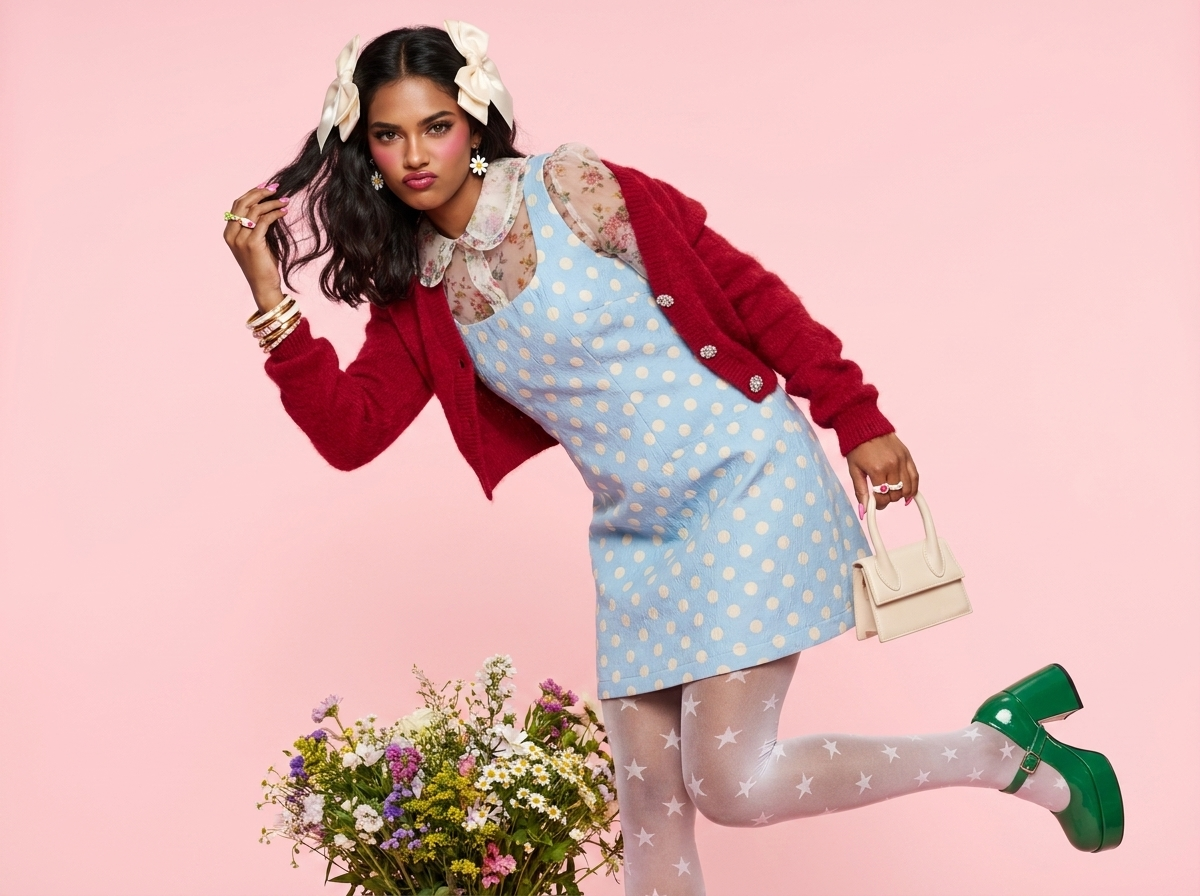
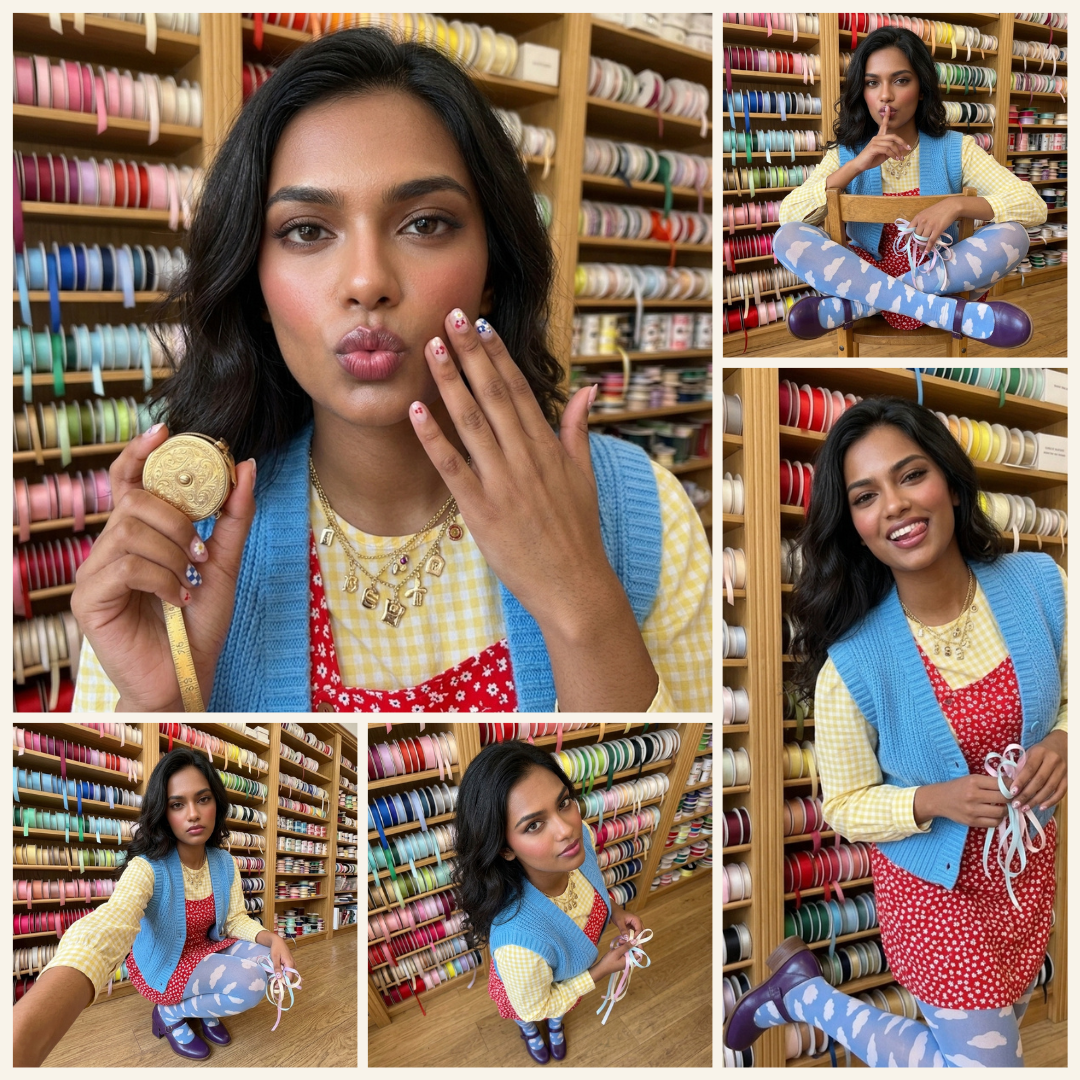
The active TikTok strain, dating to late 2024, and the clearest evidence that twee didn't die so much as go quiet for a decade. Whimsy Twee turns the volume up a bit with brighter colors, more aggressive pattern-mixing, and more childlike wonde. Where Classic Twee is composed, Whimsy Twee is a little chaotic in layering textures and prints the way a kid picks out their own outfit for the first time. It's the dialect most likely to show up paired with nostalgic motifs like deer, forests, or storybook imagery.
Color Palette
Brighter and more saturated than Classic Twee across the board
Multiple pattern families combined in one outfit
Candy tones — bubblegum pink, sky blue, buttercup yellow
Nostalgic motifs used as a color cue (forest green, deer-tan)
No single dominant neutral — the palette itself is the statement
Wardrobe Specifics
Mixed-print dress (florals with stripes, or checks with dots)
Layered cardigan over patterned top over collar
Novelty tights (motifs, not just solids)
Statement hair accessory — bows, clips, ribbons
Pinafore or overall dress
Textured knit worn as an accent piece, not a base layer
Styling Approach
Addition, not subtraction — the opposite instinct from restrained dialects
At least two patterns per outfit, deliberately mismatched
Texture mixing prioritized over color coordination
Nothing kept minimal on purpose
Hair often styled with visible accessories, not hidden
Jewelry can be playful and multiple — no single-piece rule
Shoes
Mary Janes in a bold color
Platform sneakers
Patterned rain boots
Chunky buckled flats
Makeup
Bright, matte blush placed high on the cheeks — almost doll-like
Pastel eyeshadow wash, one color, swept to the crease and no further
Colorful mascara (navy, brown, or plum) instead of black
Glossy lip, often tinted rather than neutral
Small rhinestone or sticker accents at the inner corner of the eye
Freckles left visible or lightly enhanced, never covered
Tweemo
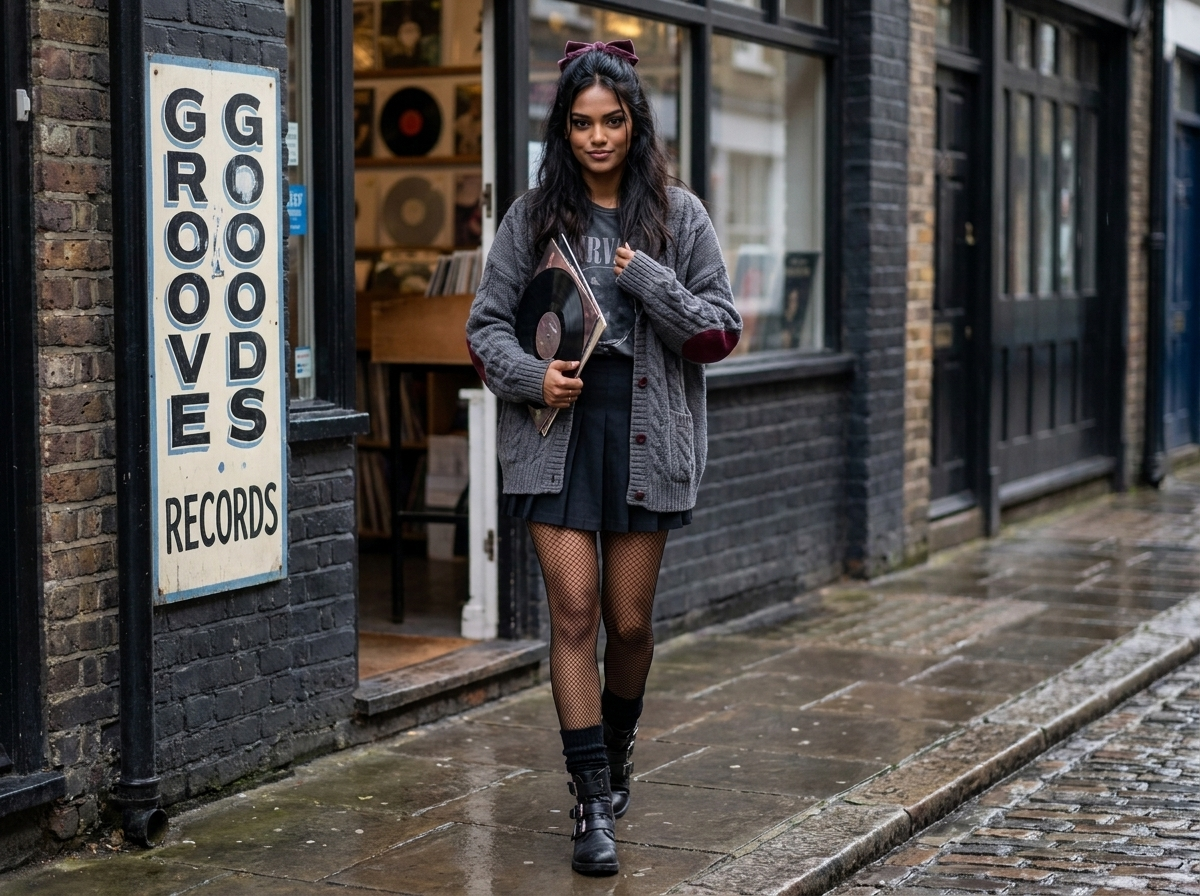
Twee crossed with emo, and more coherent than it sounds. Tweemo keeps the cardigans and the DIY sensibility but darkens the palette and brings band tees and heavier boots into the mix. It reads as twee that's been through something. Still soft and sincere, but with a little more weight than Classic Twee's cheerfulness allows for. This is the dialect most likely to overlap with alt and goth-adjacent communities online. It’s also a reminder that twee was never only about being cute.
Color Palette
Black as the dominant base (a first for this dialect family)
Twee pastels used sparingly, as contrast rather than base
Deep burgundy or plum as the "soft" accent
Band-tee graphics counted as texture, not pattern
Grey-on-black layering
Wardrobe Specifics
Cardigan over a graphic band tee
Pleated mini skirt, darker wash than Classic Twee's
Fishnet or striped tights under a skirt
Studded or buckled accessories mixed with soft knits
Peter pan collar reworked in black or dark wash
Oversized cardigan (the one place this dialect allows shapelessness)
Styling Approach
Contrast is the whole point — sweet piece against harder piece
One "hard" element required per outfit (studs, boots, dark denim)
Makeup and hair can lean darker than other dialects allow
Layering favors contrast in texture, not just color
Jewelry can include chokers, alongside twee's usual delicate pieces
Nothing fully soft, nothing fully hard — always both
Shoes
Chunky black lace-up boots
Platform Mary Janes
Black canvas sneakers
Buckled combat-style boots
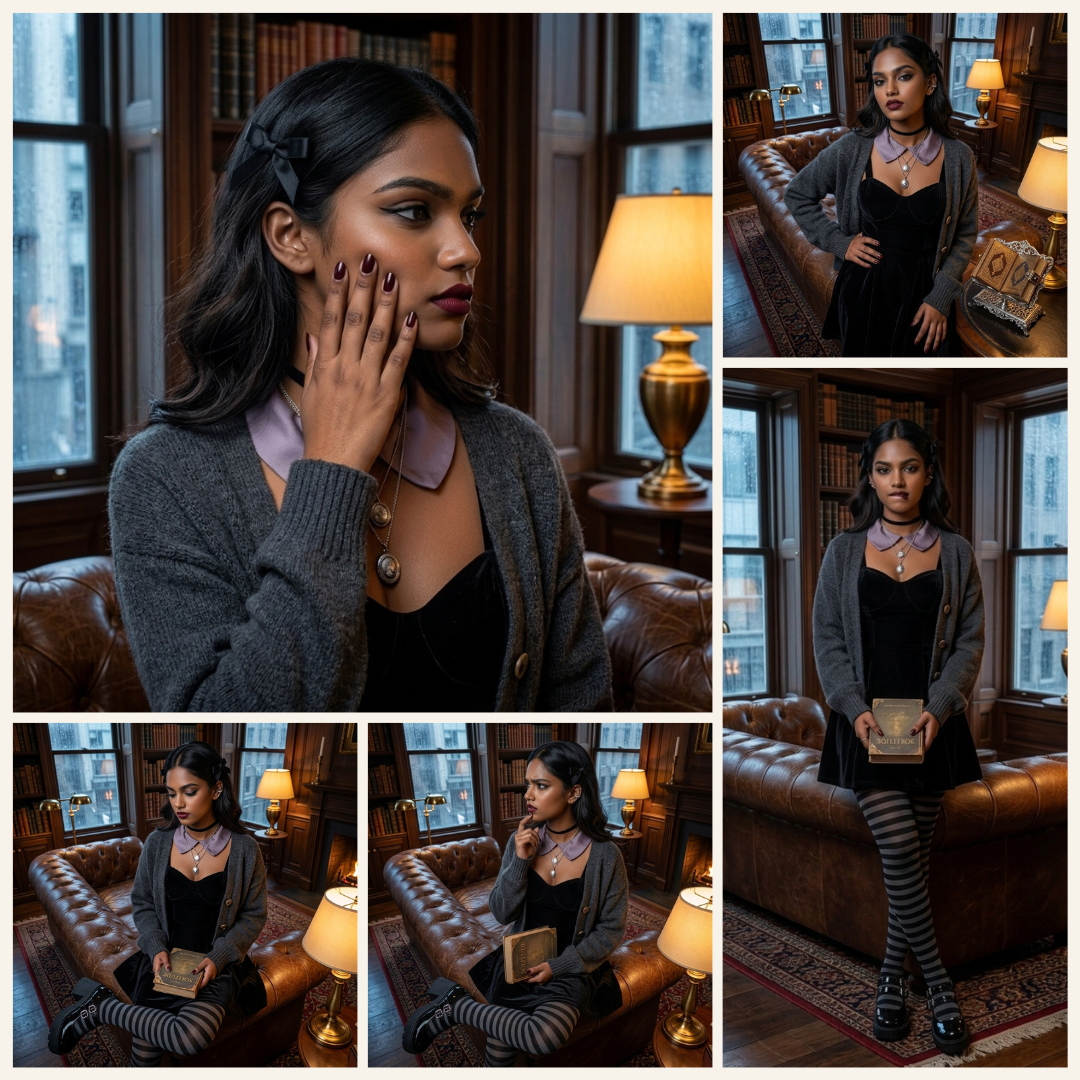
Makeup
Pale, matte base — less flushed than other dialects
Heavy black winged liner
Dark plum or burgundy lip, matte finish
Smudged black eyeshadow at the lash line only
Blush minimal or skipped
Nails often dark, painted black or deep burgundy
Cottage Twee
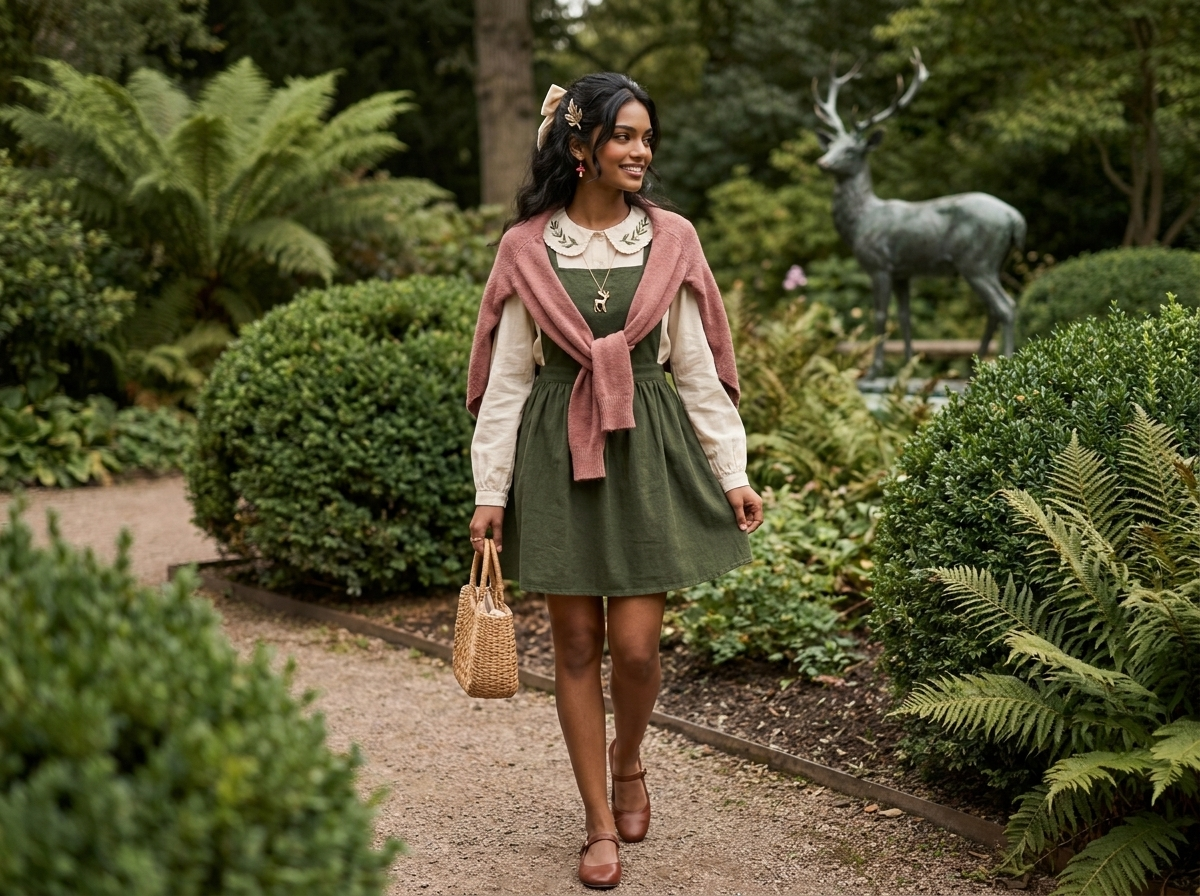
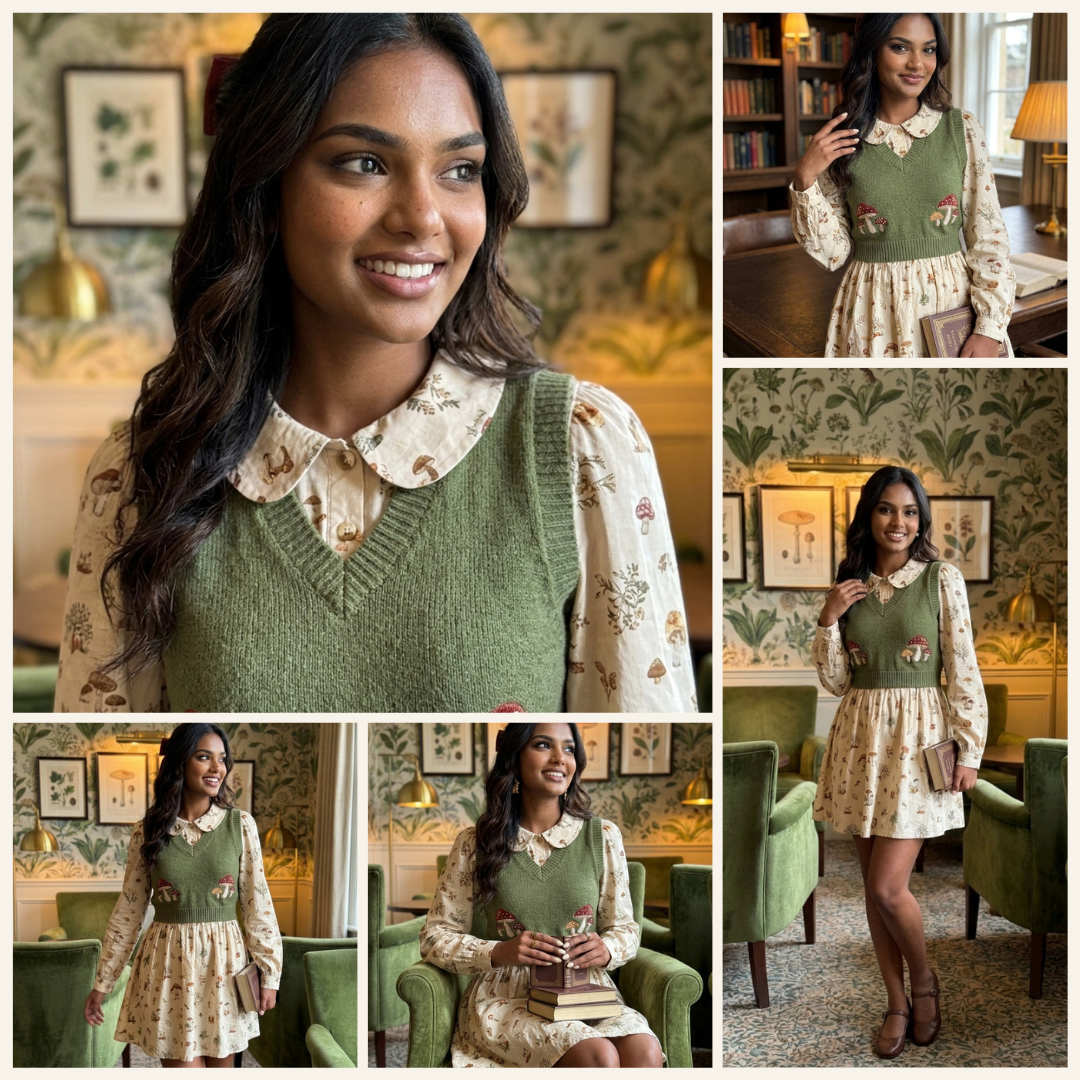
The nature-forward branch, sitting close enough to Cottagecore that the two get confused constantly, but distinct in its motivation. Cottage Twee isn't chasing rural self-sufficiency fantasy the way Cottagecore is — it's twee's usual sincerity applied to forest imagery, pressed flowers, and a fairy-kei-adjacent softness. Deer aesthetics, woodland creatures, and a slightly storybook palette all live here. It's less about pretending to churn your own butter and more about wanting your closet to feel like a walk through the woods on a good day.
Color Palette
Moss green, dried-flower pink, warm cream
Muted forest tones — bark brown, sage, soft rust
No true black; darkest neutral is a deep brown
Florals kept small-scale and pressed-flower in feel
Metallics limited to antique gold or brass
Wardrobe Specifics
Puff-sleeve prairie blouse
Floral or ditsy-print midi dress
Knit cardigan in a natural fiber look
Woven or straw accessories
Lace-trim slip layered under a dress
Fine gold locket or nature-motif jewelry
Styling Approach
Softness throughout — nothing structured or sharp
Natural-fiber textures prioritized (linen, cotton, wool)
Hair loose, braided, or with a simple ribbon
Layering mimics undergrowth — slip under dress under cardigan
Jewelry nature-themed, never bold or metallic-heavy
Nothing glossy; matte and textured finishes only
Shoes
Mary Jane flats in a natural leather tone
Woven espadrilles
Soft ankle boots, unpolished finish
Ballet flats in cream or brown
Makeup
Sheer, sun-warmed base with visible freckles
Terracotta or rosy cream blush, blended high and soft
Bare or barely-tinted lips — balm over lipstick
Brows brushed up and full, untouched by product
No liner, or a soft brown smudge at most
Lashes curled but bare, no mascara required
Wishcore / Nostalgia Twee
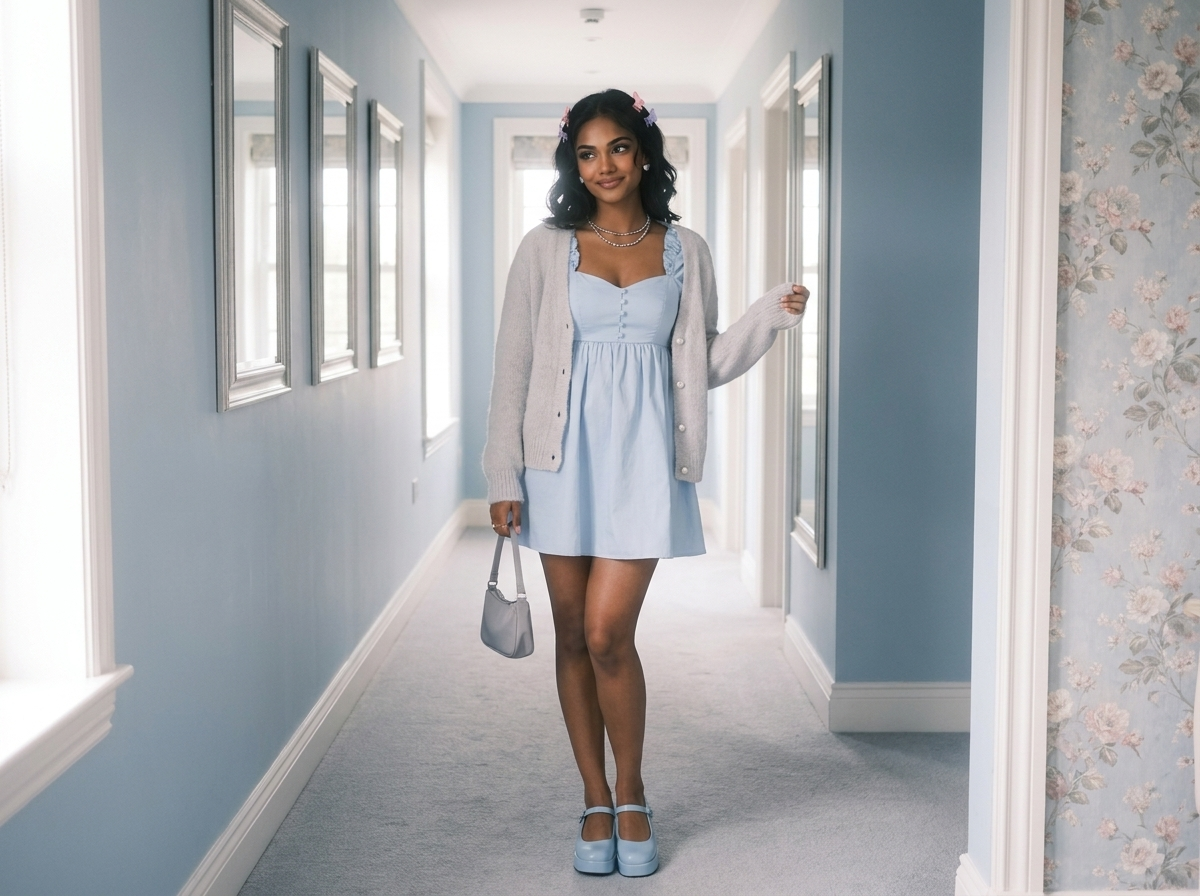
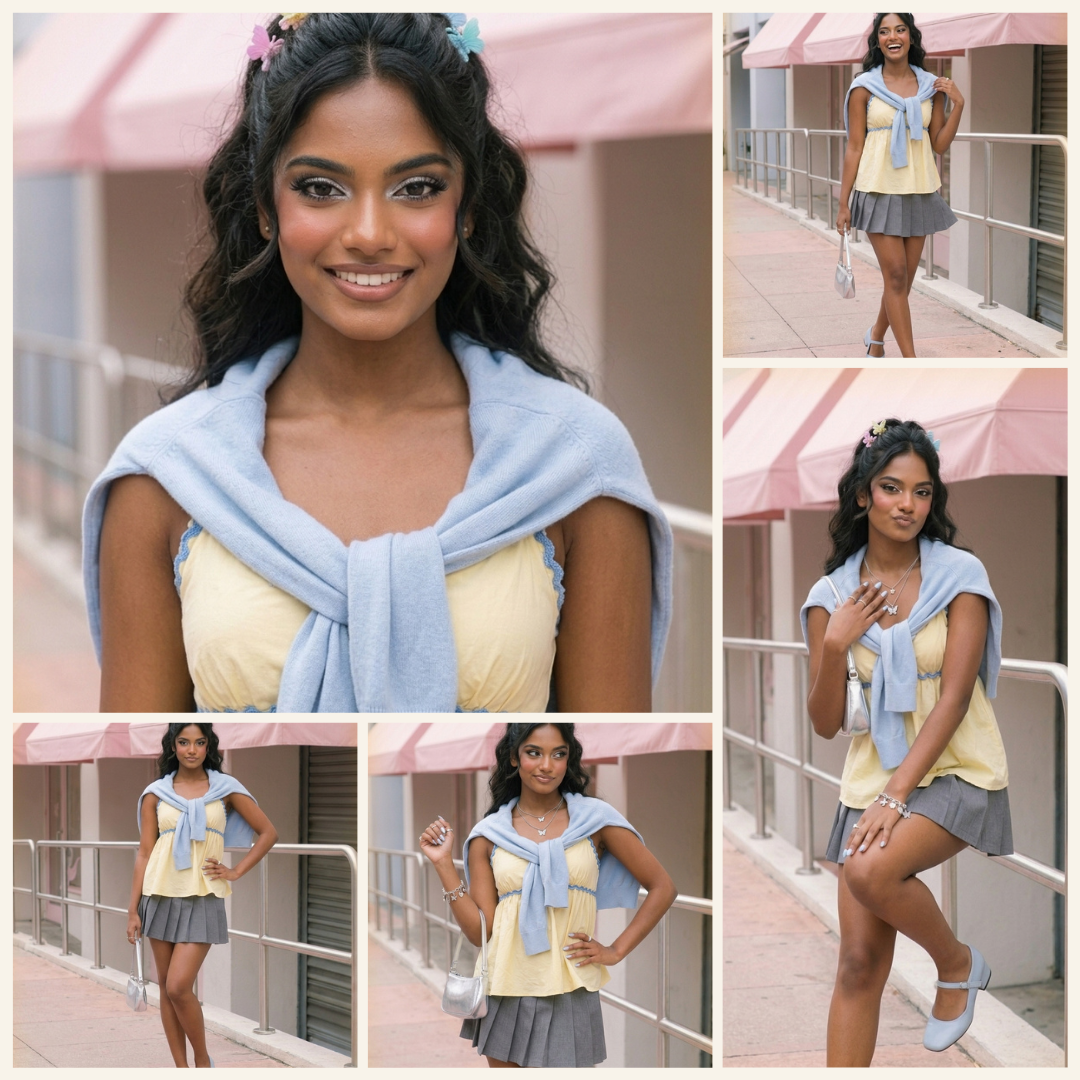
The most backward-looking dialect, built almost entirely around the optimism of millennial Tumblr culture, minus the irony. This is the strain most likely to show up captioned with something like "the children yearn for millennial optimism," and it functions less as a forward-looking style and more as comfort. Wishcore time-travels back to before twee got embarrassed about itself.
Color Palette
Faded pastels, slightly washed-out (a deliberately "old photo" tone)
Baby pink, powder blue, buttery yellow
Silver rather than gold for metallics
Sparkle and glitter used as an accent texture
Soft grey as the neutral base
Wardrobe Specifics
Babydoll top or dress
Low-rise piece as an optional 2000s nod (used sparingly)
Butterfly or heart motif accessories
Fuzzy or fluffy cardigan
Thin metallic or beaded necklace layered close to the neck
Logo tee reworked in a soft, faded print
Styling Approach
Deliberately nostalgic — the outfit should read as "remembered" rather than new
References Y2K and mid-2000s Tumblr, filtered through today's fit
Hair often half-up with butterfly clips
Glitter or shimmer makeup allowed, unlike other dialects
Jewelry delicate but plentiful — stacked rather than singular
Nothing ages the look intentionally; everything reads soft and young
Shoes
Platform flip-flops or slides
Mary Jane flats with a slight platform
Fuzzy slide sandals
Low-rise sneakers in pastel tones
Makeup
Frosted or shimmer eyeshadow, silver or baby pink
Glossy lip, often lip gloss over a lined lip for the 2000s effect
Glitter accents at the inner corner or brow bone
Blush blended in a wide, soft circle — the "doll flush"
Mascara in black, applied heavily for a fluttery look
Butterfly or star-shaped rhinestone accents optional
Mod Twee
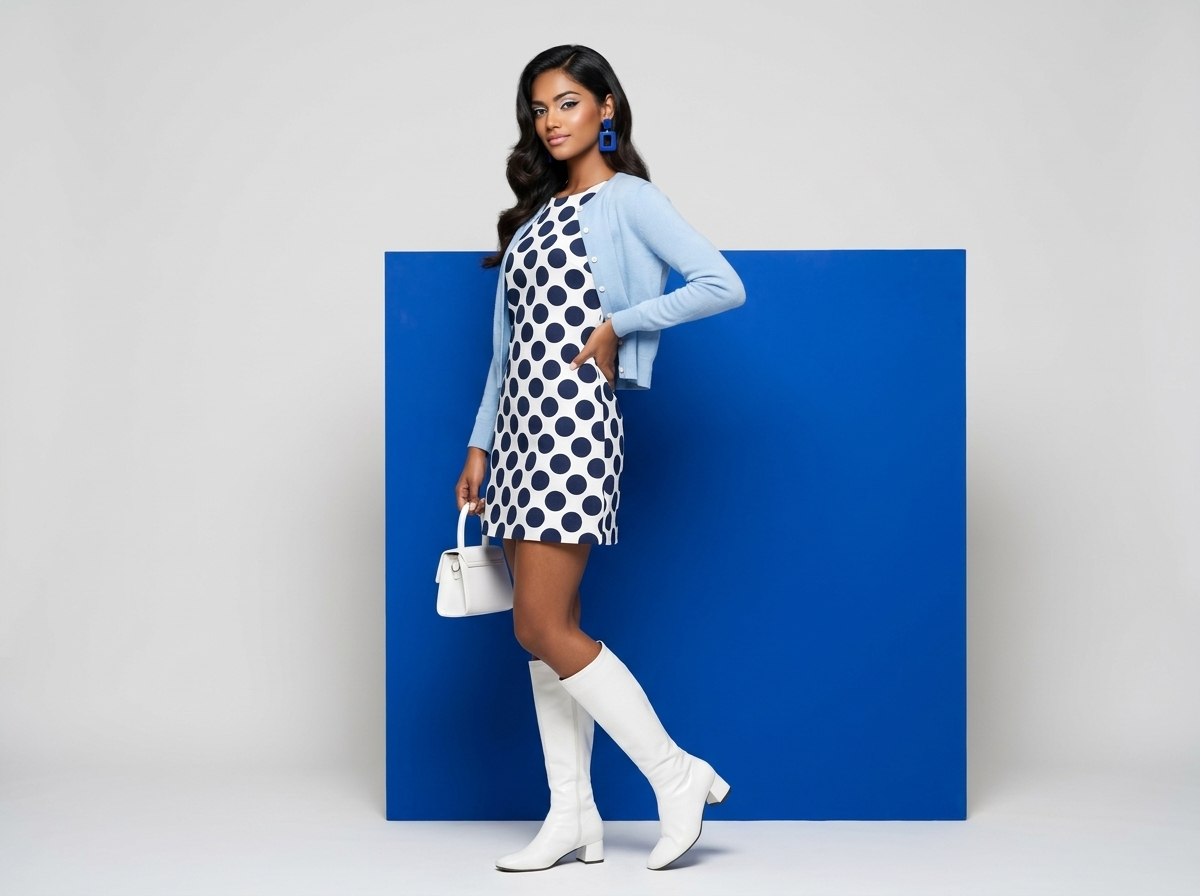
Mod and twee shouldn't really work together, however they do have a common ancestor. Mod is sharp geometric prints and color-blocking. Twee's is softness and clutter, total opposite. Mod Twee lives in the middle, narrow space. It's Twee with its spine straightened a little. Think a peter pan collar under a Mod-inflected shift dress, bold polka dots doing double duty, and a color palette that's twee-sweet but Mod-confident. This one's rarer in the wild than the other dialects. It's less a fully-formed trend and more an individual styling choice for anyone wanting Twee's warmth without Twee's shapelessness.
Color Palette
High contrast, but softened — navy and white instead of true black and white
One bold Mod accent — orange, hot pink, or cobalt
Polka dots treated as a shared color unit between both aesthetics
No true black; charcoal at the darkest
Metallics avoided, structure does the work instead
Wardrobe Specifics
Shift dress with a Mod-cut silhouette, twee-sweet print
Peter pan collar reworked onto a structured shift
Go-go boot styling paired with a soft blouse
Geometric-print scarf
A-line skirt with a graphic (not floral) pattern
Cropped cardigan, worn open over a structured dress
Styling Approach
Twee's softness borrows Mod's structure — silhouette stays sharp even when fabric is soft
One graphic element required per outfit (stripe, dot, or color block)
Hair styled, not loose — a defined shape, unlike other twee dialects
Jewelry geometric rather than delicate — a shift from twee's usual vintage pieces
Makeup can borrow Mod's graphic liner, softened with twee's pastel palette
Nothing slouchy; the structure is non-negotiable even as the sentiment stays sweet
Shoes
Go-go boots (knee-high, block heel)
Mary Jane flats with a slight platform
Structured block-heel pumps
Round-toe flats in a bold solid color
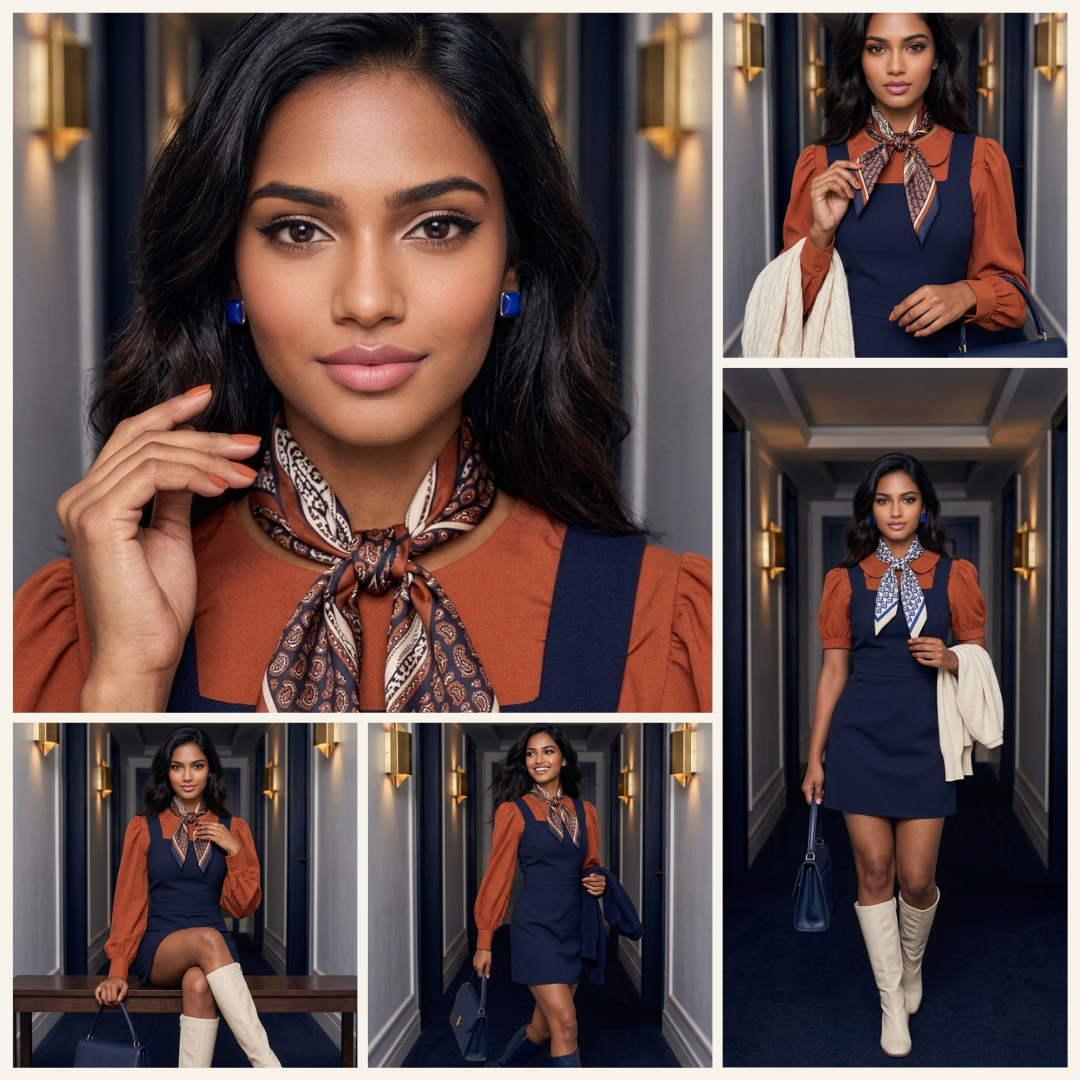
Makeup
Matte, even base — more polished than other twee dialects
Graphic liner — bold black wing or a geometric shape at the crease
Pale or white eyeshadow lid as a base for the liner to pop
Nude or pale pink lip, kept flat and matte
False lashes, ideally with a defined, spiky finish
Blush skipped or kept nearly invisible — the eyes carry the look
Twee vs. Cottagecore
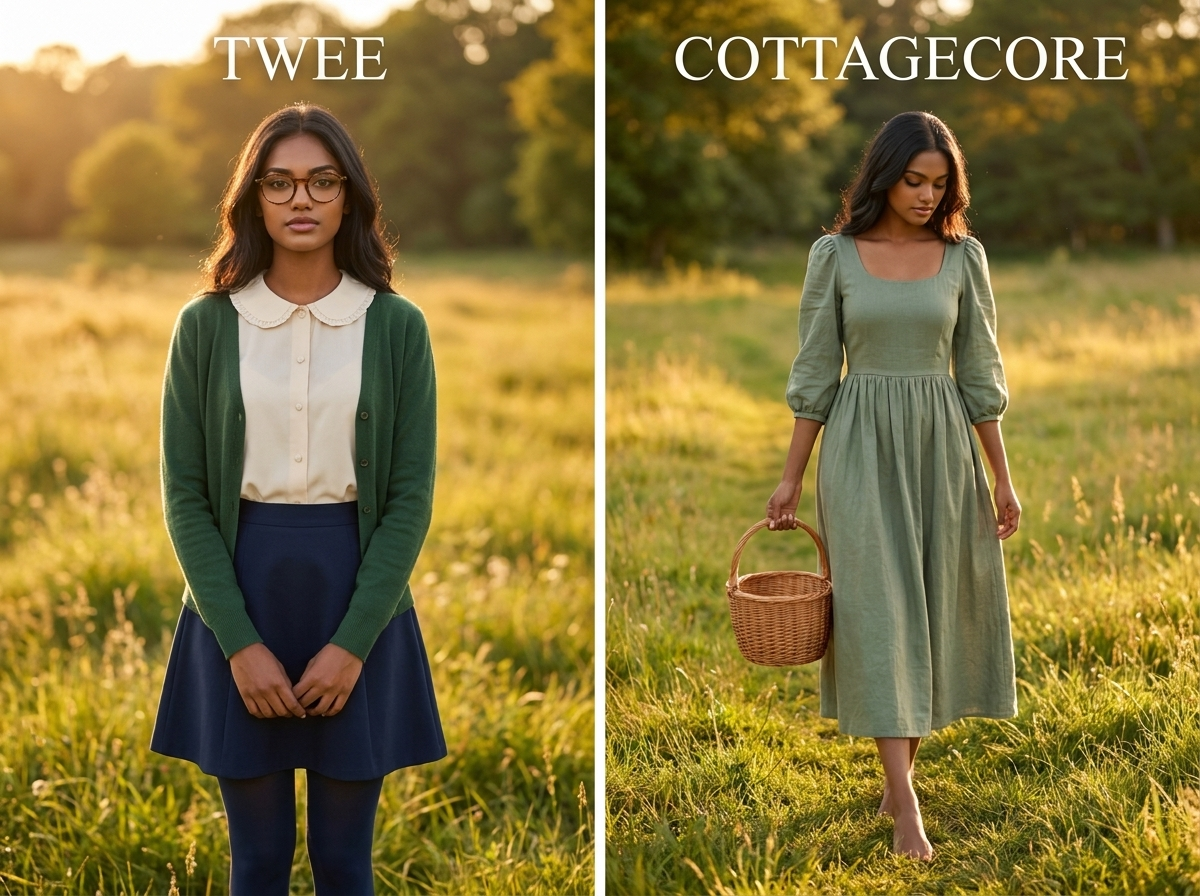
The confusion between these two is probably the most persistent of any twee comparison, and it's earned — both love a floral, both photograph beautifully outdoors, both build a whole identity around rejecting anything that looks urban, corporate, or overly polished. Cottage Twee exists because of that overlap. But the resemblance stops there.
Cottagecore is an imagined rural self-sufficiency, baking bread from scratch, and tending a garden. Twee, even in its most nature-inflected form, isn't performing farm life. It does borrow forest and meadow imagery because deer and pressed flowers happen to be a little precious.
The palettes tell the same story from a different angle.
Cottagecore's colors are the tones of things found in a garden or a hedgerow. Twee's colors are the tones of a well-loved children's book left on a shelf too long. One palette comes from walking outside. The other comes from a bookshelf.
Core Philosophy
Cottagecore: escape to somewhere — a rural fantasy of self-sufficiency
Twee: an attitude carried anywhere — sincerity and delight, location-independent
Color Palette
Cottagecore: foraged tones — sage, dusty rose, moss, mushroom, warm oatmeal
Twee: curated storybook tones — mustard, rust, forest green, cornflower blue, cherry red
Key Pieces
Cottagecore: prairie dress, apron, woven basket, linen smock
Twee: peter pan collar blouse, cardigan, colorful tights, round glasses
Mood/Temperament
Cottagecore: slow, agrarian, quietly self-sufficient
Twee: bright, bookish, unguardedly enthusiastic
Where They Differ
Cottagecore performs a lifestyle; twee performs a feeling
Cottagecore's nature imagery is the point; twee's nature imagery (Cottage Twee) is borrowed decoration
Cottagecore rarely gets loud; Whimsy Twee actively does
Twee vs. Coquette
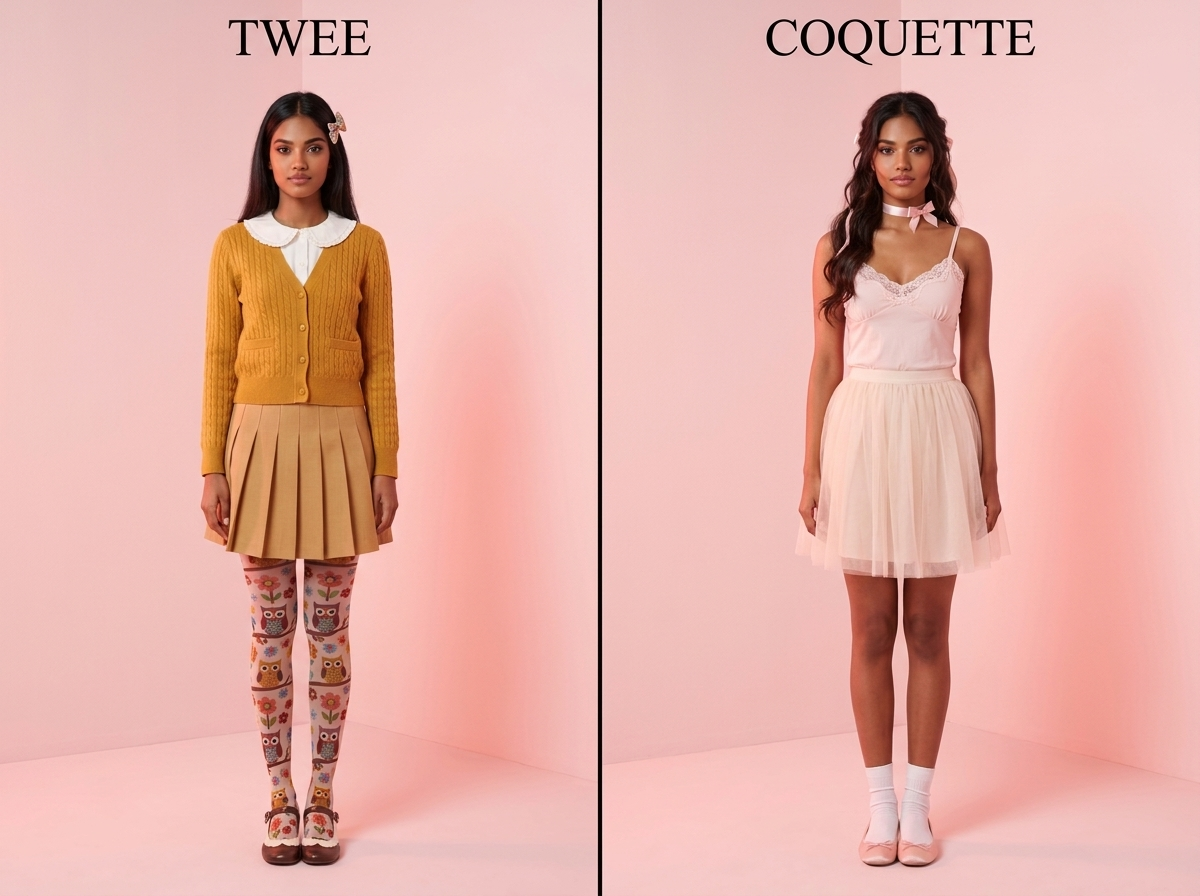
Where the Cottagecore confusion is about shared visual materials, the Coquette confusion is about shared femininity — both lean girlish, both love a bow. But the femininity itself is different. Coquette is a little flirtatious and spreads the idea of femininity being reclaimed as power. Unlike Coquette, Twee doesn't wink at the camera. Where Coquette is femininity is strategy, twee is femininity as unselfconscious preference.
Wishcore, twee's most nostalgia-driven dialect, is the one place this line gets blurry. Its glitter, Y2K signaling, and glossy finish sit closer to Coquette's territory than any other twee dialect does. That's why the difference should be clear.
Core Philosophy
Coquette: femininity as performance — knowing, flirtatious, reclaimed as power
Twee: femininity as sincerity — unselfconscious, no audience implied
Color Palette
Coquette: pastel pink, lace-white, ribbon-red, silver
Twee: mustard, forest green, cornflower blue, cherry red — warmer and less uniformly pastel
Key Pieces
Coquette: bows, lace, ballet-inspired silhouettes, corset-adjacent tops
Twee: peter pan collar blouse, cardigan, patterned tights, round glasses
Mood/Temperament
Coquette: knowing, performed, a little flirtatious
Twee: earnest, unguarded, deliberately un-ironic
Where They Differ
Coquette is aware of being looked at; twee isn't organized around being looked at at all
Coquette's softness is a chosen power move; twee's softness is just a preference
Wishcore is the one twee dialect that borders on Coquette territory — worth flagging so readers can tell the two apart
Twee vs. Light Academia
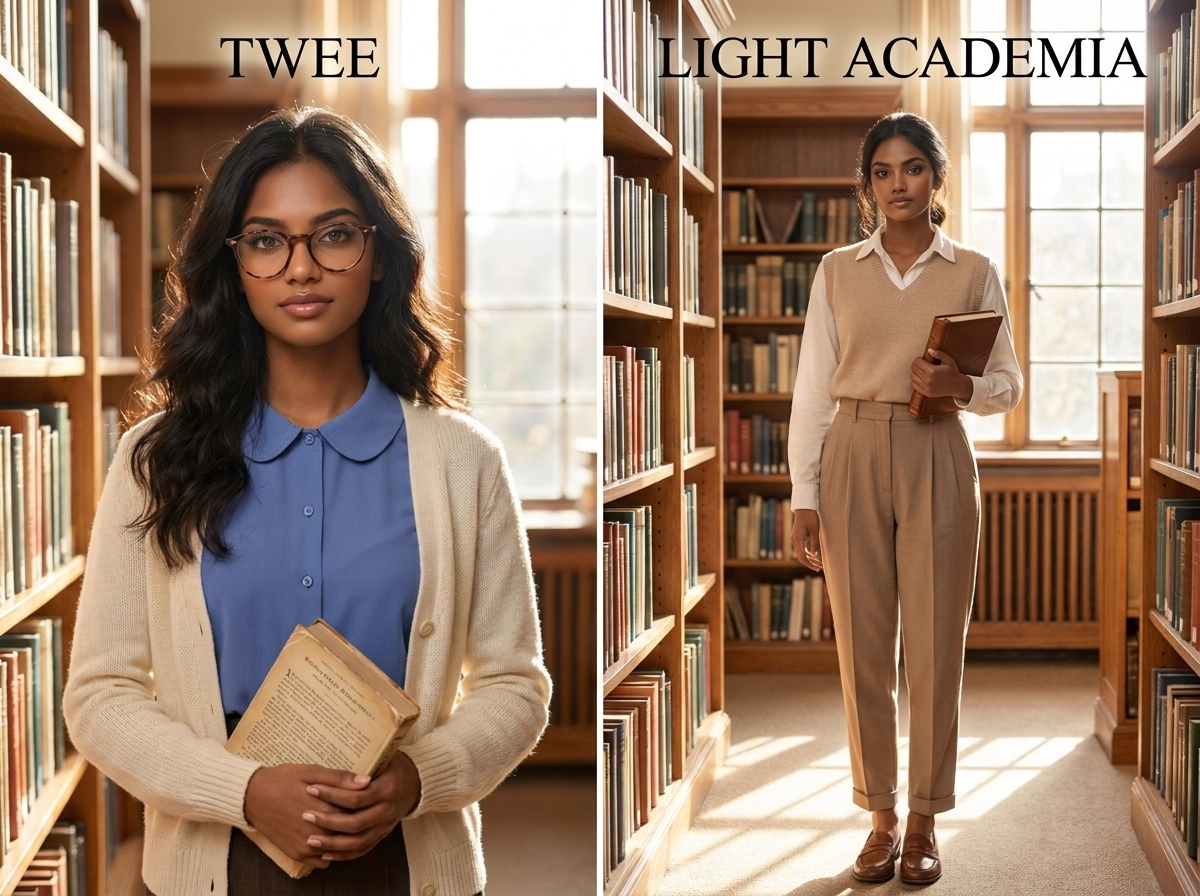
This is the trickiest comparison in the whole pillar, because Light Academia and twee actually do overlap on the peter pan collar, and both traffic love softness, optimism, and nostalgia for a gentler version of youth. Light Academia was coined on Tumblr by user plantaires back in January 2019, explicitly as the brighter, hopeful counterpart to Dark Academia.
Both Twee and Light Academia aesthetics want you to feel optimistic. Both like a collared blouse. But the reason for the softness is completely different. Light Academia is still, at bottom, an academia aesthetics. The wardrobe signals a relationship to books and study. Twee has no relationship to academia at all. A twee dresser in a cardigan is thinking about mixtapes and pressed flowers. A Light Academia dresser in a nearly identical cardigan is thinking about Keats.
That also separates this comparison from the Librarian Chic/Dark Academia one . Librarian Chic and Dark Academia read intelligence as composed and a little severe; Light Academia reads intelligence as gentle and idealistic. Twee doesn't reads delight.
Core Philosophy
Light/Romantic Academia: the romance of intellectual life, softened and optimistic rather than gothic
Twee: sincerity and childlike delight, with no relationship to academia at all
Color Palette
Light Academia: cream, beige, soft camel, warm neutrals
Romantic Academia: adds black, soft pink, gold, forest green, and blue to the Light Academia base
Twee: mustard, rust, forest green, cornflower blue, cherry red — brighter and more storybook than either
Key Pieces
Light/Romantic Academia: peter pan collar blouse, sweater vest, pleated trousers, loafers; Romantic Academia adds lace and satin
Twee: peter pan collar blouse, cardigan, patterned tights, round glasses
Mood / Temperament
Light/Romantic Academia: reflective, gentle, idealistic about study and learning
Twee: unguarded, enthusiastic, idealistic about everyday small pleasures
Where They Differ
Light/Romantic Academia's softness serves an intellectual fantasy; twee's softness serves no fantasy at all, just a preference
The shared peter pan collar is a coincidence of taste, not evidence of shared roots — the two aesthetics arrived at the same garment from opposite directions
Twee has no "dark" counterpart the way academia does; there's no Dark Twee waiting on the other side of this one
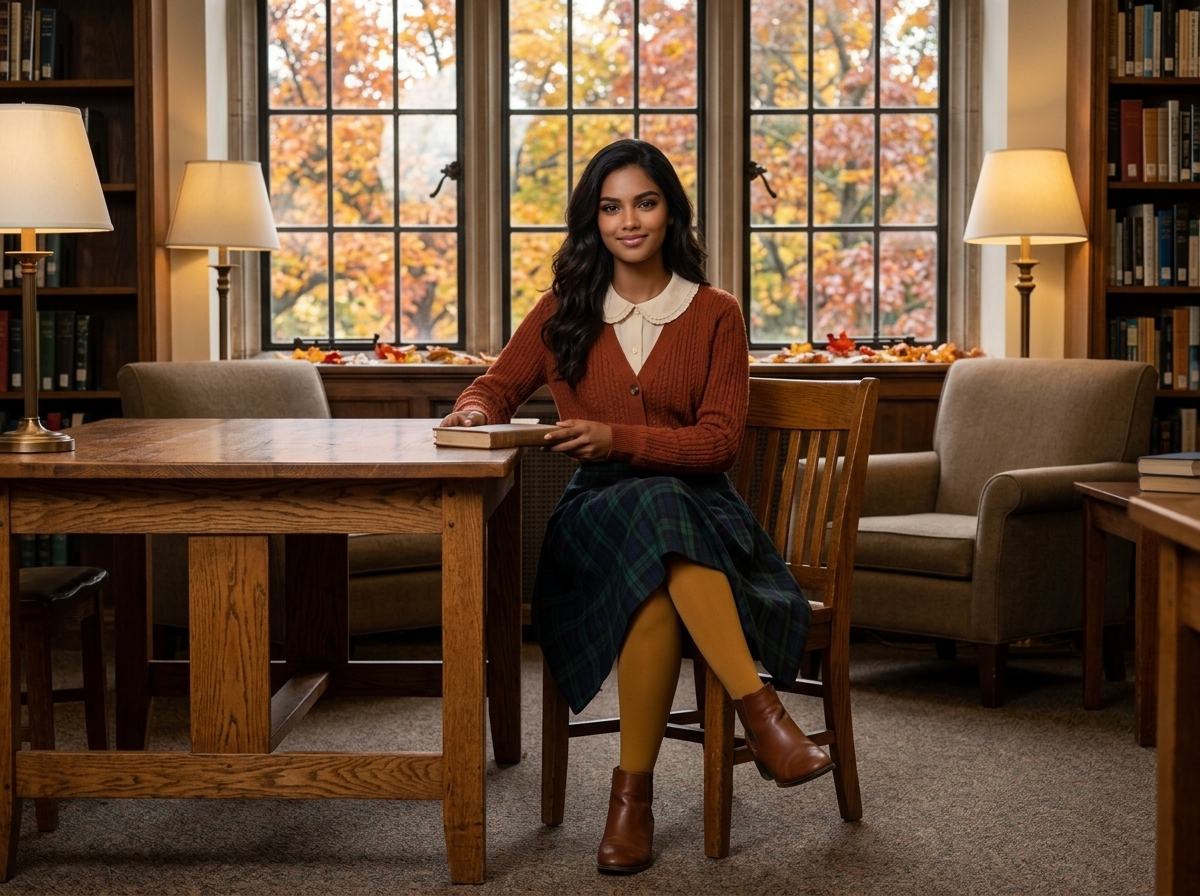
Making Twee Yours
Starting the Journey
The Beginner's Approach:
One vintage cardigan in a signature color
One Peter Pan collar blouse that fits well
One A-line skirt or tea dress
One pair of Mary Janes or ballet flats
One pair of colored opaque tights
One grosgrain ribbon for the hair
Intermediate Moves:
The full Amélie color story practiced (red, green, cream)
Two patterns mixed with one shared color
A vintage coat committed to
The bird brooch acquired
The film camera actually used
The bicycle actually ridden
Advanced Levels:
Three patterns mixed
A signature accessory that reads across every outfit
Vintage sourcing as the primary shopping method
A personal color palette codified
Character-costume completeness on ordinary days
Post-manic-pixie-consciousness fully achieved
Adaptation Tips:
Office Twee (Peter Pan collar under a blazer, pleated skirt, low heel)
Weekend Twee (tea dress, cardigan, ballet flats, small bag)
Evening Twee (velvet skirt, silk blouse, ribbon in hair, kitten heel)
Travel Twee (corduroy trouser, cardigan, blouse, comfortable flat)
Event Twee (full vintage dress commitment)
Summer Twee (gingham sundress, straw bag, sandals if you must)
The Future of Twee
Where It's Heading
Emerging Directions:
The 2024–2026 revival stabilizing rather than fading
Ballet flats becoming permanent rather than trend-cycled
Ribbons entering the general wardrobe vocabulary
Coquette absorbing into Twee rather than displacing it
Vintage sourcing becoming the default rather than the flex
Post-manic-pixie framing settled and settled well
Why It Endures
The Eternal Appeal:
Color is genuinely delightful and always will be
Whimsy is a real human appetite
The clothes are affordable through vintage
The aesthetic works at any size when styled correctly
The reference points (Amélie, Wes Anderson, Belle & Sebastian) age well
The alternative (uniform minimalism forever) is exhausting
