
The Preppy Aesthetic: When Your Trust Fund Has A Dress Code
Table of Contents
Preppy is what happens when generational wealth develops a uniform. It's looking like you summer as a verb, and your grandfather's name is on a building at Yale. This is the visual language of country clubs and custody of the family tartan, where your pearls have provenance and your boat shoes have been resoled three times because buying new ones would be gauche.
Think of it as cosplaying the American aristocracy, but with a tennis twist. It's Blair Waldorf meeting Thurston Howell III for gin and tonics at the yacht club, discussing their shared disdain for visible logos while wearing head-to-toe Ralph Lauren. It's the promise that somewhere between a monogrammed blazer and the right ZIP code lies the key to looking effortlessly expensive.
-
Preppy is what happens when clothing becomes a social language.
It originated in American preparatory schools and Ivy League campuses, where dress codes were about signaling belonging. Over time, that uniform evolved into a recognizable aesthetic: blazers, oxford shirts, loafers, cable knits, and a color palette that suggests you’ve seen the ocean at least once this season.
At its core, preppy style is less about trends and more about continuity. The pieces don’t change much. The meaning behind them does.
The Preppy Promise
What It Sells:
Old money elegance
Ivy League acceptance letters
Effortless privilege
Timeless American style
The right connections
What You Get:
Cable knit dependency
Pastel addiction
Khaki everything
Boat shoes on dry land
An inexplicable attraction to whales
Where Preppy Came From: Ivy Walls and Inherited Codes
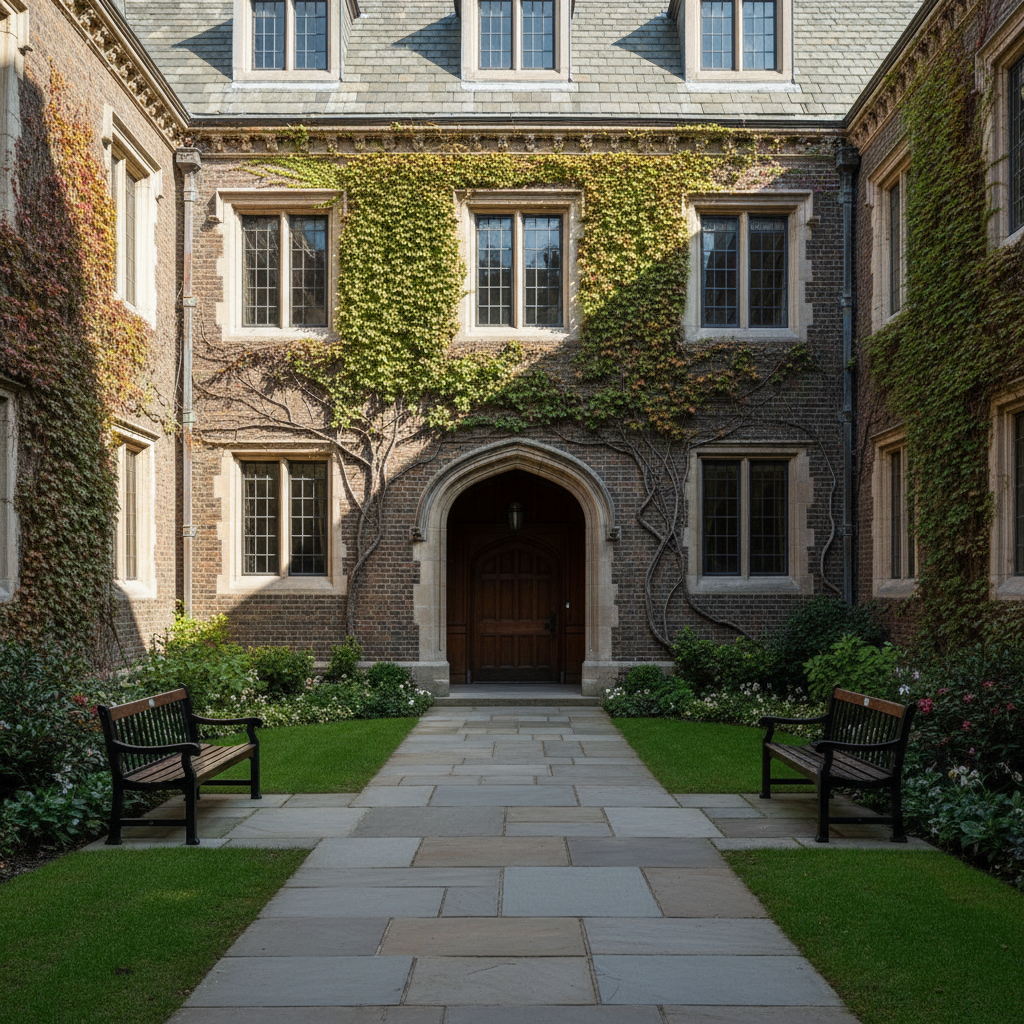
To understand preppy style, you have to start in the late nineteenth and early twentieth centuries, when a network of elite American preparatory schools formalized the country’s upper class. Institutions like Phillips Exeter Academy, Phillips Academy Andover, and Groton School were never just schools. They were finishing environments for the sons (and later daughters) of established New England families—places where academic instruction existed alongside social calibration.
Students were groomed not only for university but also future roles within the American elite. They would go on to attend Harvard, Yale, or Princeton University, join the right clubs, marry into the right families, and inherit the leadership structures of business, law, and politics.
In Europe, aristocratic hierarchies were clear and strict. In America, class structures were more ambiguous. The idea was social mobility in theory, not necessarily in practice.
Dressing preppy, even without direct access to that world, allows individuals to borrow some of its visual authority. In that sense, prep functions as a form of aspirational shorthand.
-
The word comes from "preparatory school", the primarily New England schools that prepared rich kids for Ivy League admission.
The term "preppy" as a noun and adjective entered common usage in the 1970s and was popularized by Lisa Birnbach's The Official Preppy Handbook in 1980.
-
Think institutional versus inherited. Preppy style references specific schools, clubs, or universities, and uses logos, crests, and colors as membership signals.
Old money style avoids institutional signaling in favor of a quality-focused dressing that communicates wealth through fabric and construction.
Preppy knows what blazer it is wearing and why; old money simply wears a blazer.
-
Historically, no.
For a long time, the places that introduced preppy style excluded anyone outside of a certain race and tax bracket.
Today, preppy functions less as a gatekeeping tool and more as a shared reference point.
Anyone can wear it.
Not everyone wears it the same way.And that’s where it becomes interesting.
Across the Atlantic, a parallel aesthetic emerged in Britain through the culture of boarding schools and aristocratic leisure. During the 1980s, British media coined the term Sloane Rangers to describe the fashionable young aristocrats who congregated around London’s Sloane Square.
Their wardrobes—Barbour jackets, riding boots, tailored blazers, and rugby shirts—echoed many of the same ideas that defined American prep. Both aesthetics drew from educational institutions, sporting traditions, and the quiet signaling of inherited privilege.
The 1950s and early 1960s demonstrated what historians describe as WASP cultural dominance. Universities, law firms, political offices, and social clubs all reflected the same narrow demographic profile.
The Official Preppy Handbook crystallized this mythology in 1980.
Written as a tongue-in-cheek guide to the habits of the American upper class, the book cataloged everything from acceptable nicknames to the proper number of worn-in sweaters one should keep in a summer house. It was meant to be satire.
Instead, it became a bestseller.
Suddenly, people far beyond the Ivy League were studying, imitating, and reproducing the habits of northeastern elites.
The 1980s economic boom produced a new professional class often described as yuppies—young urban professionals whose wealth came from careers rather than inheritance. Even with their newly minted lineage, these new elites adopted preppy clothing as a visual shorthand for success.
And yet, despite its exclusive origins, preppy style refuses to disappear.
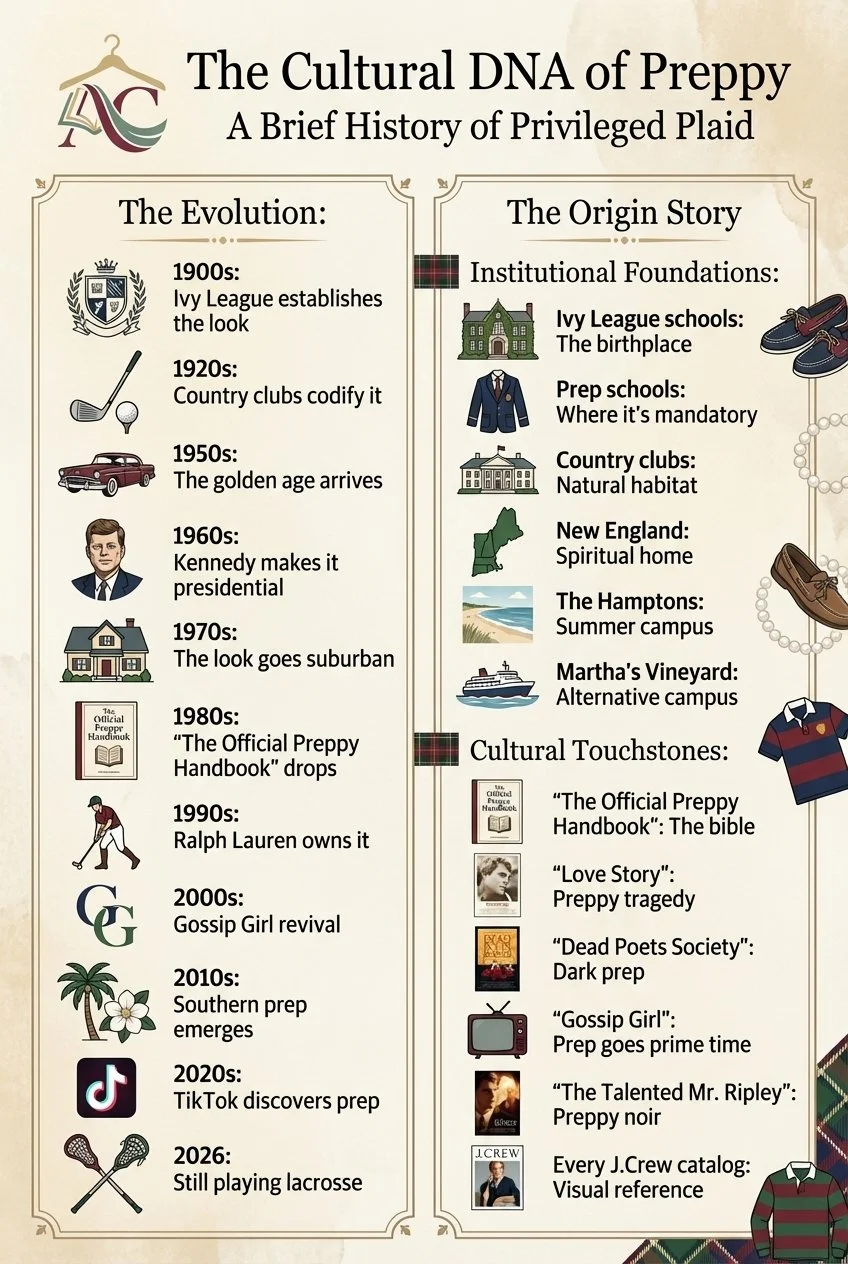
Preppy in Pop Culture: The Canon
Every aesthetic has its founding texts, its patron saints, and its defining screen moments. Preppy has an unusually rich canon, spanning a satirical handbook that accidentally became a manual, film heroines who made plaid skirts aspirational, and a TikTok revival that proved the whole thing was nowhere near finished.
The Official Preppy Handbook (1980)

1980s Official Preppy Handbook, when preppy went mainstream.
Lisa Birnbach's field guide to the American prep tribe is the document that named and fundamentally changed the preppy aesthetic. Published as affectionate satire, the book sold over a million copies and accomplished something its author likely didn’t intend: it turned a closed social system into an open curriculum.
What the Handbook captured was the aesthetic's foundational paradox. Birnbach understood that you cannot satirize something this specific without also documenting it, and her documentation has outlasted her satire.
Forty-five years later, the Handbook remains the most quoted, most referenced, and most structurally useful text in the entire preppy canon.
Heathers and Clueless — The Preppy Girl as Archetype
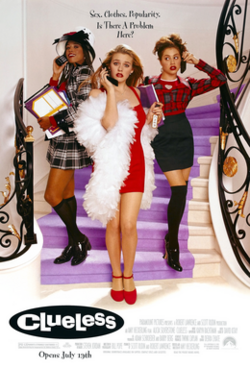
Before Blair Waldorf and the TikTok revival, the preppy girl was an American cultural archetype by two films. Heathers (1988) gave her menace and a croquet mallet and Clueless (1995) gave her a computerized wardrobe and a good heart.
Together they defined the preppy girl's range — capable of social cruelty and social generosity, always impeccably dressed, and operating a social world whose rules she both enforces and, occasionally, subverts.
Cher Horowitz in her plaid co-ord sets, knee socks, and rotating blazers is a more accurate portrait of the aspirational preppy wardrobe. The Clueless aesthetic has never fully left our culture, and it still influences to this day.
Carolyn Bessette-Kennedy and Princess Diana — The Living Icons
Two women, on opposite sides of the Atlantic, embodied the preppy aesthetic with authority.
Princess Diana's early wardrobe, the Sloane Ranger years, is the most complete documentation of Euro Preppy ever assembled.
Carolyn Bessette-Kennedy’s off-duty wardrobe of crewneck sweaters, straight-leg trousers, loafers, and clean white shirts is the bridge between classic preppy and quiet luxury. Twenty-five years after her death, she’s still one of the most referenced women in contemporary fashion, and the preppy aesthetic is a reason why.
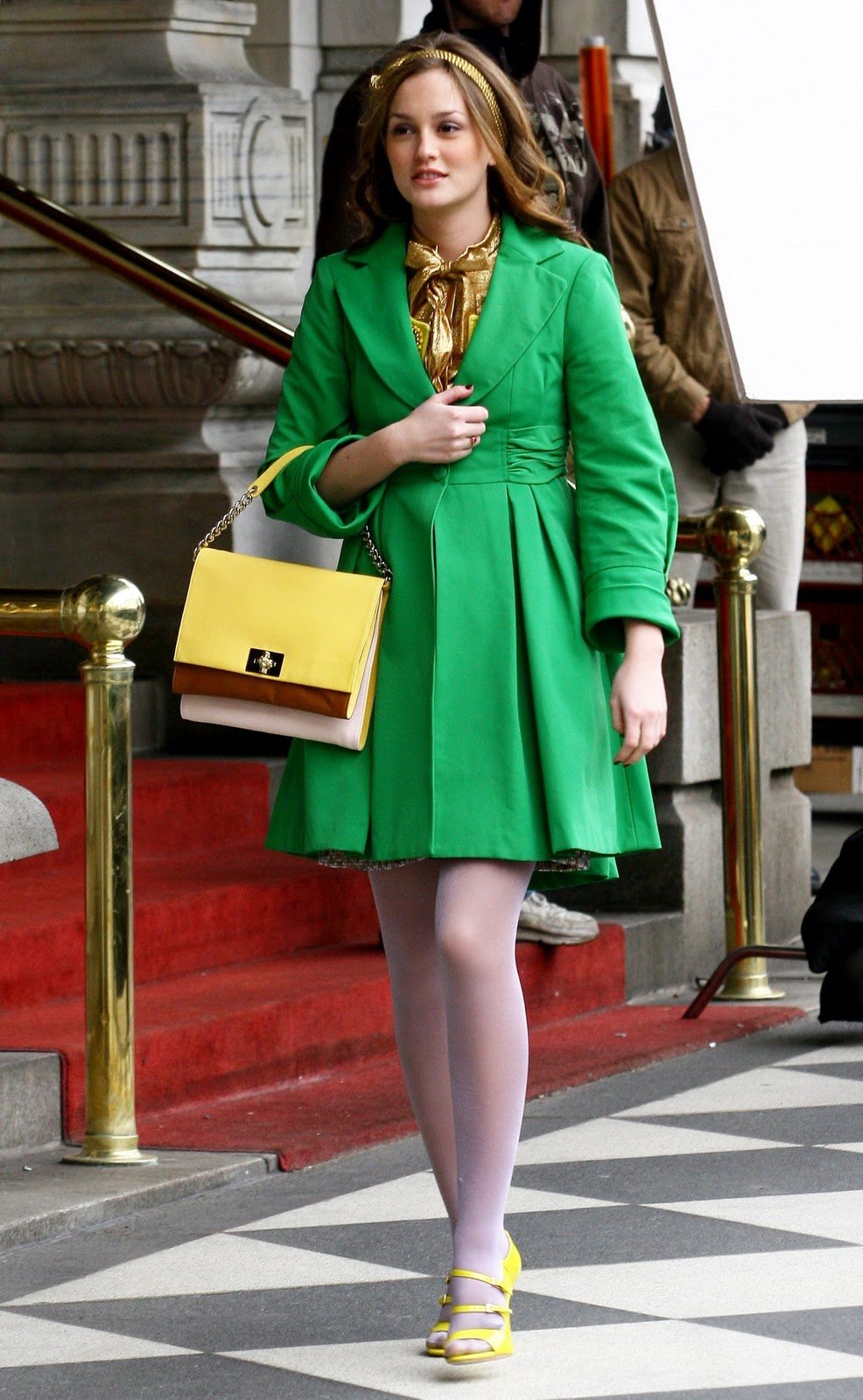
Gossip Girl — Blair Waldorf and the Upper East Side Uniform
If the Official Preppy Handbook named the aesthetic, Gossip Girl glamorized it.
Blair Waldorf’s headbands, plaid skirts and blazers turned institutional preppy dressing into aspirational television. The show ran from 2007 to 2012, and Gen Z continues to reference it.
Blair uses her wardrobe the way the original preppy tradition intended. The headband is more than an accessory, but a declaration. The show's costume designer Eric Daman understood this, and it’s the most influential portrayal of preppy dressing in television history.
TikTok and the Gen Z Rediscovery
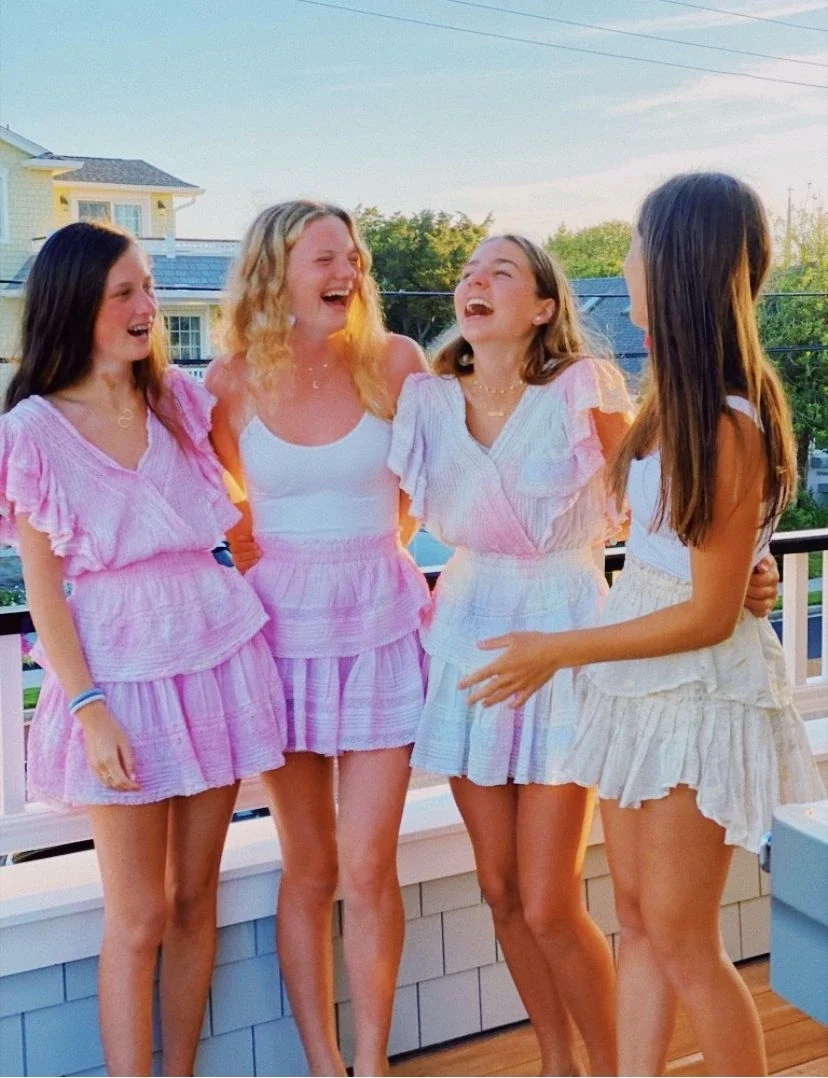
The current preppy revival did not begin in a fashion magazine, but on TikTok. Creators posted styling videos under #preppyaesthetic, trending enough for a 200%+ search surge on Lyst. The Gen Z rediscovery is notable for several reasons, the most significant being that it arrived via screen rather than firsthand institutional experience.
These are not students who attended prep schools; they are viewers who watched Gossip Girl reruns, browsed vintage Ralph Lauren finds on Depop and Pinterest boards built from decades of preppy imagery.
The brands that benefited most include Ralph Lauren and Lacoste, both heritage labels with long preppy associations. They’ve found new audiences among consumers who were not born when the Official Preppy Handbook was published.
The Gen Z interpretation is not identical to the original, but the underlying aesthetic loyalty is real. Preppy has always survived adaptations by new generations. This one is no different.
The Preppy Palette and Pattern Vocabulary
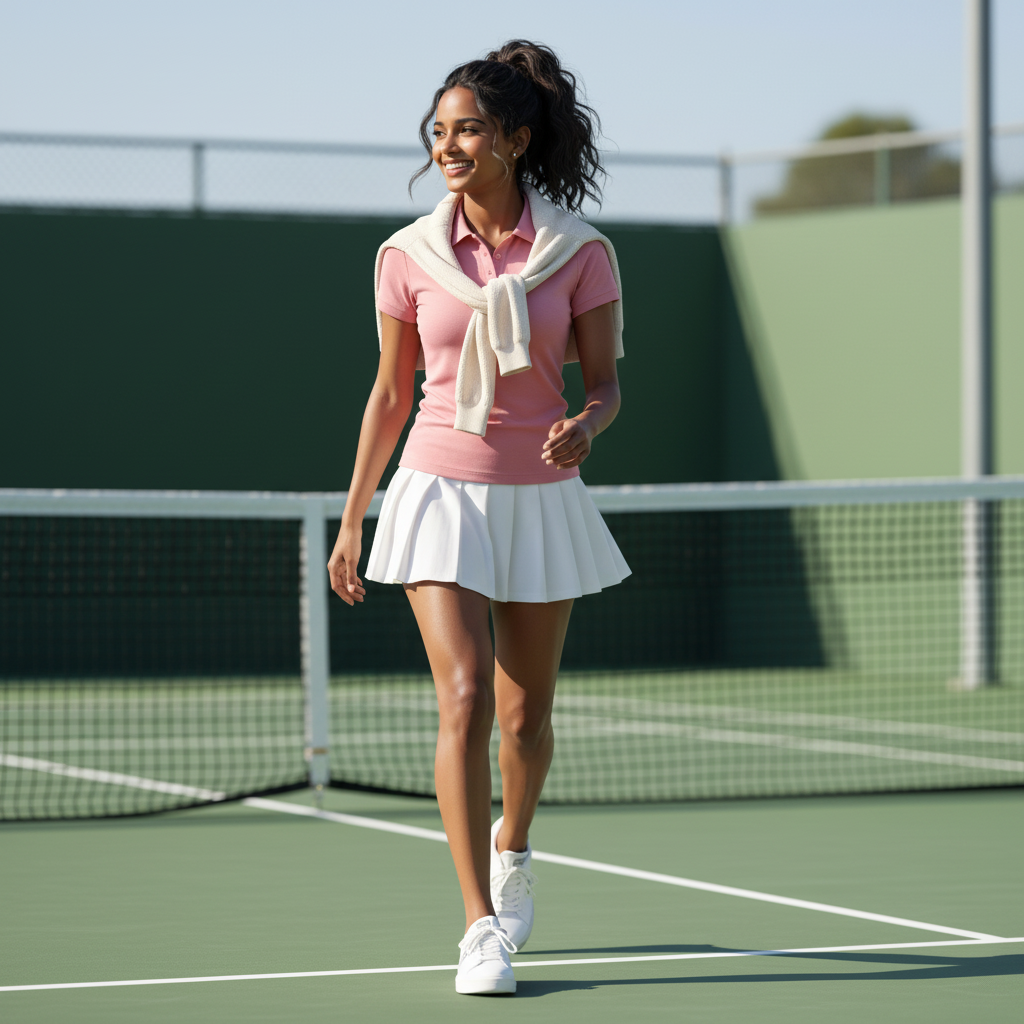
Long before mood boards and Pinterest boards, preppy operated through visual cues. Once you learn the vocabulary, you’ll see it everywhere: on campus quads, at coastal summer houses, in Ralph Lauren campaigns, and on anyone who might casually own a sailboat.
At its best, the preppy wardrobe feels coordinated rather than styled. Nothing clashes, shouts, or appears accidental. The look functions like a uniform assembled over time.
Color Theory: Pastels and Primaries
Preppy color theory lives at the intersection of American collegiate tradition and coastal leisure. Unlike minimalist palettes that lean heavily on beige and black, prep embraces color, but within reason.
The palette tends to fall into two families: strong, anchoring primaries and softer pastels.
The Classic Palette
Navy—The Foundation Color
Preppy’s foundational color. The navy blazer is arguably the central artifact, linking naval heritage and academic uniforms. Navy grounds the brighter elements of the wardrobe.
Kelly Green—Country Club Grass
Kelly green evokes golf courses, tennis lawns, and the manicured landscapes of East Coast country clubs. It appears frequently in sweaters, rugby shirts, and accessories.
Pink—Nantucket Red, Actually
Preppy pink is the faded coral known as Nantucket red, a color associated with weathered sailing trousers softened after years of sun exposure. It suggests time spent near salt air.
Khaki—The Neutral of Choice
Khaki chinos have anchored preppy wardrobes for generations. Originally military-inspired, khaki became the everyday trouser of Ivy League campuses—relaxed, durable, and versatile.
White—Tennis, Anyone?
White carries strong associations with athletic tradition. Think tennis courts, summer dresses, and crisp oxford shirts.
Burgundy—Academic Depth
Where brighter colors capture the leisure side of prep, burgundy anchors the aesthetic in academia. Found in rep ties, knitwear, and autumn layering pieces, burgundy evokes libraries, lecture halls, and polished wood interiors.
-
The preppy palette include navy, white, cream, Nantucket red (a warm coral-red associated with the New England coast), hunter green, camel, and khaki.
Seersucker blue and white is the canonical summer combination.
The madras brights — coral, goldenrod, kelly green, periwinkle — represent the palette's more exuberant register, appropriate in summer and in coastal contexts.
The palette as a whole is more varied than it is often given credit for; the constraint is not the number of colors but the register.
-
Natural fibers are non-negotiable: cotton, wool, linen for warm-weather, and silk for accessories.
Synthetic fibers like polyester are incompatible. Not just because they’re cheap, but because they age poorly and lack quality.
Seasonal Shifts
Although the core palette remains stable, preppy wardrobes subtly adapt throughout the year.
Spring: Pastel Explosion
Pastel sweaters, light pink shirts, mint green polos, and pale yellow cardigans dominate the season. The effect is cheerful but still coordinated.
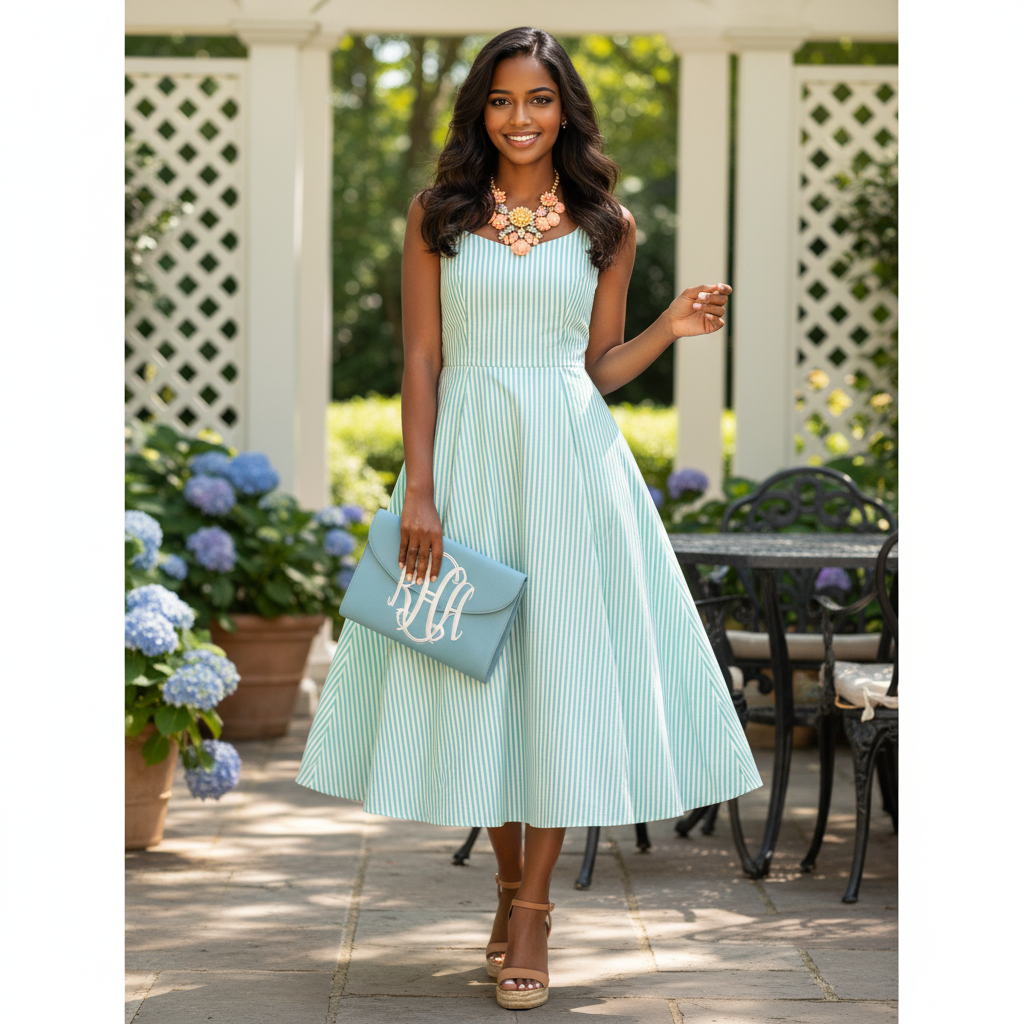
Summer: Seersucker Stripes
Seersucker suits, pale blue stripes, linen shirts, and Nantucket red shorts feel seaside-ready without sacrificing structure.
Fall: Earth Tones Emerge
Autumn introduces deeper hues—olive greens, warm browns, burgundy sweaters, and corduroy trousers. Layers become heavier and textures richer.
Winter: Jewel Tones and Tweeds
In winter, prep becomes more academic. Deep emerald, navy, plum, and charcoal appear alongside tweed jackets and wool coats.
Year-Round: Navy Blazers
Some garments transcend seasonal change entirely. The navy blazer remains constant, appearing with linen in the summer and tweed in the winter.
Always: Coordinated
Above all, preppy color theory values coordination. Nearly every item pairs easily with the others.
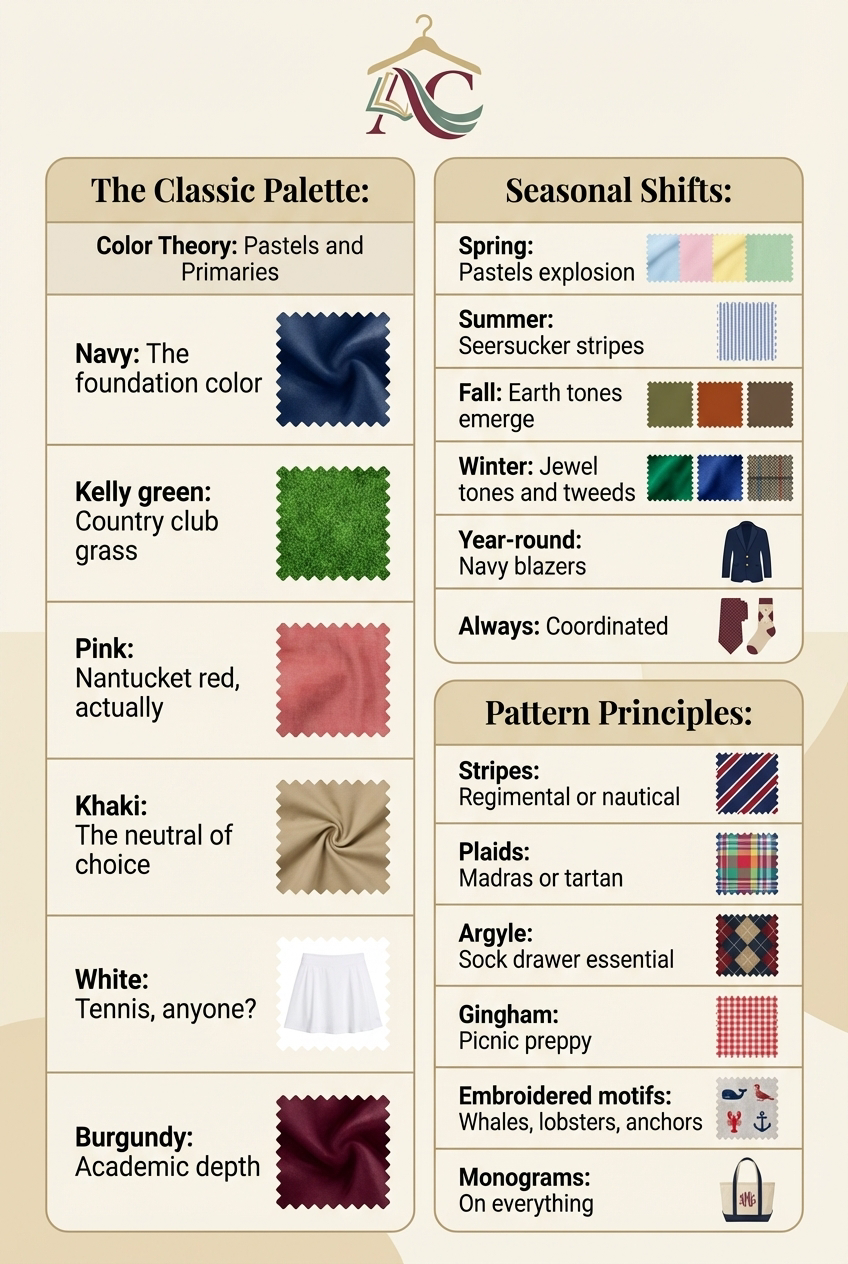
Pattern Principles
Unlike maximalist fashion, which stacks patterns unpredictably, preppy style relies on a relatively small set of recurring motifs.
Stripes—Regimental or Nautical
Stripes often appear in rugby shirts, sweaters, and Breton-style tops. Regimental stripes carry British military heritage, while nautical stripes nod to maritime traditions.
Plaids—Madras or Tartan
Madras plaids dominate summer wardrobes with bright, slightly irregular patchwork colors, while tartans bring heritage structure to colder seasons.
Argyle—Sock Drawer Essential
Argyle diamonds appear frequently on socks and knitwear. Originating in Scottish golfing attire, argyle adds visual interest without overwhelming the outfit.
Gingham—Picnic Preppy
Gingham’s small check pattern brings casual charm to shirts and summer dresses. It feels lighthearted and classic, often associated with warm-weather gatherings.
Embroidered Motifs—Whales, Lobsters, Anchors
Few aesthetics embrace whimsical embroidery quite like prep. Tiny stitched motifs, such as whales, lobsters, sailboats, and anchors, adorn shorts, belts, and shirts, subtly referencing coastal life.
Monograms—On Everything
Monograms have long been part of preppy culture, appearing on shirts, bags, towels, and stationery. They’re both decorations and indicators of tradition and identity.
Silhouette Principles
The silhouette is the most misunderstood element of preppy dressing.
Preppy clothing follows three guiding principles:
Structured but relaxed
Blazers have shoulders, and trousers have tailoring, but nothing too rigid.
Tailored but never severe
Clothes should skim the body rather than cling to it.
Nothing too revealing
Preppy historically favors modesty. Hemlines are conservative, necklines are high, and the silhouettes focus on comfort over drama.
The Layering Logic
The most legible prep technique is layering. Preppy outfits often build vertically through simple combinations:
Collared shirt under a sweater
Sweater draped over shoulders
Blazer worn over both
Each layer adds warmth and, most importantly, shows that you knew to wear a jacket. This is a great visual trick for prep: looking both overprepared and nonchalant at the same time.
The Fabric Rulebook
When a wardrobe is built on subtlety and inheritance, fabric becomes the main way to show meaning. For example, there’s a big difference between a sweater that conveys old money and one that suggests a good deal at a mall.
Remember the rule: natural fibers.
Natural fibers wear in rather than wearing out. A 10-year-old Shetland wool sweater looks like a 10-year-old Shetland wool sweater. A synthetic blend the same age looks like something you should have replaced years ago.
Preppy prefers the former, partly for aesthetics and partly because replacing things frequently is a class signal of the wrong kind.
Cotton: The Foundation Fabric
Cotton is the workhorse of the preppy wardrobe, and within cotton, one weave reigns above all others: Oxford cloth. Oxford cloth is heavier than poplin, with a slight basket weave giving it texture and structure.
Beyond Oxford cloth, cotton appears in two registers.
Piqué is the slightly raised, waffle-textured weave associated with polo shirts. It’s what gives those shirts their structure and their sporting credibility.
Poplin, meanwhile, offers the smoother, crisper alternative for dress shirts under a blazer. Brushed cotton and flannel shift the register further toward the relaxed and the academic.
Wool: The Hierarchy

Wool is where the preppy wardrobe gets intriguing, because not all wool is equal.
At the top sits Shetland, which is the rough-spun, slightly scratchy wool from Scotland's northern islands that has been a campus staple since at least the 1950s. Shetland sweaters are not particularly luxurious. The Shetland crewneck is preppy's version of artful underdressing.
Merino occupies the middle register. It’s softer and finer than Shetland and less likely to provoke complaints about itchiness.
Cashmere sits at the summit: technically a luxury fiber. The cashmere crewneck worn over a collared shirt is the best one-two combination in the entire aesthetic.
Tweed and corduroy handle the colder, more structural end of the wool vocabulary.
Tweed, a rough, dense, often multi-toned fabric of Scottish origin, serves as the fabric of the professor. It appears most often in sport coats and blazers.
Corduroy, with its distinctive ribbed pile, is tweed's more casual sibling: worn as trousers in autumn and winter, usually in tan, brown, or deep olive, always with something flannel on top.
Linen and Silk: The Seasonal Specialists
Linen is the summer fiber, full stop, and it obeys its own rules.
Worn as shirts, trousers, or the occasional unlined sport coat, linen in navy, white, and the palest yellow carries coastal preppy through June, July, and August with something approaching grace.
Silk is slightly rarer, appearing in ties, pocket squares, and scarves.
These accessories are where the most traditional preppy silences its color conservatism and allows itself a certain latitude.
As with everything in the prep vocabulary, the detail rewards attention from those who know to look.
A Note on Waxed Canvas
One fabric sits slightly outside the natural-fiber hierarchy but has earned its place through heritage credibility: waxed canvas.
The Barbour jacket—technically waxed cotton, but with a unique texture and personality—originated from British countryside dressing and became the unofficial uniform of the rural weekend in American prep. It is rugged, waterproof, and unglamorous. It is also, characteristically, better with age. A new Barbour is acceptable; a Barbour that still smells faintly of the original treatment is aspirational.
The underlying logic, across every fabric category, is the same: choose materials that earn their place through performance and heritage rather than novelty or price point.
The Preppy Wardrobe Decoder
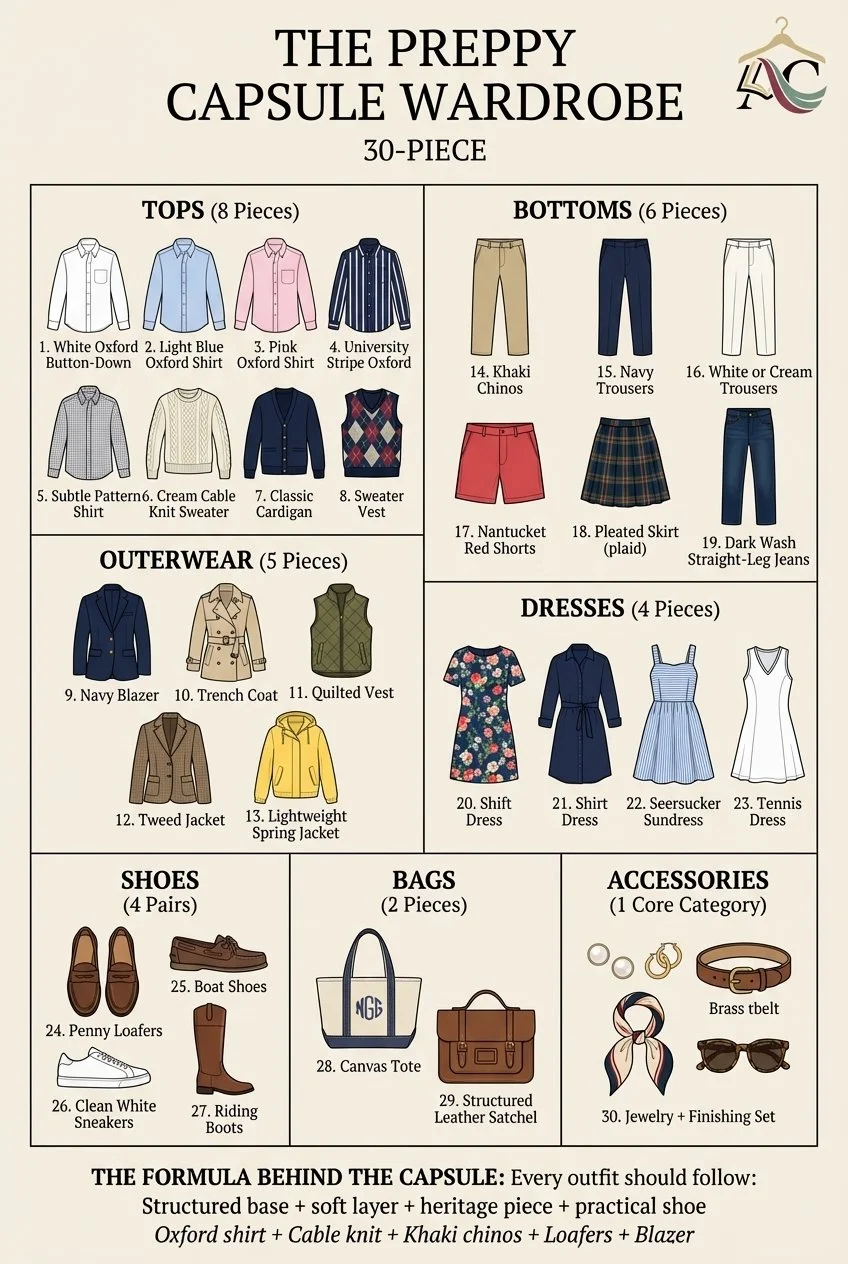
Tops: The Upper Crust
The Shirt Situation
Oxford Button-Downs:
White: Multiple required
Blue: Light and classic
Pink: Power move
Stripe: University width
Yellow: Advanced prep
Pattern: Subtle only
Styling Standards:
Collar always buttoned
Sleeves rolled precisely
Pressed but not stiff
Monogram on pocket
Tucked or untucked rules
Layering essential
The Sweater Strategy
Essential Knits:
The Cable Knit:
Cricket sweater: White with trim
Fisherman's sweater: Aran authenticity
Tennis sweater: V-neck vintage
Crew neck: Simple staple
Cardigan: Mr. Rogers refined
Sweater vest: Grandpa chic
Styling Notes:
Over collared shirts always
Shoulders seam perfect
Pushed up sleeves
Draped over shoulders
Tied around waist (rarely)
Natural fibers only
-
If you’re building from scratch, start with:
A navy blazer
A white and a blue oxford shirt
Khaki chinos
A cable knit sweater
Penny loafers
From there, everything else becomes variation.
Preppy style isn’t about having more.
It’s about knowing how to recombine what you already own. -
It can be—but it doesn’t have to be.
The original aesthetic was tied to wealth but today, you can recreate the look at any price point by focusing on:
Fabric quality
Fit and structure
Classic silhouettes
Thrifting, vintage, and resale are great here—preppy clothing actually benefits from looking like it has a past.
-
Not only can you—preppy style arguably makes more sense after 25.
While it’s rooted in school uniforms, the aesthetic is built on timelessness. Blazers, loafers, structured shirts, and classic knits don’t age out—they mature with you.
If anything, wearing prep after 25 shifts the energy from student to alumni.
And that’s where it really starts to work.
Outerwear: The Investment
The Blazer Bible:
Navy Blazer Necessity:
Gold buttons (real metal)
Natural shoulders
Center vent
Patch pockets
Year-round weight
Passed down ideally
Additional Layers:
Barbour jacket: Anglophile essential
Quilted vest: Patagonia or similar
Trench coat: Burberry preferred
Tweed jacket: Shooting party ready
Sailing jacket: Functional fashion
Toggle coat: Winter classic
Bottoms: Below the Belt
The Trouser Taxonomy
Chinos Championship:
Khaki: The default
Nantucket red: Statement piece
Navy: Versatile option
Stone: Summer selection
Olive: Outdoorsy prep
Corduroy: Fall/winter
Alternative Bottoms:
Bermuda shorts: Knee-length only
Madras shorts: Pattern play
Seersucker pants: Southern summer
Wool trousers: Winter weight
Jeans: Dark wash only
Skirts: A-line or pleated
Fit Philosophy:
Not too tight
Not too loose
Pressed creases
Proper length
Quality over trends
Timeless silhouettes
The Dress Code
For the Feminine Preppy:
Dress Categories:
Shift dresses: Lilly Pulitzer prints
Shirt dresses: Polo style
Wrap dresses: Classic cuts
Sundresses: Seersucker or cotton
Sweater dresses: With pearls
Tennis dresses: Actually for tennis
Skirt Selection:
Pleated skirts: School uniform chic
A-line skirts: Knee-length
Tennis skirts: See above
Wool skirts: Winter weight
Madras skirts: Summer fun
Khaki skirts: Versatile staple
Preppy Beauty: The Aesthetic Extends to the Face
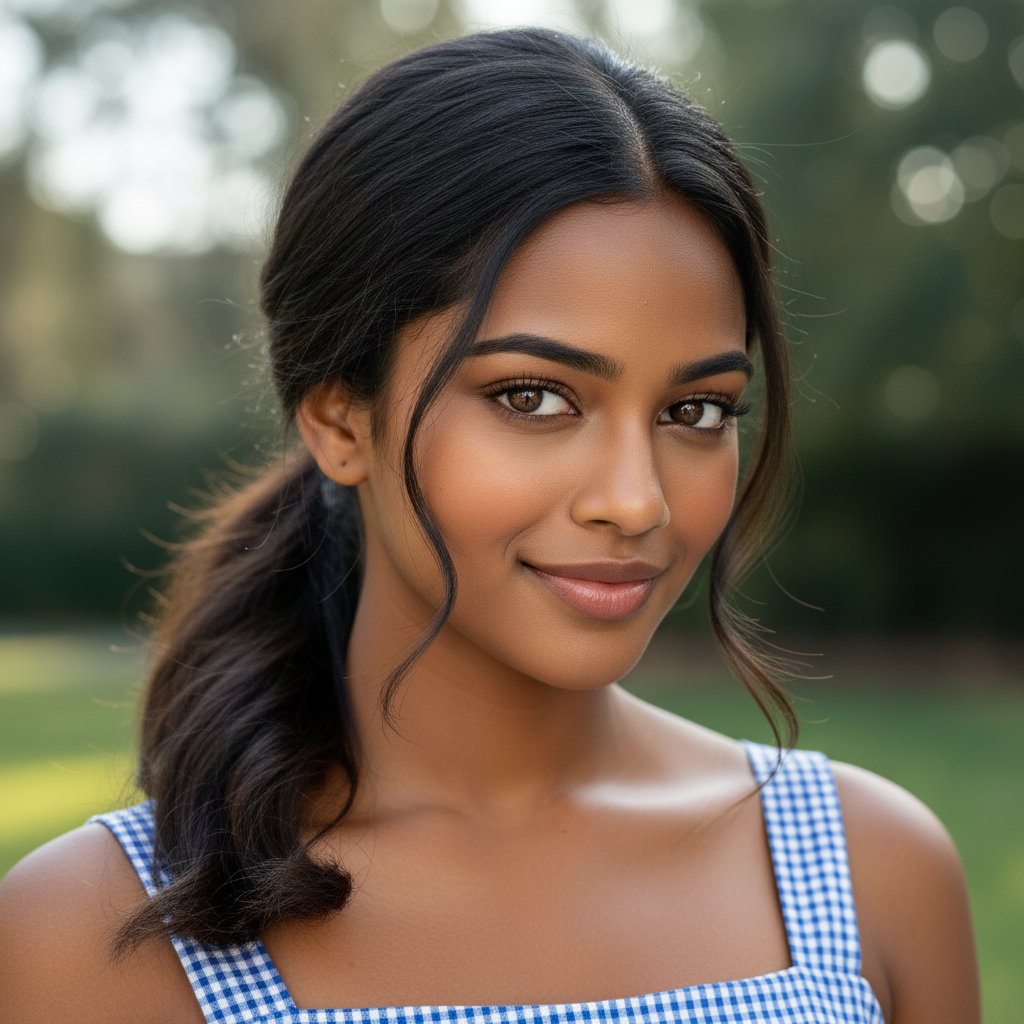
The preppy approach to beauty follows the same logic as that of clothes: nothing excessive.
Hair
The canonical prep hair move is the low ponytail — smooth, controlled, pulled back with a grosgrain ribbon or a tortoiseshell clip rather than an elastic that shows.
The blowout is the alternative: a soft, round-brushed finish that holds its shape through a full day of activity, whether that’s a tennis match or sitting in a library pretending to read.
The headband is where prep hair becomes most legible as a cultural signal.
The velvet Alice band in navy or black, the tortoiseshell half-moon, the grosgrain bow on a hard band — each version is instantly recognizable and has been worn by everyone from actual Exeter graduates to Blair Waldorf. It is perhaps the single most aesthetic shorthand in the entire preppy vocabulary: one accessory, immediate identification.
Skin
Preppy skin is clean, even, and lightly sun-kissed from outdoor activities. Remember, maintenance over transformation. Good skincare is the infrastructure beneath minimal makeup.
Sunscreen is not optional and never has been; in the preppy worldview, SPF is less a beauty product than a lifestyle value, as fundamental as owning a good rain jacket. The finish is natural, the texture is smooth.
Makeup
The preppy makeup palette is almost a non-palette: mascara, a swipe of something on the cheek, and a choice between two lip options.
The coral lip is the most preppy choice in the entire beauty vocabulary, referencing the same Nantucket red energy as the faded shorts.
Navy eyeliner, worn along the lower lash line with nothing on the lid, is the more evening-adjacent option. The rule is the same as that for accessories — one thing at a time, done well.
Nails
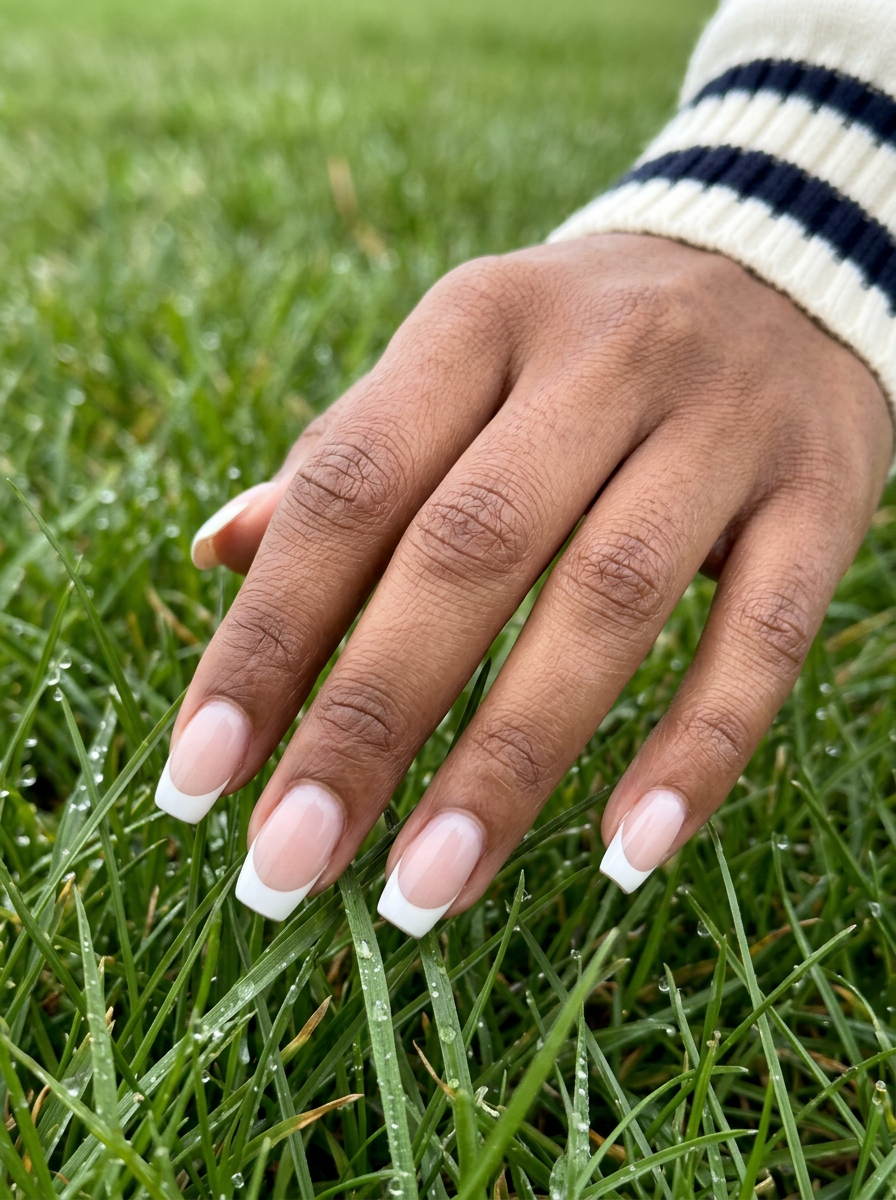
Classic French remains the default because it’s never wrong.
Ballet pink and sheer nude operate in the same register.
The seasonal exception is Nantucket red nails: a warm coral-red that arrives in May and departs with Labor Day, coordinating with the madras shorts and the boat shoes.
In autumn, deep burgundy and hunter green extend the palette into its cold-weather register without leaving the core vocabulary.
Fragrance
The preppy fragrance sensibility runs toward the outdoors, the fresh, and the quietly expensive.
Aquatic and green notes — the smell of cold salt air, cut grass, cedar, clean linen — dominate the canonical preppy scent profile, which is less about seduction and more about suggesting you’ve been somewhere pleasant.
White florals such as, gardenia, lily of the valley, and tuberose are light and discreet.
Here's the aesthetic comparisons section:
Preppy vs. The Neighbors: How to Tell the Aesthetics Apart
Preppy occupies a particular neighborhood in the broader map of polished, heritage-adjacent dressing.
Old Money, BCBG, Dark Academia, and Light Academia… each shares surface features with preppy, but but the underlying philosophies produce different wardrobes, cultural references, and answers to the question of what clothes are for.
Preppy vs. Old Money
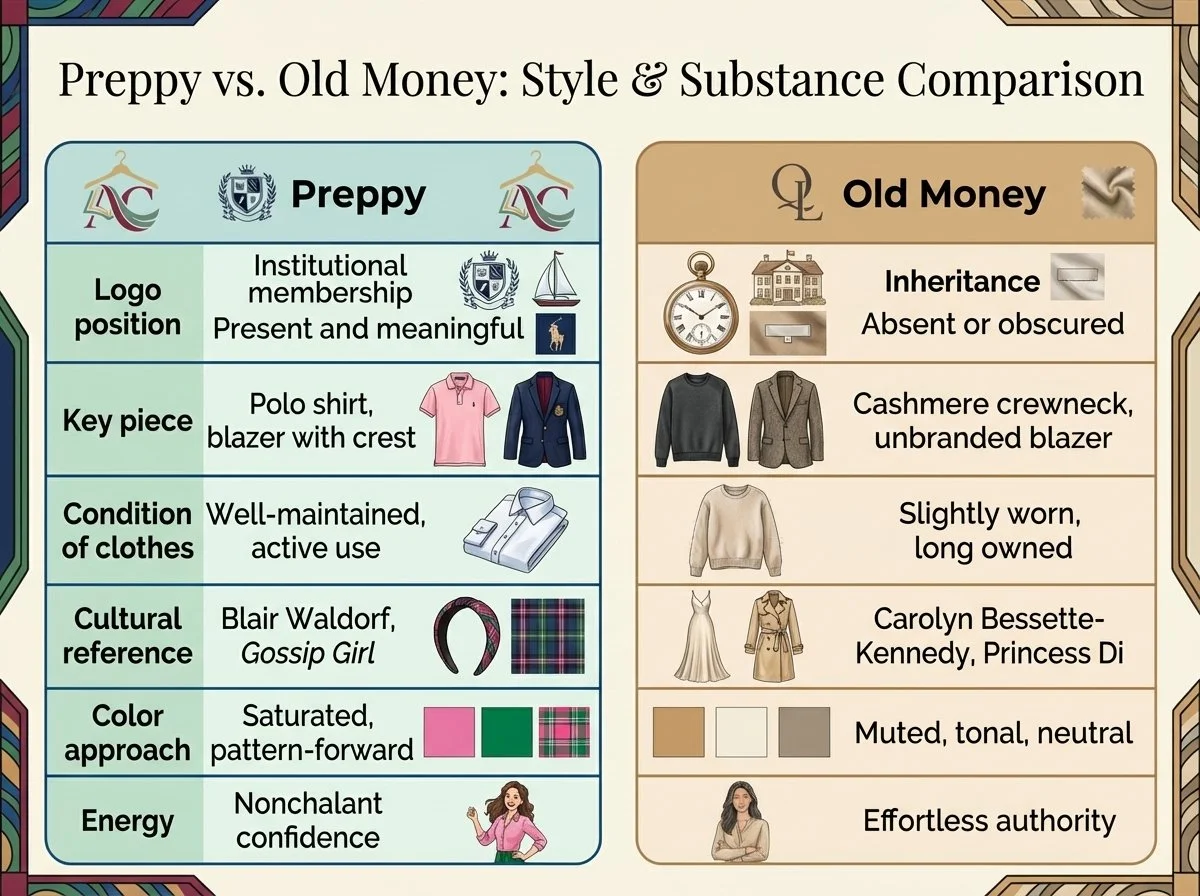
Preppy and Old Money aesthetics draw from the same social environment: generational wealth and elite institutions.
The difference lies in how visible the signals are.
Preppy style is about belonging to an institution, the school, the club, the team, the university. This is why preppy allows logos, school crests, club colors, and the occasional piece of branded heritage sportswear. These are not status signals but membership signals.
Old Money style, by contrast, resists institutional signaling. Old Money is about wealth so established there’s no need to reference origins…if you know you know. Where preppy wears its affiliations, Old Money erases them. The cashmere crewneck has no logo. The blazer has no crest.
Preppy
Colorful and playful
Rooted in campus and sports culture
Comfortable with patterns and bright accents
Slightly youthful
Old Money
Extremely understated
Focused on luxury materials rather than visual signals
Minimal color variation
Quietly aristocratic
If preppy style looks like someone heading to a sailing regatta after class, Old Money style looks like someone whose family owns the marina.
See also: [The Old Money Aesthetic: A Complete Guide →]
Preppy vs. BCBG
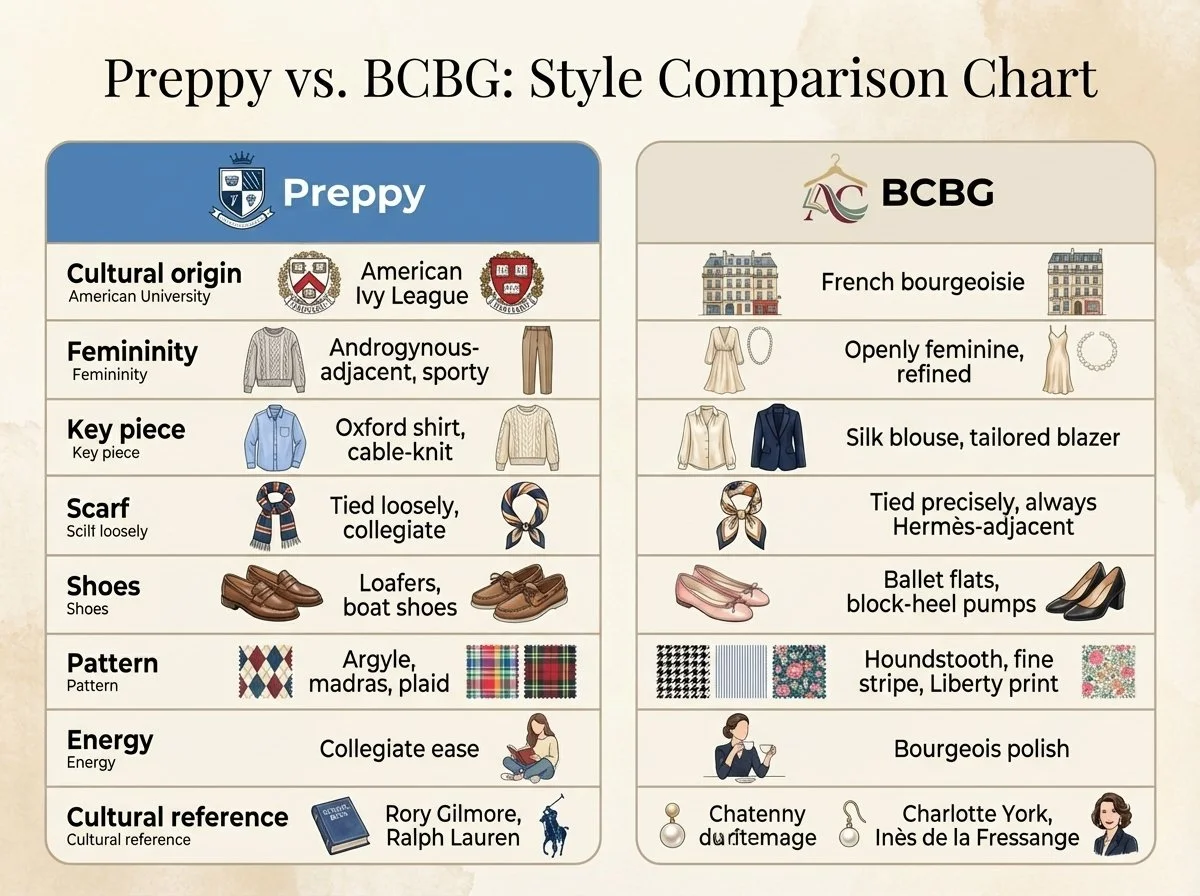
BCBG, bon chic, bon genre, is the most elegant of preppy's neighbors, and it illustrates how geography shapes aesthetic philosophy.
Both aesthetics value classic clothing, polished grooming, and high-quality fabrics. At a glance, they can look remarkably similar.
But the philosophy is different.
Preppy, in its classic American form, is heavily influenced by sportswear and campus life. That includes polo shirts, tennis skirts, boat shoes and colorful sweaters.
BCBG style leans more toward urban elegance and social correctness. The clothing tends to be slightly more tailored and refined.
Preppy
Sporty influence
Bright color accents
Casual layering
American collegiate heritage
BCBG
Parisian bourgeois heritage
More structured silhouettes
Neutral color palette
Emphasis on correctness
If preppy style belongs at a country club, BCBG belongs at a Parisian dinner party.
See also: [The BCBG Aesthetic: A Complete Guide →]
Preppy vs. Dark Academia
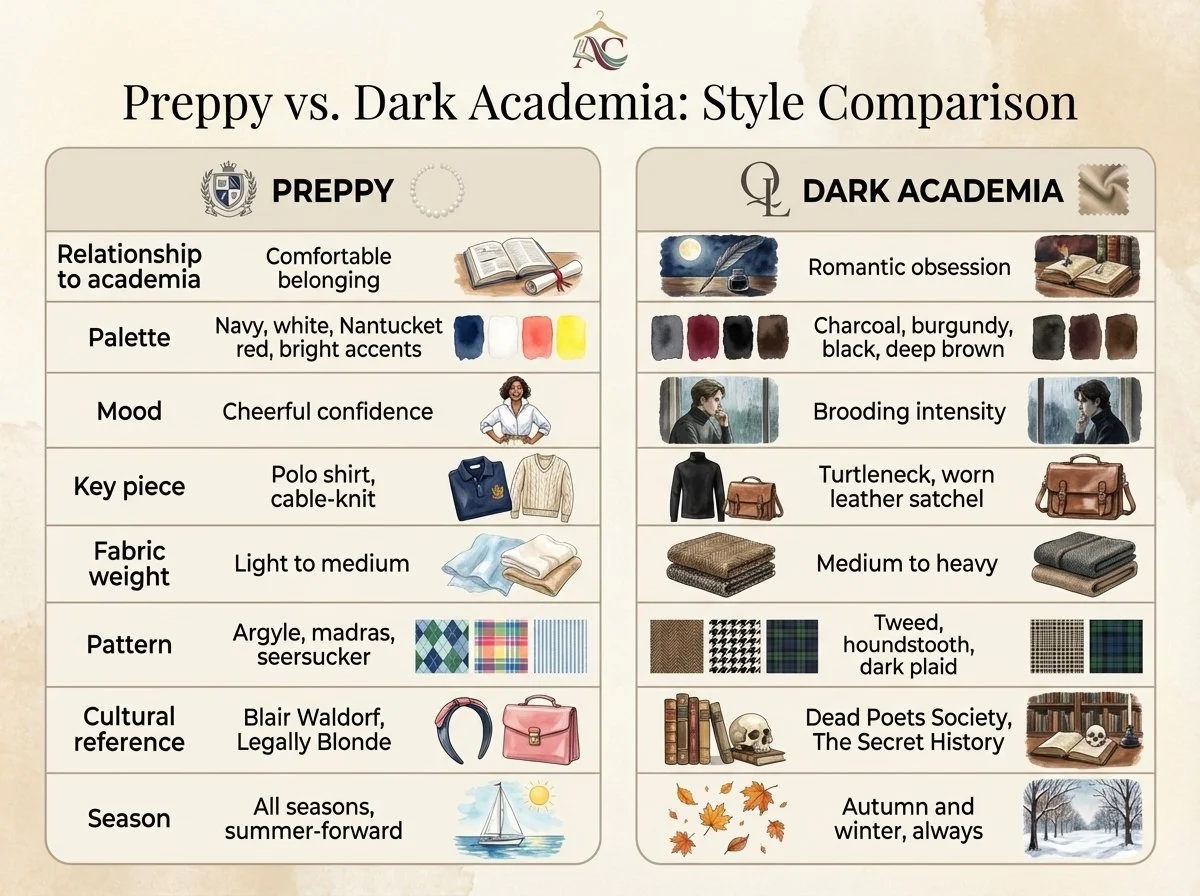
Dark Academia and preppy share enough visual DNA.
Dark Academia draws heavily from academic clothing traditions. Blazers, loafers, and wool coats appear frequently in both styles.
However, Dark Academia is more dramatic.
Preppy's relationship with academic institutions is one of belonging. Dark Academia romanticizes intellectual life through literature, gothic architecture, and classical philosophy. The color palette shifts toward deep browns, charcoal, black, and muted greens.
Where preppy style feels fresh and athletic, Dark Academia feels moody and introspective.
Preppy
Bright campus energy
Clean silhouettes
Colorful accents
Rooted in sports traditions
Dark Academia
Intellectual romanticism
Dark, muted palette
Vintage-inspired garments
Literary atmosphere
Imagine the difference between an Ivy League rowing team and a candlelit poetry reading in an old stone library.
See also: [The Dark Academia Aesthetic: A Complete Guide →]
Preppy vs. Light Academia
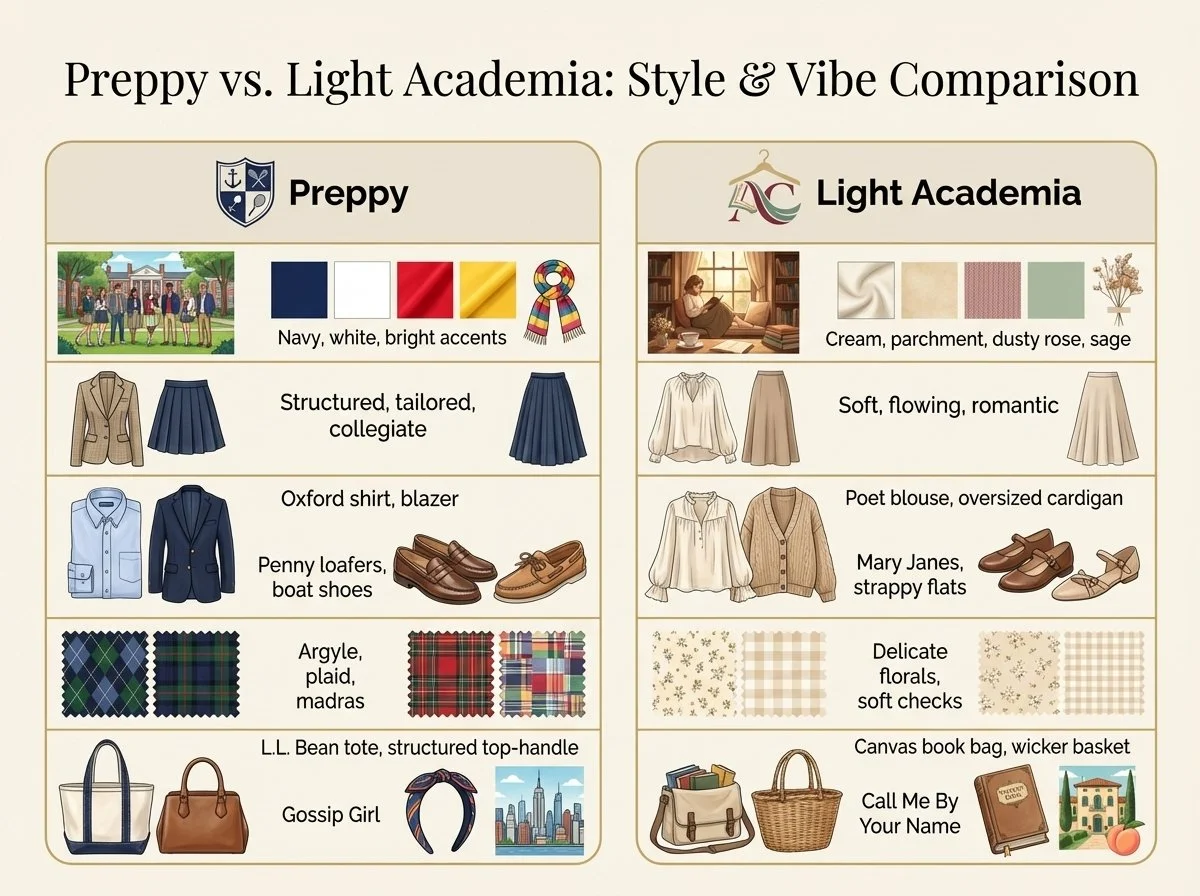
Light Academia is the most natural companion to preppy. It shares the palette optimism, the fondness for natural fibers, and the sense that reading is a legitimate personality trait.
However, in Light Academia the mood is more romantic and literary.
Light Academia’s palette shifts toward warm neutrals such as cream, beige, light brown, and soft gold. Fabrics appear slightly vintage, and the styling often emphasizes cozy intellectual environments like cafés and libraries.
The Light Academia student aspires toward something; the preppy is already there.
Where preppy allows itself bold color (the Nantucket red, the kelly green, the madras brights), Light Academia prefers less intensity.
Preppy
Crisp, structured clothing
Athletic influence
Campus traditions
Bright color palette
Light Academia
Soft vintage aesthetic
Literary and artistic themes
Warm neutral palette
Cozy, introspective atmosphere
If preppy style belongs on a university quad during a sunny afternoon, Light Academia belongs in a quiet café filled with books and sunlight.
See also: [The Light Academia Aesthetic: Coming Soon →]
One False Move (Preppy Edition)
One False Move…And You’re A Walking Easter Basket
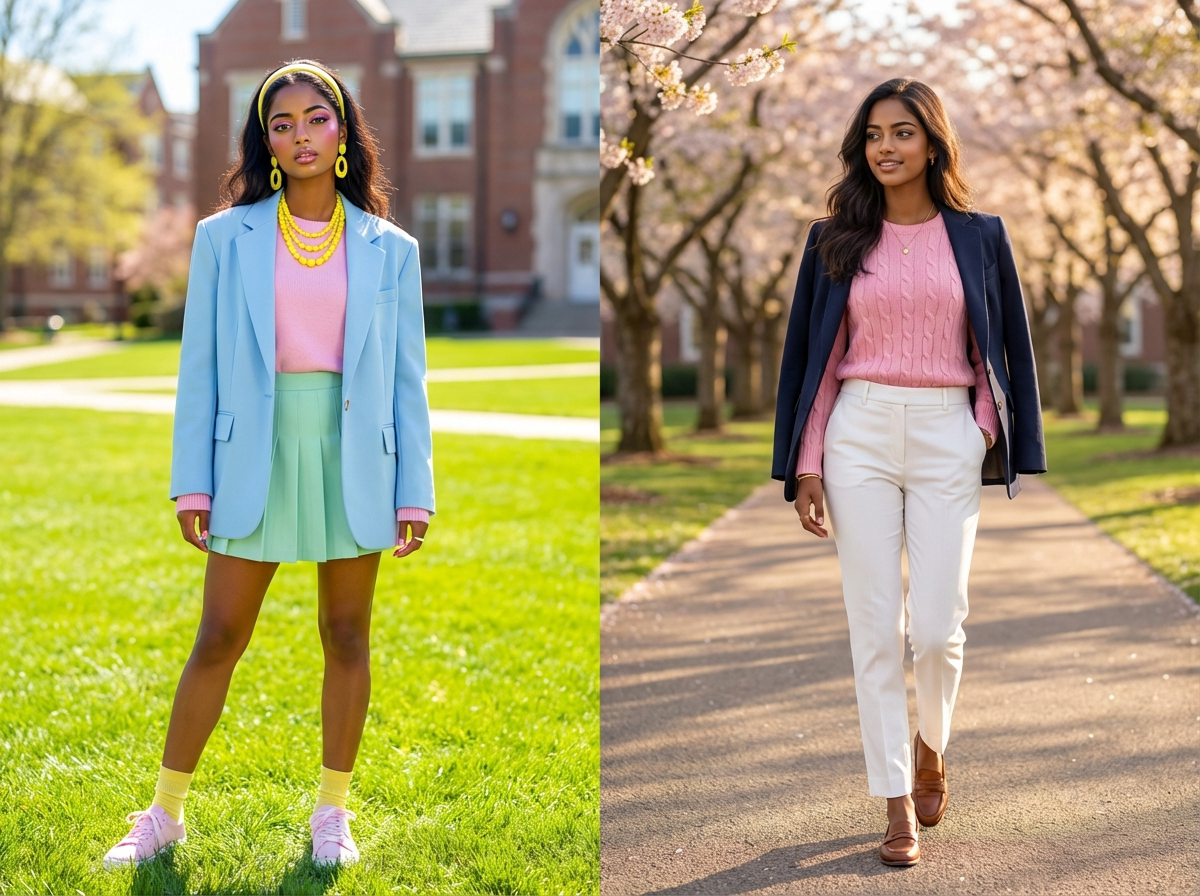
What’s Wrong
This is what happens when you misunderstand preppy color as permission rather than discipline.
Preppy style does love color—pastels, brights, even the occasional unapologetic Nantucket red—but it never wears all of them at once like it’s trying to prove a point. When every piece is competing for attention, the outfit loses its hierarchy. Nothing anchors the look. Nothing leads.
Instead of looking intentional, it looks enthusiastic. And enthusiasm, in preppy terms, reads as inexperience.
The mistake isn’t color.
It’s unrestrained color.
How to Fix It
Think in terms of one voice, supported by a chorus.
Pick one color to lead—maybe a soft pink sweater or a pair of Nantucket reds—and let everything else fall back into neutral: navy, white, camel, or khaki. Preppy color works best when it’s framed, not piled on.
A good rule:
👉 If your outfit looks like it could be described in more than two colors, edit.
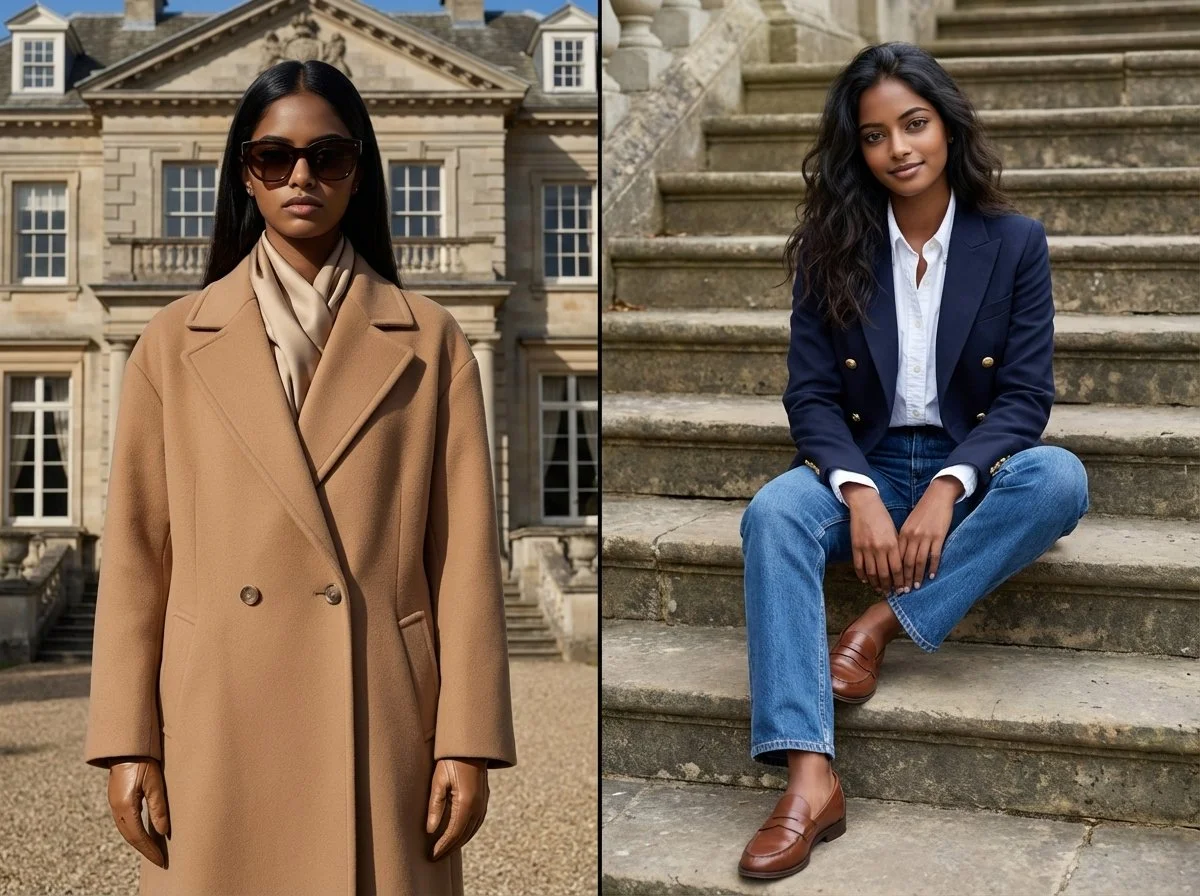
One False Move… and it’s old money fan fiction
What’s Wrong
This is the performance of wealth.
The outfit is technically correct but it’s too pristine, coordinated, and aware of itself. It looks like it was assembled with references.
Old money style leans toward invisibility.
Preppy style, by contrast, is social—it exists to signal belonging within a group. But when you overcorrect toward “quiet luxury,” you strip preppy of its casual, collegiate backbone and replace it with something overly curated.
The result feels like costume. Or worse, aspiration trying to pass as inheritance.
How to Fix It
Reintroduce life into the outfit.
Swap one “perfect” piece for something grounded:
Jeans instead of pressed trousers
A slightly rumpled oxford instead of a silk blouse
Loafers that look worn, not precious
Preppy style should feel like you have things to do.
Classes. Tennis. Lunch. Somewhere to be that isn’t posing.
If it looks like you dressed for a photoshoot, you’re trying too hard.
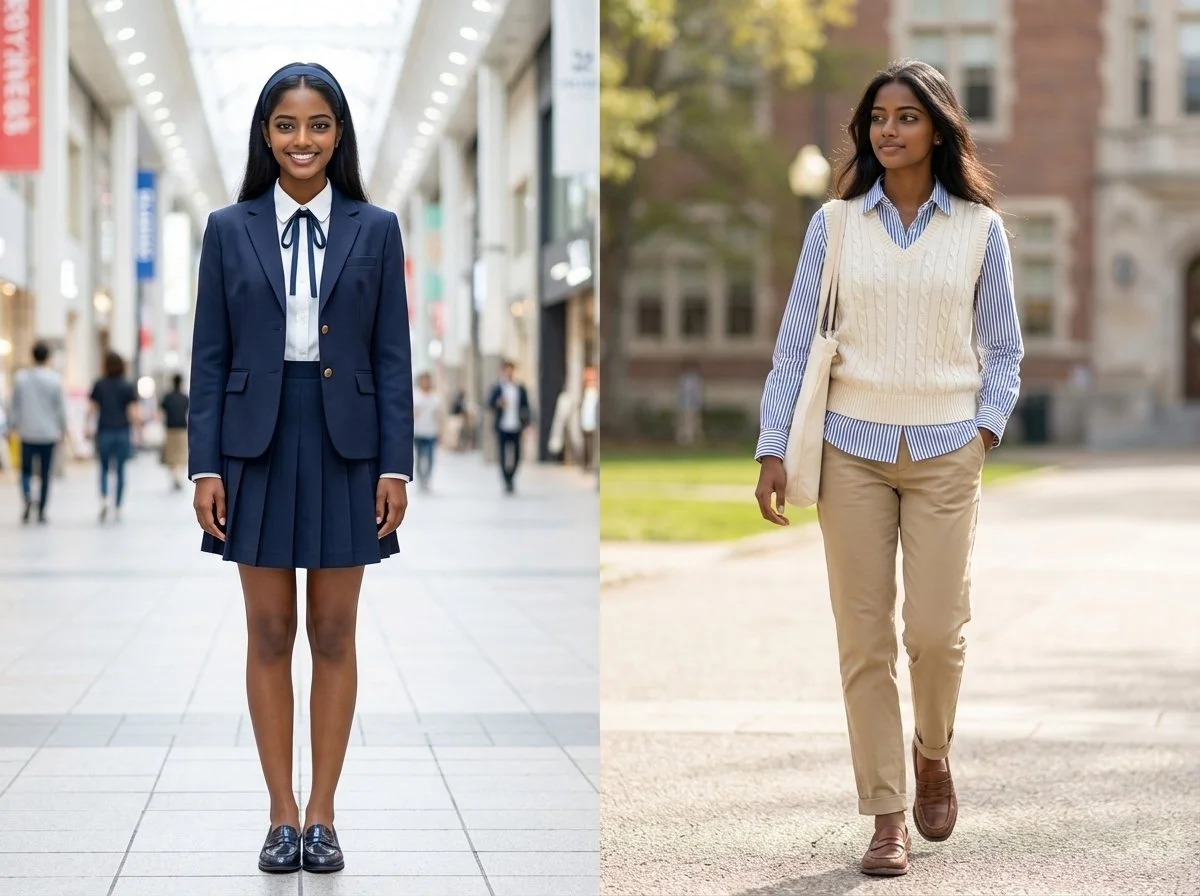
One False Move… and you bought the whole mannequin
What’s Wrong
Everything matches. And that’s the problem.
Head-to-toe coordination removes the illusion. It looks purchased in a single transaction, styled in a single moment, and worn for the first time.
Preppy style depends on the idea that your wardrobe has been accumulated over time:
Different textures
Slightly off color pairings
Pieces from different “eras” of your life
When everything aligns too perfectly, it stops reading as preppy and starts reading as retail.
How to Fix It
Break the set.
Pair a structured piece with something relaxed
Mix tones within the same color family
Combine something polished with something slightly worn
You want the outfit to feel like it came together naturally, not like it arrived on a hanger.
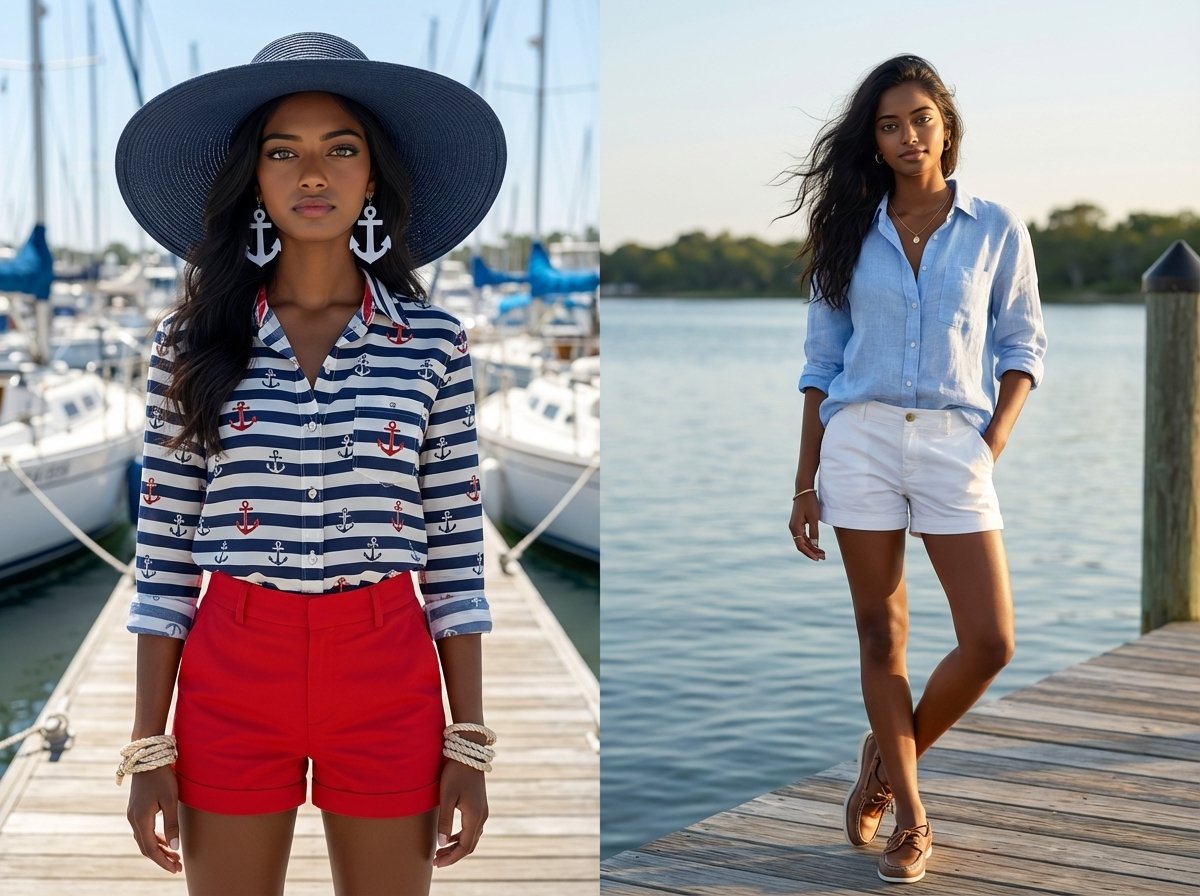
One False Move… and you’re “summering” with a lowercase s
What’s Wrong
This is preppy as theme rather than lifestyle.
The nautical stripes, the anchor motifs, the perfect marina setting—it’s too literal. It feels like you dressed for the idea of summer rather than summer itself.
Preppy summer style is practicality, softened by tradition:
Clothes that can handle sun, salt, and movement
Layers that are thrown on, not styled into place
Pieces that look better slightly undone
When everything is too on-the-nose, it stops feeling authentic.
How to Fix It
Dial it back to function first, aesthetic second.
Instead of “nautical,” think:
Linen button-down, slightly oversized
White shorts or chinos
Boat shoes that actually look worn
Let the setting do the storytelling.
Remember:
👉 You’re not dressing for summer.
👉 You’re dressing like you’ve always spent it this way.
The Many Faces of Preppy
Even at its most codified, in the golden era of the 1950s and '60s, regional variations existed between the New England boarding school contingent, the Southern fraternity interpretation, and the California country club version.
In the decades since, the aesthetic has branched and mutated, absorbing new influences and new generations without losing the original logic.
Below are the six most distinct and currently relevant expressions of the preppy aesthetic, each with its own geography and cultural reference.
European Preppy: The OG
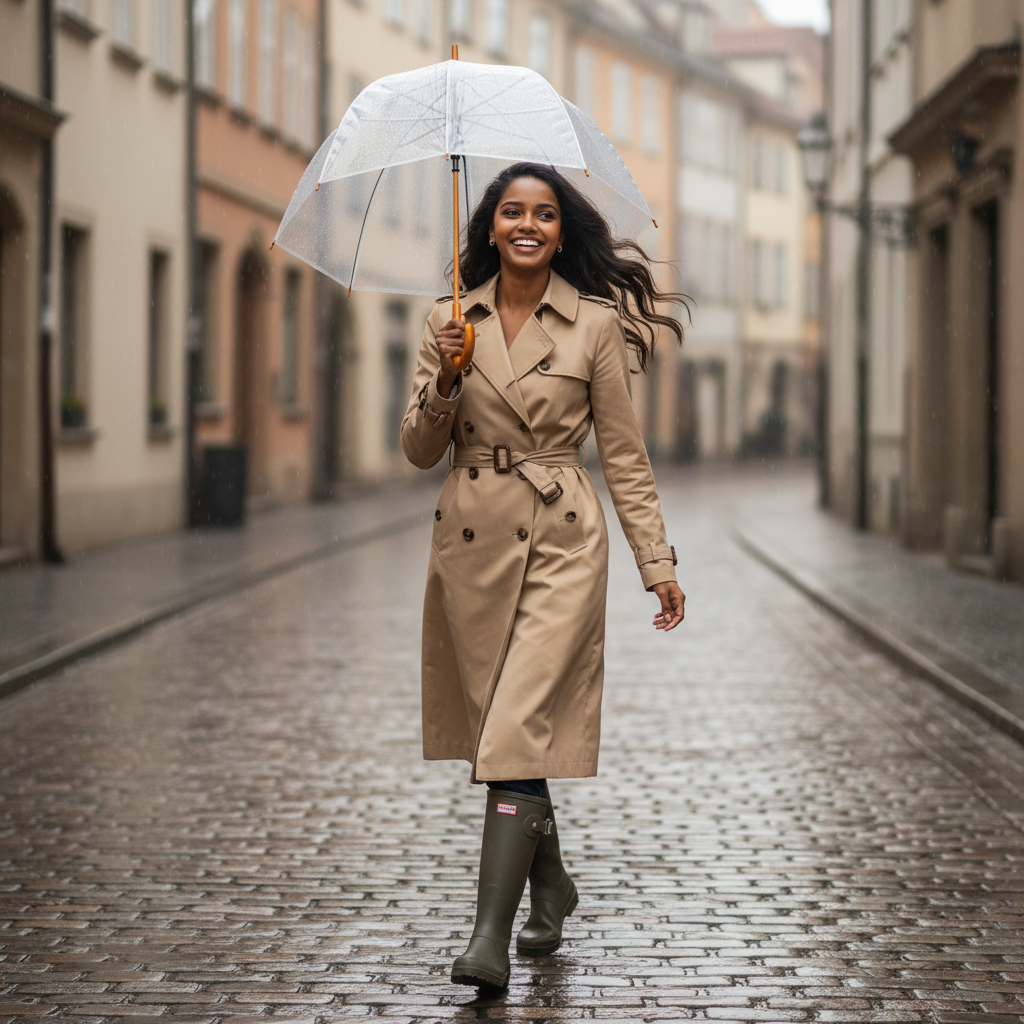
European prep reminds American prep who wore it first. It's aristocratic rather than aspirational, with centuries of tradition that make American old money look like new money.
The Sloane Ranger, the term coined in 1982 to describe the Chelsea-dwelling, countryside-visiting upper-middle-class British type, is the most specific expression of Euro prep.
British Prep:
Barbour jackets (authentic)
Tweed everything
Wellington boots
Cricket sweaters
School ties (actual schools)
Understated to the point of shabby
Dogs included
Continental Prep:
Italian tailoring influence
French Riviera colors
Swiss precision
Scandinavian minimalism
Mediterranean ease
Skiing is assumed
Multiple languages expected
Southern Preppy: When Preppy Discovers Bourbon
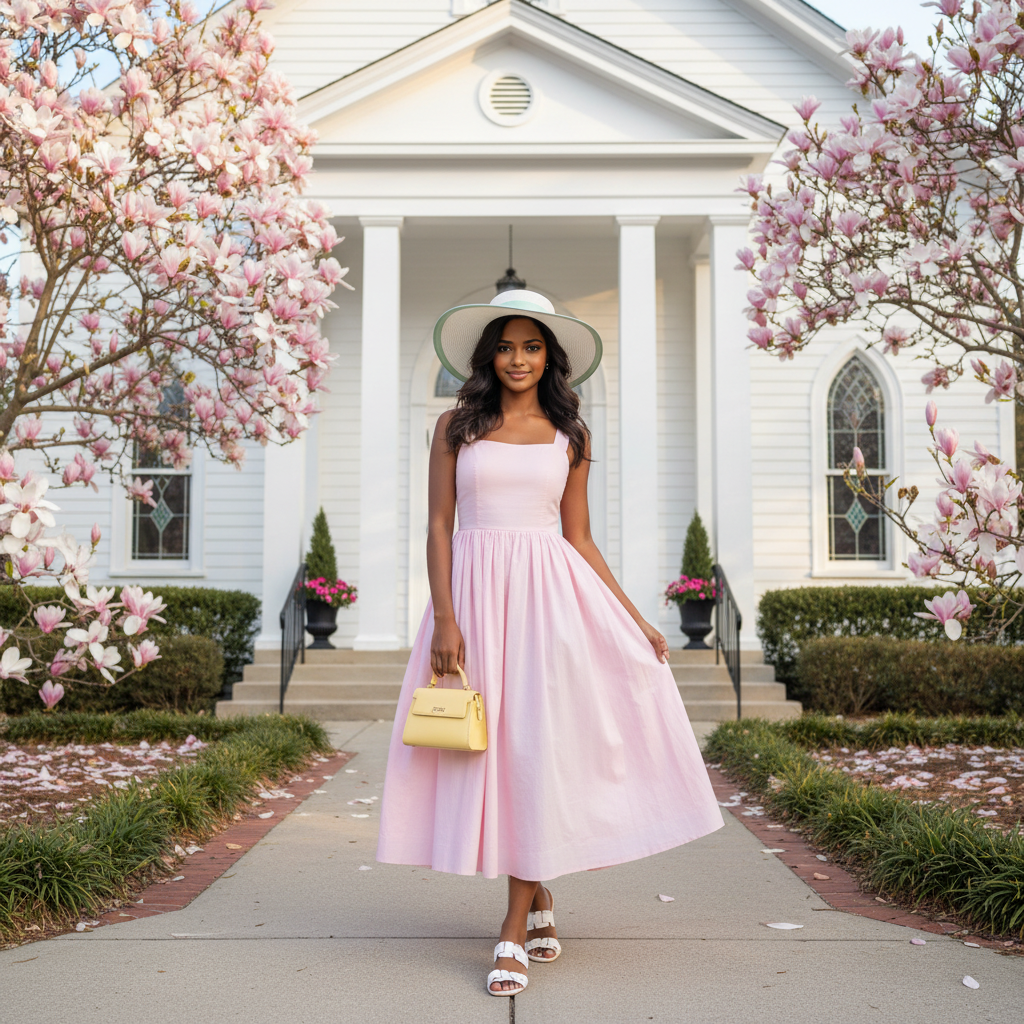
Southern preppy takes Yankee tradition and serves it with a mint julep. It's preppy with humidity, hospitality, and a healthy dose of "bless your heart." This is what happens when Connecticut prep schools meet SEC tailgates.
Key Differences
Colors: Brighter, bolder, more pastels
Fabrics: Lighter weights, more seersucker
Patterns: Louder prints acceptable
Formality: Dressier for daily wear
Accessories: Bigger pearls, bolder jewelry
Attitude: Warmer, more social
Signature Pieces
Seersucker suits (year-round debates)
Bow ties (unironically)
Sundresses (church-appropriate)
Jack Rogers sandals
Monogrammed everything (especially cars)
Statement jewelry
Derby hats
Lilly Pulitzer prints
Cultural Touchstones
Sorority/fraternity life
Cotillion traditions
Church on Sundays
SEC football
Derby parties
Debutante balls
Country music (selectively)
West Coast Preppy: Preppy Goes Surfing
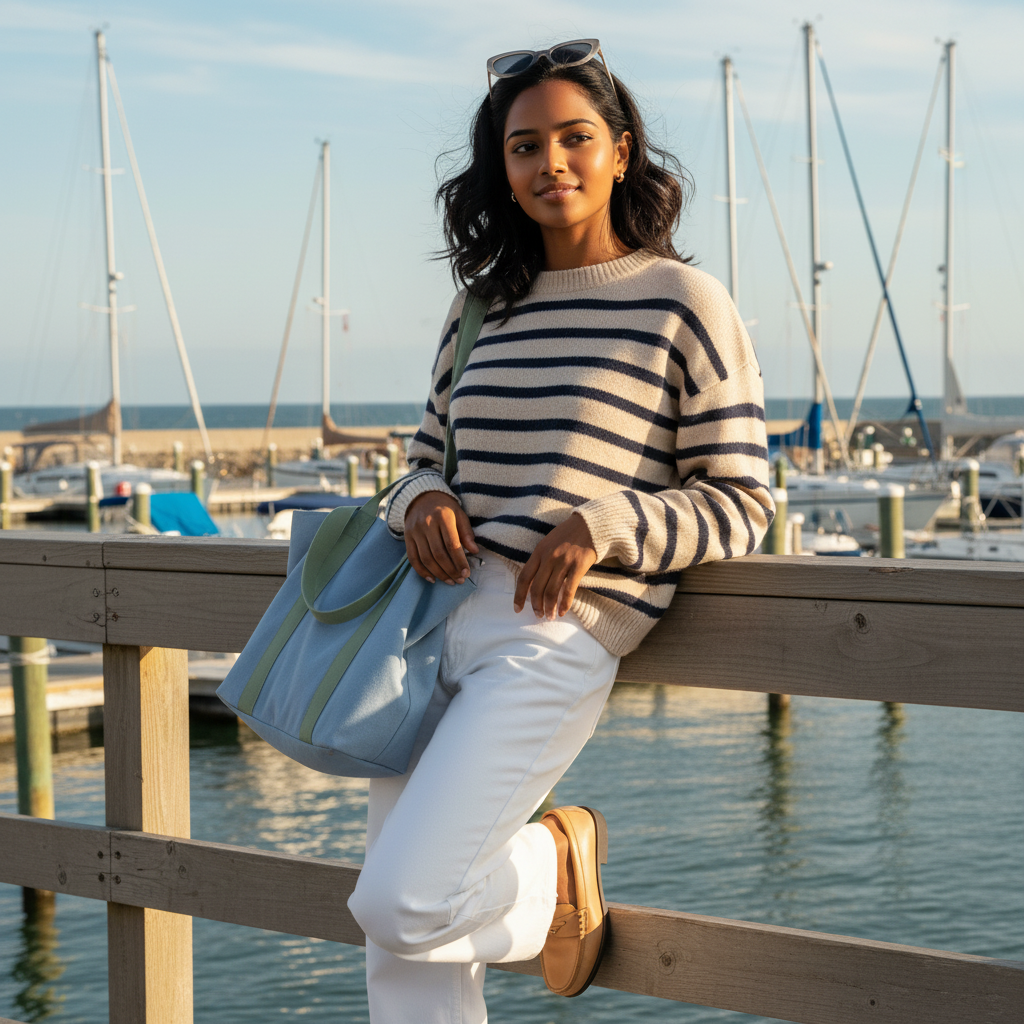
California prep is what happens when East Coast tradition meets West Coast ease. It's prep school meets surf school, where your polo shirt comes with SPF and your boat shoes actually see boats.
Key Elements:
Colors: Sun-bleached everything
Fabrics: Technical meets traditional
Fit: Relaxed but refined
Layers: Lighter, more casual
Activities: Outdoor-focused
Attitude: Laid-back luxury
Signature Pieces:
Lightweight blazers (unstructured)
Technical polos
Chino shorts (shorter)
Canvas sneakers
Patagonia vests
Aviator sunglasses
Beach-ready totes
Performance fabrics
Lifestyle Markers:
Yacht clubs (Pacific edition)
Golf (year-round)
Beach volleyball
Wine country weekends
Tech industry connections
Stanford over Harvard
Sustainable everything
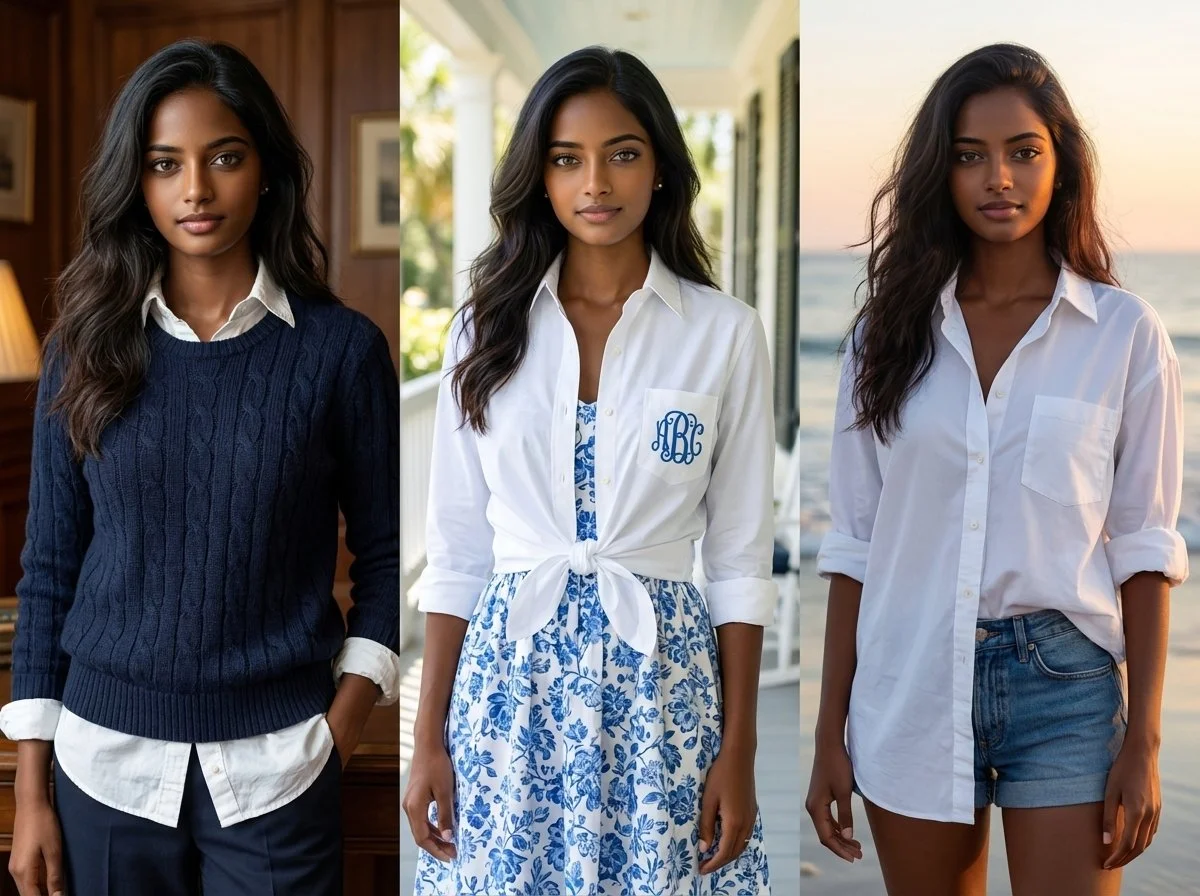
Same Piece, Different Prep: The White Button Down shirt in three preppy variations: 1. British 2. Southern 3. West Coast
The Preppy Lifestyle: Beyond the Wardrobe
The preppy aesthetic extends into every domain of life.
The clothes are easy. The lifestyle is the whole argument.
Sport: The Resume Builders
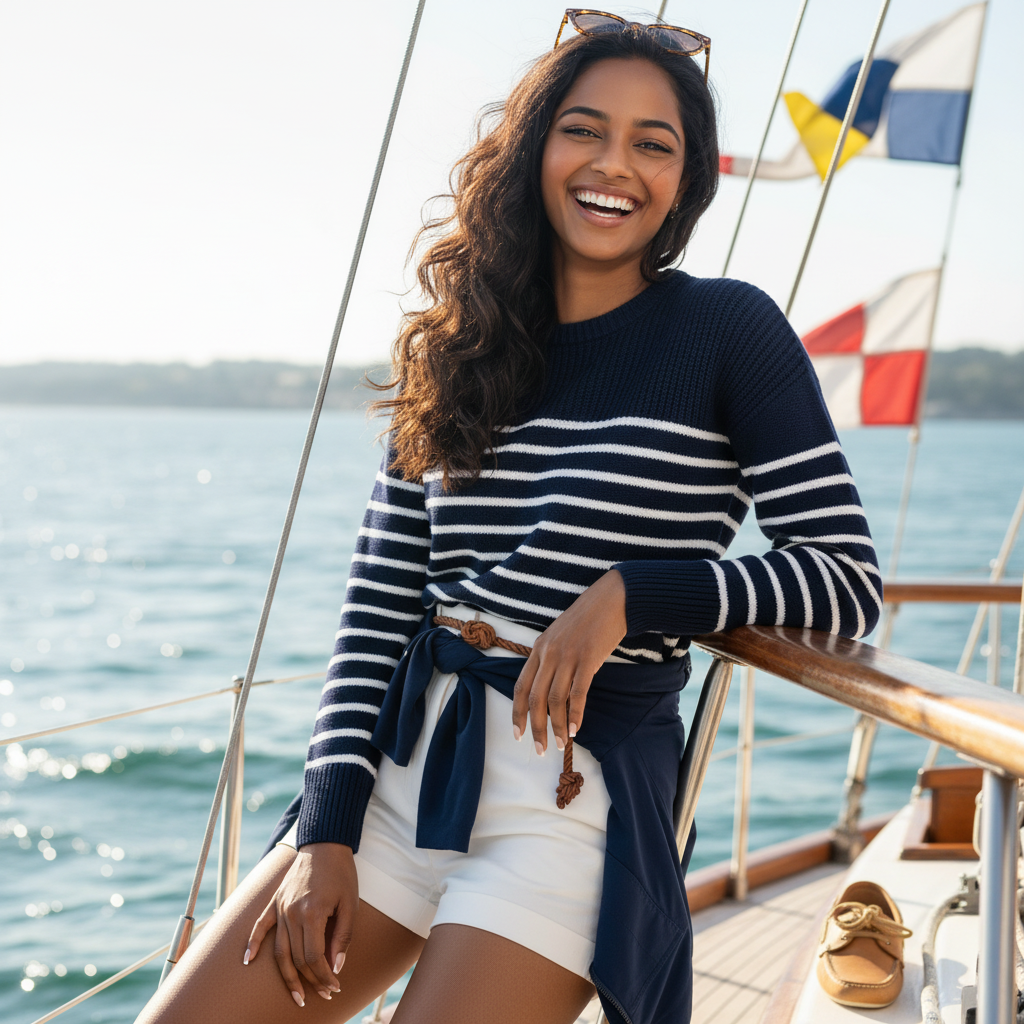
The sports associated with preppy tend to be individual or small-team rather than mass-spectator, require access to exclusive facilities, and have long traditions of amateur competition.
Tennis: It has the longest heritage, the most codified dress code, and the most direct relationship with the wardrobe.
Golf: The equipment is expensive, the courses are selective, and the dress code is aligned with preppy sensibility.
Sailing: Perhaps the most distinctly preppy sport. It’s tied to specific geography (the New England coast, the Chesapeake, the Great Lakes), most dependent on expensive equipment, and most completely absorbed into the lifestyle.
Lacrosse: The sport that most completely overlaps with prep school and Ivy League geography and that carries the most specific institutional associations.
Squash: The winter alternative.
Rowing: Origin of the preppy’s most distinctive garments, like the team blazer, club tie, and henley. University and club rowing goes back to the Oxford-Cambridge boat race of 1829.
Social Sports:
Croquet on lawns
Badminton at parties
Swimming (pools only)
Skiing (specific resorts)
Riding (English style)
Running (marathons for charity)
The Social Calendar
The preppy social calendar has been organized around a set of annual events and seasonal migrations for decades.
Spring opens with the Kentucky Derby.
Summer is the season of migration: to Nantucket, Martha's Vineyard, the Hamptons, Newport, or anywhere with salt air and a reasonable sailing breeze.
Fall brings college tailgates at one's alma mater. The tailgate is preppy's most social occasion: everyone is on the same side and the food is simple.
Winter means ski season…at specific resorts.
Year-round, the charity gala and the country club dinner. Giving is good, giving publicly is better, and having one's family name on a building is goals.
Education and Career: The Established Path
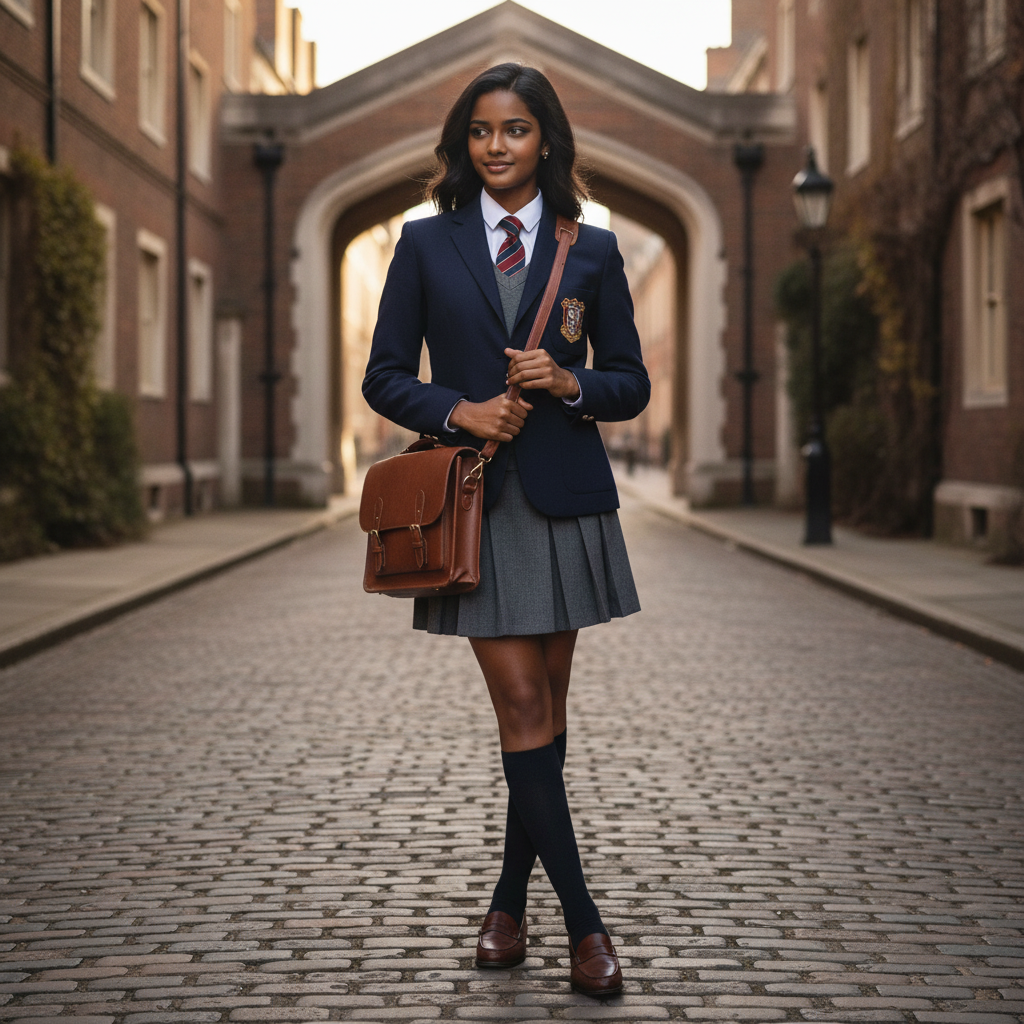
The preppy education begins, ideally, at a boarding school old enough to have mythology, like Phillips Exeter, Andover, or Groton, to name a few. The social network at boarding school is often as valuable as the education itself.
The Ivy League, or its functional equivalents—Georgetown, Duke, Vanderbilt, the University of Virginia, Williams, Amherst—is the natural next step. The point is to go somewhere with intellectual tradition and selectivity. Study abroad somewhere with historical weight (Oxford, the London School of Economics, Sciences Po, a semester in Florence studying art history) adds an international credential and a European reference point to the wardrobe.
Graduate school in law or business follows for those want it, which is most of them. Law at Yale, Harvard, or Columbia; business at Wharton, Harvard, or Stanford; medicine anywhere prestigious enough.
Career Choices:
Finance (family firm)
Law (white shoe)
Medicine (specialized)
Politics (connected)
Nonprofit (family foundation)
Academia (alma mater)
Home: The Interior Argument
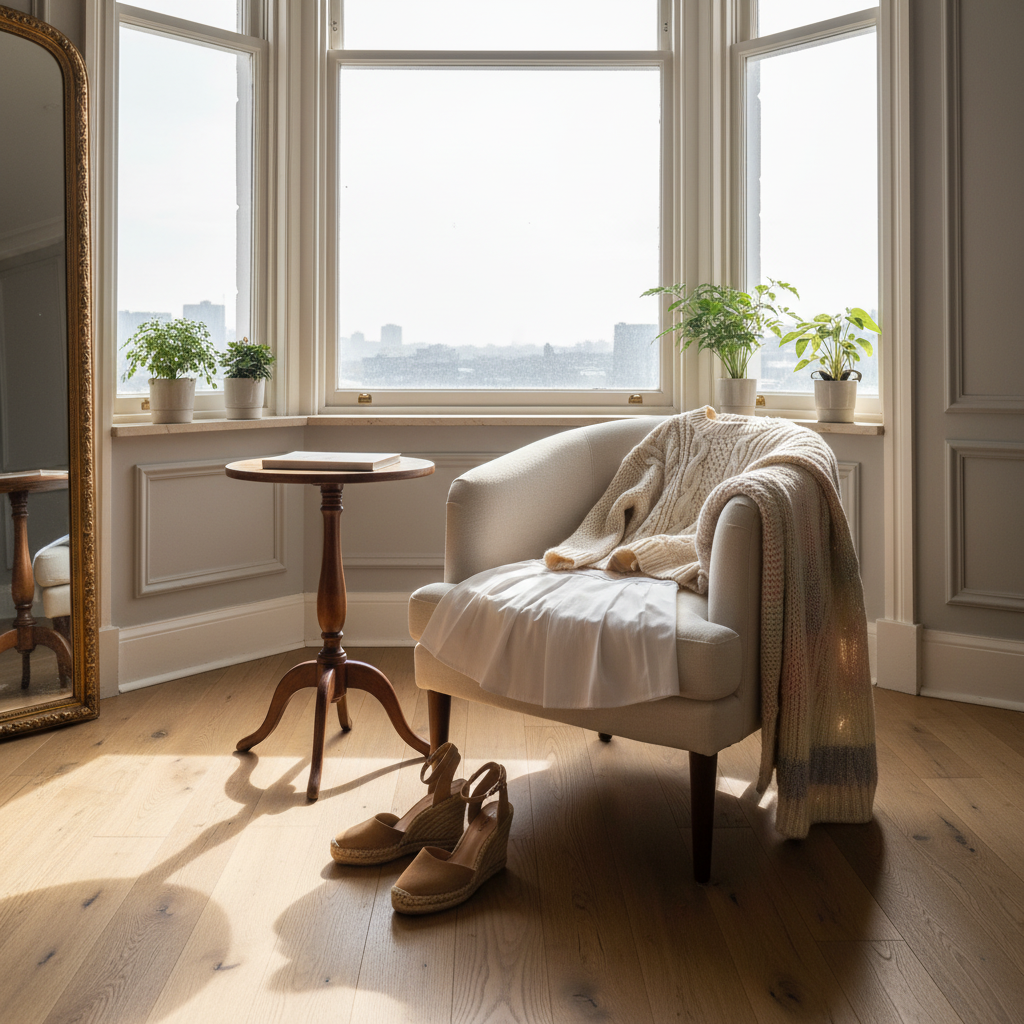
The preppy home is the wardrobe expressed in three dimensions. Your interior should look less like a design project and more like a life.
The furniture is mahogany and walnut rather than MDF, upholstery in wool or linen rather than microfiber. A painting that has been in the family for three generations communicates much more than a galley print.
The leather-bound classics on the shelves are not just decorative, though they are also decorative. The library or study is the spiritual center of the preppy home.
The color palette follows the wardrobe logic: a neutral base of cream, warm white, and greige, punctuated by the same colors in the clothes — navy in the upholstery, hunter green in the garden room, Nantucket red in the sunroom cushions, camel in the rugs. Silver-framed photographs on every surface; monogrammed linens in the guest room; a bar cart that is always stocked.
Entertaining is both social obligation and pleasure. The china pattern and is used, not stored; the silver service is polished; the crystal glassware catches light. Guest rooms are always ready.
Creating Your Preppy Presence: A Practical Guide to Getting It Right
The most common mistake people make in the preppy aesthetic the first time is treating it as a costume. They get the blazer, loafers, Oxford shirt at once, then wonder why their looks feels more theme party than wardrobe.
Preppy grows over time.
Getting Started: The Foundation Phase
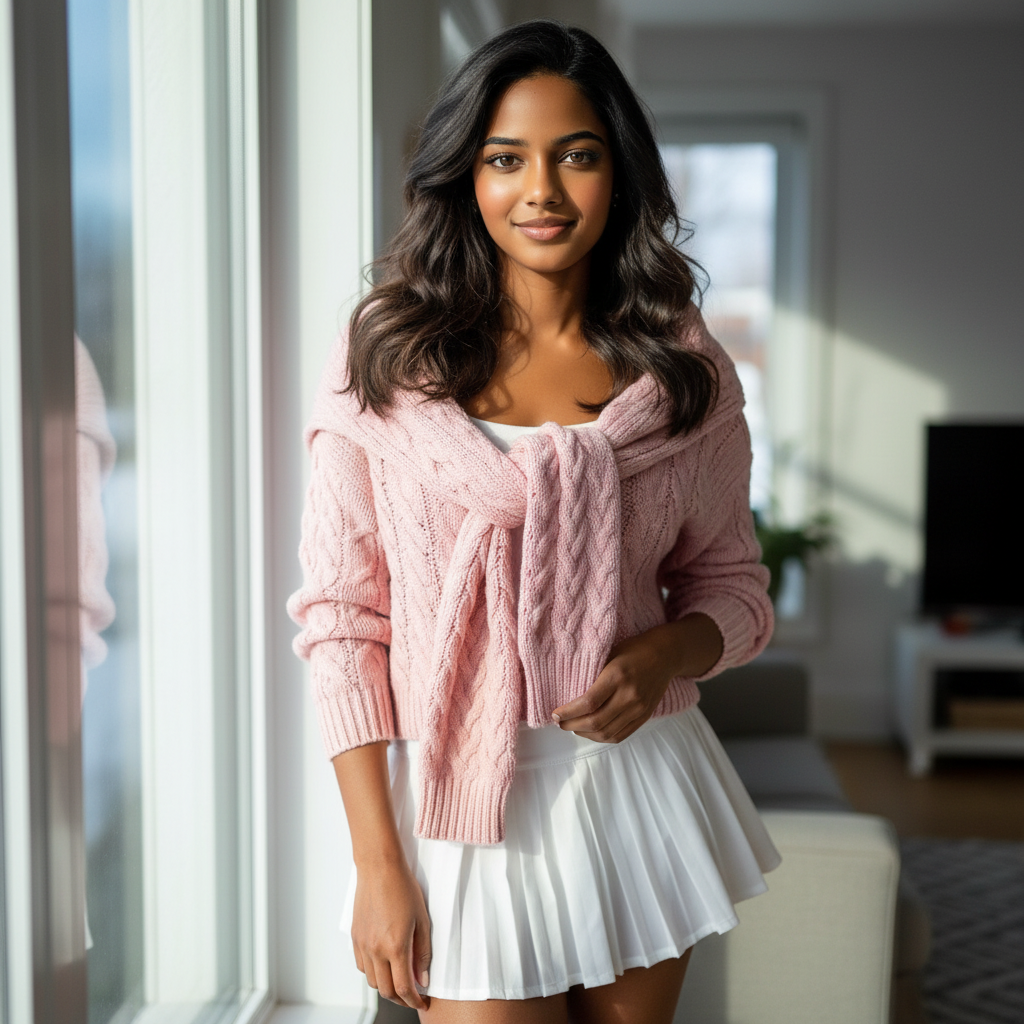
Invest in key pieces first, and only key pieces.
Learn the color system before you expand it.
Master layering as a system, not an afterthought.
Understand proper fit as the non-negotiable variable.
Advanced Moves: Gaining Fluency
Develop signature looks rather than daily decisions. Develop three or four signature combinations and remove the daily anxiety of getting dressed.
Learn the fashion history. The preppy aesthetic rewards knowledge. Understanding why the penny loafer looks the way it does, what the repp stripe tie communicates, why the Barbour jacket became the cornerstone of Euro prep. Read the Official Preppy Handbook as primary source material.
Understand fabric care. Quality clothes will only serve you well if you take care of them. Hand wash your wool sweaters. Polish your leathers. Wash your Oxford shirts in cold water and hang them to dry, this preserves the color. Invest in a good sweater stone, a cedar shoe tree, and the correct detergents for wool and silk.
Build connections within the aesthetic's institutions. Joining a tennis club, a sailing association, a rowing club, or a country club gives you social context in which the preppy wardrobe is based. The clothes look different when they are worn for their intended purposes.
Perfect the attitude, which is the hardest part. The preppy attitude is not arrogance. It’s confidence. Confidence can’t be faked.
Gen Z/Neo-Prep — The TikTok Reinterpretation
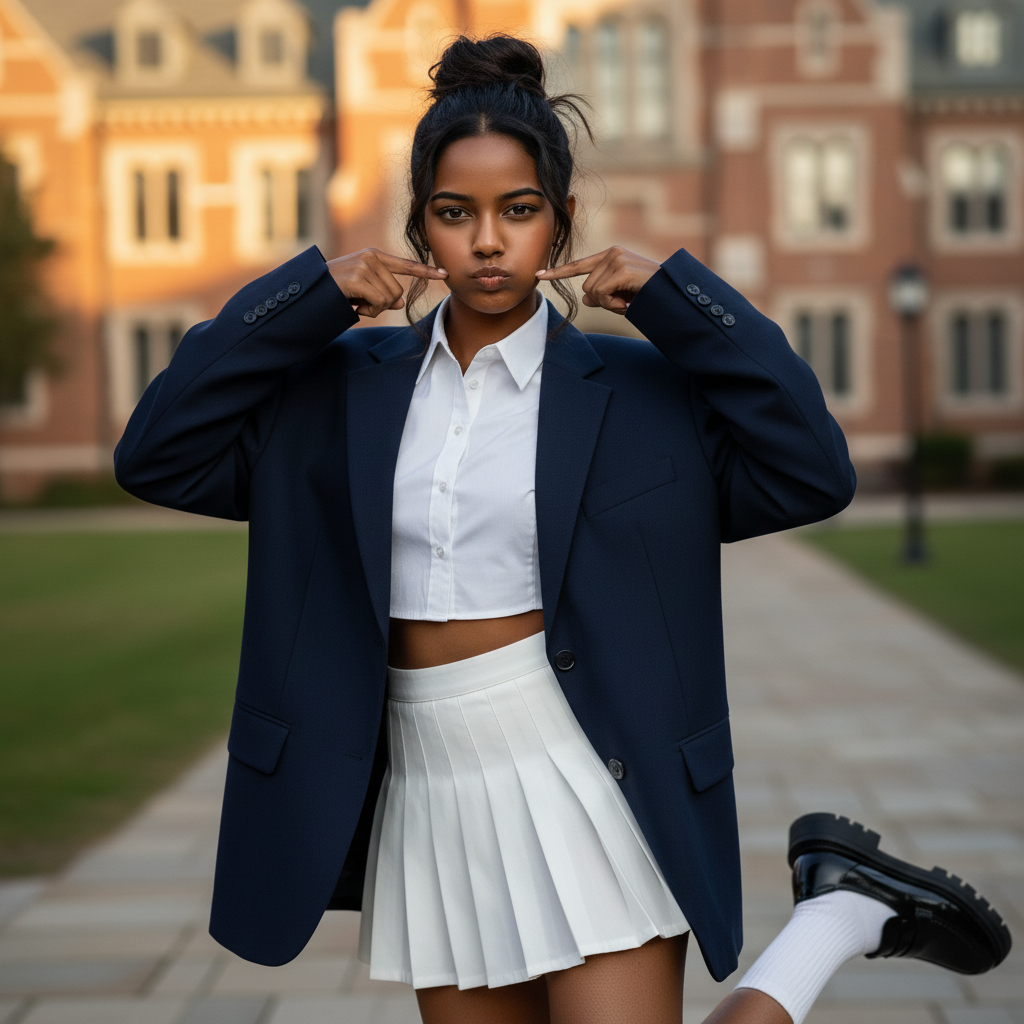
Neo-prep is what drove the 200%+ search surge in 2025, and it represents something interesting: a generation learned of the aesthetic through screens rather than schools, and then redeployed it with creative freedom.
You’ll still find the button downs and pleated skirts, but with new proportions and inspired by new references.
Gen Z doesn’t adopt style, they reinterpret it. Instead of boat shoes or loafers, they might try retro sneakers. They might experiment with new colors and patterns. Instead of fitted, you’ll find oversized blazers with cropped shirts.
Preppy style was never supposed to be questioned. Gen Z questions it. Where classic preppy is tied to specific schools and social circles, Gen Z/Neo Prep opens things up. Anyone can participate, reference and remix.
The rules are, there are no rules.
Oh this is the moment where everything comes together—the tone, the history, the humor, the quiet authority. Let’s land it in a way that feels complete, a little reflective, and very on-brand for Allyn’s Closet.
Conclusion: The Uniform That Was Never Just About Clothes
Preppy style has always been more than a wardrobe.
A blazer wasn’t just a blazer. An oxford shirt wasn’t just a shirt. They were shorthand for education, access, lineage, and a very specific version of American identity.
And yet, here we are.
Decades later, preppy style hasn’t disappeared. It’s evolved. Softened. Expanded.
That’s what makes it interesting now.
What We Keep
At its core, preppy still offers something few aesthetics do: clarity.
You know what works
You know how to build an outfit
You know how to look put-together without chasing trends
In a fashion landscape that constantly shifts, preppy style is steady.
It gives you a framework.
What We Change
But what we do with that framework is where things open up.
You don’t need the school.
You don’t need the zip code.
You don’t need the backstory.
You just need the understanding.
Modern preppy style—whether classic or neo—lets you decide how closely you follow the rules:
You can wear it traditionally, almost invisibly
You can reinterpret it with proportion, color, and attitude
You can borrow from it, remix it, or soften it
The exclusivity may have defined its origins.
It doesn’t have to define its future.
Final Thought
If there’s one thing to take with you, it’s this:
Wear the blazer. Roll the sleeves. Scuff the loafers a little.
Let the outfit breathe.
And whatever you do—
Don’t look like you’re trying.
Look like you belong.
