
How to Tie a Silk Scarf: The BCBG Essential Guide
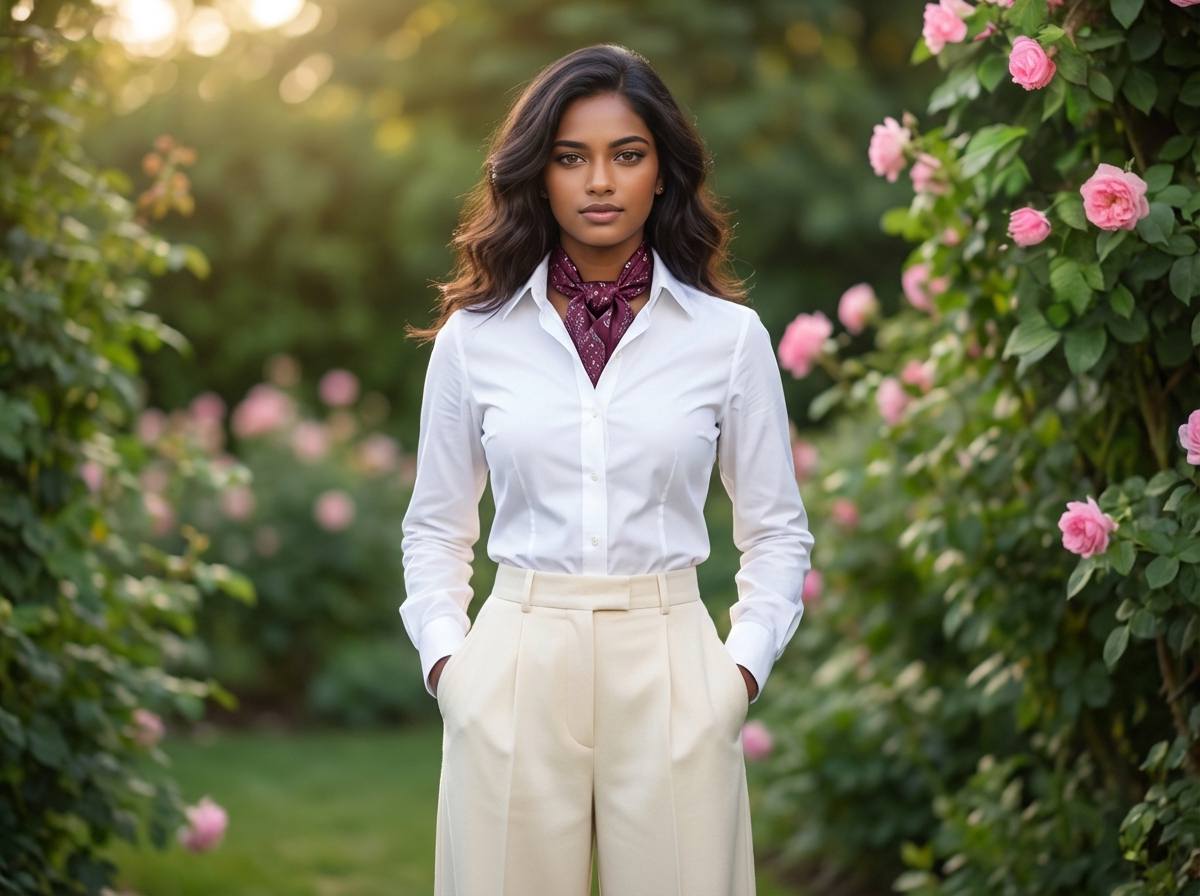
The Smallest Piece That Changes Everything
There are accessories, and then there are signals.
A silk scarf falls firmly into the second category.
It doesn’t shout. It doesn’t trend. It doesn’t need to. Worn well, it communicates something immediate and unmistakable: intention. Ease. A kind of quiet correctness that feels inherited rather than learned.
If you’ve ever wondered how to tie a silk scarf and make it look effortless instead of overly styled, this guide will walk you through exactly that—step by step, without turning you into a walking tutorial.
Because the goal isn’t perfection.
It’s fluency.
The Hermès Carré: A Brief History of the World's Most Famous Scarf
To understand why the silk scarf matters, you have to understand Hermès.
In 1937 Hermès introduced its first silk scarf, and it wasn’t just a scarf. The 90cm x 90cm carré has since become an iconic item with more than 1,500 versions created, each one a collaboration between house and artist.
A single 90cm carré, which weighs 65 grams, is made from the silk of some 250 mulberry moth cocoons. It takes up to 18 months and 800 hours of engraving and silk screening to produce. A carré needs 450km of silk thread — the length necessary for making 1,000 carrés equals the distance between the Earth and the moon. Designs can incorporate up to 27 different colors, with the color development process alone lasting up to six months.
-
Typically a carré (square scarf), most commonly 90cm x 90cm
Made from high-quality silk twill
Known for intricate, story-driven prints
Hand-rolled edges (a subtle but important detail)
-
Search for "90cm silk twill square scarf" and filter by reviews. Look for listings that specify 100% silk and momme weight.
The keywords "twill" and "hand-rolled hem" in product descriptions are positive signals.
Budget $25–$45 for something worth wearing.
-
You can, with adjustments.
Polyester doesn't drape with the same weight as silk. For tied methods — the French knot, the cravat, there’s little difference.
If budget is a constraint, prioritize a polyester scarf with good weight and a matte satin finish over a thin, shiny alternative.
The finished object then gets its signature rolled hem: seamstresses using silk thread to create a unique rolled hem on the edges of each scarf.
Queen Elizabeth II started wearing Hermes scarves in the 1940s, most famously during country outings and equestrian events. Other famous wearers include Grace Kelly, Jackie Kennedy, and Audrey Hepburn, among others.
The carré's origins are deeply BCBG: the silk scarf fit naturally with Hermès and its equestrian heritage, as 19th-century jockeys had replaced heavy suits with silk twill shirts that often reflected the owner's colors or family coat of arms. The scarf was always a piece of sporting aristocracy translated into everyday wear.
Why it became iconic
Hermès scarves became a staple of French bourgeois style because they:
Add color without overwhelming an outfit
Work across seasons
Transition from daywear to evening effortlessly
What to Look For: Silk Scarf Shopping at Every Price Point
The good news: the techniques below work on any well-constructed silk or silk-adjacent scarf. The key variable is quality of drape, which depends on fabric weight and finish. Here's the hierarchy:
The Investment Tier
Hermès carré (90cm) — the benchmark. Starts retailing at $450. Silk twill with unmatched weight and drape. New from boutique or authenticated resale at places like Vestiaire Collective, The RealReal, and Rebag.
Vintage department store silk scarves — Liberty of London, Pucci, and unsigned Italian silk squares from the 1960s–80s turn up on eBay and Etsy .
The Mid-Range Tier
Épice, Elizabetta, Furla — European brands producing genuine silk scarves in the $80–$150 range with credible quality.
J.Crew or Banana Republic silk scarves — periodically excellent, particularly during sales.
The Accessible Tier (Amazon and Beyond) You need 100% silk or a high-quality silk-satin blend. Avoid anything described only as "silky" — that's polyester wearing a costume.
On Amazon, look for sellers specifying momme weight (12mm or higher is worth your time) and search terms like "90cm silk twill square scarf."
How to Choose the Right Silk Scarf
Not all scarves behave the same way.
Fabric
Silk twill → best structure (closest to Hermès)
Satin → more fluid, less structured
Polyester blends → budget-friendly but less crisp
Size
70–90 cm square → most versatile
Smaller → better for French knot
Larger → better for draping styles
Color Strategy
Start with:
Navy + cream
Red + gold
Neutral chain prints
Avoid overly loud prints when starting—they’re harder to style.
Important mindset shift
You don’t need Hermès to achieve the look.
What matters:
Silk (or silk-like) fabric
Clean drape
Controlled styling
Think of Hermès as the reference point—not the requirement.
A silk-feel scarf tied in the right knot at the throat of a crisp white shirt is, frankly, indistinguishable from the real thing.
Before You Tie: The Fundamentals
Size matters. The classic Hermès format — 90cm square (approximately 35 inches) — is the workhorse. Most techniques below assume this size. Smaller squares (70cm) work for most neck styles but have less material for the more architectural knots. A 140cm shawl-size piece opens up entirely different possibilities.
Prep your scarf. Silk wrinkles beautifully in the French sense, but deep fold marks flatten the drape. Hang your scarf in a steamy bathroom for ten minutes before wearing, or use a steamer on the lowest setting held several inches away. Never iron directly.
What Is the Pli de Base?
Before you tie anything, you fold.
The pli de base—literally “base fold”—is the quiet starting point behind nearly every silk scarf technique. It’s not a finished look. It’s not meant to be seen.
But it determines everything that comes after.
This is the version of the scarf that most knots require.
Think of it as:
preparing the fabric to behave the way you want it to
How to Do It
Lay the scarf flat (print side down or up—your choice)
Fold one corner toward the center
Fold the opposite corner to meet it
Continue folding inward until you create a long rectangle
Adjust the width depending on the knot:
Wider → softer, more volume
Narrower → cleaner, more precise
Optional:
For a rounder, rope-like effect, gently roll instead of sharply folding
The fold hierarchy
Before every method, you'll fold your scarf into one of three configurations:
The triangle: fold diagonally in half
The band: fold into thirds or quarters lengthwise, creating a long rectangle
The loose roll: gather the scarf loosely lengthwise without precise folding, keeping volume and texture
The Core Four Methods
1. The French Knot (Le Nœud Français)
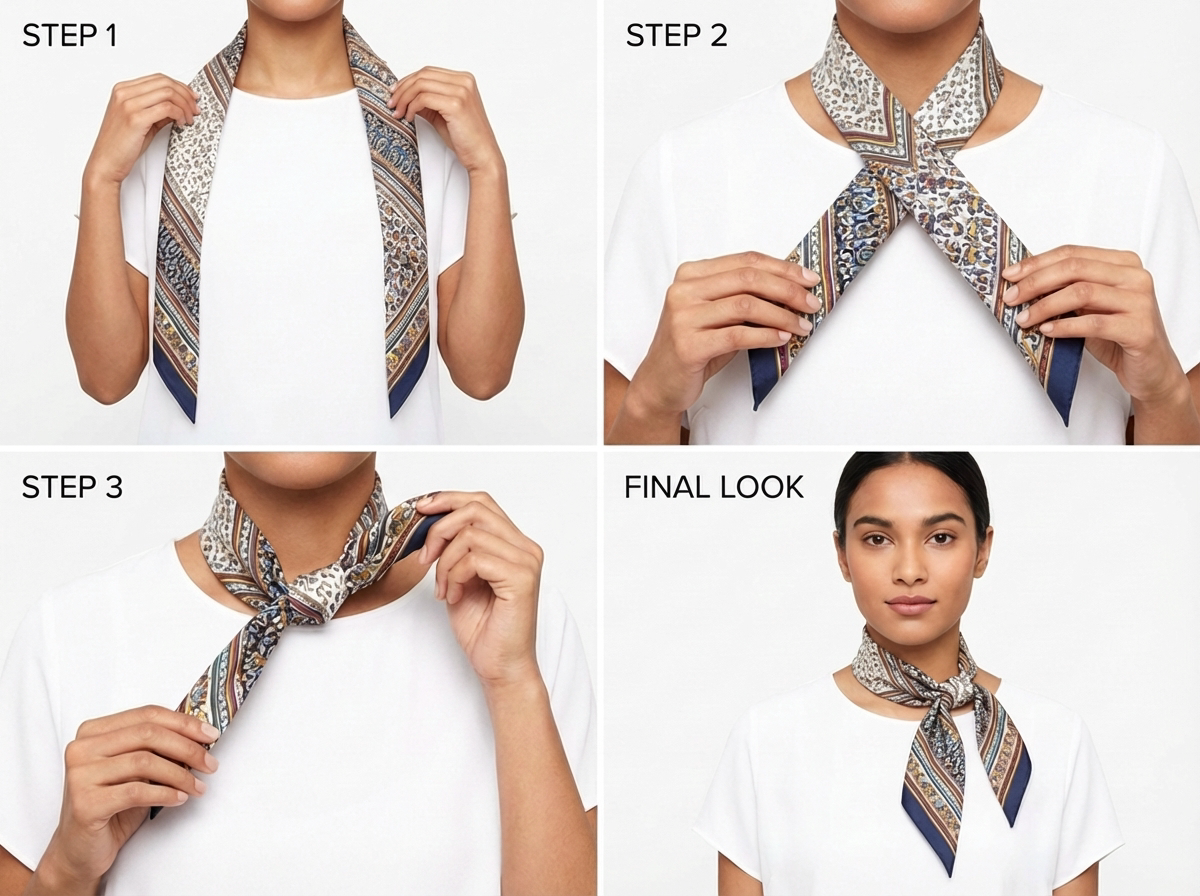
The foundational technique. This is what Grace Kelly wore in approximately 70% of documented photographs.
How to tie it:
Fold your scarf into a band approximately 3–4 inches wide
Drape it around the back of your neck with even ends hanging in front
Cross the right end over the left, then bring it up through the loop at your neck — essentially a half-knot
Slide the knot to sit slightly off-center, toward one collarbone
The ends can hang free or be tucked
The BCBG formula: A French knot in a navy or equestrian-print scarf over a white poplin button-down, collar up. This is essentially a complete outfit declaration.
Works best with: Band or loose roll fold. Square or oblong scarves.
2. The Parisian Drape (Le Fichu)
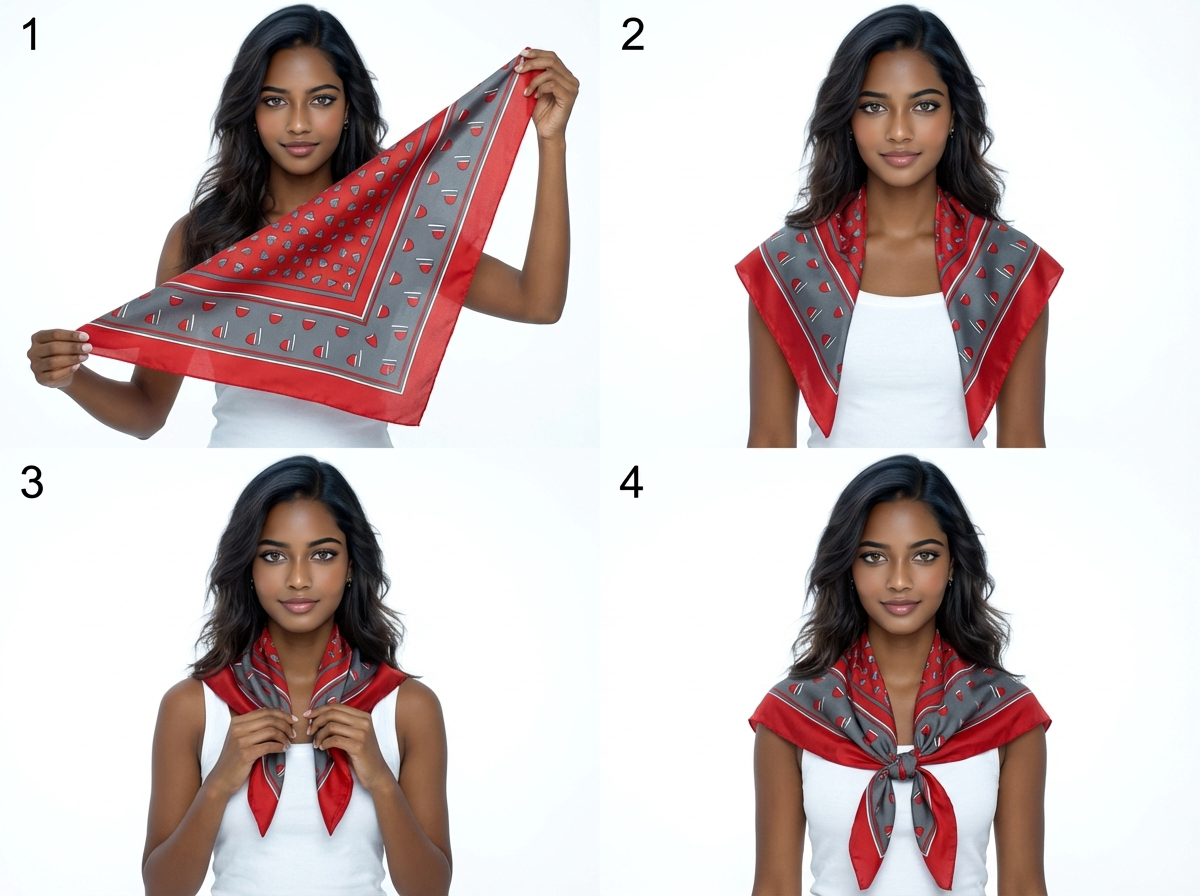
There are still many women in Provence in the south of France who take a silk scarf tied just once around their shoulders, a style called a fichu, which has been worn this way since the 18th century. It is the technique that requires the least technical skill and produces the most aristocratic effect — which is very French of it.
How to tie it:
Fold your scarf diagonally into a large triangle
Drape it around your shoulders with the long flat edge across your upper back and the pointed tip facing downward at your sternum
Bring the two corner ends to the front
Tie a single, loose knot at your sternum — not tight, not precious, just placed
Let the triangle point hang freely below the knot
The BCBG formula: Over a fitted turtleneck or draped over a blazer's shoulders for a weekend lunch. The effect is equestrian without being costumed.
Works best with: Larger squares (90cm and up) or shawl-size pieces.
3. The Neck Ring / Cravat
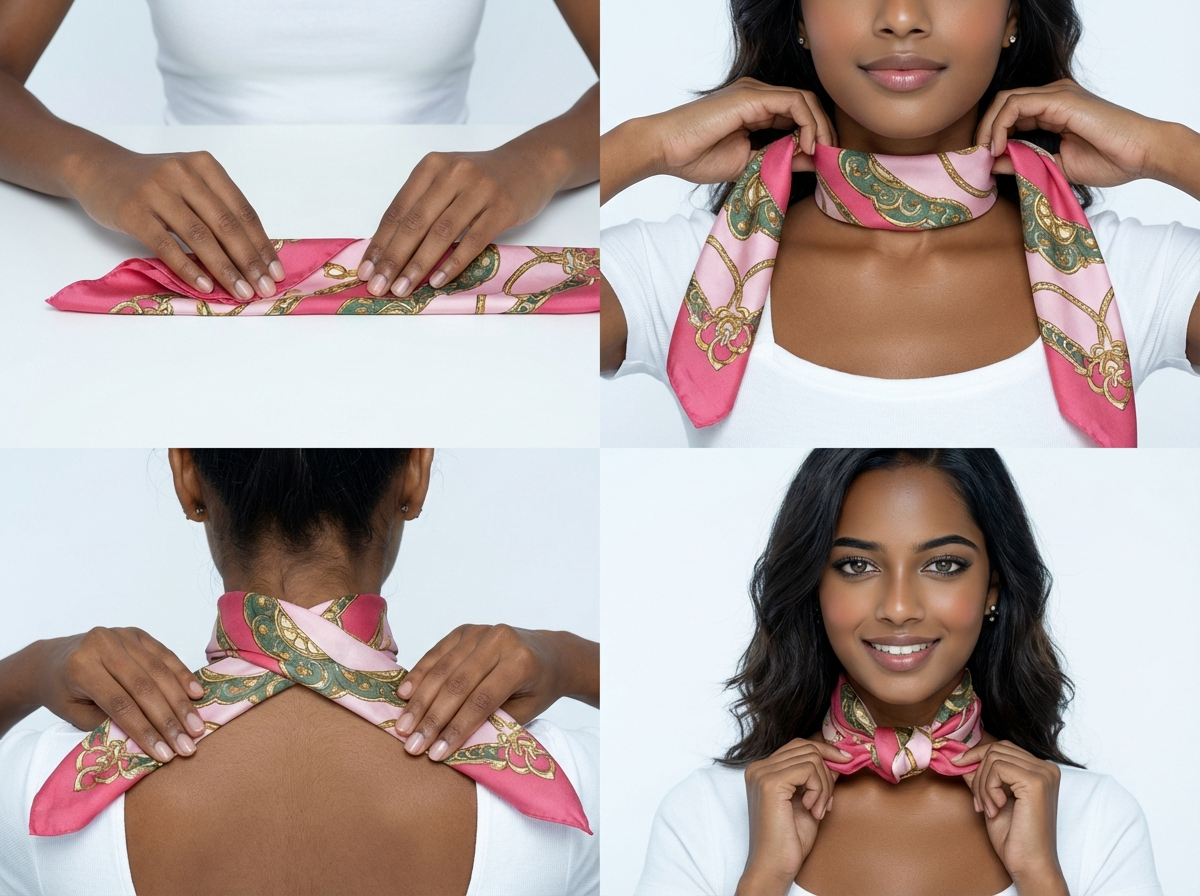
The more structured of the core techniques, and the one that photographs best. This is what you see on the Hermès website. It requires about forty seconds of practice before it becomes automatic.
How to tie it:
Fold your scarf into a band about 2–3 inches wide
Fold the band in half to find the center point
Place the center point at the front of your throat
Cross both ends behind your neck and bring them forward again
Tie a flat knot at the throat — left over right, then right over left (a square knot, which lies flat rather than twisting)
Adjust so the knot sits cleanly at the center of your collarbone
The variation: Instead of a knot, thread both ends through a scarf ring (the Hermès version exists, but any small ring or vintage brooch works) for a very French, very finished look.
The BCBG formula: With a navy blazer, pearl earrings, and nothing else at the throat. The scarf does the entire work of jewelry.
Works best with: Band fold. Any size square.
4. The Bandana / Le Cow-Boy Anneau
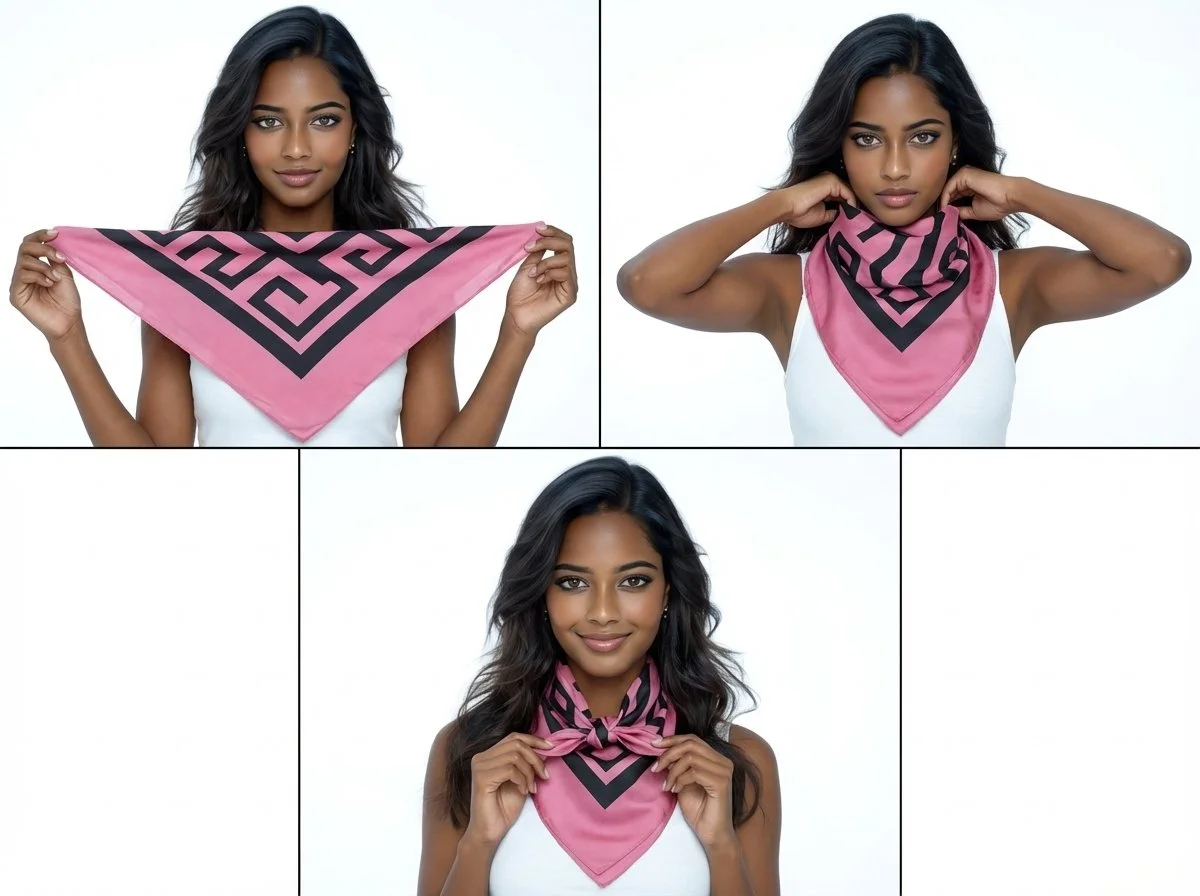
This one is BCBG by way of the yacht club — a little sporty, a little louche, unmistakably intentional. It pairs beautifully with anything from a scoop neck dress to a crisp button-down.
How to tie it:
Fold the scarf into a triangle with the point in front.
Cross the ends behind the neck.
Tie in front using a classic knot.
The BCBG formula: With a Breton stripe top and wide-leg trousers. Or over the collar of a chambray shirt with the tail tucked in. The hanging point is the visual interest — don't tuck it.
Works best with: 90cm squares.
Advanced Methods: For the Initiated
These techniques require more than one move. They reward practice and look genuinely architectural when executed well — the kind of thing that makes someone ask "wait, how did you do that."
The Scarf Necklace (Le Collier)
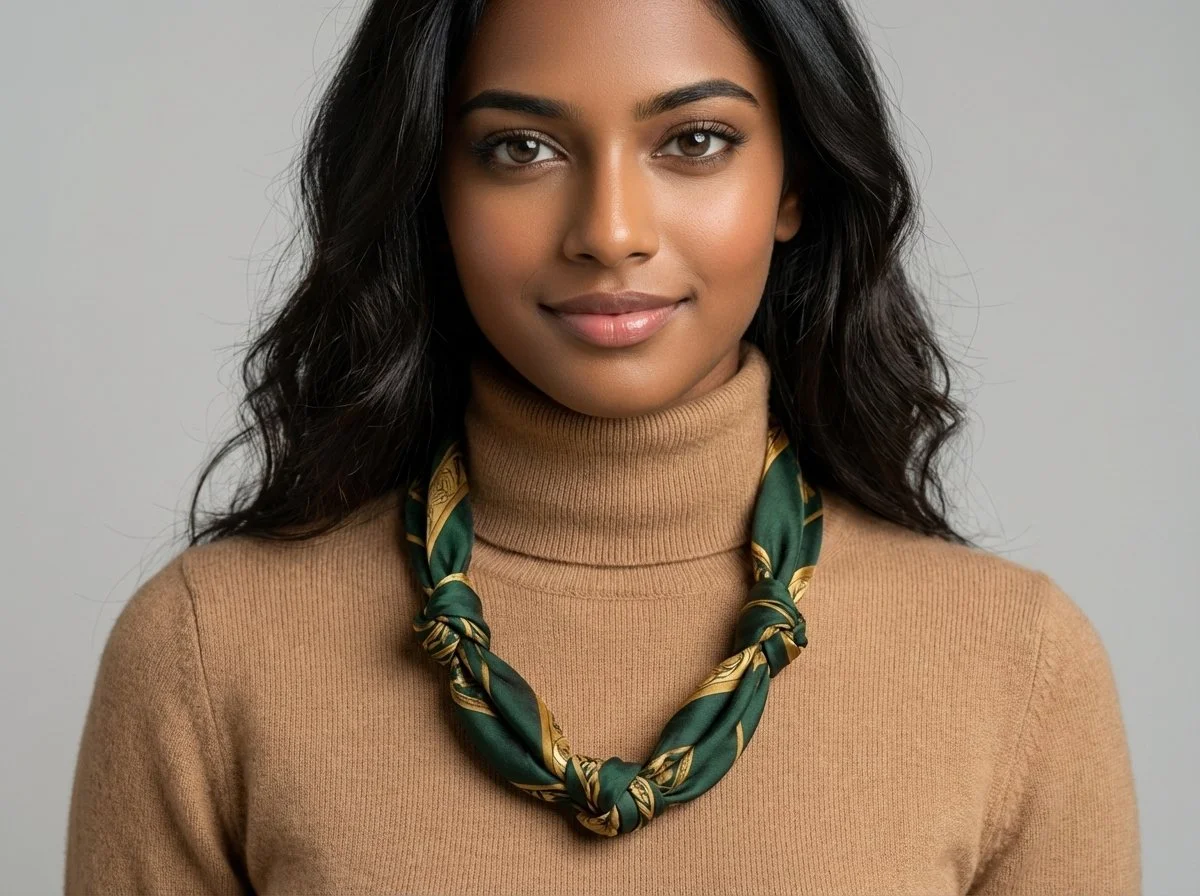
This isn’t a single-knot pendant—it’s a looped, multi-knot scarf necklace that creates a soft, sculptural “chain” effect.
It sits higher than a pendant style and mimics a chunky necklace, but in silk.
Fold into a rope
Start with a square scarf
Fold diagonally, then keep folding until you get a long, narrow strip
Twist slightly
Gently twist the fabric to give it that rounded, “rope” look
Tie 2–4 loose knots
Space them out evenly
Keep them soft, not tight (this is key for that luxe drape)
Bring ends together
Tie the ends into a final knot or tuck them together at the back
Adjust the shape
Rotate so the knots sit toward the front
Let it rest naturally against the collarbone
Key Characteristics of This Style
The scarf is folded into a rope-like strand
Multiple loose knots are spaced along the length
The scarf is then joined into a loop (necklace shape)
The knots add volume and structure, almost like beads
It’s essentially:
a silk scarf reimagined as a statement chain necklace
Why it's advanced
Requires Shape Control (Not Just a Knot)
Most beginner scarf styles are:
Fold → wrap → tie → done
In this one, you’re creating rope structure, controlling knot placement and building a balanced loop. If the proportions are even slightly off, it collapses.
👉 You’re not just tying—you’re sculpting the scarf.
It Replaces Jewelry (Higher Stakes)
With most scarf styles, the scarf is supporting the outfit.Here, it’s the main focal point.
That means:
It has to sit correctly on the neckline
It has to balance with the outfit
It has to look intentional from every angle
If it fails, there’s nothing else to “save” the look.
👉 You’re styling at the same level as choosing a statement necklace.
Fabric Quality Becomes Very Obvious
With simple knots, you can get away with polyester, stiffer fabrics and lower-quality prints
With this style? Not really.
👉 This style exposes the material.
One False Move…
…and now it’s craft project energy.
What goes wrong:
Knots are too tight or bulky
Uneven spacing
Scarf is too stiff or cheap-looking
How to fix it:
Keep knots loose and slightly imperfect
Use fluid fabric (silk or silk-like)
Let it sit naturally—don’t over-adjust
BCBG formula: Over a cashmere turtleneck or a silk blouse with a simple neckline. The knot replaces a pendant necklace entirely.
The Ascot (L'Ascot)
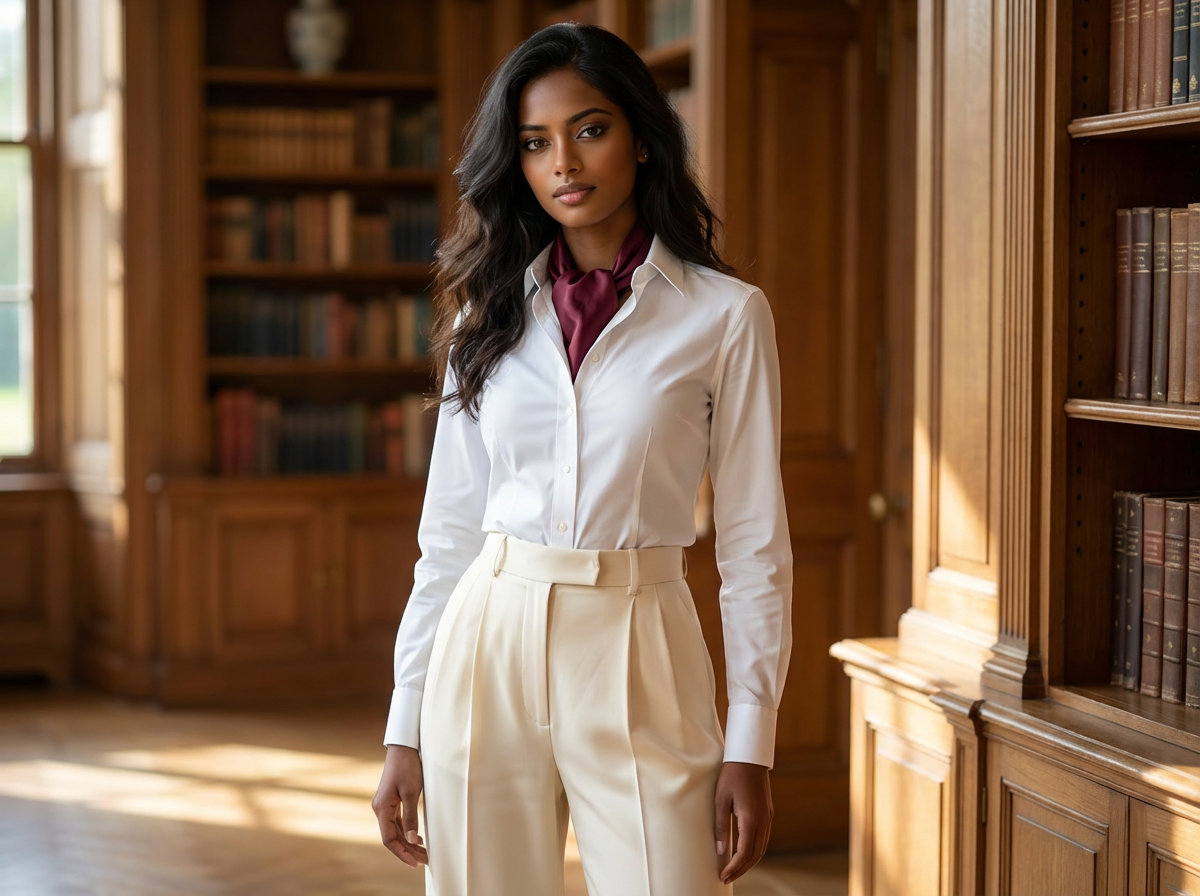
The day ascot was especially associated with Hollywood's leading men — Cary Grant, Clark Gable — and eventually became emblematic of glamorous nonchalance. On women, it reads as borrowed-from-menswear, which is what makes it interesting.
One of the earliest photographs of a woman wearing an ascot is of Amelia Earhart. Grace Kelly wore it. You can too.
How to tie it
Fold your scarf into a long rectangle (bias fold for structure)
Drape evenly around your neck
Cross one end over the other at the front
Pull one end up and through (like the start of a tie)
Let both ends fall downward
Tuck the ends neatly into a shirt, sweater, or blazer
Optional:
Leave a small portion visible for a softer, less formal effect
Key Characteristics of L’ascot Fold
Scarf is folded into a long, flat band (not twisted)
Wrapped around the neck with even or slightly uneven ends
One side crosses over the other
Ends are tucked into a shirt, sweater, or blazer
Only a portion of the scarf is visible
The overall effect:
Polished, intentional, and aristocratic
Why it's advanced
No Knot = No Safety Net
In most styles, the knot holds everything in place and defines the look. Here, there’s often no visible knot and no obvious structure. Everything depends on tension, placement and fabric behavior.
👉 If it slips or collapses, the whole look disappears.
It Has to Integrate with Clothing
This is not a standalone accessory. It must work with neckline depth, fabric weight, and layering structure.
👉 You’re styling the outfit as a system, not just adding an accessory.
Planned Imperfection
Because the scarf is folded flat and partially hidden, the fabric must hold its shape and drape without collapsing. Cheap fabric won’t do that.
👉 This style demands quality or a very good dupe.
One False Move…
…and now it’s costume-adjacent.
What goes wrong:
Knot is too high or too tight
Too much fabric is visible
It sits on top of the outfit instead of within it
How to fix it:
Loosen the knot slightly
Tuck more of the scarf into the neckline
Let just enough show to suggest—not announce
BCBG formula: Under the open collar of a navy blazer, ends tucked. This is the Katharine Hepburn move: masculine-cut jacket, feminine silk ascot, nothing else at the throat.
The Slip Ring (La Coulisse)
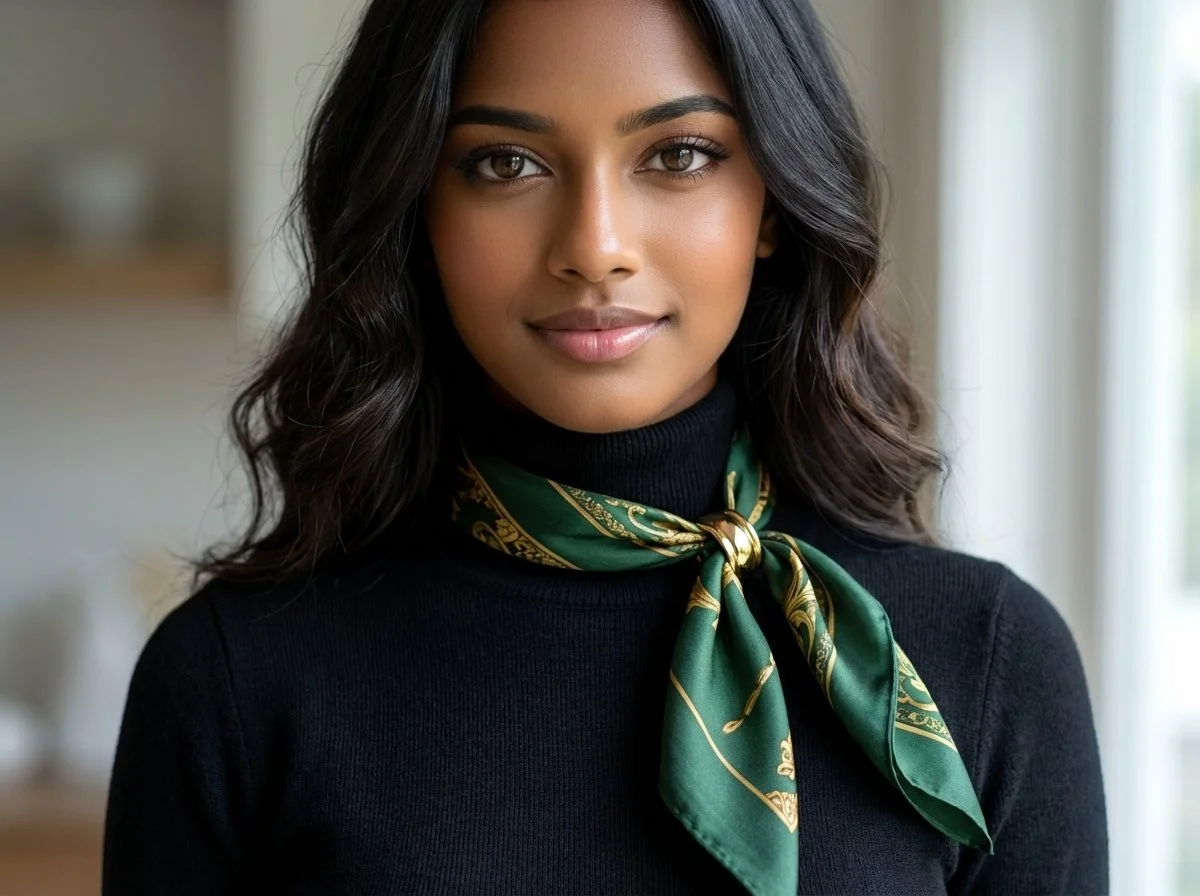
The Slip Ring is the most minimal-looking technique on this list. It uses a scarf ring as hidden infrastructure, creating a “floating” kno.
How to Do It
Fold your scarf on the bias into a long band
Fold the band in half to find the center
Thread both ends through a scarf ring from the same direction
The ring should now sit at the folded center
Pull one end through both openings of the ring (not all the way)
Pull the second end through the loop created
Adjust to secure, then drape around your neck
The ring should sit at the throat
The ends fall behind or to the back
Why It’s Advanced
This technique relies on precision and sequence, not just tying.
The threading order is unintuitive and easy to reverse
Small adjustments dramatically change the final look
The ring must sit exactly right to achieve that “invisible” effect
One False Move…
…and now it’s hardware-forward.
What goes wrong:
Ring is too visible or oversized
Knot sits too low or too tight
Fabric bunches instead of drapes
How to fix it:
Use a smaller, refined ring
Position it high at the throat
Smooth the fabric after threading
BCBG formula: With a fitted turtleneck. The ring provides the jewelry; the silk provides the color. This is the most "quiet luxury" of all the advanced techniques — it looks effortless and is not.
A Note on Scarf Rings
A scarf ring isn’t optional here—it’s infrastructure.
Classic options from Hermès include:
Chaîne d’Ancre (ideal for this technique)
Régate
Anneau
But you don’t need to invest immediately:
Vintage rings (Etsy, eBay) work beautifully
Even a simple gold-tone ring can achieve the effect
👉 Tip: Practice with an inexpensive ring first—the technique matters more than the hardware.
How to Care for Your Silk Scarf
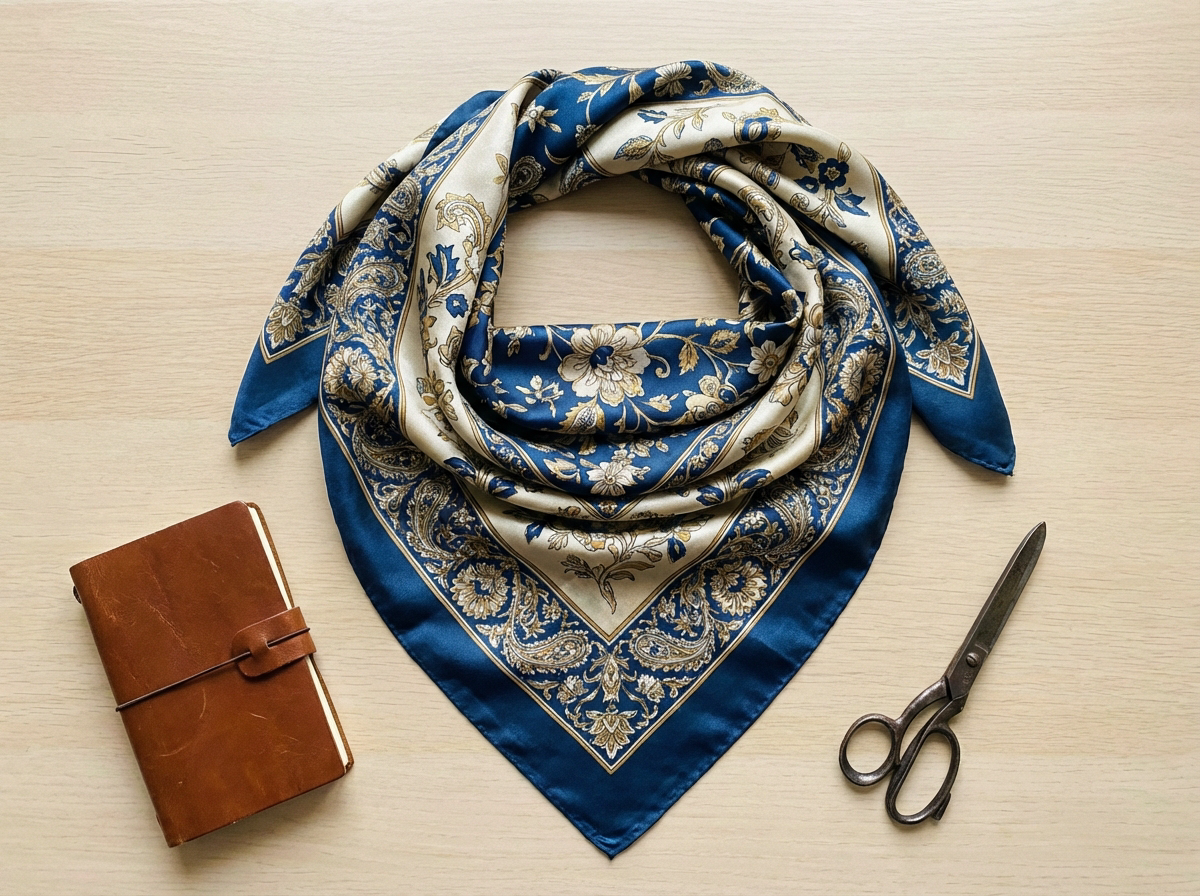
A properly cared-for silk scarf lasts decades — the Hermès vintage market is built on this fact.
Storage: Flat in a drawer, or loosely rolled around acid-free tissue. Never hung (gravity distorts the fabric over time) and never in direct light.
Cleaning: Dry clean only for Hermès and investment pieces. For mid-range silk, hand-washing in cold water with a drop of delicate detergent (Woolite or similar) is fine — never wring, never twist. Lay flat on a clean towel to dry.
Wrinkles: Steam, not iron. A handheld steamer held a few inches away removes fold marks without distorting the silk. If using an iron, a cool setting through a pressing cloth only.
Related Reading
[The Complete BCBG Aesthetic Guide]
[How to Build a BCBG Capsule Wardrobe]
[French Girl Aesthetic: The Complete Guide]
Sources
Check out these great sources for even more scarf knots!
https://www.rebag.com/thevault/hermes-101-how-to-tie-an-hermes-scarf/
https://www.scarves.net/blogs/how-to-tie-a-scarf
https://www.today.com/style/how-tie-silk-scarf-pro-t108799
https://www.cosmopolitan.com/style-beauty/fashion/a62638393/how-to-tie-a-scarf/
https://236vintage.blogspot.com/2012/03/how-to-tie-scarf.html
