
The New Money Aesthetic: When Wealth Wants to Be Seen (and Photographed, and Tagged)
Table of Contents
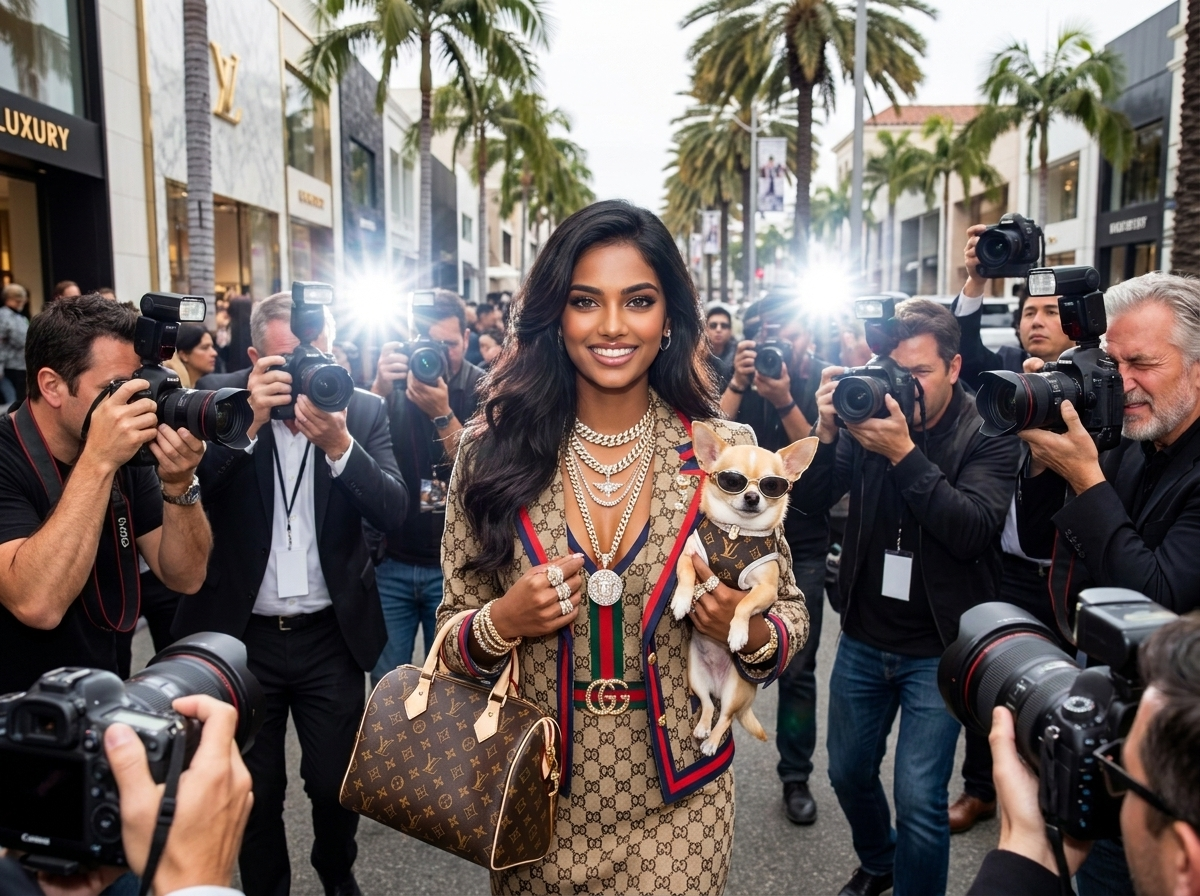
New Money absolutely, 100% does NOT apologize for its bank account.
For decades, snobby fashion magazines have treated the New Money aesthetic like a scary warning of what happens before you learn how to be "properly" rich.
But we have a different take.
New Money vs. Old Money have been at odds for decades. While Old Money is generational wealth, New Money is first generation or self-made wealth. Here is where you’ll find athletes, entertainers, and reality stars. You’ll also get some tech giants, fashion moguls, and influencers. These people remember what it was like to be broke, and they’re enjoying the ride.
Old Money spends cash to disappear. Their designer labels are on the inside of their jackets, and the vibe mutters, "We have been wealthy since the Mayflower." Meanwhile, New Money’s giant logos are right on the front, and scream, "Check out this awesome thing I just bought!" (And if they think you didn’t hear them the first time, they’ll scream it again).
Both sides just answer different questions: one group is protecting their grandpa's gold coins, while the other is announcing they just built a rocket ship.
This is a much bigger deal than it looks on the surface, because most of the New Money shade is about who is allowed to be wealthy in peace and who has to hide it. We’ll talk about that, but for now, let's start with the basics: what New Money looks like and why it loves to blind us.
The New Money Promise
What It Sells:
Wealth made visible
Success without shame
Permission to celebrate
Achievement as aesthetic
Arrival announced daily
What You Get:
"Try-hard" accusations
Old Money side-eye
Instagram engagement
Authenticity questions
But also: never being mistaken for broke
WHAT IS THE NEW MONEY AESTHETIC?
The New Money aesthetic is a fashion style built around visible, newly-earned wealth — logos and bold statement items — standing in direct contrast to Old Money's understated, inherited-wealth look.
A Short History of "New Money" as a Term
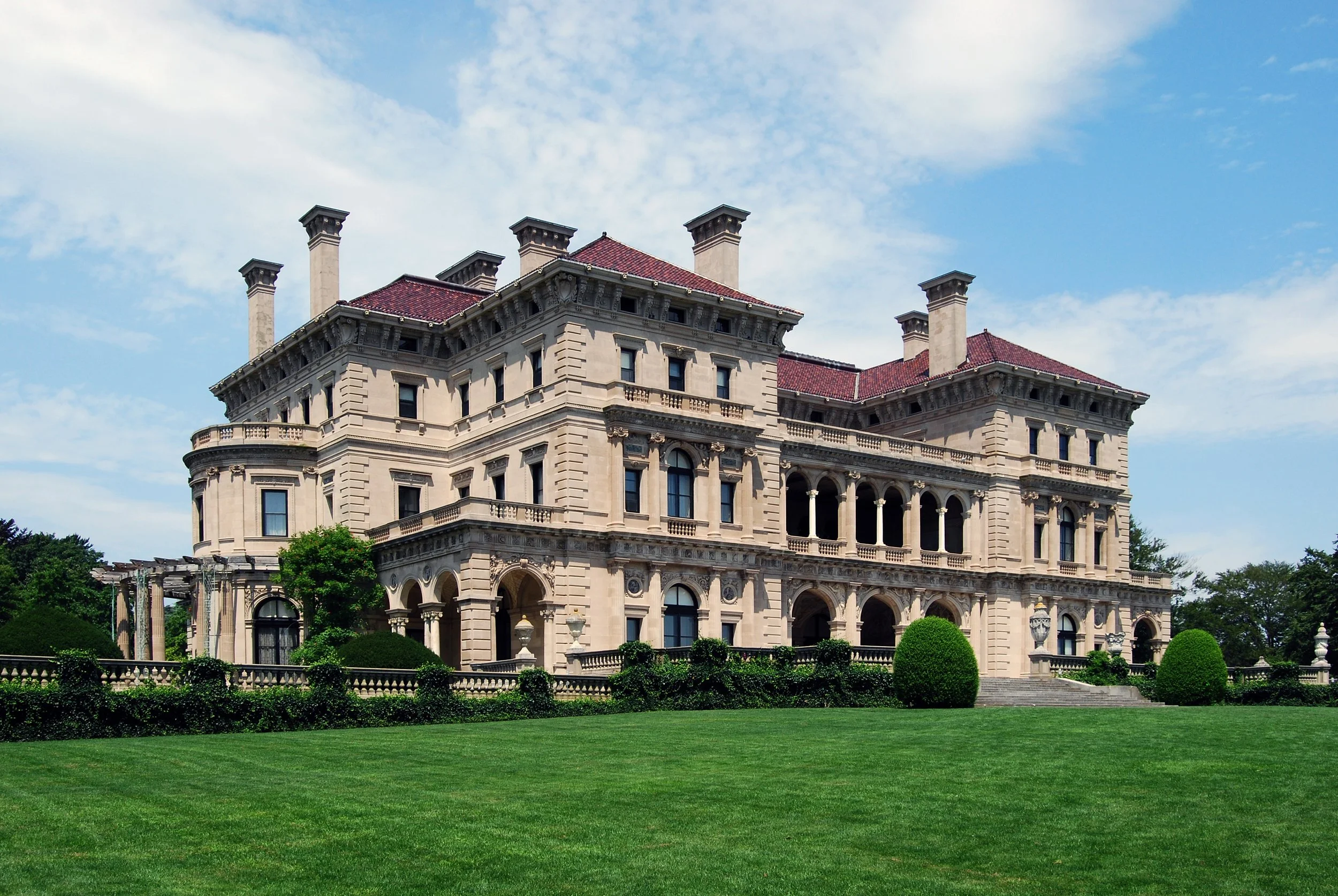
The Breakers, the summer home of Cornelius Vanderbilt II, located in Newport, Rhode Island, United States. It was built in 1893, added to the National Register of Historic Places in 1971, and designated a National Historic Landmark in 1994. (Source: Wikipedia)
Every Old Money family was once New Money. That's what they would rather you forget.
You can’t really talk about American aristocracy without talking about the UK first. New Money borrows from the older French term nouveau riche, or "newly rich". European aristocracy had centuries to perfect their art, and they used that head start as a weapon: the newly wealthy might have the bank balance, but they didn't have the bloodline. New Money became shorthand for having the means without the manners.
A title passes by law whether or not the money behind it survives intact. Britain, in other words, built institutions (entail, peerage, primogeniture) to keep land and title moving through a family regardless of money.
The United States was constitutionally engineered to make this whole pillar impossible.
Article I, Section 9 of the Constitution is direct about it: "No title of nobility shall be granted by the United States."
Hamilton called prohibiting nobility titles "the corner-stone of republican government," arguing that as long as inherited titles stayed excluded, there could never be serious danger of the government becoming anything but answerable to its people. Madison went further, treating the absolute ban on nobility as the most decisive proof that the Constitution was a republican document. The founding vision was anti-hereditary-privilege, not just anti-monarchy. They wanted a civil society where accomplishment fueled advancement, not bloodline.
While our Founding Fathers were busy prohibiting a formal aristocracy, Americans were getting rich. Very rich.
What's the difference between New Money and Old Money style?
Old Money style hides wealth through muted colors, absent logos, and understated pieces, while New Money style displays wealth through bold logos, bright colors, and visibly current, statement-making fashion.
From Nouveau Riche to Gilded Age America
Railroads came first. Building a rail network across an entire continent was too expensive and too risky for private capital to take on alone, so the federal government helped businessmen with loan subsidies and land grants — roughly 170 million acres for railroad companies to encourage expansion. High import tariffs protected American industry from foreign competition on top of that. Cornelius Vanderbilt recognized that government-subsidized rail would be the most valuable asset class in the country.
Railroads consumed steel at a staggering rate. By 1882, nine-tenths of the nations steep output went right into rail lines. Carnegie built his empire at that intersection of the railroad boom’s demand curve and a new manufacturing process cheap enough to serve it at scale.
Standard Oil combined vertical integration with horizontal integration, buying up rival refineries until, by 1882, the Standard Oil Trust controlled upward of 95 percent of the country's refining capacity. Much of that dominance came from the railroads themselves: Standard Oil's close relationships with rail companies got it shipping discounts and rebates its competitors couldn't match, letting Rockefeller underprice anyone still standing.
What ties these industries together, though, is what wasn't there to stop them.
There was no federal income tax to slow capital accumulation until 1913. While The Sherman Antitrust Act arrived in 1890. It didn’t clearly define "restraint of trade," which meant it went largely unenforced. Add a government whose central policy toward big business was, more or less, hands-off, and you got fortunes growing to astronomical amounts because there nothing to limit it.
With money inevitably comes power. The Astors, the Vanderbilts, and the rest of the "Knickerbocker" families didn’t need titles. A big enough fortune produced the same social effect a peerage produces in Britain. However, American Old Money was always more fragile than its British counterpart. Unlike a British title, which survives by law regardless of money, American social standing depended on the fortune staying intact.
That gap didn't stop the two worlds from colliding. Late 19th-century America produced wealthy American heiresses married off to cash-strapped British aristocrats holding titles but dwindling estates, also known as “Dollar Princesses”. Consuelo Vanderbilt's 1895 marriage to the Duke of Marlborough is the textbook example: American New Money fortune meeting British Old Money title, each side supplying what the other lacked.
Every American Old Money family got there by being New Money in a system making it impossible to convert into anything resembling a permanent title. It just turned out capital alone, held long enough, could counterfeit one anyway.
However, something has changed recently. Where New Money once tried to fit into Old Money respectability, a lot of today's New Money has stopped trying. They don’t hide their fortune or apologize for the timeline. Instead of trying to fit into stuffy Old Money culture, they’ve created their own.
The Media Blueprint
"Crazy Rich Asians" (2018): New Money global spectacle
"Keeping Up with the Kardashians": The instruction manual
"Bling Empire": Los Angeles at maximum volume
"Selling Sunset": Real estate as red carpet
"Succession": New Money characters playing Old
Every rap video ever made: The permanent syllabus
Style Icons
Kim Kardashian: The architect of modern New Money
Cardi B: Bodak yellow Birkin philosophy
Rihanna: New Money elevated to art
The Beckhams: New Money graduating to dynasty
Kylie Jenner: Instagram wealth codified
Every NBA player at tunnel walks: The new runway
Paris Hilton - The Bridge to Modern New Money
Before 2000, "new money" meant something different.
For most of the 20th century, flashy wealth was a soap-opera trope Think Dynasty shoulder pads and Robin Leach narrating yacht tours on Lifestyles of the Rich and Famous. Then we got the late-'90s hip-hop's shiny-suit era, and the athlete-and-rapper "bling" of MTV's early Cribs. It was flashy yes, but it was also broadcast at you from a mansion you'd never visit, worn by people you'd never meet. New Money existed, but it just wasn't yet a look to study or copy.
Paris Hilton bridged that gap between Old Money and New Money. The great-granddaughter of Conrad Hilton, founder of Hilton Hotels, she comes from genuine old-guard American hospitality money. She had the legacy fortune that should have produced a quiet, Old Money heiress. Instead, starting around 2000, she did the opposite. She moved into fashion modeling and was named New York's leading It Girl by 2001, then The Simple Life and a leaked private tape pushed her into global fame by the mid-2000s. She took an Old Money surname and spent it like New Money, very publically.
Post 2000s Paparazzi culture and reality TV found their template in her. Every influencer-era archetype covered later in this pillar owes her a debt: she proved that wealth could be celebrated, not just an open secret.
New Money vs. Old Money — The Core Comparison
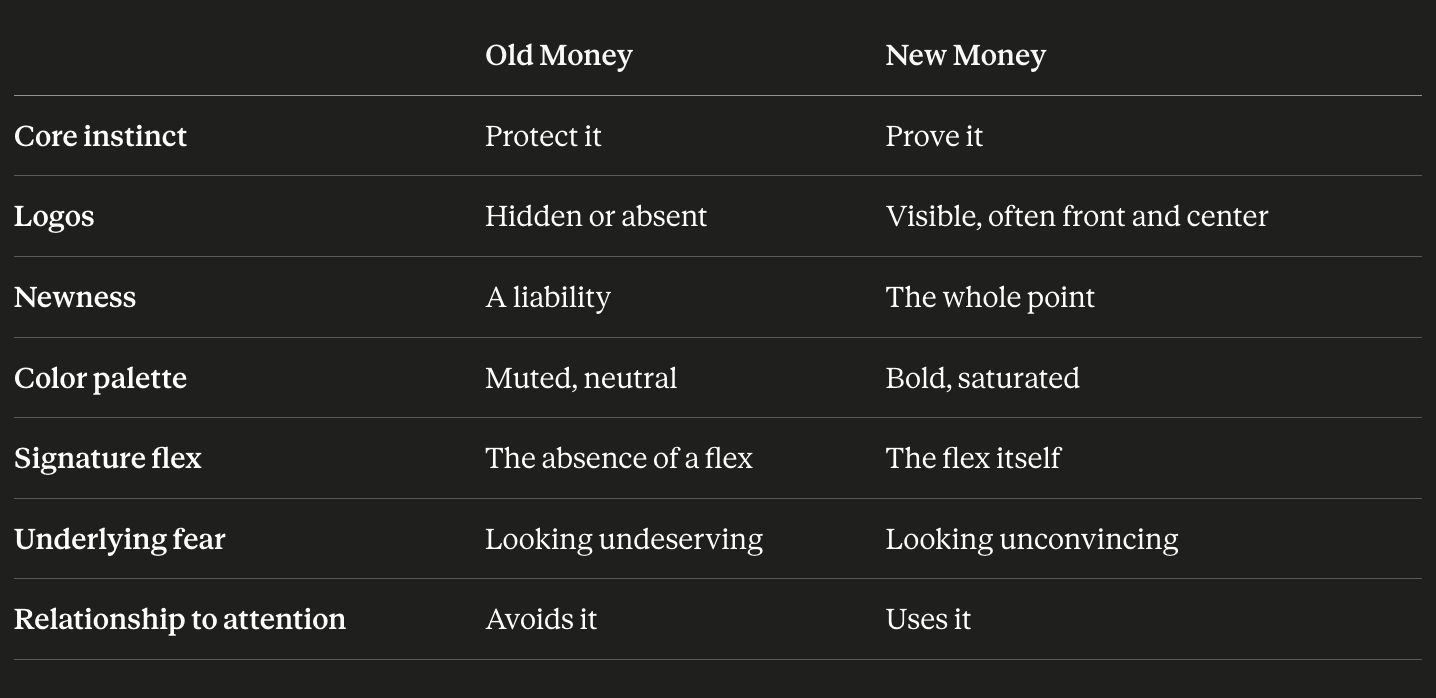
People compare 'Old Money' and 'New Money' styles like two students turning in the same assignment, where one is an overachiever and the other just scribbled some answers on the bus. In reality, these two groups aren't even in the same classroom.
Old Money asks: 'How do I keep this pile of cash I didn't earn?' Over the centuries, their strategy has been to play a high-stakes game of hide-and-seek. They avoid big brand logos like the plague and dress like they're protecting a secret bunker.
Meanwhile, New Money is asks: 'How do I prove that I built this empire from scratch?' Obviously, their strategy is the opposite of playing dead. To them, a giant logo is a shiny receipt proving they can afford it. New Money wants a round of applause for climbing a mountain that Old Money bypassed via helicopter.
When you peel back the layers, neither style is about having 'good taste.' Old Money is terrified of looking like lazy freeloaders. New Money is terrified of looking like imposters. All the other stuff is just a side effect of these two deep funny insecurities.
Where does the term "new money" come from?
"New Money" comes from the French term nouveau riche ("newly rich"), historically used by European aristocracy to distinguish inherited wealth from wealth earned within a single generation.
The Core Signifiers
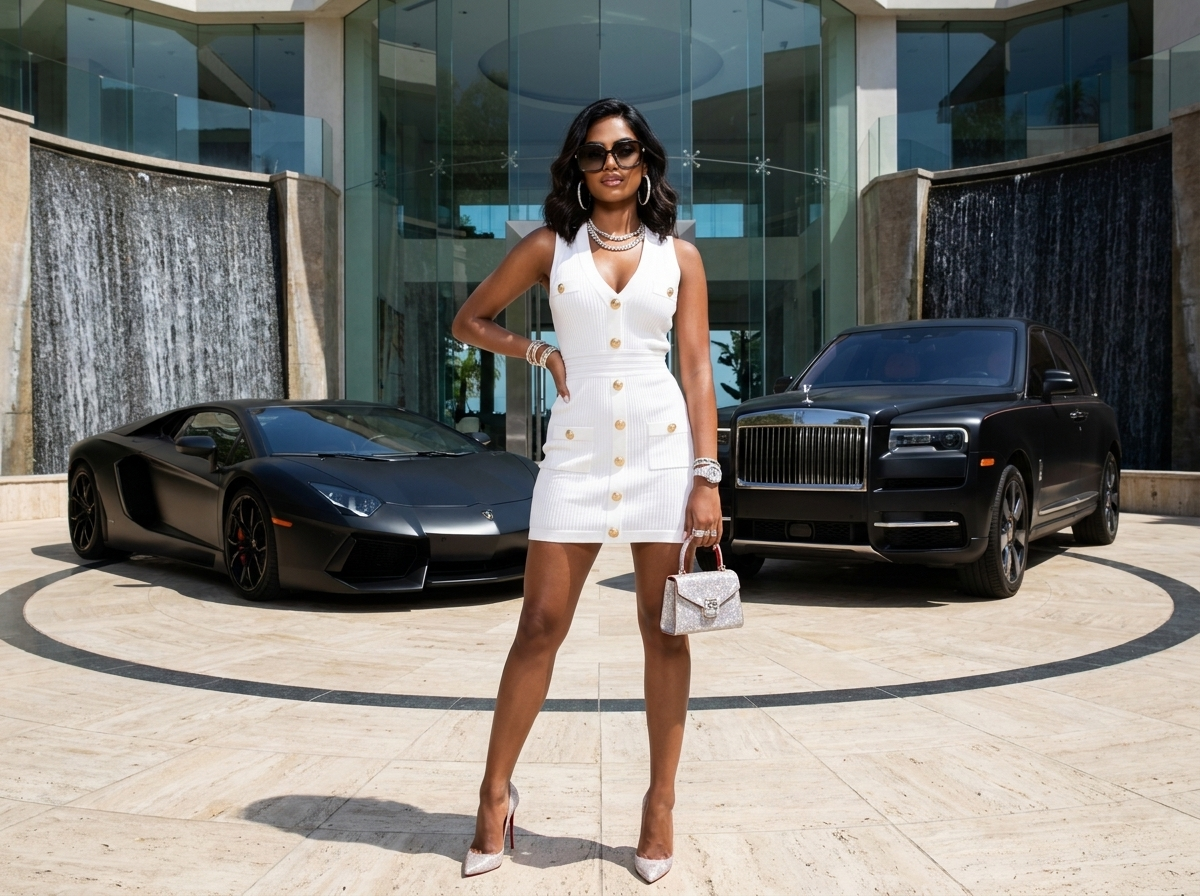
Once you figure out how to translate New Money style, you'll see it everywhere from airport terminals to those embarrassing group chat screenshots that go viral on Twitter.
Logos
We aren't talking about a tiny, elegant monogram or a subtle stamp. No, this is read from a mile away. “Quiet Luxury” fans call it gaudy, but that logo announces how many zeros were on the price tag. You don't need to understand Italian tailoring or expensive fabric; the brand name does all the heavy lifting for you.
Newness
Old money obsesses over things like heirlooms from great-aunt Gertrude and heavy wool coats that have survived ten winters. New Money wants the limited-edition sneaker and the jacket that hasn't even hit Instagram yet. Rocking something straight out of the box is evidence that you have VIP access.
Scale
While the old guard keeps everything small and modest, the new-money crowd wants bags that look like carry-on luggage, heels that require a safety harness, and sunglasses that look like windshields. A tiny, polite accessory might get missed by the crowd, and getting ignored is their worst nightmare.
Color
Old Money dresses to dodge the paparazzi, leaning towards muted colors like sandy beige, off-white, and navy blue. New Money’s shades are so saturated they can cut through a low-resolution phone screen on 1% battery. That’s intentional, most of this style is engineered for social media feeds.
Combine all four of these loud signs and you get a style that’s using a megaphone to tell you who they are, and it doesn't care if you're covering your ears.
What are the core signifiers of the New Money aesthetic?
New Money style is built on four core signifiers: visible logos, visibly current or brand-new pieces, generous scale on accessories, and bold, saturated color.
The New Money Visual Vocabulary
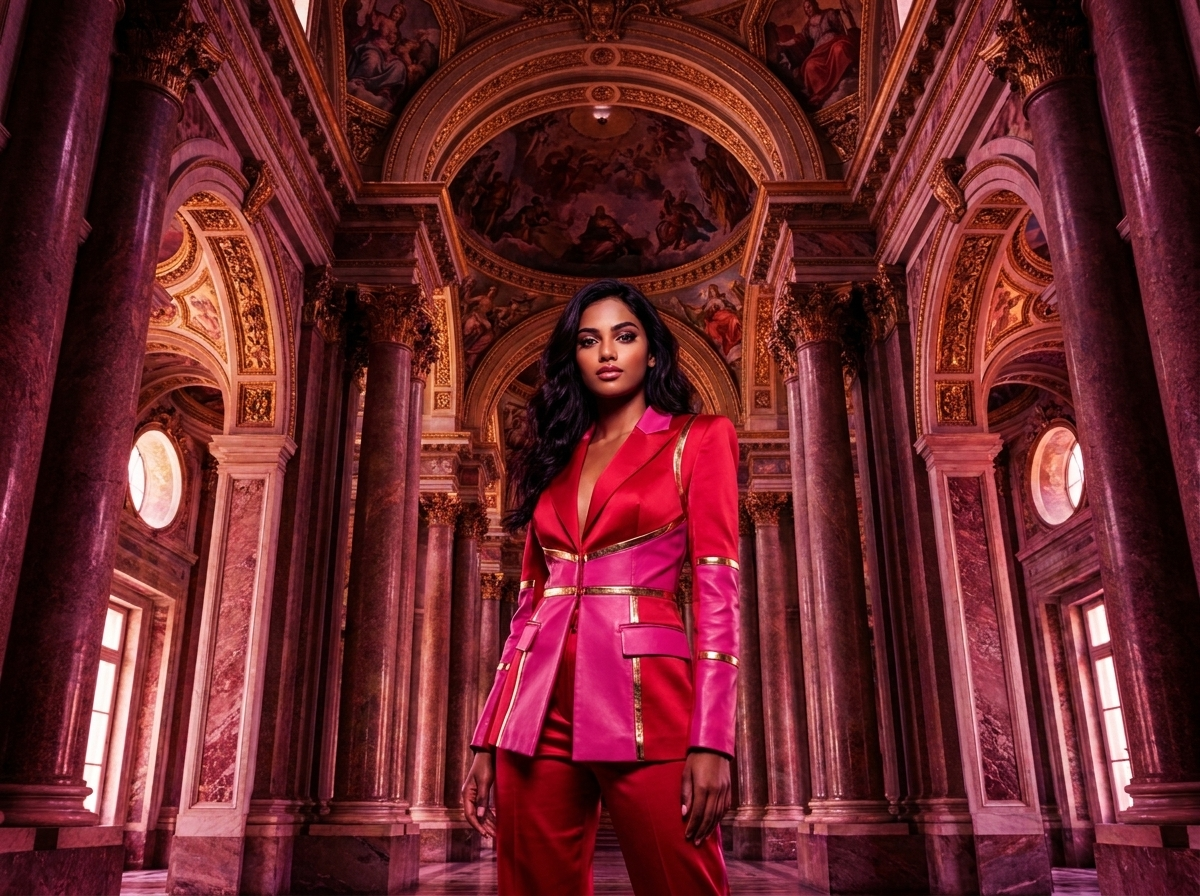
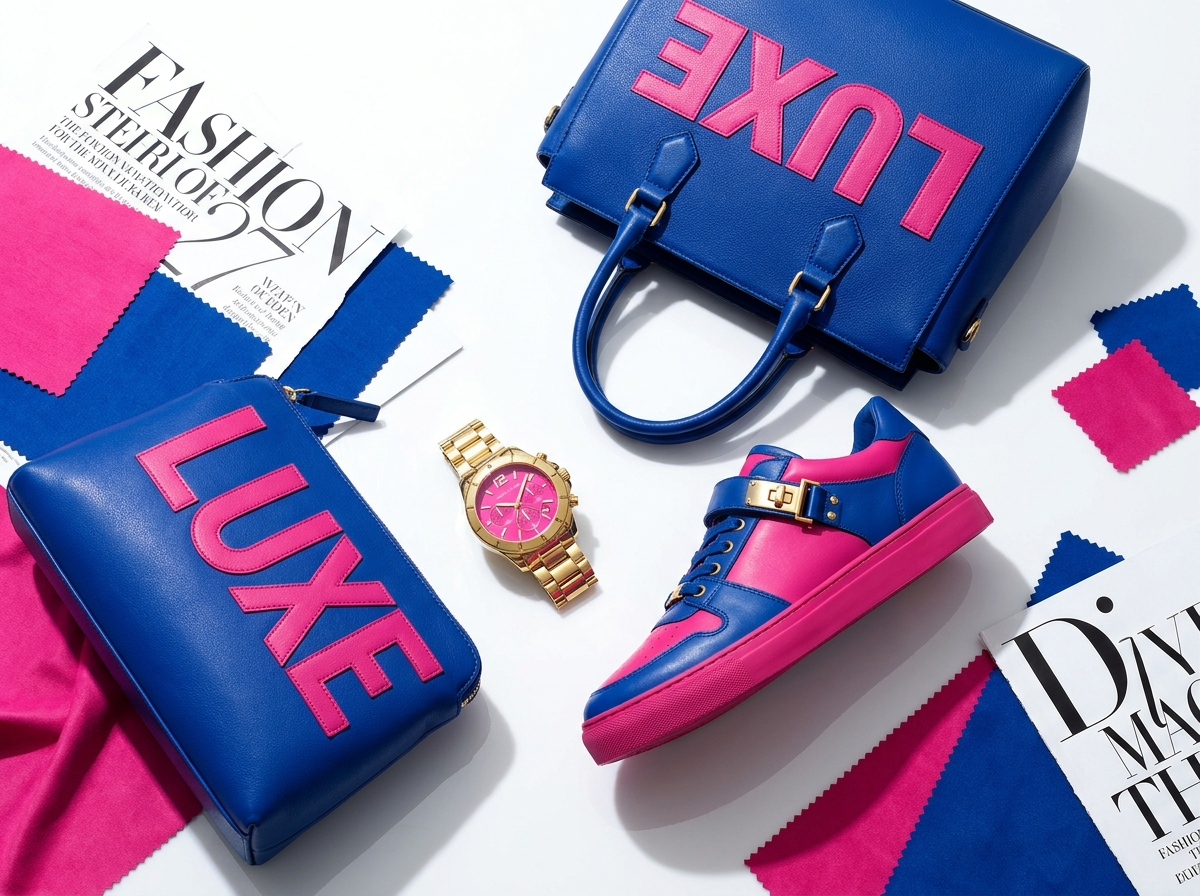
While Old Money sticks to boring navy blue and cream, New Money cranks the brightness up to one hundred percent. Bright red shoe soles are the ultimate classic flex. Turquoise gives Miami, spending summer on a yacht, and change your outfit twice a day just because you can. Hot pink gives major "Barbie dream house wealth" energy.
Gold is splattered everywhere like the basic default setting of this entire look, while blindingly bright white is a bragging right. Even their neutral colors are loud: monogram brown is just Louis Vuitton canvas pretending to be beige.
Power Combinations:
Black + gold (nightclub eternal)
White + Louboutin red (foundation flex)
Pink + turquoise (Miami manifesto)
All-white ensemble (dry cleaner defiance)
Monogram + monogram (brand loyalty)
Neon + diamonds (Vegas victory)
Logo Protocol: Yes, and Louder
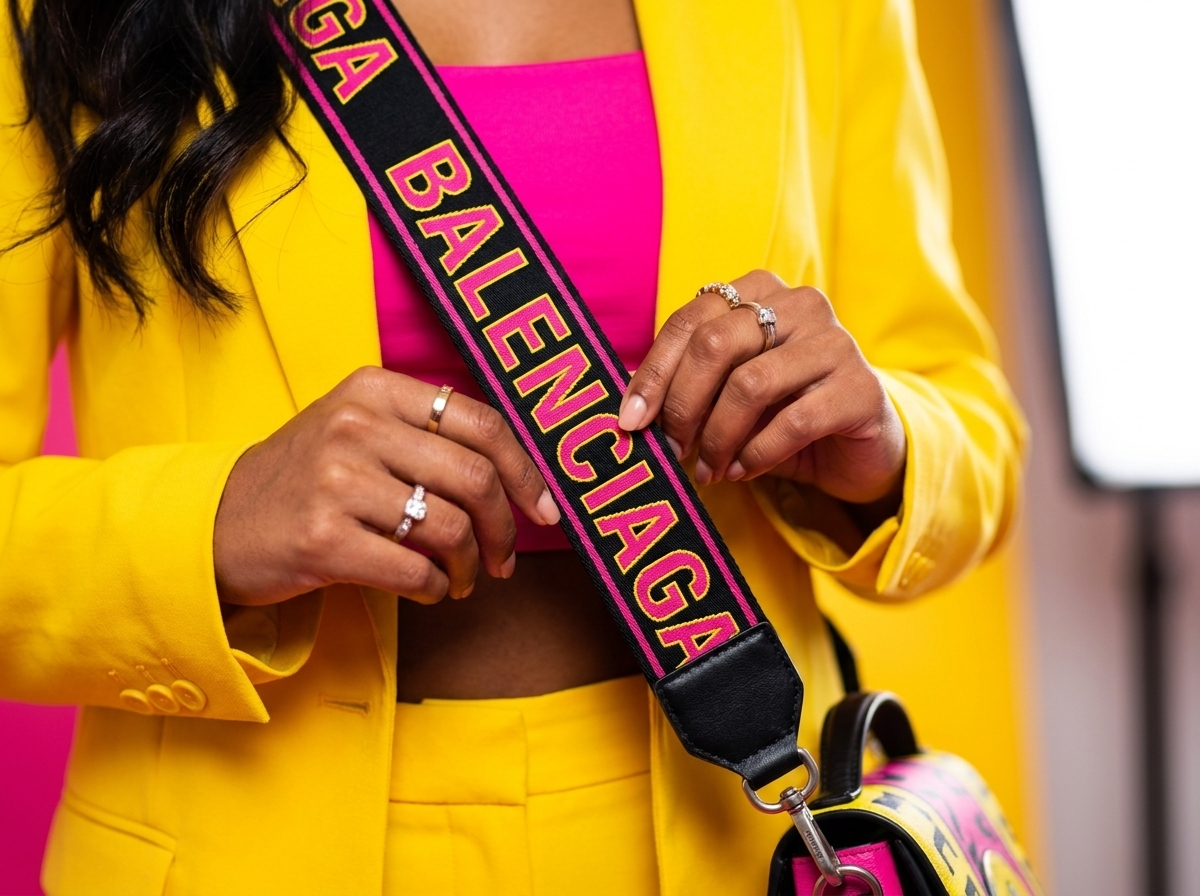
The Holy Trinity of Branding:
LV monogram: The gateway logo
Gucci GG: Green-and-red heritage
Chanel CC: Interlocking wealth
Dior oblique: French flex signature
Advanced Techniques:
Head-to-toe single brand (controversial)
Strategic brand mixing (advanced)
Monogram on monogram (fearless)
Logo scale variation
Brand era referencing
Collab piece deployment
Texture Treasury
Essential Materials:
Fur (real or convincing): Wealth marker eternal
Patent leather: Shine as signal
Metallic hardware: Visible weight
Distressed denim: Expensive damage
Sequins: Nightlife commitment
Croc and python: Exotic status
Diamonds: Actual, not costume
Cashmere: But make it visible
Silk with logos: Print over pattern
Leather everything: Head to toe
The Archetypes
New Money has several faces, each shaped by a different industry's version of "arrived." The core philosophy stays constant across: visible wealth and the logo as language. What varies is who's wearing it and what they're proving.
Tech Founder Wealth

This archetype dresses down on purpose, which makes it the most deceptive entry point. The hoodie, the sneakers, the plain t-shirt — none of it looks like New Money at first glance, until you realize that the sweater is Loro Piana, the sneakers are a limited collab, and the watch costs more than the car parked outside. Tech Founder Wealth flexes through scarcity and access rather than logos: the point isn't that you can afford the piece, it's that you got it before almost anyone else could. It's New Money's closest flirtation with Old Money's restraint, minus the actual restraint.
Reality TV Royalty
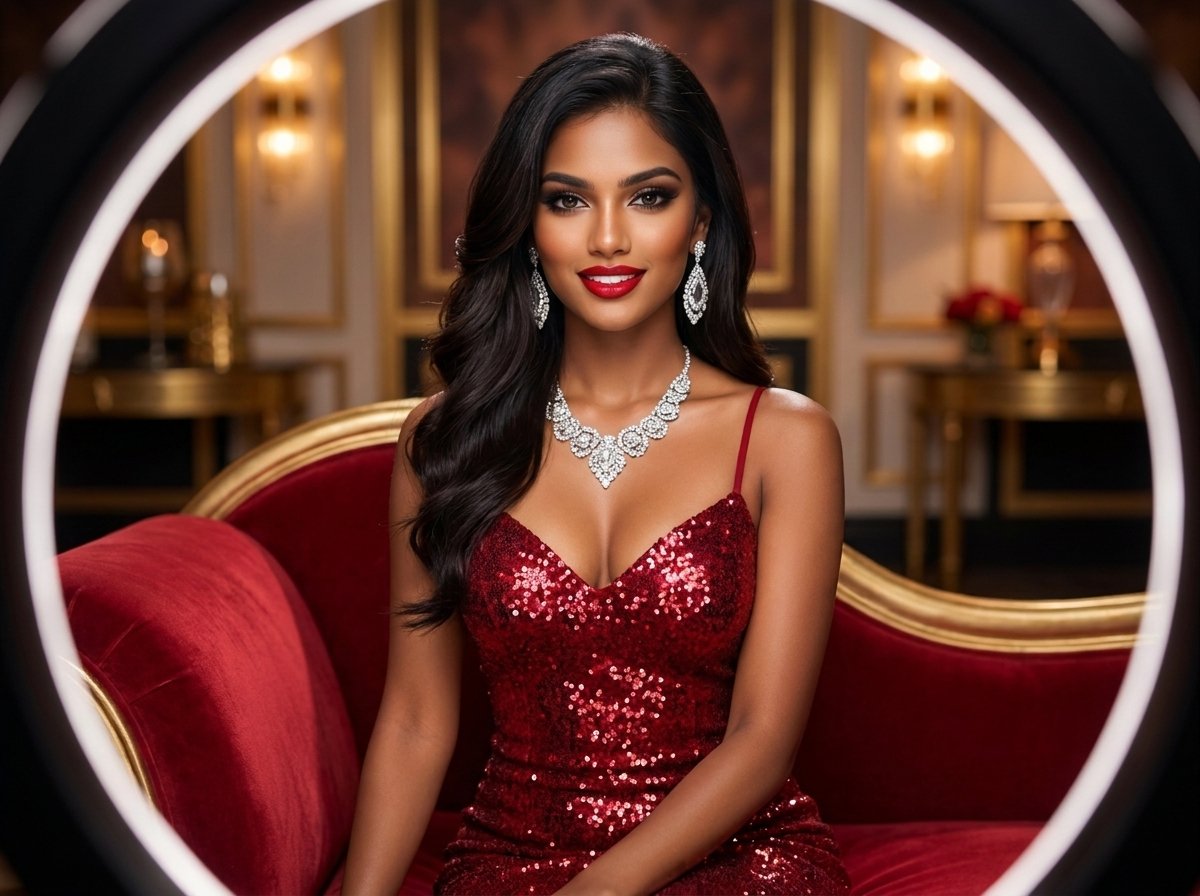
This is the Kardashian archetype. It’s where wealth performed as content, documented in real time, styled to be photographed. Reality TV Royalty treats the outfit as a plot point. Full glam is a must, the silhouette is always body-conscious, and the brand is always identifiable.
Influencer Elite

A faster-moving cousin of Reality TV Royalty, built for the feed. This archetype lives in "get ready with me" videos, unboxing hauls, and airport fits. The wardrobe skews younger and trend-forward, cycling faster than any other archetype here. Where Reality TV Royalty performs an established empire, Influencer Elite is often still building one.
Athlete Wealth
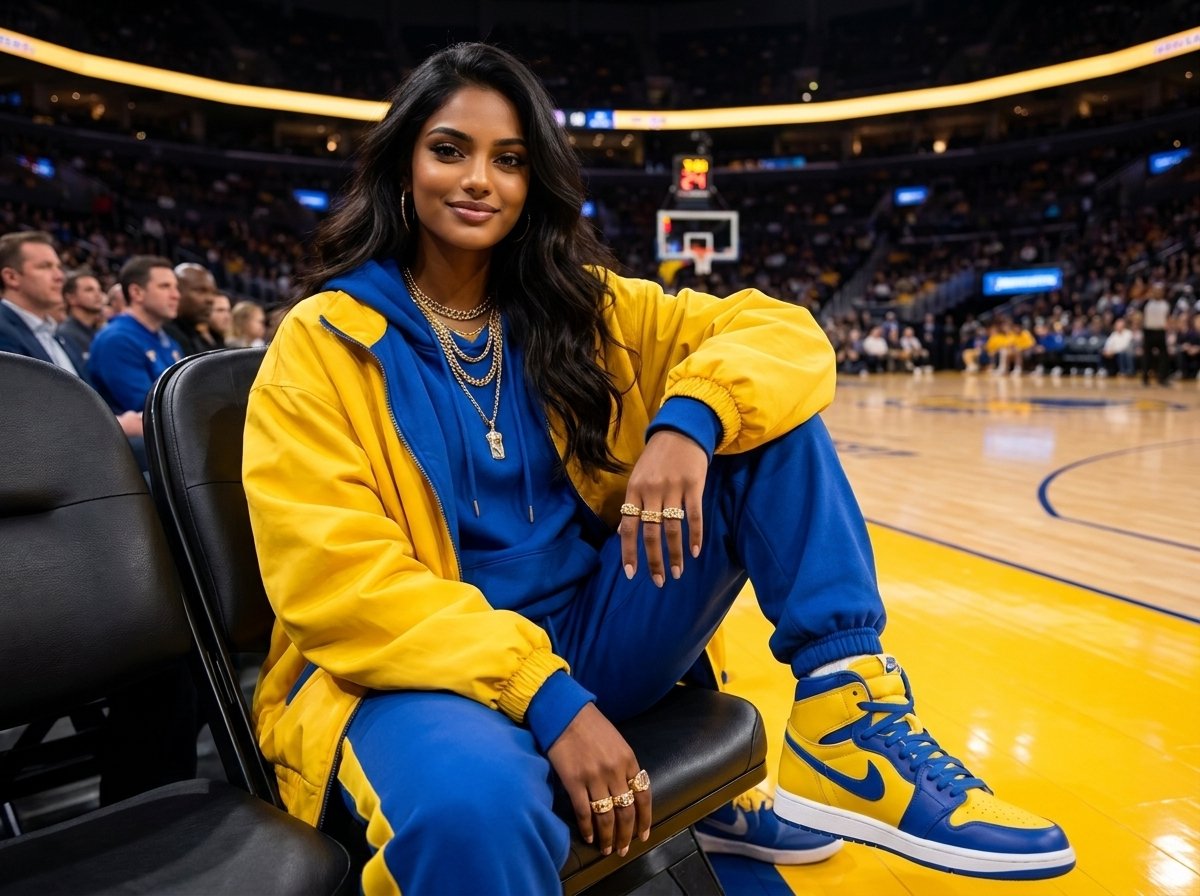
Athlete Wealth runs on a different clock than the others. It’s a career with a hard expiration date, which shapes the whole aesthetic. The spending is fast and big, including things like custom jewelry and a rotating car collection. Streetwear and luxury sit side by side here because sneaker culture and high fashion collapsed into the same category years ago.
The Wardrobe
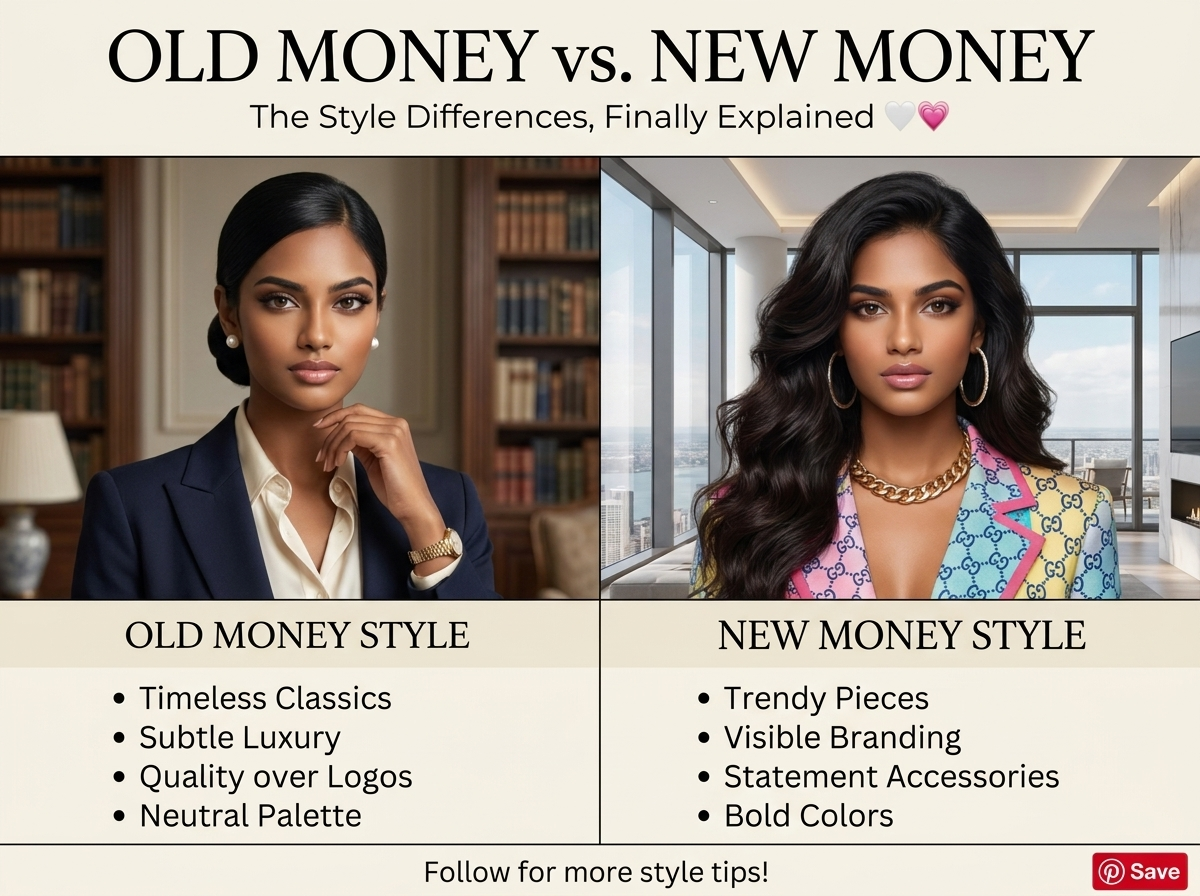
Where an Old Money close grows over decades, a New Money wardrobe is almost instant.
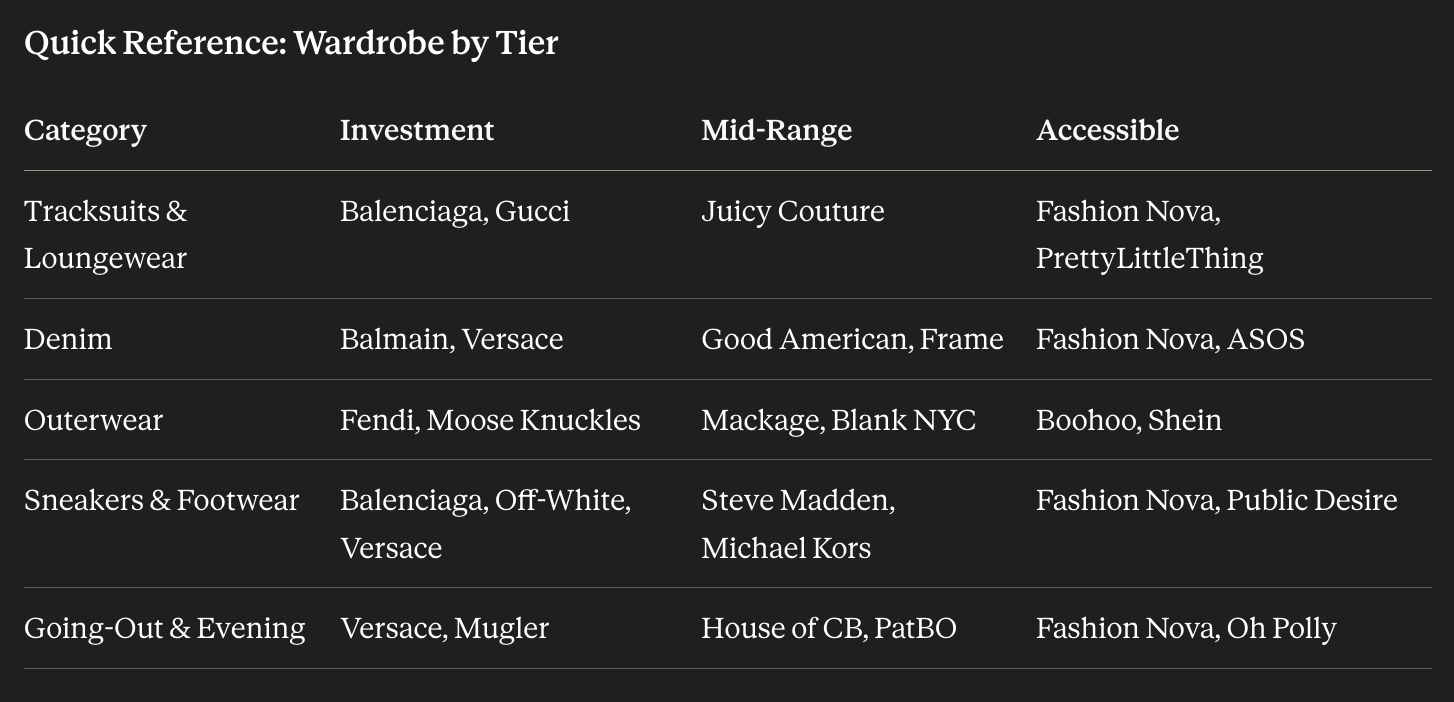
Tracksuits & Loungewear
This is New Money's founding garment, and its most Paris Hilton–coded category by a wide margin.
At the top, Investment-tier tracksuits come from Balenciaga and Gucci, velour and technical fabrics elevated into runway pieces.
Mid-range, Juicy Couture remains the category's spiritual home.
Accessible-tier loungewear comes from Fashion Nova and PrettyLittleThing, matching sets built for visibility rather than durability.
Denim
New Money denim skews toward fit and finish that photographs well: rhinestone embellishment, bold washes, visible branding on the back pocket or waistband.
Investment-tier denim comes from Balmain and Versace, where the logo hardware does as much work as the cut.
Mid-range lands with Good American and Frame, both known for the kind of fit that flatters in a full-body mirror selfie.
Accessible-tier denim comes from Fashion Nova and ASOS, leaning into trend-forward washes and embellishment over longevity.
Outerwear
Outerwear is where New Money gets its most literal about scale, fur, faux fur, and oversized silhouettes that stand out even from a distance.
Investment-tier pieces come from Fendi and Moose Knuckles, heavy on fur trim and branded hardware.
Mid-range lands with Mackage and Blank NYC, delivering the same silhouette logic at a more accessible price.
Accessible-tier outerwear comes from Boohoo and Shein, faux-fur and oversized puffers built for maximum visual impact.
Statement Sneakers & Footwear
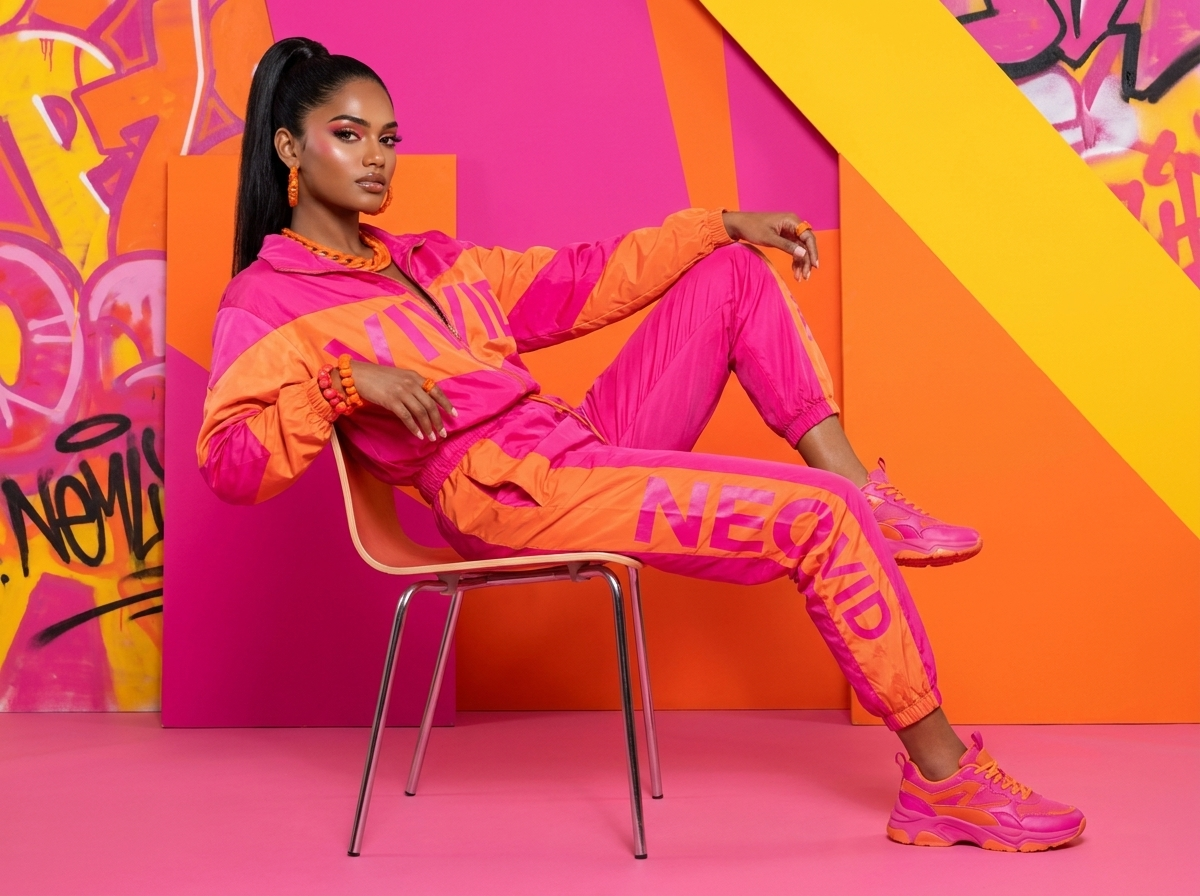
Footwear in this aesthetic isn't about comfort-first minimalism. The shoe needs to be noticed before the rest of the outfit registers.
Investment-tier picks are Balenciaga's Triple S, Off-White sneakers, and Versace's chunky heeled sandals, all oversized or logo-heavy.
Mid-range lands with Steve Madden and Michael Kors, delivering platform heels and chunky sneakers at a fraction of the price.
Accessible-tier footwear comes from Fashion Nova and Public Desire, fast-turnaround takes on whatever silhouette is currently trending.
Going-Out & Evening Pieces
This is the category built for maximum visibility under the worst possible lighting which is exactly why rhinestones, sequins, and bodycon silhouettes dominate.
Investment-tier evening pieces come from Versace and Mugler, body-conscious cuts with hardware and crystal embellishment catching light.
Mid-range lands with House of CB and PatBO, delivering the same silhouette and shine at a more attainable price point.
Accessible-tier comes from Fashion Nova and Oh Polly.
New Money doesn't care what something costs so much as it cares that the cost is legible. Investment, mid-range, or accessible — every tier is playing the same game. The only thing that changes is the price of entry.
What are the key pieces in a New Money wardrobe?
A New Money wardrobe centers on five categories: tracksuits and loungewear, embellished denim, fur or oversized outerwear, statement sneakers, and going-out pieces with rhinestones or sequins.
Jewelry & Accessories
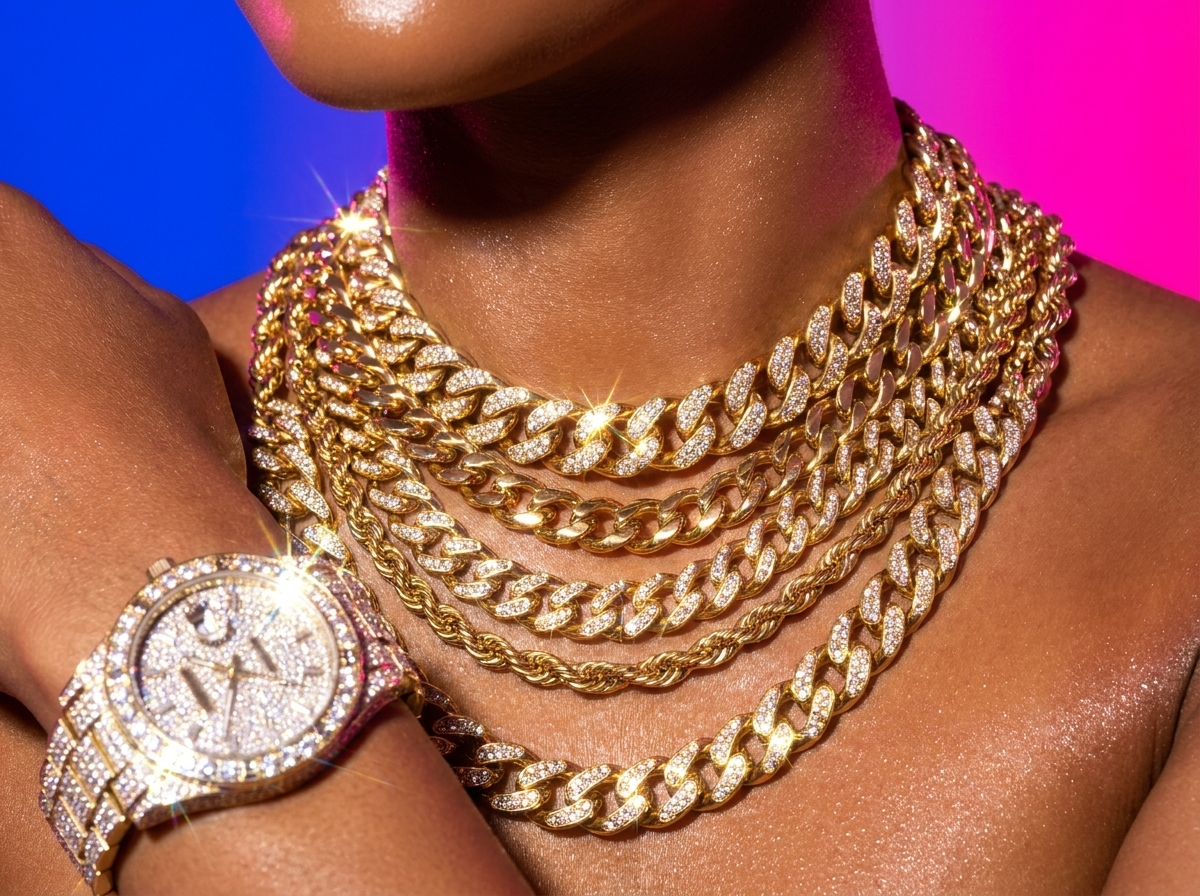
If clothing is where New Money makes its first statement, jewelry is where it makes its loudest one.
Taste isn’t the goal. It’s looking expensive.
The watch is the anchor piece, and it does something almost opposite to what an Old Money watch does. An Old Money watch is often a slim, classic face. You’d only recognize it if you already knew what you were looking at.
A New Money watch wants recognition from people who don't know what they're looking at. Iced-out cases, oversized faces, diamonds set into the bezel. You shouldn't need expertise to clock what it cost.
Chains follow the same logic, and layering is what separates New Money jewelry from a single "nice piece." One gold chain is an accessory. Three or four, at different lengths and link weights is the same "more is more" instinct that runs through Maximalism, applied to the neck and wrist.
Bracelets and rings get the same treatment: stacked, mixed, occasionally mismatched.
Even the materials skew toward maximum visual impact. Where Old Money reaches for a single strand of pearls or a thin gold band, New Money reaches for cubic zirconia and lab-grown diamonds at a scale that would be financially reckless in fine jewelry.Size and shine matter more here than the provenance. Nobody's asking to see the appraisal.
Taken together, New Money jewelry is unlike almost every other category in this pillar. It's the one place where more is more confident, not more excessive.
What jewelry defines the New Money aesthetic?
New Money jewelry favors visible impact over subtlety: iced-out watches with oversized faces, layered gold chain stacking, and mixed rings and bracelets.
How Old Money Brands Appeal to New Money
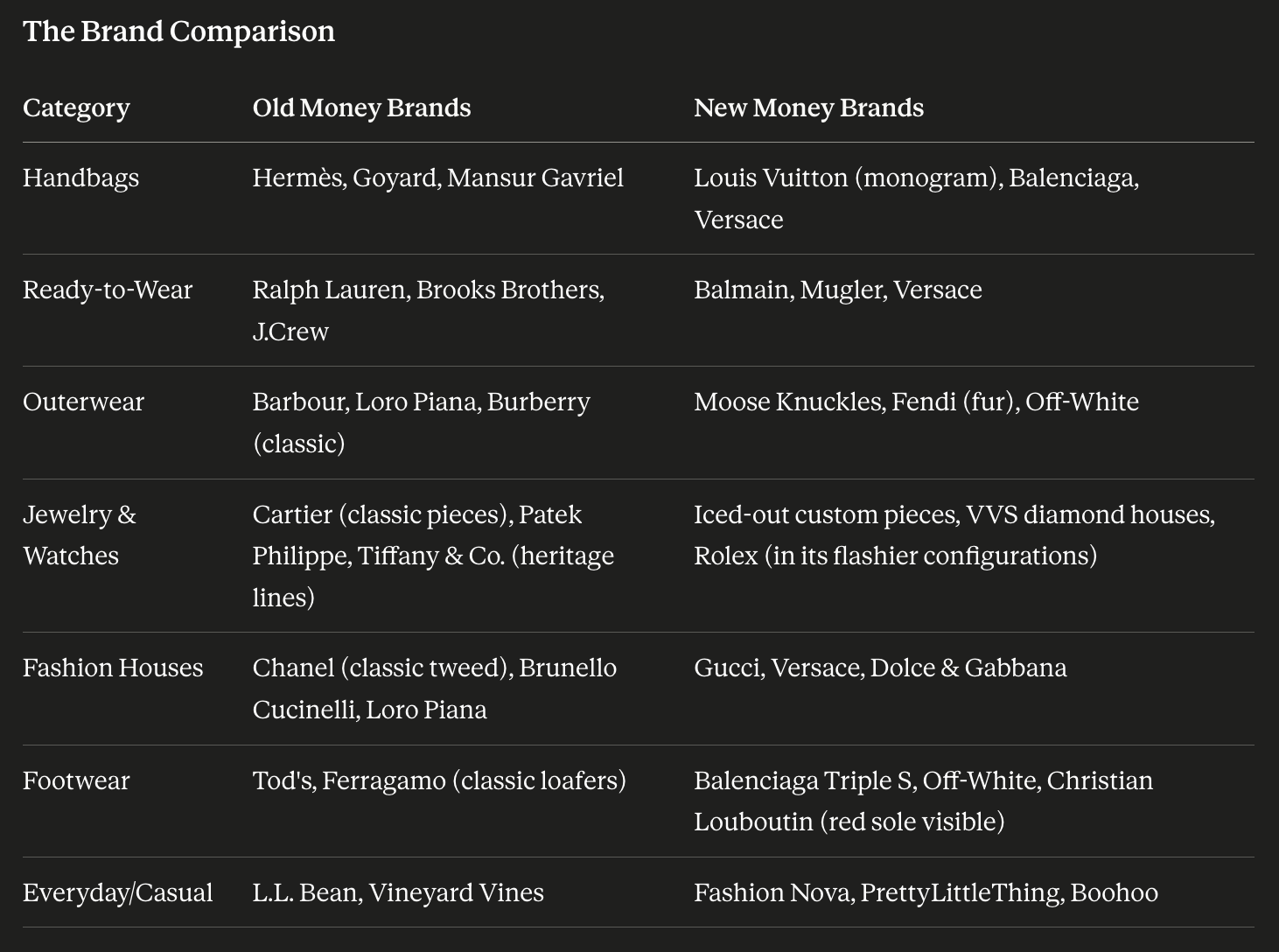
Plot twist: a lot of New Money spending goes toward Old Money houses.
Old Money brands carry institutional history. You can’t just walk into a store and purchase a Birkin bag. You have to get on a waitlist. You can’t buy the system the way a Balenciaga bag can. Owning a Birkin signals that you're not just rich, you're in.
For New Money, that borrowed legitimacy is often worth more than another visibly branded piece. This is also where the two aesthetics blur in practice.
New Money buyers reach for Chanel, Cartier, or Loro Piana specifically because those houses read as Old Money. The difference is in the styling. Old Money wears a Chanel flap bag with jeans. New Money wears the exact same bag with the receipt practically still attached and positioned as the clear centerpiece.
"Old money laundering" is spending New Money the way Old Money would to borrow the credibility that comes with it.
Beauty
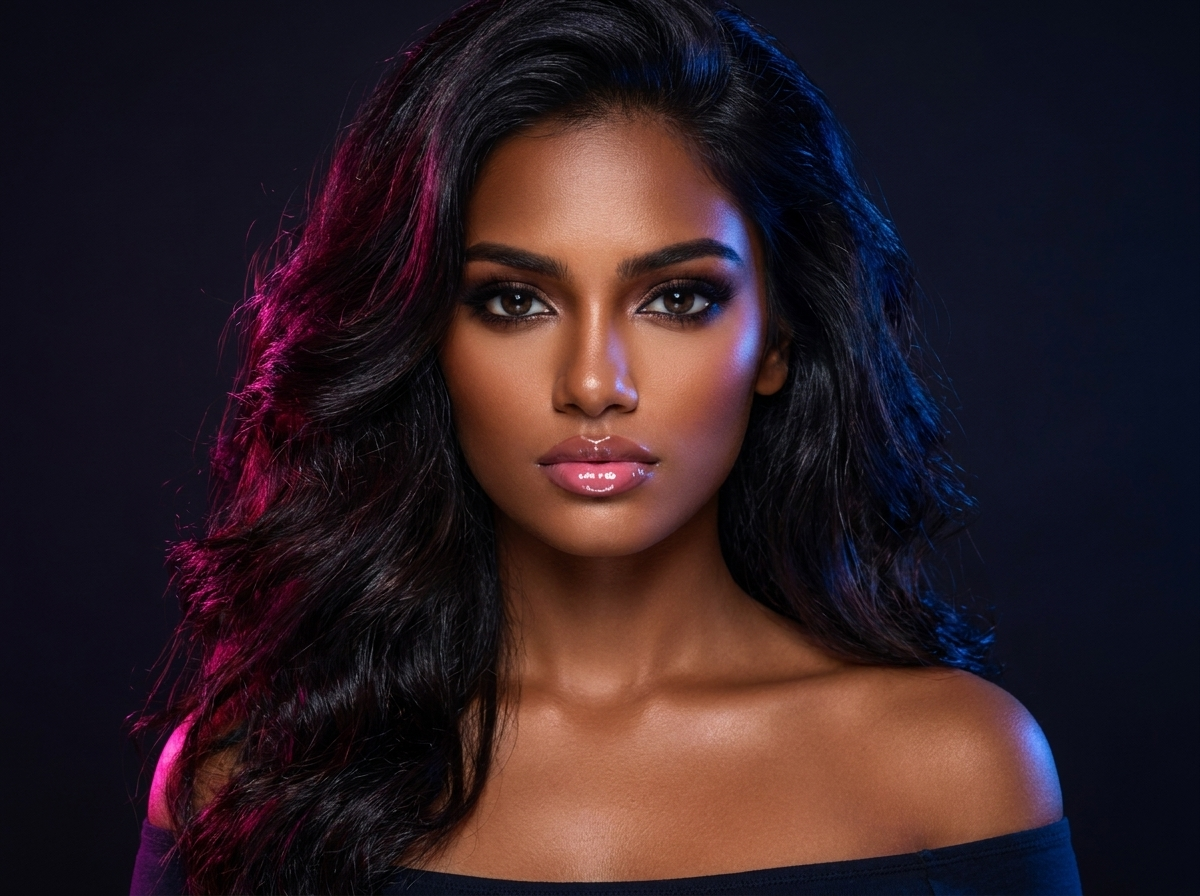
New Money beauty isn’t interested in illusion, and honestly, why would it be?
Where Old Money beauty chases the "no-makeup makeup" look, the sheer skin and barely-there flush. New Money beauty treats visiblility effort as its own flex. Think contour that reads from across a room and lashes with length and density. They're proof that time, money, and skill went into the result, the same way a logo proves a bag's price tag.
Tan does a lot of quiet work here too, and it's worth calling out on its own. Old Money's relationship to color is muted everywhere, skin included. New Money's tan is deep, and year-round, achieved through spray tanning or tanning beds. It's less about a day at the beach and more about a permanent, maintained bronze.
Hair follows the same logic: length, volume, and shine pushed past what grows naturally. You’ll find extensions, blowouts, and glossy, high-shine finishes are standard. The hair took time, and should look like it.
Nails are arguably the clearest beauty signifier in the entire aesthetic: long acrylics, bold color, elaborate nail art, and rhinestone or chrome finishes. New Money nails are to be seen at every gesture.
Fragrance follows the same volume logic as everything else: sweet, projecting scents from Tom Ford, Viktor & Rolf, or Juicy Couture's original perfume line, worn generously enough to be part of someone's memory of you.
Put it all together and the pattern repeats one more time: Old Money beauty hides the labor. New Money beauty puts it on display.
What does New Money beauty look like?
New Money beauty embraces visible effort: full glam makeup, deep year-round tans, voluminous glossy hair, long bold acrylic nails, and projecting fragrance.
Cultural Context — Why New Money Gets Mocked (and Shouldn't Be)
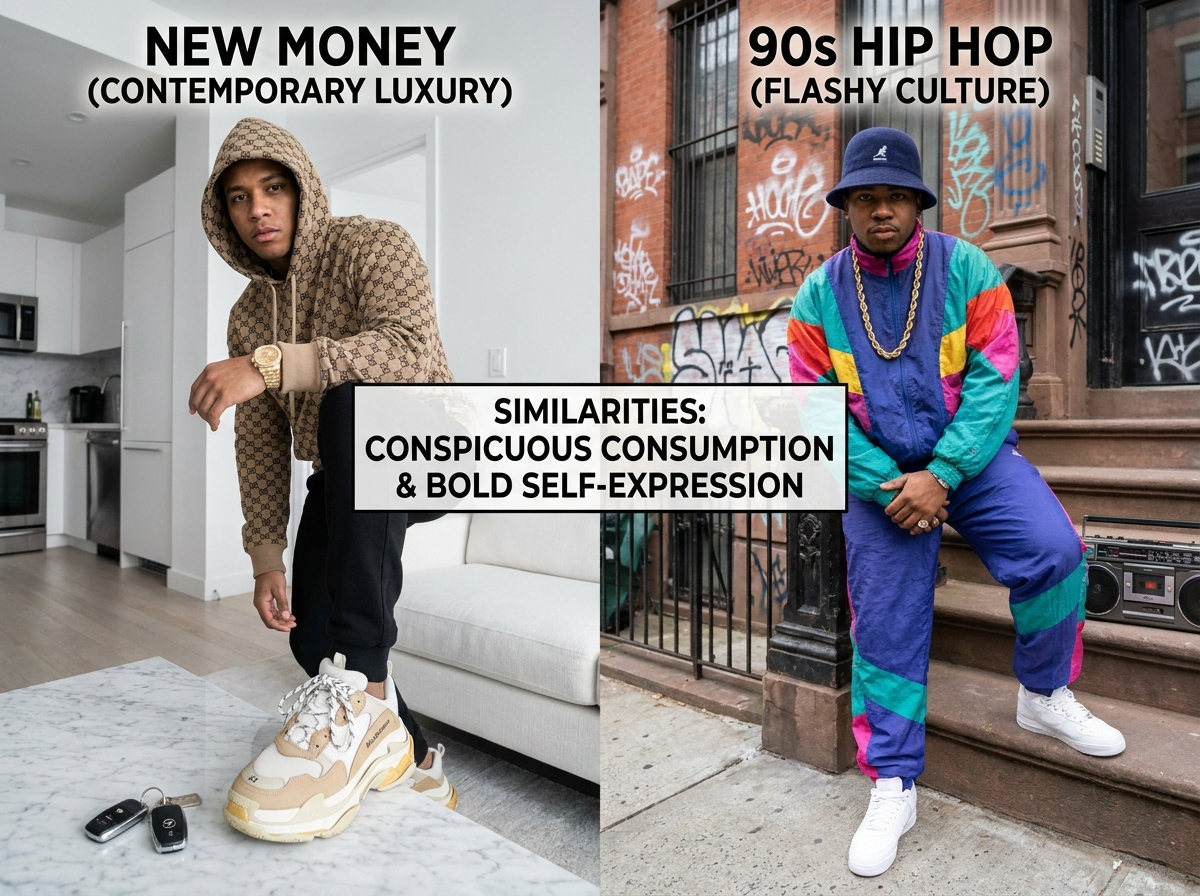
The word "tacky" does more work than most people realize.
The official, fancy term for "performative buying" is conspicuous consumption. A sociologist named Thorstein Veblen coined this phrase back in 1899 to describe the ridiculously wealthy tycoons of the Second Industrial Revolution. Ironically, their great-grandchildren now use that very same "Old Money" label to look down on anyone else who dares to show off. Their family wealth just took a few generations to become socially invisible.
And that is where the whole "New Money" mockery comes from. "Old Money" has private estates handed down through generations, exclusive clubs with snobby waitlists, and complex trust funds that move millions around like secret agents in the night.
First-generation rich people don't inherit any of that infrastructure. They have to prove they have made it from scratch, in the public eye, without a family name backing them up. For them, buying high-end, visible stuff was the only way to show the world they’ve made it.
When it comes to hip-hop, this flashy aesthetic gets targeted the most, often with a heavy dose of racial bias. However, academic research completely busts this myth. Studies on materialism and hip-hop culture show that buying flashy luxury goods correlates more with being a hip-hop fan than with race.
Hip-hop fashion emerged in the late 1970s in the Bronx, shaped by the street culture of Black and Latino communities. Harlem tailor Dapper Dan fused designer logos like Gucci, Louis Vuitton, and Fendi into custom streetwear for a clientele that mainstream luxury houses weren't courting and, in some cases, actively suing him over. It's funny that Dapper Dan's remixed logo work was a legal problem in the '80s and a Gucci creative partnership by 2017. The same visual language, valid only once the fashion establishment decided it wanted in.
The full "bling era" crystallized in the late '90s and 2000s. Tupac Shakur and The Notorious B.I.G. brought luxury brands like Versace, Tommy Hilfiger, and Polo Ralph Lauren into hip-hop's wardrobe, and by the early 2000s, artists including Jay-Z, 50 Cent, and Nelly popularized a flashier style built around diamonds, oversized chains, and designer labels.
Contemporary media framed “bling” as excess or poor impulse control. The behavior (spend visibly, prove the wealth is real) was identical to what Gilded Age industrialists did a century earlier. Cultural critics note how ridiculous it is to treat a rapper's diamond teeth as less respectable than a Gilded Age tycoon's fifty-room mansion.
How It Shaped New Money
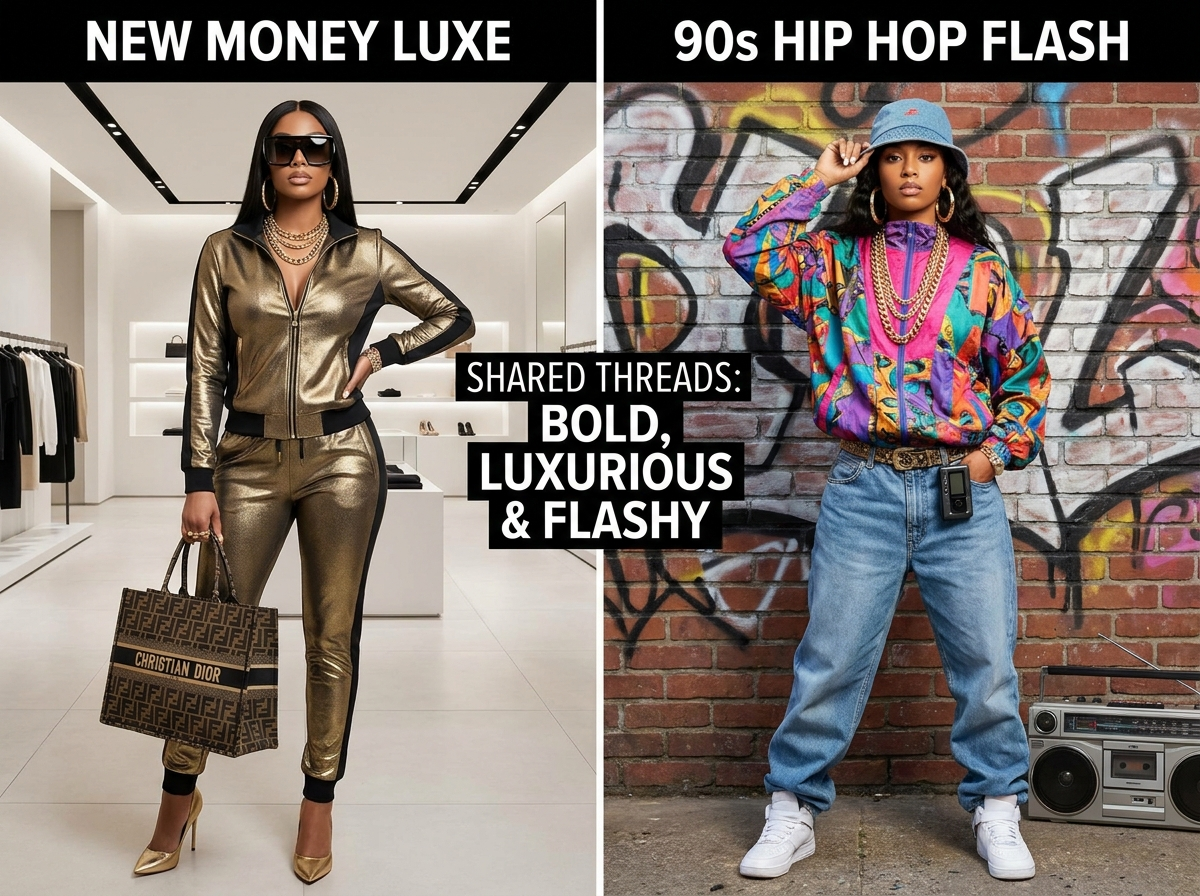
New Money as a mainstream style didn't originate independently of hip-hop's bling era. It borrowed its entire visual vocabulary from it.
The chain stacking, the logo-forward wardrobe, the oversized watch… all of that was hip-hop's template first, normalized through the '90s and 2000s before crossing over. By the late 1990s and early 2000s, artists like Missy Elliott and Diddy were setting trends in velour tracksuits, bling jewelry, and designer brands. The look moved out of its originating scene and into suburban malls and department stores.
When Paris Hilton wore a velour tracksuit in 2003, she wasn't inventing a New Money look. She adopted hip-hop’s template that hip-hop and brought to the mainstream. Suddenly, “bling” was no longer gaudy and embarrassing after adoption by white reality-TV culture.
The "flashy unapologetic" aesthetic has a specific point of origin. Pretending it sprang from The Simple Life — erases the explanation why any of it looks the way it does.
Sub-Aesthetics — Regional Flavors of New Money
Like Old Money, New Money doesn't look the same everywhere.
The core philosophy stays constant, but the expression bends hard around geography, industry, and whichever fortune got there first.
Miami & Sun Belt New Money
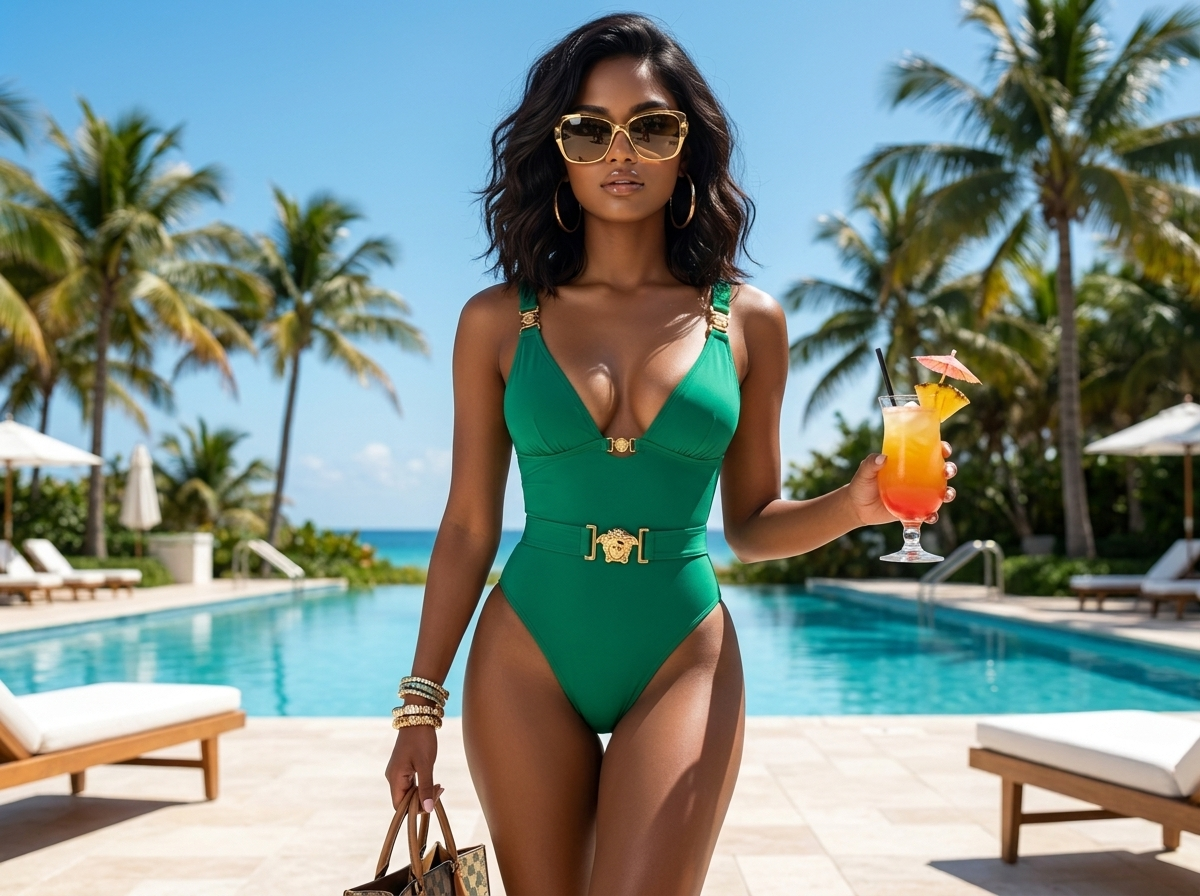
Miami New Money is celebratory.
This is where you’ll find swimwear as outerwear, white and gold as a year-round palette, and a wardrobe that assumes valet parking and outdoor dining.
Sun Belt New Money leans into body-conscious silhouettes and heavy gold jewelry in daylight, because in Miami there’s no line between day and evening wear. Designer bikinis are styled with silk trousers, sheer maxi skirts, oversized sunglasses, and stacks of gold jewelry, making them complete outfits, not just beachwear. Real estate does a lot of the flexing here. The waterfront condo is just as good as a logo bag does anywhere else.
Sun Belt New Money is bright, body-conscious, and glamorous. Metallic gold, turquoise, hot pink, and tropical prints reflect both the climate and the city's energy. You’ll see designer bikinis styled with silk trousers, sheer maxi skirts, oversized sunglasses, and stacks of gold jewelry, making them complete outfits, not just beachwear.
Accessories do much of the storytelling. Chunky gold chains, sculptural earrings, oversized watches, mirrored sunglasses, quilted designer bags, and manicured nails are everyday essentials.
Nowhere else is the line between daywear and eveningwear so blurred. It’s not unusual to find A sequined dress at brunch or a full face of glamorous makeup at noon. In Miami, every meal could become an event.
But perhaps the biggest flex isn't worn at all.
The waterfront condo, the private dock, and the valet stand all communicate status before anyone notices your handbag. Real estate is also an accessory, extending the wardrobe beyond clothing.
Dubai New Money
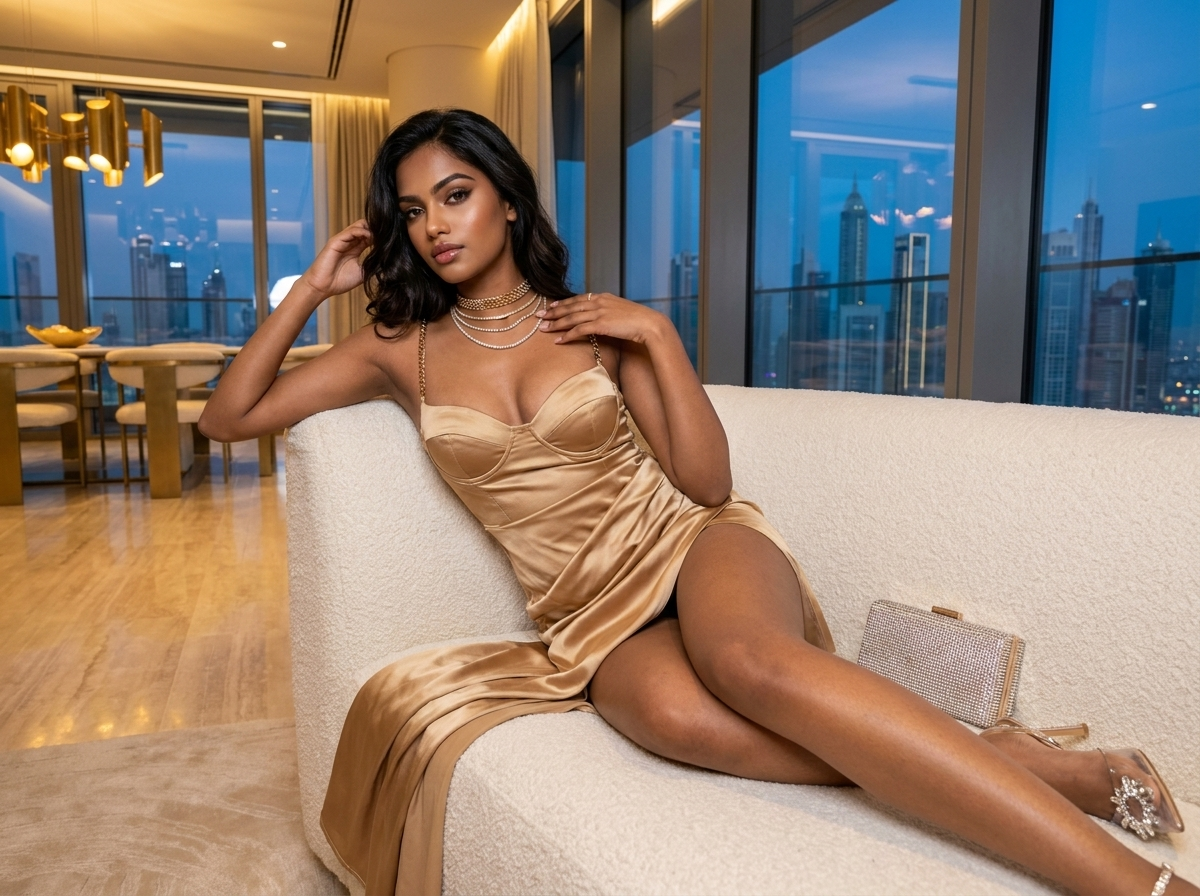
If Miami celebrates luxury, Dubai monumentalizes it.
Dubai represents New Money operating on an entirely different scale, in a city synonymous with architectural ambition and luxury without visible limits.
Extravagance in our world is normal in Dubai. Picture excessive gold everyday, supercars parked outside coffee shops, or entire districts of designer boutiques.
Fashion follows the same philosophy.
Lots of head-to-toe designer looks and layered logos. Couture sits alongside streetwear, while limited-edition handbags and exotic leather goods are everyday wardrobe staples.
The city's international population also creates a global aesthetic. European luxury houses combine Middle Eastern designers, Asian luxury brands, haute couture, and contemporary streetwear for unexpected combinations.
Helicopter arrivals and private islands make up personal style.
Dubai is relatively young. Unlike older financial capitals built over centuries, Dubai's modern identity makes reinvention part of its cultural DNA.
LA New Money

LA New Money is softer than Miami or Dubai. Here you’ll get more athleisure-luxury "I woke up like this" energy. In LA, looking like you're trying too hard reads as insecure. The tell here isn't logo size. It's the car in the driveway, the trainer on retainer, and the house in the hills.
The entertainment industry has trained generations of celebrities to appear accidentally glamorous. It’s fairly easy to achieve. All you need is several hours with personal trainers, dermatologists, nutritionists, stylists, colorists, makeup artists, and personal assistants.
Effortless has become its own luxury. This is where Clean Girl and Minimalist aesthetics were born. It looks simple, but hardly is. An oversized hoodie may cost more than an evening gown.
Unlike Miami's obvious glamour, Los Angeles relies on immaculate basics like monochromatic activewear, cut white T-shirts, and minimalist jewelry that looks deceptively simple…until you notice the label.
Crypto Heiress

The newest dialect, and arguably the purest expression since crypto wealth is, almost by definition, wealth with no history to hide or display.
This look trades old-guard status symbols for tech-forward ones: streetwear elevated with a single absurd accessory (the watch, the sneaker collab, the hoodie that costs more than the car it's worn in), a uniform that reads as casual right up until you clock what any individual piece cost. It's New Money wealth that skipped the country club and went straight to the group chat.
Each of these dialects proves the same underlying point from a different angle: New Money was never one aesthetic wearing different outfits. It's one philosophy, translated locally, by whoever got rich fastest in whatever city or industry happened to be minting fortunes at the time.
Origin Aesthetics
Y2K
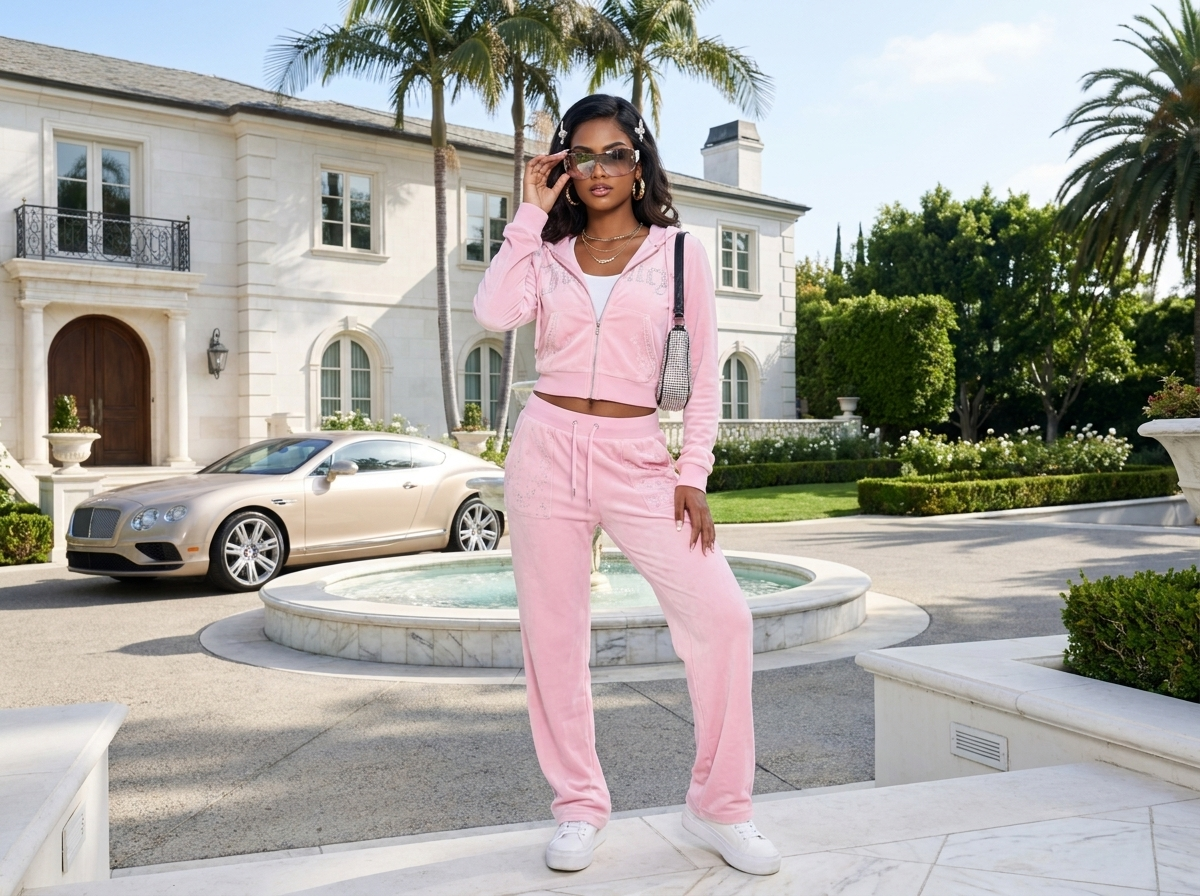
If Miami and Dubai are New Money's geography, Y2K is its point of origin. This is low-rise everything, rhinestone-studded denim, metallic fabrics, tiny sunglasses, and a color story built on baby pink, silver, and electric blue.
Y2K New Money ran on optimism as much as excess. It's also the dialect most directly traceable to a single person: the Paris Hilton era.
What reads today as a nostalgia trend on TikTok was, at the time, what the aesthetic looked like before it had anywhere else to go.
McBling
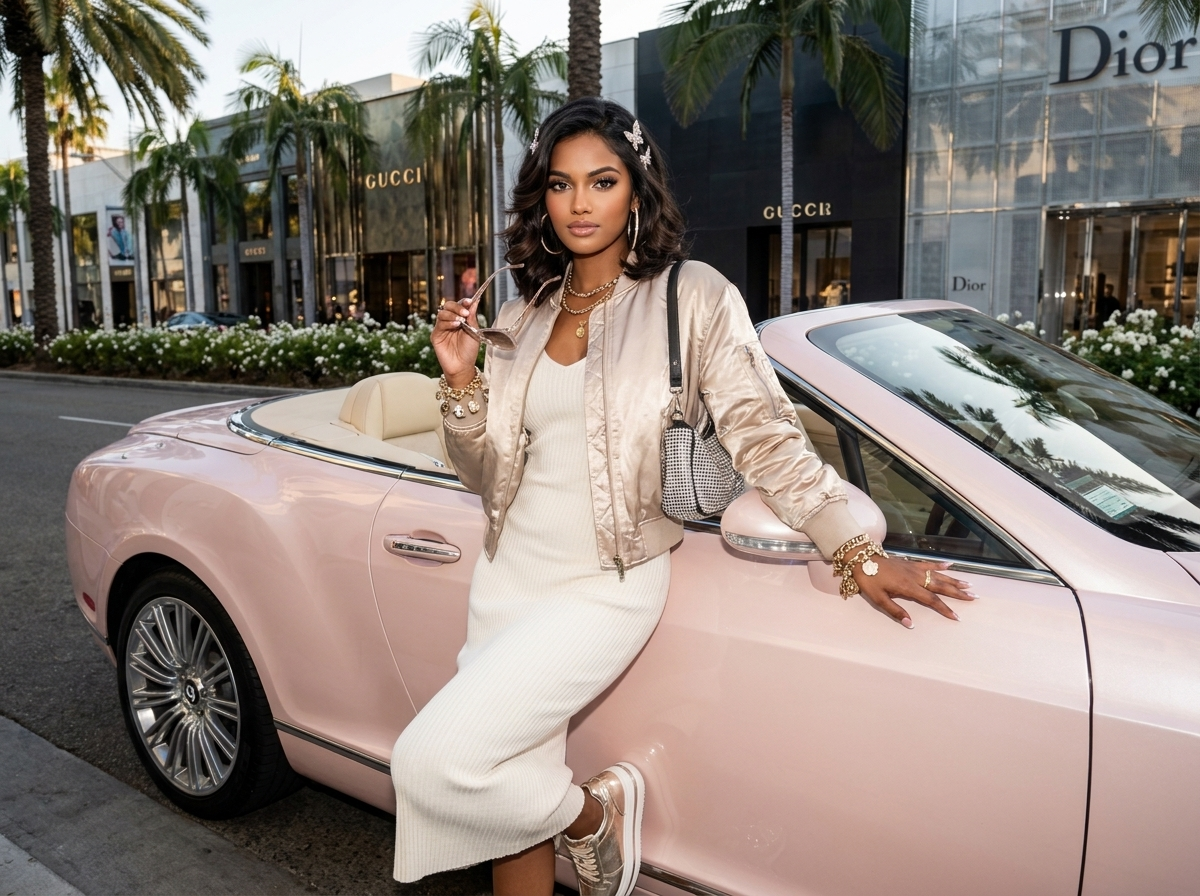
McBling is Y2K's slightly later, slightly more excessive cousin — the mid-2000s moment when the aesthetic fully absorbed hip-hop's bling era and pushed the whole look toward maximum visible spend.
Think platinum and diamonds replacing gold, oversized logo bags as status trophies, and velour tracksuits worn as outerwear. The name itself is a dig ("McBling" implies mass-produced, fast-food-grade flash) but it's the moment New Money's two major bloodlines (Y2K celebrity culture and hip-hop's luxury era) merged into the template this entire pillar has been describing.
What is McBling fashion?
McBling is a mid-2000s New Money sub-aesthetic that merged Y2K celebrity style with hip-hop's bling era — platinum and diamond jewelry, oversized logo bags, and velour tracksuits worn as maximal status symbols.
New Money vs. Adjacent Aesthetics
New Money gets lumped in with a handful of other aesthetics that share a piece of its DNA but conflating any of them flattens what makes each one distinct.
New Money vs. Mob Wife
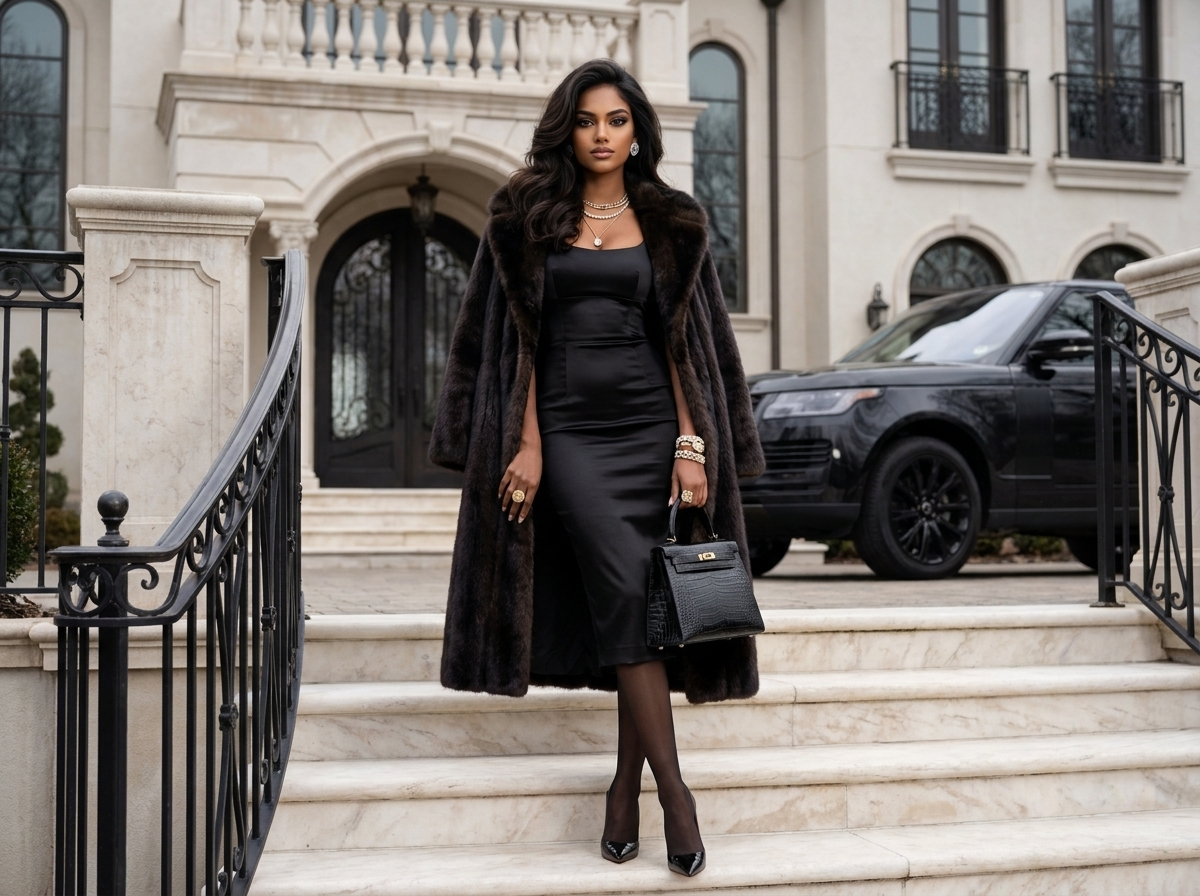
Mob Wife is probably most frequently mistaken for New Money, and you can see why with its prominent fur, gold jewelry, and bold color.
New Money is about proving the money is real and recent. Mob Wife is wealth with a backstory it isn't explaining, glamour with implied danger underneath.
New Money wants you to ask so it can tell you. Mob Wife wants you to know better than to ask.
New Money vs. Barbiecore
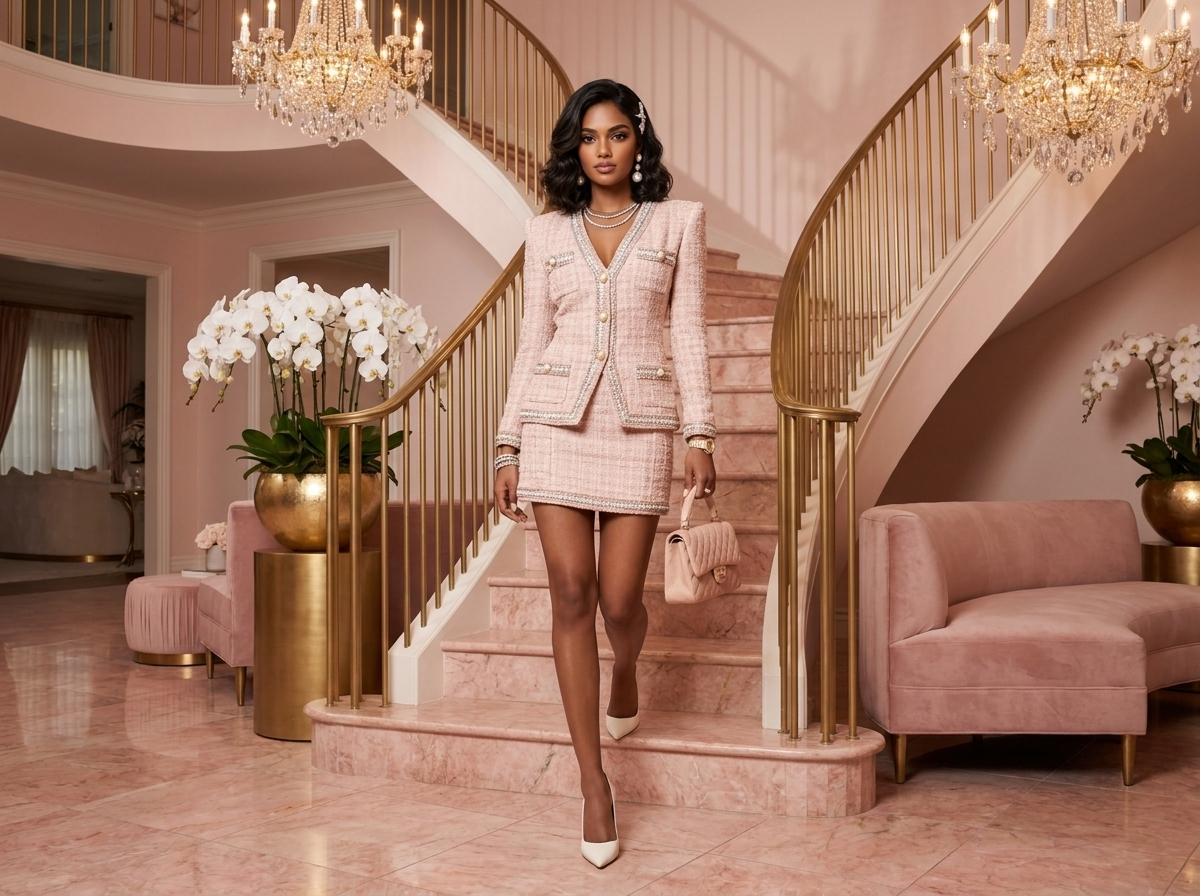
Barbiecore and New Money share a color palette.
That's where the resemblance ends. Barbiecore is playful and self-aware, borrowing from a toy's aesthetic and in on its own joke.
New Money's boldness is sincere. A hot pink logo bag in a New Money outfit is just what confidence looks like here.
New Money vs. Quiet Luxury
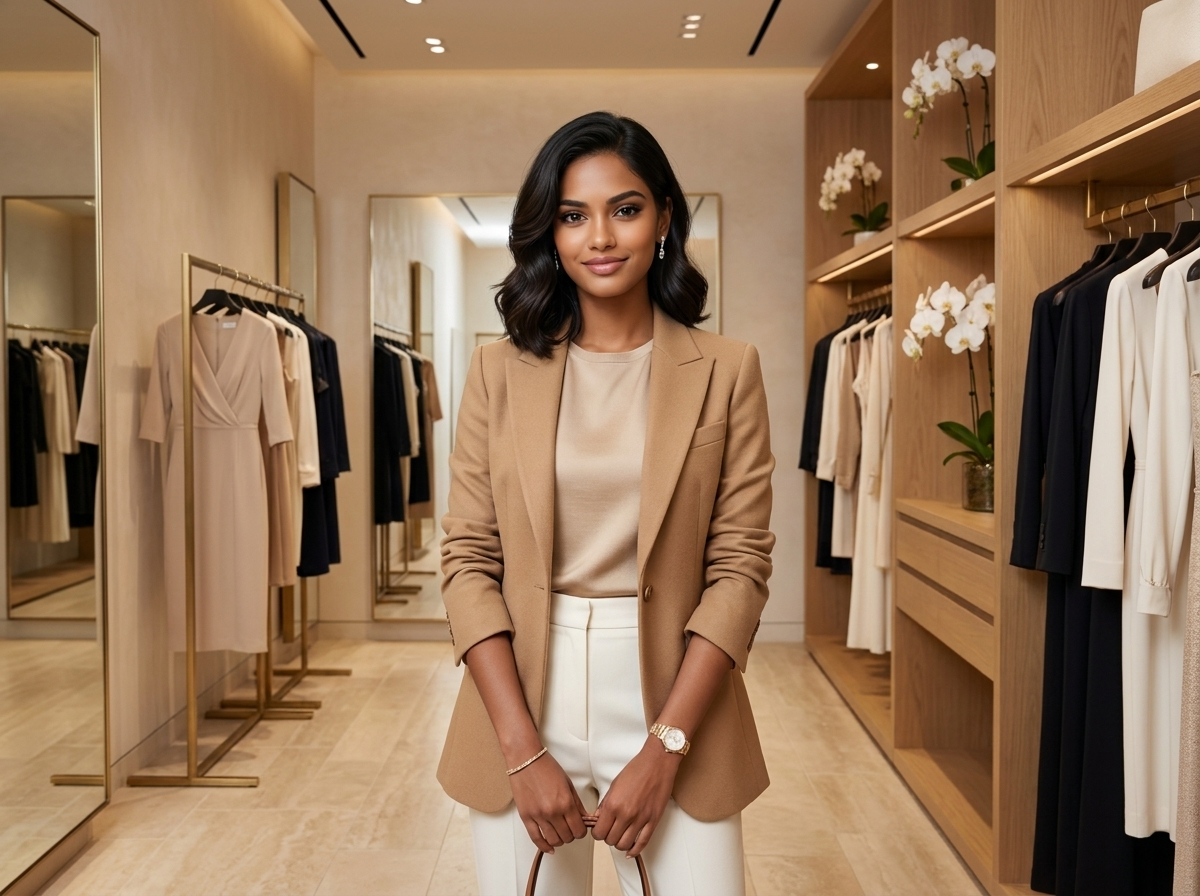
This is less a comparison than a direct opposition. Quiet Luxury is Old Money's aesthetic principles rebranded for a newer audience.
Where New Money reads as loud and trendy, Quiet Luxury is muted and timeless.
New Money vs. Maximalism
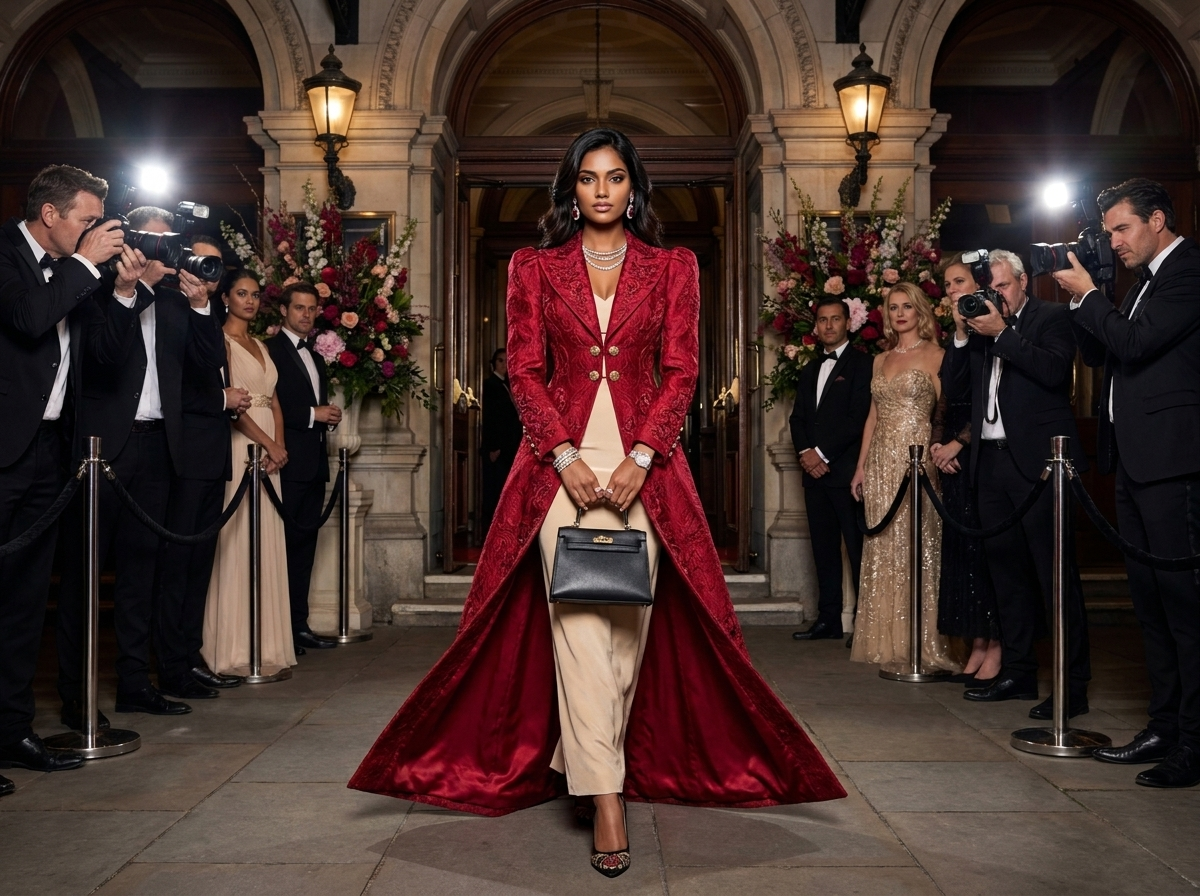
This one runs deepest, because New Money is a subset of Maximalist philosophy applied to wealth display.
Maximalism as a broader aesthetic is more about pattern and color than visible spending. New Money borrows Maximalism's volume and turns it toward status. Every excess piece communicates cost. General Maximalism is just as happy to rock a thrifted pattern.
Related philosophy, different mission.
Conclusion
New Money was never Old Money's rough draft. Old Money protects. New Money proves.
What should be clear by now is how much history is underneath all that shine. It didn't start with Paris Hilton's tracksuits or the Kardashians' feeds.. It runs back through McBling and Y2K, through hip-hop's bling era and Dapper Dan's Harlem tailoring, through Gilded Age industrialists.
New Money is already splitting into dialects the same way any aesthetic with real staying power does. It shares DNA with Maximalism, Barbiecore, and Mob Wife, borrowing and lending traits back and forth. Wherever a new fortune gets built next New Money will be there first, showing its work.
