
Mod: When London Swung and Fashion Never Recovered
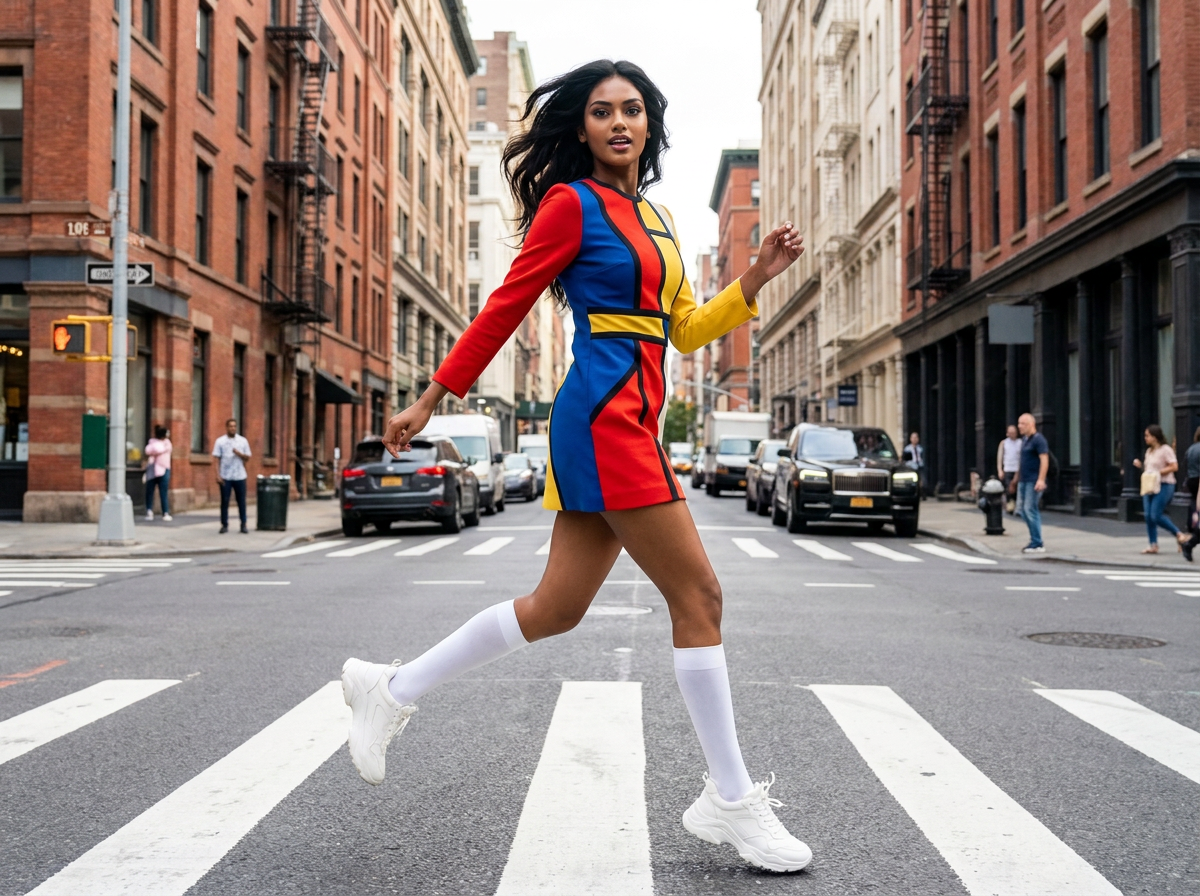
There is a hilarious confidence in deciding that history is done with you before you are done with it. That was the ultimate power move of the Mod movement in London. It was a loud, stylish "no thanks" to their parents' boring, postwar lives.
It’s technically true that Mod is a “fashion trend”, but it also misses the drama. Mod actually started in late 1950s London as an argument about social class and modern life. The name "Mod" is short for "modernist," a term stolen from jazz nerds. Soon, "modern" meant wearing sharp, geometric shapes instead of frilly flowers. It was the first time teenagers decided that "new" was the compliment, long before tech billionaires made the same claim.
What makes Mod deserve its own spot in the fashion hall of fame is how rudely it rejected every rule that came before it. The 1950s had softened everything up with spinny skirts and tiny pinched waists. Mod took one look at that look and threw it in the recycling bin. Shift dresses didn't pinch, A-lines didn't curve, and hair didn't wave. Hard structures replaced soft fabrics.
Mod Subculture vs. Mod Aesthetic: What's the Difference?
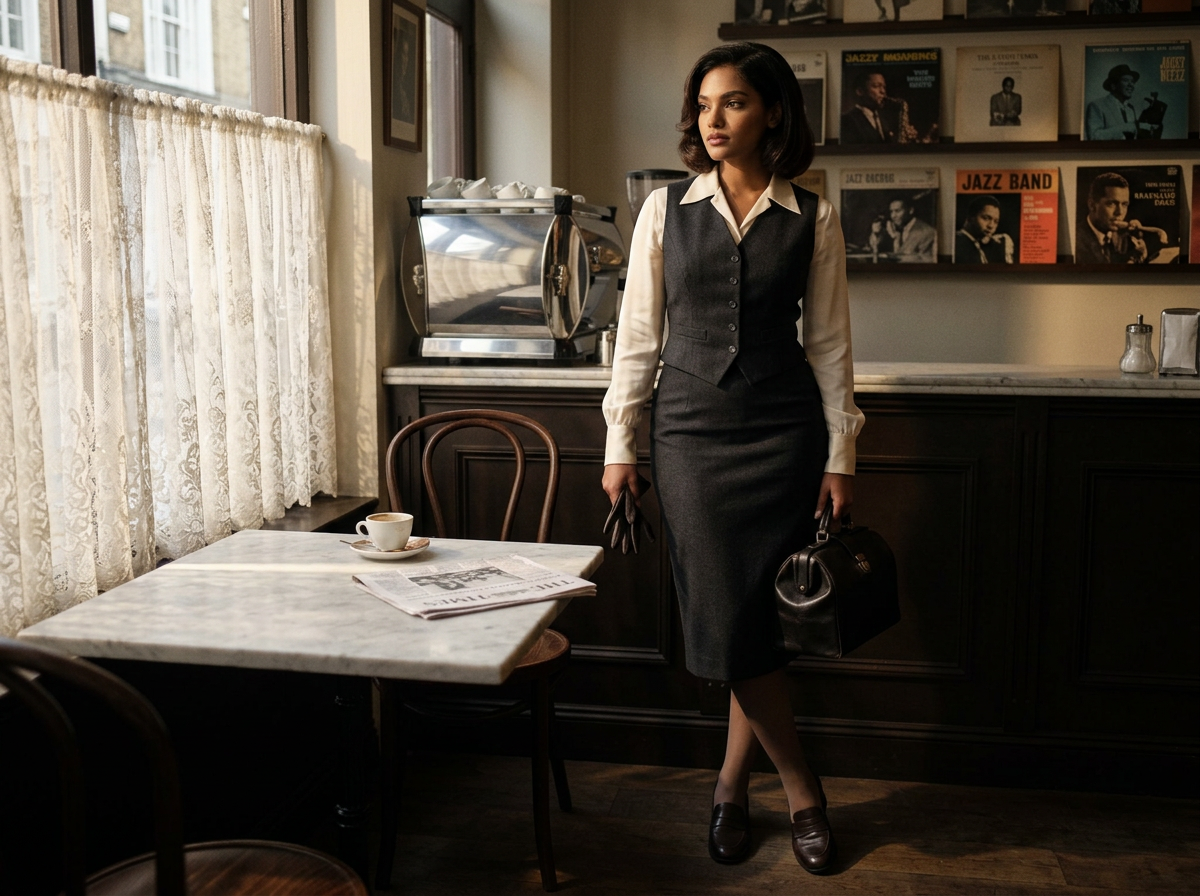
We need to separate two concepts here, because lazy history books always lump them together: the Mod subculture and the Mod aesthetic are not the same thing. The subculture came first to the gritty streets of London. These were working-class teenagers—mostly guys—who spent their paychecks on custom-tailored suits to look sharper than the rich kids. Their look was skinny collars, perfect creases, and scooters covered in mirrors because they couldn't afford real cars.
The version you see on magazine covers and draped over the famously skinny model Twiggy kept the cool shapes and the rejection of the past, but it watered down the angry class politics into something more mainstream. It became a look rather than a lifestyle. That’s what happens when mainstream culture gets its hands on something cool.
The Mod Visual Grammar: Geometry, Contrast & Structure
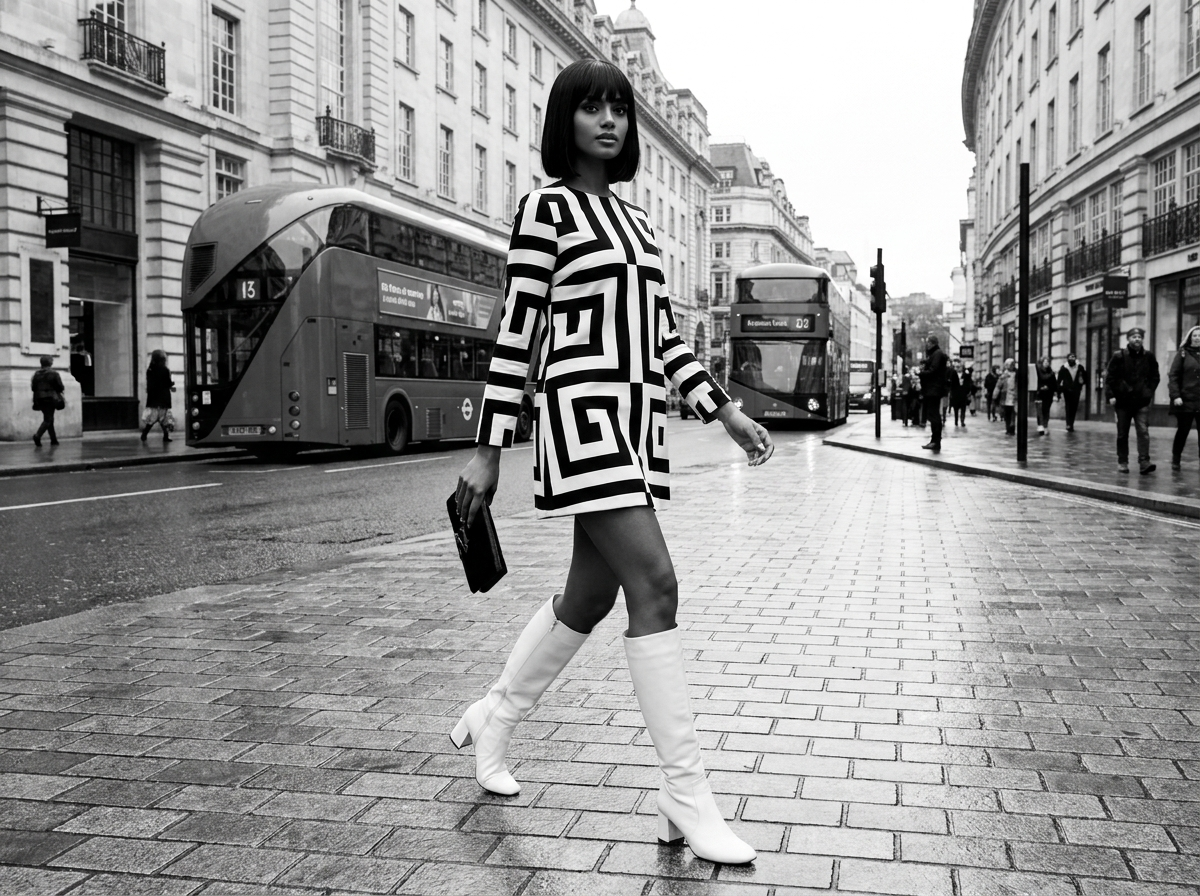
Still, the basic rules of the style survived the swap.
First, shapes over decorations—think repeating checkerboards instead of delicate floral prints. Second, high-contrast colors—harsh black against bright white, or primary colors slamming into each other. Third, structure over floppiness—the clothes should always hold their shape, which is the opposite of the hippie-boho look. These kids dressed like they were waiting for a ride on the Apollo rocket.
That goofy optimism is why Mod has aged so well. It returns whenever optical art prints hit the runway, and it lives on in every sharp bob haircut. Unlike "cottagecore" or "coastal grandmother," we already know Mod by heart.
However, do not assume this makes it easy to wear. A shift dress that doesn't fit perfectly just makes you look like you are wearing a laundry hamper, and a bright graphic print without discipline looks like a headache. It demands total commitment and punishes anyone who tries to half-bake it.
History & Cultural Context
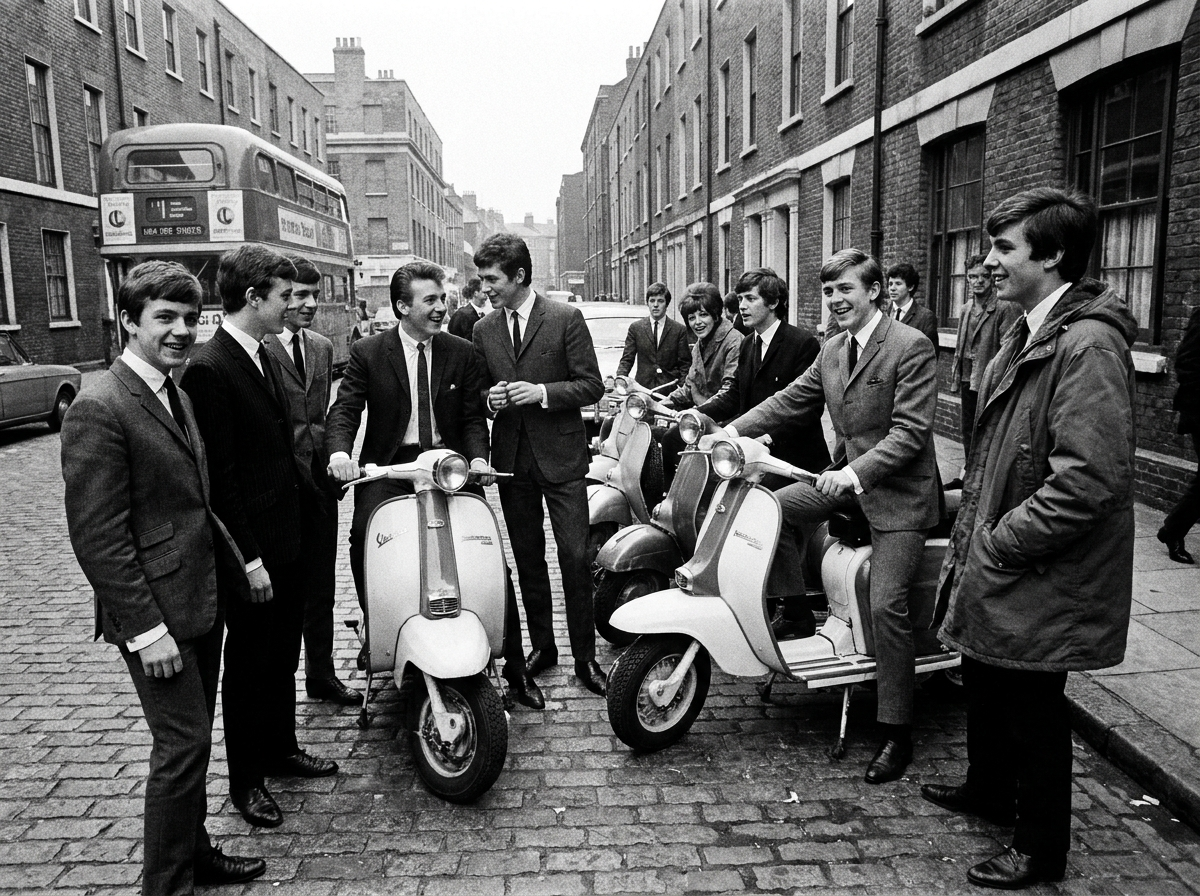
To understand Mod, we have to start with the historical ground it grew out of.
In the late 1950s, Great Britain was still recovering from World War II. Food rationing didn’t even fully end until 1954. Culturally, this created an atmosphere of exhausted conservatism. It was a generation that had earned the right to be tired, and their wardrobe showed it with charcoal grey suits and stiff raincoats. Nobody dressed for the future; they dressed for Monday morning.
Into this incredibly boring, grey climate stepped a bunch of mostly working-class London teenagers who wanted nothing to do with it. They wore pointy "winkle-picker" shoes and got meticulous, expensive haircuts instead of letting their hair grow wild. This aggressive neatness was a middle finger to both their parents' depressing wardrobes and the greasy, leather-jacket-wearing Rockers they picked fights with.
The Birth of Mod-the-Subculture
This was the birth of Mod-the-subculture, and it was about class before it was about clothes. These kids were office boys and apprentices with tiny wages. Spending almost all their money on fancy tailoring was their way of making a statement. A Mod who could out-dress a wealthy businessman on a fraction of his budget was claiming that anyone deserved to look beautiful. They did the same thing with their Vespas and Lambrettas, loading them with extra mirrors and lights until they looked like rolling art pieces. The scooter was a status symbol for kids who couldn't afford luxury cars.
Underneath all of this was the music. They obsessed over American soul, Jamaican ska and bluebeat, and early British R&B. Notably, this was all Black music imported from overseas at a time when British youth culture didn't have many other ways to hear it. This is super important because the Mod relationship with Black music and style was a mix of love and cultural borrowing (or stealing) that follows it.
It's a pattern we see all the time in history, and we aren't going to pretend it didn't happen here.
Mary Quant, Twiggy & the Boutique Takeover
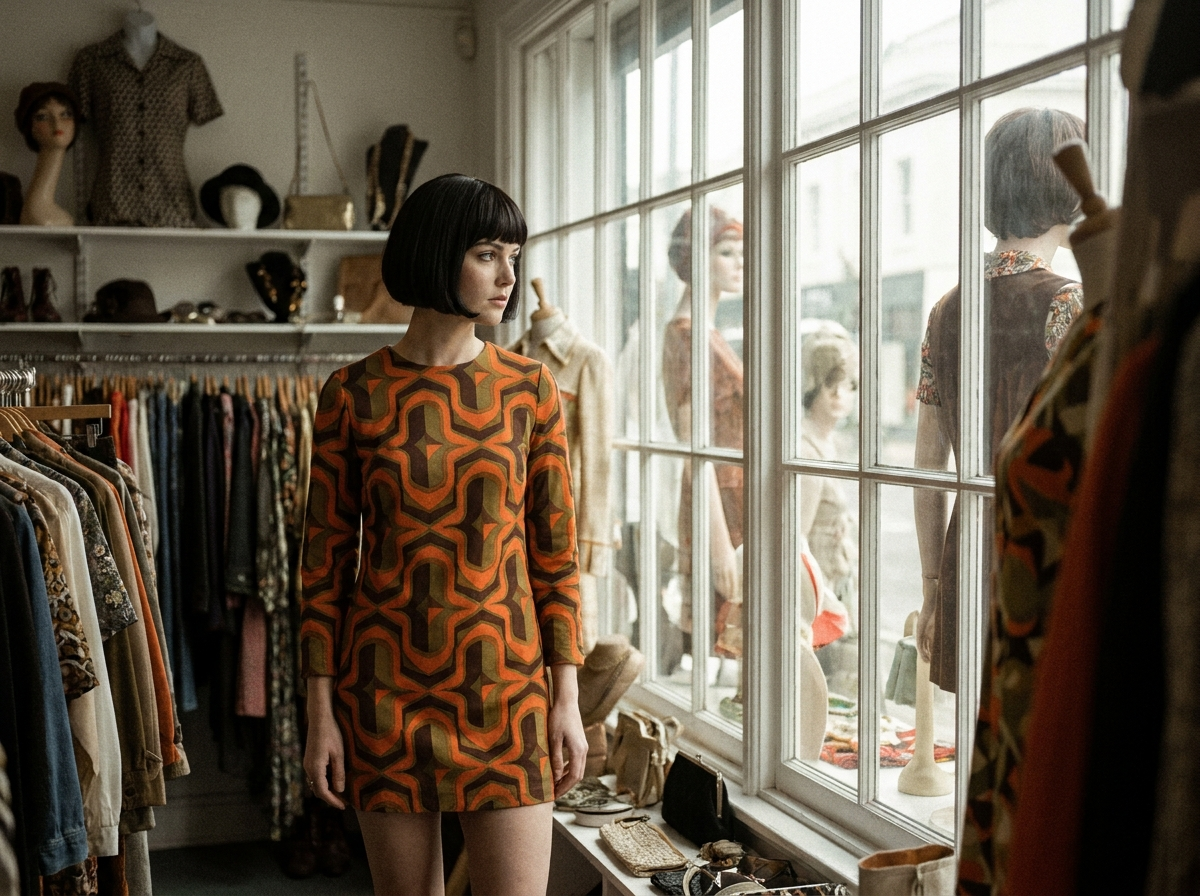
By the early 1960s, the scene had a headquarters: Carnaby Street and the King's Road. This is where Mary Quant changed the game. Quant didn't set out to invent Mod; she just designed fun clothes, like short skirts and bright tights. Her famous creation, the miniskirt, said that young women didn't need their mothers' permission to dress.
What happened next is the part of the story that most fashion articles skip: Mod got discovered by big business. By 1963, the secret club fell to a greedy fashion industry hungry. Twiggy, a five-foot-six sixteen-year-old girl who weighed barely a hundred pounds, became the face of Mod overnight.
Hairdresser Vidal Sassoon cut hair into sharp geometric shapes. Op art painter Bridget Riley's dizzying black-and-white patterns were printed directly onto dresses. Designers like Pierre Cardin pushed the look into the Space Age with white plastic and crazy helmets. By 1966, Time magazine called London "The Swinging City." The scrappy club started by working-class teens had become Britain's biggest export.
The Fracture: Psychedelia, Hard Mod & Skinhead Roots
But the trend couldn't hold together under all that pressure. By the late 1960s, the subculture split apart. Some Mods went the hippie route, getting into psychedelic music and drugs. Others took a harder, rougher path called Hard Mod, which eventually led to the early skinhead scene. The pure fashion look, became a classic style that lived on in stores.
And live on it did. Mod returned in the late 1970s with the 2 Tone ska music scene. It returned again in the 1990s with Britpop bands like Blur and Oasis. Today, the look still pops up on runways whenever designers want to capture that 1960s optimism.
That is the real history we are exploring.
Who's Who in Mod
Andy Warhol
Andy Warhol (1928–1987) wasn't a fashion designer, and he never claimed to be — but no single figure did more to make Mod's visual logic feel like fine art. Warhol's Pop Art, built on repetition, flat color blocks, and mechanical-looking reproduction, ran on the exact same instincts as Mod's geometric prints: pattern as its own subject, with nothing softer underneath it. His Campbell's Soup Cans and Marilyn Monroe silkscreens weren't fashion, but they trained an entire decade's eye to find that kind of flat, high-contrast repetition beautiful — which is a large part of why Op Art and checkerboard prints found such a receptive audience once they hit the runway.
Warhol's studio, The Factory, became one of the era's genuine style incubators. It's where Edie Sedgwick — the debutante-turned-Warhol-superstar with her cropped platinum hair, striped tops, and enormous chandelier earrings — became one of the most photographed faces of the mid-60s, doing for downtown New York what Twiggy was doing for London: turning a specific, deliberate look into something an entire generation wanted to copy. Warhol styled his own life with the same self-aware repetition as his art — the uniform of a black turtleneck, striped Breton shirt, and sunglasses became almost as recognizable as his silkscreens, and it borrowed directly from the same structured, monochrome vocabulary Mod had already established across the Atlantic.
His contribution to Mod, in short, wasn't clothing. It was permission — proof that Mod's flat, graphic, repetition-driven visual language belonged in a gallery as much as a boutique, and that the line between the two was thinner than either world wanted to admit.
Core Philosophy & Visual Language
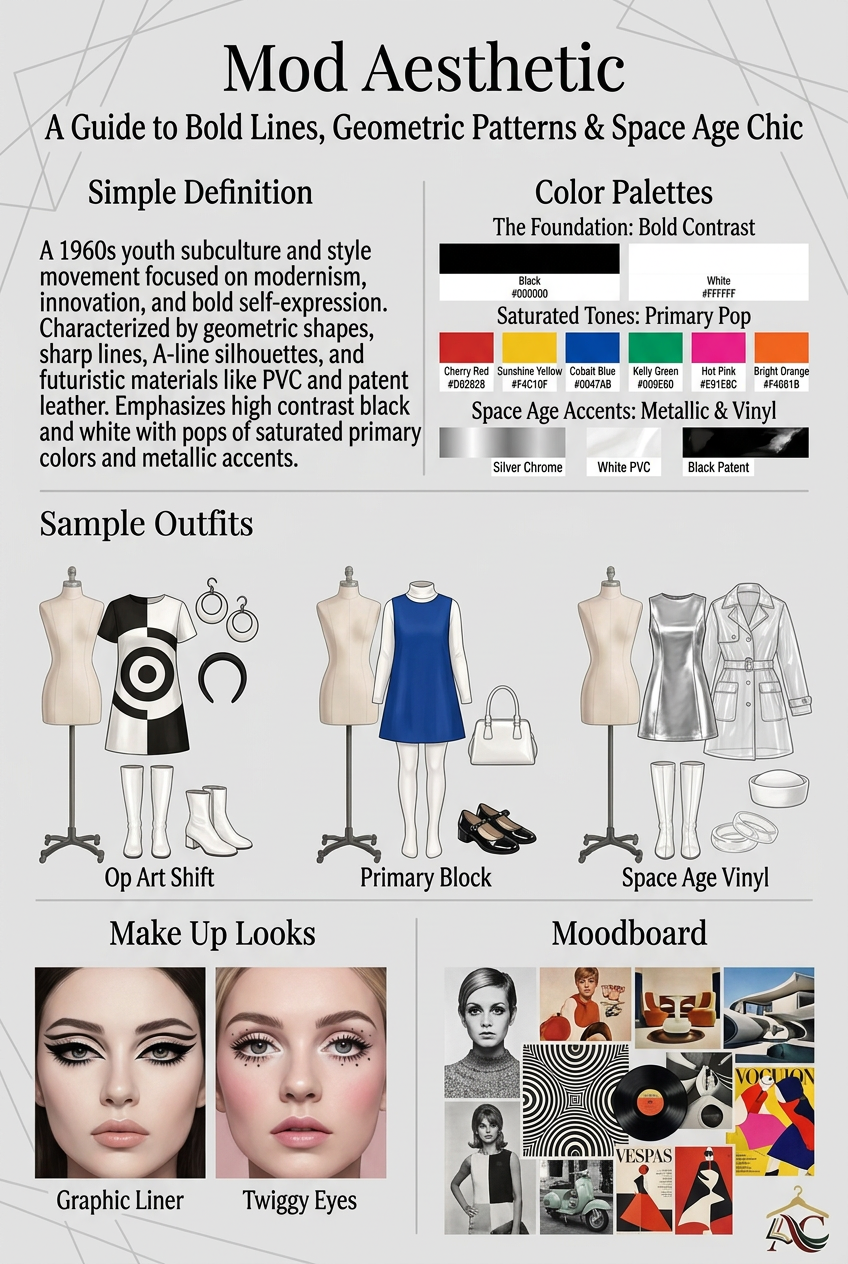
For the Old Money crowd, the big rule is "don't show off your cash." For Maximalists, it's "more is more, and if it doesn't match, wear it anyway.” Mod’s rule, however, is refusal. Almost everything weird and wonderful about the Mod aesthetic is traced back to something it decided not to do.
Let’s start with number one: In Mod, the human body is not a blueprint for clothing. This might sound like a fancy art-school thesis, but it makes sense when you think of what came before. The ultra-corseted 1950s "New Look" treated the female waist like a hostage situation. The Mod A-line shift dress, did the opposite.
If you wear it right, no one can tell where your waist is. Mod designers said, "Hey, women have places to go and things to do."
Unlike aesthetics like Cottagecore that long for the past, Mod gives you white vinyl coats resembling spacesuits, computer generated geometric prints, and hair resembling an engineering drawing. Courrèges and Cardin dressed people for a futuristic world they assumed was right around the corner.
Geometry is what people notice first in Mod’s visual style. But this geometry is not decorative like a floral print is. While a floral print illustrates a flower or garden, a black-and-white checkerboard is just there. It creates its own authority.
Fourth is contrast. While styles like Coastal Grandmother or Cottagecore live in harmony. Mod is a head-on collision. Black against white. Red against yellow. Color choices readable from across a crowded room, which makes perfect sense when you think how of Mod’s early life was spent on dance floors and speeding scooters.
Fifth and finally, Mod garments keep their shape regardless of who is wearing them. This structure is about control. That is a different relationship between person and garment than almost any other style offers.
Mod punishes anyone trying to wing it. If your shift dress doesn't fit exactly right, you won't look like a cool, 1960s rebel; you'll just look like you're wearing an awkward box.
What is Mod fashion?
Mod fashion splits into several distinct sub-styles: Space Age Mod (futuristic, structural, white and metallic), Op Art Mod (graphic black-and-white prints), Chelsea Girl Mod (the boutique-era look most associated with Mary Quant), Subculture Mod (the working-class scooter culture that originated the term), Ivy Mod (the American, collegiate-adjacent version), and Jet-Set Mod (glamorous, travel-influenced luxury Mod).
Psychology & Synthesis
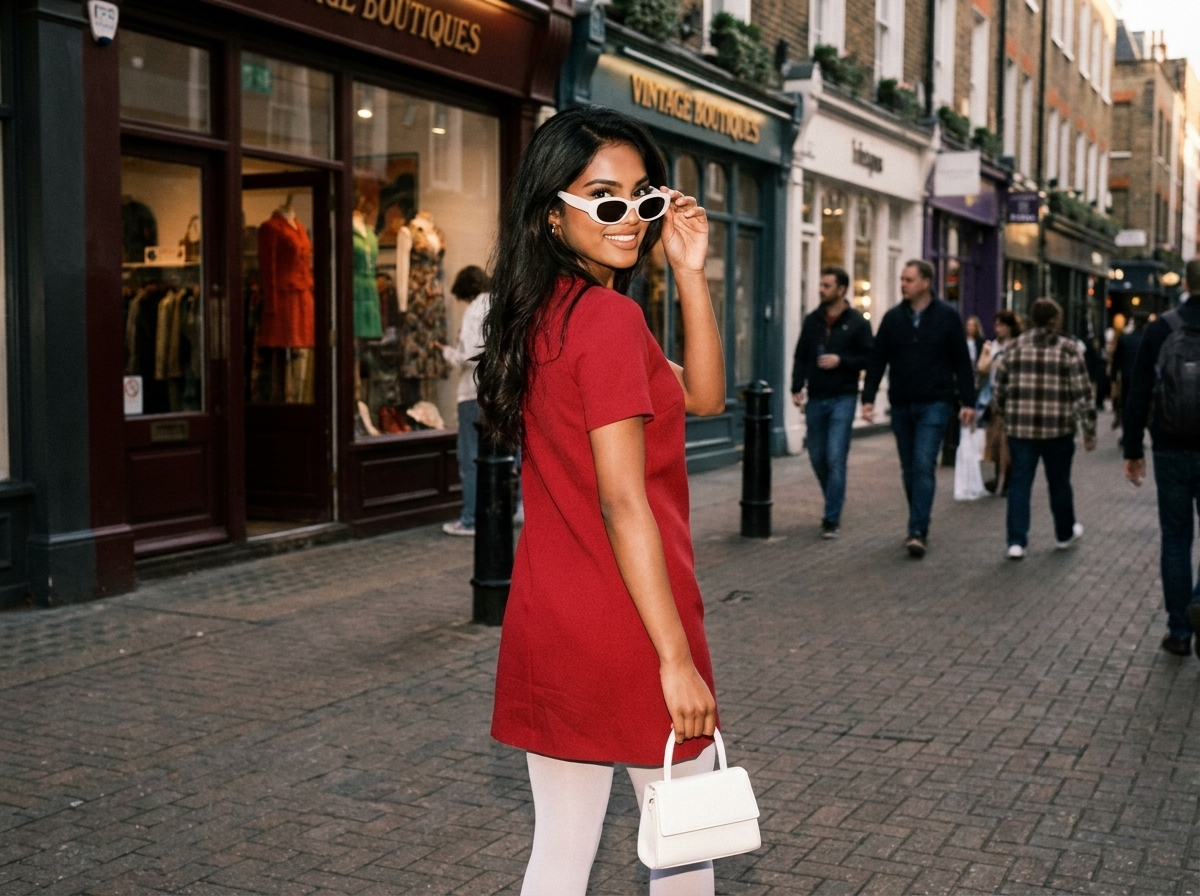
Every aesthetic in this series eventually asks the same question: why would someone dress this way? Mod's answer is because the aesthetic isn’t subtle. It was built, from the very beginning, to be seen.
Remember in Mod, the body is an outfit’s organizing principle. It de-emphasizes the waist and offers the person wearing it attention without putting their body on display. This cuts against the assumption that bold, attention-seeking clothing is about being desired. Mod's confidence is closer to armor than invitation. That armor connects to Mod's origins in social mobility.
The original Mods were dressing sharply because clothing was available to teenagers with more taste than money. There's a specific, psychological appeal in that origin story. It’s that taste can out-do inheritance. Anyone drawn to Mod today is drawing on some version of that same appeal.
Plus, Mod is just fun. It’s not subtle in a fashion landscape of neutrals, Mod wants to be seen. It commits to one loud choice and lets it land. It allows for creativity in a way other aesthetics may be more limited.
Mod endures because it offers the chance to dress like the future is something to be excited about.
Color Palette
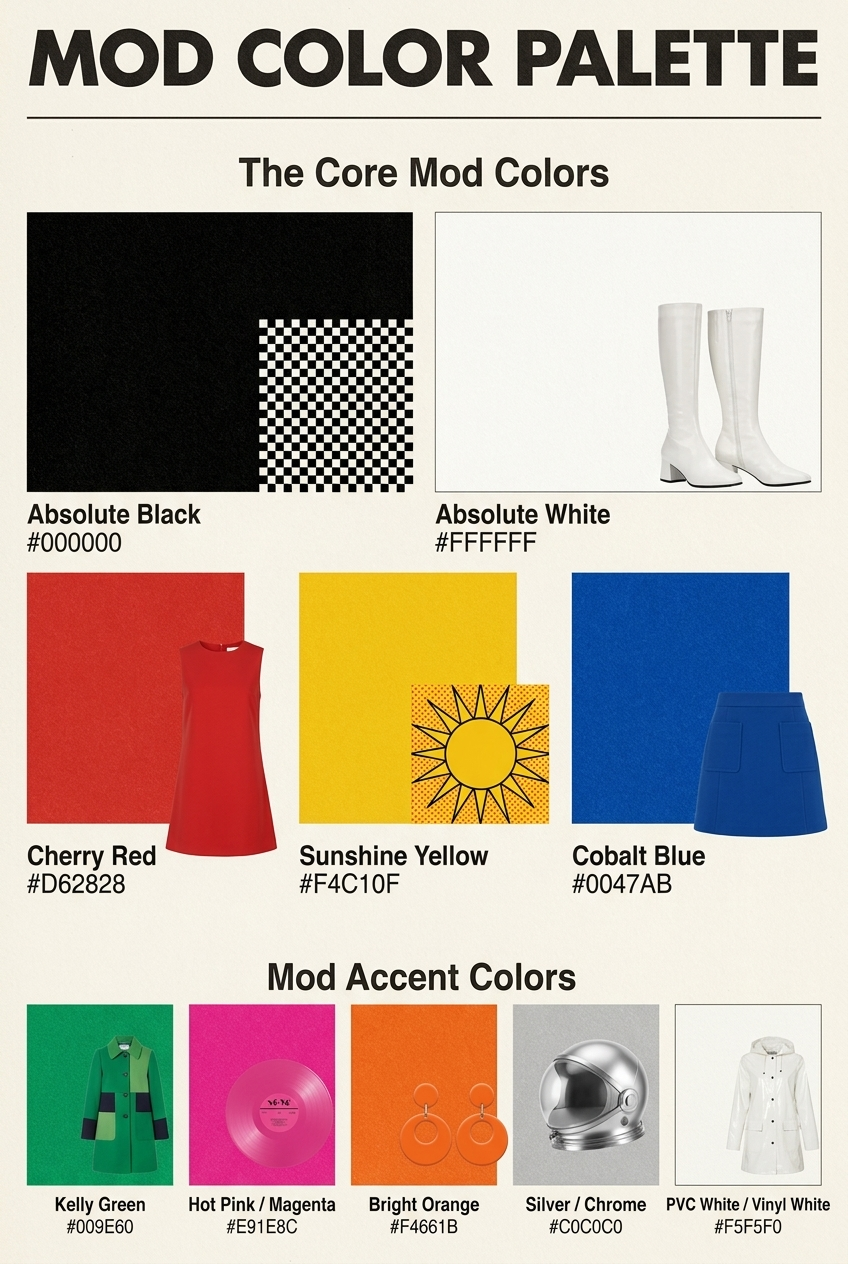
Most aesthetic palettes in this series have a mood like Old Money’s muted taupes, or Coastal Grandmother’s the sun-bleached blues. Mod's palette is all about being seen.
The Foundation: Black and White
Black and white isn't a neutral default here the way it might be in Minimalism. It’s Mod’s most extreme, confident statement, deployed at full saturation and hard contrast. This is where Op Art lives: checkerboards, target circles, and stripes in pure black against pure white.
Primary Color, Deployed Like a Weapon
When Mod introduces color, it introduces a single, saturated primary or near-primary hue, in a large, uninterrupted block. Think a shift dress in one committed red, or yellow, with black-and-white accessories. This is color-blocking in its most literal form: the goal is the punch of a single hue given nowhere to hide.
Core saturated tones:
Cherry red (#D62828 as a working reference)
Sunshine yellow (#F4C10F)
Cobalt or electric blue (#0047AB)
Kelly or emerald green (#009E60)
Hot pink or magenta (#E91E8C)
Bright orange (#F4661B)
A Mod outfit built around cobalt blue isn't also reaching for kelly green in the same look, that's a Maximalism instinct, not a Mod one. Mod picks one saturated color per outfit and lets it dominate.
Silver, Chrome & White-as-Metal
This is the color family that most clearly separates Space Age Mod from every other dialect. Silver, chrome, and stark white-as-metal (PVC, vinyl, patent leather) aren't really "colors" in Mod's palette so much as textures pretending to be colors. They read as futuristic because they behave like hard, reflective surfaces. not soft, absorbent fabric. A white cotton dress and a white PVC coat hold different places in the palette, even though a swatch book would call them the same hex code.
What's Absent
The negative space in a palette is often more revealing than what's included:
Muted, dusty, or "greige" tones have no real home here. The taupes and warm browns anchoring Old Money or Coastal Grandmother are wrong in a Mod context, because they signal the softness Mod's founders rejected. Pastels are also absent; a pale pink or baby blue reads as decades and aesthetics away from Mod's confidence. And tonal gradients like the ombré, sun-faded quality found across Boho and Cottagecore, have no place in a palette built on hard edges and flat, uninterrupted color fields.
A Working Rule
If a color choice needs explaining (i.e."sort of a dusty rose" or "a muted sage") it's probably not Mod. In Mod: a color announces itself instantly, hold its ground against black and white, and refuse to blend into anything else. That's the same instinct driving the silhouettes and the geometry running through the whole aesthetic. It's should be recognized on sight.
Mod Archetypes - The Subaeshtetic Dialects
Ask someone to describe "mod" and you’ll probably get something like: white boots, a geometric shift dress, and a blunt bob. It’s not wrong, but it’s one dialect of many. The languages of Mod are split by class, nationalality, and even chemistry. Treating "Chelsea Girl" and "Carnaby Street Mod" as interchangeable erases the class tension. So does treating Mod as a purely British phenomenon, when Paris and downtown New York ran their own dialects. Here's the fuller family tree.
Modernist Mod
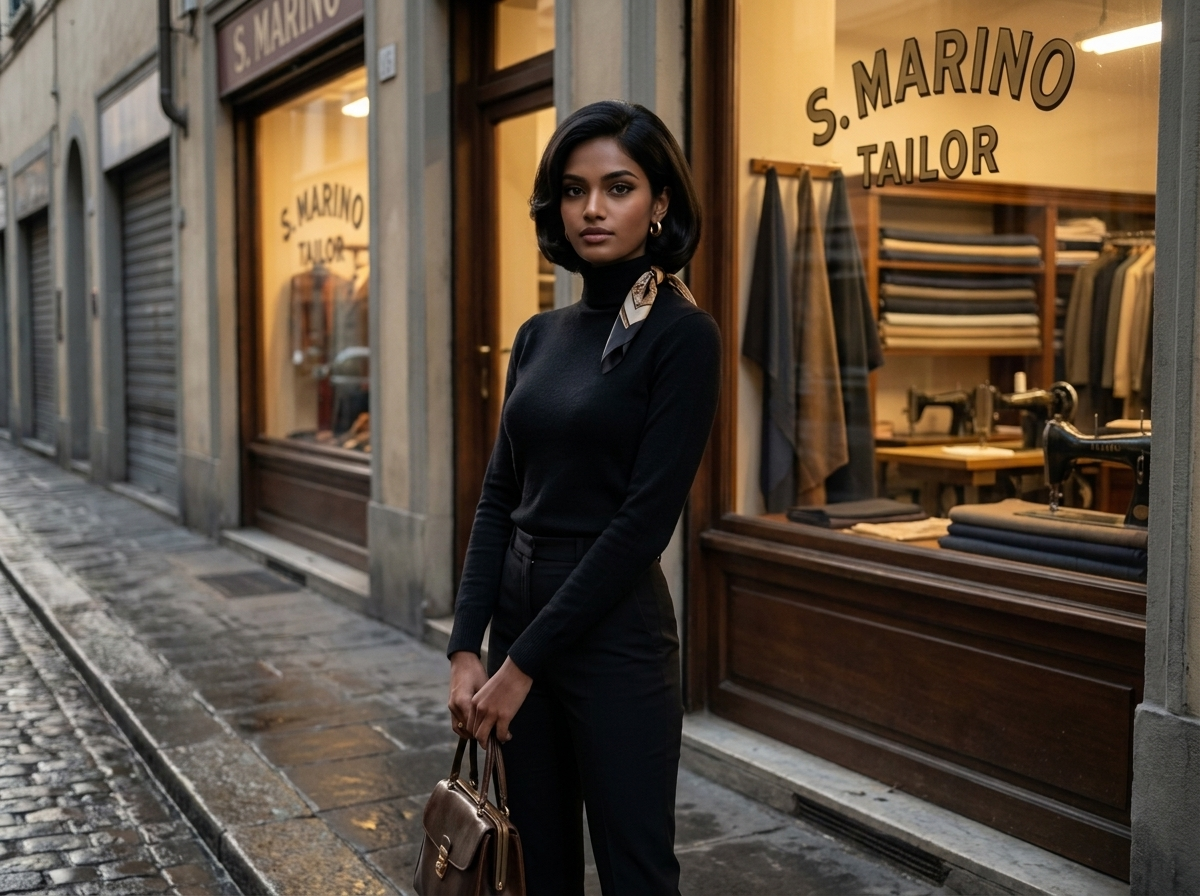
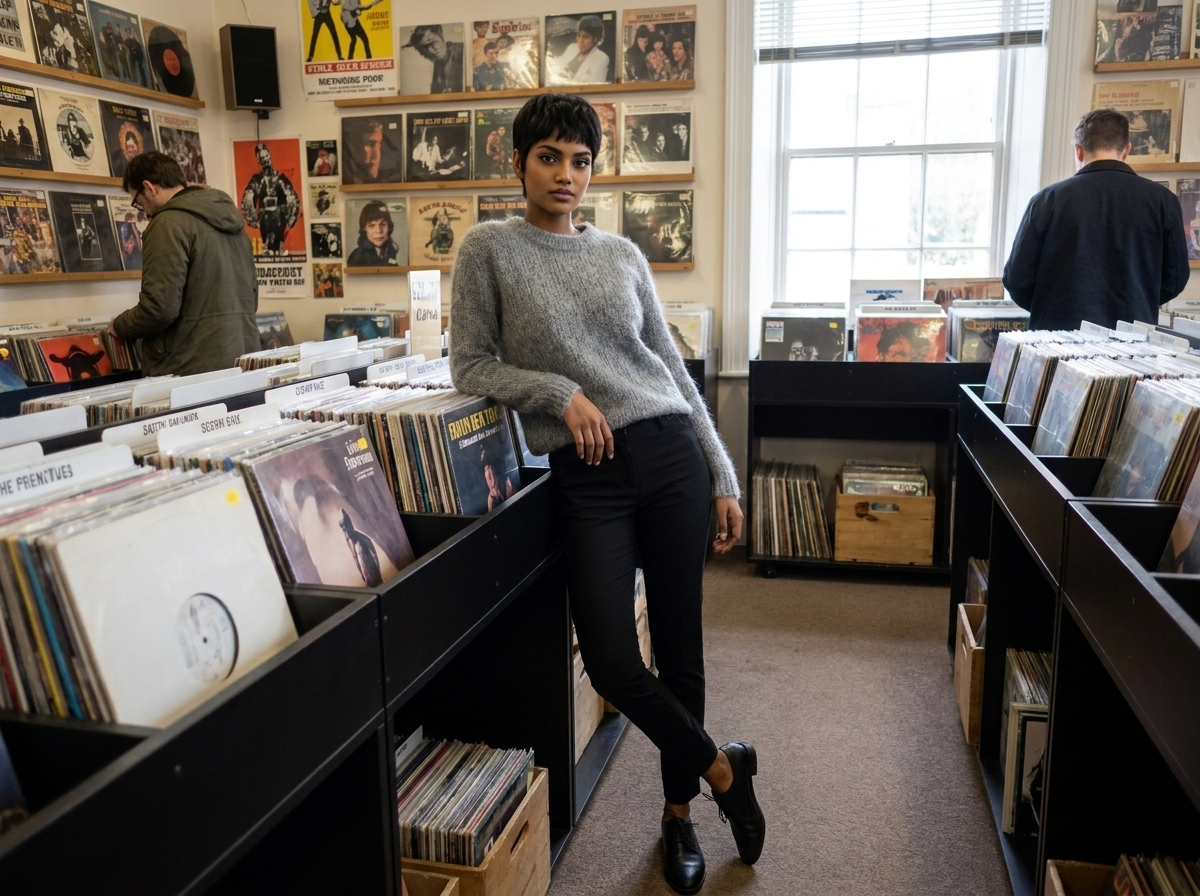
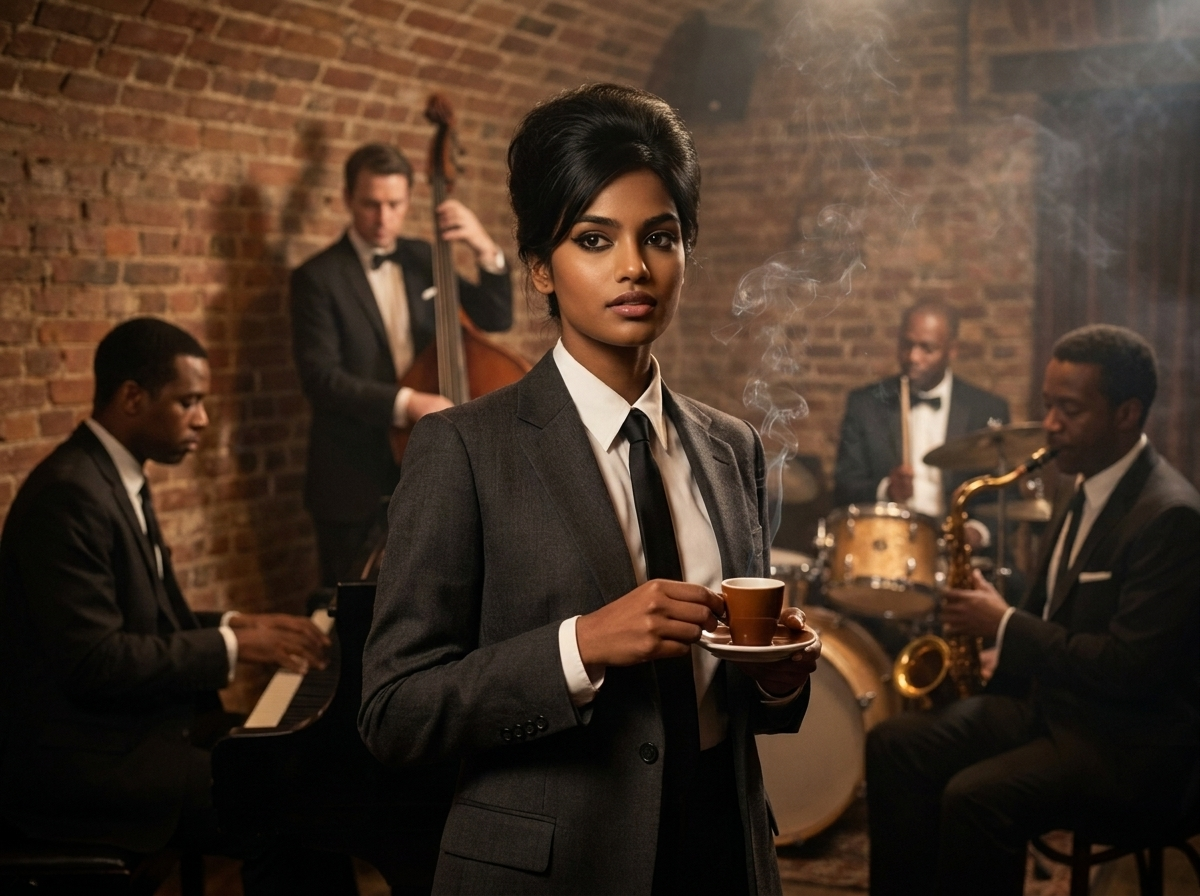
Before Mary Quant, Twiggy, and the Carnaby Street tourists, there were just working-class London kids, mostly young men, obsessed with modern jazz, and Italian tailoring. This is Mod before Mod had a boutique to sell it back to itself. The Modernists were dressing for an imagined Milan or Paris more sophisticated than postwar London.
Worth knowing mainly because it clarifies what came after.
The Look:
Bespoke Italian-cut suits (yes, women wore these too)
Sharp shirts and slim ties
Bouffant hair still teased high
Kohl-lined eyes minimal
French crop haircuts
Loafers or winkle-pickers
Cashmere and mohair
Understated luxury signals
The Vibe:
Miles Davis on the record player
Espresso in Soho coffee bars
Reading Sartre unironically
Aspiring to Continental cool
Rejecting Teddy Boy predecessors
Working-class ambition disguised
Style Icons:
Early Cathy McGowan
The girls in "Absolute Beginners"
Original Soho scenesters
Jean Seberg (French adjacent)
Carnaby Street Mod
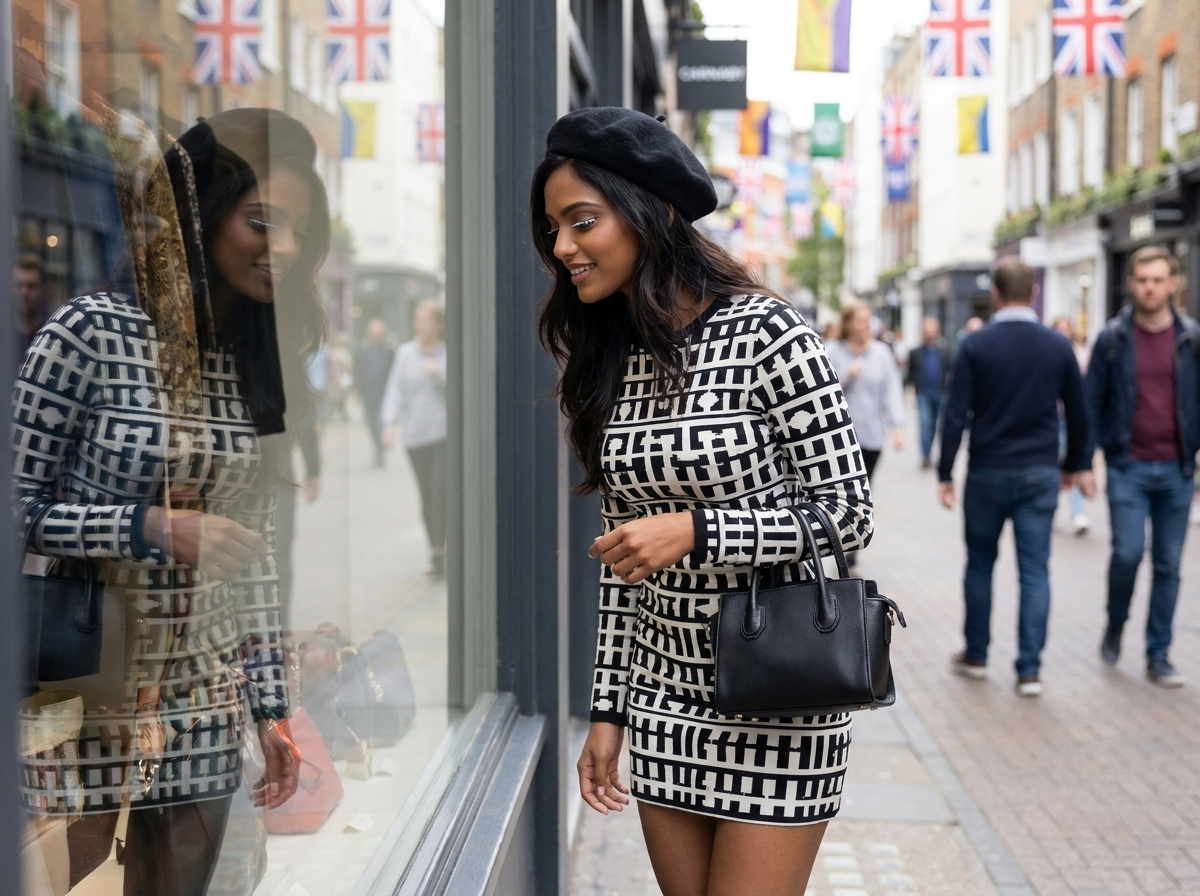
This is the dialect most people mean by default, and for good reason. It's the moment Mod became mass-cultural.
Mary Quant's Bazaar, Biba, the boutique economy exploding along Carnaby Street: mini dresses in saturated color, geometric prints, and the Vidal Sassoon bob. The defining quality here is access — working-class girls able, for the first time, to dress at the same visual pitch as anyone richer than them.
This is Mod as democracy in clothing.
The Look:
Mini dresses in every color
Geometric prints proudly worn
Vidal Sassoon precision bob
Twiggy-style makeup
Colored tights mandatory
Go-go boots essential
Mary Quant daisy logo
Small structured bags
The Vibe:
Boutique-hopping on Saturdays
Ready Steady Go! Friday nights
The Scene club membership
Beatles/Kinks/Who devotion
Working-class made good
Fashion as democracy
The Uniform:
A-line mini shift dress
White or colored tights
Flat go-go boots or Mary Janes
Statement earrings
Structured mini bag
Precision haircut
Chelsea Girl Mod
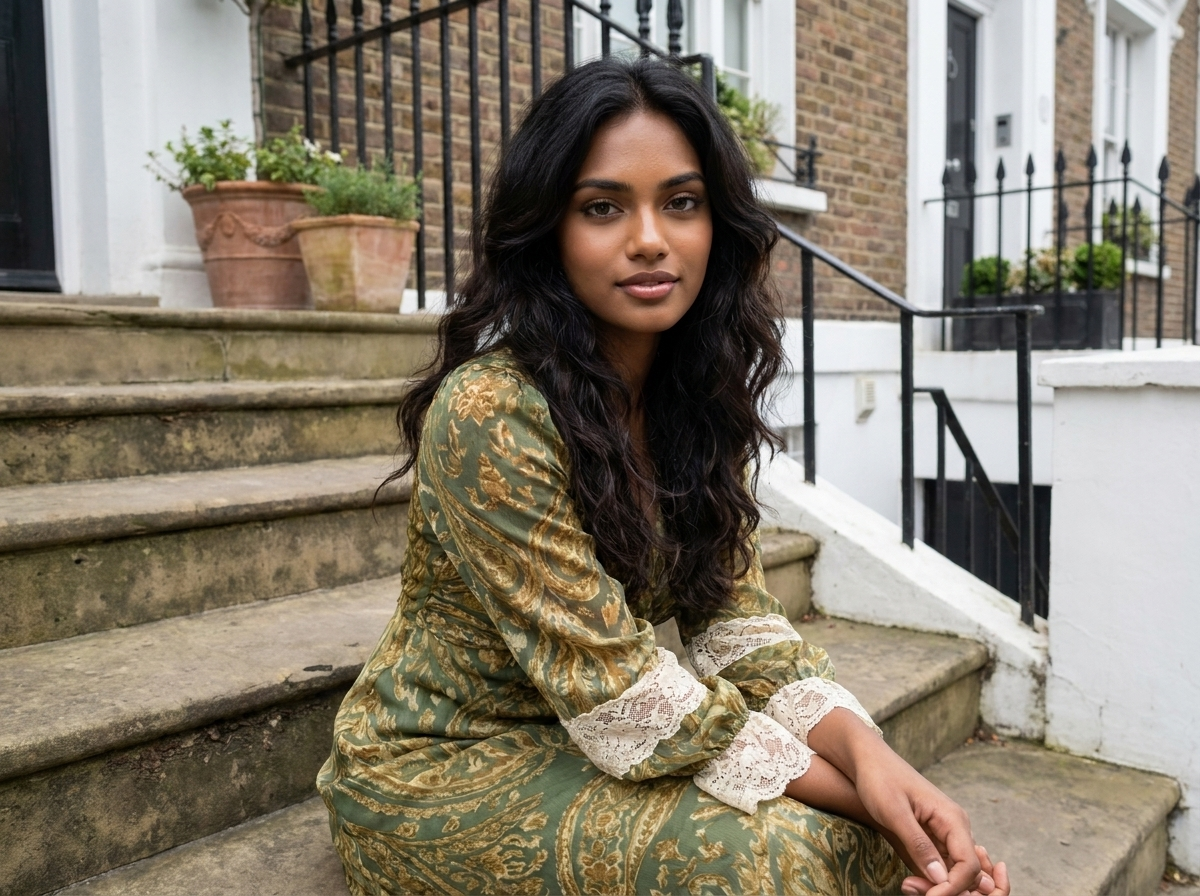
Here's what most coverage flattens: Chelsea Girl Mod is not Carnaby Street Mod with better hair. It's the aristocratic, art-adjacent, considerably richer sibling.
This was the world of Anita Pallenberg, Marianne Faithfull, and the Rolling Stones' orbit. Trust funds and art-school credentials do the work that Carnaby Street's democratic access was trying to route around. The two dialects shared a moment and a postcode radius, but they were making almost opposite arguments about who Mod was for.
The Look:
Ossie Clark dresses (dreamy, bias-cut)
Biba's darker glamour
Foale and Tuffin designs
Longer, more romantic hair
Feathered boas occasionally
Antique lace mixed with mod
Kaftan influences creeping in
Suede fringed everything
The Vibe:
David Bailey photograph subjects
Rolling Stones adjacent
Country weekend houses
Notting Hill parties
Art school connections
Trust fund optional but helpful
Style Icons:
Anita Pallenberg
Marianne Faithfull
Pattie Boyd
Jane Birkin (early)
Suki Potier
Talitha Getty (adjacent)
Space Age Mod

This is Mod at its most utopian — André Courrèges and Pierre Cardin dressing women for the future. Think white go-go boots, vinyl and PVC, cutout details, and structured silhouettes.
Space Age Mod cares about engineering. The color story leans monochrome with the occasional shot of chrome-adjacent metallic. If other Mod dialects flirt with the past, Space Age Mod refuses to look backward. It is the aesthetic equivalent of the moon landing.
The Look
All-white commitment (head to toe)
Vinyl and PVC essential
Metallic silver everything
Chainmail dresses (Rabanne)
White go-go boots always
Helmet-like haircuts
Geometric cutouts
Plastic jewelry chunky
The Vibe:
The future is now
Barbarella-adjacent
Astronaut aspirations
Modernist architecture love
Op-art gallery openings
Nothing romantic allowed
Designer Trinity:
André Courrèges: Go-go boots inventor
Pierre Cardin: Geometric sculpture
Paco Rabanne: Chainmail and plastic dresses
American Mod: The Warhol Factory
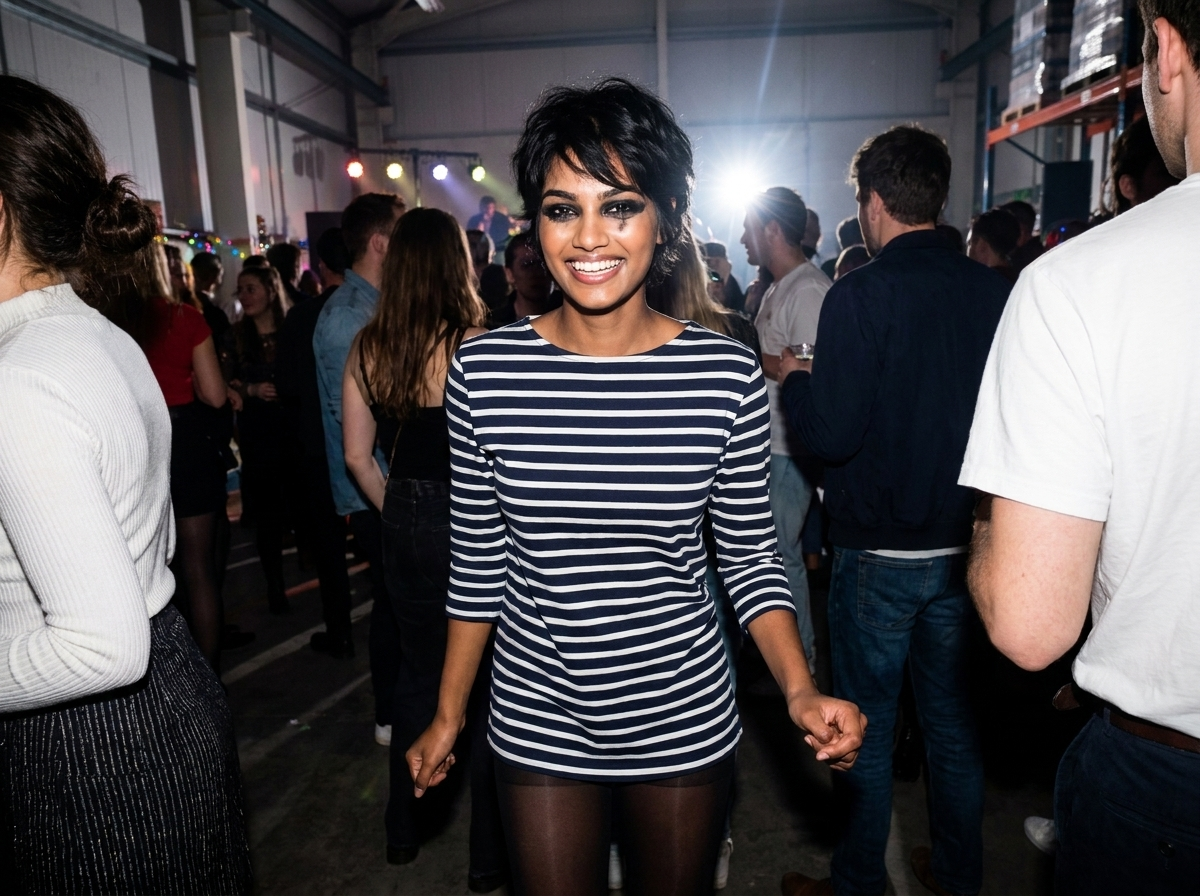
When Mod crossed the Atlantic, it landed in downtown New York and got weirder. This is the Silver Factory's dialect. It shared Space Age's love of metallic surface, but ran through an art-world, faintly chaotic filter London's version never had…a beautiful-damage sensibility that owed as much to the Velvet Underground's soundtrack as to any boutique.
The Look:
Striped Breton tops
Black tights (always black)
Chandelier earrings massive
Massive black eye makeup
Silver everything
Fur coats vintage
Leopard print accepted
Boy-cut hair often
The Vibe:
Silver Factory attendance
Velvet Underground listening
Amphetamine culture
Art openings mandatory
Andy Warhol adjacent
Beautiful damage aesthetic
Style Icons:
Edie Sedgwick (queen)
Nico
Baby Jane Holzer
International Velvet
Ultra Violet
Ivy Nicholson
These are just a few of the Mod substyles available to explore.
Wardrobe Decoder — Key Pieces & the Starter Capsule
The Pieces That Do the Work
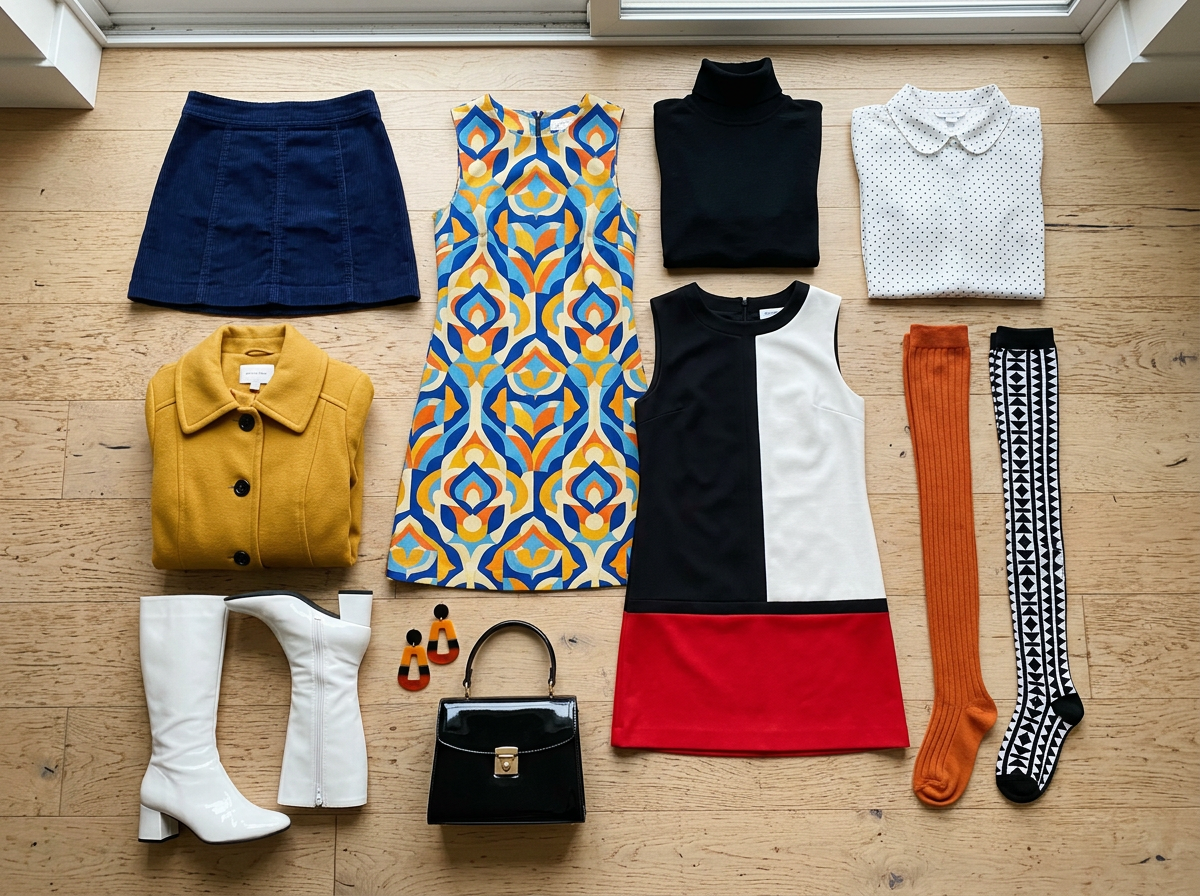
Mod's wardrobe is smaller than most aesthetics in this series, and that's by design. A handful of pieces, do more here than a closet full of approximations.
The A-line shift dress is the load-bearing piece. The proportion should skim the body without clinging, end at or above the knee, and hang from the shoulder. A shift dress cut even slightly wrong reads as a shapeless dress rather than a Mod one.
The mini skirt is the shift dress's separate-piece counterpart. The length is a statement. A-line or straight, ending well above the knee, worn almost never on its own.
Which brings in the wardrobe's most-skipped essential.
Colored or patterned tights are not optional in a serious Mod wardrobe, a point casual coverage of the aesthetic underplays. Bare legs read as a softer aesthetic; opaque tights in a saturated color or a graphic pattern complete the silhouette. This is one of the cheapest pieces in the wardrobe and one of the most visually important.
The turtleneck, fitted and in a single saturated or black-and-white color, is Mod's answer to a blank canvas top. Its structural cousin is the Peter Pan collar blouse, which softens the silhouette slightly without abandoning the aesthetic's core geometry.
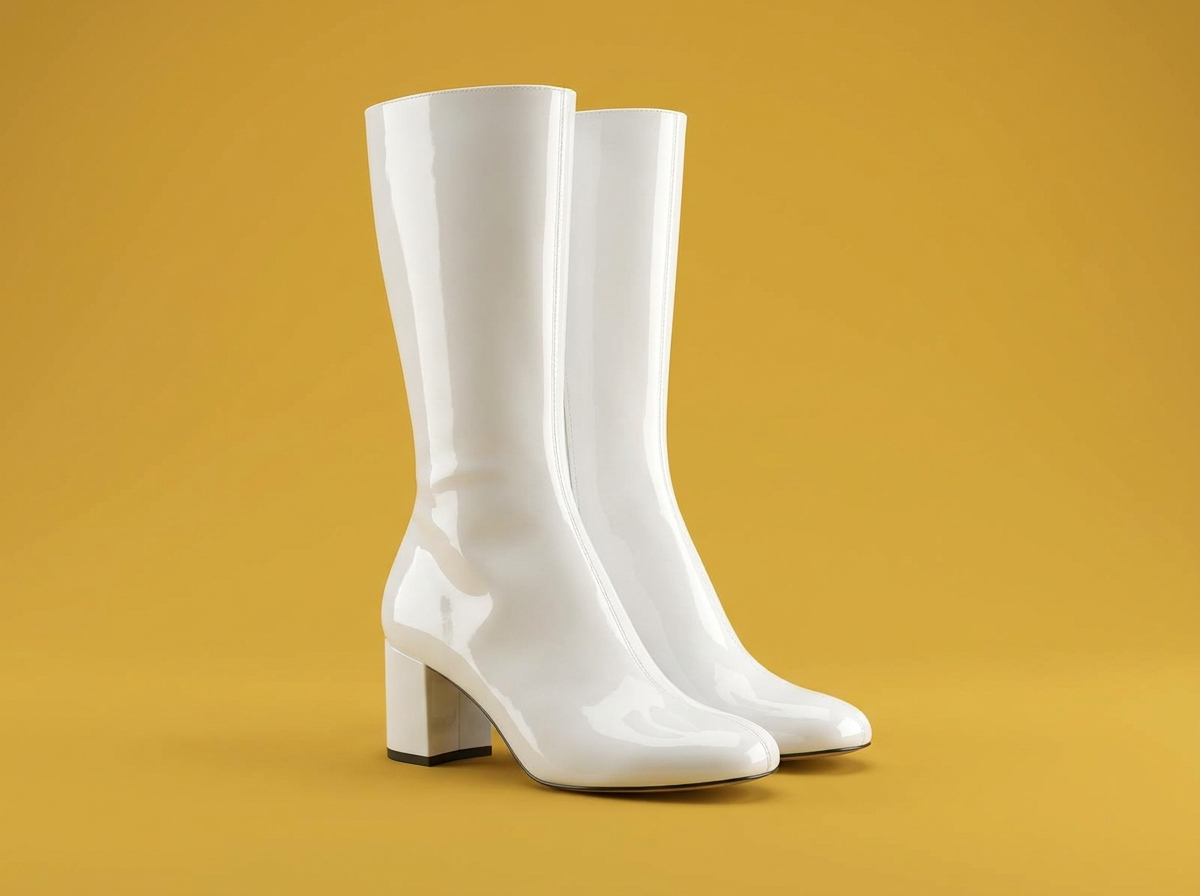
Go-go boots are Mod’s most recognizable piece. White, knee-high or ankle, with real structure. A boot that collapses at the ankle undoes the entire silhouette.
The structured mod coat is the outerwear equivalent of the shift dress. And oversized, graphic geometric statement earrings, do for accessories what the coat does for outerwear. It’s the fastest, cheapest way to signal Mod without committing to a full head-to-toe look.
The Mod Capsule Wardrobe
10 Essential Pieces, By Budget
| # | Piece | Investment | Mid-Range | Accessible |
|---|---|---|---|---|
| 1 | A-line shift dress, geometric print | Emilia Wickstead structured mini | Ganni graphic-print A-line dress | Vintage 1960s original via The RealReal or Etsy vintage |
| 2 | A-line shift dress, solid color-block | Courrèges archive-inspired mini | & Other Stories color-block shift | ThredUp or Depop solid-color mini shift |
| 3 | Mini skirt, straight or A-line | Alaïa structured mini skirt | Sandro A-line mini | Vintage wool mini skirt via Beyond Retro |
| 4 | Fitted turtleneck | Khaite fitted rib turtleneck | COS fitted turtleneck | Uniqlo Heattech turtleneck (new — see note) |
| 5 | Peter Pan collar blouse | Erdem structured blouse | Sandro Peter Pan collar top | Vintage Peter Pan collar blouse via Depop |
| 6 | Colored or patterned tights (multiple pairs) | Wolford opaque colored tights | Heist Studios patterned tights | Amazon or Target multi-pack (new — see note) |
| 7 | Go-go boots, white or black | Courrèges reissue go-go boot | Jeffrey Campbell go-go boot | Vintage go-go boots via Etsy or eBay |
| 8 | Structured mod coat | Cardin-inspired A-line coat, designer resale | Whistles boxy structured coat | Vintage boxy wool coat via ThredUp |
| 9 | Small structured handbag | Mansur Gavriel structured mini bag | Staud structured top-handle bag | Vintage geometric structured bag via Depop |
| 10 | Geometric statement earrings | Vintage designer archive pieces (Cardin, Courrèges) | Lele Sadoughi geometric earrings | Amazon or Etsy handmade geometric earrings |
Note: the Accessible tier leans heavily on vintage and resale since Mod's most iconic pieces exist in real volume secondhand. Tights and base-layer turtlenecks are the two exceptions, bought new for fit and hygiene.
Styling Formulas
Now comes the million dollar question. What do I wear?
Mod's answer is more rule-bound than most. What we have here are five formulas, each built from the capsule in the previous section, each demonstrating a different register within the aesthetic.
Formula One: The Carnaby Street Base
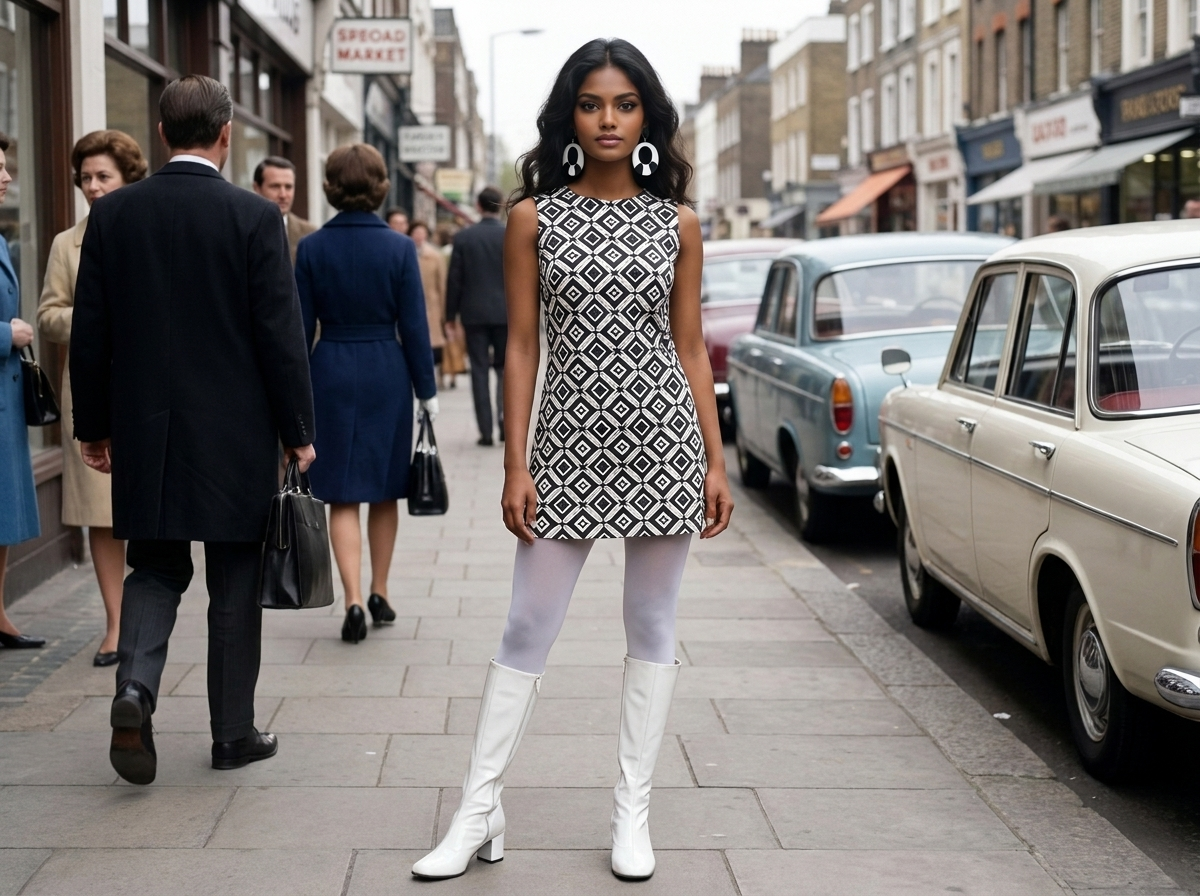
Shift dress, tights, go-go boots, statement earrings. This is the Mod combination that would have been recognizable on King's Road in 1965 and remains recognizable today. The formula only works if the dress ends where it should, the tights match or contrast the dress, and the boots have structure. Swap the earrings for something delicate and the whole look drifts toward "generic 60s costume."
Formula Two: Office-Appropriate Mod

Shift dress (solid or subtle geometric), structured blazer or mod coat layered over it, low pump instead of a go-go boot, small structured bag. This formula answers Mod's most common question: Can this aesthetic exist in a workplace? The answer is yes, provided the boldest elements get dialed back a register. A single graphic earring or a patterned tight in a muted colorway keeps the look Mod without asking a conference room to process full-saturation checkerboard before 9 a.m.
Formula Three: Full Op Art Commitment
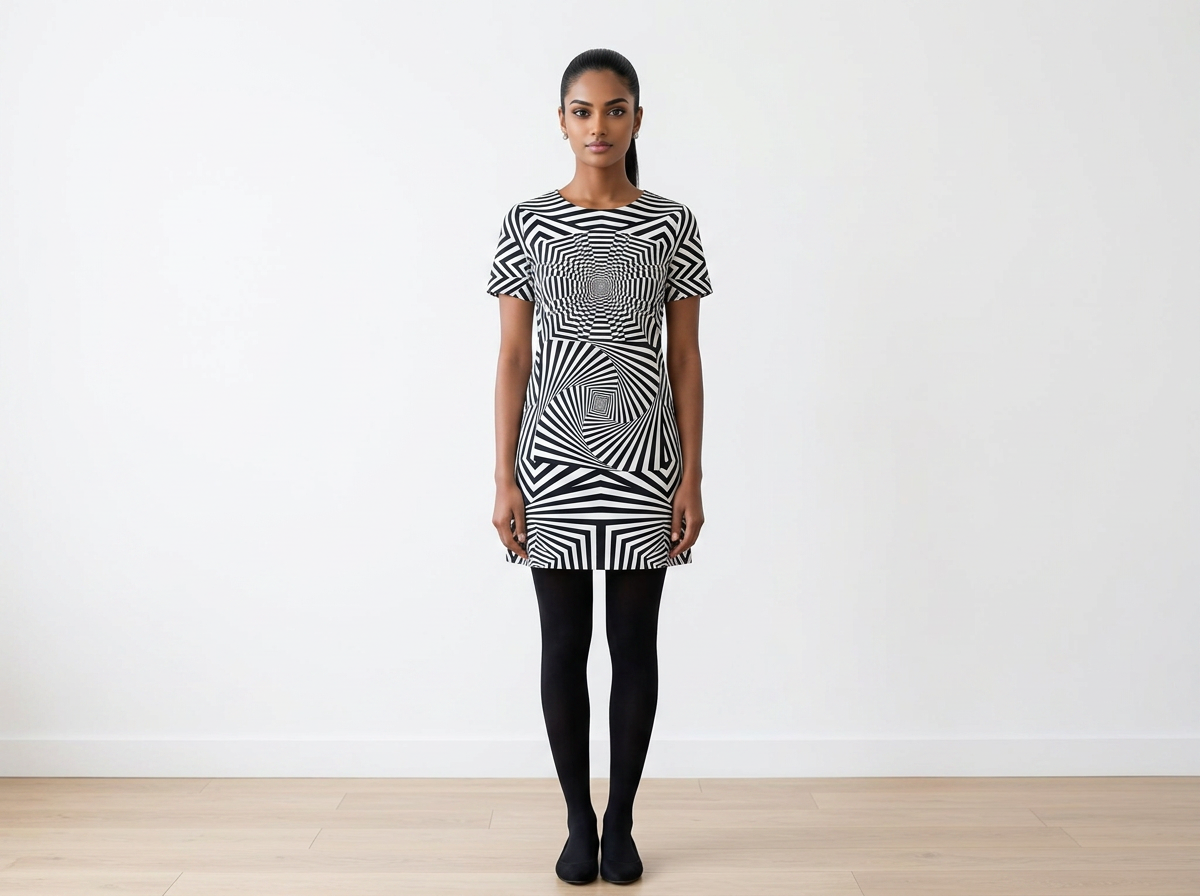
Black-and-white graphic print top or dress, worn with solid black or solid white below to give the eye somewhere to rest, minimal accessories, hair pulled back so nothing competes with the print. This formula counters a common Mod mistake: Op Art worn head-to-toe in pattern, with no negative space, tips into noise. The formula's secret is restraint everywhere the print isn't.
Formula Four: Space Age Evening
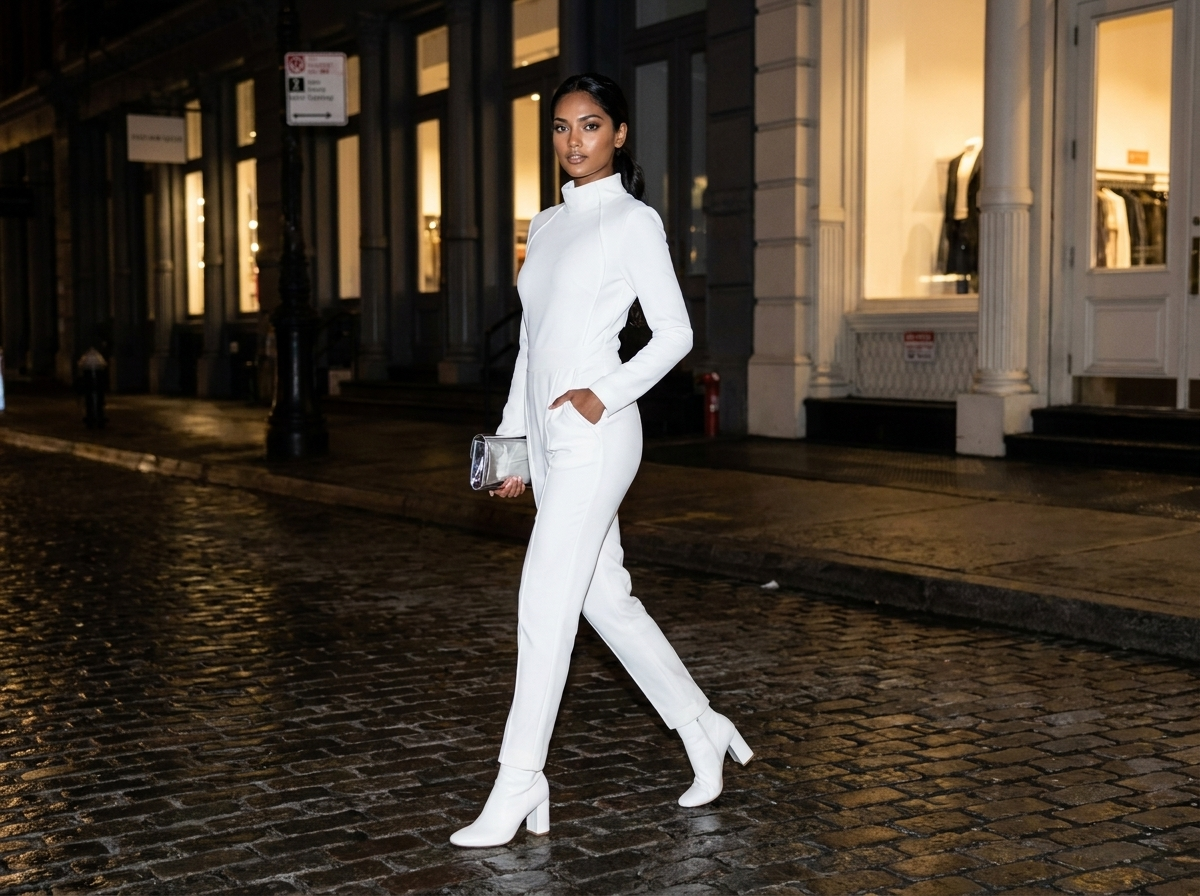
All-white or all-silver base paired with metallic or PVC accessories and a single structural piece of jewelry. This is Mod's most editorial formula and has the least everyday flexibility, but it demonstrates the aesthetic's futurist register in wearable terms. The formula lives or dies on texture discipline: matte white cotton reads as a summer dress, while the same silhouette in vinyl or a stiff structured fabric gives Space Age Mod.
Formula Five: Subculture-Referencing Tailoring
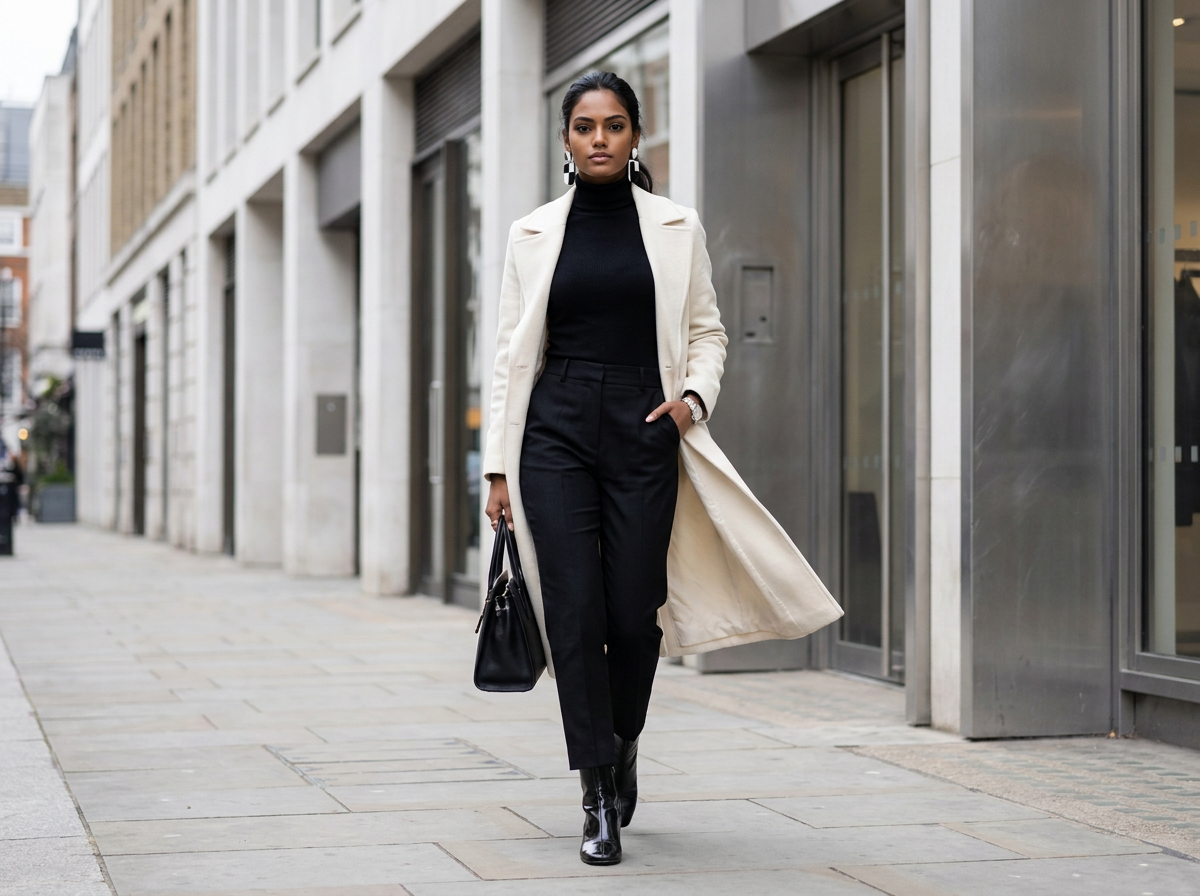
Fitted turtleneck, straight-leg trouser, structured coat worn open over the top, boot with a low stacked heel.
This formula pulls from the Subculture Mod archetype. It’s the one best adapted for anyone who wants Mod's geometric confidence without a mini skirt. The tailoring does the work the hemline does in every other formula.
A general note across all five: Mod formulas fail more often from timidity than from excess. Because the aesthetic's whole visual grammar runs on contrast and legibility, a "safe" version usually just reads as a blander aesthetic wearing Mod's silhouette.
The formulas above work because each one commits to at least one loud element and lets everything else support it. That's the discipline Mod' asks for.
Hair, Makeup & Beauty
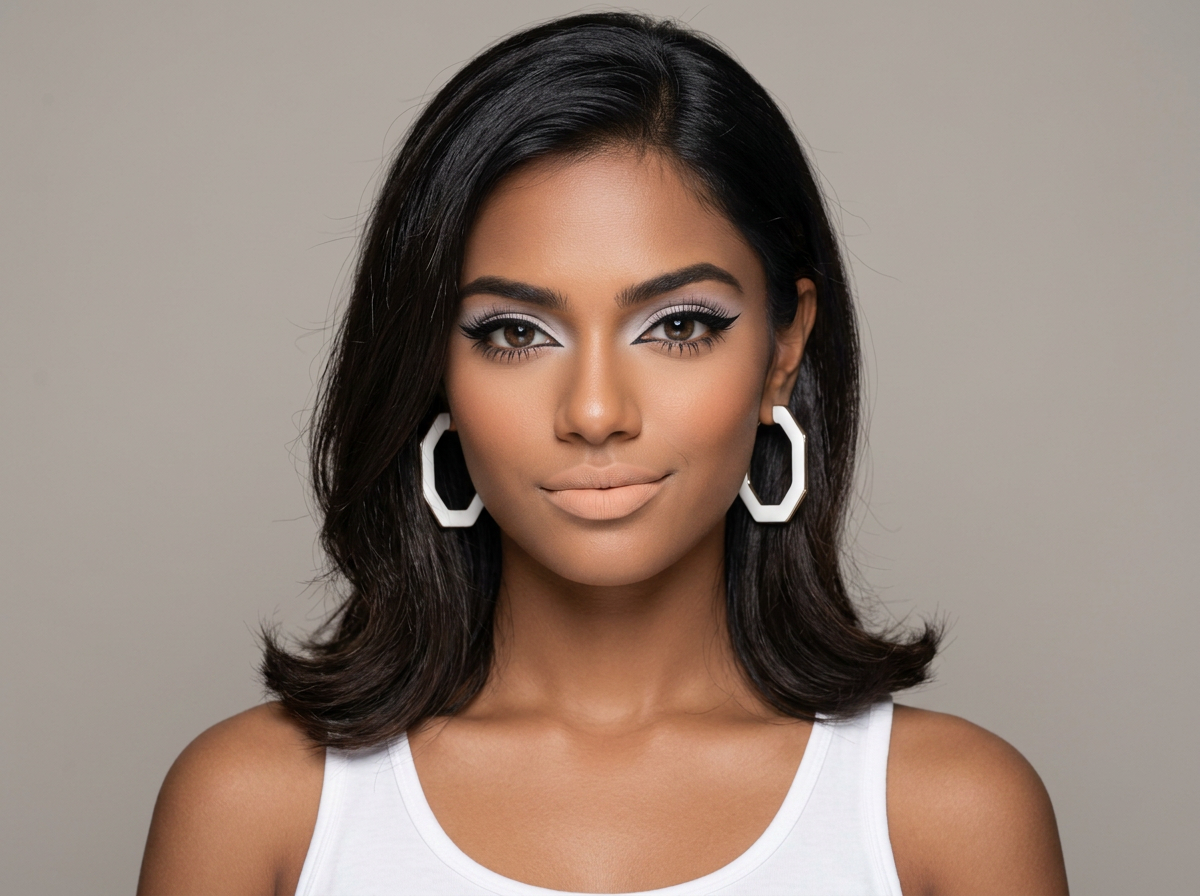
No aesthetic in this series depends on hair and makeup the way Mod does. Cottagecore doesn’t have a specific beauty look attached to it, nor does Coastal Grandmother. Mod, by contrast, is unrecognizable without its two most iconic beauty signatures — which means this section is load-bearing in its own right, on par with the shift dress itself.
Face: The Doll Complexion
The Base:
Pale foundation: The mod requirement
Matte finish: No dewy shine
Contour (subtle): Below cheekbones only
Blush (peachy): Apples of cheeks
Powder heavy: The porcelain effect
Freckles (drawn on!): The Twiggy fake
Hair: The Architectural Cut
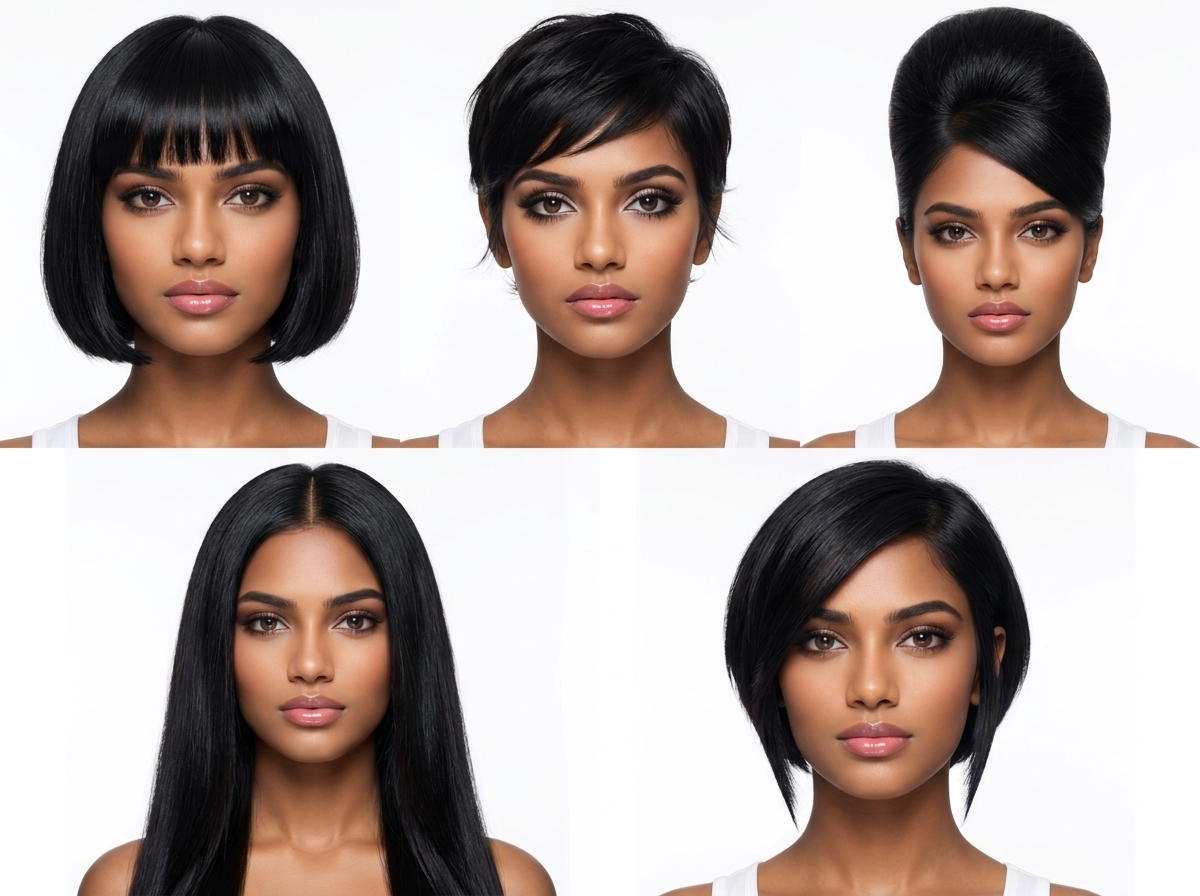
From left to right: The Vidal Sassoon Bob, The Twiggy Pixie, The Beehive, The Long Straight, The Five-Point Cut
If only one could represent Mod's entire beauty philosophy, it would be Vidal Sassoon's geometric bob. Sassoon's innovation, developed alongside Mary Quant in the early-to-mid 1960s, was a cut with a defined, geometry, designed to hold its line through movement. This was a quiet rebellion against the decade before, when a "done" hairstyle meant hours of setting and teasing.
Carnaby Street Mod favors the classic blunt bob at or above the jaw, often with a sharp fringe. Chelsea Girl Mod softens it, adds a little length and tousles it, consistent with the more bohemian lean. Warhol Factory Mod favors a boy-crop, closer to the head, part of the "beautiful damage" previously named. What unites them is the sharp edges.
The Iconic Cuts:
The Vidal Sassoon Bob:
Sharp angular geometry
Precision-cut lines
Blunt bangs (fringe)
Chin-length or shorter
Straight and glossy
Architectural commitment
The mathematical mod
The Twiggy Pixie:
Boyish crop
Long side sweep
Feminine through makeup only
Wispy at temples
Ultra-short back
The androgynous statement
The Beehive (early mod):
Backcombed volume
Sky-high height
Smooth surface
Bouffant precision
Hair-sprayed solid
The Ronettes influence
The Long Straight (late mod):
Middle part
Ironed straight
Waist-length ideal
Marianne Faithfull style
No layers ever
The proto-hippie mod
The Five-Point Cut (Sassoon):
Geometric precision
Points at nape and ears
Asymmetric drama
Architectural haircut
The salon commitment
The Precision Bob
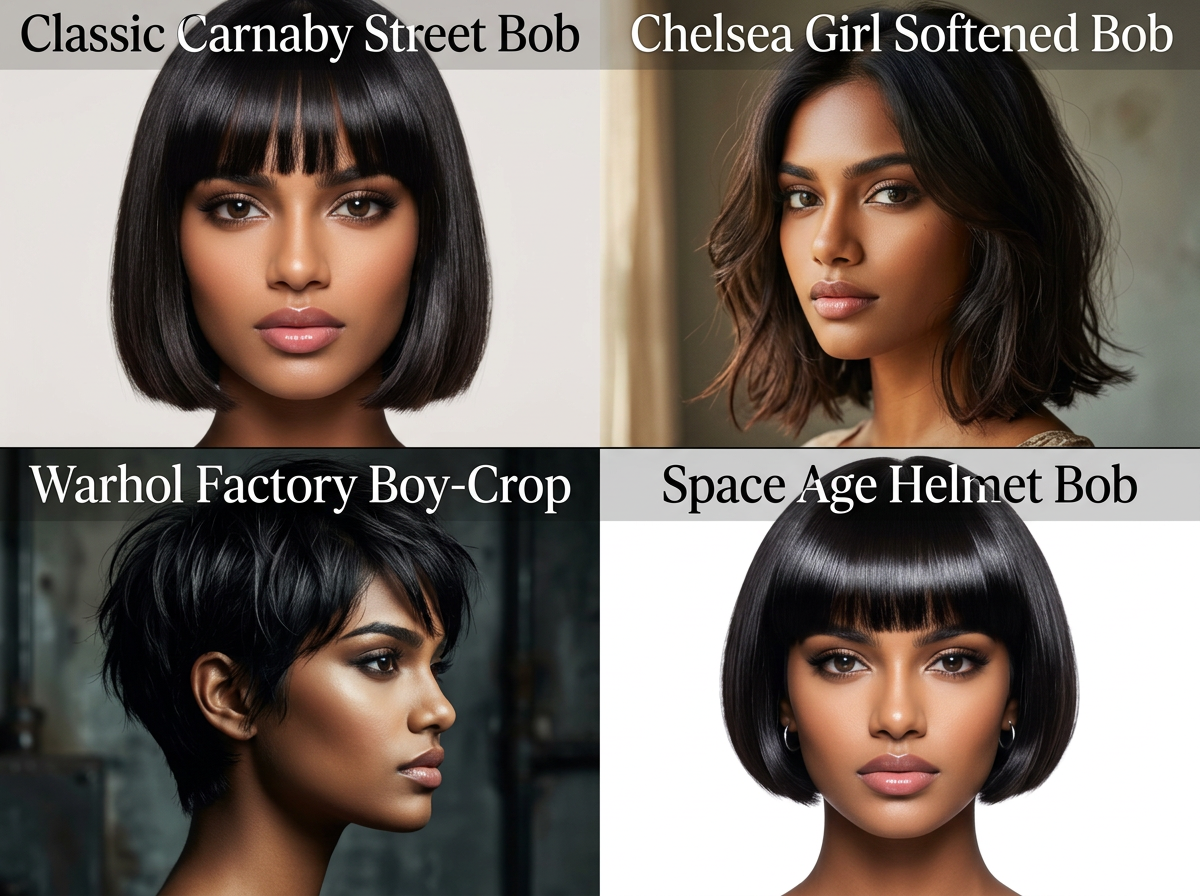
If only one could represent Mod's entire beauty philosophy, it would be Vidal Sassoon's geometric bob. Sassoon's innovation, developed alongside Mary Quant in the early-to-mid 1960s, was a cut with a defined, geometry, designed to hold its line through movement. This was a quiet rebellion against the decade before, when a "done" hairstyle meant hours of setting and teasing.
Carnaby Street Mod favors the classic blunt bob at or above the jaw, often with a sharp fringe. Chelsea Girl Mod softens it, adds a little length and tousles it, consistent with the more bohemian lean. Warhol Factory Mod favors a boy-crop, closer to the head, part of the "beautiful damage" previously named. What unites them is the sharp edges.
For the textured hair girls
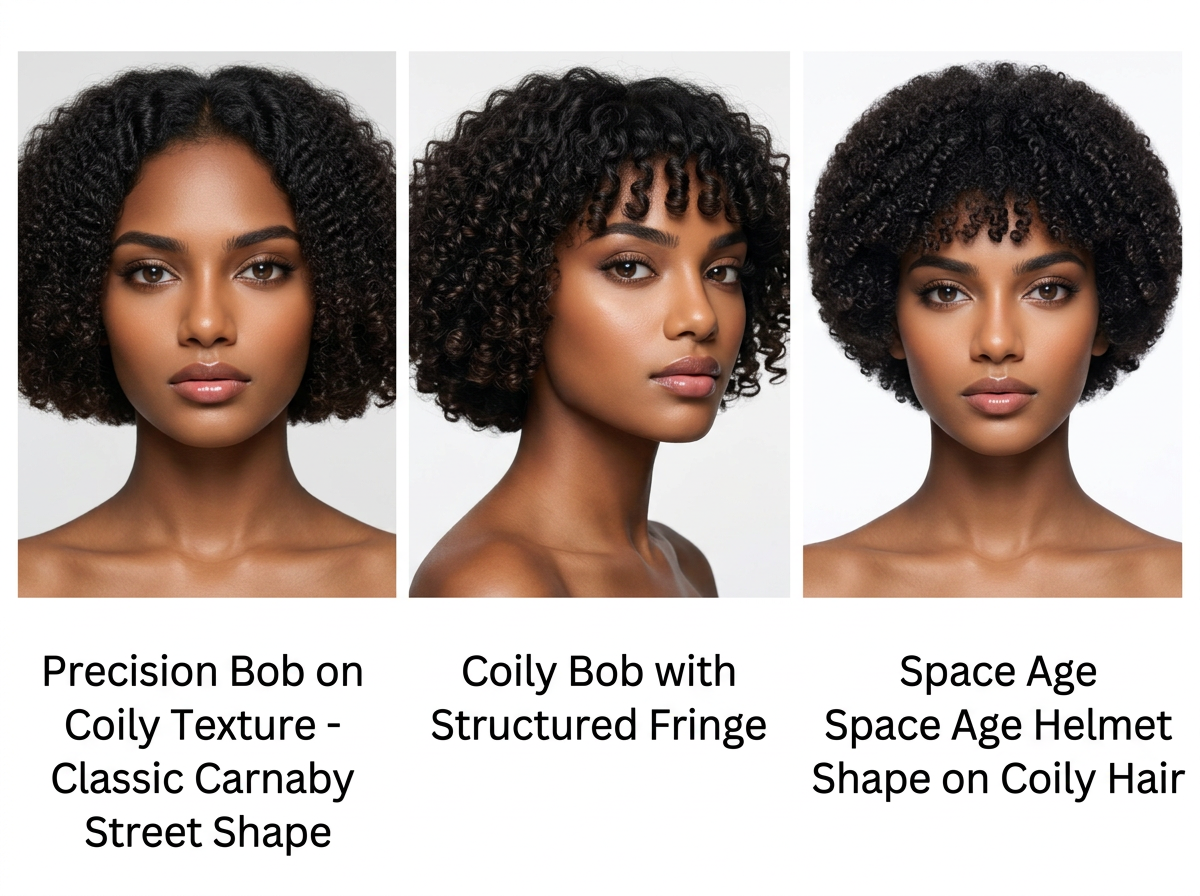
Yes, the precision bob was designed around straight hair. Translating it onto curl or coil takes real skill from a stylist who understands Mod’s clean geometric shape. A well-cut geometric bob on natural texture is totally doable; it just requires an experienced stylist working with the hair's structure, not fighting it.
The Eyes: Mod's Second Signature
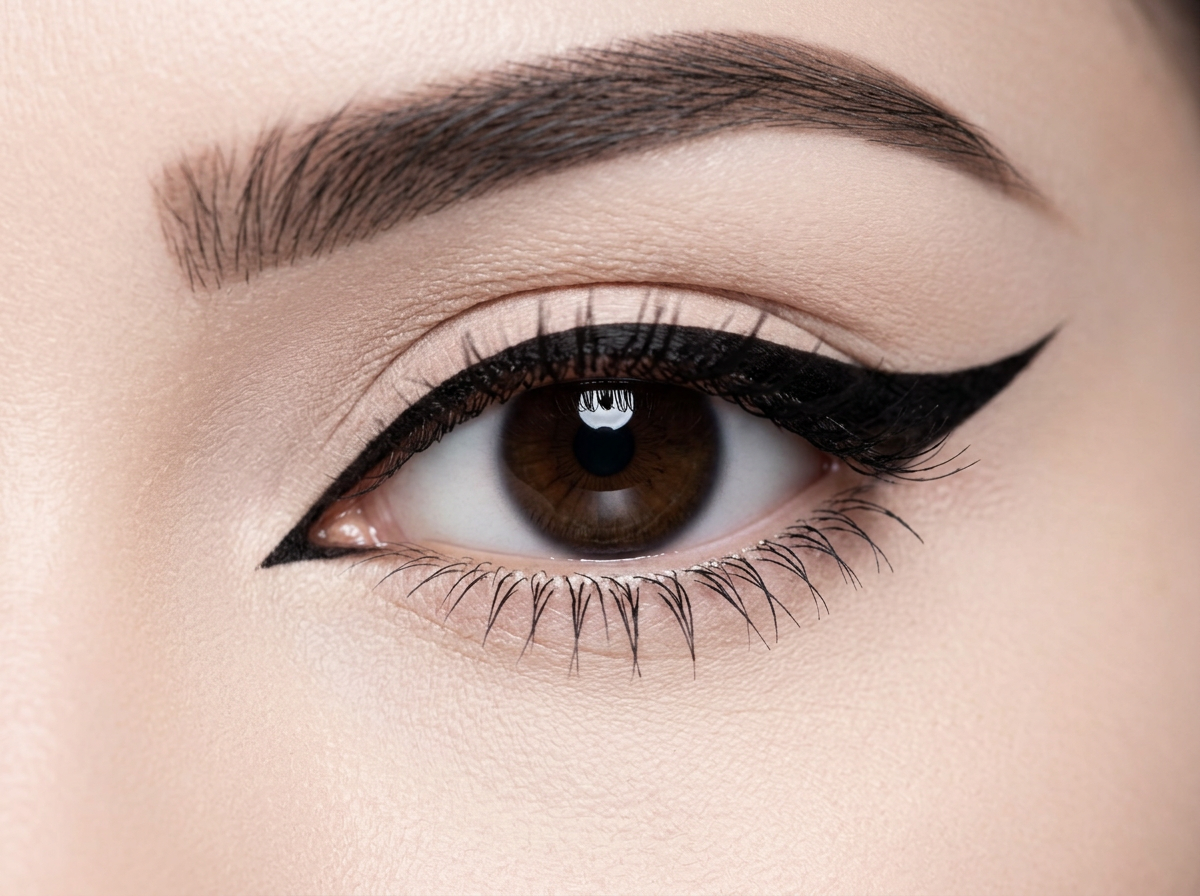
Where the bob gives structure, the eye makeup supplies Mod’s other non-negotiable: exaggerated, graphic lashes. Twiggy's innovation — drawn-on lower lashes, painted directly beneath the eye in addition to the natural upper lash line — remains the most imitated beauty detail of the Mod movement. The doll-like, almost cartoon-adjacent effect works for because of total commitment to an unambiguous graphic choice.
Winged eyeliner does the equivalent work on the upper lid.
Pale, almost invisible lips complete the formula, keeping all of the face's visual attention at the eyes; a bold lip alongside graphic liner give competing signals, which is one of the more common execution mistakes.
The Signature Looks
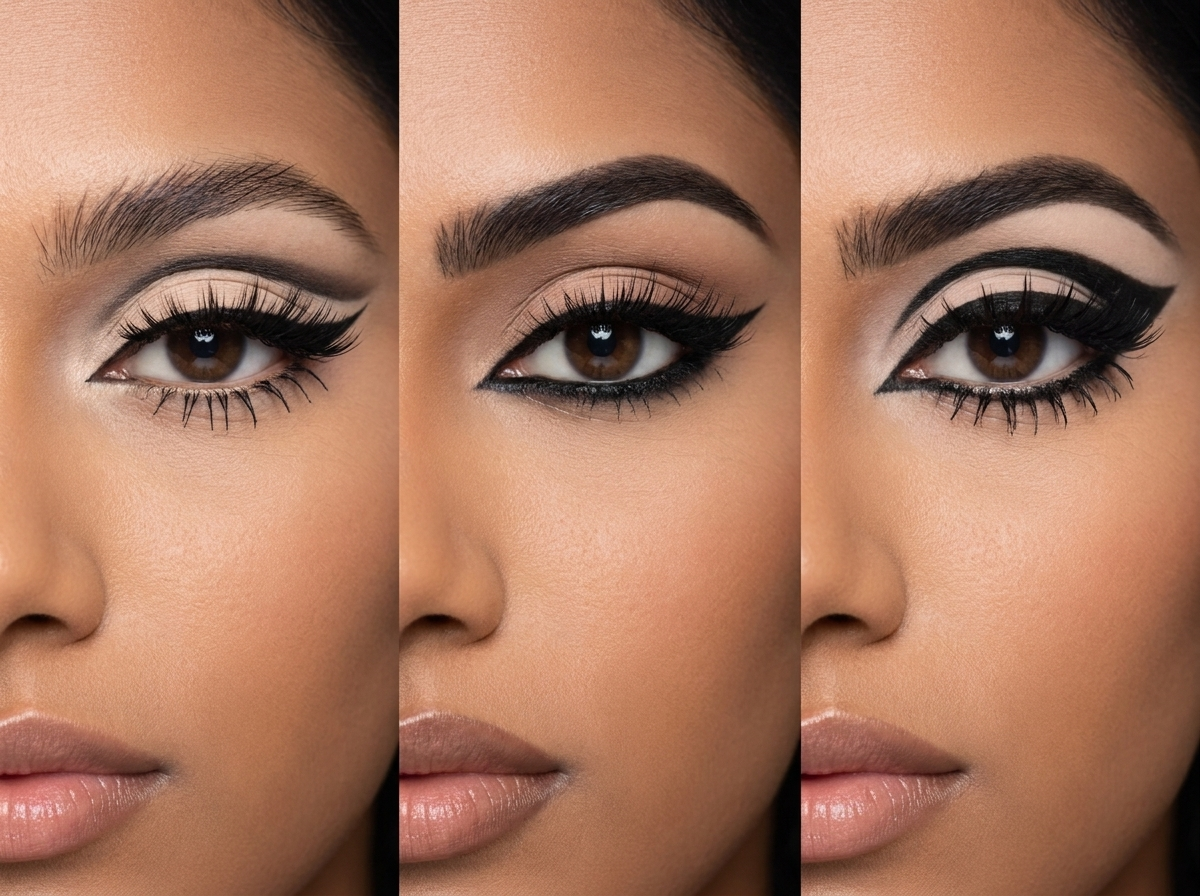
From left to right: the Twiggy eye, the Sophia Loren mod eye, and the Edie Sedgwick eye.
The Twiggy Eye:
Pale eyeshadow all over lid
Dark crease defined heavily
Winged liner extended
Bottom lashes drawn one-by-one
Top false lashes triple layered
Brows kept natural, brushed up
Effect: Doll-like innocence
The Sophia Loren Mod:
Kohl-heavy lower lash line
Winged black liner top
Neutral shadow
Extended cat-eye
Mascara heavy
Brows darkened, arched
The Edie Sedgwick:
Massive black liner
Doe-eyed drama
Pale lid emphasis
Bottom lashes very drawn
Fake lashes obvious
Almost androgynous
Lips: The Deliberate Understatement
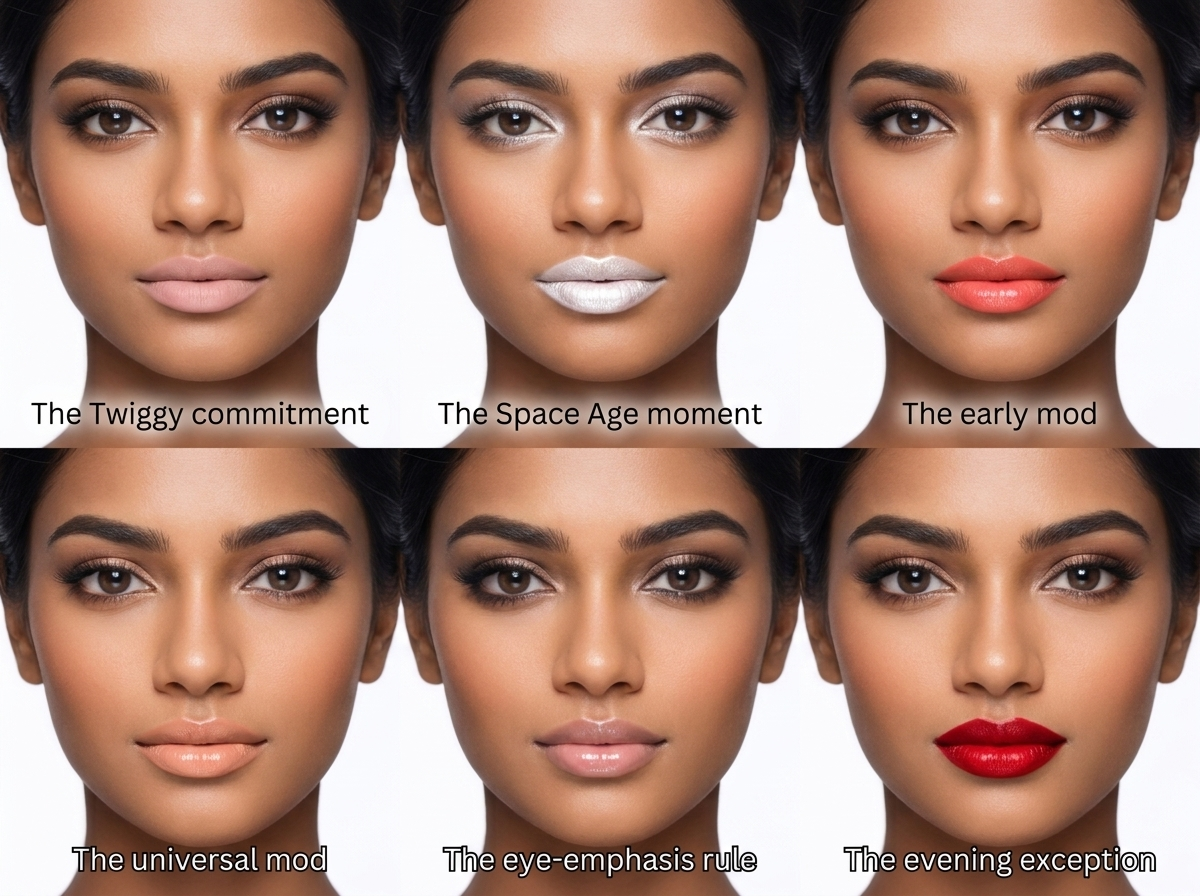
We’ve already established how a bold lip competes with Mod's eye work. What actually belongs on the mouth instead?
The Approach:
Pale pink or nude: The Twiggy commitment
Frosted white pearl: The Space Age moment
Coral (holdover): The early mod
Peachy nude: The universal mod
Barely-there lipstick: The eye-emphasis rule
Red (bold statement): The evening exception
Application Rules:
Lips must not compete with eyes
Matte or pearl finish
Overlined slightly for volume
Lip liner often skipped
Gloss occasionally added
Never dramatic reds (usually)
Nails: The Graphic Manicure
The Approach:
Short and rounded: The mod length
Pale pink: The Twiggy commitment
Frosted white: The Space Age
Nude with white tip: The proto-French
Graphic patterns (rare): The op-art nail
Squoval shape: The clean geometry
Body: The Prescribed Silhouette
The Ideal:
Very slim (Twiggy influence)
Boyish figure celebrated
Long legs emphasized
Small bust preferred
Youthful throughout
Body-conscious but not curvy
The Broader Beauty Vocabulary
A few supporting elements round out the look. Pale, matte base makeup keeps the skin from competing with the eye work. Modis not interested in the dewy, glowy finish that dominates contemporary beauty content.
Brows stay natural or softly groomed, since Mod's drama rests at the lash line. And nails, when done, tend toward pale or white polish, extending Mod’s preference for stark, clean color rather.
A Note on Commitment
Mod punishes half-measures more than most aesthetics, and nowhere is that truer than here.
A shift dress and go-go boots with soft, undone hair and no eye makeup reads as a woman wearing a 60s dress on a day she didn't have time to do her makeup. Beauty carries real weight in Mod’s legibility, more than anywhere else in this series.
One False Move…Mod Edition
One False Move… and it’s giving, “Yeah, baby!”
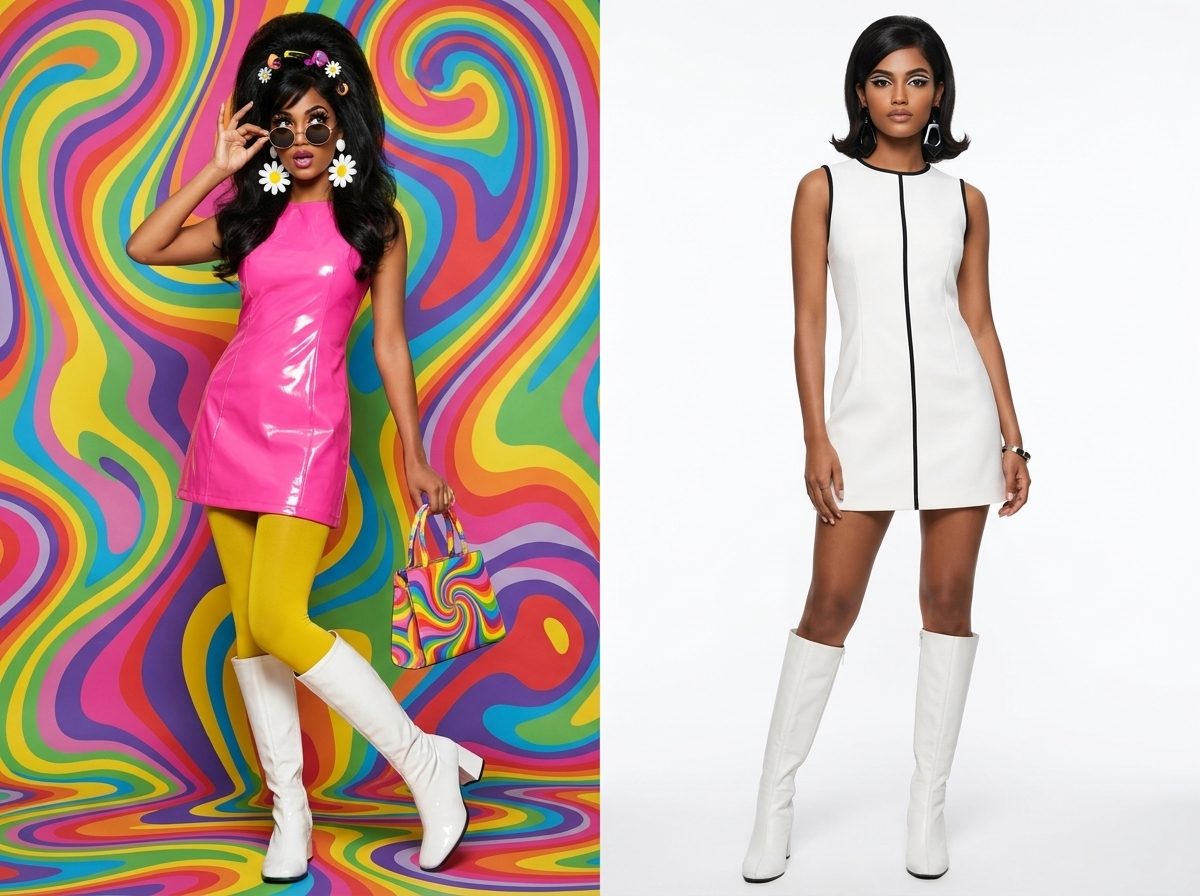
Right side: Halloween costume. Left side: Modern, wearable Mod.
The line between authentic Mod and parody is pretty thin.
The original movement embraced optimism, youth, and modern design. It borrowed from Pop Art, embraced new synthetic materials, and wasn't afraid of bold color. However, it still exercised restraint.
Hollywood remembered something different.
Somewhere along the way, Mod became shorthand for giant flowers, psychedelic prints, white vinyl boots, and exaggerated lashes. That's great if you're filming a spoof comedy. It's less successful if you're trying to be taken seriously.
What Goes Wrong
Every iconic aesthetic eventually gets reduced to its loudest visual stereotypes.
For Mod, that means every daisy, peace sign, and psychedelic swirl at the same party.
The irony is that real Mod was clean with simple silhouettes. If your outfit makes people think of movie quotes before fashion history, you've probably crossed the line.
The Wrong Outfit
Hot pink vinyl mini dress, bright yellow tights, oversized white patent go-go boots, giant daisy earrings, psychedelic handbag, oversized sunglasses, dramatic false lashes.
It's not inspired by the '60s.
It's inspired by someone's Halloween costume inspired by the '60s.
How to Fix It
Choose one Mod element and let it carry the outfit.
If you're wearing white knee-high boots, skip the psychedelic handbag. If your dress is a bold color, keep the accessories architectural. Graphic eyeliner makes a statement on it’s own.
When in doubt, ask yourself:
"Would this look at home in a modern luxury campaign?"
If the answer is yes, you're probably in Mod territory.
If the answer is, "Someone should hand me a lava lamp," edit one or two pieces.
One False Move… and it's “Our estimated arrival time is 3:45pm.”
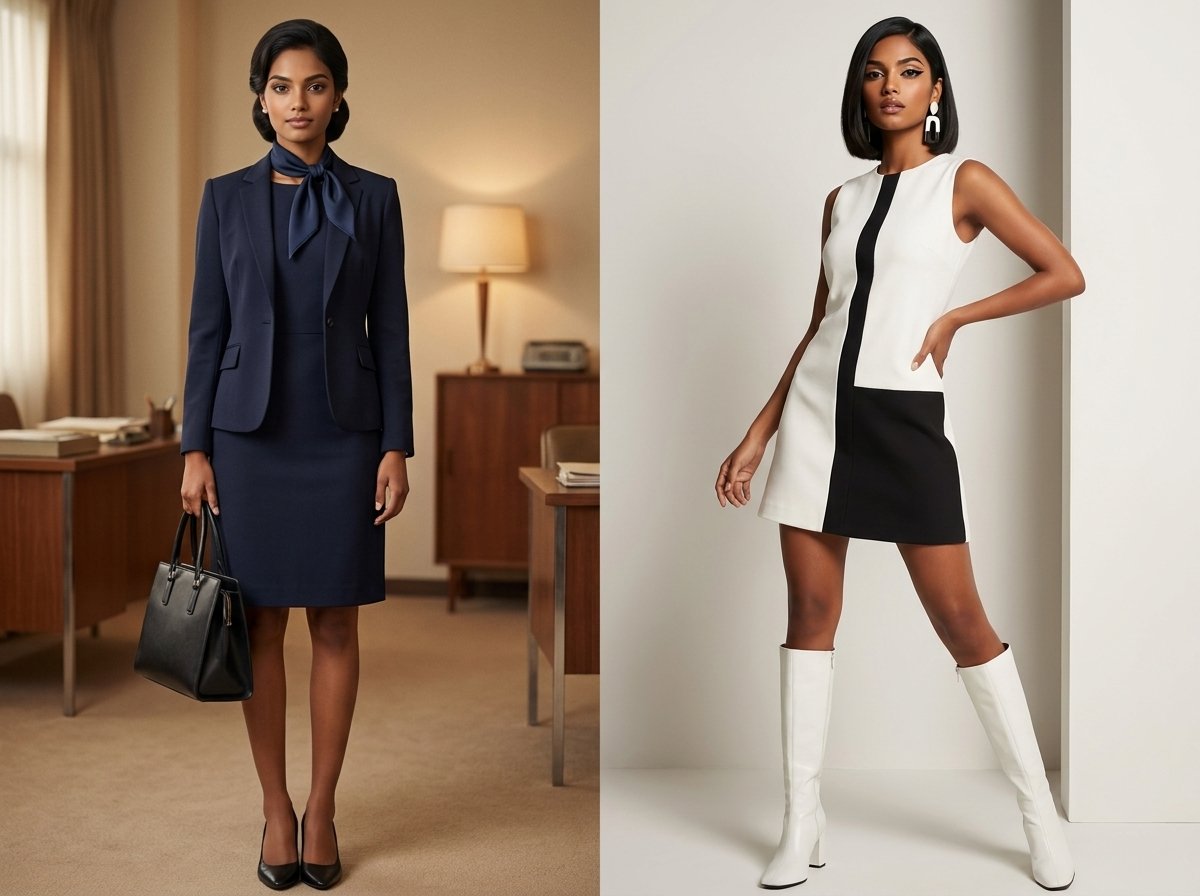
Clean tailoring is one of Mod's defining characteristics.Unfortunately, it's also one of the defining characteristics of corporate uniforms.
The difference is in the attitude. Mod carries a spirited, youthful energy and a confident sense of play. Uniforms do exactly the opposite.
What Goes Wrong
Clean tailoring is one of Mod's defining characteristics. Unfortunately, it's also one of the defining characteristics of corporate uniforms.
The difference isn't the silhouette. It's the attitude.
Mod has energy. It feels youthful, playful, slightly rebellious. Uniforms exist to do exactly the opposite—they're designed to disappear into professionalism.
The Wrong Outfit
Navy shift dress, matching blazer, silk neck scarf, structured handbag, sensible pumps, giving flight attendant.
How to Fix It
Inject personality back into the outfit.
Swap pumps for white boots, replace the silk neck scarf with sculptural earrings or use a stronger eyeliner or a bold geometric handbag.
The silhouette can stay polished—you just need one unexpected element that reminds people this is fashion rather than company dress code.
Mod should always feel a little cooler than practical.
One False Move… and it's French mime
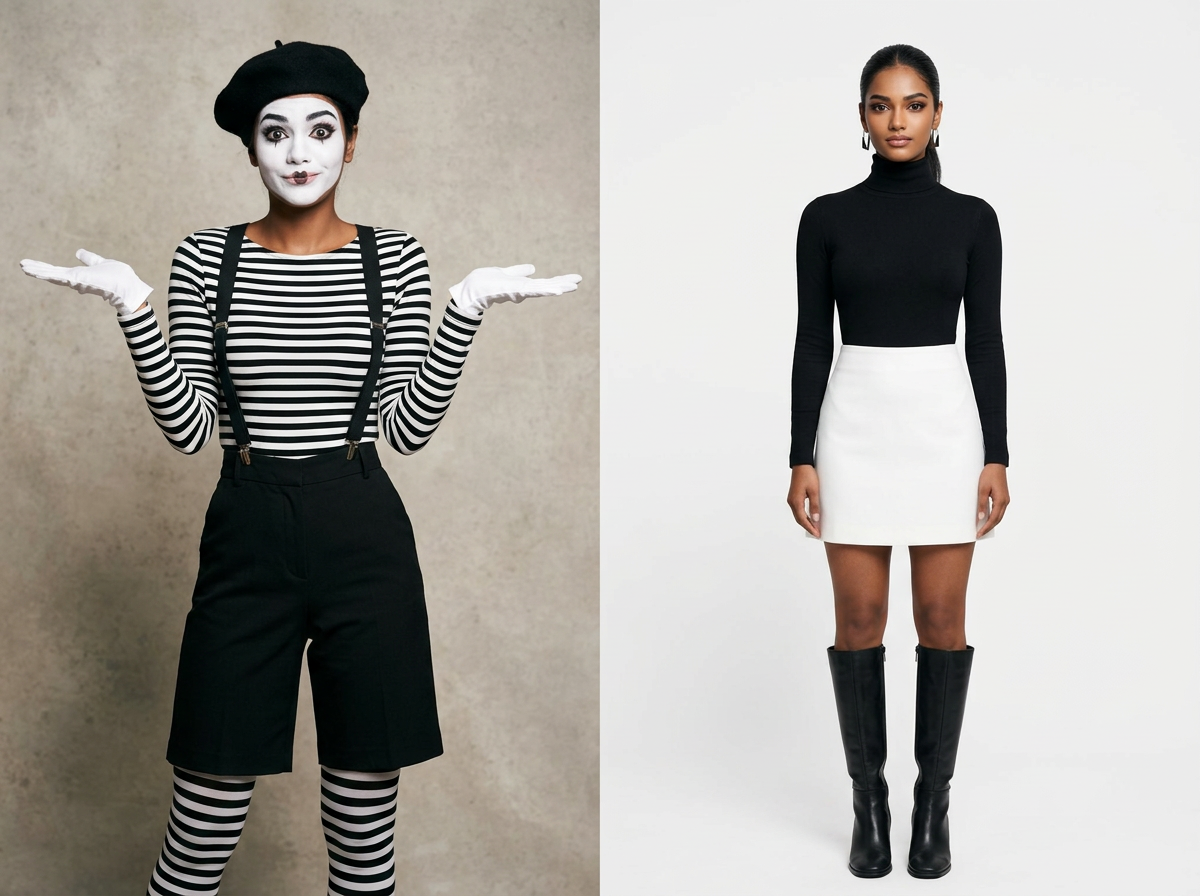
Black and white are Mod's favorite colors, but that doesn't mean every black-and-white graphic belongs in the same outfit.
Contrast gives the eye a moment’s rest. A bold stripe is exciting because it stands out. Without those quiet moments, graphic styling gets theatrical.
What Goes Wrong
The outfit stops reading as modern minimalism and becomes a stage costume.
There is nothing wrong with theatrical dressing—but unless you're specifically chasing avant-garde performance fashion, it's probably not the right destination.
The Wrong Outfit
Black-and-white striped shirt, striped tights, black beret, cropped trousers, white gloves.
Somewhere, an invisible wall is being pushed.
How to Fix It
Break up the black and white to give breathing room.
If you're wearing stripes, everything else stays simple. If the outfit already has graphic contrast, skip additional striped tights or patterned accessories.
Ironically, the stronger the graphic element, the simpler everything around it should become.
Adjacent Aesthetics
Aesthetics often share characteristics with others and Mod is no exception. Getting this wrong is how "Mod-inspired" ends up describing three completely different closets.
Mod vs. Twee
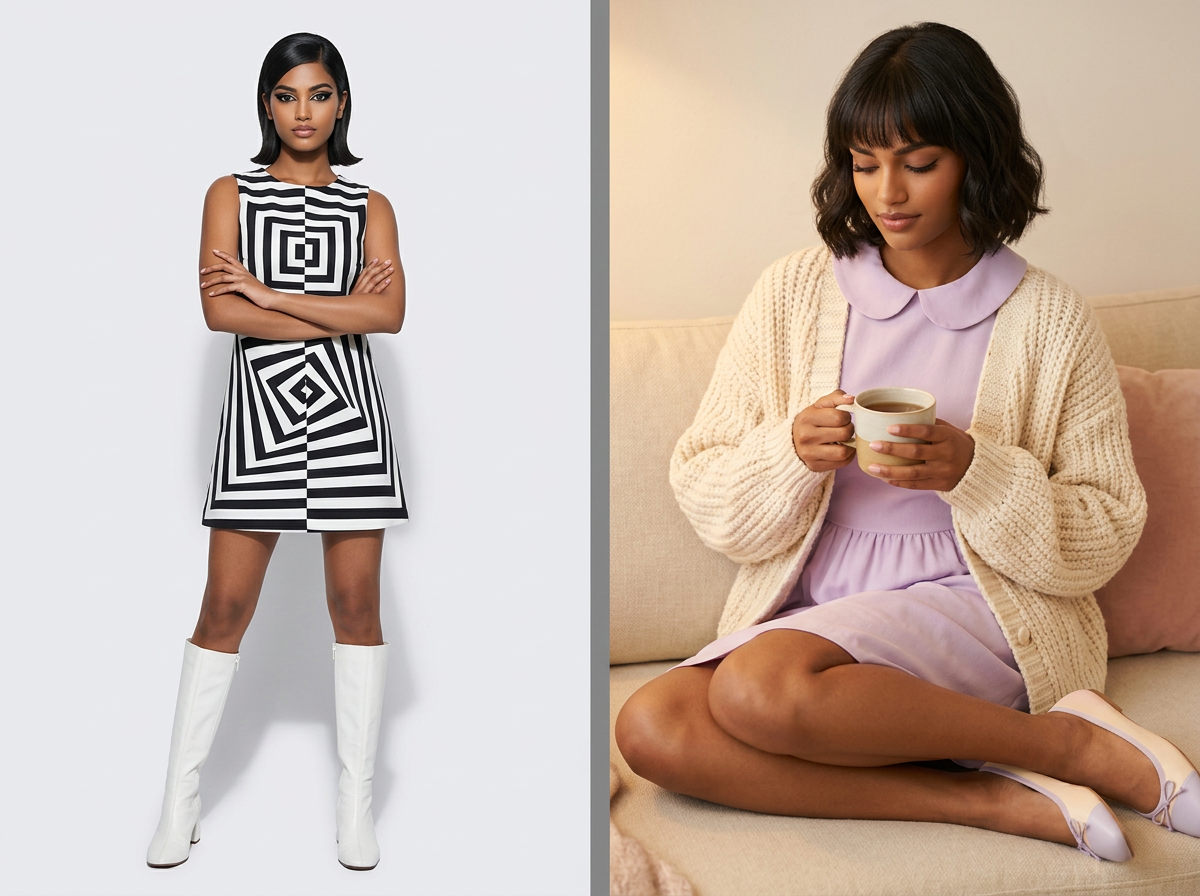
Both aesthetics reach for Peter Pan collars, A-line silhouettes, bold prints, ballet flats, and/or a bob or heavy fringe. However there are noticeable differences.
Twee embraces nostalgia, indie culture, and an "adorkable" sensibility. It's about finding joy in small, whimsical details. Key characteristics of Twee include childlike or schoolgirl-inspired elements, literary and artistic references, and handmade or crafty details.
Unlike Mod's working-class London roots, Twee's lineage runs through a more middle-class bookishness. Mod wanted wanted to command a room. Twee wanted to look like it had wandered in from a used bookstore and gotten distracted by the poetry section.
The Surface Similarity
Both aesthetics love:
Retro-inspired dressing
A-line silhouettes
Bold patterns
Whimsical accessories
What Sets Them Apart
Mod is:
Sharp, geometric, architectural
Bold, saturated primary colors
Working-class rebellion origins
Sexual and confident
Twee is:
Soft, curved, whimsical
Pastels and muted tones dominant
Middle-class bookish origins
Deliberately non-sexual
The Definitive Test
Ask: "Would this outfit work in a dance club at 2 AM?"
Mod: Absolutely! Why do you think I put it on?
Twee: Absolutely not, we're at a bookstore
Mod vs. Hippie
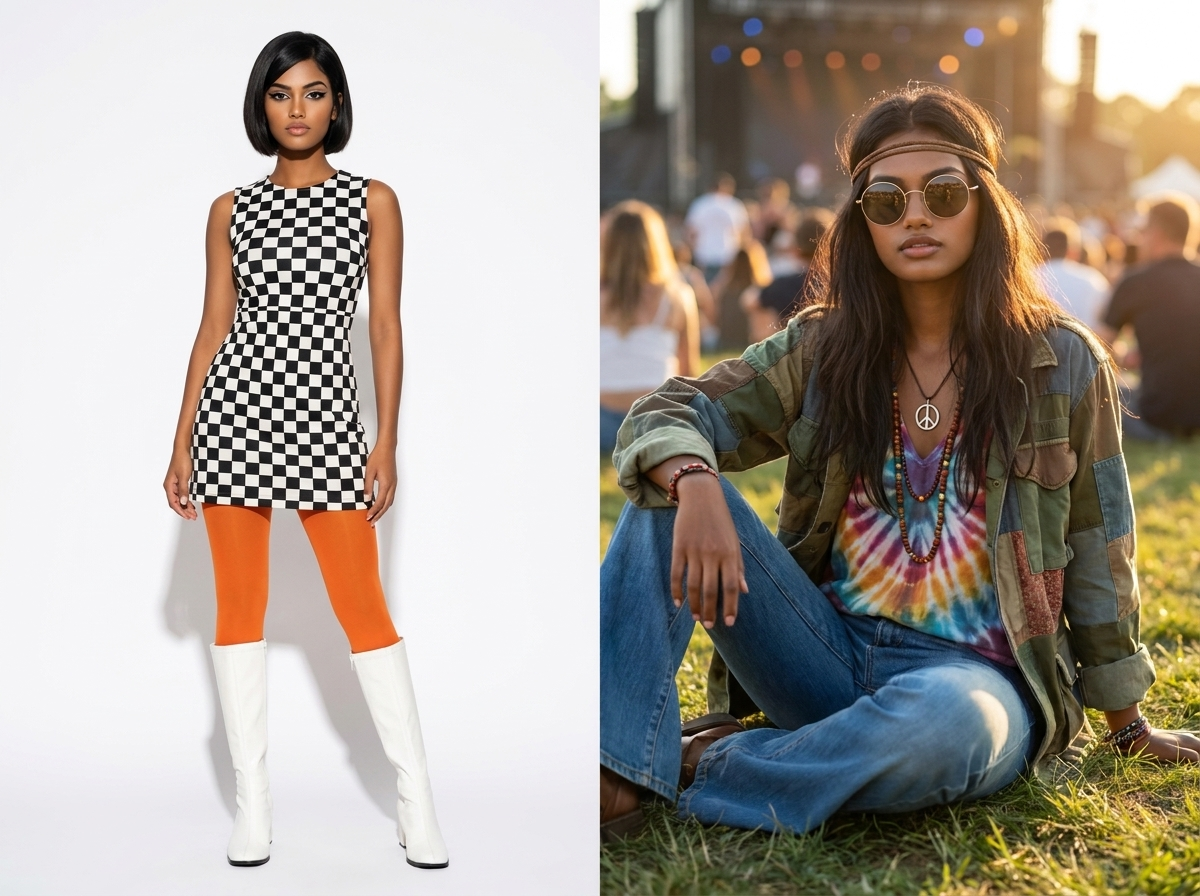
If you thought Mod and Twee was confusing, the wardrobe overlap is even stronger with Hippie.
Both aesthetics share timelines and social circles. Mod's fracture in the late 1960s fed into the psychedelic scene clustering around clubs like the UFO, which means Hippie isn't really Mod's opposite so much as one of its direct descendants.
Where Mod is engineered, Hippie is flowing silhouettes and natural fiber. Where Mod's palette is hard-edged black-and-white or a single saturated primary, Hippie embraces earth tones, tie-dye, and nature referencing patterns like florals, paisley, sun and moon motifs. Hippie's countercultural instinct ran backward as often as forward, borrowing heavily from a romanticized version of non-Western dress and spirituality that our own Boho coverage already flagged.
The politics diverge just as sharply as the silhouette. Mod's rebellion was a working-class assertion of taste and status, expressed through spending and tailoring. Hippie's rejection of the mainstream was political, anti-war and anti-establishment, uninterested in the sharp tailoring and status-conscious spending that powered Mod's original scooter culture.
Grooming is another reason why the two are so easy to tell apart. Mod's precision bob is engineering-grade, styled to hold a hard line without drooping. Hippie hair is long, loose, and unstructured.
The Surface Similarity
Both are 1960s youth movements:
Music scene central
Youth culture political
Drug culture adjacent
Fashion revolution
What Actually Sets Them Apart
Mod is:
Early to mid-1960s
Urban working-class British
Amphetamines (uppers)
Modern jazz then rock
Boutique fashion
Hippie is:
Late 1960s onward
Rural/suburban middle-class American
Psychedelics (LSD, marijuana)
Psychedelic rock
DIY and thrift
The Definitive Test
Ask: "How structured is this outfit?"
Mod: Highly structured
Hippie: Unstructured, flowing
Mod vs. Coquette
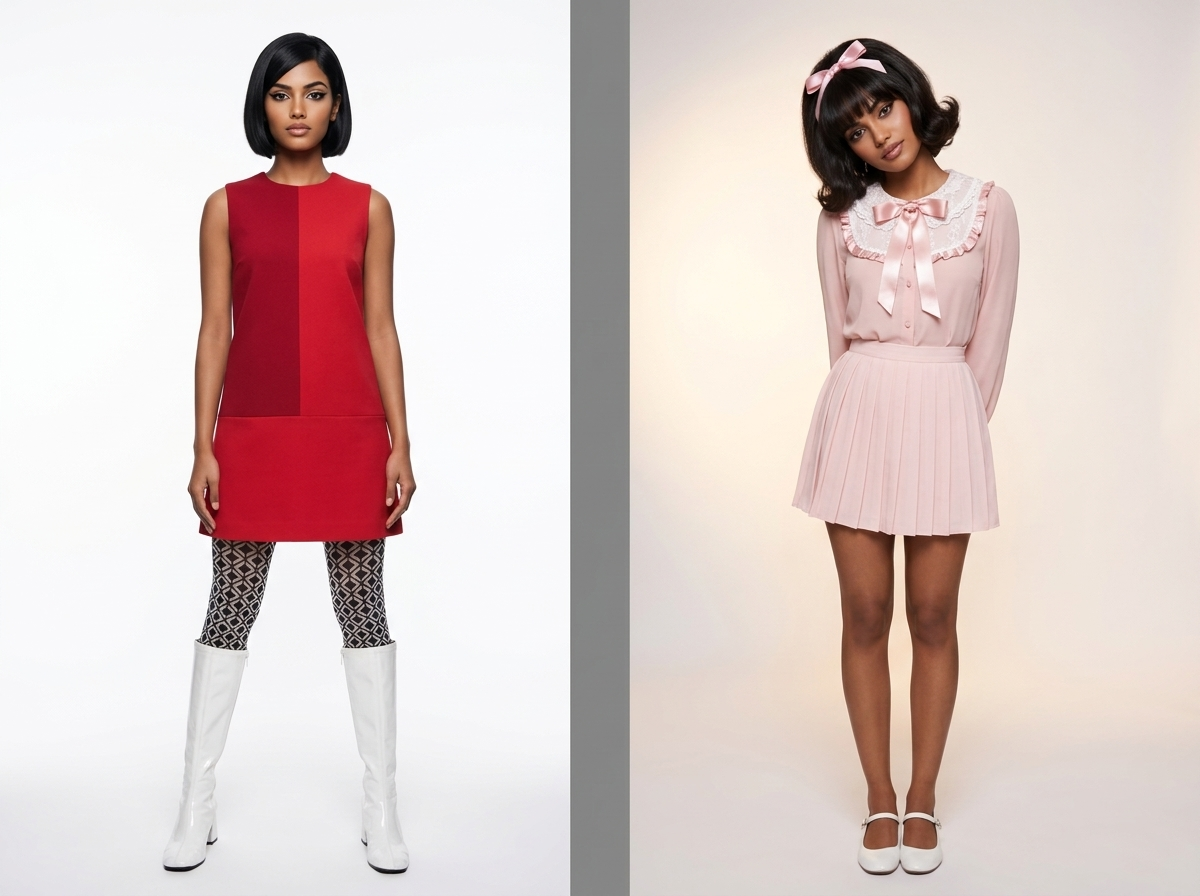
Mod and Coquette have real overlap in specific pieces. Both aesthetics enjoy ballet flats, heavy bang bobs and Peter Pan collars. Coquette borrows Bardot's ribbon-and-lace femininity like Mod borrows Twiggy's geometric confidence. That’s pretty much where the resemblance ends.
Mod rejects the feminine silhouette and traditional “softness”. The same frills that Mod rejects, Coquette embraces with waist-cinching, ribbon, and lace. Where Mod's boldness is confident and adult, Coquette's femininity is coy and delicate. A bow, In Mod's visual grammar, a bow should be geometric and graphic to belong at all; in Coquette's, bow is soft, decorative, and slightly excessive.
Mod's palette runs on absolute black-and-white or a single saturated primary, with hard contrast and zero blending. Coquette is almost entirely soft pink, cream, and pastels. Put a cherry-red Mod shift dress next to a blush-pink Coquette bow blouse and the "both are a little retro, both like a collar" resemblance collapses almost immediately.
The Surface Similarity
Both aesthetics love:
Feminine dressing
Youthful energy
Historical reference
Statement makeup
Bow accents sometimes
Retro-inspired
What Actually Sets Them Apart
Mod is:
Sharp and geometric
Confident sexuality
Adult sophistication
Youth culture political
Working-class rebellion
Direct and bold
1960s specific
Amphetamine energy
Coquette is:
Soft and curved
Innocent sensuality
Girlish presentation
Aesthetic escapism
Aristocratic fantasy
Suggestive and coy
Rococo/Regency inspired
Sugar and pills energy
The Definitive Test
Ask: "What's the primary emotion being performed?"
Mod: Confident, direct, cool
Coquette: Coy, dreamy, delicate
Mod vs. Scandi/Minimalism
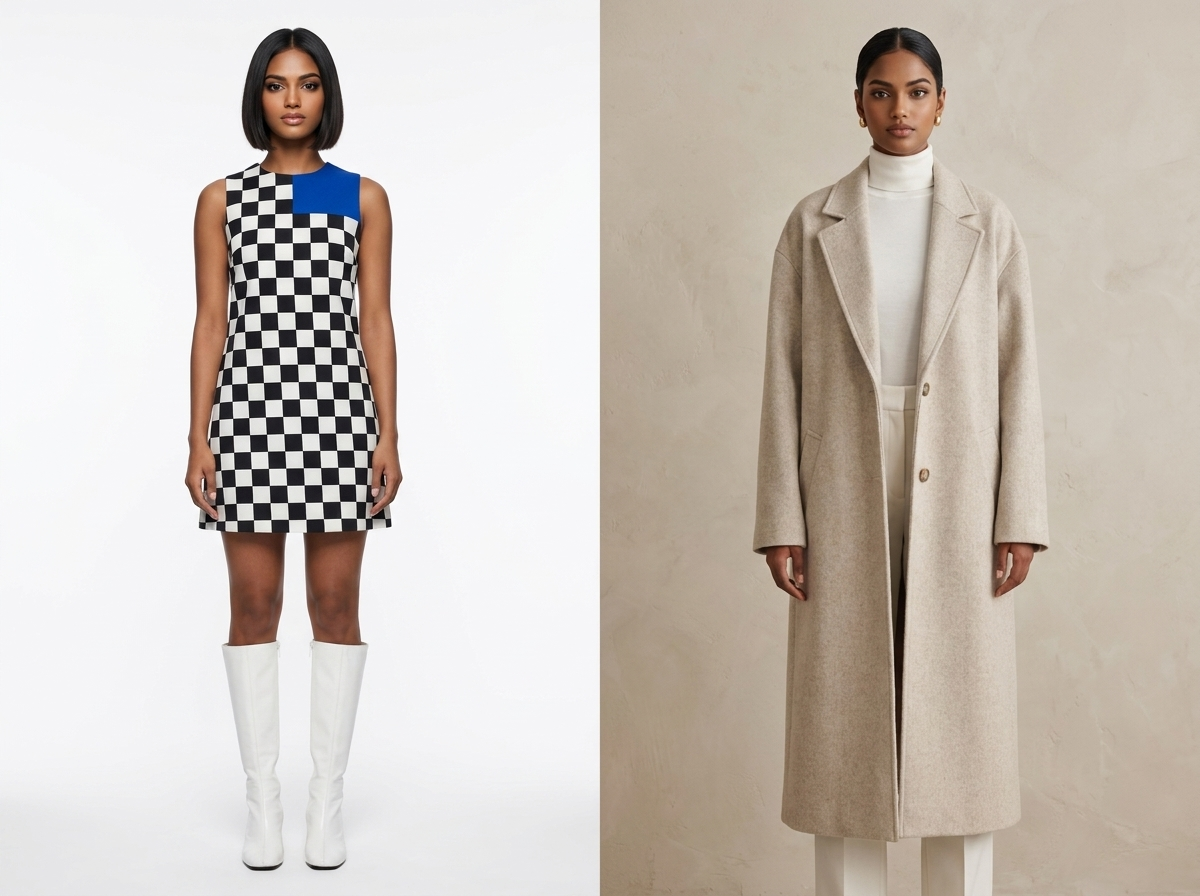
Mod and Scandi/Minimalism agree on more structural principles than almost any other pairing here. Both value clean lines and reject ornament for shape. Both distrust anything muddy, distressed, or overly embellished. You can build a Scandi-minimal outfit and a Mod outfit from the same vocabulary: a boxy coat, an A-line dress, and unfussy footwear.
The difference is in intensity. Mod restrains in one saturated color, hard contrast, or geometry recognized from across a room. Minimalism's restraint is quieter. A Scandi-minimal palette favors the neutral end of the spectrum while Mod's black-and-white foundation sets up one saturated color that punches through it.
Minimalism is pattern-averse. Mod treats graphic pattern as one of its primary tools. A Scandi-minimal wardrobe and a Mod wardrobe can share a silhouette and a base palette right up until the print shows up.
Worth noting, too, since Section 5 already flagged it directly: Scandi Mod exists as its own named dialect specifically because these two aesthetics sit close enough to genuinely hybridize — Mod's geometry stripped of its saturated color and dialed down to Minimalism's more austere register. That hybrid is the exception that proves the rule here. Left to their default instincts, Mod wants to be seen and Minimalism wants to disappear, and that's a harder gap to close than the shared boxy coat initially suggests.
The Surface Similarity
Both aesthetics love:
Clean lines
Structured silhouettes
Modernist principles
Quality over quantity
Iconic pieces
What Actually Sets Them Apart
Mod is:
Bold color and pattern
Loud and graphic
1960s specific
Boutique culture
Statement
Minimalist is:
Restrained palette
Quiet and subtle
Timeless
Investment pieces
Understatement
The Definitive Test
Ask: "How loud is this outfit?"
Mod: Loud, saturated, patterned
Minimalist: Quiet, neutral, plain
