
What is Dark Academia? Complete guide to the Aesthetic (2026)

The Dark Academia aesthetic celebrates the romance of classical learning through moody colors, vintage textures, and scholarly pursuits.
Table of Contents
Dark Academia is a fashion and lifestyle aesthetic that romanticizes classical education, literature, and scholarly pursuits through a moody, intellectual lens.
Imagine studying in a centuries-old library as rain taps on leaded glass, leather-bound books at your side, and an oversized sweater keeping you warm. That’s the heart of Dark Academia—more than an outfit, it’s a philosophy.
This aesthetic celebrates the romance of learning: the allure of old books, late-night study sessions, and the melancholy beauty of autumn on campus. It invites you to find elegance in solitude and meaning in scholarly pursuits.
The Origins: From Tumblr to TikTok
Dark Academia started as a Tumblr niche in 2015, with mood boards of Gothic architecture, vintage libraries, and handwritten notes. By 2020, TikTok made it a Gen Z favorite—cottagecore’s brainy cousin, swapping wildflowers for stacks of classic novels. The pandemic fueled its rise, offering an escape into a world where knowledge is an art form.
Literary and Philosophical Roots

Literary foundations: Dark Academia draws from Gothic novels and Romantic poetry.
Dark Academia is deeply rooted in literature. Gothic novels. Romantic poetry. Classical philosophy.
The aesthetic draws heavily from works like:
"The Secret History" by Donna Tartt - The definitive Dark Academia novel. Wealthy classics students at an elite college. Murder. Moral ambiguity. Obsessive intellectualism.
Romantic poets - Keats, Byron, Shelley, and their tragic, passionate pursuit of art and beauty.
Gothic literature - Oscar Wilde's "The Picture of Dorian Gray." Mary Shelley's "Frankenstein." The moral questions are hidden in ornate prose.
Classical texts - Ancient Greek philosophy. Latin literature. The foundations of Western education.
It’s about reveling in the beauty—and sometimes melancholy—of learning for its own sake.
Visual Inspiration: The Architecture of Learning

The visual identity of Dark Academia is rooted in historic university architecture - think Oxford libraries, stone cloisters, and centuries-old reading rooms.
The aesthetic draws from historic universities: Oxford, Cambridge, and Trinity College Dublin. Picture stone buildings, arched hallways, and reading rooms lined with antique books. These settings create the backdrop for academic pursuits steeped in history and tradition.
The Pop Culture Explosion
Several films and shows crystallized Dark Academia's visual language before it had a name:
"Dead Poets Society" (1989) - The gold standard. Boys at an elite boarding school are discovering poetry. "Carpe diem" as philosophy. Tweed jackets and tie-loosening rebellion.
The "Harry Potter" series - Hogwarts is fundamentally Dark Academia. Stone castles, house scarves, common rooms filled with books. Magic aside, it's all there.
"The Riot Club" (2014) - The darker side of elite education. Privilege and moral corruption in Oxford's secret societies.
"Kill Your Darlings" (2013) - The Beat poets at Columbia University in the 1940s. Intellectual intensity meets moral complexity.
More recently, "The Queen's Gambit" brought chess into the aesthetic. Netflix's adaptation of "The Letter for the King" included Dark Academia elements in its scholarly scenes.
The Psychology: Why We're Drawn to Dark Academia
Dark Academia appeals to something deeper than fashion trends.
Nostalgia for traditional education. Dark Academia romanticizes learning for learning's sake. When education felt like enlightenment, not just employment prep.
Escape into intellectualism. The aesthetic says studying Latin or reading philosophy matters. Knowledge is inherently valuable.
The comfort of structure. Academia has rituals. Schedules. A clear hierarchy of learning. In uncertain times, that structure appeals.
Aesthetic elitism. Dark Academia has roots in exclusive institutions. Part of its appeal is the fantasy of belonging to that world.
Beauty in melancholy. Dark Academia embraces sadness as sophisticated. Rainy days are perfect. Autumn is peak. There's romance in solitary study and bittersweet poetry.
Dark Academia Today

Dark Academia today is accessible to everyone - you don't need to attend Oxford to embrace the aesthetic's love of learning and timeless style.
The aesthetic has evolved beyond its Tumblr origins.
You don't need to attend an Ivy League school to embrace Dark Academia. You don't even need to be a student.
Mix vintage blazers with thrifted pieces. Read at your local library instead of Oxford's Bodleian. Create the aesthetic on any budget.
It's also more diverse. Early Dark Academia imagery was overwhelmingly white and European. Today's community is pushing for broader inclusion.
Some embrace it year-round. Others treat it as autumn's official aesthetic—pulling out the tweed when leaves start falling.
The lifestyle elements have grown stronger. People are learning calligraphy. Reading classic literature. Visiting museums. Building commonplace books filled with quotes and pressed flowers.
Dark Academia has become a way to make everyday activities feel more intentional and romantic. Studying becomes an aesthetic experience. Coffee shops transform into personal libraries.
It's cottagecore for people who prefer Byron to butterflies. Old Money for those who value books over country clubs. A celebration of learning that feels increasingly radical in a world of shortened attention spans.
And it looks damn good in tweed.
The Dark Academia Color Palette
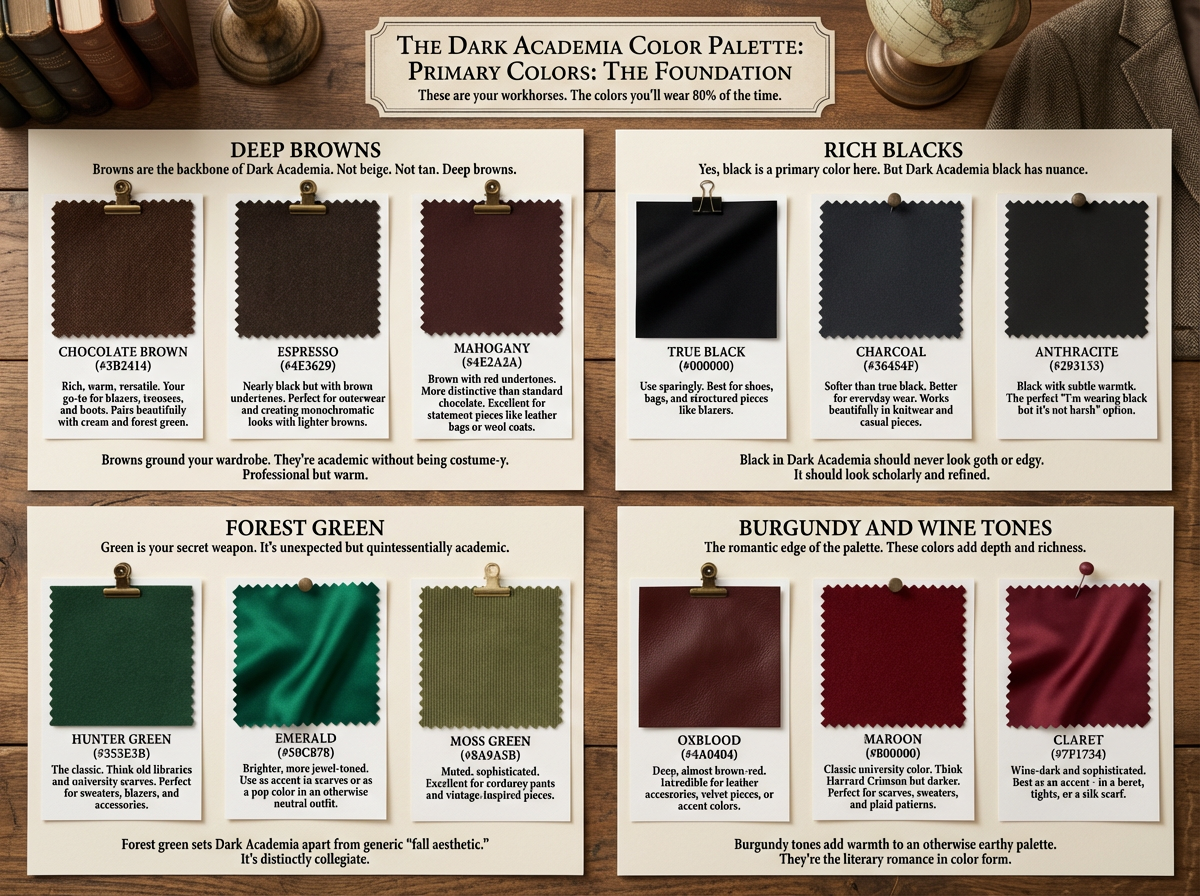
The complete Dark Academia color palette: deep browns, rich blacks, forest greens, and burgundy tones
Color is everything in Dark Academia. This isn't about following trends. It's about building a timeless, scholarly wardrobe rooted in the hues of old libraries and autumn university campuses.
The palette is rich, moody, and sophisticated. Think less "back to school" bright colors, more "centuries-old manuscript" depth.
Primary Colors: The Foundation
These are your workhorses. The colors you'll wear 80% of the time.
Deep Browns
Browns are the backbone of Dark Academia. Not beige. Not tan. Deep browns.
Chocolate Brown (#3B2414) - Rich, warm, versatile. Your go-to for blazers, trousers, and boots. Pairs beautifully with cream and forest green.
Espresso (#4E3629) - Nearly black but with brown undertones. Perfect for outerwear and creating monochromatic looks with lighter browns.
Mahogany (#4E2A2A) - Brown with red undertones. More distinctive than standard chocolate. Excellent for statement pieces like leather bags or wool coats.
Browns ground your wardrobe. They're academic without being costume-y. Professional but warm.
Rich Blacks
Yes, black is a primary color here. But Dark Academia black has nuance.
True Black (#000000) - Use sparingly. Best for shoes, bags, and structured pieces like blazers.
Charcoal (#36454F) - Softer than true black. Better for everyday wear. Works beautifully in knitwear and casual pieces.
Anthracite (#293133) - Black with subtle warmth. The perfect "I'm wearing black but it's not harsh" option.
Black in Dark Academia should never look goth or edgy (unless you’re going for Gothic Academia, which we’ll talk about later). It should look scholarly and refined.
Forest Green
Green is your secret weapon. It's unexpected but quintessentially academic.
Hunter Green (#355E3B) - The classic. Think old libraries and university scarves. Perfect for sweaters, blazers, and accessories.
Emerald (#50C878) - Brighter, more jewel-toned. Use as accent in scarves or as a pop color in an otherwise neutral outfit.
Moss Green (#8A9A5B) - Muted, sophisticated. Excellent for corduroy pants and vintage-inspired pieces.
Forest green sets Dark Academia apart from generic "fall aesthetic." It's distinctly collegiate.
Burgundy and Wine Tones
The romantic edge of the palette. These colors add depth and richness.
Oxblood (#4A0404) - Deep, almost brown-red. Incredible for leather accessories, velvet pieces, or accent colors.
Maroon (#800000) - Classic university color. Think Harvard Crimson but darker. Perfect for scarves, sweaters, and plaid patterns.
Claret (#7F1734) - Wine-dark and sophisticated. Best as an accent - in a beret, tights, or a silk scarf.
Burgundy tones add warmth to an otherwise earthy palette. They're the literary romance in color form.
Secondary Colors: Strategic Contrast
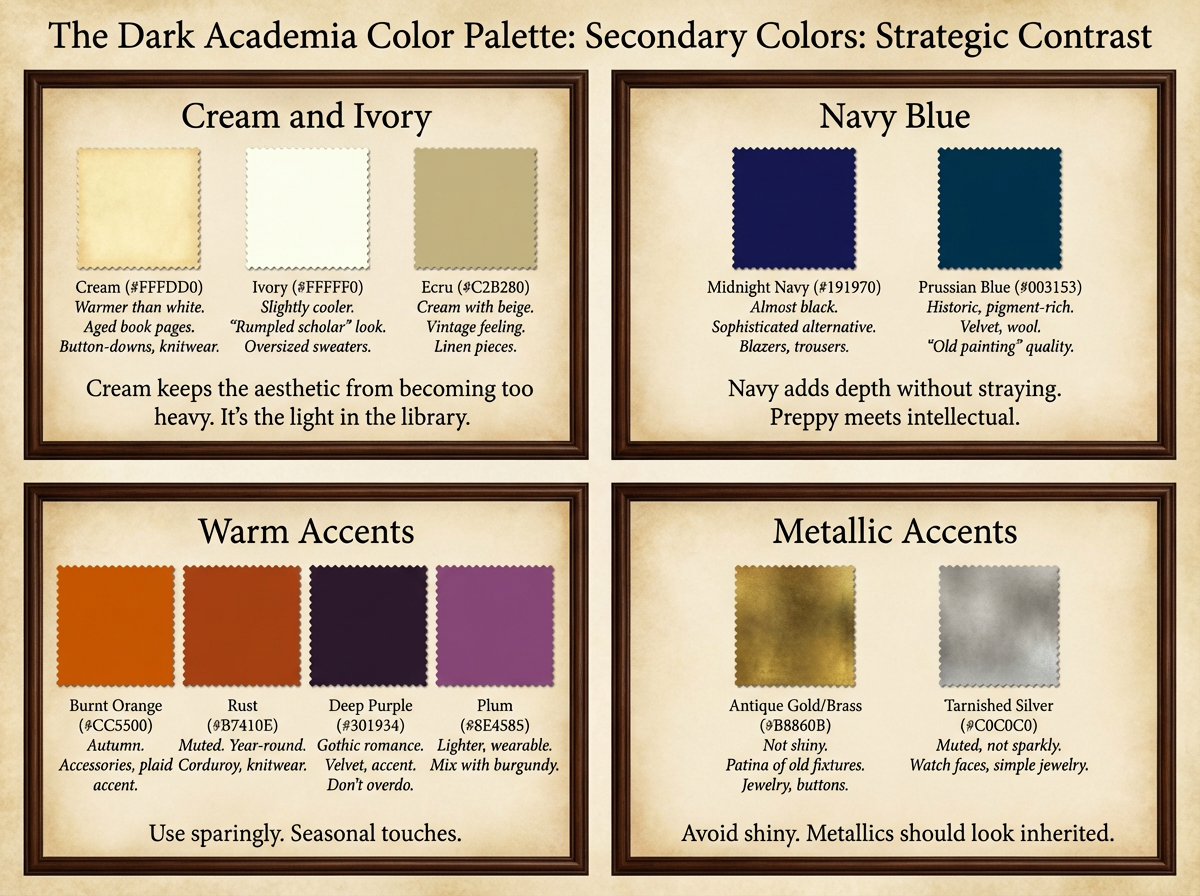
These aren't worn as often, but they're crucial for balance.
Cream and Ivory
Dark Academia isn't all dark. Cream provides essential contrast.
Cream (#FFFDD0) - Warmer than white. The color of aged book pages. Your primary color for button-down shirts and knitwear.
Ivory (#FFFFF0) - Slightly cooler. Perfect for creating the "rumpled scholar" look with button-downs and oversized sweaters.
Ecru (#C2B280) - Cream with beige undertones. More vintage feeling. Excellent for linen pieces and summer Dark Academia.
Cream keeps the aesthetic from becoming too heavy or gothic. It's the light in the library.
Navy Blue
A supporting player, but an important one.
Midnight Navy (#191970) - So dark it's almost black. Works as a sophisticated alternative to black in blazers and trousers.
Prussian Blue (#003153) - Historic, pigment-rich blue. Beautiful in velvet or wool. Has that "old painting" quality.
Navy adds depth without straying from the moody palette. It's preppy meets intellectual.
Warm Accents
Use these sparingly. They're your seasonal touches.
Burnt Orange (#CC5500) - Perfect for autumn. Excellent in accessories like scarves or as an accent in plaid.
Rust (#B7410E) - More muted than burnt orange. Works year-round in corduroy or knitwear.
Deep Purple (#301934) - Gothic romance. Best in velvet or as an accent color. Don't overdo it.
Plum (#8E4585) - Lighter, more wearable purple. Good for mixing with burgundy tones.
Metallic Accents
Metallics in Dark Academia should look tarnished and antique.
Antique Gold/Brass (#B8860B) - Not shiny. Not new. The patina of old library fixtures. Perfect for jewelry, buttons, and bag hardware.
Tarnished Silver (#C0C0C0) - Muted, not sparkly. Good for watch faces and simple jewelry.
Avoid anything too shiny or modern-looking. Your metallics should look inherited.
Color Theory: Putting It All Together
Understanding how to combine these colors is crucial.
Monochromatic Mastery
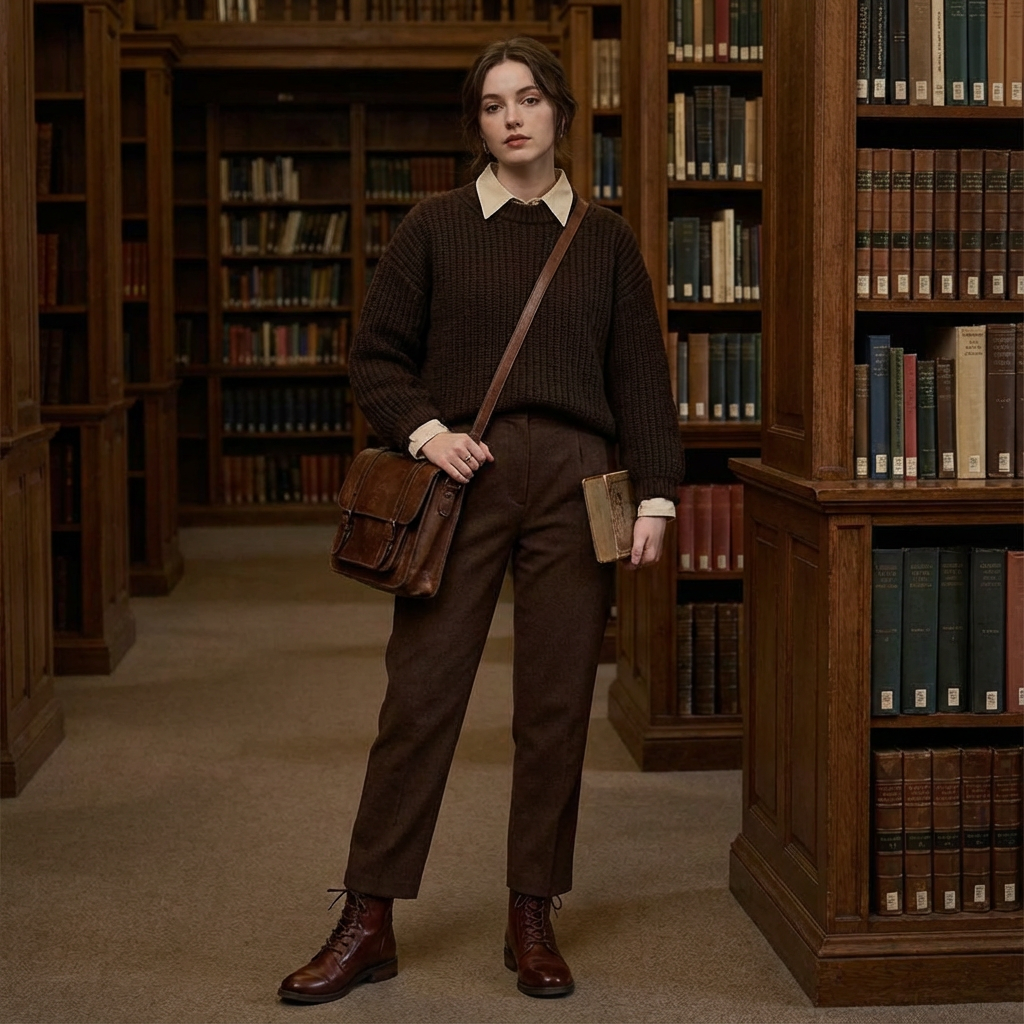
Monochromatic mastery: Layering multiple shades of brown creates sophisticated depth without using multiple colors
Dark Academia loves monochromatic dressing. Wearing multiple shades of the same color creates sophisticated depth.
All-Brown Example: Mahogany leather boots + chocolate brown corduroy pants + espresso knit sweater + cream shirt peeking through. Four shades of brown, zero colors, complete outfit.
All-Green Example: Moss green trousers + hunter green cardigan + cream turtleneck (for contrast) + forest green beret. Tonal greens with one neutral.
Monochromatic looks are foolproof and inherently scholarly.
Creating Depth Through Layering
The magic happens when you layer similar tones with different textures.
Chocolate brown tweed blazer over espresso turtleneck over mahogany corduroy pants. Same color family, distinct pieces, incredible depth.
This is why texture matters so much in Dark Academia. Without it, monochromatic looks fall flat.
Using Cream as Strategic Contrast
Cream is your reset button. It breaks up all-dark outfits without introducing bright colors.
The Formula: Dark top + dark bottom + cream layer (shirt, sweater, or scarf).
Examples:
Charcoal blazer + black trousers + cream button-down
Forest green cardigan + brown corduroy pants + ivory turtleneck
Burgundy sweater + navy skirt + cream collar showing
Cream adds breathability to your wardrobe. It's the page breaks between chapters.
Color Pairing Rules
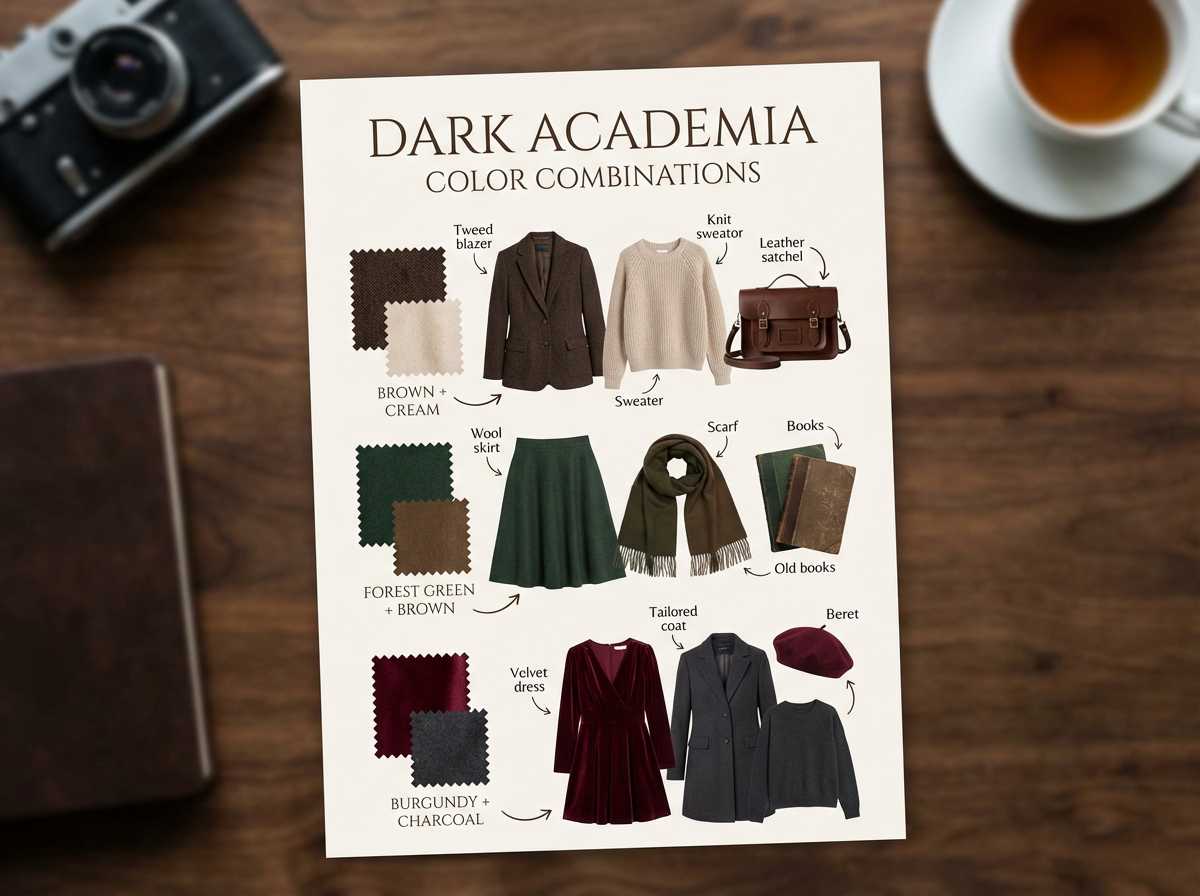
Foolproof Dark Academia color pairings: brown + cream, forest green + brown, and burgundy + charcoal always work.
Always works:
Any brown + cream
Forest green + brown
Burgundy + charcoal
Navy + cream
Black + any earth tone
Proceed with caution:
Burgundy + forest green (can work but needs cream to balance)
Multiple jewel tones (pick one, keep the rest neutral)
Black + brown (controversial, but works in Dark Academia if textures differ significantly)
Avoid:
Bright, saturated colors
Pastels (save for Light Academia)
Anything neon or synthetic-looking
Too many competing colors (stick to 2-3 per outfit)
Seasonal Adjustments
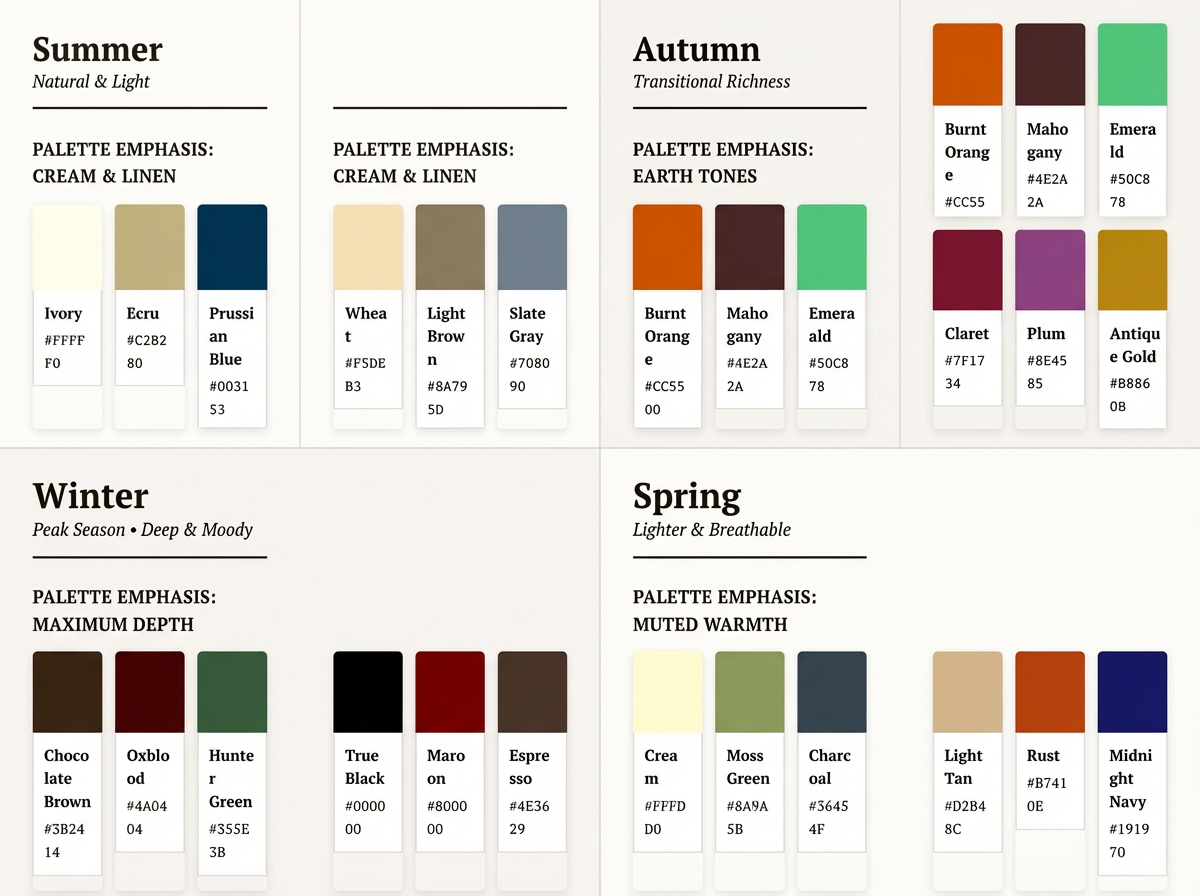
Seasonal adjustments: Deep burgundy and espresso for fall/winter, lighter creams and moss greens for spring/summer.
Dark Academia is year-round, but the palette shifts slightly by season.
Fall/Winter (Peak Season)
Go full depth. This is when oxblood, espresso, and forest green dominate. Heavier fabrics in darker shades. Minimal cream except for layering.
Palette emphasis: Browns, burgundy, deep greens, blacks.
Spring
Lighten up without losing the mood. More cream, moss green instead of hunter, lighter charcoal instead of true black. Keep the intellectual vibe but let in some air.
Palette emphasis: Cream, navy, lighter browns, muted greens.
Summer
The most challenging season for Dark Academia. Focus on cream and lighter neutrals. Use linen in ecru and ivory. Navy becomes more prominent. Save the deep colors for accessories.
Palette emphasis: Cream, ivory, navy, light browns in breathable fabrics.
Keep your color choices natural and muted year-round. Even summer Dark Academia doesn't mean bright colors.
The Psychology of the Palette
These colors aren't arbitrary. They're chosen for emotional and historical resonance.
Browns and greens: Earth tones connect to nature, groundedness, stability. They're the colors of old wood, leather bindings, and ancient trees on university grounds.
Burgundy and wine: Sophistication, maturity, a hint of decadence. These are colors associated with old wealth and classical art.
Cream: Aged paper, candlelight, intellectual pursuit. It's the color of knowledge itself - old manuscripts and library cards.
Blacks and charcoals: Seriousness, focus, mystery. The Gothic edge of Dark Academia lives here.
Together, they create a palette that feels timeless. You could have worn these colors in 1890 or 2024. That's the point.
Common Color Mistakes
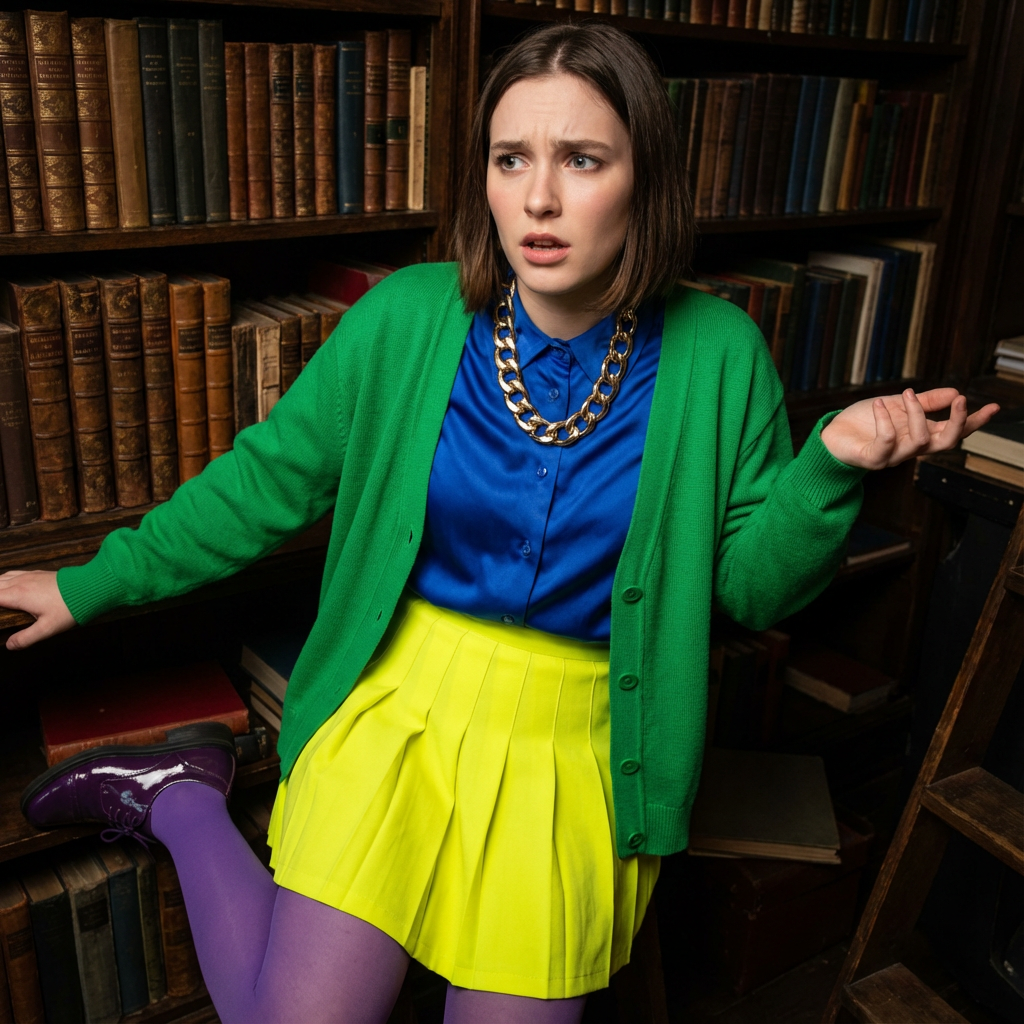
Mistake #1: Introducing bright colors That Kelly green sweater isn't Dark Academia. Neither is bright red nor royal blue.
Fix: Stick to muted, deep versions of colors. Hunter green, not lime. Burgundy, not scarlet.
Mistake #2: Forgetting cream Without cream or ivory, your outfits become heavy and gothic rather than scholarly.
Fix: Always have one cream element - even if it's just socks or a collar peeking out.
Mistake #3: Too many colors at once Five different colors in one outfit reads as chaotic, not academic.
Fix: Stick to 2-3 colors maximum. Build around one main color with one accent and cream.
Mistake #4: Shiny, modern-looking pieces That bright gold button-down or synthetic burgundy blouse doesn't fit the aesthetic.
Fix: Choose matte finishes. Look for vintage or vintage-inspired pieces with natural fabrics.
Building Your Color Wardrobe
Start with neutrals. Build in this order:
Browns and creams (60% of your wardrobe)
Blacks and charcoals (20%)
One signature color - forest green OR burgundy (15%)
Accents - navy, rust, plum (5%)
This ratio ensures versatility while maintaining the aesthetic.
Your signature color becomes your Dark Academia. Maybe you're the burgundy person. Maybe you're all about forest green. Own it.
The palette should feel instinctive eventually. You'll walk into a store and immediately know what fits. That's when you've mastered Dark Academia color theory.
Essential Dark Academia Wardrobe Pieces
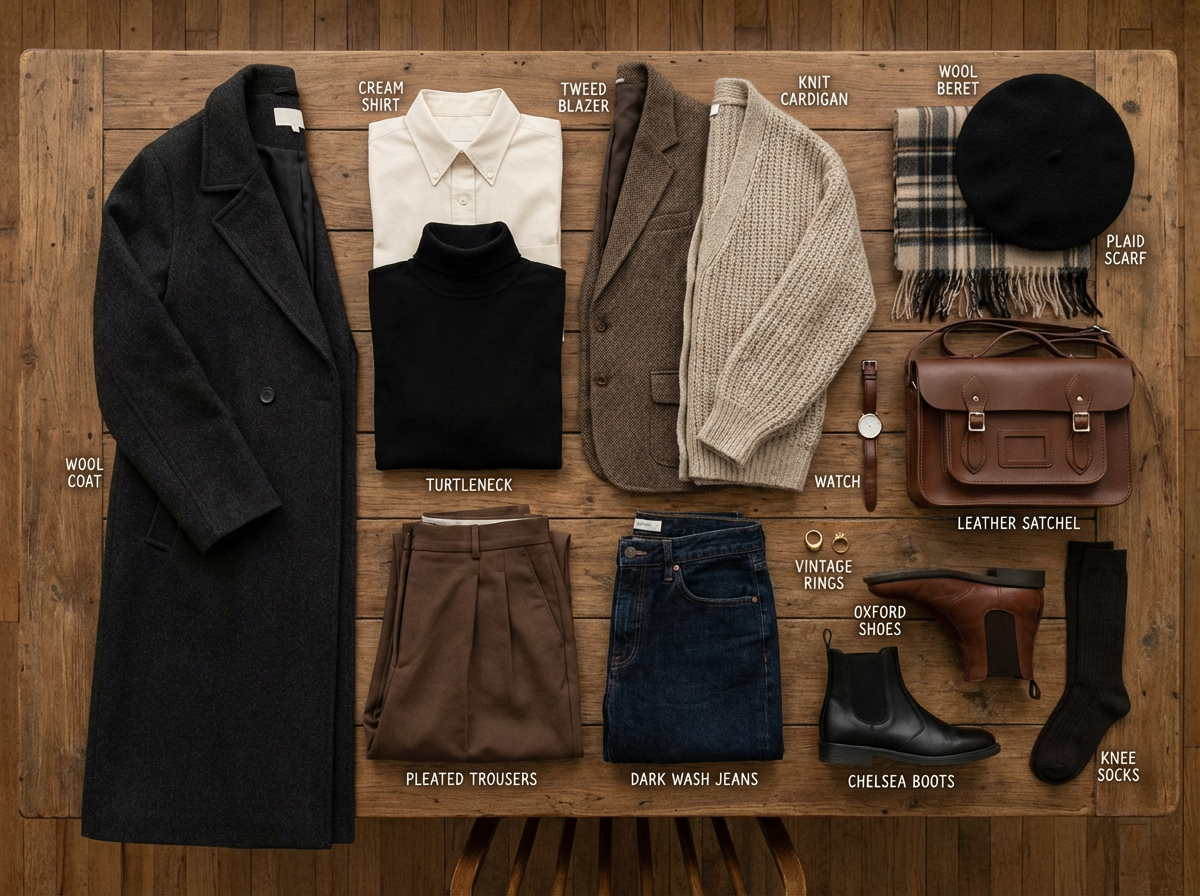
The 15 essential Dark Academia wardrobe pieces: Start with these timeless basics to build your scholarly aesthetic.
Building a Dark Academia wardrobe isn't about buying everything at once. It's about collecting the right pieces over time.
These are the foundations. The items you'll wear on repeat. The pieces that actually create the aesthetic.
Start here. Build slowly. Choose quality over quantity when you can.
Tops: The Layering Foundation

Core Dark Academia tops: Button-downs, turtlenecks, tweed blazers, oversized cardigans, and vintage tees for layering.
Your tops do the heavy lifting in Dark Academia. They're what creates that scholarly, lived-in look.
White or Cream Button-Down Shirt
This is non-negotiable. Your most versatile piece.
What to look for: Oxford cloth or poplin fabric. Slightly oversized fit—not fitted, not balloon-sized. The collar should be substantial enough to layer under sweaters and show nicely.
How to wear it: Slightly untucked with the sleeves rolled. Or fully tucked into high-waisted trousers with a sweater vest. Or layered under everything as your base neutral.
The vibe: Rumpled academic. Like you've been in the library for hours and forgot to check your appearance.
Price range: $25-$80. Uniqlo and Everlane make excellent affordable options. Sezane and & Other Stories for mid-range investment.
Turtleneck Sweater
The intellectual's uniform. Wear it alone or as a layering piece.
Colors: Black, chocolate brown, forest green, cream, charcoal. You need at least two—one neutral, one color.
Fabric: Merino wool is ideal but pricey. Cotton blends work for most budgets. Avoid acrylic if possible—it looks cheap and pills quickly.
Fit: Fitted but not tight. Should sit close to the body without clinging. Sleeves should be long enough to push up slightly.
Styling: Alone with trousers and loafers. Under a blazer for professorial vibes. With a plaid skirt for feminine academia. Under an oversized cardigan for cozy days.
Price range: $30-$150. COS and Uniqlo for basics. Sandro and Equipment for luxury.
Tweed or Wool Blazer
This is your statement piece. The item that instantly reads "Dark Academia."
What makes it right: Structured shoulders. Slightly oversized or vintage-inspired fit—avoid ultra-modern slim cuts. Elbow patches are a bonus but not required. Look for herringbone, houndstooth, or subtle plaid patterns.
Colors: Brown tweed, charcoal, forest green, or black. Your first should be brown or charcoal for maximum versatility.
The fit question: Should sit slightly loose on your shoulders. Long enough to cover your hips. Sleeves should show about half an inch of shirt cuff.
How to style it: Over a turtleneck with trousers. With a button-down and jeans for casual academic. Over a vintage tee for unexpected contrast. With a midi skirt for feminine scholarly style.
Price range: $60-$300. Thrift stores are gold mines for authentic vintage tweed. Zara and Mango for new budget options. Massimo Dutti and Sandro for investment pieces.
Chunky Knit Cardigan
Cozy intellectualism personified.
The look: Oversized. Cable knit or ribbed texture. Preferably with pockets. Should hit mid-thigh or longer.
Colors: Cream, oatmeal, chocolate brown, forest green, charcoal. Earth tones only.
Styling secret: Wear it slightly open and loose. Roll or push up the sleeves. Layer over a turtleneck or button-down. The more lived-in it looks, the better.
Material: Wool, wool blends, or thick cotton. Should have substantial weight—thin cardigans don't create the right silhouette.
Price range: $40-$200. H&M and Uniqlo for budget. & Other Stories and Everlane for mid-range quality that lasts.
Vintage Band Tees or Literary Quote Tees
The unexpected element. Adds personality and prevents costume vibes.
What works: Worn-in band tees (classic rock, indie, folk). T-shirts with literary quotes or book covers. University tees. Film references that fit the aesthetic.
How to wear them: Never alone. Always layered under blazers, cardigans, or paired with structured pieces. Tucked into high-waisted trousers or skirts.
The balance: One casual element (the tee) makes everything else feel more intentional, not costume-y.
Where to find them: Thrift stores. Etsy for vintage band tees. Redbubble for literary quotes. Your own collection from concerts and travels.
Price range: $10-$40. Authenticity matters more than price.
Bottoms: Building the Base

Essential Dark Academia bottoms: High-waisted pleated trousers, plaid skirts, corduroy pants, dark wash jeans, and velvet midi skirts.
Your bottoms anchor every outfit. They should feel effortless and slightly vintage-inspired.
Pleated Trousers
The most quintessentially academic bottom you can wear.
Details that matter: High-waisted (sits at natural waist). Pleated front—usually two pleats. Wide-leg or straight-leg cut. Wool or wool-blend fabric for structure.
Colors: Chocolate brown, charcoal, black, forest green, navy. Avoid khaki—too preppy, not moody enough.
Fit guide: Should hit at your natural waist. Roomy through the hips and thighs. Breaks slightly on your shoes or hits at the ankle for a modern take.
Styling formula: With a tucked button-down and blazer for full professor energy. With a cropped turtleneck and oxfords for student scholar vibes. With an oversized cardigan and loafers for a cozy academic look.
Price range: $40-$150. Zara and Mango have excellent options. Massimo Dutti for quality that lasts years.
Plaid Skirts
Feminine Dark Academia in one piece.
The right plaid: Muted colors only. Forest green and burgundy. Brown and cream. Black and charcoal. Avoid bright reds or blues.
Length: Knee-length or midi. Too short reads as a schoolgirl costume. Too long can feel frumpy—find the balance.
Styles: A-line or pleated. Both work. Pleated feels more academic. A-line is easier to style for different occasions.
How to wear it: With a tucked button-down and sweater vest. With tights, Mary Janes, and a turtleneck. With an oversized cardigan and knee socks. Always with tights or knee-highs—never bare legs.
Price range: $35-$120. ASOS has great, affordable options. Urban Outfitters for vintage-inspired styles.
Corduroy Pants
Texture is everything in Dark Academia. Corduroy delivers.
Colors: Brown (any shade), forest green, black, burgundy, mustard. The more vintage-looking, the better.
Fit: Straight-leg or slightly flared. High-waisted or mid-rise. Should feel substantial—not stretchy jegging-style.
The appeal: Corduroy has instant vintage credibility. It photographs beautifully. The texture adds visual interest to simple outfits.
Styling: With a cream button-down and loafers. With a turtleneck and Chelsea boots. With an oversized blazer and oxfords. Treat them like your pleated trousers, but more casual.
Price range: $30-$90. Levi's makes excellent corduroys. Thrift stores are overflowing with vintage options.
Dark Wash Straight-Leg Jeans
Yes, jeans have a place in Dark Academia. But not any jeans.
What works: Dark indigo wash. No distressing or whiskering. Straight-leg or wide-leg cut. High-waisted or mid-rise. Should look timeless, not trendy.
What doesn't work: Light wash. Skinny jeans. Ripped or distressed. Anything with obvious branding.
How they fit the aesthetic: Jeans ground the look. They prevent it from becoming too costumey. They're your casual option that still maintains the vibe.
Styling secret: Always dress them up. Pair with a blazer and oxfords, not a hoodie and sneakers. Add a turtleneck and satchel. Make them scholarly, not streetwear.
Price range: $50-$150. Levi's Ribcage or Wedgie Straight are perfect. Everlane and Madewell for quality denim.
Midi Skirts in Velvet or Wool
For when you want to feel more romantic academic.
Fabrics: Velvet for drama. Wool for everyday. Corduroy for casual. All in dark, rich colors.
Colors: Black, burgundy, forest green, chocolate brown, navy.
Length: Mid-calf. Long enough to be dramatic without being costume-y.
Styling: With a tucked turtleneck and Chelsea boots. With a button-down and blazer for structured looks. With tights and Mary Janes for feminine scholar energy.
Season: Fall and winter primarily. Too heavy for summer Dark Academia.
Price range: $40-$130. & Other Stories and COS for beautiful midi skirts. Reformation for sustainable options.
Outerwear: Making an Entrance

Investment outerwear: A long wool coat in camel or charcoal is your most important Dark Academia purchase.
Long Wool Coat
The cornerstone of a Dark Academia wardrobe—and the piece worth investing in.
Colors: Camel, charcoal, black. Camel is the most versatile and unmistakably academic.
Length: Mid‑calf to ankle for maximum drama.
Cut: Single- or double-breasted with wide lapels; structured but never tight.
The professor test: If you don’t instantly feel ready to lecture on 19th‑century literature, it’s not the one.
Styling: Throw it over everything. A great wool coat elevates even the simplest outfit.
Price range: $150–$600. Massimo Dutti, COS, and Sandro excel; vintage shops often have pristine options for $80–$150.
Trench Coat
The intellectual’s rainy‑day uniform.
Style: Classic or oversized; belted; khaki, beige, or black; double‑breasted with epaulets.
When to wear: Rainy fall days, layered over blazers, or anytime you want a lighter alternative to wool.
The vibe: Detective meets scholar—mysterious, polished, subtly European.
Styling note: Wear open for ease, belted for structure. Slightly oversized always looks more effortless.
Price range: $80–$300. Everlane for budget-friendly; Burberry for heritage.
Leather Jacket
A touch of edge that still reads academic.
The right leather: Dark brown or black in a vintage-inspired cut. Hip length. Avoid cropped or moto styles.
Why it works: It keeps Dark Academia from veering into costume and adds lived‑in credibility.
How to wear: With a turtleneck and trousers, a midi skirt and boots, or a crisp button‑down.
Price range: $100–$500. AllSaints for quality; thrift stores for true vintage.
Cape or Poncho
For the maximalists and romantics.
Warning: This is advanced Dark Academia—confidence required.
When it works: As a statement layer over simple outfits in charcoal, camel, or brown. Minimal accessories recommended.
When it doesn’t: With busy outfits or if you’re still building your wardrobe—start with classic coats first.
Price range: $60–$200. Zara and ASOS offer trend-forward versions.
Dresses: One-Piece Academic
Dresses in Dark Academia should feel vintage-inspired and slightly romantic.
Midi Length in Dark Florals or Solids
Patterns: Dark florals in burgundy, forest green, and black; small vintage prints; or deep, moody solids.
Length: Midi only—mid‑calf is the sweet spot. Shorter loses the mood; longer veers costume.
Neckline: Collared shirt dresses, high necklines, Peter Pan collars. Skip plunging cuts.
Styling: Pair with tights and Mary Janes, layer under a cardigan or blazer, or add Chelsea boots for casual days. Always carry a bag that looks like it could hold three novels and a notebook.
Price range: $50–$150. & Other Stories, Reformation, and Christy Dawn offer beautiful vintage‑leaning options.
Vintage‑Inspired Silhouettes
Era influence: Think 1940s–1960s—A‑line shapes, fit‑and‑flare cuts, structured bodices.
What to look for: Natural waistlines, modest necklines, tea‑length or midi hems, and fabrics with structure.
Fabrics: Velvet, corduroy, heavy cotton, wool blends. Avoid anything too light or summery.
Styling note: These dresses do the talking. Keep accessories minimal—a leather watch, small earrings, a classic satchel.
Price range: $40–$200. Thrift and vintage shops are ideal for authentic finds; ModCloth and Unique Vintage excel at reproduction styles.Shoes: The Foundation
Shoes: The Foundation
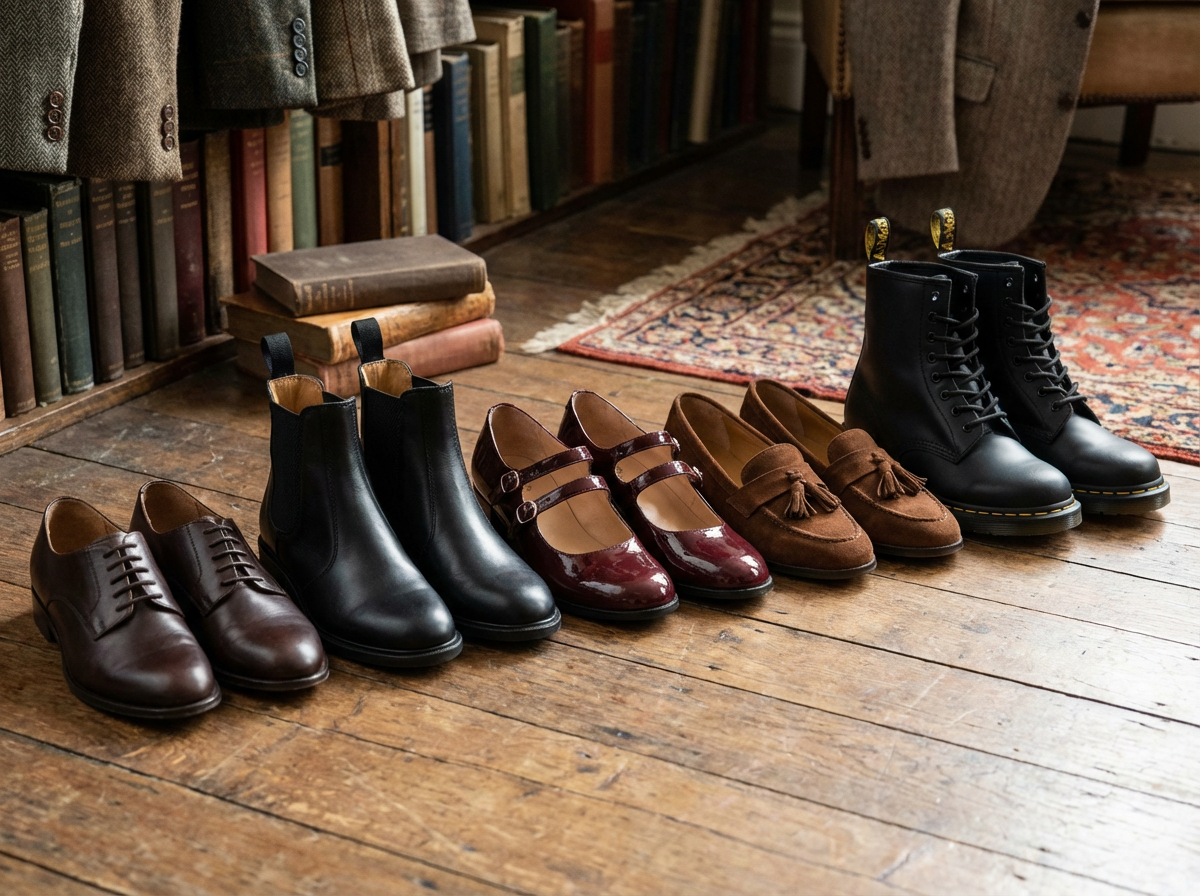
Complete your Dark Academia look with the right shoes: Oxfords, Chelsea boots, Mary Janes, loafers, or Doc Martens.
Your shoes complete the look. They can make or break the entire aesthetic.
Oxford Shoes or Brogues
The quintessential Dark Academia shoe.
Colors: Brown or black leather; brown is softer and more versatile.
Details: Wingtip brogues or plain oxfords with a slightly worn‑in finish.
Fit: Substantial, low‑heeled, ideally full leather.
Styling: Works with everything—trousers, skirts, dresses, jeans.
Price range: $60–$250. Dr. Martens, Frye, and Clarks are reliable picks.
Chelsea Boots or Riding Boots
Your autumn‑to‑winter staples.
Chelsea boots: Ankle height, elastic panels, brown or black leather, slightly chunky sole.
Riding boots: Knee‑high brown leather with subtle equestrian influence.
When to wear: With jeans and blazers, under midi skirts, or with corduroy.
Why they work: Practical, polished, and walkable.
Price range: $80–$300. Blundstone and Frye are classics.
Mary Janes
Feminine, scholarly, and quintessentially Dark Academia.
Style: Leather, flat or low heel, round toe, classic strap.
Colors: Black, brown, burgundy—preferably matte.
Styling: With tights and skirts, cropped trousers with socks, or midi dresses.
Why they work: Romantic without being overly sweet.
Price range: $60–$200. Doc Martens and Swedish Hasbeens offer great options.
Loafers
The preppy‑academic hybrid.
Types: Penny or tassel loafers in brown or black leather.
Styling: With cropped trousers, jeans, and blazers, or skirts with knee socks.
Signature detail: Visible socks—mustard, burgundy, or forest green.
Price range: $60–$180. Bass Weejuns, G.H. Bass, and Sam Edelman are dependable.
Doc Martens or Combat Boots
For adding grit to the aesthetic.
The right Docs: 1461 oxfords or 1460 boots in black or brown, slightly worn‑in.
Why they work: They keep the look grounded and prevent it from feeling costume‑y.
Styling: With midi skirts, jeans and oversized knits, or dresses with tights.
Price range: $140–$170. Durable and long‑lasting.
Accessories: The Details That Matter

The finishing touches: Accessories like berets, scarves, leather bags, and vintage watches complete the Dark Academia aesthetic.
Accessories make the aesthetic feel authentic rather than costume-y.
Wool Beret or Newsboy Cap
The most instantly recognizable Dark Academia accessory.
Beret: Classic French-style. Brown, black, burgundy, or forest green. Wool or felt. Wear it slightly to the side, never perfectly centered.
Newsboy cap: Tweed or wool. Brown tones primarily. More masculine-leaning but works for everyone.
Styling note: One statement hat per outfit. Don't add other dramatic accessories when wearing a beret.
Price range: $15-$50. Affordable and makes an immediate impact.
Plaid or Tartan Scarf
Warmth meets aesthetic perfection.
Patterns: Muted plaids in brown, green, and burgundy. Tartan patterns in dark colors. Avoid bright or primary-colored plaids.
Size: Oversized. Should be large enough to wrap multiple times or drape dramatically.
Fabric: Wool, cashmere, or wool blends. Should have weight and warmth.
How to wear it: Loosely draped. Wrapped twice around your neck. Over one shoulder with a coat.
Price range: $20-$100. Uniqlo for affordable cashmere blends. Acne Studios for luxury investment.
Leather Satchel or Messenger Bag
Your bag should look like it could hold a semester's worth of books.
Style: Structured leather satchel. Brown is most versatile. Should have visible buckles, straps, or hardware.
Size: Medium to large. Should look practical, not decorative.
Worn-in is better: Scuffed leather adds authenticity. Brand-new and pristine can look try-hard.
Styling: Crossbody or over one shoulder. Should look effortless, like you've carried it for years.
Price range: $50-$300. Cambridge Satchel Company for classic styles. Vintage shops for authentic worn leather.
Round or Wire-Frame Glasses
Even if you don't need prescription lenses.
Frames: Thin metal wire frames. Round or oval shapes. Gold, silver, or tortoiseshell.
The aesthetic value: Glasses instantly add intellectual credibility. They're one of the most effective Dark Academia signifiers.
Non-prescription option: Many retailers sell blue-light or clear-lens versions.
Price range: $15-$150. Warby Parker for prescription. Amazon for affordable fashion glasses.
Vintage Watch with Leather Band
Jewelry should look inherited, not trendy.
Watch style: Leather band in brown or black. Classic round face. Simple, minimal design. Should look timeless, possibly vintage.
The appeal: A watch says you value time and punctuality—very academic. It's a subtle but powerful detail.
Styling note: Wear alone on your wrist. Don't stack with bracelets—let it be the statement.
Price range: $30-$200. Timex and Casio for affordable classics. Vintage shops for authentic antique watches.
Signet Rings or Antique-Looking Jewelry
Less is more. Quality over quantity.
Rings: Signet rings. Simple bands in gold or silver. Antique-style settings. Nothing too sparkly or modern.
Necklaces: Simple chains. Lockets. Vintage pendants. Shakespeare quotes or literary references.
Earrings: Small studs or simple hoops. Pearl studs. Nothing dangling or statement-making.
The rule: One to three pieces maximum per outfit. Should look like family heirlooms, not fast fashion.
Price range: $10-$100. Etsy for vintage jewelry. Local antique shops for authentic pieces.
Knee-High Socks or Tights
The finishing touch for legs.
Colors: Mustard yellow, burgundy, forest green, charcoal, black, cream. Never bright or neon.
Knee socks: Worn with skirts and Mary Janes or loafers. Should hit just below the knee.
Tights: Opaque in dark colors. 80+ denier for substantial coverage. Wear under skirts and dresses year-round.
Pattern option: Subtle cable knit or ribbed texture adds visual interest.
Price range: $8-$30. Uniqlo for quality basics. Swedish Stockings for sustainable options.
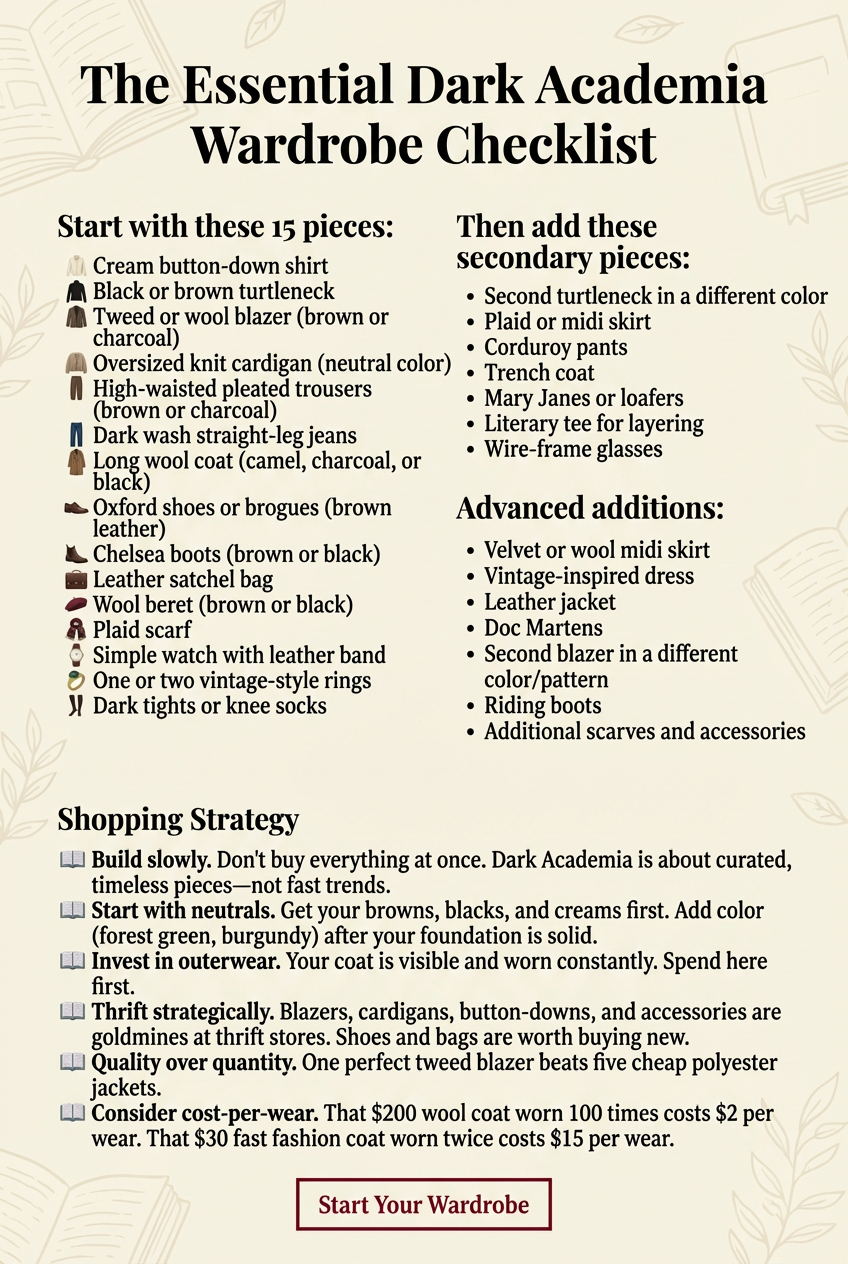
Build your Dark Academia wardrobe strategically: Start with 15 essentials, add secondary pieces, then invest in advanced items.
The Dark Academia Styling Formula
You have the pieces. Now let's talk about how to wear them.
Dark Academia styling isn't random. There are formulas. Patterns. Equations that always work.
Think of this section as your styling blueprint. Mix-and-match templates you can return to when you're staring at your closet, wondering what counts as "academic enough."
These aren't rigid rules. They're starting points. Foundations you can build on and personalize.
Equation 1: The Student Scholar

The Student Scholar formula: The most quintessential Dark Academia look perfect for library days and casual academic settings.
The formula: White or cream button-down (slightly untucked) + high-waisted pleated trousers + oversized knit vest or cardigan + oxford shoes or loafers + leather satchel
Color variation 1: Cream shirt + chocolate brown trousers + oatmeal oversized vest + brown oxfords
Color variation 2: White button-down + charcoal pleated trousers + forest green cardigan + black loafers
Why it works: This is quintessential Dark Academia. The rumpled shirt suggests you've been studying all day. The vest or cardigan adds the scholarly layer. The pleated trousers elevate it beyond casual. You look like you're running between classes at Oxford.
Styling details:
Roll the sleeves of your button-down to show at the cuffs of your vest
Leave one side of the shirt slightly more untucked than the other
Let your cardigan hang open
Add a watch on the wrist showing past your cardigan sleeve
Satchel should look full, like you're actually carrying books
Occasions: Library study sessions. Coffee shop work days. Casual academic settings. Weekend errands while maintaining the aesthetic.
Season: Year-round. Lighter fabrics in spring/summer, heavier wools in fall/winter.
Equation 2: The Library Afternoon

The Library Afternoon: Feminine Dark Academia combining turtlenecks, plaid skirts, colored tights, and a wool beret.
The formula: Turtleneck + plaid midi skirt + opaque tights + Mary Janes or oxfords + wool beret + crossbody bag
Color variation 1: Black turtleneck + brown and burgundy plaid skirt + burgundy tights + brown Mary Janes + black beret
Color variation 2: Cream turtleneck + forest green and brown plaid skirt + mustard tights + brown oxfords + brown beret
Why it works: This is feminine Dark Academia without being precious or costume-y. The turtleneck keeps it cozy and intellectual. The plaid skirt is iconic. The tights add color and personality. The beret completes the scholarly aesthetic.
Styling details:
Tuck your turtleneck into the skirt's waistband
Let the skirt hit mid-calf—not too short
Colored tights are your opportunity to add a pop of burgundy, mustard, or forest green
Wear the beret slightly to one side
Add simple stud earrings or a vintage watch
Occasions: Museums. Bookstores. Coffee dates. Autumn walks. Anywhere you want to feel romantic and intellectual.
Season: Best for fall and winter. Can work in early spring with lighter tights.
Equation 3: The Autumn Lecture

The Autumn Lecture: Professorial energy with structured blazer, corduroy texture, and polished button-down—scholarly authority personified.
The formula: Cream or white button-down + corduroy trousers + tweed blazer + loafers or oxfords + leather watch + optional scarf
Color variation 1: Cream button-down + brown corduroy trousers + brown tweed blazer + brown loafers
Color variation 2: White button-down + forest green corduroy pants + charcoal blazer + black oxfords
Why it works: This is "professor energy." You look like you could teach a seminar on Victorian literature. The corduroy adds texture. The tweed blazer is peak academia. The whole outfit has structure and authority.
Styling details:
Tuck the button-down fully into the trousers
Roll the shirt sleeves to show at the blazer cuffs, or leave them buttoned
Wear the blazer open or with just the bottom button fastened
Add a plaid scarf in cooler weather
Socks should match your trousers or add subtle color
Occasions: Presentations. Work meetings. Formal academic settings. Anywhere you want to project intellectual authority.
Season: Fall through spring. Too structured and warm for summer.
Equation 4: The Rainy Day
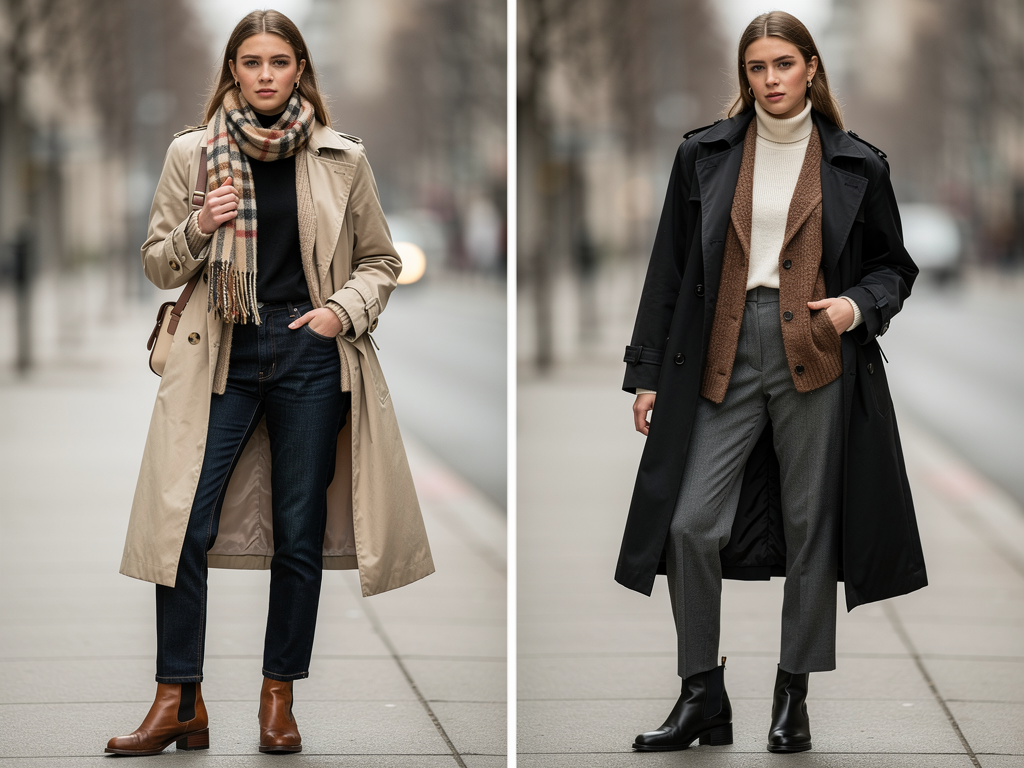
The Rainy Day: Practical romance with layered cardigan, turtleneck, trench coat, and Chelsea boots—perfect for moody autumn weather.
The formula: Oversized cardigan + turtleneck + straight-leg jeans or trousers + Chelsea boots + trench coat + scarf
Color variation 1: Oatmeal oversized cardigan + black turtleneck + dark wash jeans + brown Chelsea boots + beige trench + plaid scarf
Color variation 2: Brown chunky cardigan + cream turtleneck + charcoal trousers + black Chelsea boots + black trench
Why it works: Practical romance. This outfit handles real weather while maintaining the aesthetic. The layers create warmth and coziness. The trench coat is quintessentially scholarly. Perfect for moody autumn days.
Styling details:
Layer the cardigan over the turtleneck, both visible
Push up the cardigan sleeves to show the turtleneck beneath
Leave the trench coat open so all your layers show
Wrap the scarf loosely around your neck
Let the boots peek out from straight-leg jeans or full-length trousers
Occasions: Rainy days. Commuting. Running errands. Outdoor autumn activities. Travel.
Season: Fall and winter primarily. Early spring in cooler climates.
Equation 5: The Poetry Reading

The Poetry Reading: Dark Academia with edge—vintage tee under structured blazer with Doc Martens for intellectual cool without stuffiness.
The formula: Vintage band tee or literary quote tee + high-waisted trousers or jeans + blazer + Doc Martens or combat boots + signet rings + optional beret
Color variation 1: Worn-in black band tee + brown high-waisted trousers + charcoal blazer + black Doc Martens
Color variation 2: Cream vintage tee + black jeans + brown tweed blazer + brown combat boots
Why it works: This is Dark Academia with edge. The casual tee prevents it from being too formal or costume-y. The blazer adds structure and intellectualism. The boots ground it and add personality. You look intellectual but also cool.
Styling details:
Half-tuck the tee into your trousers or jeans
Wear the blazer open, sleeves pushed up slightly
Add one or two rings—signet or simple bands
Consider a beret for extra flair, but not required
Satchel or simple crossbody bag
Occasions: Casual hangouts. Creative events. Coffee shops. Anywhere you want to look, academic but not stuffy.
Season: Year-round. Adjust with coat layering for cold weather.
The 5-Minute Formula
When you're rushed but want to maintain the aesthetic:
Grab these 5 things:
Dark wash jeans or pleated trousers (bottom)
Turtleneck or button-down (base top)
Cardigan or blazer (layer)
Oxfords or loafers (shoes)
Satchel or crossbody bag (bag)
Done. You've achieved Dark Academia in under five minutes.
The secret: Having your core pieces clean, accessible, and ready to grab makes daily styling effortless.
Final Styling Philosophy
Dark Academia styling should feel intuitive eventually.
You'll stop thinking "what's the formula" and start thinking "what feels right today."
The goal isn't perfection. It's authenticity. Clothes that make you feel scholarly, intellectual, romantic. Outfits that make you want to read poetry in a library or discuss philosophy in a coffee shop.
Wear what makes you feel like the main character in an academic novel. That's the real formula.
Beyond Fashion: The Dark Academia Lifestyle

The Dark Academia lifestyle: Creating spaces where intellectual pursuit becomes aesthetic experience.
Dark Academia is more than clothing—it’s a way of spending time. The aesthetic honors intellectual curiosity, creative expression, and the romance of learning. You can wear tweed and still miss the point; the lifestyle is what makes it real.
Academics & Intellectualism: The Core Philosophy
Reading Classics
Dark Academia treats reading as immersion, not entertainment.
What to read:
Gothic literature (Shelley, Stoker, Wilde, Poe)
Romantic poetry (Keats, Byron, Shelley, Wordsworth, Coleridge)
Philosophy (Plato, Aristotle, Stoics, Camus, Sartre)
Victorian novels (Brontës, Hardy, Dickens)
Modern classics (Tartt, Rio, Ishiguro)
How to read: Slowly, with annotations, commonplace notes, and conversations that let books reshape your thinking.
Studying Languages
Classical languages embody the aesthetic’s devotion to knowledge for its own sake.
Languages: Latin, Ancient Greek, French, Old or Middle English.
Even without formal study, exploring etymology and linguistic roots fits the spirit.
Keeping Commonplace Books
A commonplace book is a personal archive of ideas.
Include: Quotes, poems, questions, sketches, pressed flowers, ticket stubs, and reflections.
How to keep one: Use a physical journal, write by hand, date entries, and let it evolve organically.
Visiting Cultural Sites
Learning extends beyond classrooms.
Where to go: Museums, libraries, historic homes, lectures, poetry readings, and book clubs.
Approach: Visit intentionally—take notes, sketch, research, engage.
Aesthetic Activities: Daily Rituals

Active reading in Dark Academia: Annotate books, keep commonplace journals, and engage deeply with classic literature.
Writing by Candlelight
Candlelight adds ritual and focus.
Write: Journals, poetry, essays, letters, and fiction.
Ritual: Dim lights, use good paper and pen, write slowly.
Collecting Books & Academic Objects
Surround yourself with objects that inspire learning.
Collect: Vintage books, maps, globes, instruments, botanical prints, typewriters, fountain pens.
Find them: Antique shops, estate sales, used bookstores, flea markets.
Calligraphy & Penmanship
Handwriting becomes a meditative practice.
Skills: Fountain pen basics, calligraphy styles, hand lettering, wax sealing.
Why: Slow writing deepens thought.
The Ritual of Tea & Coffee
Beverages become part of the intellectual atmosphere.
Tea: Loose leaf in vintage cups.
Coffee: French press or pour‑over in ceramic mugs.
Brew slowly and pair with reading or writing.
Annotating Books
Marginalia is a conversation with the text.
Annotate: Key lines, questions, themes, connections, interpretations, dates.
Dark Academia embraces marked‑up books.
Listening to Classical Music & Dark Folk
Music sets the mood for study and reflection.
Classical: Chopin, Debussy, Tchaikovsky, Bach, Vivaldi.
Dark folk / atmospheric: Fleet Foxes, Sufjan Stevens, Hozier, Dresden Dolls.
Instrumental: Piano, quartets, ambient classical.
Home Aesthetic: Creating Your Space

Dark Academia home essential: Floor-to-ceiling bookshelves where books dominate your space and shape your environment.
Furniture & Layout
Build a space that feels like a personal library.
Essentials: Dark wood desk, comfortable chair, floor‑to‑ceiling bookshelves, reading chair, vintage side tables.
Layout: Natural light, defined zones, room to pace, cozy but scholarly.
Lighting
Avoid harsh overhead lights.
Use: Brass desk lamps, warm floor lamps, candles, subtle string lights, heavy curtains.
Aim for warm, dim, focused illumination.
Decorative Objects
Choose items that evoke study and history.
Display: Typewriters, globes, telescopes, hourglasses, busts, and scientific instruments.
Wall art: Botanical prints, antique maps, classical portraits, architectural drawings, framed quotes.
Color Palette for Walls & Textiles
Dark Academia interiors are rich and layered.
Walls: Forest green, charcoal, burgundy, navy, black accents, or aged cream.
Textiles: Persian rugs, velvet curtains, worn leather, wool blankets, earth‑tone linens.
Avoid bright, minimalist, or ultra‑modern elements.
Dark Academia Subgenres
Dark Academia subgenres let you specialize. They take the core and morph into your interests, personality, and favorite subjects.
You don't have to pick just one. But understanding the differences helps you find your community.
Let's explore the five main Dark Academia subgenres.
1. Darkest Academia / Gothic Academia: The Shadow Side
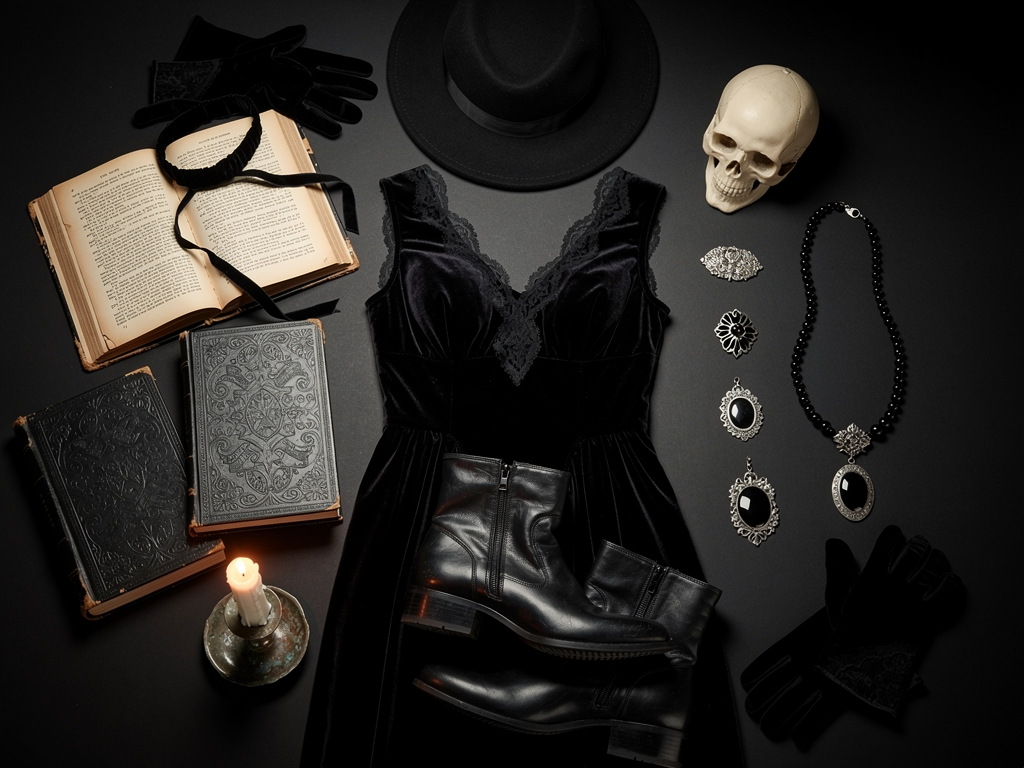
Darkest/Gothic Academia: Dark Academia's shadow side embracing macabre themes, Victorian mourning culture, and predominantly black wardrobe.
If regular Dark Academia romanticizes melancholy, Darkest Academia embraces it. This is Dark Academia's goth cousin. The one who takes everything darker, more dramatic, more Gothic.
The Philosophy
Regular Dark Academia: "There's beauty in sadness and studying by candlelight."
Darkest/Gothic Academia: "There's beauty in darkness itself—in death, decay, the macabre, and the forbidden knowledge."
This subgenre leans into Gothic literature's darkest themes. Moral ambiguity. Obsession. The pursuit of knowledge that destroys you. The scholar who goes too far.
It's Frankenstein's monster. Dorian Gray's corruption. The descent into madness for the sake of understanding.
The Aesthetic Differences
Color palette:
More black than regular Dark Academia
Deep purples and plums
Oxblood and burgundy (darker shades)
Charcoal and anthracite
Minimal cream (only for stark contrast)
The vibe: Less "cozy library afternoon" and more "midnight research in a candlelit study." Less autumn sunshine through library windows and more stormy nights and secret societies.
Wardrobe Specifics
Everything from regular Dark Academia, but darker.
Key pieces:
Black turtlenecks (your most-worn item)
Black blazers with dramatic cuts
Velvet everything (skirts, blazers, pants—in black, burgundy, deep purple)
Long black coats (floor-length preferred)
Black oxford shoes or tall boots
Lace details (collars, cuffs, gloves)
Victorian-inspired pieces (high collars, long sleeves, dramatic silhouettes)
Silver jewelry (skull rings, Gothic crosses, Victorian mourning jewelry)
Black leather accessories (bags, gloves, belts)
Styling approach:
Monochromatic black outfits with one deep jewel tone
Dramatic layering (capes, long coats, flowing scarves)
Victorian mourning aesthetic meets modern academic
Candlelight over electric light
Antique jewelry that looks cursed
2. Cryptid Academia: The Folklore Scholar

Cryptid Academia: The folklore scholar aesthetic combining Dark Academia intellectualism with practical field research gear.
Cryptid Academia is Dark Academia's weird, wonderful cousin. Where other subgenres focus on classical education, this one obsesses over folklore, mythology, cryptozoology, and the unexplained.
The Philosophy
Regular Dark Academia: "Knowledge is found in books and universities."
Cryptid Academia: "Knowledge is found in forests, folklore, and the stories people try to forget."
This subgenre romanticizes the study of what exists outside mainstream academia. Cryptids, folklore, myths, legends, paranormal phenomena, and the liminal spaces between known and unknown.
It's the researcher in the woods with field notes. The folklorist collecting oral histories. The cryptozoologist documenting footprints. Academic methodology applied to the supernatural.
The Aesthetic Differences
Color palette:
Forest greens (darker, mossy shades)
Browns (more earthy, outdoorsy)
Olive, sage, moss
Burgundy and rust
Black and charcoal
Cream for field notes and maps
The vibe: Less library, more forest. Less candlelit study, more midnight investigations. Research happens outdoors as much as indoors.
Wardrobe Specifics
Dark Academia meets practical field research.
Key pieces:
Flannel shirts (in dark greens, browns, blacks)
Utility vests and cargo pants (for actual field work)
Hiking boots or tall leather boots
Waxed canvas or oilcloth jackets (practical and vintage-looking)
Wool sweaters in earthy tones
Corduroy pants (practical and aesthetic)
Vintage band tees with occult or nature themes
Wide-brimmed hats (for outdoor research)
Layered necklaces (crystals, teeth, bones, talismans)
Practical backpacks or satchels (well-worn, covered in patches)
Accessories:
Field notebooks and weatherproof journals
Vintage cameras for documentation
Compasses and maps (real, functional)
Binoculars
Flashlights (old-school metal ones)
Collection bags and specimen containers
Patches and pins (cryptids, moths, mushrooms, occult symbols)
Styling approach:
Functional layering (can actually hike in these clothes)
Vintage outdoor gear aesthetic
Mix academic pieces (button-downs) with practical gear (cargo pants)
Looks like you could teach a folklore seminar or trek through the woods
Slightly disheveled from actual fieldwork
3. Chaotic Academia: The Brilliant Mess

Chaotic Academia: The beautiful mess of obsessive learning—scattered brilliance, coffee stains, and hyperfocused research.
Chaotic Academia is Dark Academia without the organization. The genius who forgets to eat because they're too absorbed in research. The student whose notes are illegible but brilliant.
The Philosophy
Regular Dark Academia: "Beauty in structured scholarly pursuit. Organized bookshelves. Neat handwriting."
Chaotic Academia: "Beauty in obsessive learning regardless of order. Stacks of books everywhere. Notes on napkins. The mess is part of the process."
This subgenre celebrates the chaotic side of intellectual pursuit. The all-nighters fueled by coffee and hyperfocus. The scattered genius. The person who has fifteen books open at once and knows exactly which page has the quote they need.
It's less about the aesthetic performance of being scholarly and more about actual, messy, obsessive learning.
The Aesthetic Differences
Color palette:
Same as regular Dark Academia but less coordinated
Browns, blacks, greens, burgundy
But nothing matches perfectly
Coffee stains are part of the aesthetic
Worn-in and lived-in everything
The vibe: Brilliant but disorganized. Your blazer has pen marks. Your notes are brilliant but illegible. You look like you've been researching for 72 hours straight (because you have been).
Wardrobe Specifics
Dark Academia pieces, but make it chaos.
Key pieces:
Oversized sweaters (worn until they have holes)
Mismatched patterns (plaid skirt + striped shirt, both in Dark Academia colors)
Vintage tees with coffee stains
Cardigans with missing buttons
Glasses (slightly crooked, definitely needed)
Doc Martens (untied or half-tied)
Layered jewelry that doesn't quite match
Patches and pins covering bags and jackets
Hoodies (in Dark Academia colors, under blazers)
Styling approach:
Intentional dishevelment taken further
Nothing matches perfectly but it works
Layers that look thrown on (because they were)
Comfort prioritized over polish
Evidence of actual studying (ink stains, wear patterns)
Mix of "trying" and "gave up trying"
The key difference from regular Dark Academia: Regular Dark Academia's dishevelment is strategic. Chaotic Academia's dishevelment is actual.
4. Theatre Academia: All the World's a Stage
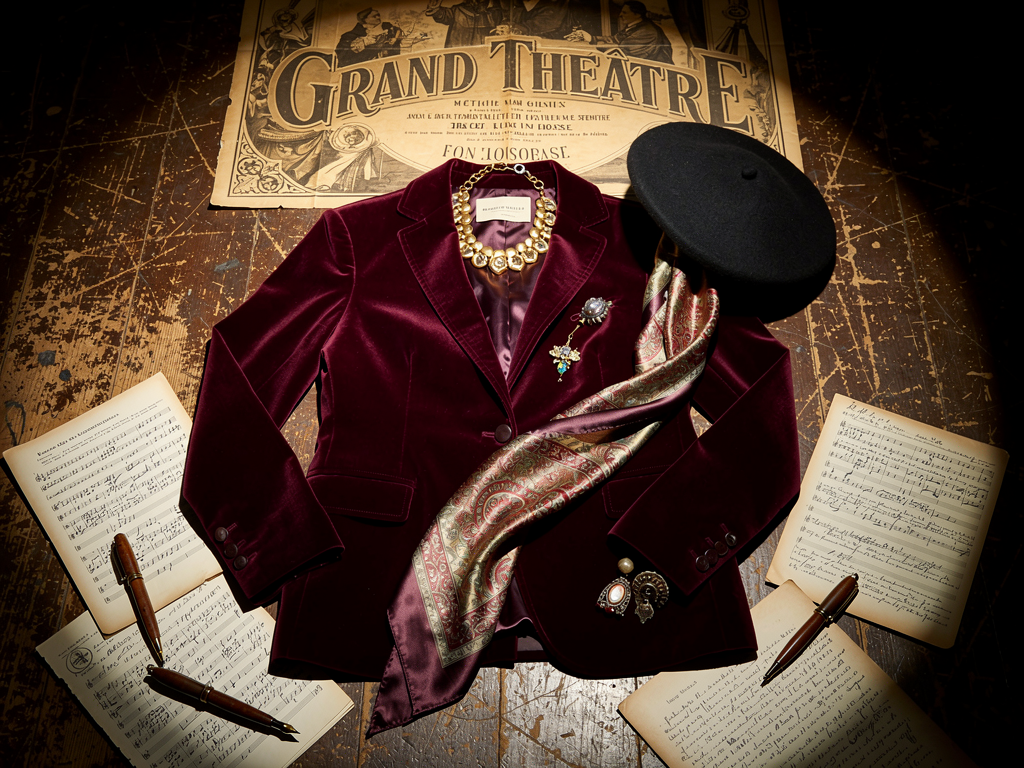
Theatre Academia: Dark Academia performed—dramatic pieces, theatrical flair, and every outfit staged for effect.
Theatre Academia is Dark Academia performed. It's the dramatic interpretation—scholars who treat life as performance, knowledge as script, and learning as rehearsal.
The Philosophy
Regular Dark Academia: "Beauty in quiet scholarly pursuit."
Theatre Academia: "Beauty in dramatic intellectual performance. Every moment deserves staging."
This subgenre combines Dark Academia's intellectualism with theatrical flair. Think Dead Poets Society's most dramatic moments. Think English majors who gesture while quoting Shakespeare. Think studying literature but performing it.
It's academic, but make it theatrical.
The Aesthetic Differences
Color palette:
Dark Academia colors with dramatic flair
Rich burgundy and deep purple (theatrical royalty)
Black (always dramatic)
Gold and brass accents
Velvet in jewel tones
Dramatic contrast (black with cream)
The vibe: Every outfit could be a costume. Every study session could be a scene. Life is performance and you're always on stage.
Wardrobe Specifics
Dark Academia meets costume drama.
Key pieces:
Velvet blazers (dramatic texture)
Dramatic collars (Peter Pan, ruffled, Victorian-inspired)
Capes and cloaks (actually worn, not just owned)
Statement scarves (silk, dramatically draped)
Wide-leg trousers (movement and drama)
Flowing skirts (midi or maxi, dramatic fabric)
Vests and waistcoats (with pocket watches)
Dramatic outerwear (opera coats, theatrical cuts)
Statement jewelry (cameos, dramatic rings, vintage brooches)
Beret or wide-brimmed hat (worn with intention)
Styling approach:
Everything slightly more dramatic than regular Dark Academia
Pieces that move well (for gesturing while talking)
Vintage theatrical costume influences
One statement piece per outfit (minimum)
Looks intentional and performed, not casual
Color coordination for dramatic effect
Accessories as props
Shoes:
Oxford shoes (classic)
Mary Janes with slight heel (character shoes)
Tall boots (dramatic and practical)
Vintage heels (1940s-1960s inspired)
5. Art Academia / Literary Academia: The Creative Scholars
Art Academia and Literary Academia are sibling subgenres—one visual, one written, both creative. They split Dark Academia's scholarly focus toward specific creative disciplines.
Art Academia: The Visual Scholar
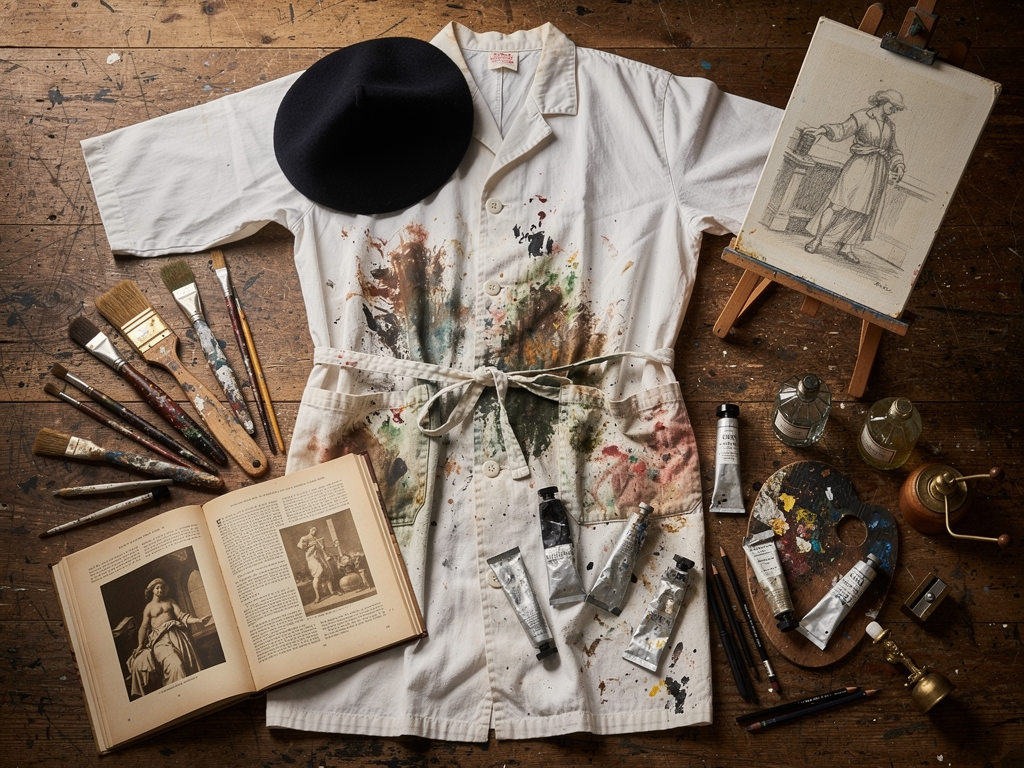
Art Academia: The visual scholar combining art history study with studio practice, paint-stained clothes, and museum devotion.
The Philosophy: "Knowledge isn't just learned—it's created, painted, sculpted, and seen."
Art Academia romanticizes the pursuit of visual knowledge. Art history, studio practice, museum studies, classical techniques. The scholar-artist who studies Renaissance masters while creating their own work.
Color palette:
Dark Academia base colors
Paint-stained additions
More muted, vintage pigment colors
Burnt sienna, raw umber, Prussian blue
Cream and aged paper tones
Charcoal and graphite gray
Wardrobe specifics:
Key pieces:
Smocks and aprons (actually paint-stained)
Oversized button-downs (covered in charcoal or paint)
Black turtlenecks (artist uniform)
Wide-leg pants (easy movement for studio work)
Berets (the artist cliché, embraced)
Canvas sneakers or boots (paint-splattered)
Vintage cardigans with evidence of creative work
Overalls or coveralls in Dark Academia colors
Accessories:
Vintage art supply bags
Portfolio cases
Paintbrushes and pencils (carried everywhere)
Wire-frame glasses (paint-speckled)
Simple jewelry (doesn't interfere with work)
Vintage watches with leather bands
Minimal but intentional
Styling approach:
Practical for studio work
Evidence of creative process (paint, charcoal, clay)
Comfortable and functional
Dark colors hide stains
Lived-in and well-used
European art student aesthetic
Literary Academia: The Written Word Scholar

Literary Academia: Pure devotion to the written word—fountain pens, stacks of books, and ink-stained fingers.
The Philosophy: "Language is the highest form of art. Words are everything."
Literary Academia is Dark Academia's most focused form—pure devotion to literature, writing, poetry, and the written word. This is the English major who lives and breathes books.
Color palette:
Classic Dark Academia colors
Ink-stained additions (actual ink, not metaphorical)
Sepia and aged paper tones
Black (for ink and intensity)
Deep burgundy (like old book covers)
Cream (like manuscript pages)
Wardrobe specifics:
Key pieces:
Ink-stained button-downs
Cardigans with worn elbows (from leaning over desks)
Tweed blazers with pockets full of notebooks
Turtlenecks (writer uniform)
Comfortable trousers (for long writing sessions)
Vintage tees with literary quotes
Oversized sweaters for cozy writing
Scarves (for dramatic flair while writing)
Accessories:
Fountain pens (a collection of them)
Leather journals (multiple, for different projects)
Vintage typewriter (aesthetic and functional)
Reading glasses
Literary quote jewelry
Bags stuffed with books (always carrying at least three)
Bookmarks (beautiful, collected)
Wax seal stamps
Styling approach:
Comfortable for writing marathons
Pockets for carrying pens and notebooks
Layers for temperature changes in libraries and cafés
Ink stains are badges of honor
Looks like you could write for hours
Cozy but intellectual
Finding Your Subgenre (Or Blending Them)
Most people aren't purely one subgenre. You might be:
Darkest Academia on weekends, regular Dark Academia for school, Cryptid Academia in summer, cozy Dark Academia in winter, Theatre Academia socially, Chaotic Academia when actually studying, Art Academia as practice, Literary Academia as passion
The subgenres are frameworks, not rules.
Questions to Identify Your Subgenre(s)
What draws you to Dark Academia specifically?
The darkness and macabre → Darkest/Gothic Academia
Folklore and mystery → Cryptid Academia
The messy reality of learning → Chaotic Academia
Performance and drama → Theatre Academia
Visual arts → Art Academia
Literature and writing → Literary Academia
What's your ideal study environment?
Candlelit room with Gothic decor → Darkest Academia
Forest or field with notebooks → Cryptid Academia
Chaotic desk covered in open books → Chaotic Academia
Dramatic, well-staged space → Theatre Academia
Art studio with natural light → Art Academia
Cozy library nook → Literary Academia
What are you most likely to obsess over?
Death, decay, Victorian mourning → Darkest Academia
Cryptids, folklore, myths → Cryptid Academia
Random topics that catch your interest → Chaotic Academia
Shakespeare, performance, theatre → Theatre Academia
Renaissance art, museum visits → Art Academia
Classic novels, poetry, writing → Literary Academia
How do you want to be perceived?
Dark, mysterious, intense → Darkest Academia
Curious, adventurous, eccentric → Cryptid Academia
Brilliant but scattered → Chaotic Academia
Dramatic, expressive, theatrical → Theatre Academia
Creative, observant, artistic → Art Academia
Well-read, introspective, literary → Literary Academia
Blending Subgenres Successfully
Common successful blends:
Darkest Academia + Literary Academia = Gothic Literary Scholar
Reading Gothic literature obsessively
Writing dark poetry
Victorian mourning culture through texts
All black wardrobe with fountain pens
Cryptid Academia + Art Academia = Nature Documentation Artist
Sketching cryptids and folklore
Documenting nature artistically
Field journals with illustrations
The Museum of Natural History focuses
Chaotic Academia + Literary Academia = Messy Writer
Writing obsessively in disorganized notebooks
Multiple writing projects simultaneously
Ink-stained everything
Brilliant but scattered manuscripts
Theatre Academia + Literary Academia = Performance Poetry
Dramatic readings of classic texts
Performing original poetry
Shakespeare obsession
Literary analysis through performance
The rule: Pick one dominant subgenre (60-70%) and add elements from another (30-40%). Don't try to be all five at once.
Dark Academia vs. Similar Aesthetics: What's the Difference?
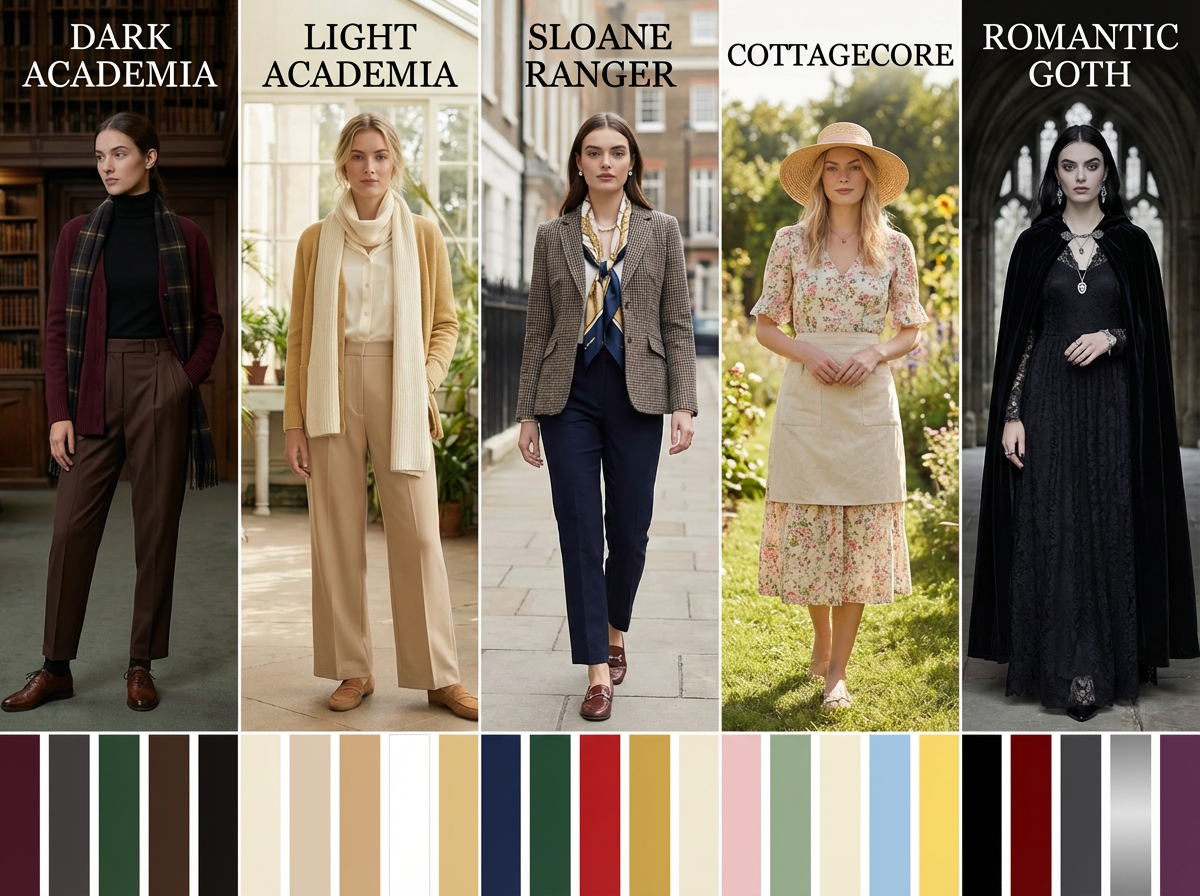
Compare aesthetics by color: Each has distinct palettes that define their mood and style philosophy.
Dark Academia shares DNA with other aesthetics—similar color palettes, overlapping wardrobe pieces, related philosophies.
But the differences matter.
Let's break down the aesthetics most commonly confused with Dark Academia and what sets them apart.
Light Academia: The Optimistic Sibling
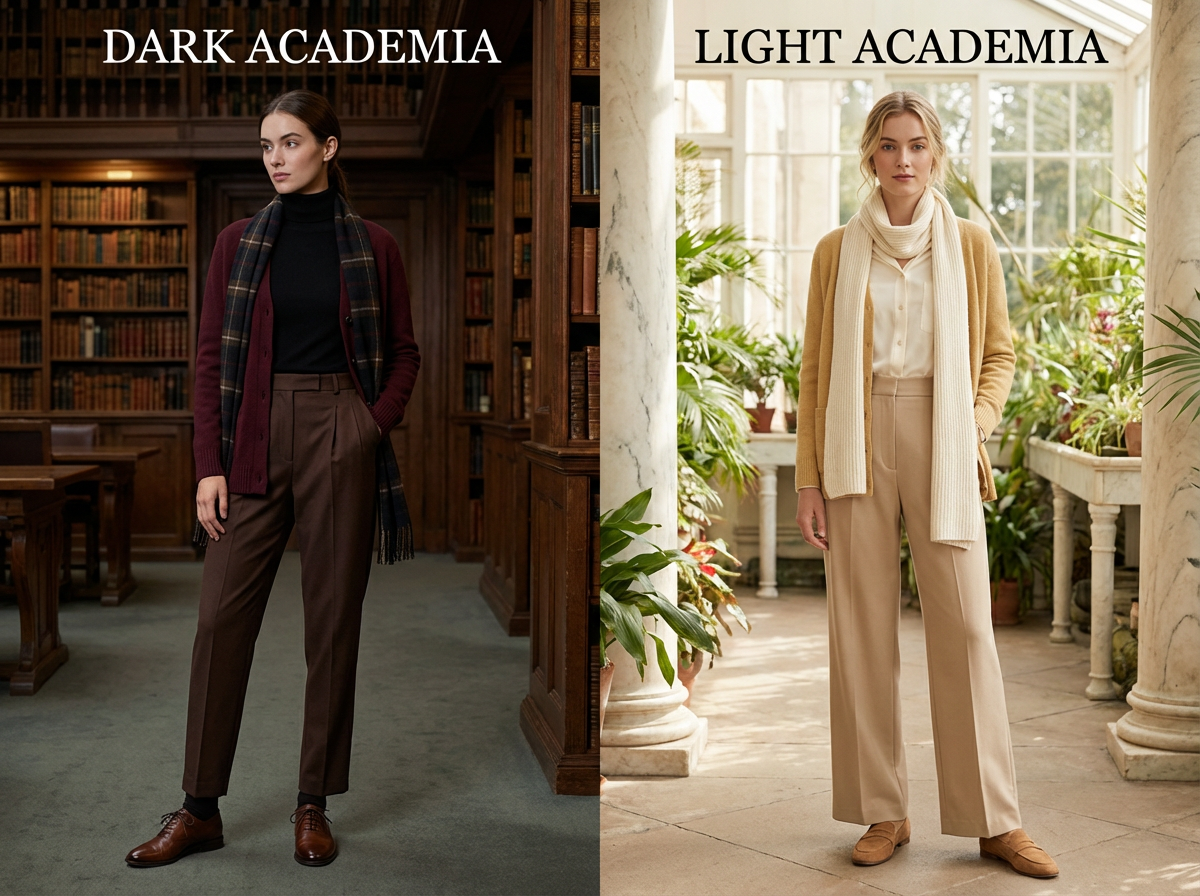
Light Academia is Dark Academia's sister aesthetic. They share the same parents—classical education, scholarly pursuits, literary romance—but with completely different temperaments.
The Core Difference
Dark Academia: Melancholic. Gothic. Pursuit of knowledge has a darker edge. Beauty in sadness. Rainy days and candlelit libraries.
Light Academia: Optimistic. Bright. Knowledge is joyful discovery. Beauty in learning itself. Sunny mornings and garden study sessions.
It's the difference between reading Gothic poetry by lamplight versus studying ancient Greek in a sunlit courtyard.
Color Palette Comparison
Dark Academia:
Deep browns (chocolate, espresso, mahogany)
Rich blacks and charcoals
Forest green, burgundy, oxblood
Cream as accent/contrast
Light Academia:
Cream, beige, ivory as primary colors
Soft white and off-white
Light brown, tan, camel
Soft gold, pale yellow
Muted pastels (blush pink, powder blue)
The test: If it looks like it belongs in a gothic novel, it's Dark Academia. If it looks like it belongs in a Renaissance painting in daylight, it's Light Academia.
Styling Differences
Dark Academia styling:
Layers in deep, moody tones
Deliberate dishevelment
Worn-in, vintage aesthetic
Gothic and romantic literature references
Autumn and winter energy
Light Academia styling:
Lighter, airier layers
More polished and put-together
Fresh, clean aesthetic
Classical literature and art references
Spring and summer energy
Example outfit comparison:
Dark Academia: Black turtleneck + chocolate brown pleated trousers + burgundy cardigan + brown oxfords + dark plaid scarf
Light Academia: Cream button-down + beige wide-leg trousers + soft gold cardigan + tan loafers + ivory scarf
When You're Actually Light Academia
You might be Light Academia if:
You prefer sunny days to rainy ones
Your ideal study spot is a garden or bright café, not a dim library
You gravitate toward cream and beige over brown and black
You prefer Greek philosophy and Renaissance art over Gothic literature
You want the intellectual vibe without the melancholy
The hybrid approach: Many people blend both. Dark Academia in fall/winter, Light Academia in spring/summer. It's not betrayal—it's seasonal adaptation.
Sloane Ranger: Posh Countryside Prep
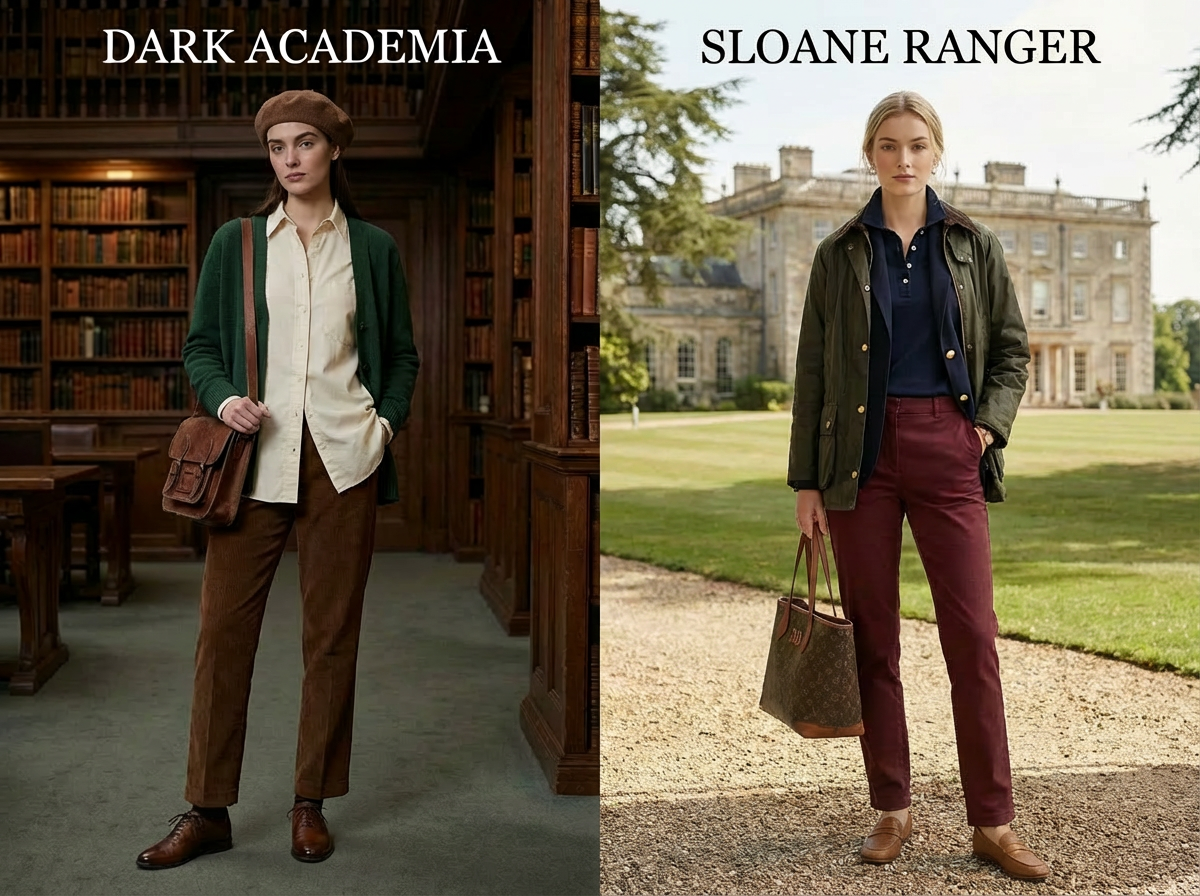
Dark Academia looks scholarly and rumpled; Sloane Ranger looks aristocratic and polished—both use traditional pieces differently.
Sloane Ranger is the British upper-class aesthetic that shares Dark Academia's love of traditional clothing but comes from a completely different world.
The Origin Story
Dark Academia: Born from romanticizing scholarly life. Universities, libraries, intellectual pursuit. Middle-class aspiration to aristocratic education.
Sloane Ranger: Named after Sloane Square in London. Actual British upper class. Country estates, equestrian culture, old money families. This is Princess Diana's aesthetic in the 1980s.
The confusion happens because both love tweed, both wear blazers, both appreciate traditional British style. But the context is entirely different.
The Core Difference
Dark Academia: Intellectual. Academic. You look like you study Latin and write poetry. The aesthetic is about knowledge and learning.
Sloane Ranger: Social. Aristocratic. You look like you attend garden parties and go foxhunting. The aesthetic is about class and tradition.
Dark Academia wants to be in the library. Sloane Ranger wants to be at the country club.
Color Palette Comparison
Dark Academia:
Deep browns, forest green, burgundy
Rich, moody, autumnal
Scholarly and Gothic
Sloane Ranger:
Navy blue (primary)
Hunter green, burgundy
Cream and white
Bright, clear colors (not muted)
Red accents
Pastel shades
The key distinction: Sloane Ranger uses brighter, clearer colors. Dark Academia uses deeper, more muted tones. Both might wear burgundy, but Sloane's is brighter and more vibrant.
Wardrobe Piece Comparison
Both wear:
Tweed blazers
Pleated skirts
Wool coats
Oxford shoes
Cable knit sweaters
Dark Academia specific:
Turtlenecks (very academic)
Corduroy in brown and green
Vintage band tees
Doc Martens
Berets
Satchel bags that look studious
Sloane Ranger specific:
Polo shirts and rugby shirts
Barbour jackets and waxed cotton
Hunter boots (Wellington boots)
Riding boots for actual riding
Quilted vests
Pearl necklaces and stud earrings
Monogrammed items
Hermès scarves
The litmus test: If it looks like you could wear it horseback riding or at a regatta, it's Sloane Ranger. If it looks like you could wear it in a library or poetry reading, it's Dark Academia.
Styling Differences
Dark Academia:
Intellectual dishevelment (rumpled scholar)
Literary and artistic references
Vintage and thrifted pieces encouraged
Mix high and low (thrift blazer + designer shoes)
Urban or university setting
Sloane Ranger:
Pristine and polished (country club ready)
Equestrian and country sport references
Heritage brands preferred (Barbour, Hunter, Ralph Lauren)
Expensive-looking everything
Country house or posh London setting
Example outfit comparison:
Dark Academia: Cream oversized button-down (half-tucked) + brown corduroy trousers + forest green cardigan + brown oxfords + worn leather satchel + beret
Sloane Ranger: Navy polo shirt (fully tucked) + khaki or burgundy chinos + navy blazer + brown loafers + Barbour jacket + pearl earrings + monogrammed bag
When You're Actually Sloane Ranger
You might be Sloane Ranger if:
You prefer navy blue to brown
You love equestrian style and country sports
You want to look polished and proper, not rumpled
You gravitate toward Ralph Lauren, Barbour, and heritage brands
You prefer bright, clear colors over moody tones
The countryside appeals more than the city or university
Can you blend them? Somewhat. Both appreciate quality, traditional clothing. But the energy is different enough that mixing them requires careful balance. Maybe Sloane Ranger basics with Dark Academia accessories and styling.
Cottagecore: Romantic Countryside Living
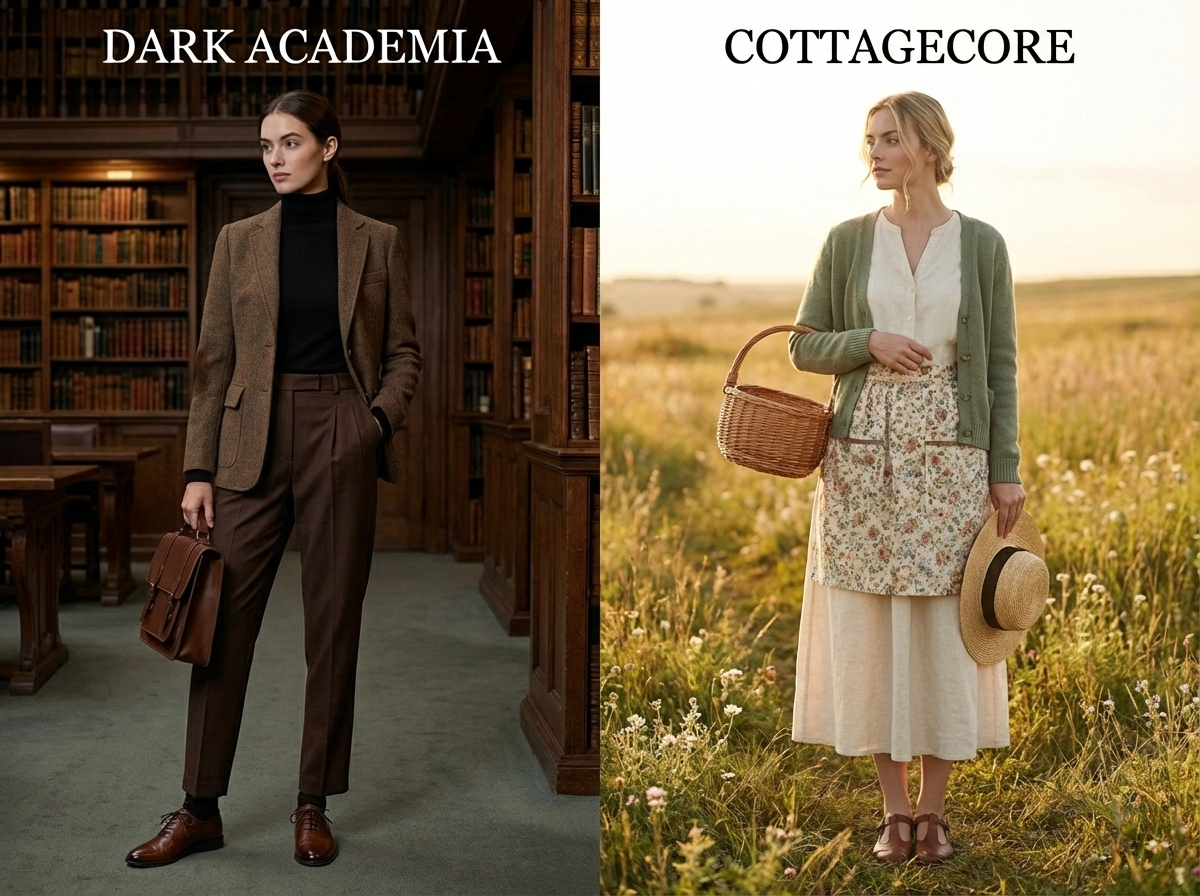
Cottagecore and Dark Academia are cousins. Both romantic. Both nostalgic. Both reject modernity. But they're romanticizing very different things.
The Core Difference
Dark Academia: Romanticizes intellectual pursuit, classical education, universities, libraries, scholarly life in urban or academic settings.
Cottagecore: Romanticizes rural life, nature, domestic activities, simple living, pastoral beauty.
Dark Academia wants to read about nature. Cottagecore wants to be in nature.
Color Palette Comparison
Dark Academia:
Browns, blacks, forest greens, burgundy
Deep and moody
Autumn and winter colors
Cottagecore:
Cream, beige, soft white
Sage green, moss green
Soft pink, peach, lavender
Earth tones but lighter
Spring and summer colors
Floral patterns
Overlap: Both use cream and earth tones. The difference is depth—Dark Academia goes deeper and darker.
Wardrobe Piece Comparison
Both might wear:
Cardigans
Midi skirts
Linen pieces
Vintage-inspired dresses
Simple jewelry
Dark Academia specific:
Tweed blazers
Pleated trousers
Turtlenecks
Oxfords and brogues
Academic accessories (satchels, berets)
Structured, scholarly pieces
Cottagecore specific:
Prairie dresses
Pinafores and aprons
Puff sleeves
Straw hats
Wicker baskets
Embroidered details
Soft, flowing pieces
The distinction: Dark Academia is structured and intellectual. Cottagecore is soft and domestic.
Styling Differences
Dark Academia:
Layers with structure (blazers, coats)
Gothic and classical references
Urban or university aesthetic
Books, writing, studying
Intellectual activities
Cottagecore:
Layers with softness (flowing fabrics)
Nature and domestic references
Rural, countryside aesthetic
Gardening, baking, crafts
Domestic and nature activities
Example outfit comparison:
Dark Academia: Black turtleneck + brown pleated trousers + tweed blazer + brown oxfords + leather satchel
Cottagecore: Cream linen dress + sage green cardigan + apron + Mary Janes + wicker basket + straw hat
When You're Actually Cottagecore
You might be Cottagecore if:
You prefer nature and gardens to libraries
You love baking, gardening, and domestic crafts
You gravitate toward soft, flowing fabrics over structured pieces
You prefer floral patterns to plaids
Your ideal day is in a garden, not a library
The overlap: "Romantic Academia" sits between Dark Academia and Cottagecore. Feminine, romantic, but still intellectual. Think soft cardigans with books and flowers.
Romantic Goth: Dark but Different
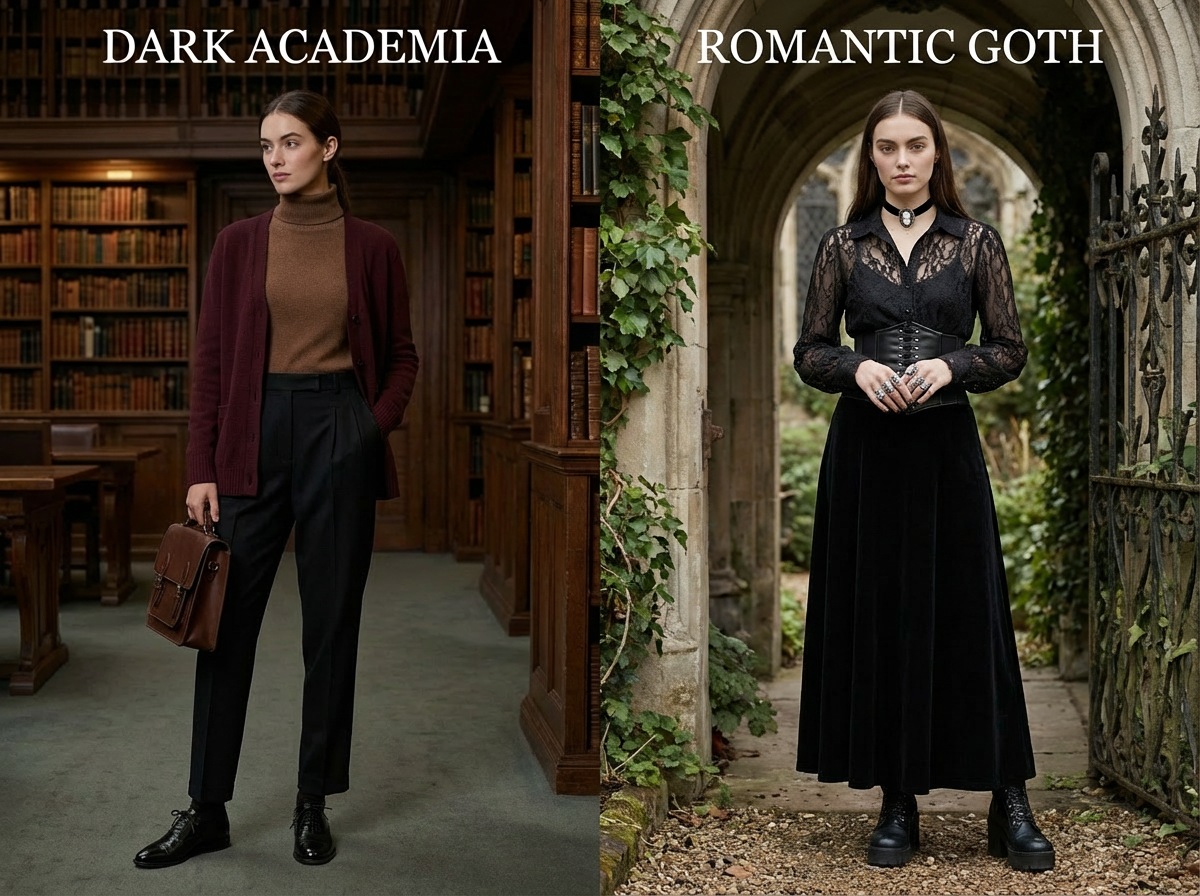
Romantic Goth and Dark Academia both embrace darkness, vintage aesthetics, and Gothic influences. But one is scholarly, the other is purely aesthetic.
The Core Difference
Dark Academia: The darkness comes from Gothic literature and melancholic intellectualism. It's about scholarly pursuits with romantic sadness.
Romantic Goth: The darkness is aesthetic and emotional. It's about Gothic romance, mystery, and dramatic beauty. Less about books, more about mood.
Dark Academia reads Victorian novels. Romantic Goth lives in them.
Color Palette Comparison
Dark Academia:
Browns, greens, burgundy
Black as accent, not dominant
Earth tones primary
Romantic Goth:
Black as primary color
Deep purple, burgundy, dark red
Minimal earth tones
The key: If it's mostly black with jewel tones, it's Romantic Goth. If it's mostly browns with strategic black, it's Dark Academia.
Wardrobe Piece Comparison
Both wear:
Black clothing
Vintage pieces
Victorian-inspired silhouettes
Velvet and lace
Dark Academia specific:
Tweed blazers
Corduroy
Turtlenecks
Oxfords
Scholarly accessories (satchels, berets)
Brown as primary color
Romantic Goth specific:
Corsets and bodices
Long flowing skirts
Lace and mesh
Platform boots
Chokers and dramatic jewelry
Black as primary color
More skin showing (despite Victorian inspiration)
The distinction: Dark Academia looks scholarly. Romantic Goth looks Gothic romantic.
Styling Differences
Dark Academia:
Intellectual and academic
References classical education
Structured, layered
Urban and university settings
Can be worn to class or work
Romantic Goth:
Romantic and emotional
References Gothic romance and Victorian era
Dramatic, flowing
Evening and artistic settings
More costume-like for everyday
Example outfit comparison:
Dark Academia: Brown turtleneck + black pleated trousers + burgundy cardigan + black oxfords + leather satchel
Romantic Goth: Black lace blouse + black velvet skirt + black corset belt + platform boots + choker + dramatic rings
When You're Actually Romantic Goth
You might be Romantic Goth if:
You prefer all-black outfits to earth tones
You love lace, corsets, and Victorian romance
You want to look mysterious and romantic, not scholarly
You prefer dramatic, flowing pieces over structured ones
Gothic aesthetic matters more than academic references
The overlap: "Gothic Academia" sits between them. Dark Academia's structure and intellectualism with more black, lace, and Gothic romance.
The Overlap: Can You Mix Aesthetics?
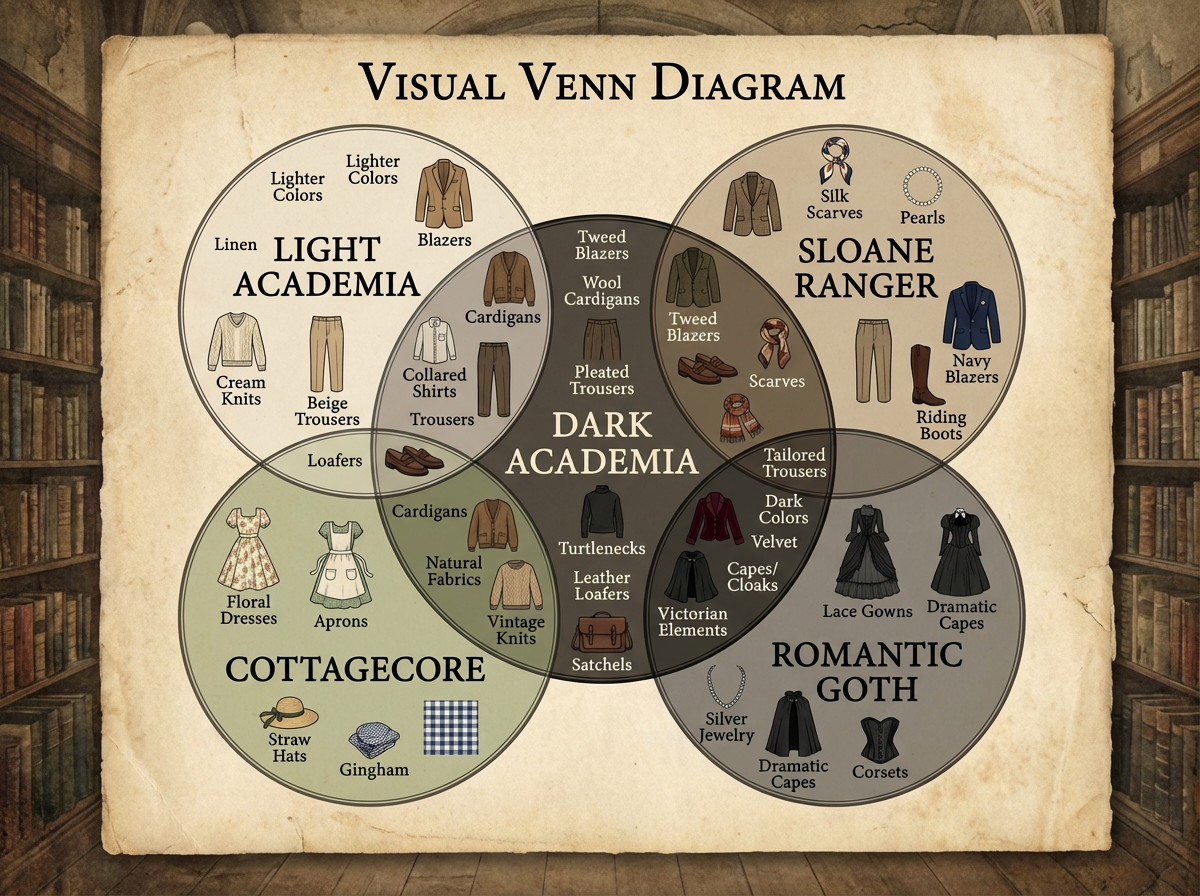
Understanding the overlap: Many aesthetics share basics like blazers and cardigans, but styling and color choices create distinction.
Most people aren't pure anything. You're allowed to blend.
Common Successful Blends
Dark Academia + Light Academia (by season):
Dark Academia in fall/winter
Light Academia in spring/summer
Same scholarly philosophy, different moods
Dark Academia + Cottagecore = Romantic Academia:
Intellectual but feminine
Books and flowers
Libraries and gardens
Structured pieces with soft details
Dark Academia + Romantic Goth = Gothic Academia:
More black, more dramatic
Gothic literature taken seriously
Victorian influences emphasized
Still scholarly, just darker
How to Blend Successfully
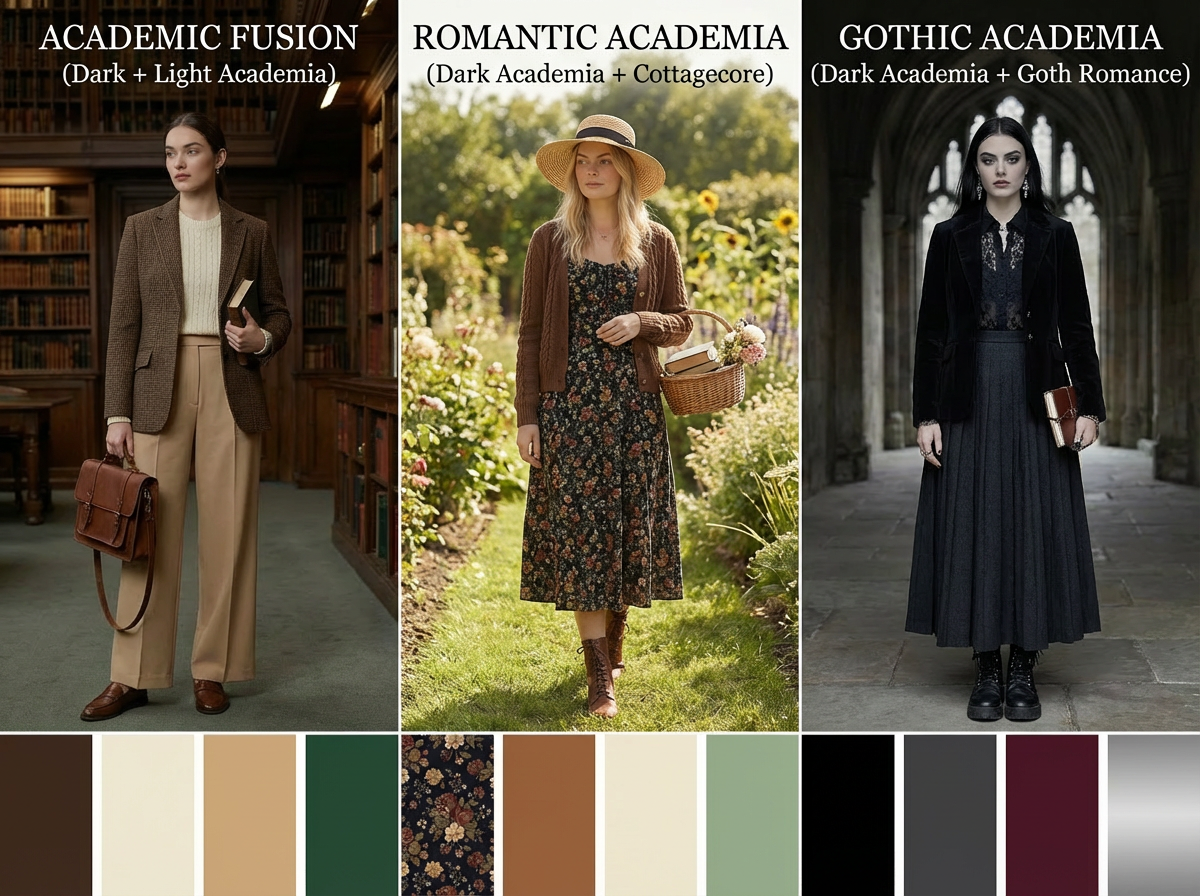
Successful aesthetic blends: Dark + Light Academia by season, Romantic Academia (Dark + Cottagecore), and Gothic Academia (Dark + Romantic Goth)
Rule 1: Pick a dominant aesthetic. Don't try to be 50/50. Choose your base (Dark Academia) and add elements from another (10-20% Sloane Ranger).
Rule 2: Maintain color palette consistency. If you're blending Dark Academia with Preppy, keep the moody colors. Don't suddenly add bright Kelly green.
Rule 3: Let context guide you. Maybe you're Dark Academia for intellectual activities and Sloane Ranger for professional settings. Context switching is valid.
Rule 4: Watch for clash points. Dark Academia's dishevelment clashes with Sloane Ranger’s pristine polish. Romantic Goth's drama clashes with Cottagecore’s optimism. Some aesthetics don't blend well.
Finding Your Aesthetic Truth
You might have realized while reading this section that you're not pure Dark Academia. That's fine. That's normal.
Maybe you're:
70% Dark Academia, 30% Light Academia
Dark Academia with Sloane Ranger accessories
Romantic Academia (Dark Academia + Cottagecore)
Gothic Academia (Dark Academia + Romantic Goth)
The labels are guides, not rules. Use them to understand what you're drawn to and why, then make it your own.
The questions to ask yourself:
What draws me to Dark Academia specifically?
The intellectualism? → Could blend with Light Academia
The Gothic elements? → Might lean Romantic Goth
The British traditional style? → Consider Sloane Ranger influence
What doesn't feel quite right?
Too dark/moody? → Add Light Academia elements
Too casual/rumpled? → Add Sloane Ranger polish
Too masculine? → Add Cottagecore or Romantic Academia softness
What's my ideal setting?
Library → Dark Academia
Sunny garden → Light or Romantic Academia
Country estate → Sloane Ranger or Cottagecore
Gothic mansion → Romantic Goth
Your answers reveal your aesthetic truth.
The Final Word on Labels
Dark Academia is a starting point, not a rigid uniform.
The aesthetics that get confused with it—Light Academia, Sloane Ranger, Cottagecore, Old Money, Preppy, Romantic Goth—all share elements because they draw from similar historical periods and cultural references.
But the distinctions matter because they represent different values, different moods, different philosophies.
Dark Academia values intellectual pursuit, melancholic romance, and scholarly beauty. If that resonates, lean into it fully. If you want the aesthetic but brighter, that's Light Academia. If you want it wealthier, that's Old Money. If you want it softer, that's Cottagecore.
Know the differences. Then break the rules intentionally.
That's how personal style is born.
