
Poetcore: The Complete Guide to Literary Fashion
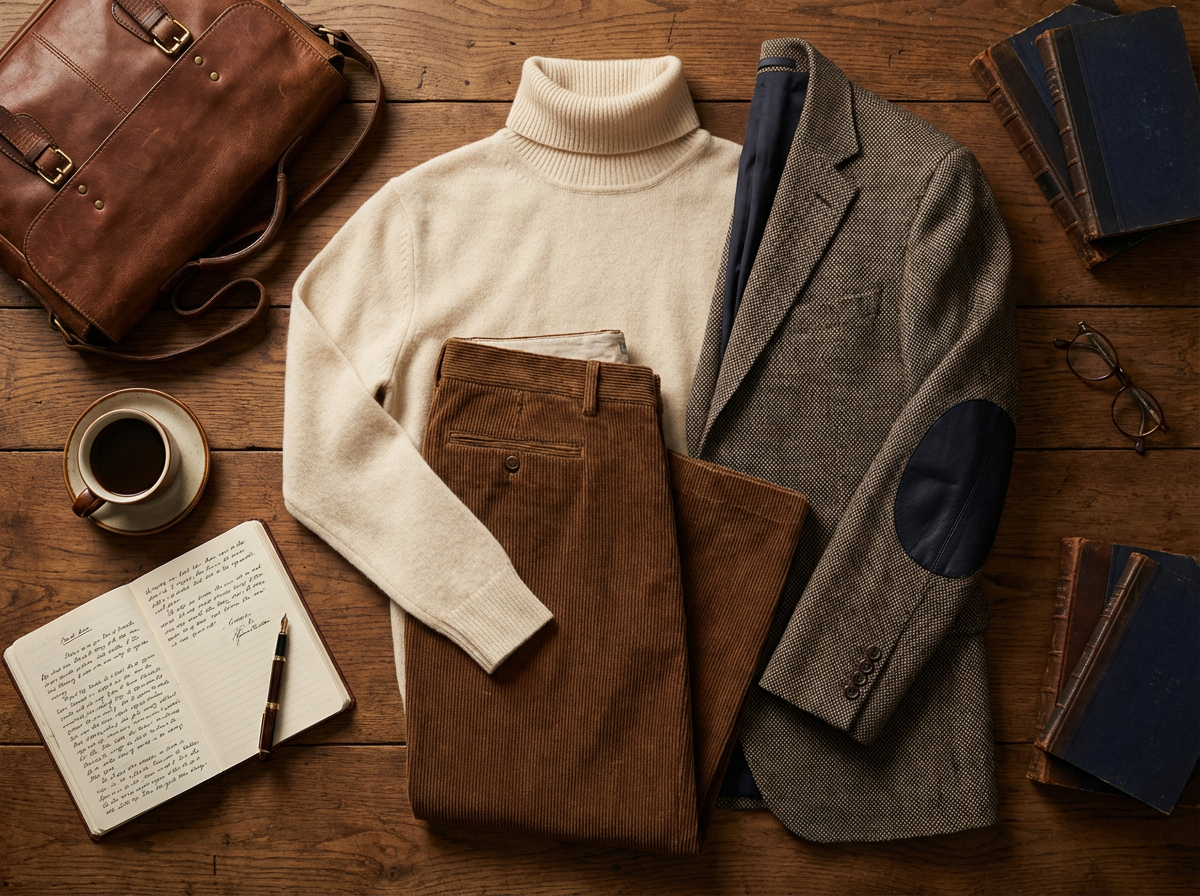
The poetcore aesthetic: where literary ambition meets vintage fashion.
What is Poetcore? When Words Become Wardrobe
There's a special type of person who carries a notebook everywhere—not because they're writing, but because they might.
That is the poetcore aesthetic.
The poetcore aesthetic is the embodiment of living like the protagonist of a literary novel: tweed-wearing, café-haunting, fountain-pen-owning, perpetually "in revision."
It's what happens when your wardrobe channels a university English department, your accessories feel like literary props, and your entire vibe whispers, "I have complicated feelings about punctuation."
This complete poetcore style guide covers everything from outfit formulas and capsule wardrobes to color palettes and vintage shopping strategies. Whether you're drawn to Beat poetcore's restless energy or prefer the contemplative café aesthetic, this guide will help you master the writer's wardrobe without the MFA debt.
-
Poetcore is a literary fashion aesthetic characterized by:
Vintage tweed blazers and corduroy trousers
Turtlenecks in earth tones (black, cream, burgundy, brown)
Worn leather messenger bags
Fountain pens and notebooks as accessories
Café culture and bohemian intellectual energy
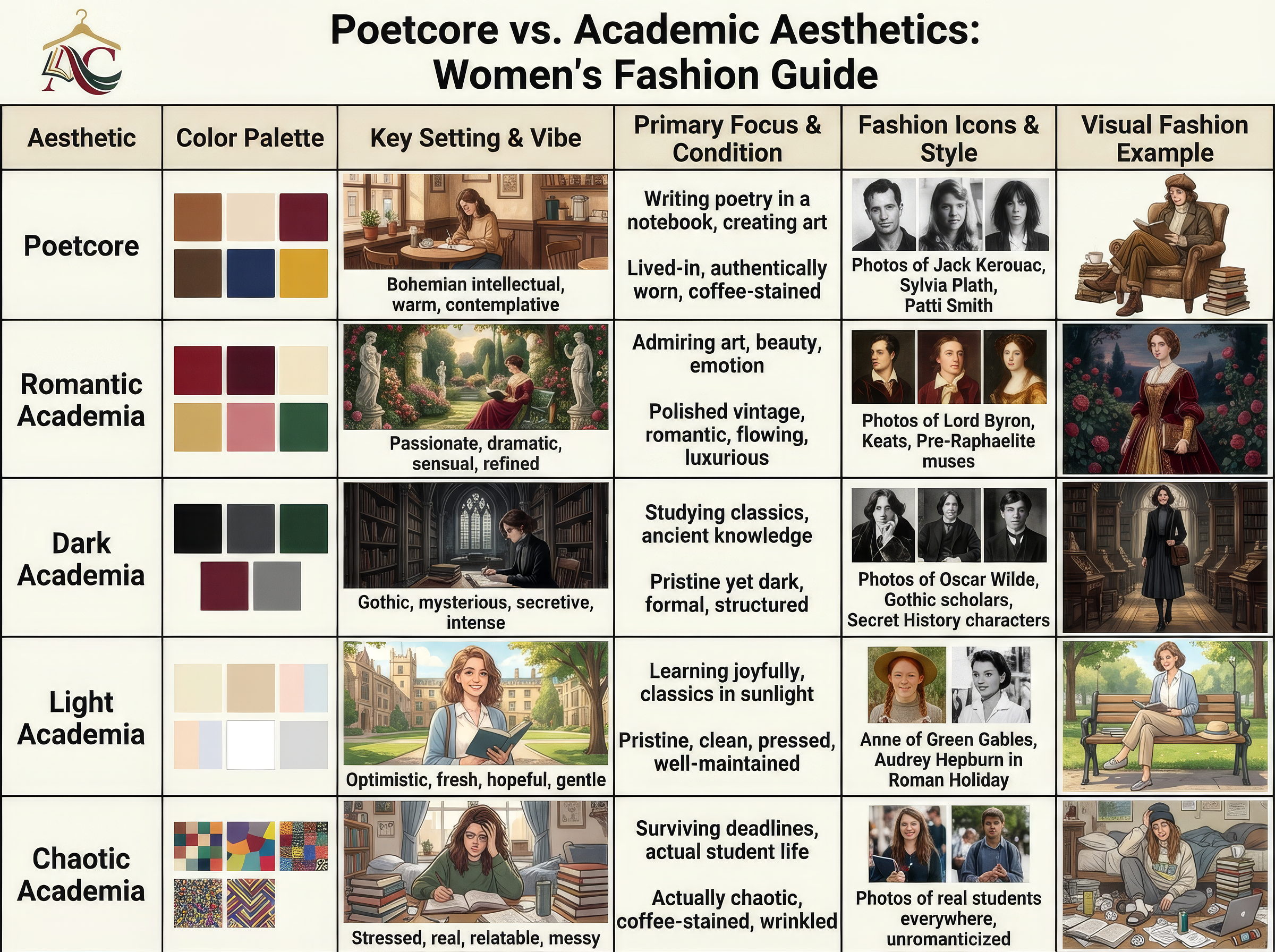
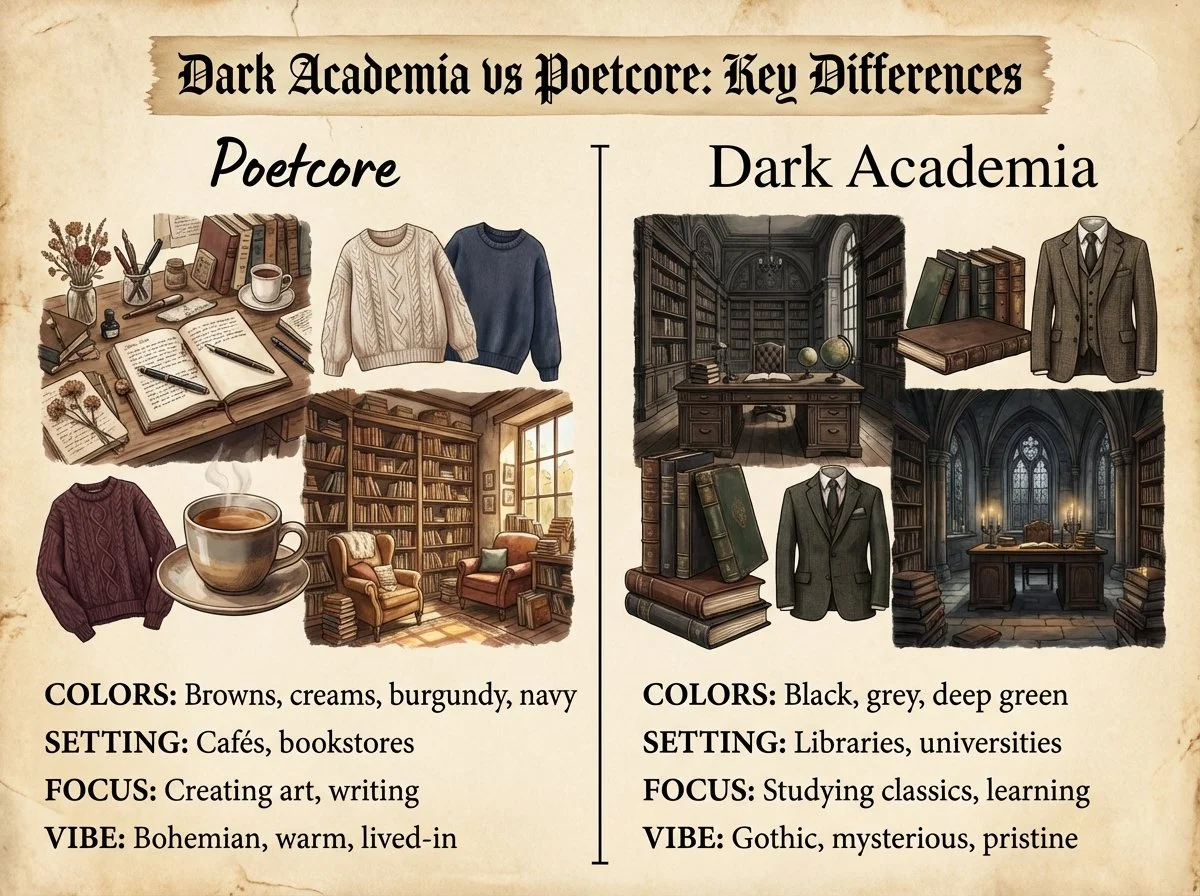
Warmer, more lived-in than Dark Academia
The aesthetic romanticizes the writer's lifestyle through vintage academic fashion, creating a "literary novel protagonist" vibe.
The Poetcore Promise: What It Sells vs. What You Get
Poetcore is not about being a poet.
It’s about looking like one.
It romanticizes:
The struggling novelist
The misunderstood genius
The MFA candidate who dropped out “to find their voice.”
The writer who prefers longhand drafts
The café regular who orders the same drink and tips in exact change
“Poetcore isn’t about being a poet. It’s about looking like one.”
It sells:
Intellectual mystique
Creative authenticity
Timeless sophistication
Tortured artist credibility
Literary main-character energy
What you actually get:
A messenger bag full of unread books
A fountain pen you can’t refill
Turtlenecks in every shade of autumn
An urge to quote Sylvia Plath
Chronic coffee stains
Poetcore is the aesthetic MFA you never had to pay tuition for.
No thesis defense required.
The History and Evolution of Poetcore
Why Now? The 2024-2026 Emergence
BookTok exploded in 2020-2021. By 2024, it had evolved beyond book recommendations into a full lifestyle aesthetic. Users were curating entire personas around their literary tastes.
Literary TikTok created a generation that knows their Donna Tartt from their Sally Rooney, can discuss the merits of different translation choices, and wants their lives to look like the Instagram version of a writer's retreat. They grew up watching booktubers and BookTokers romanticize the reading experience, and now they want the whole package: the books, the aesthetic, the vibe.
Poetcore is BookTok's evolution into fashion. It's what happens when the people who made dark academia go viral start asking: "But what if I want to look like I write the books instead of just reading them?"
The Perfect Storm
Post-pandemic appreciation for slow living
BookTok's continued influence
AI anxiety driving analog nostalgia
Academic aesthetic evolution
Gen Z discovering millennials' liberal arts degrees
Revenge of the humanities majors
Academic Aesthetic Evolution Timeline
2019-2020: Dark Academia explodes on social media. It's all gothic architecture, dead languages, and "I would kill for knowledge" energy.
2021: Light Academia emerges as the softer sister – same scholarly energy, but make it sunshine and coffee dates. Less Frankenstein, more Pride and Prejudice.
2022: Chaotic Academia enters as the messy reality check – coffee-stained notes, 3 AM panic…finally, something relatable.
2023: Academic aesthetic fatigue sets in. The market is oversaturated with pleated skirts.
2024: Instead of generic "academia," aesthetics start focusing on specific disciplines and personas. We get science academia, art academia, and theatre academia, among others.
2025-2026: Poetcore crystallizes as a distinct identity. It's not just "academic" – it's literary, creative, writerly. It's for people who loved Dark Academia but realized they're not actually interested in Greek or Latin – they just want to look like they're writing the next Great American Novel.
The Literary & Cultural Influences
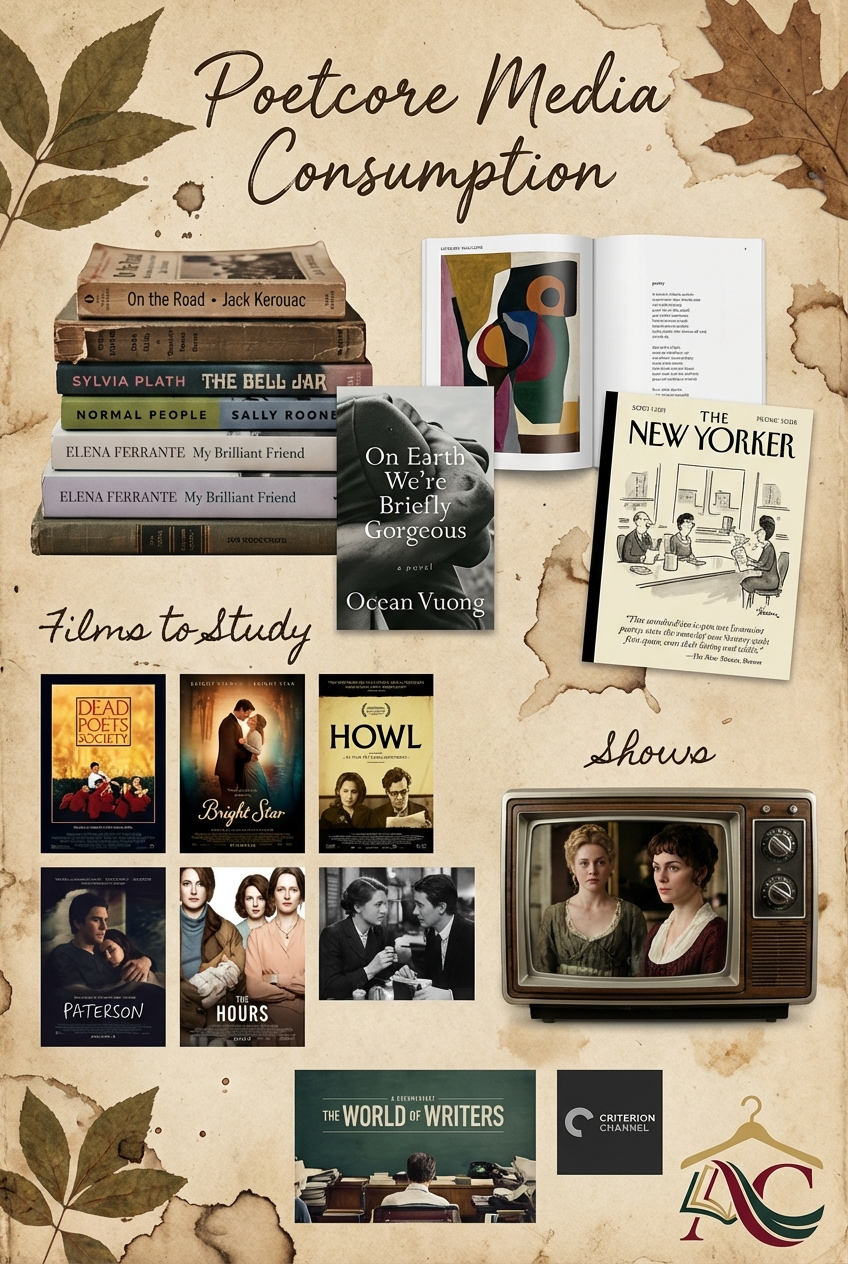
Poetcore is built on a foundation of literary movements and cultural moments.
Beat Generation Writers (Kerouac, Ginsberg)
The Beats gave us the blueprint for the bohemian writer aesthetic. Jack Kerouac's On the Road, Allen Ginsberg's Howl, and the entire 1950s counterculture movement established that writers should look slightly disheveled and too cool for mainstream society.
The Beat influence on Poetcore shows up in:
The essential messenger bag (Kerouac carried his manuscript in one)
The café as office/home/creative space
The aesthetic of constant movement and seeking
Coffee and cigarettes as lifestyle markers
The romantic notion that suffering and authenticity are linked
Journals and notebooks as extensions of self
Beat Poetcore is the variation leaning hardest into this – more masculine energy, leather jackets, restless quality. But even mainstream Poetcore owes a debt to the Beats for making the writer's lifestyle look cool.
Romantic Poets (Byron, Shelley, Keats)
If the Beats gave Poetcore its bohemian edge, the Romantic poets permitted it to be dramatic, emotional, and beautiful. Lord Byron's cultivated image – simultaneously intellectual and sensual – is the original poetcore influencer.
The Romantics contributed:
The tortured artist archetype
Nature as inspiration and escape
Emotion as an intellectual pursuit
The aesthetic of beautiful suffering
Poetry as lifestyle, not just output
Dramatic fashion as self-expression
Keats died at 25, never knowing his poems would become immortal. Shelley drowned with a book of Keats in his pocket. Byron scandalized society and looked good doing it. These are the original literary tragic heroes, and Poetcore is partially about embodying that same mysterious, intellectual magnetism (minus the actual tragedy, hopefully).
Modern Writer Aesthetics (Sally Rooney Era)
Contemporary literary culture gives Poetcore its modern edge. Sally Rooney's minimalist intellectual style, Ocean Vuong's poetry-as-identity, the professionalization of the "writer lifestyle" on Instagram – these shape how Poetcore functions in 2026.
Modern influences include:
The Instagram-ready writing desk
Authors as personal brands
Literary magazines as lifestyle objects
Poetry collections as accessories
Writing as performed identity
The aesthetic of being "a writer" separate from actually writing
The Sally Rooney’s characters wear minimal clothes and have maximal feelings – very Poetcore.
Poetcore vs. Related Aesthetics
Understanding what Poetcore isn't is as important as knowing what it is. Here's how it distinguishes itself from similar aesthetics:
Poetcore Color Palette & Aesthetic Codes
The Poetcore hues symbolize libraries, coffee shops, autumn afternoons, and intellectual bohemia. These are the colors of worn leather, aged paper, spilled wine, and golden hour light through a bookstore window. This palette demonstrates how those colors work together to create that "I'm living in a literary novel" energy.
Primary Colors
Cognac brown (#8B4513) - leather and coffee stains
Deep navy (#1A1A40) - midnight ink
Burgundy (#800020) - wine wisdom
Forest green (#228B22) - vintage velvet
Aged cream (#FFFDD0) - worn pages
Accent Notes
Mustard (#FFDB58) - vintage book spines
Rust (#B7410E) - fallen leaves
Plum (#8E4585) - ink-stained drama
Charcoal (#36454F) - typewriter ribbon energy
Olive (#808000) - army surplus romanticism
Winning Combinations
Navy turtleneck + brown corduroy + cream scarf
Burgundy sweater + charcoal trousers + cognac leather bag
Cream Oxford + forest green cardigan + deep brown jacket
Mustard scarf + navy coat + brown boots
Olive bag + rust sweater + camel trousers
No neon.
No tech fabrics.
Nothing that suggests cardio.
The Rule: If it would work in a 1970s university library or a 1920s Parisian café, you're on the right track.
This palette says:
“I prefer hardcover.”
“I own at least one wool coat.”
“I have strong opinions about adverbs.”
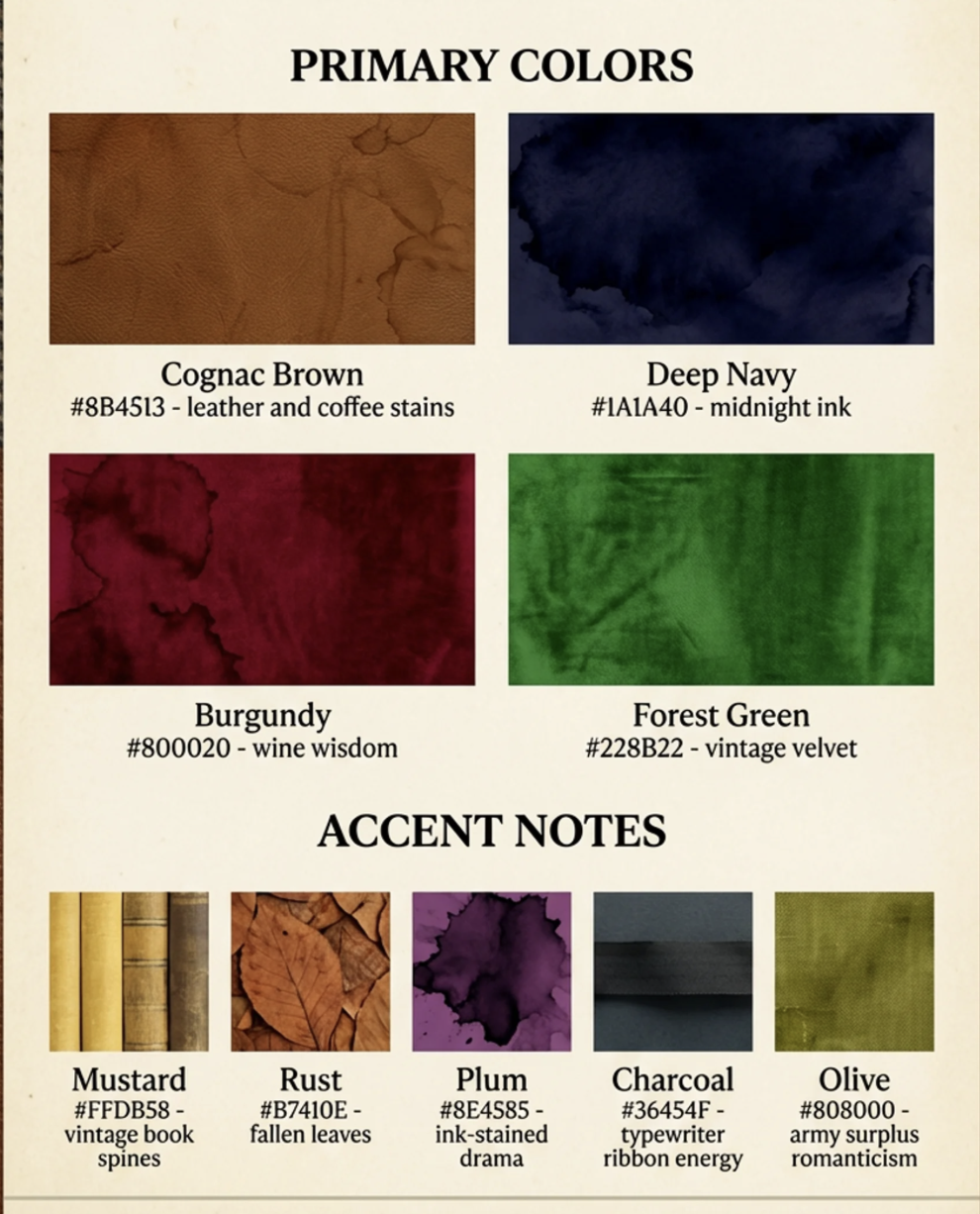
The complete poetcore color palette: from cognac leather to midnight ink.
Essential Textures, Fabrics & Materials
Poetcore is as much about texture as hue – worn wool, aged leather, rough tweed. These textures create visual interest and communicate the aesthetic's core values: quality, character, and patina.
Tweed (Professor-Core Foundation)
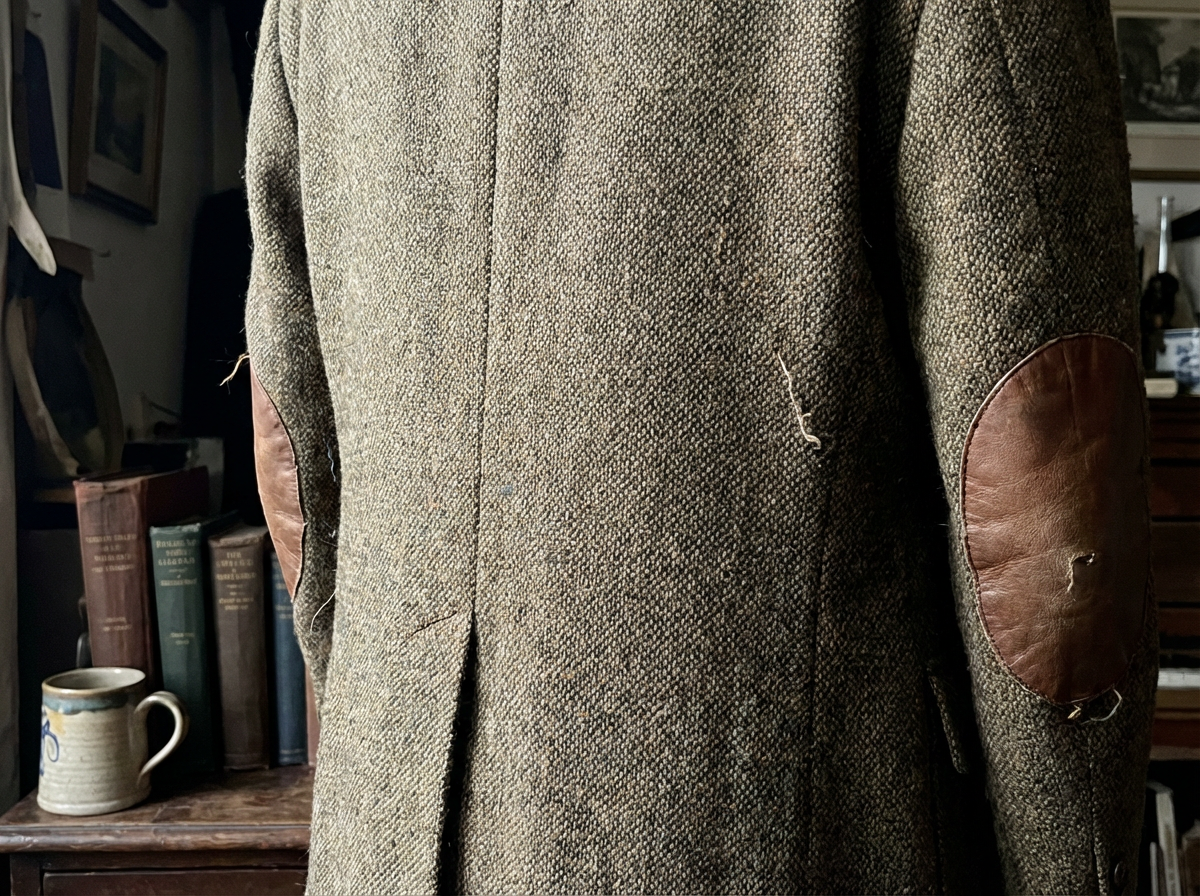
Tweed: The signature poetcore texture
Tweed is Poetcore's signature texture. It's academic, vintage, and recognizable. That nubby, textured surface says "I have tenure" even if you've never set foot in a classroom. Tweed adds weight, sophistication, and literary credibility.
The appeal: It ages beautifully, hides coffee stains, and makes you look approximately 40% more intelligent.
Where it works: Blazers (obviously), trousers (if committed), caps, vests, skirts, anything you want to elevate to "professor emeritus" status.
Corduroy (Worn and Wise)
The more approachable cousin of tweed. Corduroy has that same textured, vintage quality but feels more lived-in, more bohemian, less formal. Those vertical ridges (wales, if you want to be technical) signal "I read poetry for fun." Wide-wale corduroy is more casual and vintage; fine-wale is more refined.
The appeal: Soft, comfortable, available in every Poetcore color, and practically begs to be worn in coffee shops.
Where it works: Trousers (essential), blazers, jackets, skirts, shirts, anywhere you want texture without formality.
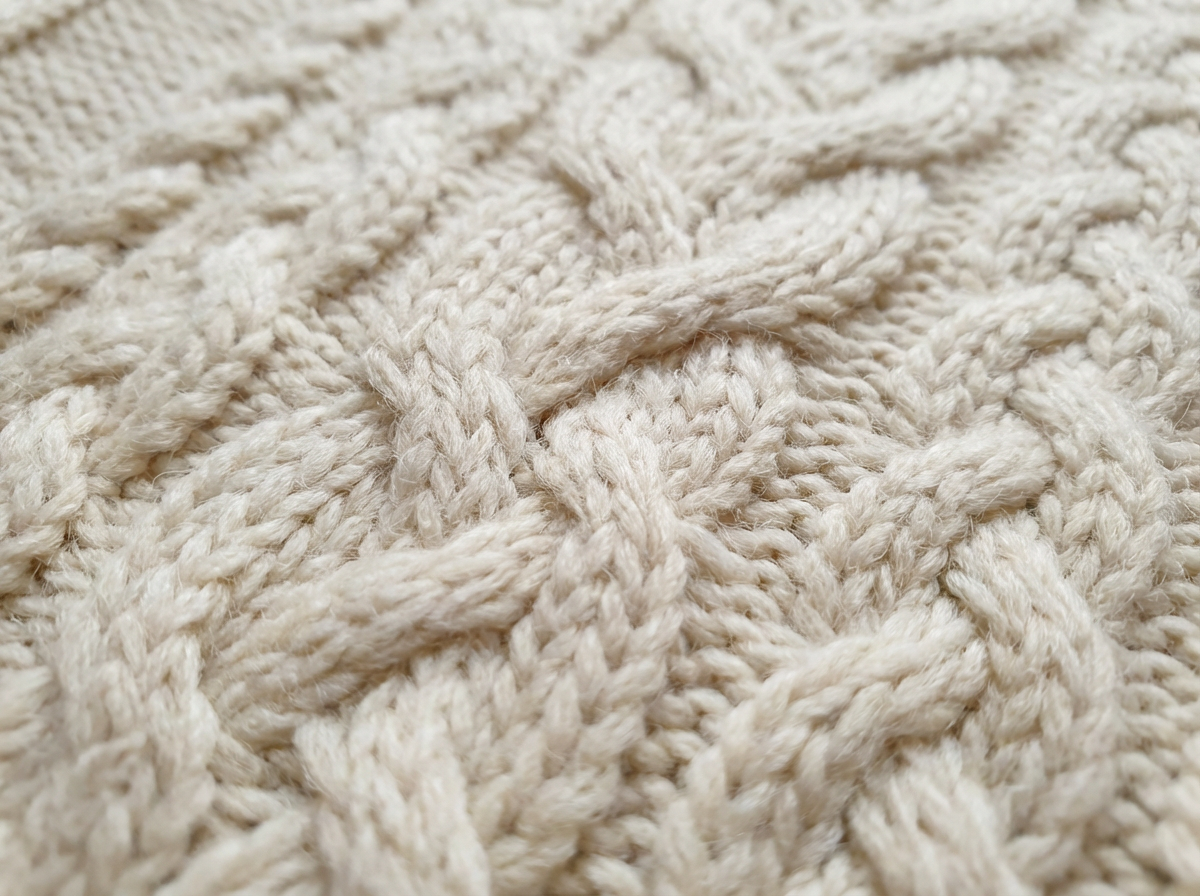
Chunky cable-knit: Essential poetcore winter texture
Wool (Chunky Cable-Knit)
Heavy, cozy wool is Poetcore's winter foundation. We're talking thick cable-knits, fisherman sweaters, and chunky cardigans. The chunkier the knit, the more it looks like it was hand-made by someone's grandmother in 1973, which is exactly what we're going for.
The appeal: Warm, creates beautiful silhouettes, and feels like a hug from literature itself.
Where it works: Sweaters, cardigans, coats, scarves, socks, anything that needs to look both thoughtful and warm.
Velvet (Dramatic Moments)
Velvet is Poetcore's luxury texture, deployed sparingly for maximum impact. It's theatrical without being costume-y, rich without being flashy. The way velvet catches light adds sophistication and a touch of romance. This is your poetry reading texture, your "I'm the mysterious stranger in the corner" fabric.
The appeal: Elegance, vintage character, makes everything feel like an occasion.
Where it works: Blazers for special moments, occasional trousers, accent pieces, accessories, anywhere you want to feel particularly literary and dramatic.
Worn Cotton (Oxford Shirts)
Poetcore cotton is soft and slightly wrinkled. Oxford cloth is the gold standard. The more washed-out and lived-in, the better. Pristine cotton is for business casual; worn cotton is for creative intellectuals.
The appeal: Comfortable, gets better with age, wrinkles are features not bugs, affordable, and flattering.
Where it works: Button-down shirts (essential), casual tops, anything effortless and authentic.
Distressed Leather (Aged Bags)
Leather in Poetcore is never shiny or pristine. That worn leather messenger bag should look like it survived graduate school, three cross-country moves, and countless café sessions. The distress should be authentic – not manufactured.
The appeal: Gets better with age, lasts forever, and makes you look like you have your life together even when you don't.
Where it works: Bags (essential), shoes, belts, jacket accents, watch straps, anything that benefits from looking well-loved.
Linen (Summer Concession)
Let's be honest: Poetcore is an autumn aesthetic forced to survive other seasons. Linen is how we cope with summer. It's rumpled, literary (think Mediterranean writers), and acceptably intellectual. Linen's natural wrinkles signal that you're too busy contemplating existence to iron.
The appeal: Breathable, feels European and literary, saves you from heat stroke while maintaining aesthetic integrity.
Where it works: Summer button-downs, lightweight trousers, the three months you can't wear tweed.
Texture Combinations: The Art of Layering
Mixing Rough and Smooth
The magic happens when you combine textures. These contrasts prevent your outfit from looking flat or one-dimensional.
Successful rough/smooth pairings:
Tweed jacket + silk scarf
Cable-knit sweater + smooth wool trousers
Textured corduroy + smooth leather shoes
Rough canvas bag + sleek cotton shirt
Layering for Depth
Poetcore thrives on layers. You're not just piling on clothes – you're creating a textile landscape.
Layering formula:
Base: Smooth cotton or thin knit
Middle: Medium-weight knit or woven
Outer: Structured jacket or coat
Accent: Contrasting texture in scarf or bag
Patina
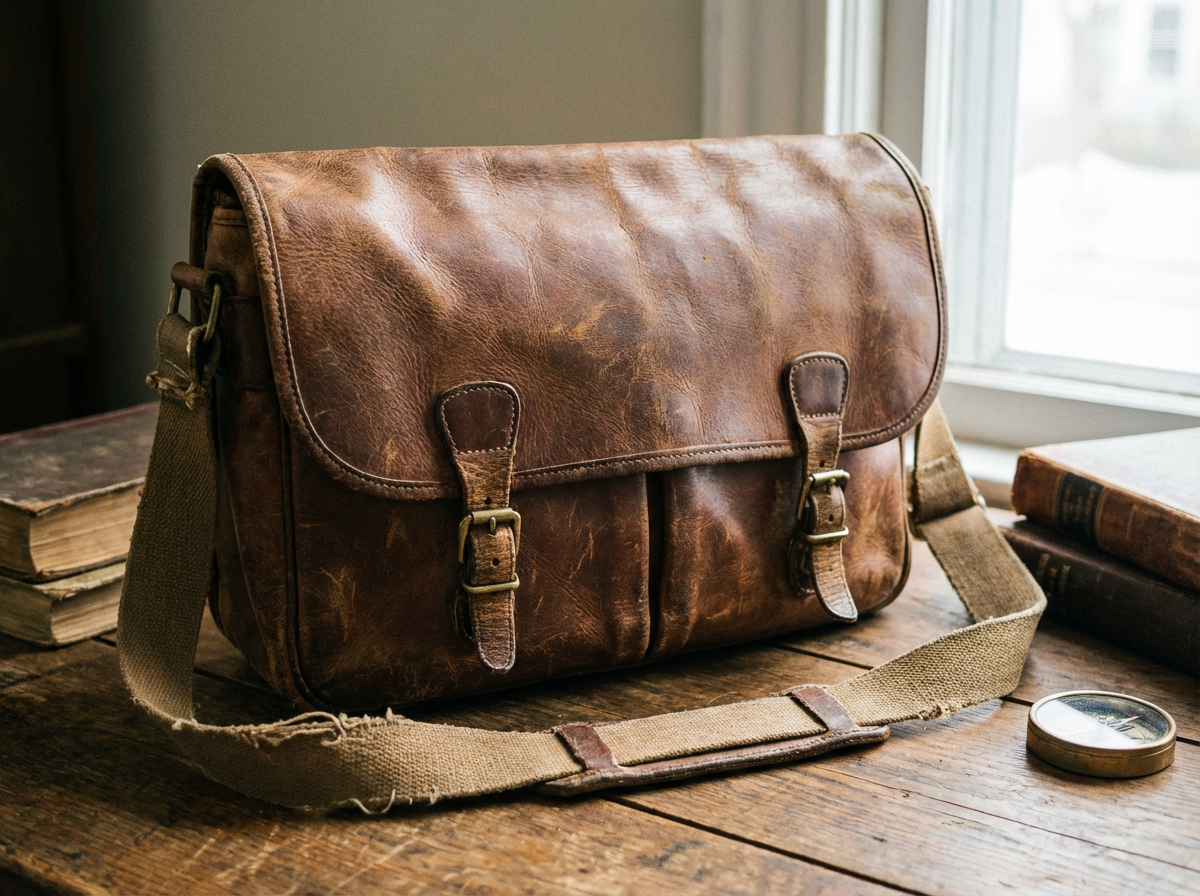
Authentic patina: The soul of poetcore accessories
Here's where Poetcore differs from just looking sloppy: the patina should be authentic.
Good patina:
Natural fading from sun and wear
Honest scuffs from actual use
Softening of fabric from washing
Color variation from age
Authentic vintage pieces
Bad patina:
Pre-distressed fast fashion
Obviously manufactured "vintage" look
Intentional damage to new items
Trying too hard to look old
Poetcore Patterns & Prints Guide
Poetcore patterns are subtle, classic, and often miniature – they add interest without demanding attention. Think "vintage academic" not "look at me."
Fair Isle Knits
Those traditional Nordic-inspired patterns with their geometric motifs and multiple colors. Fair Isle instantly reads as vintage, cozy, and intellectual. It's the pattern of ski lodge weekends and university common rooms in the 1960s. Stick to traditional colorways (browns, creams, burgundies).
Subtle Plaids
We're talking muted windowpane checks, tiny tartans, and restrained plaid patterns. Nothing loud, nothing lumberjack-y. The plaid should whisper "I have good taste," not scream "I'm wearing a pattern!"
Houndstooth
Houndstooth is an academic pattern royalty – it shows up in vintage blazers, wool trousers, and scarves. Large houndstooth veers into costume territory; tiny houndstooth is timeless elegance.
Minimal Florals (Dark, Moody)
If you're going to do florals in Poetcore, they need to be dark, small, and preferably vintage-inspired. Think tiny pressed flowers on navy backgrounds, not bright ditsy prints. Remember, poetcore, not cottagecore.
Hard No's:
Loud prints of any kind
Geometric modern patterns (this isn't 1980s Memphis design)
Anything neon or fluorescent (obviously)
Large-scale prints
Tropical or bright florals
Obvious branding or logos
Tie-dye (wrong kind of bohemian)
Animal prints (too aggressive)
The Pattern Rule: If you notice the pattern before you notice the person, it's too loud for Poetcore.
Building Your Poetcore Wardrobe: Essential Pieces
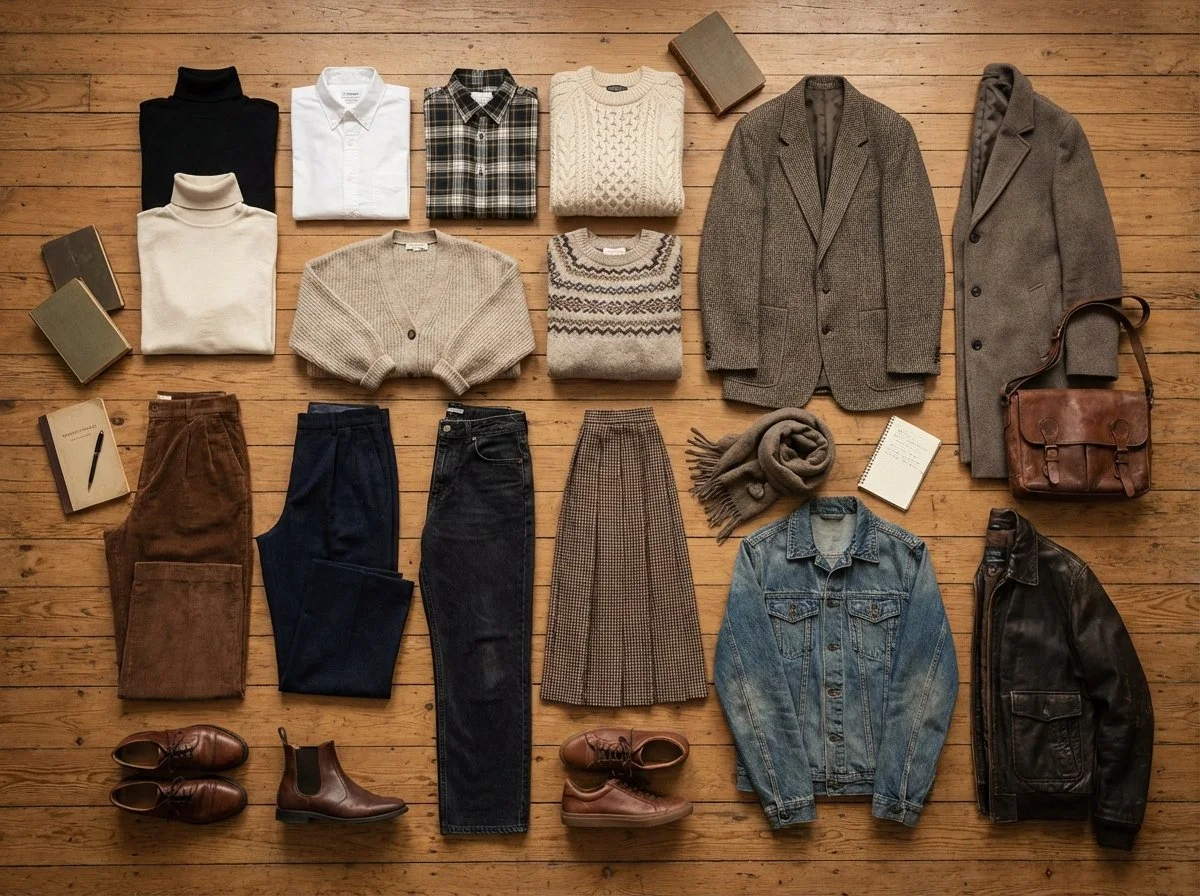
Poetcore dressing is structured like a thesis. Everything builds toward credibility.
The Upper Canon: Tops & Knitwear for Poetcore Style
Turtlenecks
Black (essential)
Cream (classic)
Burgundy (bold)
Brown (earthy)
Ribbed textures
Slightly oversized
Button-Downs
Oxford shirts (wrinkled)
Flannel patterns
Oversized fits
Rolled sleeves mandatory
Missing buttons acceptable
Coffee stains authentic
Knitwear
Cable-knit sweaters
Fair Isle patterns
Elbow patches
Fisherman styles
Grandpa cardigans
Vest situations
Lower Literature: Trousers, Skirts & Denim
Trousers
Wide-leg corduroys
Pleated wool pants
Tweed everything
High-waisted fits
Cuffed hems
Suspender-ready
The Jean Question is controversial.
If you must wear jeans:
Dark wash
No distressing
Cuffed properly
Worn like you didn’t think about it (you did)
Skirts
Midi-length pleated
Wool A-lines
Plaid patterns
Dark florals
Vintage cuts
Paired with tights
Outerwear & Jackets: The Protective Verse
Vintage Blazers:
Tweed with elbow patches
Oversized '80s cuts
Corduroy options
Inherited vibes
Pockets full of receipts
Slightly musty smell
Long Coats:
Wool overcoats
Trench situations
Cape possibilities
Military surplus
Peacoat classics
Mysteriously stained
Casual Layers:
Denim jackets (worn)
Bomber jackets (leather)
Quilted vests
The Metric Feet: Footwear for the Poetcore Aesthetic
Approved footwear:
Oxfords
Penny loafers
Chelsea boots
Brogues
Vintage sneakers (only if you’re a Beat variant)
Scuffed > polished.
Darned socks? Elite-tier.
Poetcore Accessories: The Literary Details
Bags (The Most Important Accessory)
Leather: Aged, worn, wise
Canvas: Army surplus energy
Size: Fits a typewriter
Color: Brown, black, olive
Contents: Books, notebooks, pens, angst
Alternative Carriers
Vintage briefcases
Messenger bags
Canvas tote bags
Leather backpacks
Doctor's bags
Nothing too new
The Fountain Pen & Writing Tools

The poetcore fountain pen: more personality trait than writing tool
The fountain pen is the ultimate Poetcore flex. It is less a writing instrument and more a personality trait. Is it used regularly? Probably not. But that’s not the point.
The fountain pen says, I don’t just jot things down. I compose.
And if there happens to be a faint ink stain on your fingers or the inside of your pocket, even better. In Poetcore, ink smudges aren’t accidents — they’re proof of proximity to genius.
Fountain Pen Hierarchy
Inherited vintage (priceless)
Flea market finds ($15-50)
Lamy Safari ($30) - student starter
Pilot Metropolitan ($20) - budget-friendly
TWSBI Eco ($35) - enthusiast entry
Vintage Parker or Waterman ($50-200)
Mont Blanc (if trust fund exists)
Other Writing Supplies
Moleskine notebooks (cliché but correct)
Leather journal covers
Vintage composition books
Fountain pen ink bottles
Blotting paper
Eyewear, Scarves & Other Essentials

Eyewear
Wire-rimmed = philosopher
Tortoiseshell = novelist
Reading chain = eccentric literary aunt
Monocle = too far
Budget tiers: Zenni ($30) → Warby Parker ($95) → Oliver Peoples ($400)
Scarves
Wool university scarves
Silk pocket squares
Knitted infinity scarves
Blanket scarves
Cashmere if possible
Hats
Newsboy caps
Wool berets (French energy)
Fedoras (carefully)
Knit beanies
Baker boy caps
Jewelry & watches
Vintage analog watches (leather strap)
Signet rings (family crest optional)
Long pendant necklaces (vintage lockets)
Brooches (pins with literary quotes)
Simple gold hoops or studs
Avoid: Anything sparkly, trendy, or logo-heavy
How to Style Poetcore: Outfit Formulas & Ideas
The Classic Poetcore Outfit Formula
Base Formula: Turtleneck + Wide-leg trousers + Oversized blazer + Leather oxfords + Messenger bag + Fountain pen
The Café Writer
Cream turtleneck
Brown corduroy wide-legs
Oversized tweed blazer (elbow patches)
Scuffed brown loafers
Leather satchel
Wool scarf
Wire-rim glasses
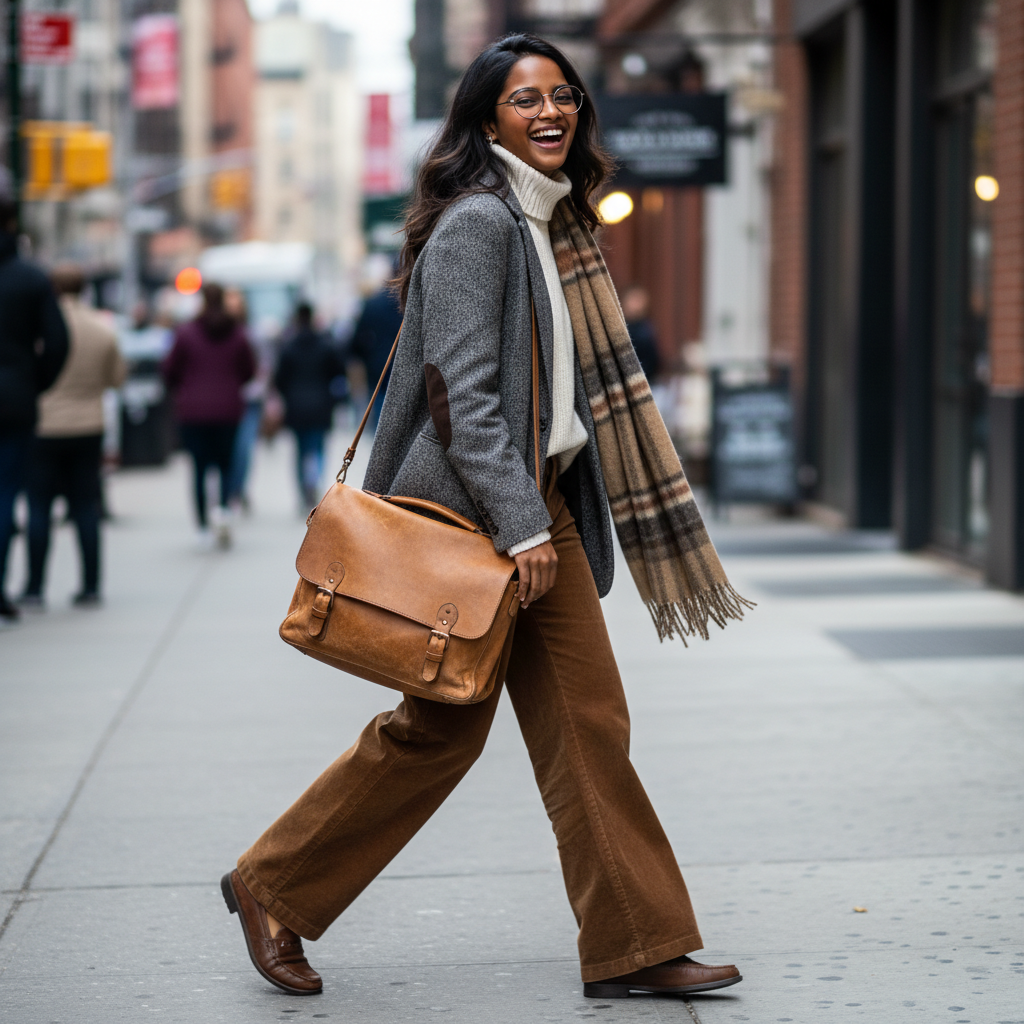
The Café Writer: Your go-to poetcore outfit formula
The Bookstore Browser
White oxford shirt (wrinkled)
Navy wool trousers
Cable-knit cardigan (oversized)
Chelsea boots
Canvas tote bag
Newsboy cap
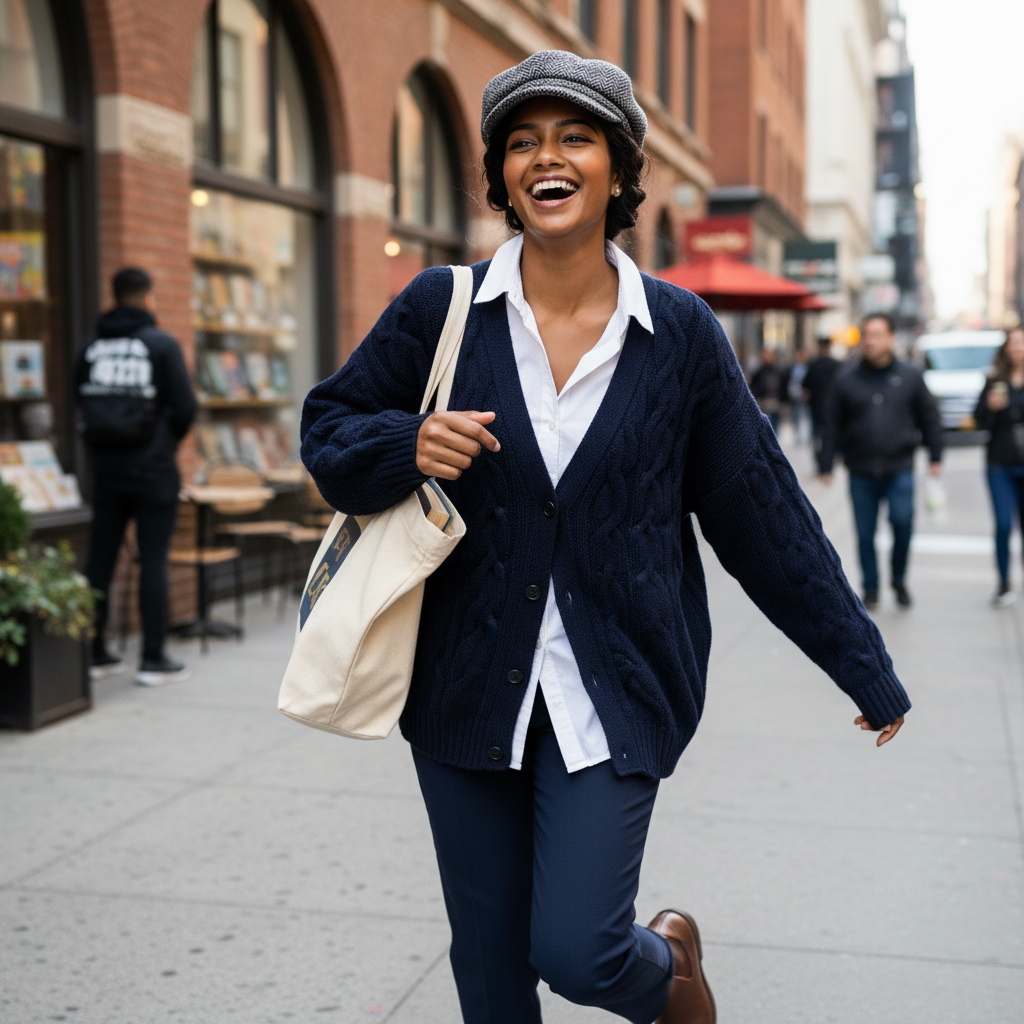
The Bookstore Browser: Casual poetcore for weekend literary adventures
The Poetry Reading
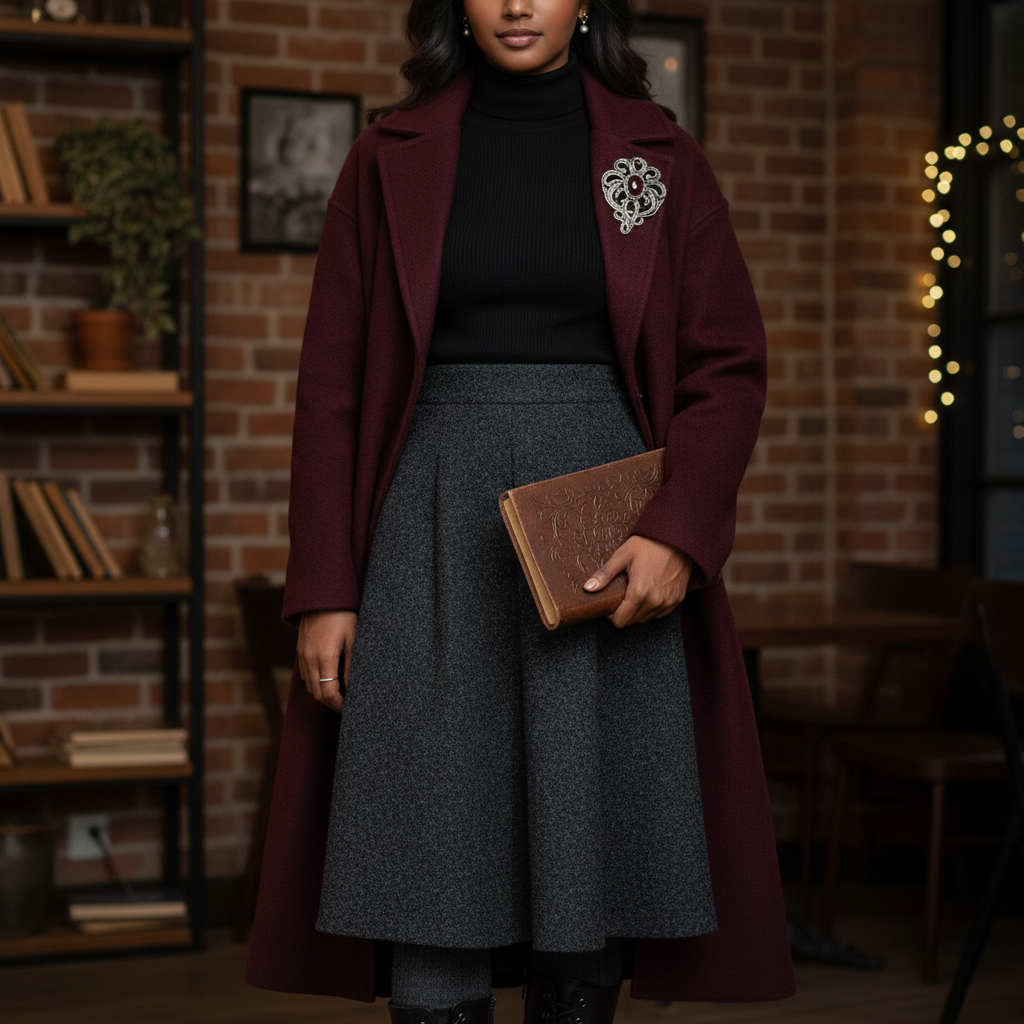
Black turtleneck
Tweed midi skirt
Thick wool tights
Combat boots
Long wool coat
Vintage brooch
Leather journal clutched dramatically
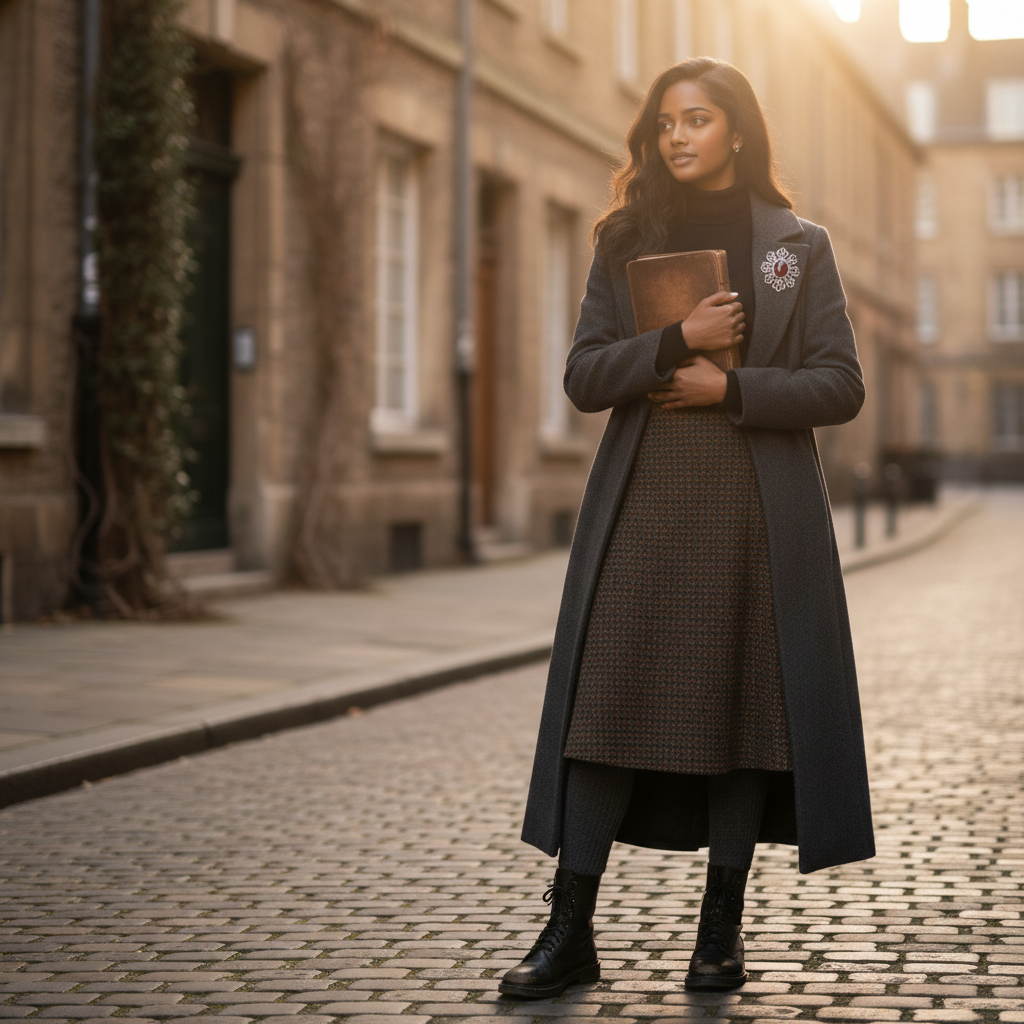
The Poetry Reading: Poetcore style for evening events
The Campus Wanderer
Flannel button-down
Straight-leg jeans (cuffed)
Fair Isle sweater
Dr. Martens boots
Messenger bag overflowing with books
Beanie
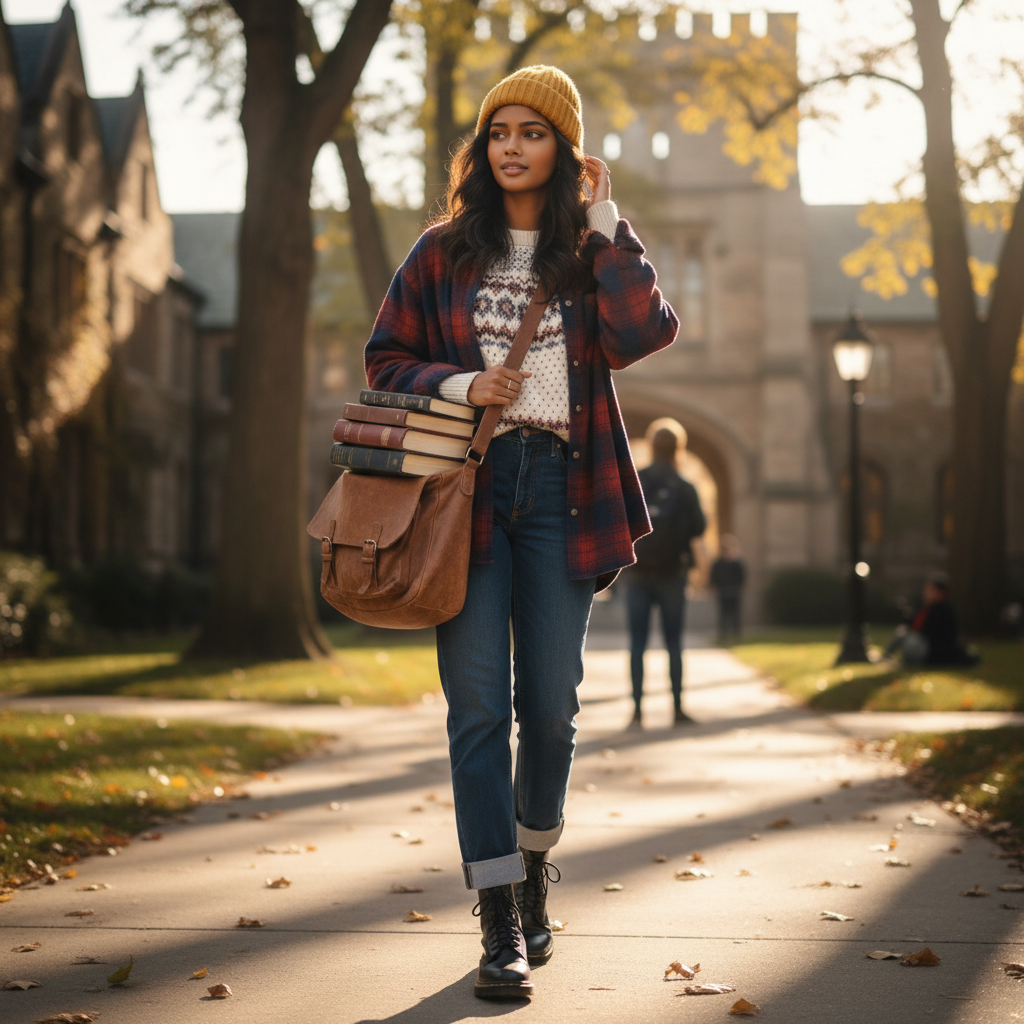
The Campus Wanderer: Relaxed poetcore for everyday wear
The Published Author (Aspirational)
Burgundy turtleneck
High-waisted pleated trousers
Velvet blazer
Polished loafers
Briefcase
Silk scarf tied at neck
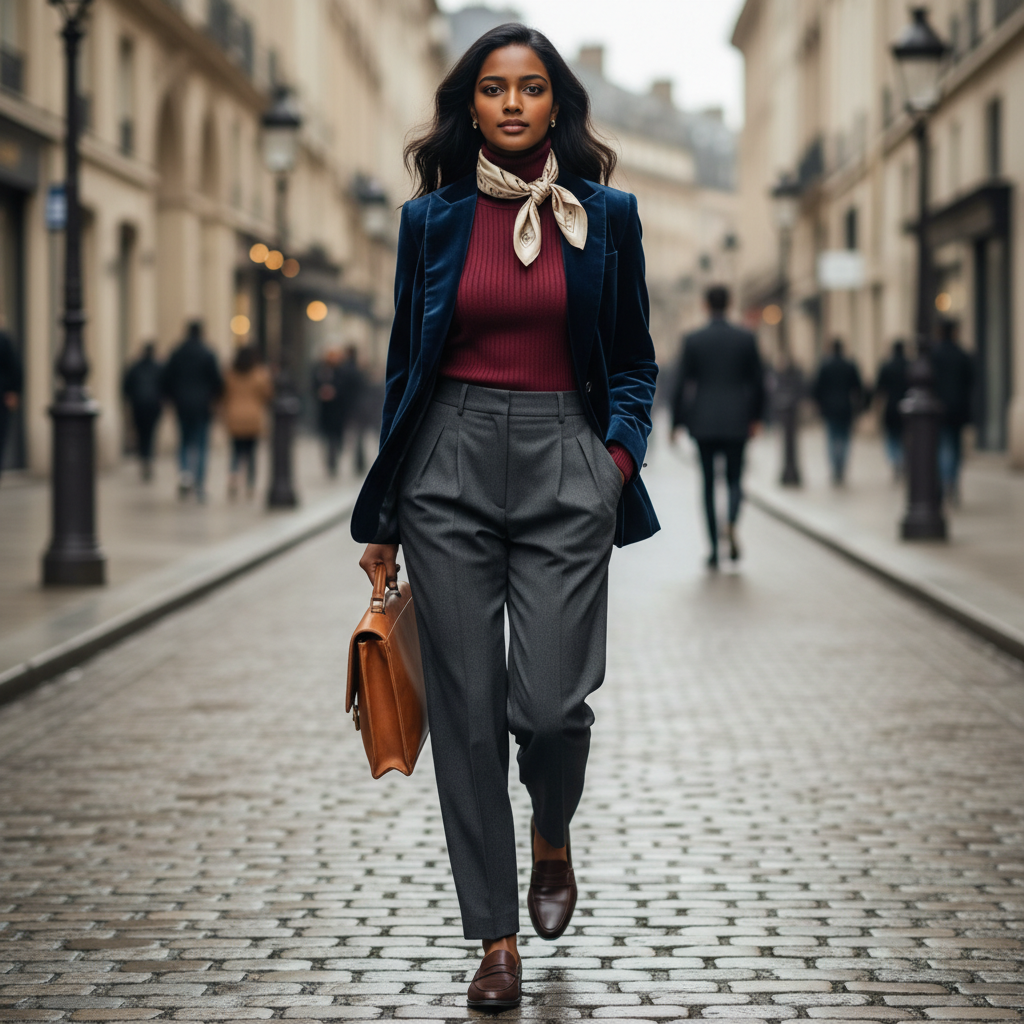
The Published Author: Aspirational poetcore for special occasions
Seasonal Outfit Adaptations
Fall (Peak Poetcore Season)
Maximum layering potential
All the tweed
Scarf deployment
Hot coffee as accessory
Winter
Long wool coats over everything
Chunky knits
Leather gloves
Indoor activities justified
Spring
Lighter blazers
Rolled sleeves
Fewer layers
Iced coffee transition
Summer (Challenge Mode)
Linen button-downs
Lightweight trousers
Suffer elegantly
Seek air conditioning
Styling Tips & Tricks
The Art of Looking Disheveled:
Perfectly imperfect wrinkles
Strategic coffee stains
Authentically worn items
Lived-in vs. sloppy
Layering Strategy:
Start with turtleneck base
Add button-down or sweater
Top with blazer or coat
Scarf for extra drama
Should look like you grabbed layers in the dark
The Fit Question:
Oversized on top (blazers, sweaters)
Fitted at waist (trousers, skirts)
Proportion is key
Intentionally borrowed from someone else's closet
One False Move (Poetcore Edition)
One False Move…and you’re back on TikTok

Tweed blazer + corduroys + chunky dad sneakers + oversized logo bag.
Logos and trend-heavy pieces disrupt the timeless illusion. Poetcore should feel discovered, not sponsored.
One False Move…And You’re Launching A Startup

Black turtleneck + slim black jeans + Apple Watch + pristine white sneakers.
Visible tech disrupts the analog fantasy. If you must wear a smartwatch, hide it under a cuff.
One False Move…And You’re Auditioning for Pirates of the Caribbean
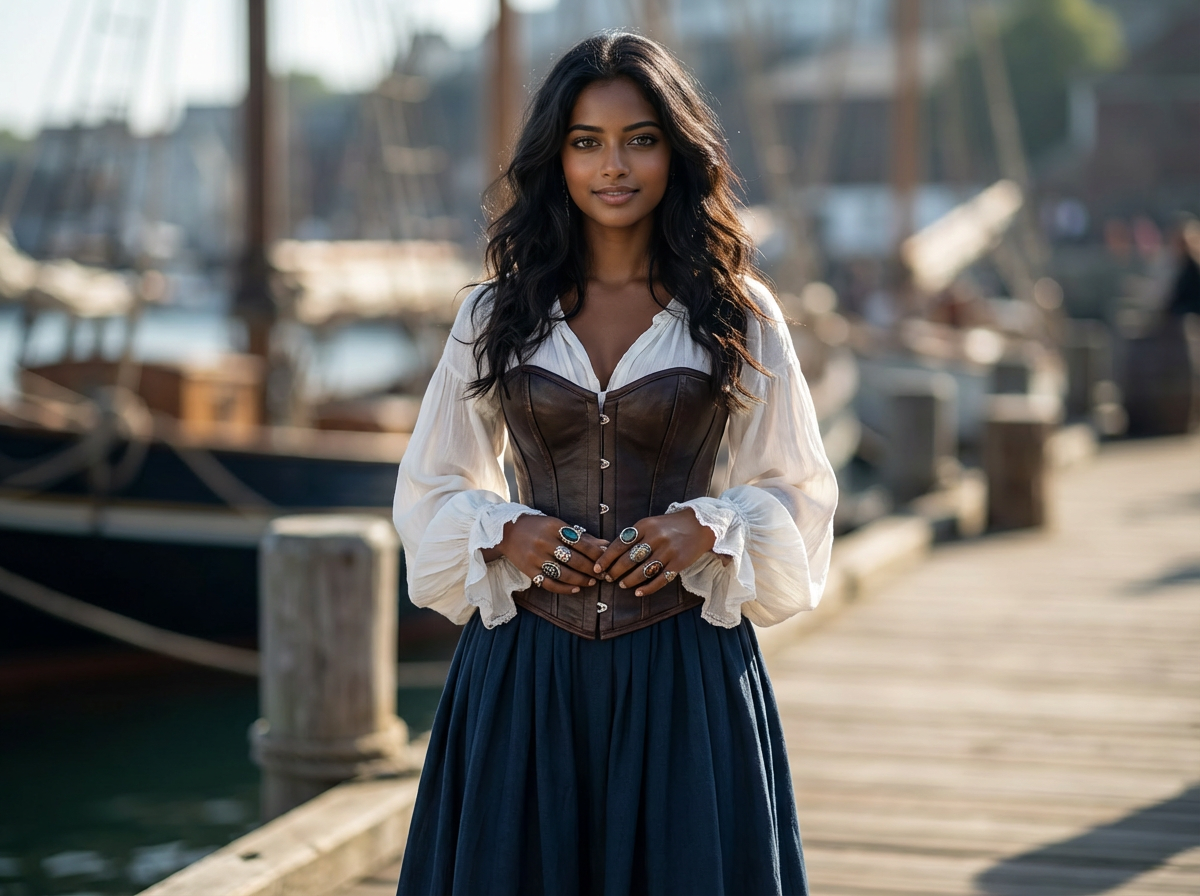
Flowing pirate blouse + corset + floor-length skirt + heavy rings.
Poetcore is subtle signaling. The moment it becomes theatrical cosplay, you lose the credibility.
The Core Poetcore Mistake
The biggest mistake of all:
Trying to look like a poet instead of living like one.
If every element feels performative — the exaggerated brooding, the theatrical sighing, the aggressively displayed unread classics — the illusion collapses.
Poetcore works when it feels:
Internalized
Lived-in
Slightly unbothered
The aesthetic should suggest:
“I’ve been like this.”
Not:
“I dressed for this.”
The Essential Poetcore Capsule Wardrobe
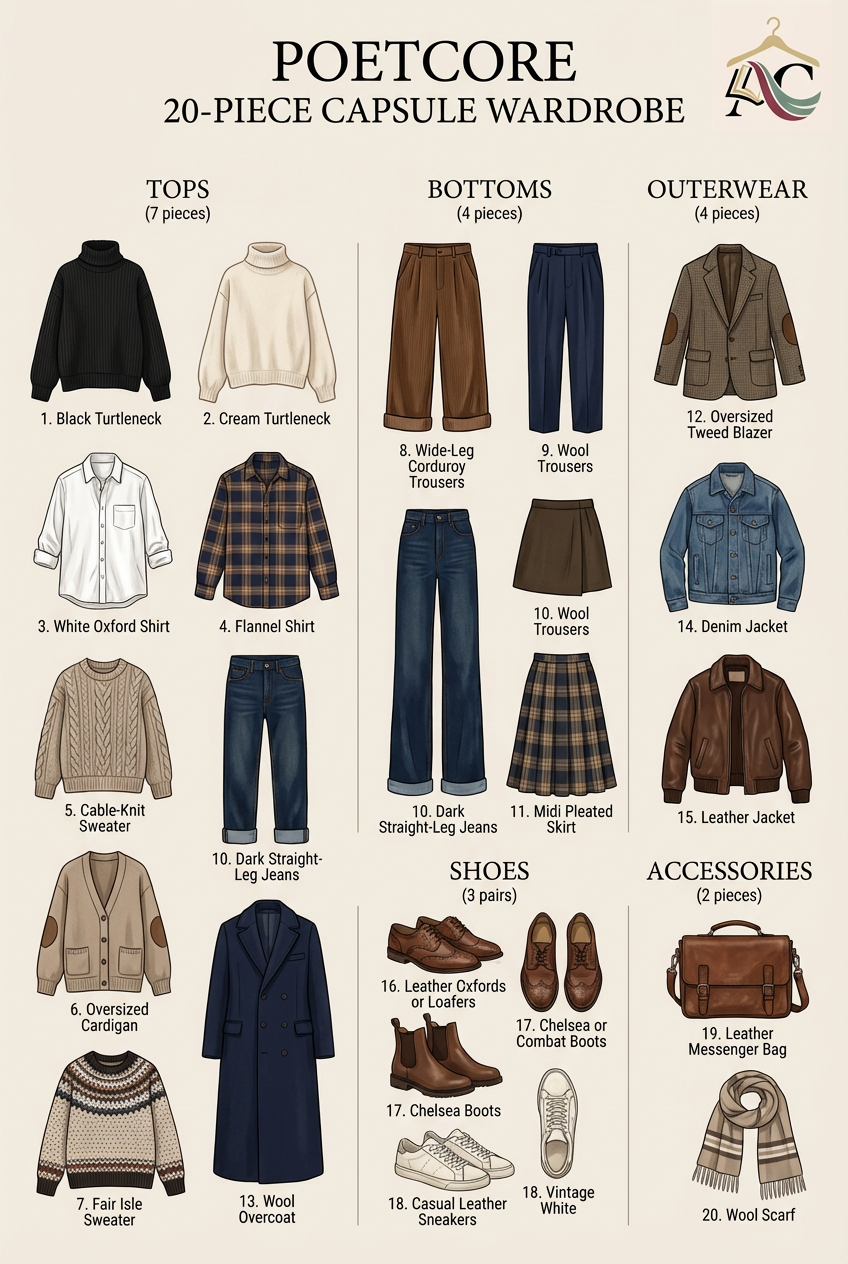
Your complete 20-piece poetcore capsule wardrobe
Building a Poetcore wardrobe doesn't require raiding every vintage store in a fifty-mile radius or spending your rent money on tweed (though the temptation is real). What it requires is strategic thinking, patience, and understanding that the goal is creating a cohesive collection of pieces that work together effortlessly – like a well-edited anthology where every piece earns its place.
This isn't about having a massive closet. It's about having the right closet – one where you can grab items in the dark and still look like you're about to write the next great novel (or at least a very compelling grocery list).
The 20-Piece Starter Capsule
This is your foundation. With these 20 items, you can create dozens of outfits across multiple seasons.
Tops (7 pieces)
1. Black Turtleneck The non-negotiable foundation. This is your "I'm a serious intellectual" piece, your "it's getting cold but I still look put-together" savior, your blank canvas for layering. Slightly oversized fit, ribbed texture preferred. This will be your most-worn item, so invest in quality. Merino wool, if possible, cotton blend if budget-conscious.
2. Cream Turtleneck Black's softer, more approachable sibling. Cream (not white – we've been over this) adds light to your darker pieces without looking too pristine. Same fit as the black – slightly oversized, comfortable enough to wear all day in a café while pretending to write.
3. White Oxford Shirt The workhorse of button-downs. Slightly oversized, preferably men's cut for that borrowed-from-the-boyfriend aesthetic. Should be worn wrinkled – this is Poetcore, not business casual. Roll the sleeves, leave the collar unbuttoned, maybe miss a button halfway down.
4. Flannel Shirt Browns, navys, forest greens – nothing too lumberjack-y. This is your weekend piece, says, "I'm comfortable but still look like I read poetry.
5. Cable-Knit Sweater (Neutral) Chunky, textured, cozy. Choose brown, cream, or charcoal grey – something that plays well with everything else. It's your fall-to-winter transition piece.
6. Oversized Cardigan This is your cozy layering piece that works over turtlenecks, under blazers, and as light outerwear in spring. Neutral color – brown, camel, cream, or grey. Elbow patches optional but encouraged.
7. Fair Isle Sweater Your pattern piece, your statement knit, your "I have personality" sweater. Traditional Fair Isle patterns in Poetcore colors – browns, creams, burgundies, forest greens. One is enough; more becomes costume-y.
Bottoms (4 pieces)
8. Wide-Leg Corduroy Trousers (Brown) The Poetcore trouser par excellence. Wide-leg, high-waisted, cuffed at the hem. Brown corduroy is impossibly versatile. Look for them in thrift stores or men's sections for the best cuts.
9. Wool Trousers (Navy) Pleated front if you can find them, high-waisted always, slightly tapered or straight leg. Navy wool trousers are office-appropriate, poetry-reading-ready, and sophisticated without trying.
10. Dark Straight-Leg Jeans Dark wash, straight or wide leg, no distressing, always cuffed. They should be worn less than your other bottoms but appreciated when you need that denim energy.
11. Midi Pleated Skirt If skirts are your thing, a wool midi-length pleated skirt in navy, brown, or plaid is incredibly versatile. Pair with thick tights, turtlenecks, and boots.
Outerwear (4 pieces)
12. Oversized Tweed Blazer THE Poetcore piece. Should be oversized (shop men's vintage), have elbow patches (or room to add them), and look like it survived several decades of university life. This is worth hunting for.
13. Wool Overcoat Your serious outerwear, your winter armor, your "I'm a character in a literary novel" coat. Long, structured, dramatic. Navy or charcoal grey preferred. Can be thrifted or a worthy investment piece.
14. Denim Jacket Your casual layer for spring and fall. Should look like you've owned it for years, even if you just found it. Works over turtlenecks, under blazers (if you're bold with layering), and as a standalone piece in transitional weather.
15. Leather Jacket Brown leather bomber or moto-style jacket (less aggressive than black moto). Your edge piece, your cool factor. Vintage is ideal – that worn, buttery leather that gets better with age. This is your "I read Beat poetry and occasionally have adventures" piece.
Shoes (3 pairs)
16. Leather Oxfords or Loafers Your everyday shoe, your workhorse footwear. Brown leather, slightly scuffed, comfortable enough for hours of café-sitting. Oxfords are more structured; loafers (penny or tassel) are slightly more relaxed.
17. Chelsea or Combat Boots Your boot option – the piece that works in rain, snow, and "I'm feeling particularly literary today" moments. Chelsea boots in brown leather are sleeker; combat boots (Dr. Martens or similar) are more casual.
18. Casual Leather Sneakers Your "I still need to be comfortable" option. Vintage-style leather sneakers in white, cream, or tan. Think Converse, Vans, or similar classics in leather rather than canvas. These keep you grounded when oxfords feel too formal and boots too heavy.
Accessories (2 pieces)
19. Leather Messenger Bag The most important accessory. Aged brown leather, large enough for books and a laptop, worn enough to have character. This bag becomes part of your identity – it should look like it holds the manuscript that will change everything (even if it just holds snacks and your charging cable).
20. Wool Scarf One excellent scarf in a neutral (cream, brown, charcoal) or a subtle pattern. Long enough to wrap multiple times, substantial enough to provide actual warmth. This is your finishing touch, your "the outfit is complete" piece. University stripes acceptable, solid colors safer.
With These 20 Pieces:
You can create 40+ distinct outfits across three seasons (summer requires additions, addressed in the expanded wardrobe). Every piece works with at least 60% of the others.
“The goal isn’t to own everything Poetcore—it’s to own the right things.”
Budget Breakdown by Tier
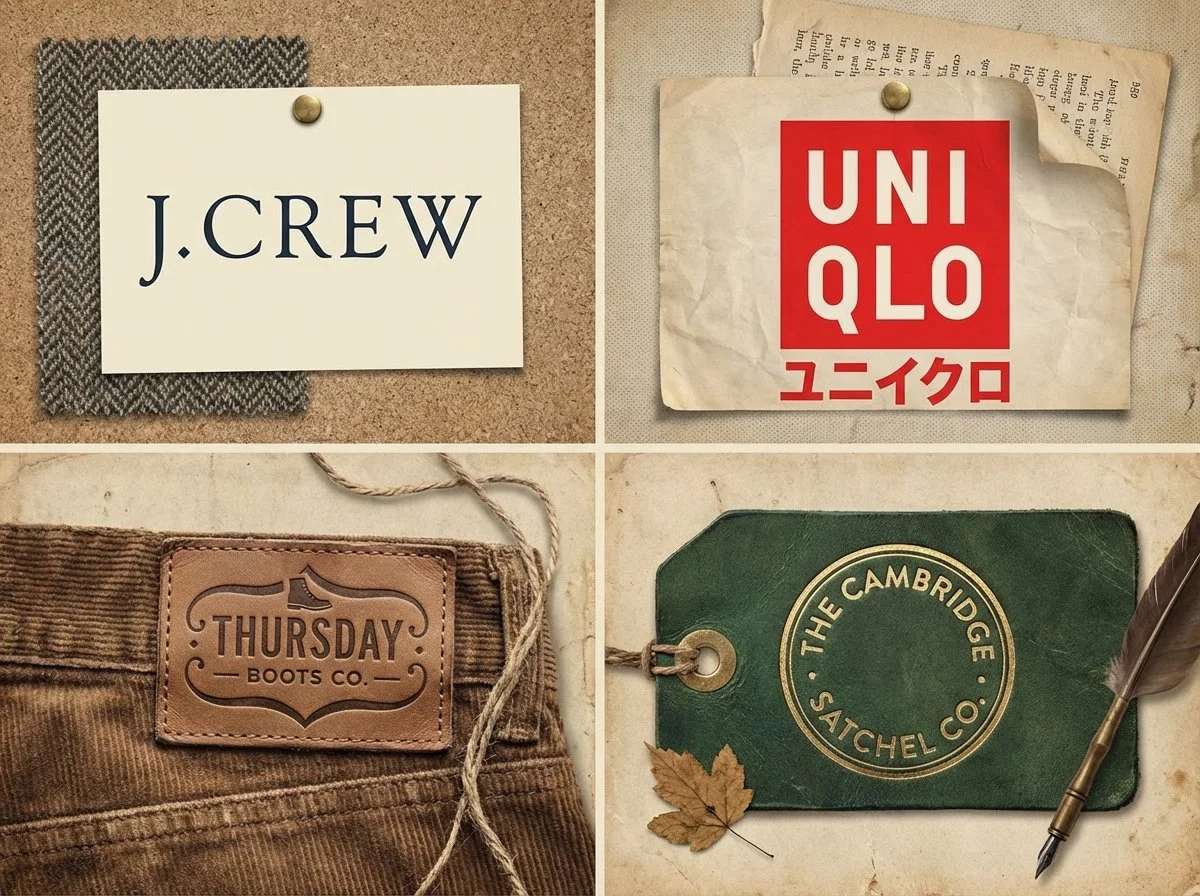
Where to shop poetcore: retail edition
Thrift-Heavy Build ($300-500)
This is the scrappy, patient approach – 80% of your wardrobe comes from thrift stores, vintage shops, and secondhand sources. You invest in new basics only when necessary (turtlenecks, underwear, socks).
Strategy:
Hunt estate sales in university towns
Check thrift stores weekly
Buy men's vintage for better quality and fit
Invest new money in: turtlenecks, underwear basics
Thrift everything else: blazers, trousers, coats, shoes, bags
Realistic Timeline: 6-12 months to build a complete capsule
Patience Required: High
Satisfaction Level: Extremely high (you found everything yourself)
Best For: Those who love the hunt, have time to search, and want authentic vintage pieces
“Thrifting for Poetcore isn’t just budget-friendly—it’s aesthetically essential.”
Mixed Approach ($800-1,200)
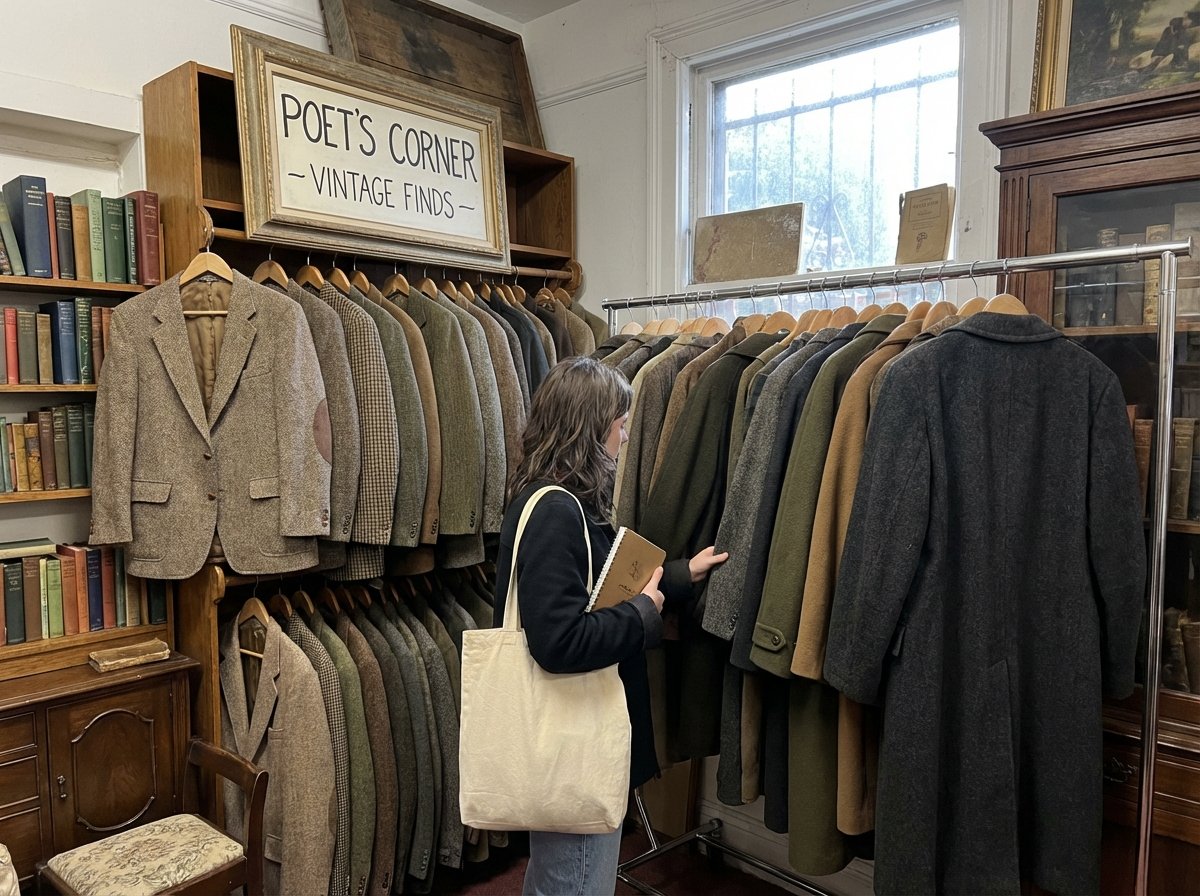
Thrifting for poetcore: where the best pieces live
The realistic middle ground – 50% thrifted, 50% strategically purchased new. You thrift the character pieces (blazers, coats, bags) and buy new for perfect-fit basics and items that are hard to find secondhand in good condition.
Strategy:
Thrift: blazers, coats, bags, some shoes
Buy new: turtlenecks, underwear, specific trouser fits, boots
Shop sales and secondhand for mid-tier items
Invest in one or two quality pieces that will last
Buy New:
All turtlenecks (Uniqlo, Everlane, COS)
Perfect-fit trousers (Uniqlo, Dickies, ASOS)
Quality boots (Dr. Martens, Thursday Boots)
Basics that need specific fits
Thrift/Vintage:
All blazers and sport coats
Wool overcoats
Messenger bags
Oxford shoes
Sweaters and cardigans
Realistic Timeline: 2-4 months to build complete capsule
Patience Required: Moderate
Satisfaction Level: High (balanced effort and results)
Best For: Most people – balances budget, time, and quality
Investment Build ($2,000-3,500)
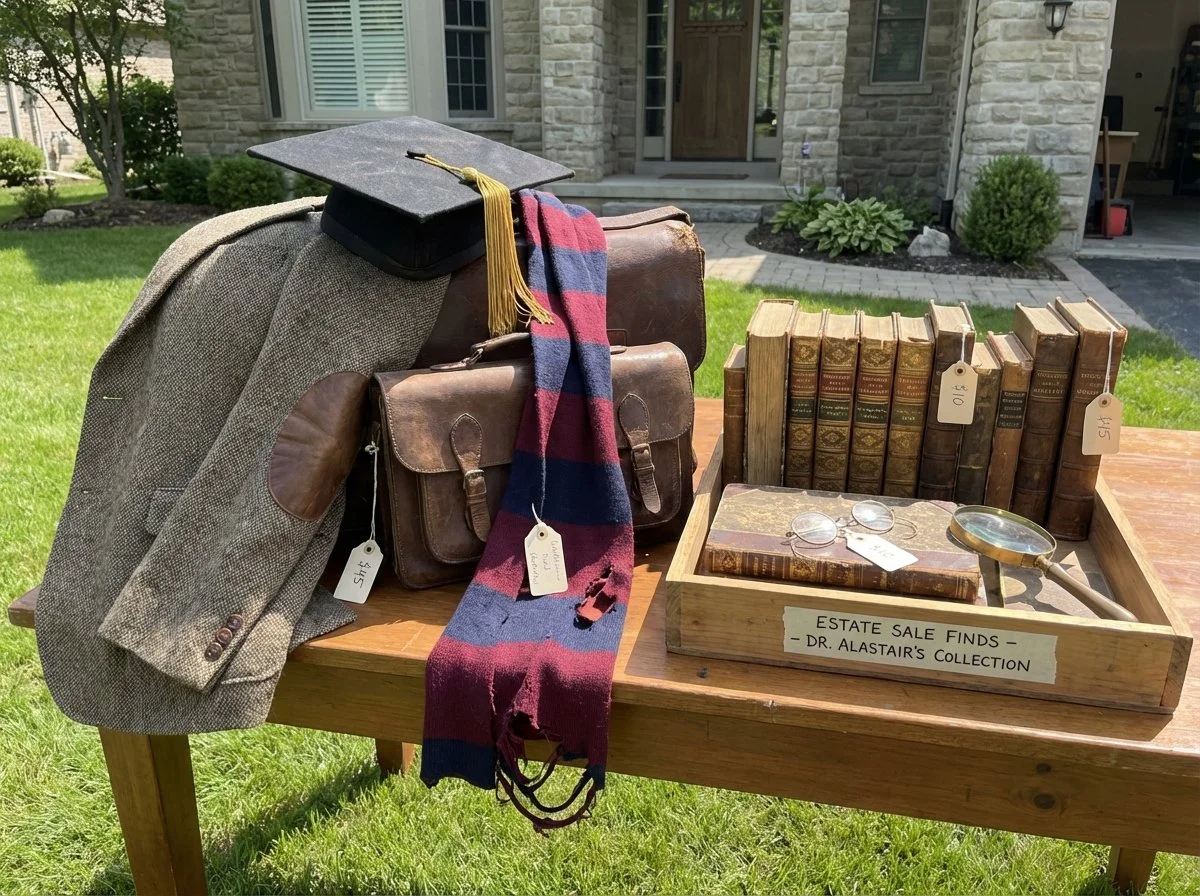
Estate sale jackpot: professor wardrobes are poetcore gold
The quality-focused approach. You invest in new quality pieces that will last decades.
Strategy:
Buy quality new pieces from reputable brands
Invest in vintage statement items (perfect blazer, leather bag)
Prioritize natural materials and construction quality
Build slowly, choose carefully
Investment Pieces:
Cashmere turtlenecks (Naadam, Everlane, J.Crew)
Quality wool trousers (Margaret Howell, A.P.C.)
Excellent leather boots (Thursday Boots, Red Wing)
Investment coat (COS, A.P.C., vintage Burberry)
Perfect leather bag (Filson, vintage Coach, Cambridge Satchel)
Still Thrift:
Vintage tweed blazers (better quality than new)
Unique sweaters and cardigans
Vintage accessories
Character pieces with patina
Realistic Timeline: 3-6 months for core pieces, ongoing refinement
Patience Required: Moderate (less hunting, more saving)
Satisfaction Level: Very high (quality you can feel)
Best For: Those with budget, wanting longevity, and committed to the aesthetic
The Capsule Philosophy
The goal isn't to own everything Poetcore – it's to own the right things. Every piece should earn its place through versatility, quality, or pure joy. You should be able to get dressed in five minutes. That's the power of a well-built capsule.
Start with the 20-piece foundation, expand thoughtfully, and remember that Poetcore is about looking like you prioritize ideas over possessions. The irony is part of the charm.
Poetcore Aesthetic Variations & Substyles
Like poetry, Poetcore contains multitudes. The core aesthetic is flexible enough to accommodate literary influences, personal styles, and creative philosophies. You might lean heavily into one variation, or cherry-pick elements from several to create your own. That's the beauty of an aesthetic rooted in creative expression.
Beat Poetcore: On the Road Energy
"The only people for me are the mad ones, the ones who are mad to live, mad to talk, mad to be saved..." – Jack Kerouac

Beat Poetcore is Poetcore's restless cousin. Where standard Poetcore sits in cafés, Beat Poetcore is always on the move
Key Elements:
Constant Movement – Look like you can transition from coffee shop to cross-country drive to poetry reading without changing.
Jazz Influences – This variation draws from bebop and jazz culture – late nights, improvisation, rhythm over structure.
1950s Americana – Beat Poetcore is rooted in post-war American counterculture. Diners, highways, basement jazz clubs, and working-class intellectualism.
The Beat Uniform:
Brown leather jacket (essential)
White or grey t-shirt
Dark worn jeans (straight leg)
Work boots or Chuck Taylors
Canvas messenger bag (military surplus)
Wool beanie
Moleskine journal
Coffee and cigarettes (aesthetic purposes)
Icons: Jack Kerouac (the romantic wanderer), Allen Ginsberg (the howling poet), Neal Cassady (the beautiful chaos)
When to Lean Beat: If you love movement, masculine energy, jazz, or identify more with "writer as rebel" than "writer as scholar."
Punk Poetcore: Patti Smith Homage
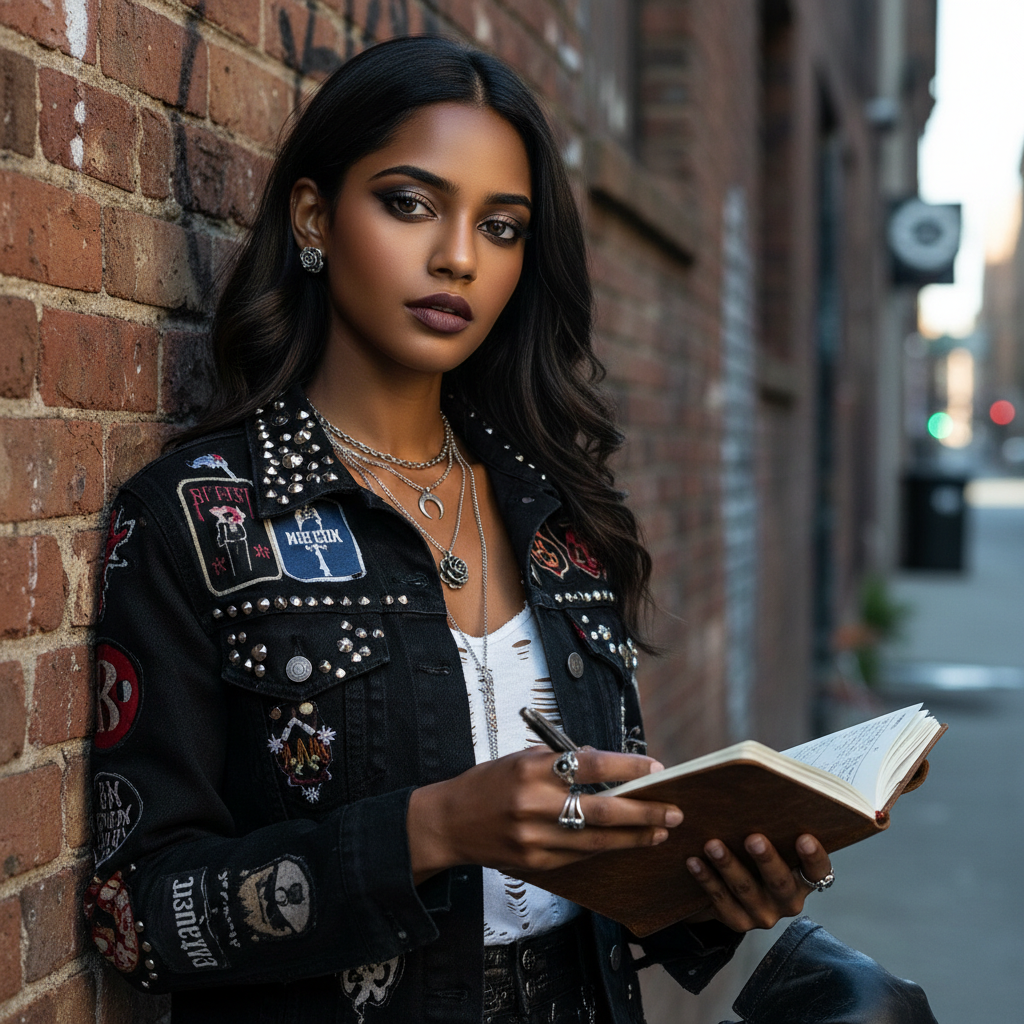
"Jesus died for somebody's sins but not mine" – Patti Smith
This is where poetry becomes protest. Punk Poetcore keeps the intellectual foundation while adding confrontation, anger, and rock and roll. This is for people who want to look literary but refuse to look polite.
Key Elements:
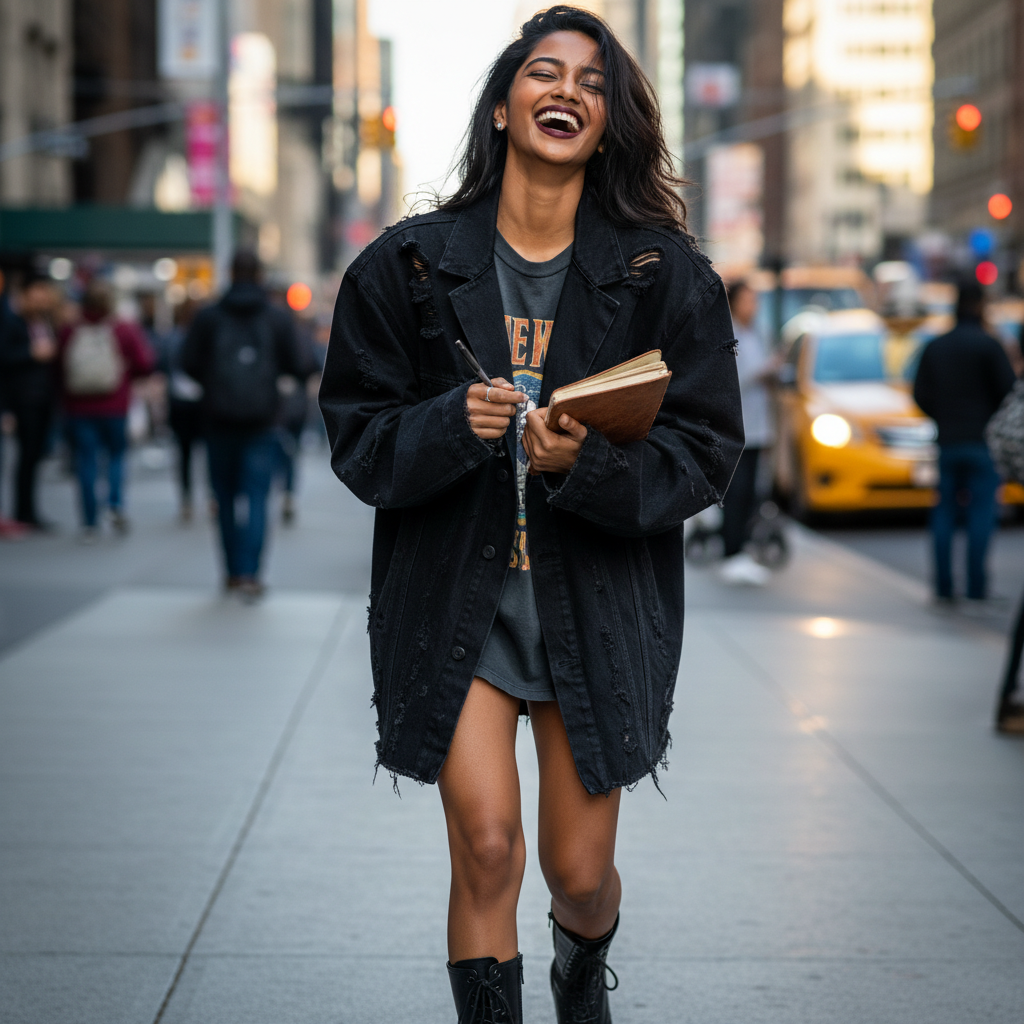
Band T-Shirts Under Tweed – Vintage band tees (punk, new wave, proto-punk) layered under blazers and cardigans. The Ramones meet Shakespeare. This juxtaposition is essential – high and low culture deliberately combined.
Safety Pin Details – Functional or decorative. Holding together that ripped blazer, as jewelry, as attitude. The punk signifier that says "I'm literary but dangerous."
Angry Poetry – Punk Poetcore tends toward actual creation. Slam poetry, zines, manifestos, angry verse scrawled in margins.
The Punk Poet Uniform:
Ripped tweed blazer (DIY)
Band t-shirt (vintage punk)
Black jeans (skinny or straight)
Combat boots (always)
Leather jacket (black moto)
Multiple pins/patches
Messenger bag covered in buttons
Sharpie for guerrilla poetry
Icons: Patti Smith (the godmother of punk poetry), Richard Hell (blank generation poet), Jim Carroll (basketball diaries to rock and roll)
When to Lean Punk: If standard Poetcore feels too genteel, you're into punk music and politics, or you revel in edge and confrontation.
Cottage Poetcore: The Countryside Scribbler

"I wandered lonely as a cloud..." – William Wordsworth
Take Poetcore out of the city café and into the countryside. It's Poetcore meets Cottagecore, where the romance of the writing life includes chickens and vegetable gardens.
Key Elements:
Rural Setting – This variation doesn't work in urban environments. You need actual nature, weather, countryside.
Nature Poetry Focus – Your literary influences are Wordsworth, Mary Oliver, Ted Hughes – poets of landscape, season, and natural world.
Tea Over Coffee – Instead of endless espressos, it's strong tea (builders' tea, Earl Grey) in chipped mugs, preferably overlooking fields or forests.
The Cottage Poet Uniform:
Chunky hand-knit sweater
Corduroy trousers (muddy hem)
Waxed cotton jacket
Wellington boots
Wool scarf (thick, practical)
Canvas bag for foraging/notebooks
Fingerless gloves
Thermos of tea
Icons: William Wordsworth (Lake District wanderer), Mary Oliver (observer of the ordinary), Ted Hughes (raw nature poetry)
When to Lean Cottage: If you prefer nature to cities, write about landscape and season, or want pastorial Poetcore.
Living the Poetcore Lifestyle

The poetcore workspace: where magic happens (theoretically)
Poetcore does not stop at clothing.
It spills into your apartment.
It rearranges your schedule.
It rebrands your procrastination as ritual.
The lifestyle is the scaffolding that makes the wardrobe believable. Without the environment, the tweed is just fabric. With the environment, it becomes narrative.
The Poetcore Living Space
A Poetcore room should look like someone once wrote something important there — even if they didn’t.
Essential Decor
Books: Everywhere, obviously
Not color-coordinated. Not staged by height. Stacked horizontally and vertically. Some spines cracked. Some face-down. Some with receipts marking pages.
Typewriter: Decorative only
It does not need to function. Its purpose is symbolic. It represents a slower era of creation.
Desk lamp: Green banker’s style
The kind of lighting that implies midnight drafts. A pool of seriousness on the desk.
Papers: Scattered
Loose sheets. Margins scribbled. Lines crossed out. The illusion of ongoing work.
Mugs: Half-finished coffee
Never fully empty. Never fully fresh. Rings at the bottom are authenticity markers.
Candles: For atmosphere
Not scented like cupcakes. Think tobacco leaf, library wood, rainstorm.
The Poetcore Room
The structure beneath the clutter matters.
Dark wood furniture
Walnut, oak, anything with weight. Poetcore furniture feels inherited.
Vintage rugs
Worn patterns. Slight fading.
Leather chairs
Slightly cracked. Perfect for brooding. Ideally, near a window.
A globe (why not)
No one uses it. It just implies curiosity.
Dead plants
Watering schedules are inconsistent.
The room is not minimalist. It feels like a mind externalized.

The natural poetcore habitat: corner café table by the window
Daily Rituals & Routines
Morning Routine
Wake at dawn — or dramatically at noon. Either works.
The day begins with the coffee ritual. French press preferred.
Then:
Stare at the blank page.
Convince yourself that thinking counts.
Re-read yesterday’s paragraph.
Adjust a comma.
You dress in a turtleneck. The blazer becomes armor. The messenger bag is optimistically packed.
Then you head to the café.
Not because you have to.
Because you are a writer.
Afternoon Activities
The café is the Poetcore habitat.
You:
Sit by a window
Open the notebook
Order something dark and bitter
Check the time slowly
Underline one sentence
Write half of another
You people-watch. You imagine lives for strangers. You convince yourself this is research.
You write nothing.
You look pensive.
You move the pen across the page once or twice to maintain credibility.
Another coffee.
Evening Plans
Evenings lean socially restrained.
Browse used bookstores
Attend poetry readings
Sit in the back row
Nod thoughtfully
Drink red wine
Debate something
You might reference Franz Kafka. You might not have finished him. That’s beside the point.
Early bedtime.
Dream of publication.
Wake up tomorrow and repeat.
Poetcore FAQs & Troubleshooting
-
Short answer: No.
Long answer: Poetcore is about the aesthetic appreciation of the literary life, not literary output. Carrying a notebook counts. Reading poetry counts. Looking like you might write poetry absolutely counts.
-
Solutions:
Suffer for your art (not recommended)
Linen button-downs
Short-sleeve turtlenecks (compromise)
Lightweight knits
Embrace iced coffee season
Move to a colder climate
Accept that summer is off-season
-
Responses:
"It's in revision"
"Still in the research phase"
"Taking a break to let ideas percolate"
"Focusing on short form right now"
Change subject immediately
Actually write something (radical)
-
No, here's why:
Less gothic, more bohemian
More coffee shops, less libraries
Writer-specific rather than general scholar
Warmer color palette
More lived-in, less pristine
Beat Generation influences
-
Budget Solutions:
Thrift stores in college towns
Online: eBay, Poshmark, Depop
Family closets (free)
Estate sales
University surplus sales
Men's section always cheaper
Patience pays off
-
Reality check:
You might be a little pretentious
Own it with self-awareness
Humor deflects judgment
Confidence is key
Your people will find you
Pretentious is subjective
Life's too short for boring clothes
The Unspoken Truth
Poetcore lifestyle elements create the feeling of creative gravity.
But here’s the interesting tension:
Ritual is comforting.
Environment is inspiring.
Aesthetic is motivating.
None of it replaces the work.
The candle can burn for hours.
The coffee can refill three times.
The notebook can open and close repeatedly.
But at some point, the pen has to move.
And maybe that’s the quiet brilliance of Poetcore.
It builds a world where writing feels possible.
Even if you haven’t started yet.
Your Poetcore Journey Starts Now
The Essence: Poetcore isn't about actually being a published poet – it's about embodying the romantic ideal of the literary life. It's coffee-stained authenticity, thoughtfully disheveled intelligence, and the aesthetic equivalent of a very serious Goodreads account.
Getting Started:
Find one perfect turtleneck
Thrift an oversized blazer
Invest in a leather messenger bag
Buy a fountain pen (use optional)
Start carrying books everywhere
Find your corner café
Practice looking pensive
Remember:
Tweed implies wisdom
Messenger bags suggest purpose
Coffee stains equal authenticity
Fountain pens are personality
Books are accessories
Actually writing is optional
Looking literary is enough
The Best Part: Whether you're crafting sestinas or just really love turtlenecks, whether your messenger bag contains manuscripts or snacks, whether you're a published author or perpetual coffee shop lurker – Poetcore welcomes all who appreciate the aesthetic of the eternal student, the forever reader, the mysterious figure in the corner.
Now What? Go forth and cultivate your literary mystique. Visit that bookstore café. Buy that tweed blazer. Carry that notebook. Drink that coffee. Live your best tortured artist life.
The muse awaits (she's not coming, but the coffee is excellent).
