
Table of Contents
Gothic Academia is what happens when Dark Academia looks in an antique mirror by candlelight and decides it hasn’t gone far enough.
The Gothic Academia aesthetic draws from Gothic literature and Dark Romanticism. Picture Poe’s crumbling houses, the Brontës’ moors and the mad wife in the attic, Dostoevsky’s fever-bright rooms in St. Petersburg, and the moss-draped decay of the American South. Add the Gothic Revival movement, which made Victorian England build churches that looked older than they were.
Where Dark Academia leans into scholarly nostalgia, Gothic Academia is less interested in the classroom itself and more interested in what haunts it. It filters academia’s trappings through horror-literary and Victorian mourning sensibilities.
The short version is this: Dark Academia wants to belong to the institution. Gothic Academia wants to know what the institution is hiding. (The next section shows exactly where the two styles split.)
So where does Dark Academia end and Gothic Academia begin? And how do you bring that mood to an everyday outfit without feeling dressed for a costume party?
This guide explores Gothic Academia’s influences, its relationship to neighboring styles, and the clothing details that create the look. Then we’ll turn the mood into wardrobe staples, Gothic Academia outfits, and a small capsule you can adapt to your own life. You don’t need a castle or a candlelit study. You just need a few thoughtful choices about what you wear.
The Gothic Academia Promise
What It Sells:
Gloom as a lifestyle
Intellectualism costumed to the hilt
The tortured-scholar escape hatch
A wardrobe made of catechism references
The status of being genuinely haunted
What You Get:
Actually beautiful clothing
People asking if you're a mortician (you might be)
A serious relationship with used bookshops
Membership in the "reads dead languages" society
Also: never wondering how to dress for a funeral
Here’s the styling framework we’ll use:
Mood: Bookish, mysterious, and darkly romantic.
Palette: True black as the foundation, with charcoal, bone or ivory, oxblood, and deep ecclesiastical purple. Forest green and tarnished brass show up as small accents.
Key pieces: Collared shirts, blouses, waistcoats, blazers, tailored trousers, skirts, and long coats.
Defining details: Lace, velvet, expressive necklines, and deliberate layering.
Overall effect: Scholarly structure, softened or intensified by Gothic drama.
You may also encounter the labels “Goth Academia” and “Darkest Academia.” Some online guides and community discussions use these names alongside Gothic Academia, but their boundaries are loose. Treat them as cousins rather than three separate styles.
What is the Gothic Academia Aesthetic?
Gothic Academia is academic tailoring with Gothic-inspired details. Think of a collared shirt with a lace neckline, a waistcoat over a flowing skirt, or a long black coat over an otherwise simple, bookish outfit. Online descriptions often place it close to dark academia, with a stronger emphasis on black clothing, dramatic textures, and Gothic romance.
The academic side gives the look its foundation. Blazers, shirts, waistcoats, tailored trousers, and pleated skirts tie it to the school-inspired wardrobe of Dark Academia. The Gothic side changes the mood through lace, velvet, and more dramatic silhouettes. In our read, the shift looks like trading earth tones for black and gray, swapping tweed for velvet, and leaning into poetic, Victorian-inspired clothing.
Goth Academia and Darkest Academia: Are They the Same?
Dark Academia already borrows from Gothic imagery. Gothic Academia is less understated schoolwear, more of what a scholar might wear in a Gothic novel.
The distinction isn’t simply that Gothic Academia is dark while dark academia isn’t. Dark academia already draws on Gothic imagery, mystery, and historical-looking clothing. Here, we’re using Gothic Academia to describe a version that brings those elements further into the foreground: less emphasis on understated schoolwear, more on the wardrobe of a scholar in a Gothic novel.
Gothic Academia is an Aesthetic, Not a Uniform
The name describes an imagined world beyond the clothes. Books, old academic buildings, shadowy interiors, and literary mystery help create the atmosphere associated with academia aesthetics. Your outfit can suggest that world without reproducing every part of it.
The goal is a scholarly foundation with a darker, more romantic edge. You might get there through restrained black tailoring, or build a more expressive outfit around lace, velvet, and long layers.
The Gothic Family: Shared Shadow, Different Grammar
A long black coat, high collar, and silver jewelry could belong to several different aesthetics. What sets them apart is what the outfit references and whether the drama lives on the surface or underneath it.
In this section, we'll use Darkest Academia to mark the severe, black-dominant end of the Gothic Academia spectrum we've been exploring. That makes it easier to see how this wardrobe sits within the broader Gothic family.
Treat the distinctions below as styling heuristics rather than a formal taxonomy.
Traditional Goth: The Older, Louder Cousin
The overlap: Nearly everything visual. Black as the default, Victorian references, mourning jewelry, and a shared literary ancestor in Byron, who shaped gothic literature and then the goth subculture itself.
The distinction: Traditional Goth is a subculture; Darkest Academia is an aesthetic. Goth is a music-based subculture that emerged in the United Kingdom in the late 1970s and early 1980s. Bauhaus's 1979 recording "Bela Lugosi's Dead" is widely credited as a founding track, and the Sisters of Mercy remain one of the most-referenced acts in the genre. While Goth has shows to attend, Darkest Academia is a visual and literary mode with no required soundtrack. Goth's fashion vocabulary, with dramatic makeup, platform shoes and fishnets, is loud; Darkest Academia keeps the drama interior. Where Goth is maximalist within the dark palette, Darkest Academia is minimalist within it.[guitarguitar.co]
The easy test: If there's a band patch, a studded belt, or eye makeup that reads from across the room, it's Goth. If the drama is in the wool texture and the silver weight, it's Darkest.
Romantic Goth: The Overlapping Cousin
The overlap: This is where the two families most genuinely blur. Victorian silhouettes, mourning jewelry, long skirts, lace, candles, poetry—both aesthetics claim them.
The distinction: Romantic Goth retains more theatricality. Descriptions of the style center on corsets, frilly blouses, velvet, brocade, and "an almost theatrical staging of melancholy"—a romantic turn goth fashion took in the 1980s, channeling the dark glamour of Victorian mourning dress. Corsets may appear as outerwear, necklines sit lower, and velvet in deep purple or burgundy works as a dominant rather than accent color. Darkest Academia stays buttoned, severe, and institutional in reference. A useful character sketch: Romantic Goth's imagined wearer runs a vintage shop; Darkest Academia's wearer teaches comparative literature.
The easy test: If the silhouette emphasizes the body, it's Romantic Goth. If the silhouette favors fabric drape, it's Darkest.
Trad Goth and Deathrock: The Distant Cousins
The overlap: Black, melancholy, and the same Victorian ancestor references.
The distinction: These are subcultural identities first and visual aesthetics second. Deathrock, for example, grew from the early-1980s Los Angeles punk scene as its own movement. running parallel to UK goth rather than deriving from it. That's a music scene means venues, lineages, and community history. Darkest Academia doesn’t have that infrastructure. Confusing the two risks disrespecting real subcultures and histories.
The easy test: If the wearer can name five Sisters of Mercy songs, they're probably Goth proper. If they can name five Dostoevsky novels, they're probably Darkest Academia.
Whimsigoth: The 90s Cousin
The overlap: Dark colors, mystical references, velvet, celestial jewelry.
The distinction: Whimsigoth is the witchy look of the late 90s and early 2000s. Think Stevie Nicks, Practical Magic, and Sabrina the Teenage Witch with celestial motifs, gold moons and stars, and flowing skirts. One thing to remember, the name itself is newer than the look. "Whimsigoth" was coined around 2020 by Evan Collins of the Consumer Aesthetics Research Institute, and the aesthetic spread through TikTok. Its references are witchy rather than scholarly. It embraces color like deep burgundy, forest green, amethyst; Darkest Academia doesn't. It references magic; Darkest references theology.
The easy test: If there are moons and stars anywhere, it's Whimsigoth. If there are crosses and crypts, it's Darkest.
Victorian Revival: The Direct Ancestor
The overlap: Nearly total. High collars, long skirts, mourning references, lace, boots, buttoned-up silhouettes.
The distinction: Victorian Revival is costume-committed—the full period silhouette, the bustle, actual historical accuracy. The bustle, after all, defined womenswear across roughly 1870–1890; wearing one is a commitment to the period, not a nod to it. Darkest Academia takes Victorian elements and modernizes them. One is reenactment; the other is reference.
The easy test: If the outfit could fit in a BBC period drama, it's Victorian Revival. If it uses Victorian elements but reads as contemporary, it's Darkest.
Mob Wife: The Unexpected Neighbor
The overlap: Full-length black coats, dark hair, red lips, severity, confidence.
The distinction: Mob Wife is glamorous and expensive. It arrived as a 2024 TikTok trend of vintage and faux furs, bold gold jewelry, and maximalist statement pieces, often with a black base. Darkest Academia is intellectual and expensive-looking only on closer inspection: tarnished silver, worn leather, inherited rather than purchased reads. Mob Wife commands a room; Darkest Academia leaves a room to go read.
The easy test: If there's visible gold or power fur, it's Mob Wife. If there's tarnished silver and grief, it's Darkest.
-
Gothic Academia is a fashion and lifestyle aesthetic that blends academic intellectualism with Gothic literary and Victorian mourning influences.
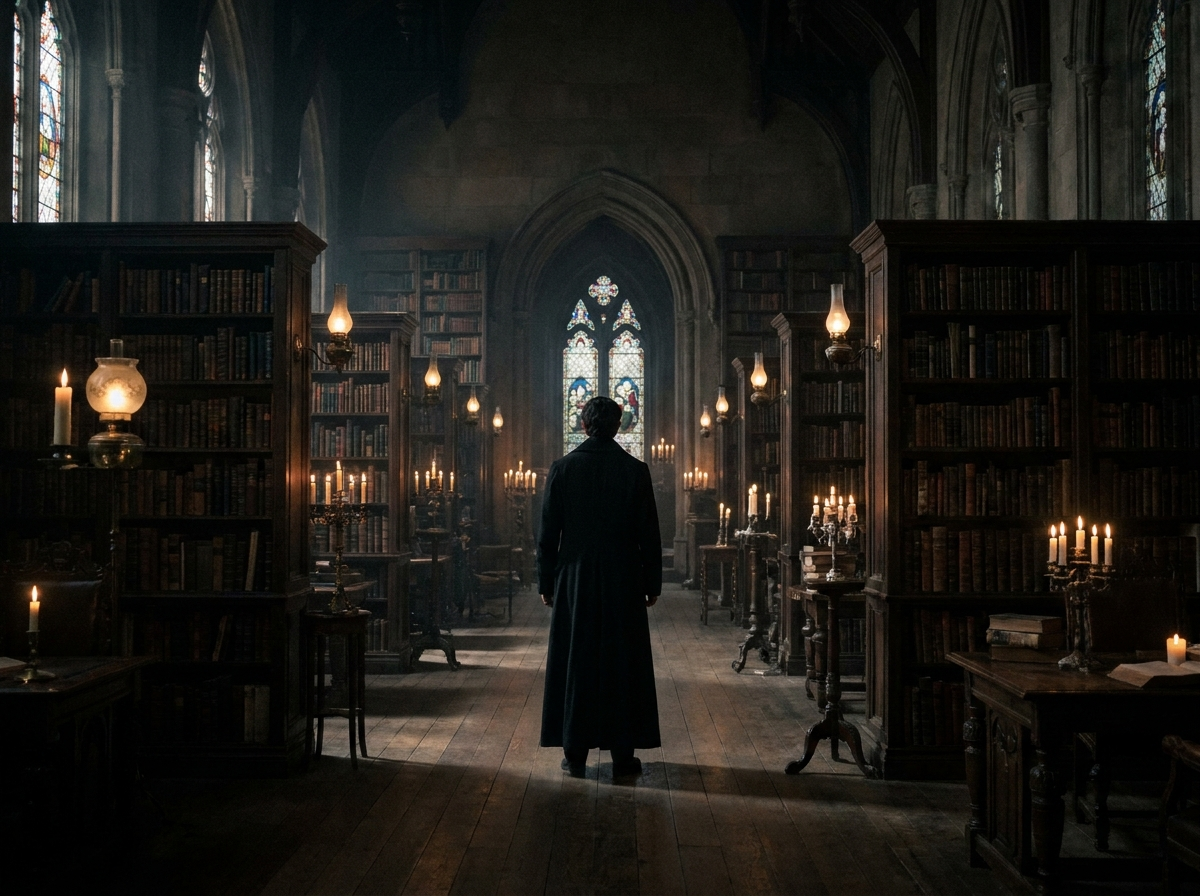
think candlelit libraries, cathedral architecture, and the dark romanticism of writers like Poe and the Brontës, rather than Dark Academia's tweed-and-leather scholarly nostalgia.
The Cultural DNA of Darkest Academia
Gothic Academia's canon leans literary and cinematic in ways that are distinct from Dark Academia's, which matters more than it might seem, since the two get conflated constantly in casual conversation and almost never in the actual reference points people search for.
Why It's Ascendant Now:
Dark Academia exhaustion (tweed can only do so much on its own)
General cultural fatigue with performed brightness
Catholic-imagery revival in high fashion (Schiaparelli, Balenciaga)
The continued Donna Tartt canonization (the 30th anniversary Secret History editions)
Literary touchpoints start where the aesthetic itself started: the Brontës, Poe, Shelley, and the broader Gothic novel tradition. These are the mood board readers picture when the aesthetic comes up. More recent literary Gothic Academia touchpoints include Gothic-inflected campus novels and dark fantasy with academic settings. The shelf sits near Dark Academia's The Secret History but pulls in more supernatural or Gothic elements.
The Yale setting in Leigh Bardugo’s Ninth House could belong to Dark Academia, but Alex Stern’s work monitoring magic secret societies and raising the dead changes the atmosphere. The university is where knowledge, power, and the supernatural become dangerous together.
Guillermo del Toro’s Crimson Peak is a great example of Gothic romance. Edith Cushing is an aspiring writer, while the decaying house, its secrets, and ghosts shape the story’s visual world. It is not a campus story, but a great reference for architecture and atmosphere. Silvia Moreno-Garcia’s Mexican Gothic also offers a heroine investigating the secrets of an isolated house, but Noemí Taboada’s glamorous 1950s wardrobe belongs to her own character and setting.
On screen, the aesthetic favors cathedral-adjacent settings and candlelit interiors, Gothic horror films set in boarding schools and universities, and old European universities shot to look more haunted than historic.
The clearest screen example of Gothic Academia is Wednesday. Nevermore Academy supplies the school setting, but Wednesday Addams’s monochrome wardrobe, amateur detective work, and the show’s Gothic architecture pull it beyond the usual autumn-campus fantasy.
A Brief History of Committed Gloom
The Evolution:
Late 1800s: Victorian mourning culture codifies the visual grammar — jet jewelry, crepe, weeping veils
1890s: Decadent movement crystallizes (Huysmans, Wilde, Beardsley) — the aesthete-in-black is born
1920s: The Bloomsbury shadow — Virginia Woolf's melancholia, Lytton Strachey's severity
1947: Dior's post-war black — Existentialist Paris makes black an intellectual position
1980s: Yohji Yamamoto and Rei Kawakubo bring Japanese black to the West
1992: Donna Tartt publishes The Secret History — the foundational novel
1989–1999: Goth codifies but stays separate — Darkest Academia will borrow selectively
2015: Tumblr's Dark Academia era begins with quote graphics over Caravaggio
2019–2020: TikTok formalizes "Dark Academia" as a named aesthetic during lockdown
2021–2023: The aesthetic splinters — light academia, chaotic academia, romantic academia
2024: Saltburn radicalizes the gothic-academic register
2024–2026: Darkest Academia emerges fully
Where Does Gothic Academia Draw Its Inspiration?
Gothic Academia’s reference points bring together Gothic fiction, old academic spaces, historical-looking clothing, and online academia communities. Those connections help explain its mood, but they do not establish an origin story for the aesthetic.[thredup][ijcmr]
Gothic Literature and the Scholarly Imagination
Gothic literature can make the pursuit of knowledge disturbing. Think of Mary Shelley’s Frankenstein, published in 1818. Its central figure is a young scientist whose attempt to create life leads to horrifying consequences. Here, intellectual ambition becomes dangerous.[bl]
For Gothic Academia, that helps explain the “haunted scholar” mood. The imagined wearer might be absorbed in an experiment, investigating a troubling history, or reading something better left unopened. That gives the clothing a character beyond “formal and dark.”
You can translate that into an outfit without dressing as a literary character. A severe collar, a dark waistcoat, or a long coat suggests the mood. The reference lies in the atmosphere.
Architecture and Academic Spaces
Accounts of dark academia repeatedly return to Gothic-inspired campuses, misty university quadrangles, and dim libraries. These spaces connect learning with age, grandeur, and mystery—the same combination we draw forward in Gothic Academia.
A tailored jacket photographed against a plain wall is a jacket; but place it beside a shadowy archway, and the image suggests a particular life.
For wardrobe inspiration, we can borrow that structure and atmosphere without treating architecture as a literal dress code. Long lines, layers, and contrasts between light and dark echo the mood.
Historical Clothing—Reimagined, Not Reconstructed
Historical references can be more complicated than a mood board suggests. In its exhibition Gothic to Goth: Romantic Era Fashion & Its Legacy, the Wadsworth Atheneum explains that early nineteenth-century fashion borrowed from earlier periods. Romantic-era clothing combined historical influences rather than expressing one uniform idea of “old-fashioned” dress.
The exhibition also shows a specific connection between architecture and clothing: a nineteenth-century silk dress whose pointed waistline, bodice decoration, and overall shape echo a Gothic arch. That is a documented example of Gothic Revival design influencing fashion—not proof that today’s Gothic Academia developed directly from that dress.
This distinction gives us a more useful way to approach historical-looking details. An elaborate collar, full sleeve, or fitted bodice contributes to a contemporary outfit without making it historically accurate. Meanwhile, research on dark academia describes its wardrobe as a mixture of American preppy style and Victorian-era masculine influences, with garments such as tweed blazers, knitwear, pleated trousers, and Oxford shoes. The scholarly foundation is already a blend.
For Gothic Academia, we can make that mixture more expressive: perhaps a romantic blouse beneath a tailored waistcoat, or a long skirt paired with a restrained jacket. The aim is to create a coherent modern outfit, not reconstruct a single decade.
Online Aesthetic Culture
The older references are only part of the story. Online communities bring clothing, books, buildings, and interiors under a shared aesthetic label. Dark academia on Tumblr examines this relationship between digital community and nostalgia, including the aesthetic’s increased popularity during the COVID-19 pandemic.
That helps explain why an academia mood board can feel consistent even when its individual references come from different periods. The organizing principle is a shared atmosphere rather than strict historical accuracy.
Community discussions and fashion guides describe overlapping labels and suggest darker palettes, velvet, and Victorian-inspired details, but they don’t establish a single founder or agreed starting date. It is more accurate to describe the influences people combine than to claim a definitive history for the name.
Together, these references give us a way to read the clothes: scholarly tailoring supplies the structure, Gothic storytelling adds tension, and historical details bring romance and drama. The next step is to make those influences visible through color, texture, shape, and detail.
Style Icons:
Camille Paglia (in her lecture-hall austerity): The intellectual foundation
Fernanda Torres (in I'm Still Here press): The current dignified-mourning register
Tilda Swinton (in her Suspiria register): The severe defining face
Andrew Scott (as Ripley): The monochrome male icon
Cate Blanchett (in Tár): The powerful-severe crossover
The Palette of Committed Shadow
Gothic Academia works through contrast: a structured jacket against a soft blouse, a pale collar above dark layers, or a velvet finish beside plain wool. Contemporary academia styling guides combine scholarly staples such as tweed and knitwear with velvet, high necklines, and Victorian-inspired details. For our interpretation, those combinations offer a starting point.
Rather than making every piece dramatic, choose where you want the drama to sit. Color, texture, shape, and small finishing details can each contribute to the mood.
Color: A Dark Foundation, With Room for Contrast
For this guide’s palette, start with black and charcoal, then consider supporting shades such as deep burgundy, forest green, midnight blue, or espresso. Similar combinations appear in contemporary dark academia outfit guides, which pair dark neutrals with muted colors and cream.sewmamasew+1
You can take that palette in several directions:
Black and charcoal for a restrained, nearly monochromatic outfit.
Black and cream for a clear contrast between a blouse and its surrounding layers.
Charcoal and burgundy for a little color without abandoning the darker mood.
Black and midnight blue for a quieter alternative to a high-contrast combination.
There’s no need to include every shade. For a simple starting point, try two main colors and repeat one of them in your shoes, bag, or outer layer.
A cream collar can become the focal point of an otherwise dark outfit. If you prefer less contrast, choose a charcoal blouse under a black waistcoat and let the difference in fabric do more of the work.
The Core Tones
True black is the foundation and the dominant color. Explore it in multiple textures. Matte wool reads differently than crushed velvet, which differs from stiff silk. A wardrobe built in black only works if it exploits that textural range. A monochrome look in one fabric reads flat.
Ecclesiastical purple is the the color of vestments and mourning ribbon, historically tied to penitence and solemnity. Use sparingly so it will carry weight. Overused, it drifts toward costume.
Oxblood and dried-blood red signals the aesthetic isn’t fully sanitized into prettiness. Like ecclesiastical purple, it’s best used in small doses like a lip color. (Gothic Horror Academia can push this further than, say, Minimalist Gothic Academia).
Bone and old-ivory provide relief from all that darkness, and they should be aged. White is clinical, modern, and institutional which breaks the aesthetic's entire premise of belonging to another century. Wax-candle ivory is the cream with real warmth. If you’re choosing between an "ivory" blouse and a "cream" blouse, wax-candle ivory is the useful shorthand for which one belongs in this palette.
Charcoal and slate give the system room to breathe. Think the gray of old stone and worn slate roofing, not the a gym t-shirt.
Deep forest green is used the way Gothic architecture uses ivy. It’s something that has crept in and taken hold, not as a fresh, outdoorsy accent. It always read as encroachment.
Tarnished gold and antique brass carry the metallic register standing in for jewelry, buttons, and hardware. The metal should look like it's been found in someone else’s drawer.
At A Glance:
True black: The foundational and dominant color
Ecclesiastical purple: The advanced dialect
Oxblood and dried-blood red: The transgressive accent
Bone and old-ivory: The relief color, always slightly aged
Charcoal and slate: The variation from black
Deep forest green: The single natural tone permitted
Tarnished gold and antique brass: The metallic register
Wax-candle ivory: The specific cream that reads as beeswax, never white
Power Combinations:
Black wool + bone lace + tarnished silver (the mourning triad)
Charcoal + oxblood + ivory (the study-at-midnight register)
Full black head-to-toe in three different textures (the discipline move)
Black + ecclesiastical purple + antique gold (the sacramental)
Forest green + black + bone (the single-concession dialect)
Black + dried-blood red at the lip only (the beauty commitment)
The Anti-Palette: What Gothic Academia Isn't
Where the line sits matters as much as the palette itself, because this is exactly the aesthetic that gets flattened into "just wearing a lot of black" by people who haven't looked closely.
Any pastel (entirely different worldview)
Bright true white (bone and ivory; white is too clinical)
Any neon or fluorescent (unthinkable)
Warm autumnal browns (that's regular Dark Academia)
Denim blue (there is no denim in this aesthetic)
Fabric and Texture: Give Dark Clothing Depth
When several garments share a similar color, texture gives you another way to distinguish the layers. Tweed and knitwear feature prominently in academic-inspired fashion, while velvet is also used in contemporary interpretations to introduce a more romantic mood.theotheraesthetic+1
For our Gothic Academia wardrobe, try balancing a familiar, structured fabric with something softer or more decorative:
A wool jacket over a lace-trimmed blouse.
A velvet waistcoat with plain tailored trousers.
A fine-knit top beneath a textured blazer.
A flowing skirt paired with a firmly shaped jacket.
The aim isn’t to collect as many rich fabrics as possible. Choose one texture to lead, then give it a simpler backdrop. A velvet jacket can be the interesting part of an outfit without competing with an elaborate blouse and heavily decorated accessories.
If you prefer an understated look, keep the decorative fabric to a small area: a collar, a cuff, or the panel of a waistcoat.
The Darkest Academia Pattern Hierarchy
Solid black (in varied textures): The foundational statement
Damask and jacquard (tonal, black-on-black): The advanced move
Thin pinstripe (black on charcoal): The severe dialect
Ecclesiastical brocade: The commitment level
Small-scale gothic florals (black on oxblood): The Victorian-mourning reference
Herringbone (dark, tonal): The tailoring texture
Lace (black or bone, always vintage or vintage-cut): The gothic-romantic detail
No plaid, no gingham, no ditsy florals: The absolute prohibitions
Shape and Proportion: Balance Structure With Movement
Tailoring provides a useful anchor for this interpretation of the aesthetic. From there, decide whether you want a compact, orderly silhouette or something longer and more expressive.
High collars, full sleeves, high-waisted trousers, and long skirts appear in contemporary academia outfit suggestions, often combining historical-looking details with modern clothing. You can borrow that approach without reproducing a whole outfit.sewmamasew+1
Try one of these combinations:
Full sleeves beneath a fitted waistcoat, leaving the blouse’s volume visible.
A high-neck blouse with straight-leg trousers for a clear, restrained outline.
A softly moving midi skirt with a structured jacket.
A close-fitting knit beneath a long coat for an uncomplicated layered look.
These are options, not rules about which shapes belong on which bodies. Choose the fit and amount of fabric that feel comfortable to you.
If an outfit feels busier than you intended, simplify one area. A dramatic sleeve might need only a plain neckline and a straightforward pair of trousers.
Details: Decide Where the Eye Should Go
Small details let you adjust the mood without changing the whole outfit. Contemporary styling examples use elements such as decorative buttons, cameo brooches, pendants, structured satchels, and lace-up shoes alongside academic clothing.sewmamasew
For your own version, consider:
Collars and cuffs: A pointed collar for a sharper effect, or a ruffle or lace edge for something softer.
Buttons and closures: A visible row of buttons as the main decoration on an otherwise plain garment.
Jewelry: A locket, brooch, or pendant chosen as a single focal point.
Hosiery: Plain opaque tights for a simple finish, or a subtle pattern when the rest of the outfit is restrained.
Bags and shoes: A structured bag and polished shoes for a neater interpretation, or lace-up boots for a heavier finish.
You don’t need to add all of them. If the blouse already has an elaborate collar, you might skip a necklace. If a brooch is the feature you want to show, place it against a relatively plain layer.
Bringing the Elements Together
Start with a black knit top and charcoal trousers. Add a velvet waistcoat for texture, a long coat for shape, and a small pendant for detail. The colors stay quiet while the materials and proportions create interest.
For a softer interpretation, try a cream blouse, black skirt, and fitted jacket, with lace visible only at the cuffs. Both are ways to express the mood we’re exploring: scholarly structure with enough romance and drama to make it your own.
The Darkest Academia Wardrobe Decoder
Outerwear: The Coat as Vow
For this wardrobe, use blazers and waistcoats as the scholarly anchor. Choose the fit according to how you want to layer: a closer-fitting waistcoat can define the shape of a full blouse, while a roomier blazer gives you space for knitwear.
Coats and Jackets:
The full-length black wool coat: The foundational grail
The cassock-inspired long coat: The ecclesiastical commitment
The Victorian frock coat (fitted, mid-thigh): The archival move
The military greatcoat (vintage, black or charcoal): The severe dialect
The mourning cape (wool, floor-length): The advanced piece
The black leather trench: The transgressive-modern option
The astrakhan-collared overcoat (vintage): The Slavic-inflected register
The tailored black blazer (oversized, structured): The daily default
Styling Strategy:
Length matters — mid-thigh at minimum, floor-length aspirational
Buttoned high, worn heavy, allowed to drag slightly
Silhouette should read as vestment, not garment
Never a bright lining — black or oxblood only inside
Should look like it was inherited from a difficult uncle
Possible starting pieces include:
A charcoal or black blazer for a restrained foundation.
A subtly checked jacket if you want a visible pattern.
A plain waistcoat that works over shirts and blouses.
A velvet jacket or waistcoat as an optional, more expressive layer.
Before adding several versions, think about which one suits your everyday outfits. You may get more use from a simple blazer than from a decorative jacket you only enjoy wearing on special occasions.
Try it: Pair a black waistcoat with a charcoal shirt and tailored trousers. Keep the accessories minimal and let the layered neckline provide the interest.
Tops: The Blouse-and-Turtleneck Foundation
Tops are a useful place to decide how romantic or restrained you want an outfit to feel.
For a straightforward foundation, consider a plain collared shirt, a fine-knit turtleneck, or a mock-neck top. Our proposed palette of black, charcoal, cream, and deep burgundy gives you several ways to combine them with darker layers.
For more expression, look for a blouse with one distinctive feature:
A high collar or softly ruffled neckline.
Lace at the collar or cuffs.
Full sleeves gathered at the wrist.
A row of small, visible buttons.
You don’t need all these details in one garment. A blouse with an interesting neckline can provide enough decoration for an otherwise simple outfit.
Try it: Wear a cream high-neck blouse with charcoal trousers and black shoes. Add a waistcoat when you want a more layered interpretation.
Blouses and Shirts:
The Victorian high-neck blouse (black or bone): The foundational piece
The pussy-bow blouse (black silk): The severe-romantic dialect
The ruffled-jabot shirt: The Byronic reference
The pintucked cotton blouse (bone): The single-concession-to-light option
The lace-collared blouse (mourning-inspired): The Victorian commitment
The priest-collar shirt: The ecclesiastical statement
The oversized poet's blouse (black or ivory): The Romantic-era reference
Knitwear:
The black cashmere turtleneck: The single most important garment
The oversized black wool sweater (fisherman-cut): The layering foundation
The cropped black cardigan: The tailored-over-blouse move
The mock-neck fine merino (black, thin, tucked): The severe daily option
The academic gown-adjacent robe cardigan: The advanced piece
The Black Turtleneck: The Load-Bearing Garment
The Turtleneck Protocol:
Full black, always, never charcoal, never navy: The rule
Cashmere or fine merino: The material commitment
Fitted but not tight — sculptural drape: The silhouette
Sleeves that cover the wrist bone: The proportion
Worn tucked into high-waisted trousers, or under a pinafore: The layering
Sleeves pushed back to reveal a single ring or watch: The styling detail
Why It Works:
Frames the face in black, forcing attention upward
Reads as intellectual across every context
Layers under everything Darkest Academia owns
Photographs beautifully in low light
The single garment that most identifies the aesthetic
Bottoms: The Trouser-and-Skirt Discipline
Trousers:
Trousers offer a way to explore the look without relying on skirts, dresses, or elaborate details.
Consider straight-leg, wide-leg, or gently tapered cuts, depending on your preferences. Pleats, a visible waistband, or a sharp crease are details you can use to make a simple trouser outfit feel more deliberate.
For an initial pair, choose a color that works with several tops you already own. Black and charcoal fit our proposed palette, but a subtle check could also give a plain outfit a focal point.
Try it: Combine charcoal wide-leg trousers with a black fine-knit top and a cropped or waist-length jacket. Add a pendant if you want one decorative element.
High-waisted black wool trouser (wide-leg, cuffed): The foundational silhouette
Charcoal pinstripe trouser: The tailored dialect
Black cigarette pant (ankle-length): The severe-modern move
Riding trouser (jodhpur-adjacent, black or charcoal): The equestrian reference
The knickerbocker (advanced, controversial): The full-commitment archival move
Never jeans, never chinos, never anything with visible casual DNA
Skirts:
Choose length and volume around your comfort and routine. There’s no need to commit to a sweeping skirt if you prefer something shorter or easier to move in.
Try it: Wear a black midi skirt with an ivory blouse and fitted waistcoat. Alternatively, pair the same skirt with a plain mock-neck top for a quieter outfit.
Black wool midi (A-line, pleated or plain): The foundational skirt
Long black skirt (ankle-length, wool or heavy cotton): The monastic reference
Black velvet midi: The evening option
Pinstripe pencil skirt: The severe-professional dialect
Black lace-hem underskirt (visible under a shorter overskirt): The Victorian commitment
The pinafore over a black turtleneck: The layering thesis
The Darkest Academia Dress: The Vestment
Skirts and dresses give you another set of silhouettes to work with—not a more authentic version of the aesthetic.
One-Piece Solutions:
The black wool midi dress (long-sleeved, high-necked): The universal foundation
The Victorian mourning dress (vintage or vintage-cut): The advanced grail
The black lace tea-length dress: The evening move
The pinafore worn over a lace or turtleneck blouse: The layering commitment
The prairie dress in black (never in cream): The gothic-cottagecore crossover
The velvet floor-length gown (for actual evenings): The full-commitment piece
The cassock dress (mid-calf, black, high-buttoned): The ecclesiastical statement
Styling Strategy:
Always with black opaque tights or dark stockings
Always with a heavy shoe — never a delicate sandal
Always with a coat layered over — the dress is rarely the outermost layer
Never body-conscious, always covered
Should photograph well in a candlelit chapel
The Footwear Situation: Where the Aesthetic Grounds Itself
Choose footwear around where you’ll actually wear these outfits. For our styling framework, loafers, lace-up shoes, ankle boots, and simple flats all offer possibilities.
Use them to adjust the finish:
Loafers with trousers or a pleated skirt for a neat, understated outfit.
Lace-up shoes with a shirt and waistcoat to continue the tailored theme.
Ankle boots beneath a long skirt or wide-leg trousers.
Simple flats when you want less visual weight at the foot.
Heels are optional. Start with a comfortable pair you already own, then see how it works with the proportions of your clothes.
Try it: Wear black loafers with charcoal trousers, a cream shirt, and a dark cardigan. Add a brooch or an expressive collar if you want more ornament.
The Boot Hierarchy
The Foundation Tier:
Church's Shannon (black): The heritage grail
Grenson Nanette (brogue boot, black): The accessible commitment
Doc Martens 1460 (black, worn-in): The transgressive-modern crossover
Vintage Victorian lace-up boots: The archival move
Paraboot Michael (black): The elevated European
Ann Demeulemeester lace-up (aspirational): The avant-garde-crossover grail
The Broader Shoe Vocabulary
Beyond the Boot:
Black leather loafer (heavy sole, worn): The daily default
Oxford lace-up (black, polished): The academic formal
Mary Jane with a substantial heel: The dark-feminine dialect
Kitten-heel slingback (black patent): The severe-elegant move
Riding boot (tall, black leather): The equestrian commitment
Chelsea boot (black, worn): The daily option
Monk-strap shoes (double buckle, black): The ecclesiastical reference
Never sneakers, never sandals, never anything summer-coded
The Shoe Philosophy
The Rules:
Black leather always — brown only if genuinely antique and worn to grey
Substantial soles, never delicate
Polished but never shiny — a matte finish reads correct
Should be walkable through cobblestones, cathedrals, and cemeteries
Never a color, never a print, never a novelty
Worn-in preferred, new pieces should be aged deliberately
Accessories: The Details That Do the Sacramental Work
Accessories add character, but they don’t need to make your outfit a prop collection.
Consider a structured satchel, a compact shoulder bag, or another practical bag with enough room for your daily essentials. A plain belt finishes a trouser-and-shirt outfit; a scarf introduces some color.
You don’t need an antique-looking accessory in every outfit. If your blouse, jacket, or waistcoat already supplies the drama, a simple bag and minimal jewelry may be all you want.
The Hair Accessory Question
Head Territory:
Black silk ribbon (worn in the hair, at the neck, at the wrist): The universal signature
Black velvet headband: The severe-schoolgirl move
Tortoiseshell combs and pins: The archival detail
Black lace mantilla (advanced, worn to actual events): The ecclesiastical commitment
The black wool beret: The Left Bank crossover
The wide-brim black felt hat: The dramatic move
Never a bow that reads as coquette — the ribbon must read as somber
The Bag Territory
The Carry Culture:
The leather satchel (black or oxblood, worn): The academic foundation
The vintage doctor's bag: The advanced archival move
The black leather portfolio: The severe-professional
The book strap (leather, over the shoulder, holding actual books): The commitment level
The small black structured handbag: The evening move
The tapestry carpet bag (Victorian): The archival advanced
Never nylon, never canvas with logos, never anything colorful
Jewelry: Sparse, Sacramental, Significant
The Approach:
Silver crucifix or cross pendant: The foundational piece (worn regardless of faith or as commentary on faith)
Tarnished silver signet ring: The universal signal
Mourning brooch (jet, hair-jewelry, Victorian): The advanced piece
Cameo (in profile, on black background): The Victorian commitment
Rosary as accessory (charged, proceed with awareness): The full-transgressive move
Antique pocket watch on a chain: The archival detail
Onyx or garnet earrings: The color-permitted move
Never gold that reads as bright, never pearls that read as bridal
Everything should look inherited or grave-robbed
The Glasses Question
Eyewear Territory:
Round wire-rimmed frames (Yeats-adjacent): The intellectual signal
Small oval frames (fin-de-siècle): The archival move
Black cat-eye (severe-modern): The Cate Blanchett dialect
Pince-nez (advanced, worn only if actually needed): The full commitment
Reading glasses on a black silk cord: The daily gesture
Vintage frames genuinely vintage: The archival authenticity
Never oversized modern fashion frames — the frames should read as prescription
The Legwear Situation
The Leg Commitment:
Black opaque tights (heavy denier): The foundational
Black wool stockings (winter): The commitment level
Black lace stockings (advanced, under a longer hem): The Victorian move
Black over-the-knee wool socks: The pinafore accompaniment
Fishnets (fine gauge, worn as texture not statement): The transgressive dialect
Bare legs are never correct in this aesthetic: The rule
Shopping the Darkest Dream
Investment Tier
Darkest Academia investment pieces should be things you'll wear for decades — the wardrobe is nearly the opposite of trend-driven.
Ann Demeulemeester: The avant-garde grail — everything holds
Yohji Yamamoto: The Japanese-black foundation
The Row: The elevated-severe modern
Comme des Garçons (Noir line): The advanced-black commitment
Rick Owens (his tailored side, not the dramatic): The transgressive investment
Church's and Grenson: The footwear pilgrimage
A single genuine Victorian mourning piece: The archive centerpiece
Mid-Range (Where It Lives)
Darkest Academia is a mid-market and vintage aesthetic. The best pieces cost less than they look.
COS: The severe-modern anchor
Toteme: The elevated European daily
Massimo Dutti: The tailoring workhorse
Arket: The wool and cashmere basics
Uniqlo (fine merino and cashmere): The turtleneck foundation
Aritzia Wilfred (the Effortless Pant, in black): The unlikely staple
Batsheva (the darker pieces): The Victorian-cut option
Accessible (Where To Shop)
Darkest Academia is a vintage-first aesthetic. The best wardrobe is 70% secondhand.
eBay (Victorian and Edwardian mourning wear): The archival grail
Etsy (vintage sellers, mourning jewelry): The foundational source
1stDibs (for actual antique pieces): The advanced tier
The RealReal (Yohji, Comme, Demeulemeester secondhand): The designer path
Local vintage stores in university towns: The tactile requirement
Estate sales in old cities: The advanced move
Church rummage sales (genuinely): The unexpected source for wool and lace
The Exceptions:
Turtlenecks: New — fit and pilling matter, and vintage cashmere often reads worn-out rather than worn-in
Boots: New with intentional aging, unless vintage pair is in genuinely wearable condition
Underlayers: Always new — nobody wants vintage stockings
Investment Strategy
Splurge On:
One perfect black wool coat (mid-thigh or longer)
A pair of Church's or Grenson boots
Two black cashmere turtlenecks (identical, so one can be at the cleaner's)
A leather satchel that will outlast the wearer
One genuine antique mourning piece (brooch or ring)
Save On:
Trousers (any brand cuts black trousers acceptably)
Blouses (Uniqlo and COS are correct)
Tights (Wolford for splurge, Falke for daily)
Ribbons and hair pieces (grosgrain by the yard, tortoiseshell from any vintage shop)
Books (used, always used)
Beauty: The Face That Has Read Too Much
Face: The Consumptive Elegant
The Philosophy:
Matte porcelain skin: The foundational finish
A single flush at the cheekbone (never the apple): The tubercular reference
The oxblood or dried-blood lip: The signature commitment
Winged liner (black, sharp, or smudged into shadow): The severe dialect
Brows kept dark and defined: The framing move
Hollowed cheekbone contour (subtle): The advanced technique
The face should read as though the wearer has not slept
Signature Approaches:
The Secret History Blueprint:
Dark hair pulled back severely
Bare eye, oxblood lip
Face left visibly unrested
Skin matte and cool-toned
The face is the confession
The Ripley (2024) Dialect:
Slicked-back dark hair
Almost-bare face
A single stroke of matte red on the lip
Skin left almost translucent
Face reads: "I am watching you very carefully"
Hair: The Considered Severity
Cuts and Styles:
The blunt bob (chin-length, dark): The severe foundation
The long dark hair worn straight and unstyled: The gothic-romantic
The severe low chignon: The advanced daily
The braided crown (Frida-adjacent but darker): The archival move
The half-up with black ribbon: The everyday commitment
The single long braid (over one shoulder): The Pre-Raphaelite reference
The wet-look slick-back (very current): The Ripley-influenced modern
Style Statements:
Color: black, near-black, or genuine natural dark tones only
No highlights, no balayage, no visible modernity
Grey and white hair welcomed and dramatized
Air-dried, oiled, or slicked — never blowout-styled
Products should read as pomade, not mousse
If long, worn straight or in a single considered arrangement
Nails: Short, Dark, Deliberate
The Approach:
Short and rounded or almond: The foundational shape
Oxblood polish: The universal signature
Black polish (matte finish): The advanced move
Dark plum or aubergine: The permitted variation
Bare with clear polish and buffed shine: The severe-natural
Never long, never square, never chrome, never nail art
How to Put Together a Gothic Academia Outfit
The easiest way to build an outfit is to make one choice at a time. Start with a scholarly foundation, introduce a darker or more romantic element, then decide how much detail you want. For our approach to Gothic Academia, the goal is balance: give the outfit a clear direction without asking every piece to make a statement.
Here’s how that process could work using a cream shirt, charcoal trousers, and black lace-up shoes as a starting point.
1. Start With a Scholarly Base
Choose a simple combination that you already feel comfortable wearing. That might be a collared shirt and tailored trousers, a fine-knit top and pleated skirt, or a shirt dress.
For our example, tuck the cream shirt into the charcoal trousers and add the black shoes. Keep the shirt plain for now. This gives you a foundation you can take in several directions without replacing the whole outfit.
Before adding anything else, check the fit. Can you sit, walk, and move comfortably? Do you like the shirt tucked in, loosely tucked, or worn out? Settle those choices before moving on to decoration.
2. Add One Darker or More Romantic Element
Now choose the piece that will shift the mood.
For our example, add a black velvet waistcoat over the shirt. We’re using it to introduce both a dark layer and a richer texture while keeping the outfit’s tailored foundation.
You could take a different route instead:
Replace the plain shirt with a lace-trimmed blouse.
Add a long black coat.
Keep the clothes simple and choose an ornate pendant or brooch.
Start with one change and assess the result. You can always add more, but you may find that a single expressive piece gives you the effect you wanted.
3. Choose a Deliberate Silhouette
Look at how the pieces sit together rather than considering each garment separately.
With our shirt, waistcoat, and trousers, try fastening the waistcoat and adjusting the shirt so it sits comfortably underneath. Leave enough ease for movement rather than pulling the layers tight. If you prefer a looser outline, wear the waistcoat open and let more of the shirt show.
Use this step to decide where you want structure and where you want movement. A fitted layer over a fuller blouse is one option; a relaxed jacket over a simple knit is another. Neither needs to be the default.
If the outfit feels more elaborate than you intended, simplify one area. You might keep the expressive sleeves but choose a plainer neckline, or swap a flowing skirt for straight-leg trousers.
4. Repeat a Color or Texture
Next, look for a small connection between the pieces.
Our example already repeats black in the waistcoat and shoes. Add a black bag if that feels useful, but there’s no need to make every accessory match. The cream shirt provides contrast, while the charcoal trousers sit between the lighter and darker elements.
If you introduce an accent color, try repeating it once: a burgundy scarf could pick up a similar shade in a brooch, for example. Treat repetition as an option for tying the outfit together, not another rule to satisfy.
5. Adjust the Finish for Your Day
Finally, choose the outerwear and accessories around what you’ll actually be doing.
For a restrained version of our outfit, keep the lace-up shoes, add a practical bag, and leave the neckline unadorned. For a more expressive version, try boots, a long coat, and a small brooch on the waistcoat.
Then do a final comfort check. Does your bag hold what you need? Can you walk comfortably in the shoes? Will the layers work indoors as well as outside? Remove or replace anything that makes the outfit harder to wear than it needs to be.
Choose Your Level of Drama
Using the same foundation, you can adjust the intensity without building a completely different wardrobe. These are our styling options, not separate aesthetic categories:
Subtle: Cream shirt, charcoal trousers, black lace-up shoes, and a plain black waistcoat.
Expressive: The same foundation with a velvet waistcoat and a brooch.
Theatrical: A full-sleeved blouse in place of the shirt, with the velvet waistcoat, boots, and a sweeping coat.
Choose the version that suits your taste and the occasion. An outfit doesn’t need to be the most dramatic interpretation to feel complete.
Gothic Academia Outfit Ideas for Real Life
A wardrobe becomes useful when you can picture where you’ll wear it. These outfit formulas take our interpretation of Gothic Academia into everyday settings, from a quiet bookstore visit to a workday or an evening out. Adapt the colors, fit, and amount of ornament to your preferences—and substitute pieces you already own.
1. A Bookstore Visit or Everyday Errands
The formula: A charcoal cardigan, a cream collared shirt, black straight-leg trousers, and flat lace-up boots.
Wear the cardigan open for a relaxed outline, or fasten a few buttons if you prefer a more defined shape. Let the shirt collar show, and add a practical shoulder bag with enough room for your daily essentials.
For this outfit, keep the detail small: an interesting button, a narrow belt, or a little lace at the shirt cuff. There’s no need for all three.
Make it your own: Swap the trousers for a pleated skirt if you prefer. Choose the length around what feels comfortable for walking and sitting.
2. A Workday With a Darkly Romantic Detail
The formula: A black blazer, a burgundy mock-neck top, charcoal tailored trousers, and loafers.
This version keeps the foundation straightforward. Use the burgundy as the outfit’s main color, then choose one optional detail—a small brooch on the lapel or a subtle pendant against the plain top.
Select the jacket and trousers according to your workplace’s expectations rather than trying to reproduce a particular mood-board silhouette.
Make it your own: If your workplace is more formal, use a matching suit as the foundation. If it’s more relaxed, replace the blazer with a cardigan.
3. A Relaxed Weekend
The formula: A fine-knit black top, a long charcoal skirt, a soft cardigan, and flat ankle boots.
Here, we’re interpreting the aesthetic without a blazer, waistcoat, or elaborate blouse. Choose a skirt you can move in comfortably and wear the cardigan open or partially fastened.
A locket or pendant can provide the focal point. If you would rather skip jewelry, try a cardigan with buttons you particularly like.
Make it your own: Replace the skirt with relaxed trousers. Keep the rest of the outfit the same rather than adding decoration to compensate.
4. Dinner, a Concert, or an Evening Out
The formula: A black velvet blazer, a simple dark top, a fluid midi skirt, and ankle boots.
Let the velvet be the main decorative element. Keep the top relatively plain, then decide whether you want a pendant, earrings, or no jewelry at all. A small shoulder bag completes the outfit without introducing another elaborate feature.
Try a nearly monochromatic combination, or choose a deep burgundy skirt if you want more color.
Make it your own: Swap the skirt for wide-leg trousers. Choose flat boots or low heels according to your comfort and the venue.
5. A Cold-Weather Interpretation
The formula: A fine-knit turtleneck, a buttoned waistcoat, tailored trousers, a long coat, and weather-appropriate boots.
Start with a base layer that feels comfortable beneath the waistcoat, and leave enough room in the coat for the complete outfit. For our proposed palette, try a charcoal knit, black waistcoat, and dark gray trousers.
Add a scarf and gloves you’ll actually want to wear. The outfit can carry its atmosphere through its dark layers and long outline; the winter accessories don’t need to look antique or decorative.
Make it your own: Leave out the waistcoat if it makes the layers feel restrictive. A knit, trousers, and long coat can be your simpler version.
6. A Warm-Weather Interpretation
The formula: A lightweight collared blouse, a black A-line skirt, flat shoes, and a compact bag.
For this version, leave out the heavy tailoring and concentrate on a few selected details: perhaps a pointed collar, small dark buttons, or a narrow lace trim. Try a cream blouse with a black skirt, or charcoal and black if you prefer less contrast.
Choose sleeve length, skirt length, and footwear around the conditions and your comfort. There’s no need to add a jacket simply to make the outfit feel more “academic.”
Make it your own: Wear loose, lightweight trousers instead of the skirt. If you want an additional layer, try an unlined waistcoat only when it feels comfortable.
Reuse the Pieces, Change the Emphasis
These outfits don’t require six separate wardrobes. The workday loafers can accompany the warm-weather outfit; the weekend knit can sit beneath the evening blazer; the everyday cream shirt can replace the turtleneck in the cold-weather combination.
Start with the formula closest to how you already dress. Then decide whether you want more tailoring, a richer texture, or one romantic detail. The setting may change, but your wardrobe can remain recognizably yours.
The Darkest Academia Lifestyle: Beyond the Wardrobe
Take our interpretation of Gothic Academia a little further, and the clothes become part of a larger imagined world: crowded bookshelves, handwritten notes, long walks, and a desk you actually sit down to use. We’ll call this its Darkest Academia side—a deliberately heightened version of the bookish, darkly romantic mood.
Treat it as an invitation, not an entrance exam. You don’t need to abandon your e-reader, acquire a rare-book collection, or turn your kitchen into a monochrome still life. The interesting question is which parts of this imagined life would make your real one richer.
At Home: A Room for Reading and Thinking
Picture bookshelves reaching toward the ceiling, arranged alphabetically by author rather than by the color of their spines. The collection isn’t selected to match the room. Familiar paperbacks sit beside reference books, unfinished novels, and the occasional volume you bought with ambitious intentions.
A worn Persian-style rug lies over dark wood. A writing desk holds a notebook and a single lamp, with enough clear space to work. On the walls, framed etchings, mezzotints, or memento-mori prints continue the darker mood. A small arrangement of deep red roses or dark calla lilies offers an alternative to more permanent decoration.
For the kitchen, imagine a quieter palette: plain porcelain, dark cupboards, and simple surfaces, with color supplied by the food itself.
These are design ideas, not requirements. If you have one bookshelf and a corner of the kitchen table, start there. Let the room suggest a life being lived rather than a photograph waiting to happen.
Daily Rituals: Make Time for the Things You Enjoy
The most useful rituals are the ones you genuinely want to repeat.
That might mean drinking coffee or tea from a favorite porcelain cup, taking a walk when you need to think, or keeping a journal in ink. A fountain pen can turn an ordinary note into a small pleasure; it doesn’t need to turn every shopping list into an archival document.
For this version of the lifestyle, physical books provide the tactile appeal: paper, bindings, marginal notes, and the satisfying evidence of a well-read spine. But that preference doesn’t need to become a prohibition. An audiobook on a walk or an e-reader in your bag can belong to your reading life, too.
A used bookshop might become a regular place to browse and linger. An evening reading session might begin with putting your phone aside and settling beside a lamp. Candles can contribute to the atmosphere without becoming the whole point of the evening—or replacing useful reading light.
The Mindset: Serious, but Not Self-Punishing
The spirit of this interpretation is deliberate attention. Take a poem seriously. Stay with a difficult passage long enough to discover whether it rewards the effort. Allow an old object to remain useful instead of replacing it simply because something newer exists.
But keep the romantic claims in perspective. Difficulty is not automatically depth. Vintage is a preference, not a guarantee of quality. Melancholy can be part of an artistic mood without making distress something to cultivate.
You can enjoy solemnity without giving up humor, and intellectual ambition without making every pleasure into homework. Seriousness doesn’t require suffering.
A little self-awareness helps, too. “Am I performing intelligence?” is a more interesting question than “Do I look intellectual enough?” The goal is to let the performance lead you toward something you actually value: reading, writing, learning, or paying closer attention.
A Reading, Watching, and Listening List
Rather than “required consumption,” think of this as a proposed cultural shelf drawn from the mood we’re building:
Reading: Dostoevsky, the Brontës, Donna Tartt, and Flannery O’Connor’s short fiction.
Poetry aloud: T. S. Eliot, Sylvia Plath, Anne Sexton, Philip Larkin, and Louise Glück.
Film evenings: A selection of films by Ingmar Bergman or Yorgos Lanthimos.
Music: Nick Cave, with The Boatman’s Call as one possible starting point.
There’s no need to read an author’s complete works before exploring another, choose a translation to impress someone else, or reread three novels annually to retain imaginary membership. Follow the book, film, or poem that holds your attention, then let it lead you somewhere unexpected.
Build a Feed That Opens Doors
If you want the aesthetic to extend to your online life, consider following rare-book dealers, university presses, museum drawing collections, literary scholars, and antique jewelers who discuss mourning pieces.
Use those accounts as starting points for curiosity rather than another shopping list. Save an unfamiliar artist’s name. Look up a book mentioned in a publisher’s post. Learn what an object meant before deciding whether you want to wear something similar.
Religious imagery deserves particular thought: a crucifix or devotional practice need not become an accessory simply because it fits the palette. You can appreciate something without incorporating it into your personal aesthetic.
Keep a Little Humor in the Darkness
For a less solemn set of daily reflections, try:
“Would Richard Papen do this?” Perhaps choose a less ominous decision-making framework.
“Is this severe enough?” Possibly. Check whether you can move your arms before adding another layer.
“Am I enjoying this book, or enjoying being seen with it?” Either answer is worth noticing.
“Does this object mean something to me, or does it merely match?”
“Have I made time to read—or only rearranged the reading corner?”
Let the lifestyle remain an imaginative framework, not a test of discipline. The wardrobe, room, and rituals should leave space for the person who lives inside them.
Gothic Academia Subgenres: Five Ways to Wear the Mood
Once you have a basic capsule, you can tilt it toward a more specific story. The five subgenres below are our own playful framework, not official categories. Think of each one as a "dialect" of Gothic Academia: the same scholarly base, with different references and a few key pieces added.
You don't need to pick just one. Borrow a coat from one and a collar from another, or try a subgenre for a season and see what sticks.
Ecclesiastical Darkest: The Cassock Lineage
The approach: Religious imagery as visual vocabulary.
This version borrows from church clothing and old monasteries. The lines are long and straight, the colors are mostly black, and the details are spare. One reference point is Umberto Eco's The Name of the Rose, a 1980 murder mystery set in an Italian monastery in 1327, where much of the story centers on the abbey's maze-like library. On the runway, Schiaparelli's Spring 2022 couture collection under Daniel Roseberry featured gilded crosses, halo shapes, and a strict black, gold, and white palette. Roseberry, the son of a priest, grew up in a deeply religious family and once considered entering the seminary.[russh][schiaparelli][britannica]
Pieces to add to your capsule:
A band-collar or clerical-style shirt: The narrow, standing collar is the look's signature.
A long, single-breasted black coat: Buttoned to the top, it echoes the shape of a cassock.
A plain black midi or maxi skirt, or straight trousers: Keep the lines column-like.
One meaningful piece of jewelry: A simple cross or a small medal, if it means something to you.
Styling note: Religious symbols carry real meaning for many people. The Archdiocese of San Antonio notes that wearing a rosary around the neck as jewelry is usually seen as disrespectful, even though the Church has no explicit rule against it. EWTN gives similar guidance: wearing one as a sign of faith is fine, but "it would not be respectful to wear it merely as jewelry". A band collar and long coat can create the mood without sacred objects. A Latin phrase in your journal is fine; Latin in casual conversation is your call.[archsa][ewtn]
Reads: "I have read all of Aquinas."
Victorian Mourning Darkest: The Grief-Costumed Lineage
The vision: 1880s mourning dress as an everyday wardrobe.
This subgenre takes its cues from Victorian mourning customs. After Prince Albert died in 1861, Queen Victoria wore black until her own death in 1901, and her mourning style shaped what many women wore for decades. Formal mourning called for black crepe or bombazine clothing, and jet became especially popular for mourning jewelry. Susan Hill's 1983 ghost story The Woman in Black, in which a young lawyer keeps seeing a mysterious woman dressed in black, adds a spookier side.[victorianweb][collections.vam.ac][bbc.co]
Pieces to add to your capsule:
A high-neck black dress: The base of the look. Choose one you can move and sit in.
Jet or jet-look jewelry: Real jet is fossilized wood, mostly from Whitby in Yorkshire. The Victorians wore look-alikes too. Supply couldn't keep up with demand, so black glass called "French jet" became a common substitute. Glass or resin versions are historically fitting.[collections.vam.ac]
A lace collar or lace cuffs: A detachable collar can change your existing black dress or knit top.
A small piece of veiling: A netted fascinator or a short veil on a hat for evening events. Victorian mourning outfits included accessories such as crepe veils and bonnets.[web.prm.ox.ac]
Styling note: A sleek, pulled-back bun finishes the look neatly. A full veil makes a strong statement, so save it for events where it suits the setting. For everyday wear, a lace collar and one jet brooch carry the mood.
Reads: "I am in eternal mourning."
Gothic-Southern Darkest: The Flannery O'Connor Lineage
The statement: American Gothic Academia.
This version moves the story from European stone buildings to the rural American South. Flannery O'Connor is considered a master of Southern Gothic, a style built on grotesque, macabre, or fantastic events. Her first novel, Wise Blood (1952), follows a preacher's grandson who has lost his faith and founds a "Church Without Christ". Her 1955 story collection A Good Man Is Hard to Find made her famous. The clothes here are simpler, lighter, and better suited to heat.[britannica][nypl]
Pieces to add to your capsule:
A long black cotton skirt: Breathable and easy to move in.
A dark-ivory or off-white blouse: Softer than bright white, with a simple collar.
A plain straw hat: Practical for sun, and a quiet nod to the setting.
Sturdy flat shoes or boots: Made for dirt roads, not marble halls.
Styling note: The mood comes from contrast between plain, modest clothes and the strange, unsettling stories behind them. A worn Bible or a well-marked book of Southern Gothic fiction fits the scene as long as it's something you actually read. That suits O'Connor, a devout Catholic whose work often wrestles with questions of faith and morality. Here, questioning matters more than decoration.[lib.guides.umd]
Reads: "I have inherited theological complications."
Romantic-Poet Darkest: The Byronic Dialect
The approach: The tragic young poet, made wearable.
This is the most dramatic and romantic subgenre. It looks back to the Romantic poets, such as Lord Byron and John Keats. Jane Campion's 2009 film Bright Star follows the romance between Keats and his neighbor Fanny Brawne, which began in 1819, two years before he died of tuberculosis. The film is also good for clothing ideas, since Fanny designs and sews her own striking outfits. Henry Wallis's 1856 painting The Death of Chatterton, now at Tate Britain, offers the more theatrical version. It shows the 17-year-old poet Thomas Chatterton dead in his attic room.[en.wikipedia][bfi.org][stlpr]
Pieces to add to your capsule:
A loose white or ivory blouse with ruffled cuffs: The center of the look.
A velvet frock coat or long velvet blazer: Black, plum, or deep green.
A single dramatic ring: One bold piece is enough.
Slim dark trousers or a long skirt: Let the top half carry the drama.
Styling note: Hair can be loose, tousled, or a little undone. The Romantic poet image often tied illness and early death to genius. Wallis even painted Chatterton in a Christ-like pose that made him look like a martyr. You can keep the poetry and drop the idea that suffering makes art better. A little ink on your fingers is a fun detail if you really write with a fountain pen.[shop.tate.org]
Reads: "I write, tragically."
Slavic Darkest: The Dostoevsky Register
The mood: Russian literature, made wearable.
This subgenre is built for cold weather. It draws on Dostoevsky's novels and on the films of Andrei Tarkovsky, which are known for slow pacing, long takes, and dreamlike images of nature. In Andrei Rublev, fog, rain, mud, and snow work as active parts of the picture. Portraits of the poet Anna Akhmatova add another reference: painter Nathan Altman was struck by her famous bangs and "unchanging shawl".[dailyartmagazine][sightlines][en.wikipedia]
Pieces to add to your capsule:
A heavy, long wool coat: The anchor. Ankle-length if it's practical for you, mid-calf if not.
A coat with a curly-textured collar: Astrakhan fur comes from the fleece of very young or stillborn karakul lambs. Imitation "astrakhan cloth" is a woolen fabric made to look like it. Vintage or faux versions give you the texture without buying new fur.[cameo.mfa]
A dark wool shawl or headscarf: Warm, practical, and a nod to Akhmatova's portraits.
Knit layers and thick tights: Comfort matters when the coat is doing the drama.
Styling note: Orthodox icons are religious objects, not decorations. Orthodox churches describe them as holy images meant for prayer, not "spiritual accessories". Admire them in museums and books instead of wearing them as costume. As for "vodka literacy," a strong cup of black tea works just as well for the mood.[savannahorthodox]
Reads: "I have opinions about which Dostoevsky is best."
Choosing Your Dialect
SubgenreKey piece to start withBest seasonEcclesiasticalBand-collar shirtYear-roundVictorian MourningLace collarFall and winterGothic-SouthernLong black cotton skirtSpring and summerRomantic-PoetRuffled-cuff blouseFallSlavicLong heavy wool coatWinter
Start with one piece from the subgenre that interests you most and wear it with your existing capsule. If it feels like you, add another. If it feels like a costume, keep the piece you liked and leave the rest.
