
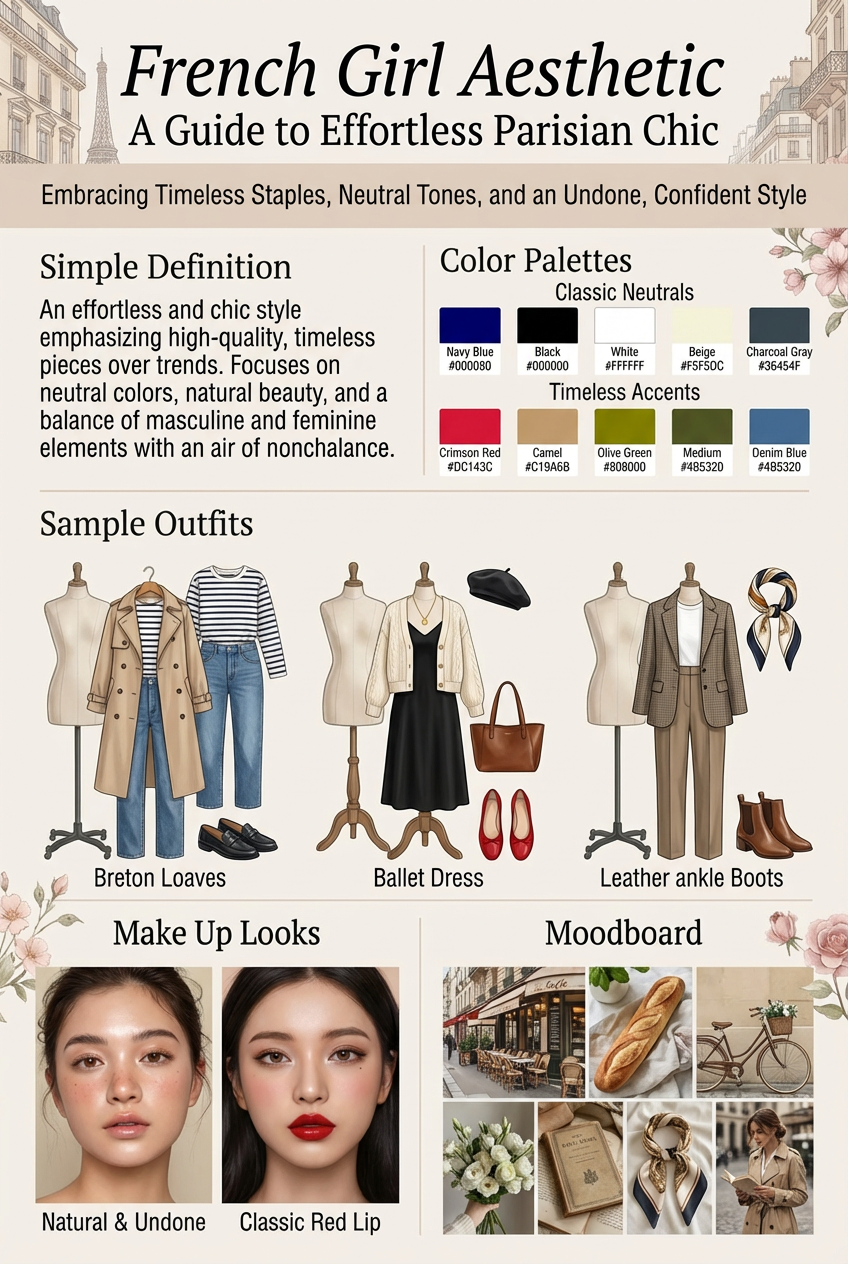
French Girl Style: The Philosophy Behind the Je Ne Sais Quoi
The French girl aesthetic is the world's most imitated style — and its most misunderstood. It's been bottled, exported, pinned, and sold in approximately forty countries, usually as a striped top and a beret. That version is a cartoon. This guide is about the real thing.
French girl style is a posture. An orientation toward yourself. The Breton stripe is real. So is the red lip, the undone hair, the blazer. But none of those things work without the philosophy underneath them.
Here's the philosophy.
What Is the French Girl Aesthetic?
The French Girl aesthetic may be the most copied style formula on the internet. It has survived Tumblr waves, Pinterest boards, TikTok micro-trends, and algorithmic changes. It resurfaces every few years with a new name — “Parisian chic,” “effortless French style,” “how to dress like a French girl” — but the main fantasy stays the same.
French Girl is different from trend-driven aesthetics that rely on obvious visual signals (hyper-femininity, maximalism, streetwear branding). You don’t know it because it’s loud, but because it’s familiar.
And that’s why it’s misunderstood.
What’s known worldwide is the uniform: the striped shirt, the trench coat, the red lipstick. We copy the pieces and wonder why we still don’t look like her.
Because the pieces were never the point.
The Paradox: Easy and Thoughtful
The French Girl aesthetic lis full of contradictions:
It looks like it was an accident.
It has been heavily edited.
She looks like she didn't dress up enough for the event, but at the same time, she looks like she did. Her hair looks messy, but not like it was forgotten. Her outfit seems simple, but it's not.
The heart of French style is le naturel, or natural maintenance. The French have always been wary of excess (just ask Marie Antoinette), and they resist anything seeming overworked.
French Girl differs American style interpretations because they tend to focus on focus on finishing touches like matching sets or coordinated accessories. French Girl is undone on purpose. A cuff rolled casually. A button left undone. A strand of hair out of place.
Not because she forgot.
Because she stopped.
The Archetype vs. Reality
Before we go any further, we need to separate the archetype from the people.
When we talk about the "French Girl" in fashion writing, we don't mean every woman in France. France is a mix of cultures, races, and economies. Styles vary depending on where you live, come from, and your age. Paris is not the only thing that makes up French identity. The aesthetic doesn’t represent the daily wardrobe of every French woman.
What we have is a style mythology heavily influenced by movies, photography, and media.
A model.
The myth is important because it affects what people want. But if we think of it as a myth, we can look at it without turning real people into a stereotype.
How the Myth Took Over
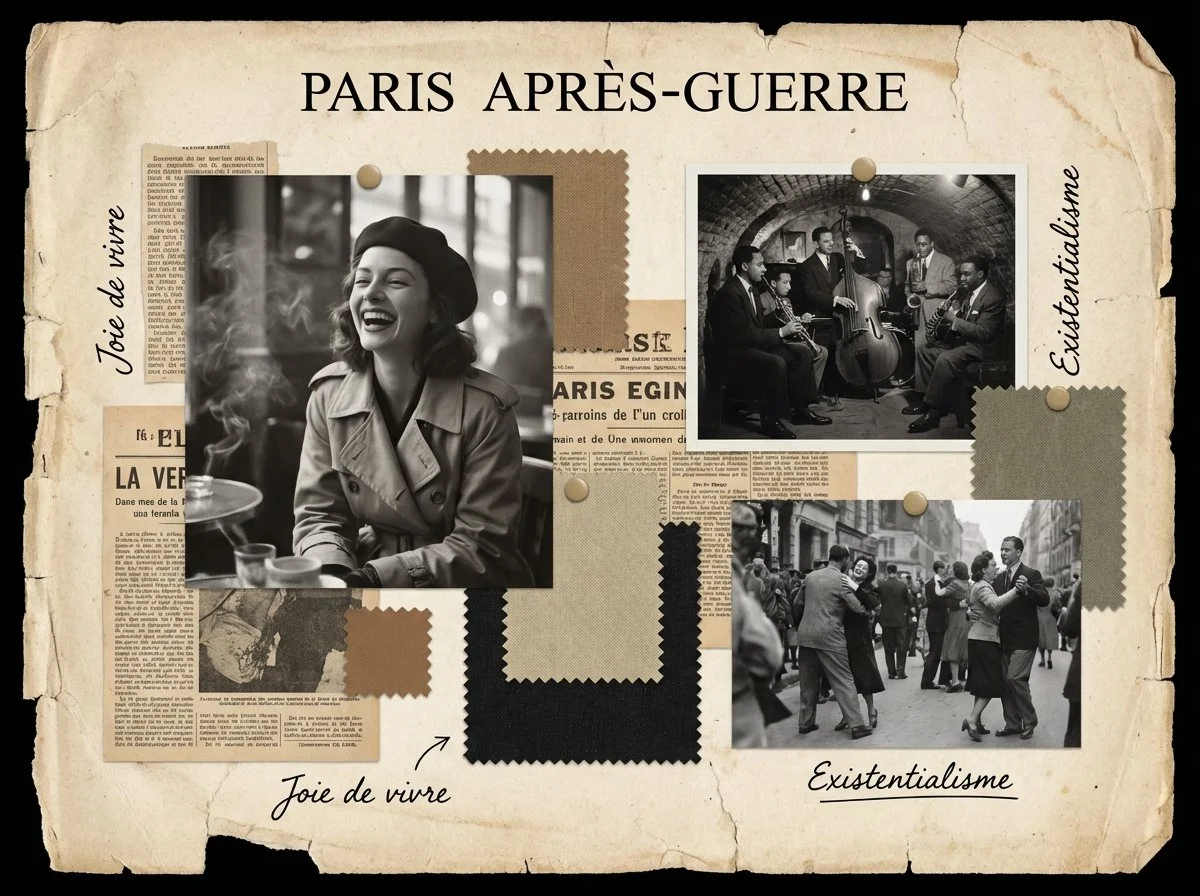
Postwar Paris exported more than perfume and cinema. It exported a mood.
Images of women like Brigitte Bardot, Françoise Hardy, Catherine Deneuve, and Jane Birkin circulated globally. They didn't look too fancy. They looked like they were alive in their clothes.
That was the revelation.
Later, in the digital era, the archetype became official. Blog posts promised formulas. Pinterest boards broke her down in five parts. Instagram influencers recreated café poses against Parisian balconies. What started as an attitude became algorithm.
And yet — unlike many internet aesthetics — French Girl didn’t collapse under saturation.
Why?
Because it isn’t about novelty.
It’s classic.
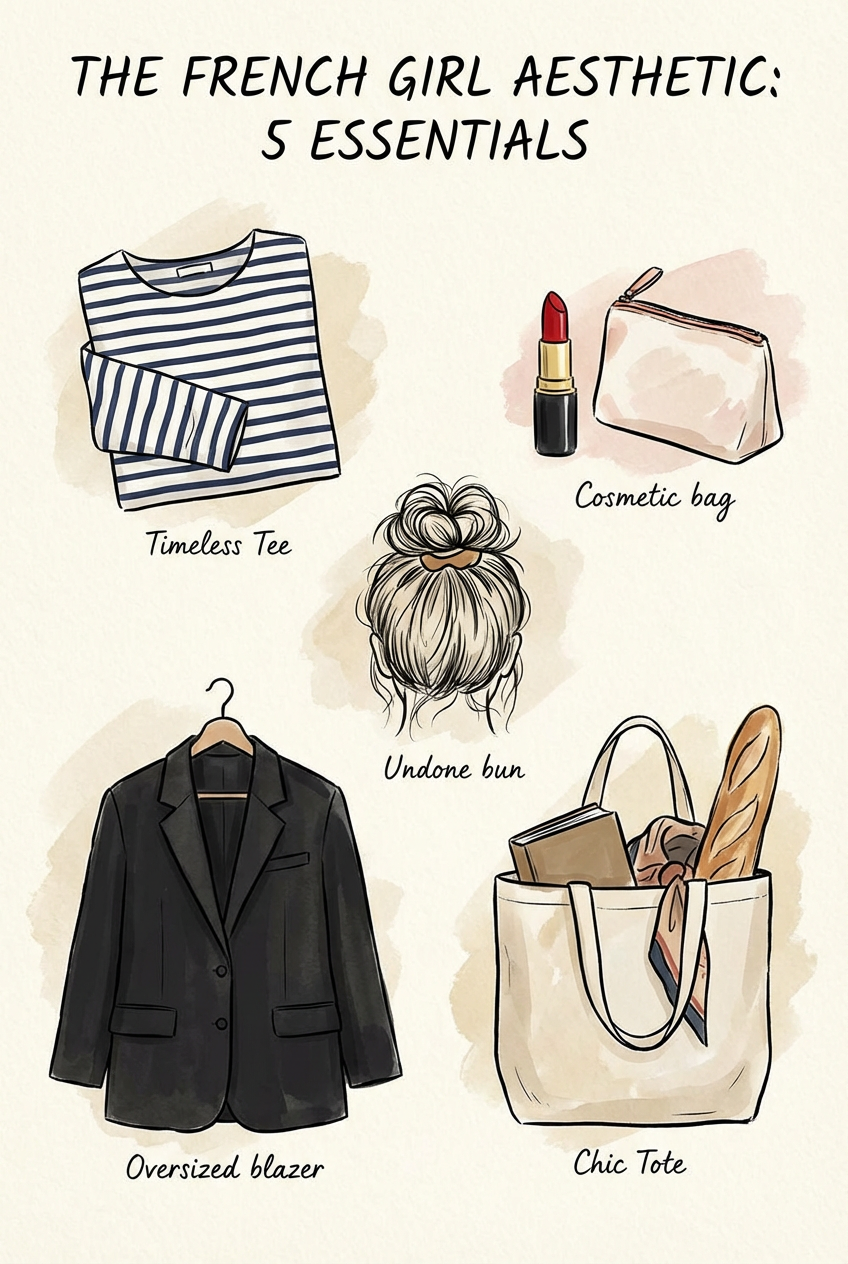
Five Things That Made the Fantasy
BCBG has her navy blazer and polished loafers, and French Girl has her own symbolic anchors. These are not requirements. They are storytelling devices.
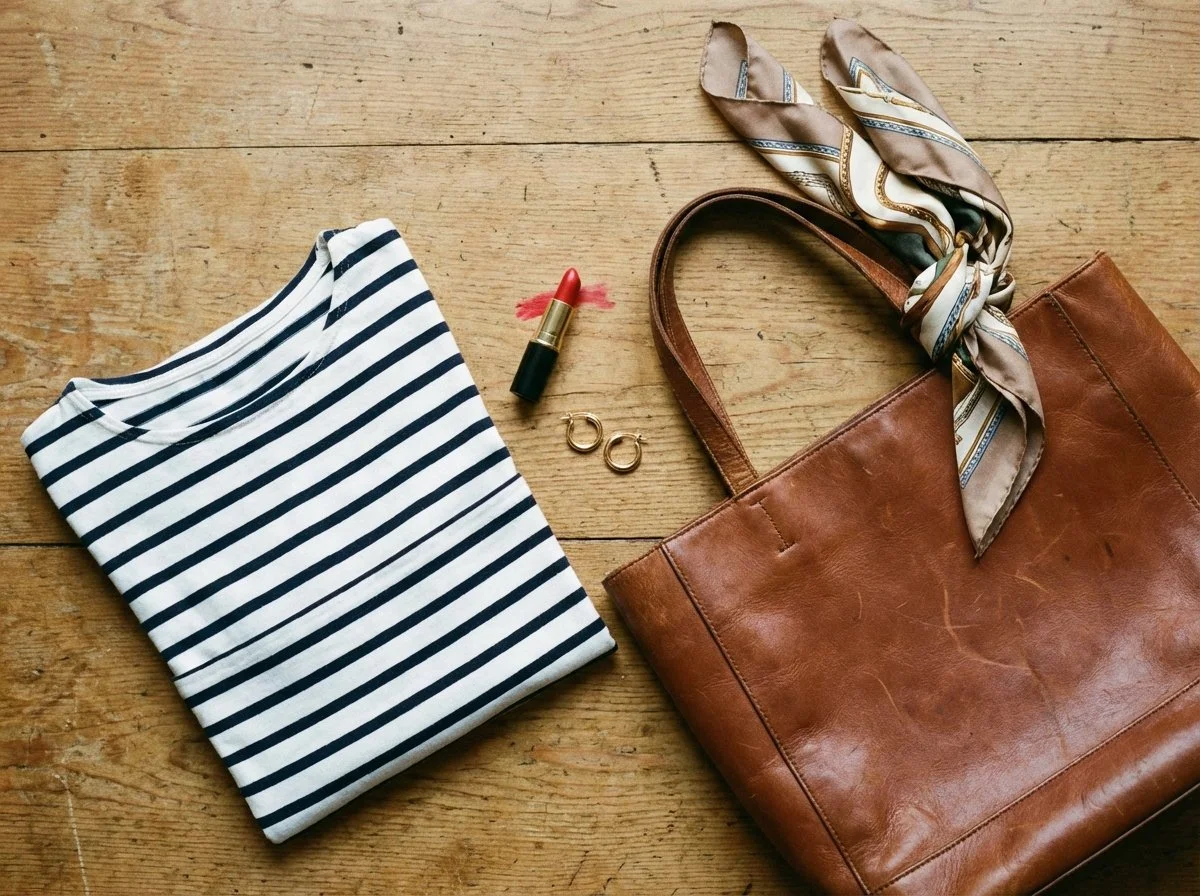
The striped tee.
The marinière. Graphic but simple. Nautical but intellectual. It signals heritage without trying.
The red lip.
Not glossy or overlined. Matte or softly blurred. The only bold statement she needs.
The undone hair.
The bun that took practice. The air-dried wave that wasn’t entirely accidental.
The slightly oversized blazer.
Structured, but worn open. Authority without stiffness.
The full tote.
Because she is going somewhere. She has things to do. She doesn’t pause for the camera.
On their own, these are just things. Together, they tell a story about a woman who is more interesting than her clothes.
What This Guide Is (And Isn’t)
This is not a costume manual.
It is not a list of things to buy in order to look like you stepped off a Paris métro.
It is a study of posture — physically and mentally.
We’ll examine:
French girl’s historical roots
The unwritten codes
The color logic
The wardrobe pieces
The beauty philosophy
The variations across class, geography, and generation
The styling mistakes that instantly turn French Girl into parody
And most importantly:
We'll explain why you can own every "French Girl" thing and still not get the point.
The Real Question
People keep asking:
“How do I dress like a French girl?”
But the better question might be:
“How comfortable am I with being unfinished?”
The French Girl aesthetic survives because it isn’t about perfection. It’s about knowing when to leave well enough alone.
And that is much harder to copy than a red lipstick.
Next, we'll go back in time, because the myth didn't just pop up out of nowhere. It was built up over decades, one picture at a time, until it became the world's shorthand for casual cool.
Good — no specific writing skill to consult, so I'll work directly from the BCBG article's voice and structure as the template. Here's the section:
The French Girl Codes: A Book of Unwritten Rules
We know that every aesthetic has rules. French girls? Their rules are don’t are about rules, and be wary of anyone following rules.
But here we are.
The main idea behind everything—the undone hair, the blazer worn open, and the red lip with the market tote—is le naturel.
Naturalness.
Not a lack of effort, but the look of a lack of effort.
French girl is one of the most time-consuming styles there is. But if you do it right, no one will ever know. It took three products and fifteen minutes to get the skin to look bare. The messy hair didn't happen by accident.
Le naturel is the name of the operating system. It runs everything else.
Here's how it works.
Underdressing as a Power Move
The French Tuck.
You were expecting her to wear a dress to dinner, but she shows up in dark jeans and a silk blouse. Yet somehow, she is still the most elegant person in the room.
It works because underdressing, in the right hands, sends a very clear message: "I know the room well enough not to try to impress it."
Overdressing means, "I wanted to make sure I was okay."
Underdressing says, "My presence is enough," when done right.
This does not mean you can wear yoga pants to a wedding, just calibrate. The French girl figures out what’s expected, then comes in just below that.
Confidence lives in the space between what you expect and what you do.
The One Thing Rule
The French girl doesn’t stack.
Lipstick red? Then the eyes are bare with minimal jewelry and a simple outfit. The red lip doesn't need any other actors.
Interesting earrings? Then that’s it. Make them the first and last thing you see.
Statement coat? Then a basic outfit. The coat is the look.
Remember, one part is always talking. Everything else is fine.
Americans tend to add things. More is more until it becomes too much.
The French girl takes away until nothing else can be taken. The outfit is all that's left.
Controlled Messiness
The hair is never really finished. It is never completely undone. It is, in some way, both at all times.
The chignon with pieces that got away. The blowout that has only been slept on once. The clip that holds about 60% of the hair and has made peace with the rest.
This skill takes years to master and about twenty minutes to look easy.
Things that look random, are never random.
What a French Girl Is
Le naturel as a promise. It has failed if it looks like it took a lot of work.
Restraint as editing, not lack. The closet is small and works perfectly.
Quality that doesn't need to say anything to be known.
Self-possession as the real art. The woman is the subject, not the clothes.
Simple but with personality. The old find. The interesting smell.
The French girl has an opinion; she just doesn't say it out loud.
What a French Girl Is Not
A costume. A beret, baguette, red lipstick, basket bag, and a Breton stripe at once isn’t style; it's tourism. Pick one.
A body type. It's not about proportions; but posture.
Easy. No one wakes up a French girl. They only make it look that way.
Only French. You don't need a passport, only to understand the philosophy which is: buy less, choose wisely, stop trying to be seen, and start being confident. Geography not required.
The French Girl Color Palette
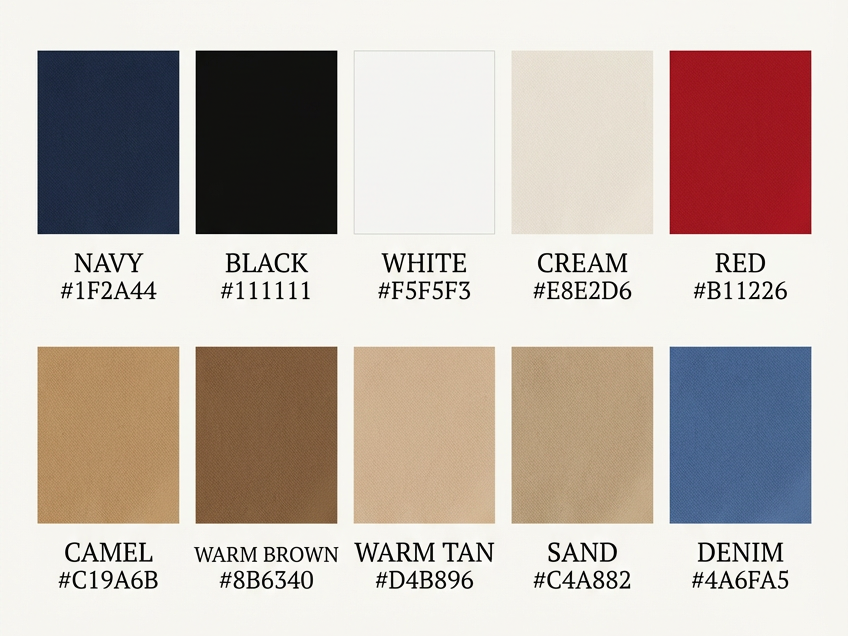
The French girl color system: navy and black as constants, red as the only drama, everything else in quiet agreement.
If BCBG is navy, French Girl is whatever she picked up.
That's what people say, anyway.
The truth is that she took it because it already works.
The French Girl color palette doesn't limit you. There aren't five set colors that you have to use. Minimalism doesn't mean "no color allowed." It's harmony—natural, practiced harmony. The kind that happens when your closet has slowly adjusted over the years.
The French Girl Primary Color Palette
A small, group of colors is at the heart of the French Girl look. They look good on camera whether you’re in a café in the morning, a gray Paris afternoon, or during a late dinner glow.
Navy (#1F2A44)
French Girl Navy is softer than corporate navy and darker than preppy blue. It looks more like an intellectual costume than a nautical one. You can find it in blazers, sweaters, men's shirts, and well-loved knits. It takes the place of black during the day and makes everything softer.
Black (#111111)
Not jet, but a little lived-in. Black pants, turtlenecks, and ballet flats. It holds its ground without making a fuss. French Girl Black is not lacquered; it is matte.
White (#F5F5F3)
A softer, more forgiving white with a little creaminess. It makes light without looking sterile.
Cream (#E8E2D6)
French Girl warmth lives in cream. Sweaters, silk blouses, and linen pants. It keeps the palette from getting too harsh.
Red (#B11226)
The only real "statement" color in the permanent cast. Lipstick. A ballet flat. A winter sweater. It doesn't show up much, but when it does, it looks great. Just one red thing is enough.
None of these colors clash. Navy and cream. Black and white. Red against everything.
The harmony is already there.
The Supporting Colors
Camel & Warm Brown (#C19A6B, #8B6340) The coat. The bag. The boot. Warm browns carry the French girl through autumn and winter without ever feeling heavy. A camel coat over black jeans and a white tee is one of the most reliably excellent outfits in existence.
Warm Tan & Sand (#D4B896, #C4A882) The summer neutrals. Linen trousers in sand. A basket bag in warm tan. These are the colors of things that have been left in the sun — comfortable and faintly Mediterranean.
Denim (#4A6FA5) Not technically a color, but worth naming because it functions as one. Dark indigo, mid-wash, sometimes a faded vintage rinse — it operates as a base the way navy or black might for another aesthetic. The straight-leg jean in the right wash goes with everything.
The Colors You Won't See
You won't find:
Pastels just for the sake of pastels (especially powder pink and baby blue together)
The color of the week from head to toe the week it goes viral.
Neon
Obvious color stories (like a matching scarf, bag, and shoes on purpose)
French Girl doesn't like things that are obvious.
She will wait if a color seems like it is trying too hard to be "of the moment." And sometimes, years later, when it isn't as urgent, she will take it on.
Time turns trends into classics.
The Real Reason
The French Girl palette puts durability ahead of showiness.
Every piece must:
Combine with at least three other things.
Work in more than one season.
Feel natural on the skin.
Age well.
It's not so much about limits as it is about trust.Have faith that the navy will still work next year. Have faith that red will still feel strong. Believe that cream will always smooth out the edge.
And most importantly:
You don't need more color to look interesting, so trust that.
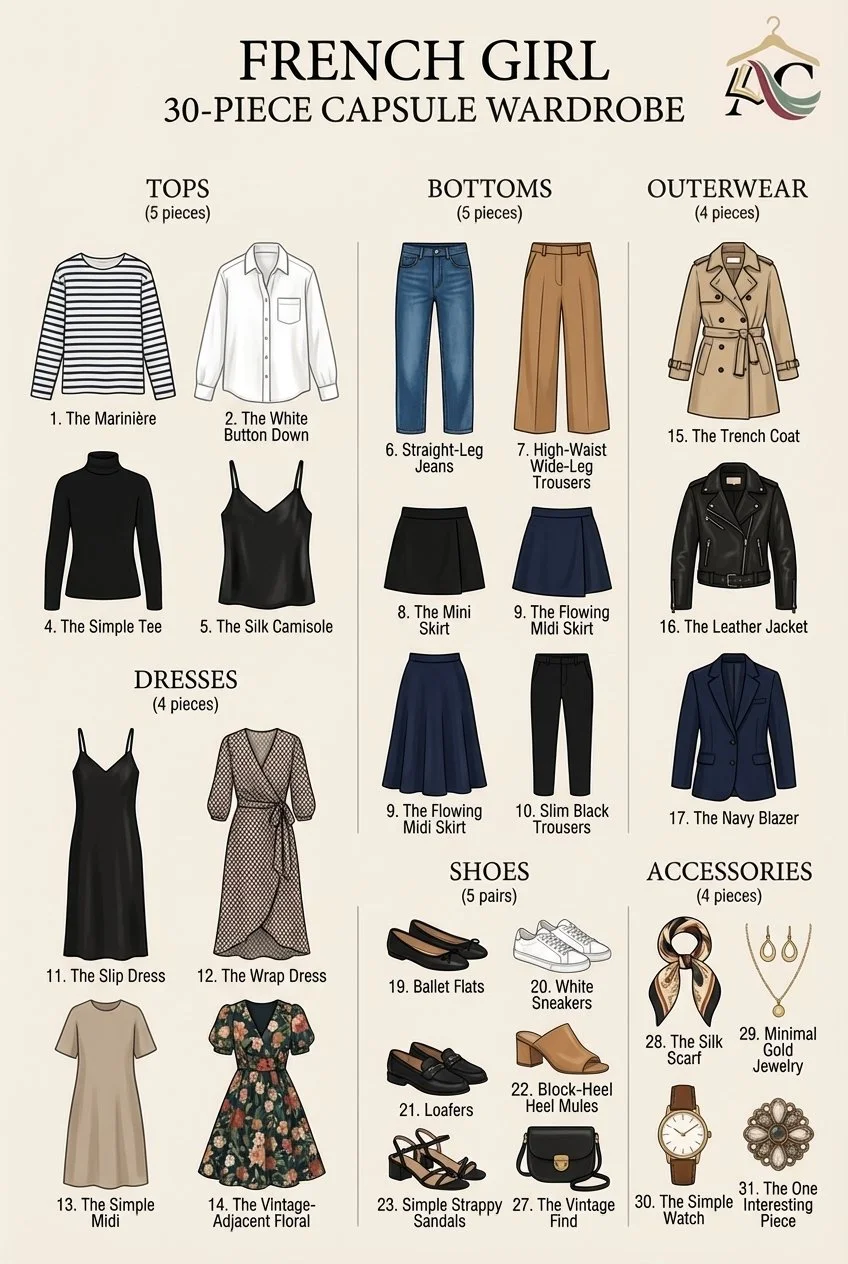
The French Girl Wardrobe: Building the Garde-Robe
A note before we begin.
The pieces matter less than how you wear them. A Breton stripe from a luxury retailer and one from a French pharmacy look and feel the same, but worn incorrectly neither will make you look like a French girl. Philosophy comes first. Wardrobe is a physical extension of that policy.
That said: here are the pieces.
French Girl Outerwear
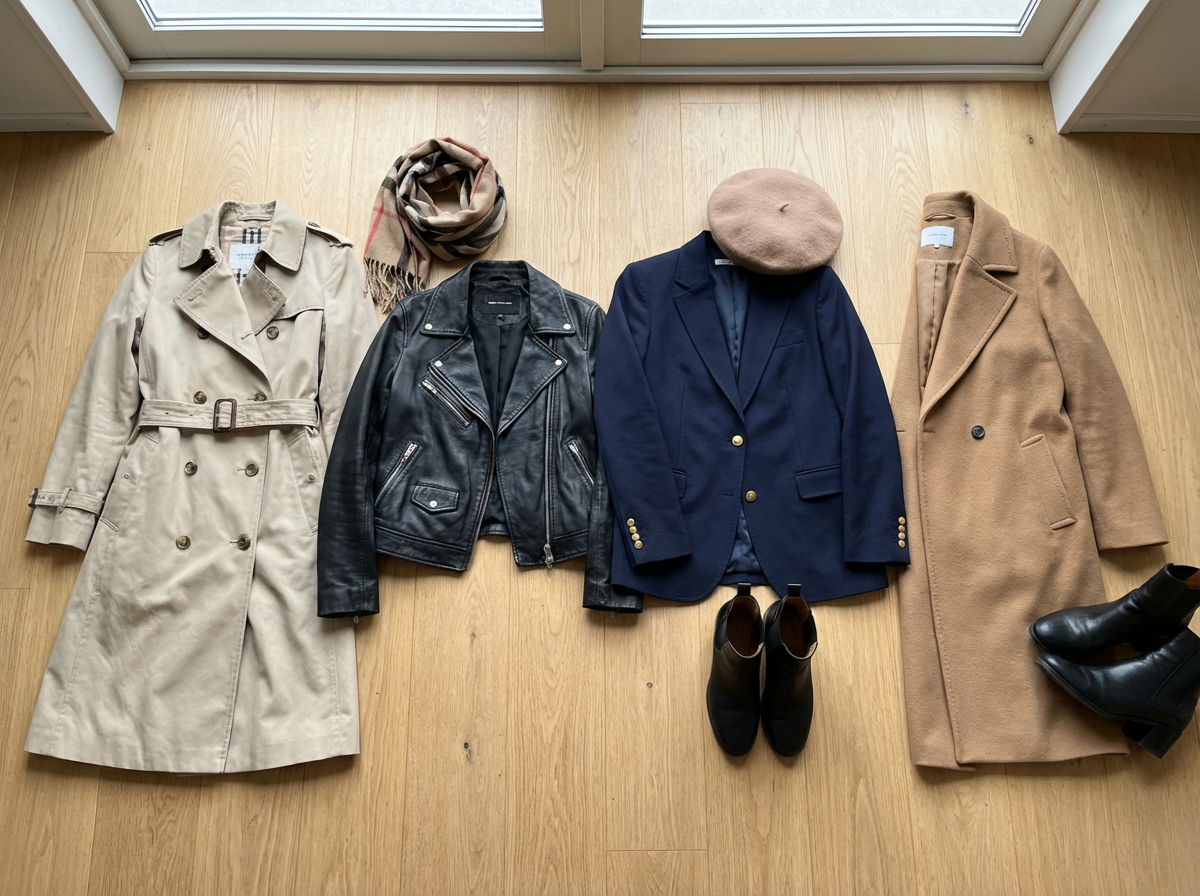
The opening argument. Before anyone sees the rest of the outfit, they see the coat.
Before anyone sees the outfit, they see the coat. Outerwear is the opening argument.
The Trench Coat
Classic. Double-breasted, belted, khaki or camel, hitting somewhere between the knee and mid-calf. This is not asymmetric, cropped, or reimagined. It is the trench coat, unchanged, because it has never needed changing.
The French girl wears hers slightly oversized and loosely belted. The collar is sometimes up. The lining may be visible at the hem. She either found the coat at a vide-grenier, or she’s owned it for years.
Worn over: everything. That's the point.
The Leather Jacket
Not the Moto with the hardware, or the cropped blazer. The real one—broken in, softened, in black or a warm dark brown, in all-weather leather with minimal detailing.
It should look like it has a story. If it doesn’t yet, give it one. Live in it. Leave it in the back seat of a car occasionally, let it get a little wet. A pristine leather jacket is a costume. A leather jacket with history is a wardrobe piece.
Worn over: the silk camisole for evening, the marinière for weekend, the white button-down for everything else.
The Navy Blazer
One key distinction between this and BCBG's navy blazer is that it is worn open—always or almost always. Unlike the pristine BCBG, the French girl throws hers on. It’s slightly oversized—likely borrowed from her boyfriend.
The navy blazer is a layer rather than a statement piece.
Worn Over: A silk top to elevate, a tee to structure, or a slip dress to give an evening ensemble a morning-appropriate vibe.
The Camel Coat
Clean lines, quality wool, hitting at or just below the knee. If the trench is the French girl's autumn, the camel coat is her winter. It works on the same principle: one great piece of outerwear that instantly elevates without altering anything underneath.
It should look inherited, but it doesn't have to be. The idea is for the coat to look slightly older than you, a hand-me-down rather than a purchase.
French Girl Tops
If outerwear is the opening argument, tops are the sentence structure. A good sentence structure goes unnoticed, but a bad one stands out in all the wrong ways.
The Marinière
The Breton stripe is the most exported symbol of French girl style, which has led to considerable dilution and occasional parody. It deserves rehabilitation.
The original marinière — navy stripes on white or cream, traditional proportions, worn in cotton or fine jersey — is a legitimate masterpiece of casual dressing. It layers under blazers, over high-waisted trousers, tucked half-in to jeans, alone on warm days with flat sandals. It’s easygoing without being thoughtless.
The rule: classic proportions only.
No contrasting panels or interesting necklines. No wide stripes that veer nautical-themed. Just the marinière, doing what it has done since sailors wore it in Brittany and Coco Chanel adopted it.
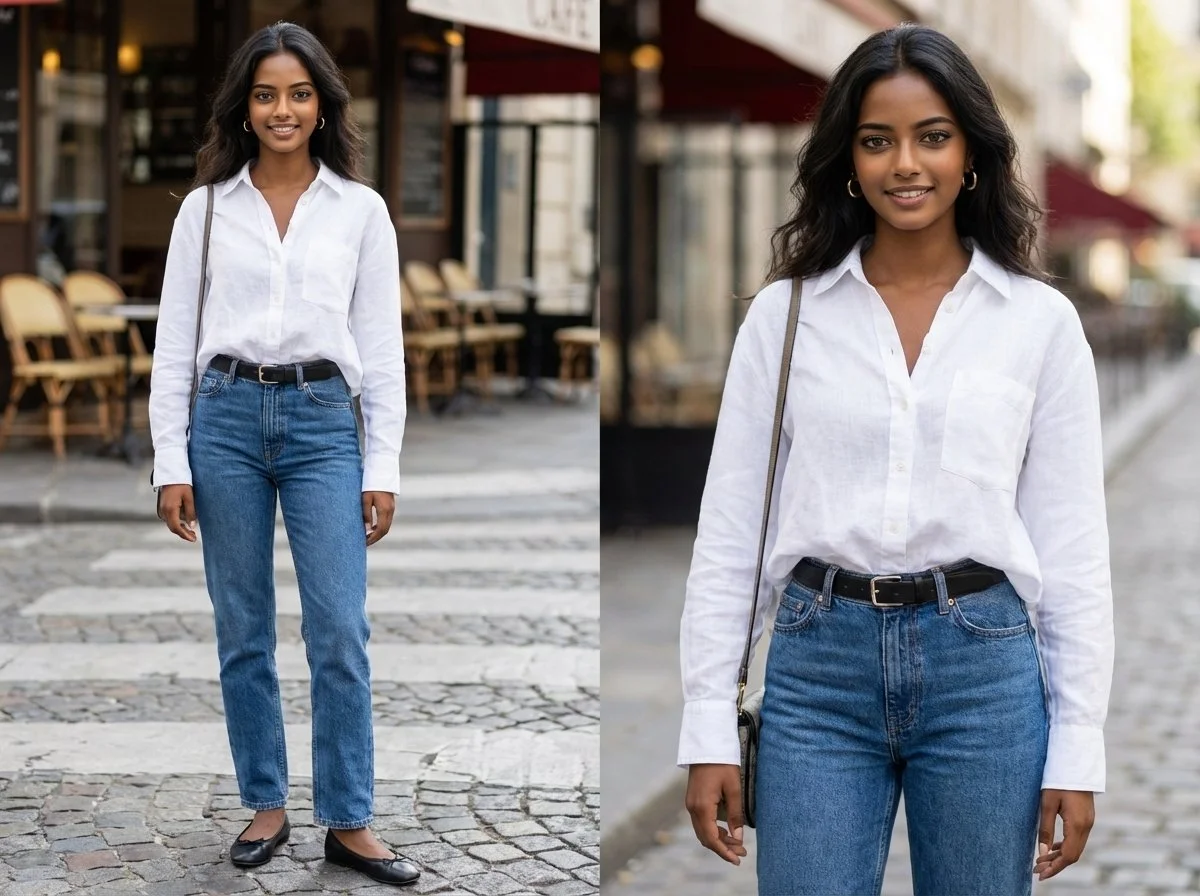
The White Button Down
Two to three buttons open at the collar. Either untucked or half-tucked (see The French Tuck). The sleeves are rolled just once. Wear it as a layer over a camisole or alone for simplicity.
Fit matters: it should skim the body without pulling. Too large reads borrowed or sloppy. Too fitted reads corporate. The goal is the middle territory — a shirt that fits a person, not a silhouette.
The Fitted Black Turtleneck
The intellectual staple. Fine knit, fitted but not tight, in the best quality affordable. This reads Left Bank — worn with straight-leg jeans and loafers. Confident. Slightly literary.
The black turtleneck has no bad season. In winter, it layers under coats and over nothing at all. In shoulder seasons, it anchors transitional outfits. In summer, it does not appear — the French girl has enough self-awareness to know that some things are seasonal.
The Simple Tee
White, cream, or black. Slightly fitted or relaxed — never boxy. No graphics or weird cuts. It’s a tee, in good fabric, that doesn’t make a scene. Wear it tucked into trousers, half-tucked into jeans, under an open blazer, or alone weather permitting.
Quality matters here. The difference between a good tee and a poor one shows in drape, how the fabric holds its shape after washing, in whether the color maintains or fades. It doesn't need to be expensive. It just needs to be right.
The Silk Camisole
Not as underwear, not as a layering piece, but as the top. Over high-waisted trousers for dinner. Under the open blazer for the transition between day and evening. With the camel coat for a winter night.
The camisole should be silk or a silk equivalent in ivory, cream, black, or the occasional deep burgundy. Thin straps, simple neckline. The neckline is simple. It does almost everything and takes little space, making it one of the most efficient pieces in the wardrobe.
The French Tuck
Tuck the front. Leave the rest alone.
The French tuck — tucking just the front of a shirt or top into a waistband while leaving the sides and back untucked — is one of the most useful techniques in the French girl wardrobe. It creates the appearance of a defined waist without the rigidity of a full tuck, adds proportion to loose tops, and produces exactly the kind of controlled dishevelment the aesthetic runs on.
It should look like it happened on the way out the door. That is the goal. That is also not entirely what happened.
It works on
The technique
- Tuck two to three inches of the front center into your waistband.
- Leave the sides untucked. Leave the back untucked. Do not revisit this.
- Adjust once — only if something is visibly wrong. Then stop adjusting.
- The slight asymmetry is not a mistake. It is the look.
The full tuck says: I dressed carefully. The French tuck says: I dressed, and then I left. There is a meaningful difference, and the French girl is aware of it.
French Girl Bottoms
Straight-Leg Jeans
The most reliable piece in the French girl wardrobe. Dark indigo to mid-wash, no distressing, straight leg and hitting at the ankle or just above with the right shoe. Not skinny — the straight-leg works with more tops, reads more current, and photographs better. Not wide-leg — that's for different occasions.
She wears these with everything. With the marinière and loafers: classic. With the silk camisole and leather jacket: evening. With the turtleneck and ballet flats: autumn Saturday. They are the wardrobe's axis.
High-Waist Wide-Leg Trousers
The second register of the bottom half in black, cream, or camel. Worn with the fitted turtleneck tucked in or the silk camisole, with flat sandals in summer and loafers in autumn.
The fit is specific: high-waisted enough to be flattering, wide enough to move properly, hemmed at exactly the right length for the shoe you’ll wear it with. If the hem is wrong, the trouser is wrong. Budget for alterations.
The Mini Skirt
Yes. She wears one.
French girl is not conservative, but restrained.
In black, a subtle tweed, or dark denim, the mini works with the blazer and the turtleneck because the French girl is not afraid of her legs.
She applies the one thing rule: if the skirt is short, everything else is covered. The top is fitted and modest. The shoes are flat. The accessories are minimal. The mini does one thing. The rest of the outfit holds.
The Flowing Midi Skirt
A skirt that moves in silk, viscose, or a Liberty-print cotton that softens with washing. Wear with a simple tee and flat sandals in summer or with a fitted knit in autumn. This skirt photographs beautifully in golden hour.
Slim Black Trousers
Not tailored in the BCBG sense, but a slim, well-cut black pant that bridges the gap between casual and evening. Wear with the silk camisole for dinner, the turtleneck for work, or with the leather jacket.
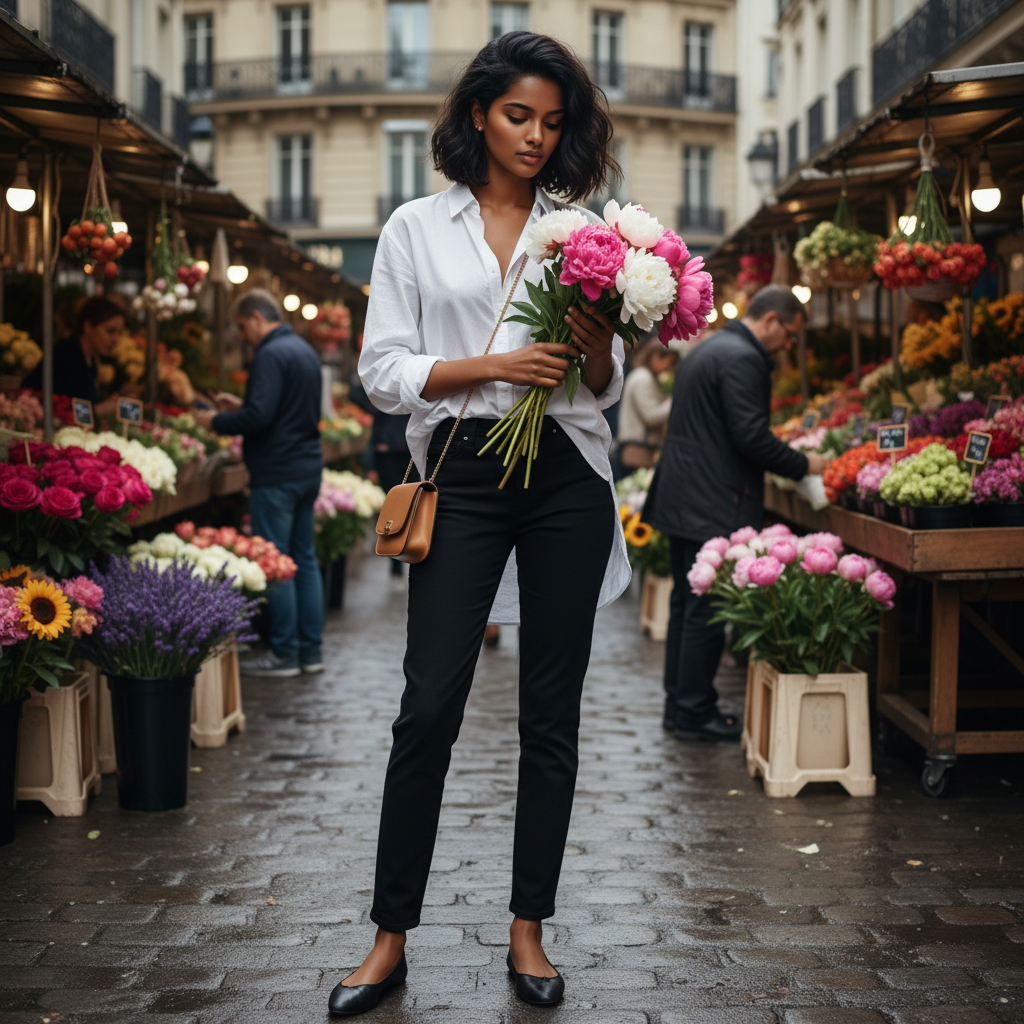
French Girl Dresses
The Slip Dress
Wear alone in summer with flat sandals and the leather jacket or under the camel coat in winter with ankle boots.
The slip dress is almost a concept more than a garment. Wear it in ivory, black, or a deep jewel tone, bias cut preferred.
The Wrap Dress
Universally flattering, which is why it has survived every trend cycle since Diane von Furstenberg made it famous. Go with a small print or solid color, conservative length, and belted, not cinched dramatically, just tied.
The Simple Midi
A clean-lined, non-fussy dress in a solid color or minimal pattern. This is the dress she reaches for to be dressed without the fuss. Go with navy, black, or cream. Wear with loafers for day, block-heel mules for evening, or a trench coat for autumn.
The Vintage-Adjacent Floral
The most personality.
A floral dress with history, this dress is the proof that French girl is not a minimalist.
She has taste, and people with taste own at least one floral that makes no logical sense.
French Girl Shoes
Ballet Flats
The signature, in nude, black, or red (red is a complete French girl move) and softening leather. They make every outfit more Parisian. The French girl does not suffer in her shoes. She considers suffering in shoes a failure of planning.
White Sneakers
Clean. Simple. Classic silhouette — no chunky sole, no performance detailing. Wear with the midi skirt or the straight-leg jeans on the days when ballet flats feel like too much work.
Loafers
Structured, leather, in black or brown. The shoe that straddles casual and formal without fully committing, which makes it the most French girl shoe.
Block-Heel Mules
The evening shoe that doesn't punish. Low enough to walk in and interesting enough to elevate in black or a warm neutral.
She slides these on with the slim black trousers and the silk camisole.
Simple Strappy Sandals
Summer only. Minimal construction, good leather, in tan or black. They should look like they were made for walking along warm stone pavement, because that is what they will be asked to do.
French Girl Bags
The Basket Bag
Summer's signature. Woven, structured, with a simple leather or cotton handle. It is the least precious bag in the wardrobe and the most characterful. It looks good at the market, the beach, or an extended lunch.
The Leather Tote
The daily workhorse. Always full. The French girl tote is not organized. The bag is good leather in a simple shape. What it holds is nobody's business.
The Small Leather Crossbody
For evenings and days when she has decided not to carry her entire life. Simple shape, functional strap, in black or cognac. It holds a phone, a card, a lipstick. It is enough.
The Vintage Find
You can find this at a vide-grenier, a brocante, a mother's closet, or an estate sale. It can be an unusual color or shape. It is the bag people ask about, and it has history.
French Girl Accessories
The Silk Scarf
The French girl's scarf and the BCBG woman's scarf are technically the same, but executed in different ways. BCBG ties hers correctly. The French girl's is tied once. It may be in her hair or on a bag handle. It looks accidental, but it wasn’t.
Minimal Gold Jewelry
Small hoops or simple studs. A delicate chain. A ring, possibly two.. Gold only, silver reads cooler and more Scandinavian. The jewelry should be noticeable only when you're close enough to notice it.
The Simple Watch
Small face, leather or metal strap, in gold or warm silver. Not a statement watch or a smartwatch with a glowing face that interrupts dinner. It tells time and suggests you value.
The One Interesting Piece
Every French girl wardrobe contains at least one thing that cannot be explained. A brooch from a grandmother, a silk scarf in a weird color that shouldn't work but does, a vintage belt with a decorative buckle, jewelry from a brocante that she bought for twenty euros.
This piece is not decorated into the wardrobe. It arrived and it’s proof that the wardrobe is not a system.
That is the difference between a French girl wardrobe and a Pinterest board.
One False Move…(French Girl Edition)
One False Move…you're the Paris section of a gift shop
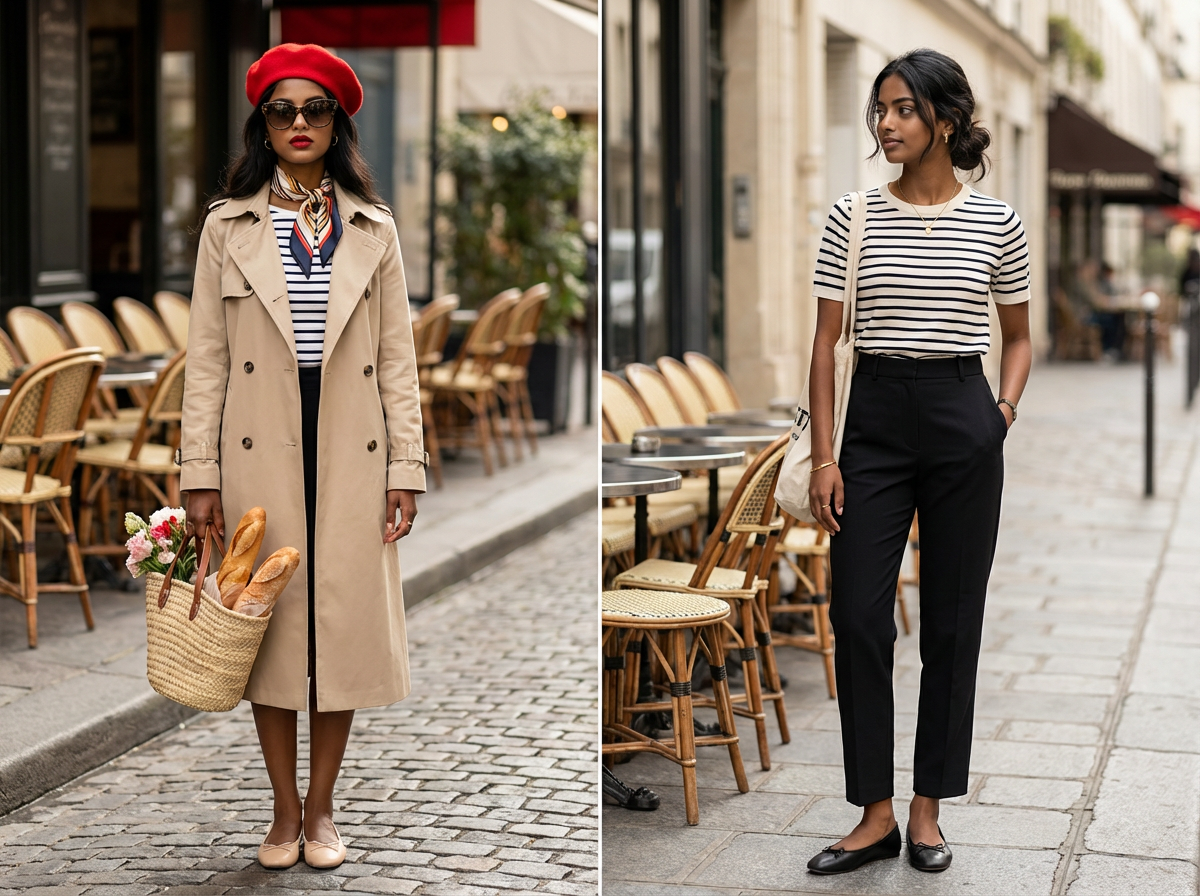
The mistake isn’t any single piece. Every one of those items belongs somewhere in the French Girl wardrobe.
The mistake is stacking them.
French Girl style works because the references are subtle. If everything in your outfit screams “Paris,” the illusion collapses.
The Fix
Choose one reference, maybe two.
Example:
Breton stripe + jeans + loafers
Trench coat + white tee + black trousers
Red lip + simple outfit
Let the suggestion do the work.
One False Move…And You’re Making Closing Arguments
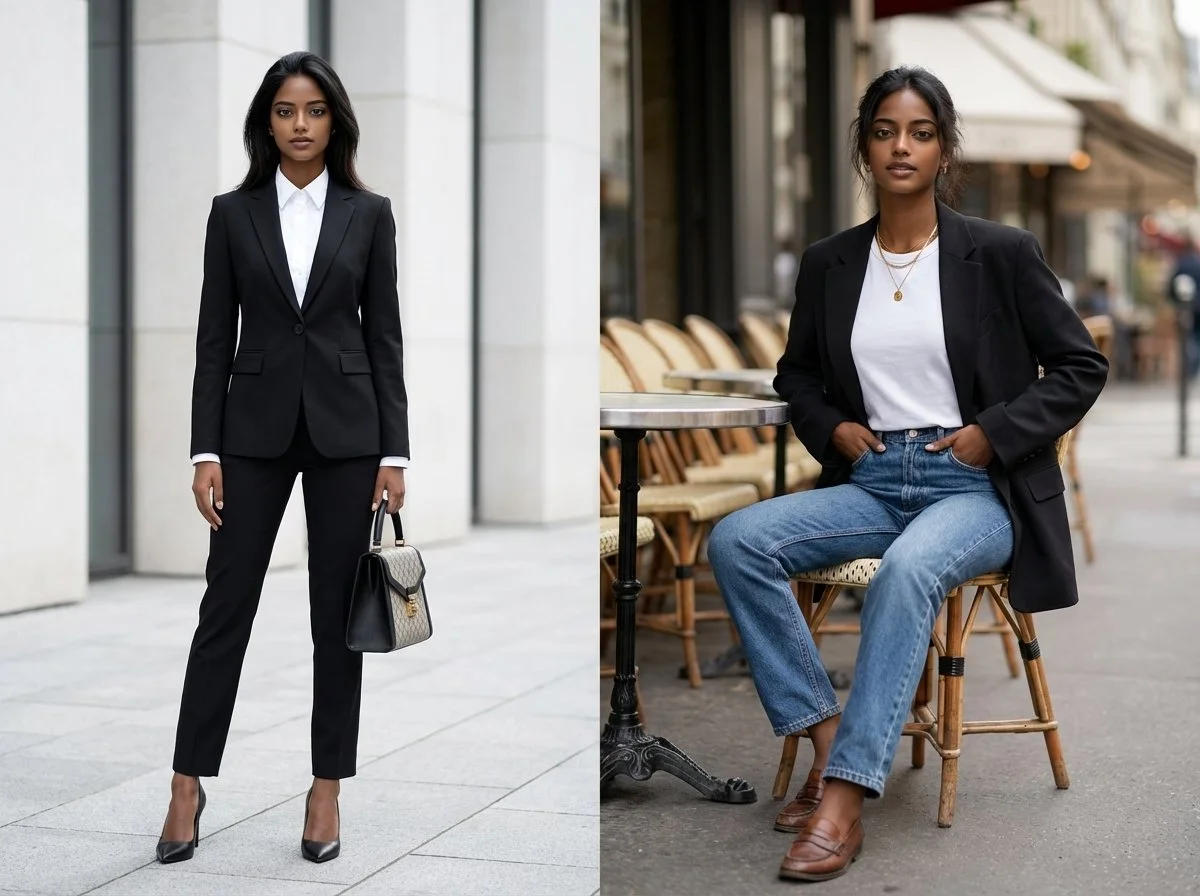
There should always be one element slightly undone.
A cuff rolled.
A button open.
Hair not quite perfect.
Without that imperfection, the outfit becomes polished instead of relaxed.
The Fix
Break the symmetry.
Push up blazer sleeves
Leave the collar slightly open
Swap heels for loafers
Let your hair move
Perfection is not the goal.
Ease is.
One False Move…And You’re Headed to the Laundromat
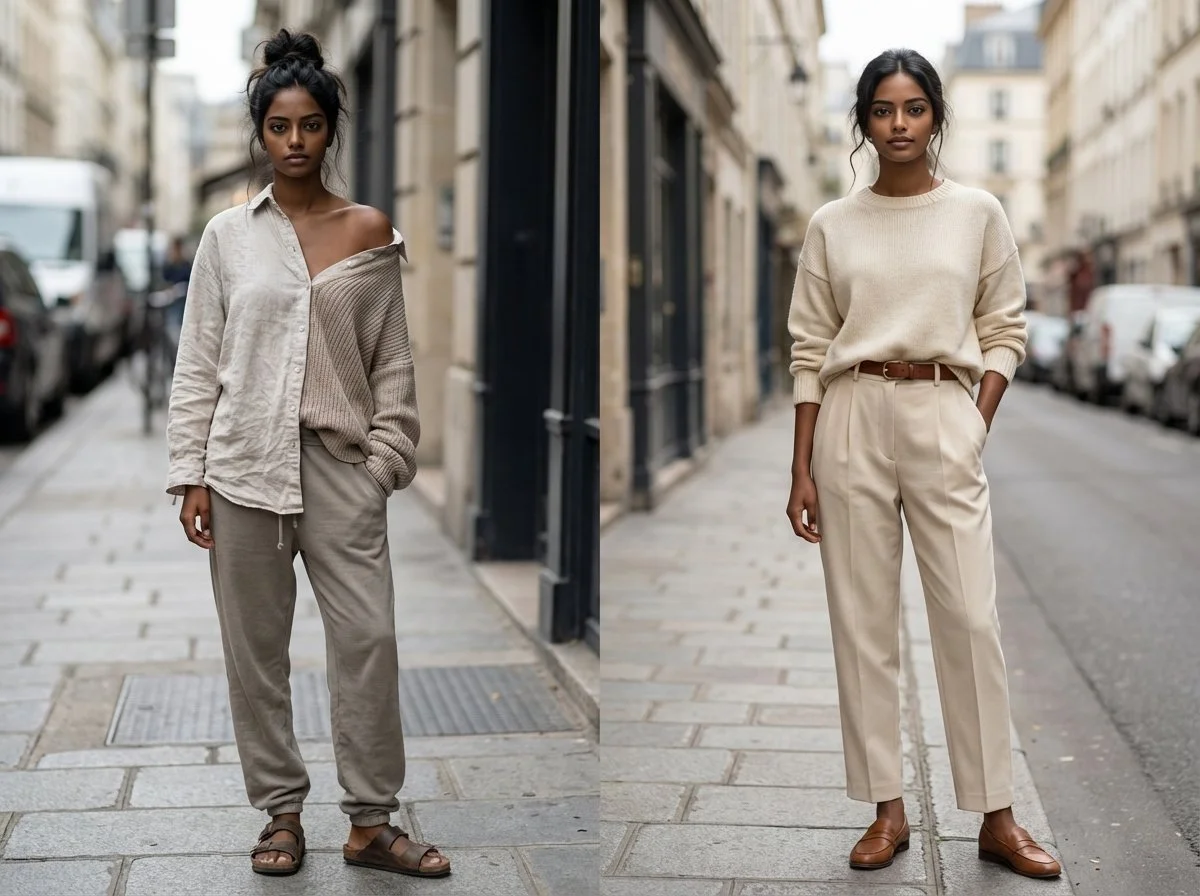
Effortless does not mean careless.
French Girl style still relies on structure somewhere in the outfit.
A good coat.
Well-cut jeans.
Clean shoes.
There’s always one anchor holding everything together.
The Fix
Add a grounding piece.
Example:
Slouchy sweater + tailored trousers
Messy bun + sharp blazer
Linen dress + structured bag
Relaxed is chic.
Neglected is not.
French Girl Beauty & Grooming
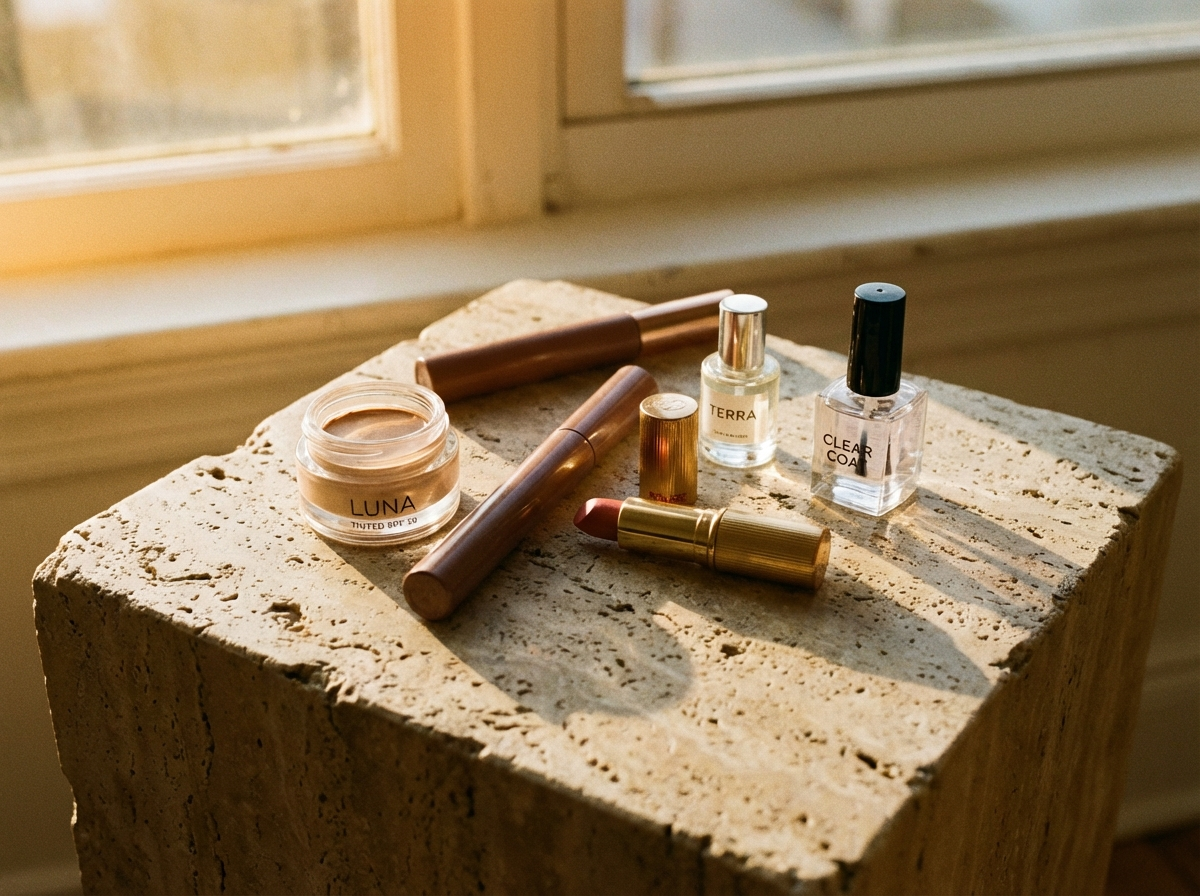
Bonne mine. The skin that looks bare isn't. The result of consistent effort, made invisible.
There’s a phrase the French use for what they're going for: bonne mine.
Literally: good face. Good complexion. The appearance of health, rest, and a body that is being taken care of. Bonne mine is not a makeup look. It is not a skincare routine. It is both.
This is the organizing principle of French girl beauty. The skin that looks bare isn't. The hair that looks air-dried isn’t. The “nude” lip color is a very specific shade.
Skin: The Real Product
The French girl's skin is not perfect. Real skin has texture, pores, a warm flush. The French girl beauty enhances these things, it down’t hide them.
Skincare includes a good cleanser, moisturizer, and daily SPF without exception. You won’t need a rotating cabinet of active ingredients and weekly treatments. The basics produce skin that looks good without explanation.
Foundation, if worn at all, is light. A tinted SPF or moisterizer with sheer coverage. Concealer when necessary.
The complexion goal is not flawless. It is vivant — alive. Slightly flushed. Luminous for well-hydrated skin, not highlight powder.
A light cream or gel blush, patted onto the apples of the cheeks and blended naturally. Add a dusting of translucent powder if needed. Then stop.
The Red Lip: When and How
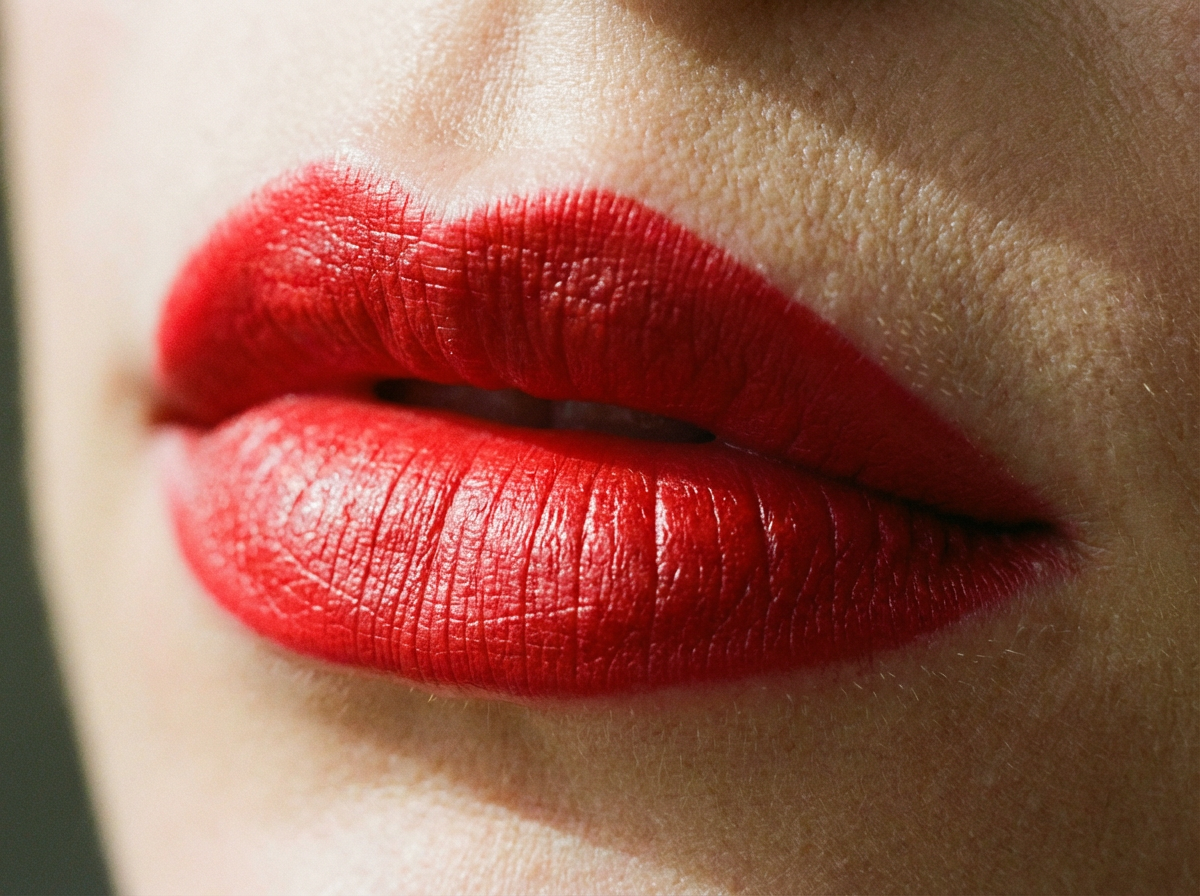
The formula: red lip, clean skin, mascara. Not two statements. One
The red lip is the French girl's most iconic beauty move.
It is not worn as a finishing touch. The red lip is the look. Everything else steps back.
The formula: red lip, clean skin, and mascara. Not a smoky eye and a red lip. Not a contoured face and a red lip. The red lip with other statements is not French girl, it is American prom.
Go for a satin finish, never matte.
Why it works with the striped tee: because the contrast is the point. The marinière is the most casual garment in the wardrobe. The red lip is the most formal beauty move. Together they create the French girl frisson.
Eyes: Enhance, Then Stop
Mascara. Good mascara, applied to the upper lashes, occasionally the lower, never so much that it announces itself.
Or, the alternative, kohl liner in black or dark brown, applied to the waterline or the upper lid and then smudged until it reads as shadow. The smudge is the technique.
These are the two modes. Mascara for the natural register. Smudged kohl for the slightly more evening-adjacent version. What does not appear: winged liner, shadow in multiple shades, lash extensions, anything requiring a small brush.
Brows are full, groomed, shaped naturally. The brow should look like hers, only slightly better. Never architectural. The brow is a feature, not a construction project.
Hair: The Coiffure Déstructurée
The French girl's hair is the most accidental thing about her.
She rotates between three modes based on the time she had and the right clip.
The tousled blowout. Dried with a round brush or a diffuser, then left alone, or slightly disturbed. The blowout that has been lived in for four hours and is better for it. This is the hardest of the three to execute.
The undone chignon. Twisted at the nape of the neck and coolly secured with pieces left out.
The clip-up that escaped. A claw clip or simple barrette, applied to approximately sixty percent of the hair. The rest has made its own arrangements. This is the lowest-effort version and, in the right hair and on the right morning, the best-looking.
Color, if enhanced, reads as unenhanced. Subtle dimension, natural-looking highlights, maintained roots. The goal is never for anyone to ask if you changed your hair. The goal is for your hair to look like itself, in the best way.
Nails: Discipline in Small Things
The French girl nail does not extend beyond the fingertip. It is shaped — oval or slightly square, filed consistently — and either bare, nude, or red.
Go with clear polish or natural gel for minimal mode, or classic red for something fancier.
No nail art. No press-ons. No gel extensions in a fashion color. The hands are hands. They are maintained, not decorated.
Fragrance: Discovered at Close Range
The fragrance is invisible until you are standing next to her. Not the thing that enters a room before she does.
The fragrance is worn for herself, and discovered only at conversational distance.
The French girl fragrance comes from a heritage house or a Parisian pharmacy. Think Guerlain, Chanel, Hermès, Diptyque, or the small brands with good reputations and minimal marketing. The composition is classic: a chypre, a floral, or an oriental. It’s the fragrance with enough gravity to be worn by more than one generation.
Nothing gourmand. Nothing that smells like a dessert. Nothing viral.The fragrance should smell like a person, not a trend.
The Grooming Truth
Here it is: French girl beauty is maintenance with the appearance of negligence.
None of this is low-effort. It is consistent effort, applied quietly, over time.
The whole thing, the wardrobe, the beauty, the scarf tied once, is an extended argument that elegance is natural. For some people, looking like this is simply how they are.
It is not how they are, but what they’ve become. The difference, after long enough, becomes invisible.
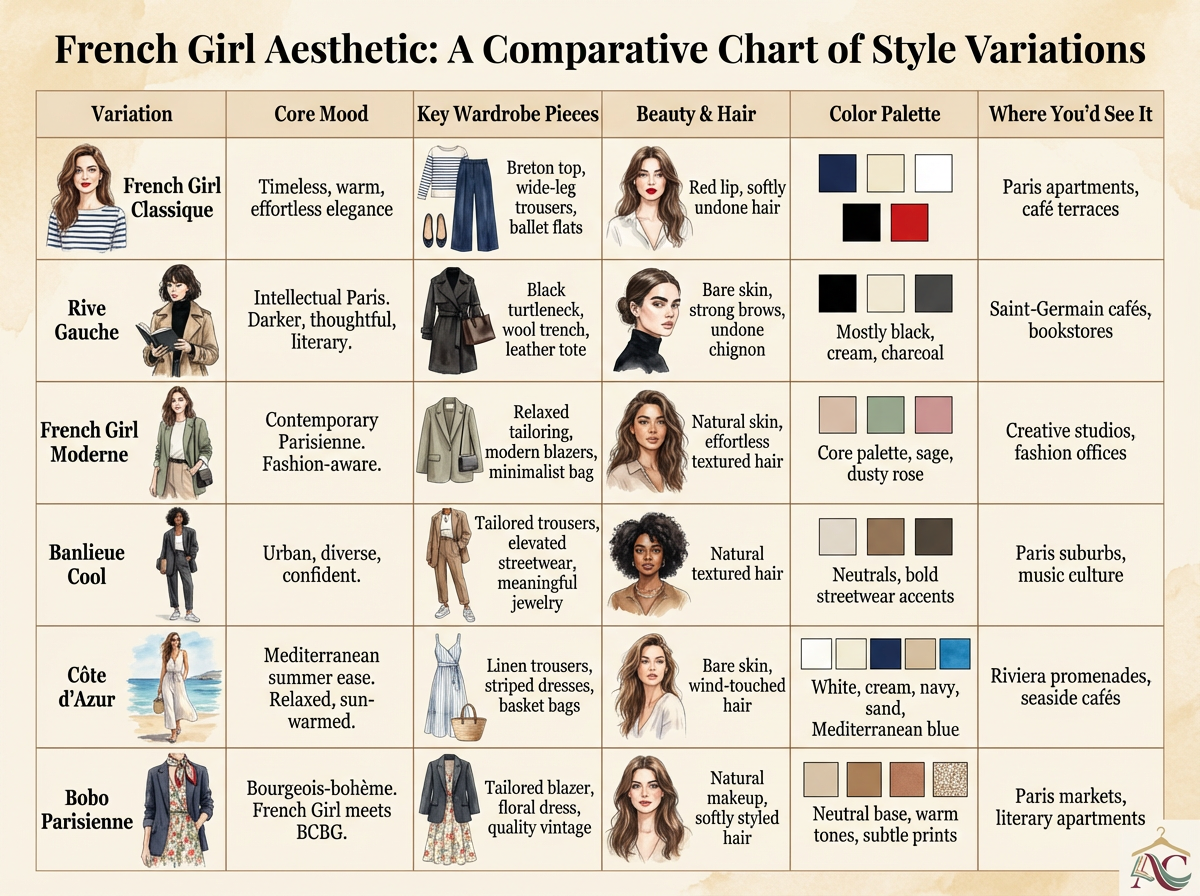
The French Girl Aesthetic Variations
French girl is not a uniform, it’s a framework, and like any durable framework, it produces variations. Some classic, some contemporary, all of them are related. None of them identical.
Think of these as dialects. Same accent. Different vocabulary.
French Girl Classique
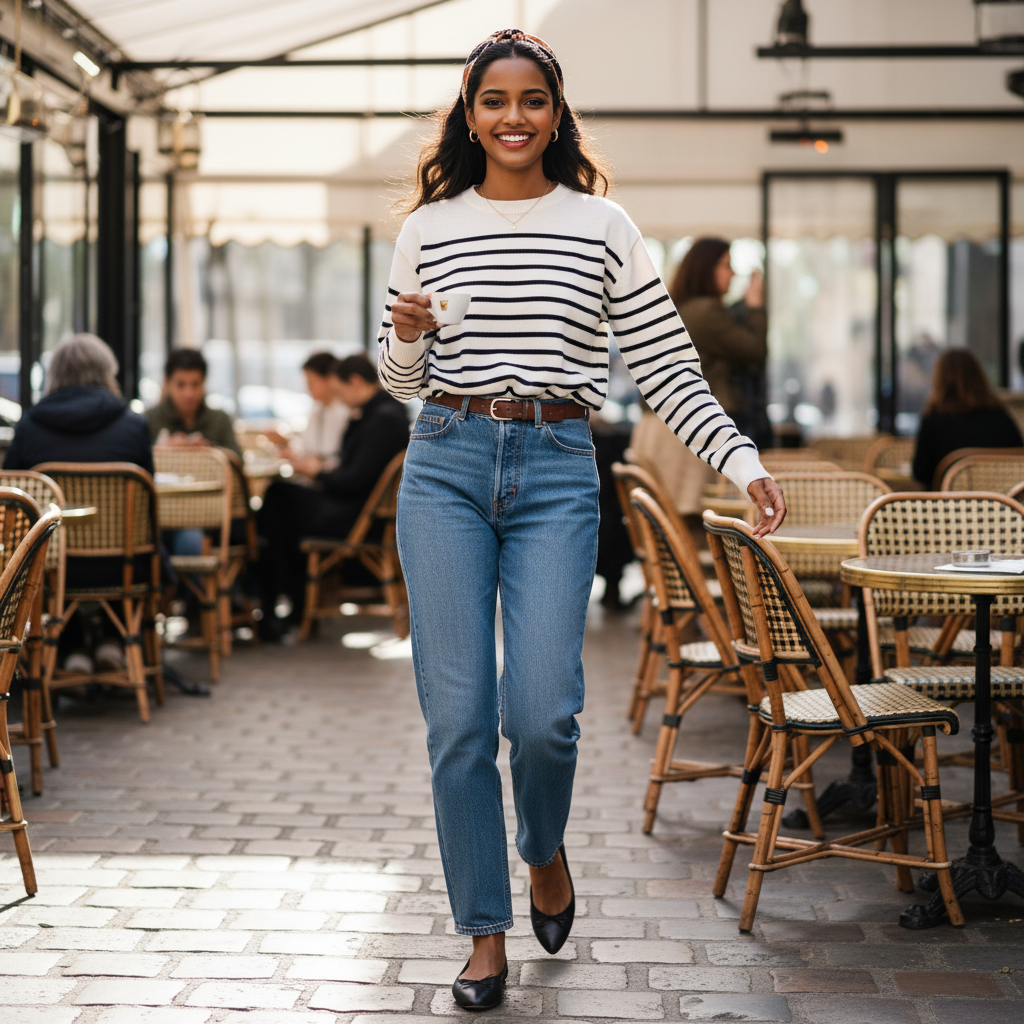
Mood: warm, lived-in Parisian elegance — timeless rather than trendy.
The original text.
Visual mood:
warm, lived-in Parisian elegance — timeless rather than trendy.
This is French girl as the world imagined it and, for a specific generation, actually lived it. Bardot on a Riviera morning. Françoise Hardy in a Paris apartment. The aesthetic that got exported, copied, diluted, and remains — underneath all of that — completely intact.
The codes here are the most legible: the marinière, the red lip, the undone hair, the wide-leg trousers or the full skirt in a soft print. A leather belt worn loosely. Ballet flats. The silk scarf in the hair or around the neck. Everything warm and imperfect in the way that things look when they belong to a person rather than a mood board.
It is not trying to be timeless. It just is.
Who wears it now: Women who resolved the "what do I wear?" question years ago and have the wardrobe to prove it. Younger women who have chosen the original text over the annotated edition. Anyone who finds the current moment's aesthetics exhausting and has decided to opt out entirely.
Rive Gauche
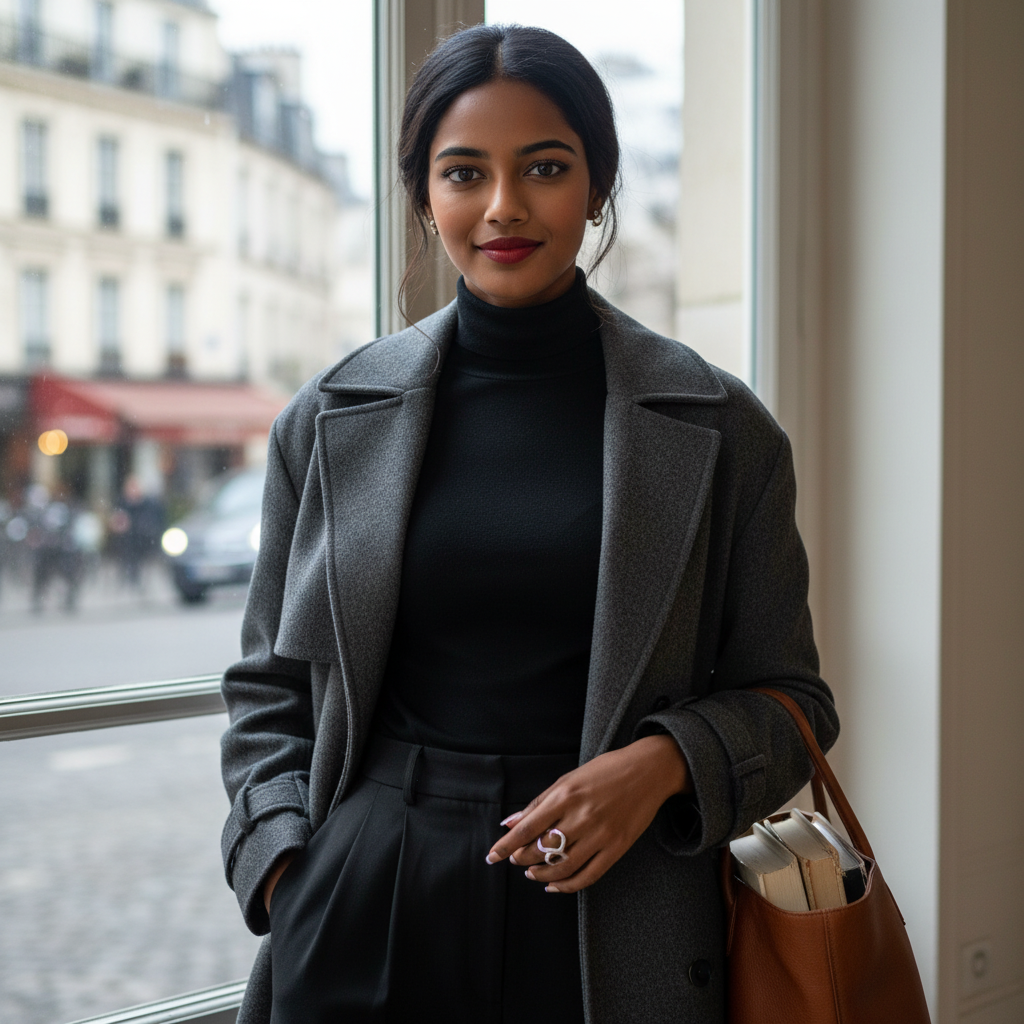
Mood: darker, thoughtful, Left Bank literary energy.
More black. More ideas per square meter.
Where the Right Bank is institutional the Left Bank is intellectual. The sixth arrondissement. Saint-Germain-des-Prés.
Rive Gauche is French girl with a philosophy degree and strong opinions about cinema.
The wardrobe is darker (more black) and more textured. The fitted black turtleneck is the uniform's spine. Wide-leg black trousers. A trench coat in good wool. The occasional interesting vintage piece that is interesting rather than eccentric. Jewelry is minimal but not absent: a single unusual ring, a delicate chain with something meaningful attached to it.
The red lip appears here too, but worn differently — less Bardot, more Simone. Less sun-warmed southern France, more a decision made at a kitchen table at midnight.
Beauty is extremely minimal — the skin, the brow, perhaps the lip, nothing further. Hair is more likely the undone chignon than the tousled blowout. No basket bags, but a well-worn leather tote with books in it.
Who wears it now: Women in publishing, academia, the arts. Anyone who treats bookshelves as biography and considers cultural fluency as important as any other form of dressing correctly.
French Girl Moderne
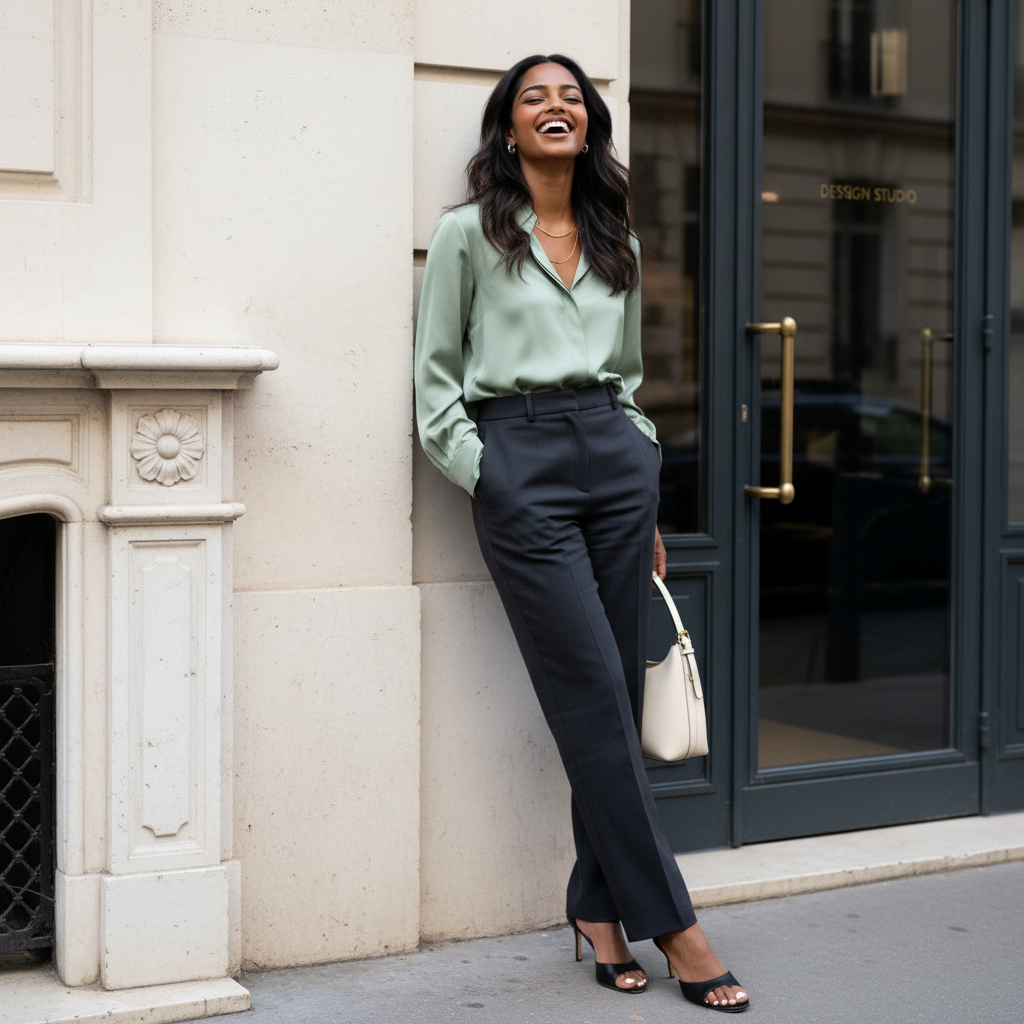
Mood: contemporary creative professional, subtle awareness of fashion.
Fashion-aware. Not fashion-driven.
This is the contemporary Parisienne, the woman who works in a creative industry and reads the collections. She understands fashion and but isn’t ruled by it.
Her silhouettes are slightly more current than Classique. She wears a wider trouser where Classique wore slim, and a relaxed shoulder where Classique wore structured. She might own one piece by a contemporary designer and mix it with things she’s owned for years.
The palette is the core palette, with occasional departures: a muted sage in late summer or a dusty rose in winter, neither too trendy but more adventurous than the permanent cast.
This variation is the hardest to execute because it requires knowledge. French Girl Moderne is not "French girl plus trends." It is French girl with a sophisticated editorial eye identifies the rare trend worth absorbing.
Who wears it now: Editors, architects, creative directors, anyone who engages with fashion as a cultural conversation.
Banlieue Cool
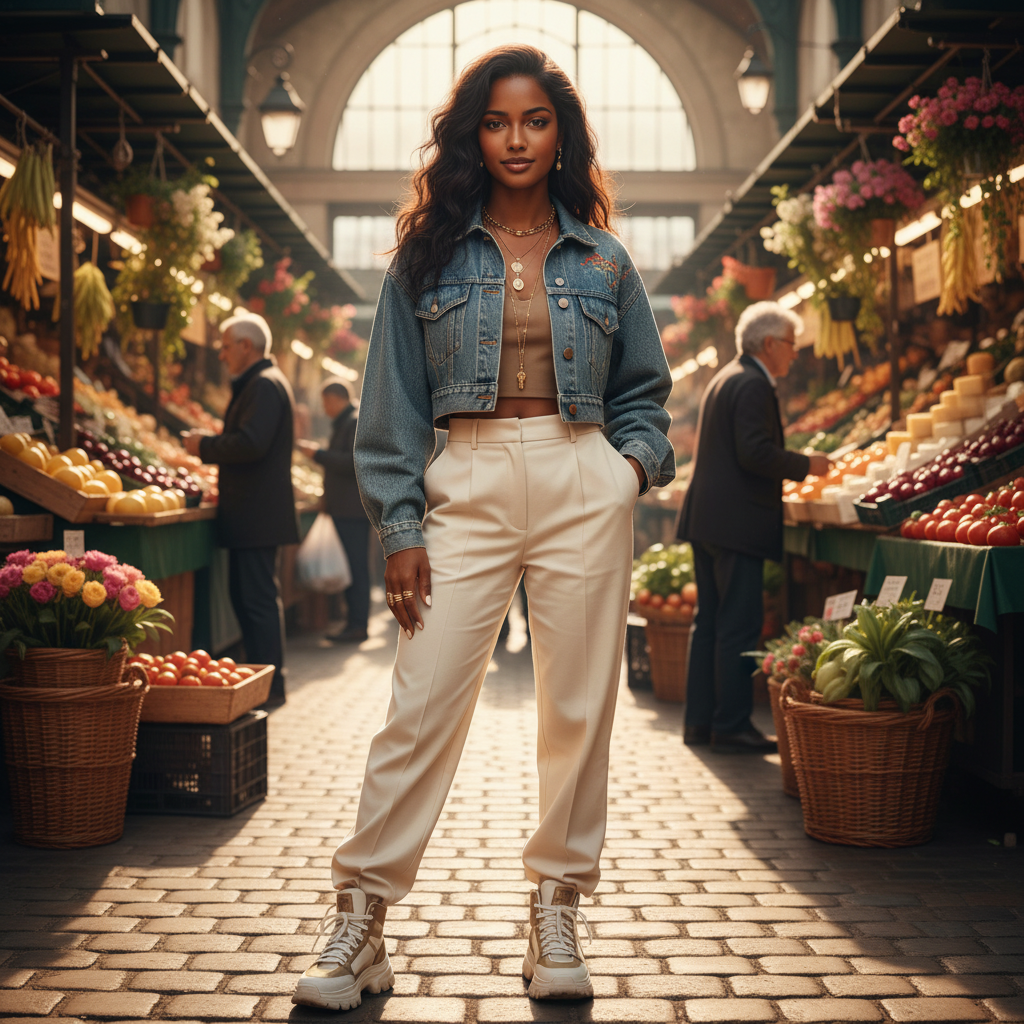
Mood: urban, diverse, confident, street-influenced elegance.
The actually current Paris.
Here is what the French girl aesthetic looks like when you stop pretending Paris is only the sixth arrondissement.
The banlieues — the suburbs and outskirts that surround the city proper — have produced some of the most vital style in contemporary French culture, and it looks nothing like a Breton stripe and a basket bag. It looks like: excellent sneakers with tailored trousers, quality oversized jackets, naturally textured hair rather than the straight-and-undone sense, and meaningful jewelry. It’s the kind of put-together-without-trying.
The le naturel principle still applies. The wardrobe pieces are just different: elevated streetwear, sport-influenced dressing, or the occasional piece referencing French-African or French-Caribbean heritage.
This variation matters because the French girl aesthetic has a representation problem that the mythology has mostly ignored.
The archetype — white, Parisian, Bardot-adjacent — excludes the majority of actual French people. Banlieue Cool is what French girl looks like when you account for the full picture: diverse, contemporary, urban style culture that does le naturel on its own terms.
Who wears it now: The generation of French women who grew up between the city and its edges, who inherited the self-possession of the archetype and built something more honest with it.
Côte d'Azur
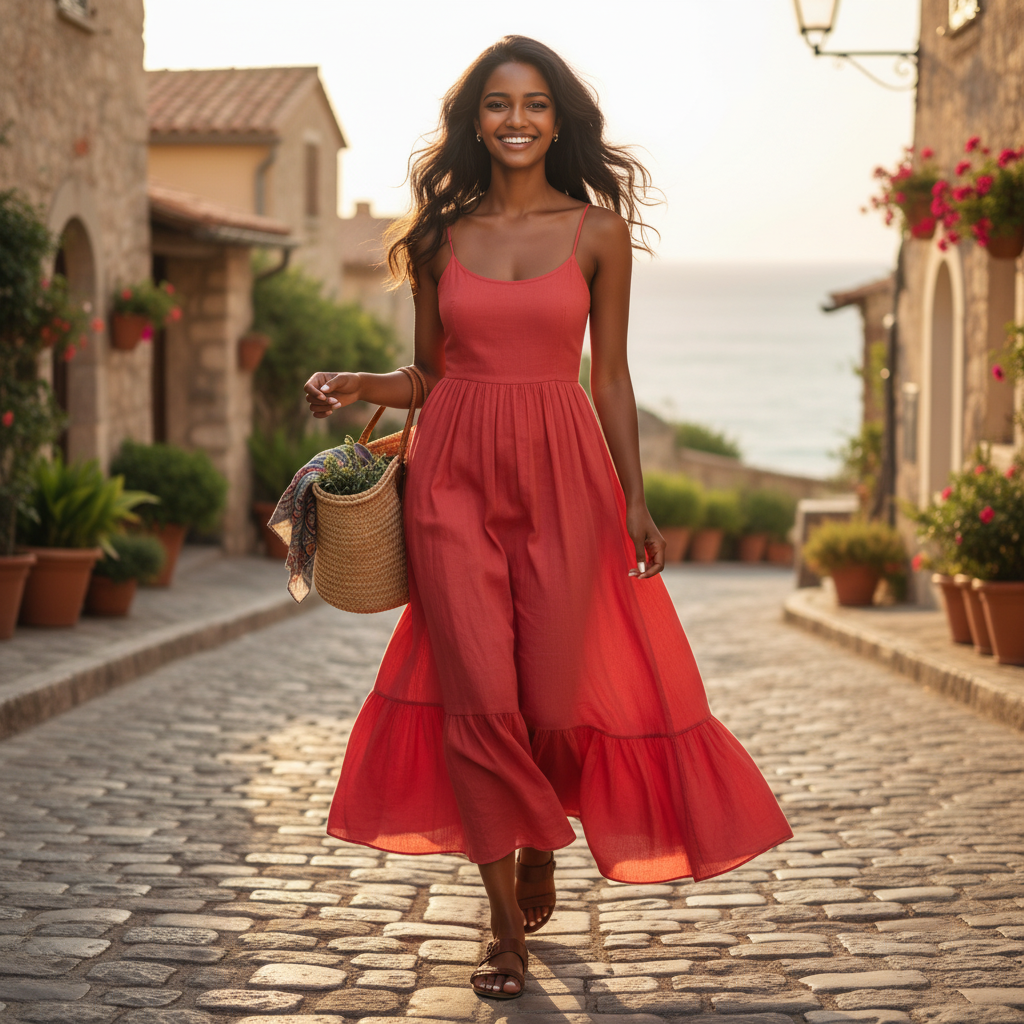
Mood: relaxed Riviera elegance.
No effort whatsoever.
French girl summer has the most lenient rules of any register in the entire system, and it earns this by being the most fun variation to wear.
Linen trousers in cream or white, slightly wrinkled. The marinière, especially in August. Espadrilles. A basket bag. A simple striped dress. Slightly oversized in a classic frame. The silk scarf in the hair, tied for approximately forty seconds before the wind does something better with it.
The palette goes lighter: white, cream, sand, navy, and the warm Mediterranean tan. Colors are allowed a degree of freedom here that only work in summer: a red sundress, a cobalt that references the sea, a yellow linen blazer.
Beauty is even more minimal: tinted SPF, sunscreen, and whatever the sun does. Lips are glossed or bare. Hair is what salt water and warm air decide together.
Who wears it now: Everyone BCBG and French girl and anyone with access to warm weather and the sense to simplify when the season permits it.
Bobo Parisienne
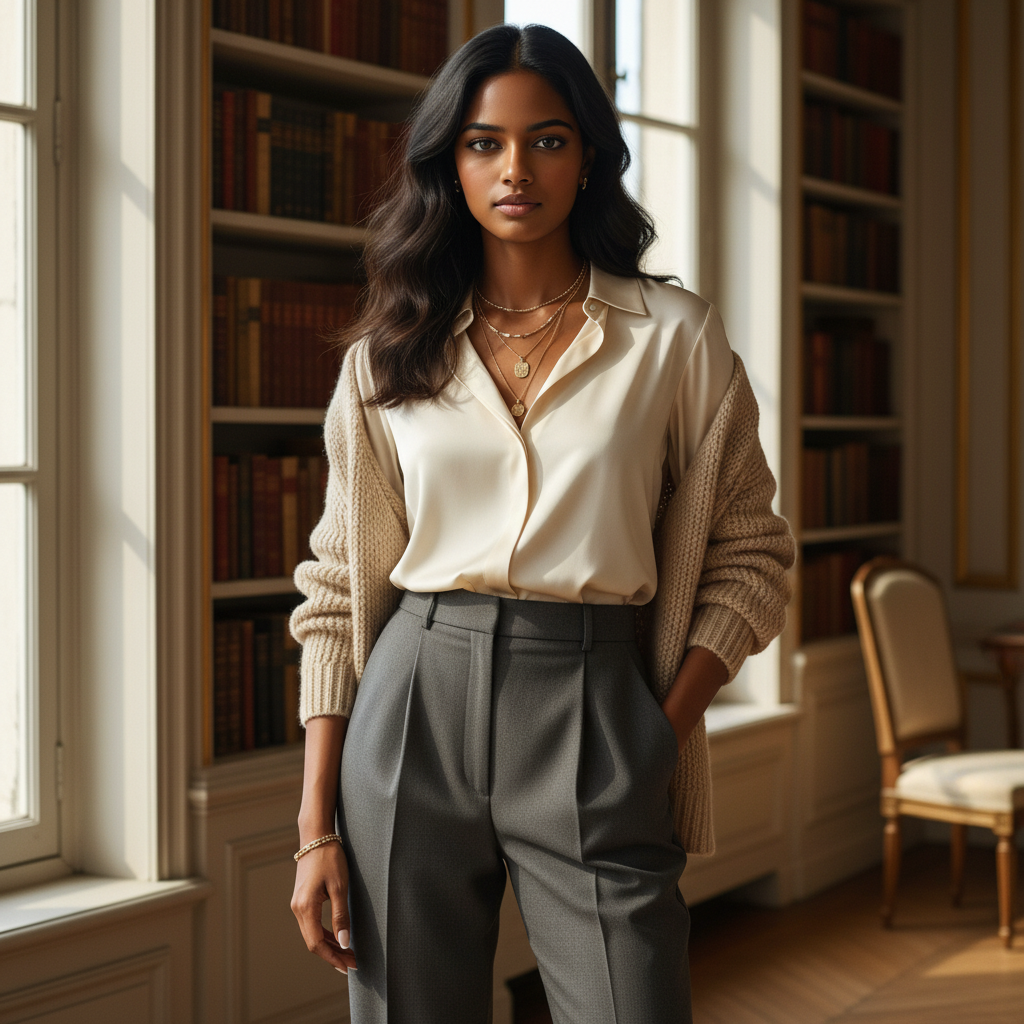
Mood: French girl × BCBG overlap.
Where French girl meets BCBG, and they discover they have the same grandmother.
Bobo is bourgeois-bohème, the Parisian type who wears money like an afterthought. She lives in a well-located apartment with too many books, shops at the organic market and also owns something from Hermès, sends her children to good schools and has strong opinions about natural wine.
The wardrobe occupies the overlap between French girl ease and BCBG quality. A tailored blazer over a soft floral dress. A silk scarf tied lazily in quality fabric. Quality vintage mixed with contemporary investment pieces.
If you've read the BCBG deep dive, you know this woman. She is BCBG Parisienne wearing her weekend self. She has the codes. She’s just stopped performing them.
Who wears it now: The French women who grew up with BCBG mothers.
The real fluency test, as always: true French girl doesn't choose one variation and stay there. She moves between them as the day, the season, and the setting require. Classique at a business lunch. Côte d'Azur in August. Rive Gauche when she wants to be the most interesting person in the room.
The pieces overlap. The values remain constant.
And the woman who has internalized the system doesn't consult a guide. She just gets dressed.
French Girl vs. Similar Aesthetics: The Family Tree
The first thing that happens when you explain French girl to someone is that they think they already know it.
"Oh — like BCBG."
"So… Clean Girl, but make it Parisian?"
"Isn't that just quiet luxury with a baguette?"
They're not entirely wrong. These aesthetics share vocabulary. They would recognize each other at a dinner party. They might even borrow each other's coats.
But they are built on different foundations, geographies, status, and what they're trying to communicate. The distinctions matter because understanding where French girl sits in the family tree clarifies what it actually is.
So. The family tree, examined with the appropriate level of competitive spirit.
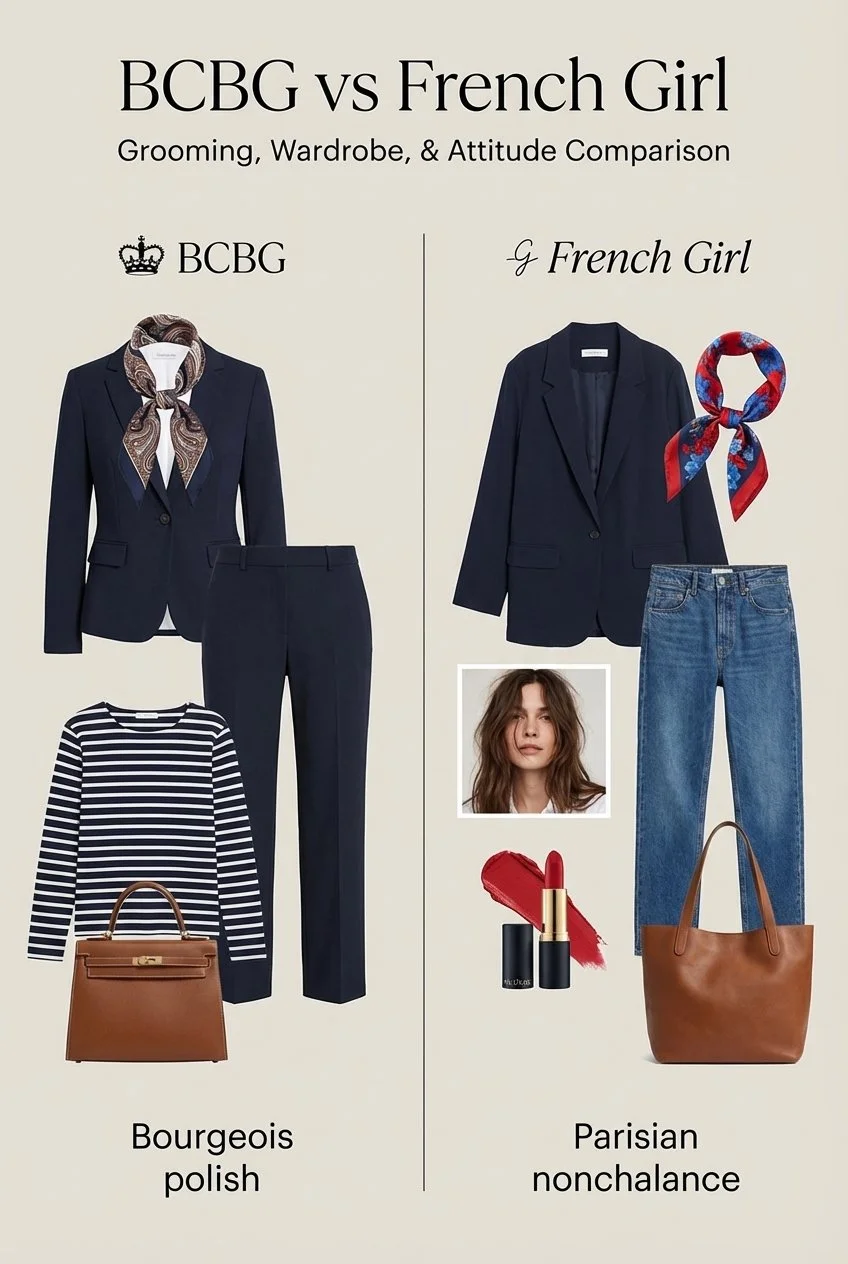
French Girl vs. BCBG
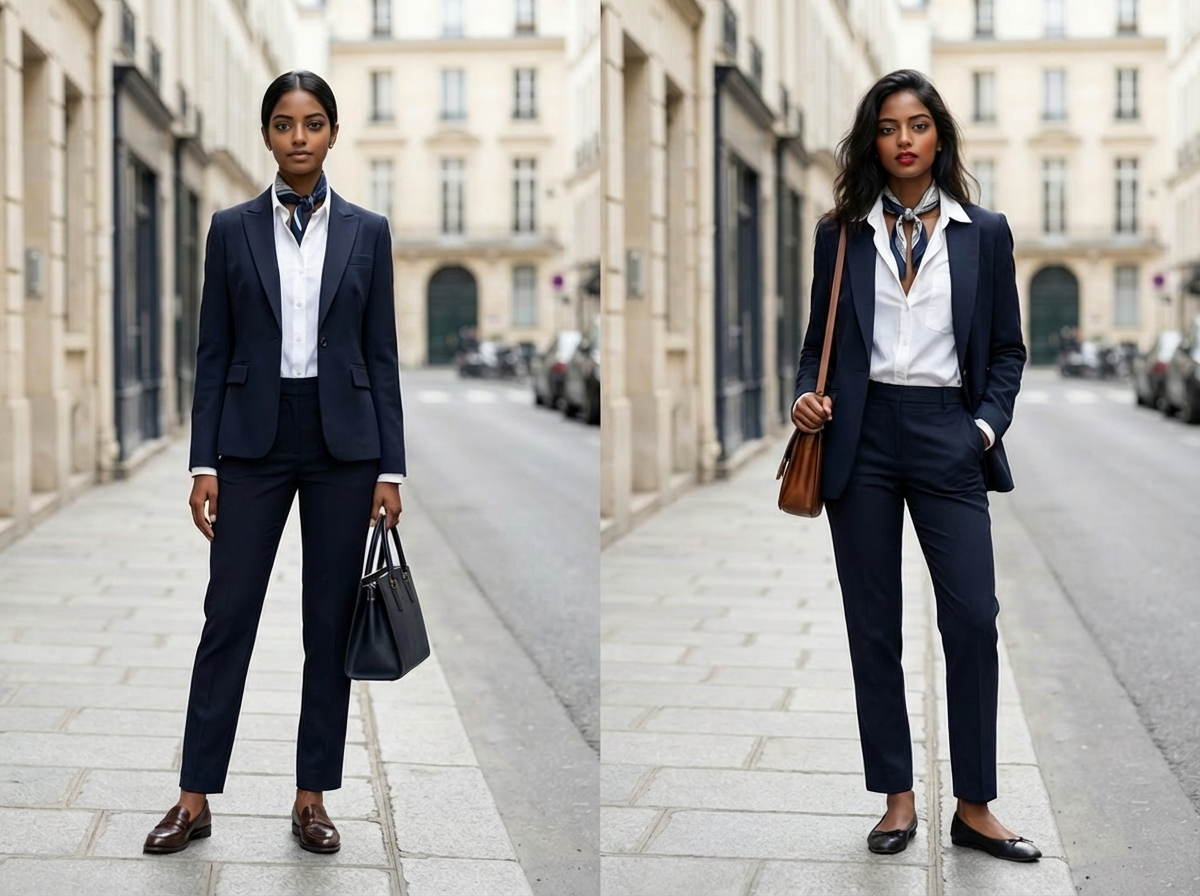
Left: BCBG Right: French Girl
Cool vs. correct.
These two aesthetics are more related than any other pairing on this list. Both are French. Both would look at home in Paris. Both own a silk scarf, navy blazer and a leather bag that cost more than seems reasonable and is worth it.
Put them in the same outfit and you might struggle, briefly, to tell them apart.
The difference is in the why.
BCBG dresses for correctness. The BCBG woman knows every rule. Her scarf is tied correctly. Her blazer is buttoned.
French girl dresses for herself. She knows the rules too — she just finds them optional. The scarf is tied without thought. The blazer is worn open. Where BCBG asks is this correct?, French girl asks is this me?
The practical difference: BCBG wears the trench coat belted properly. French girl wears it with the belt looped and the ends hanging.
The second distinction is class coding. BCBG carries the cultural weight of the French bourgeoisie. French girl's codes are more democratic. You don't need the cultural context, just the philosophy.
The third: BCBG is conservative. French girl is not. French girl isn’t interested in being appropriate. She wants to be herself which is sometimes appropriate and sometimes not, and she is comfortable with both outcomes.
Wear BCBG when: You want the cultural depth, the bourgeois codes, the system behind the wardrobe. [→ See the full BCBG deep dive for the complete guide.]
Wear French Girl when: You want the nonchalance and the philosophy without the protocol. You are dressing for yourself first and everyone else second, in that order, without apology.
French Girl vs. Old Money
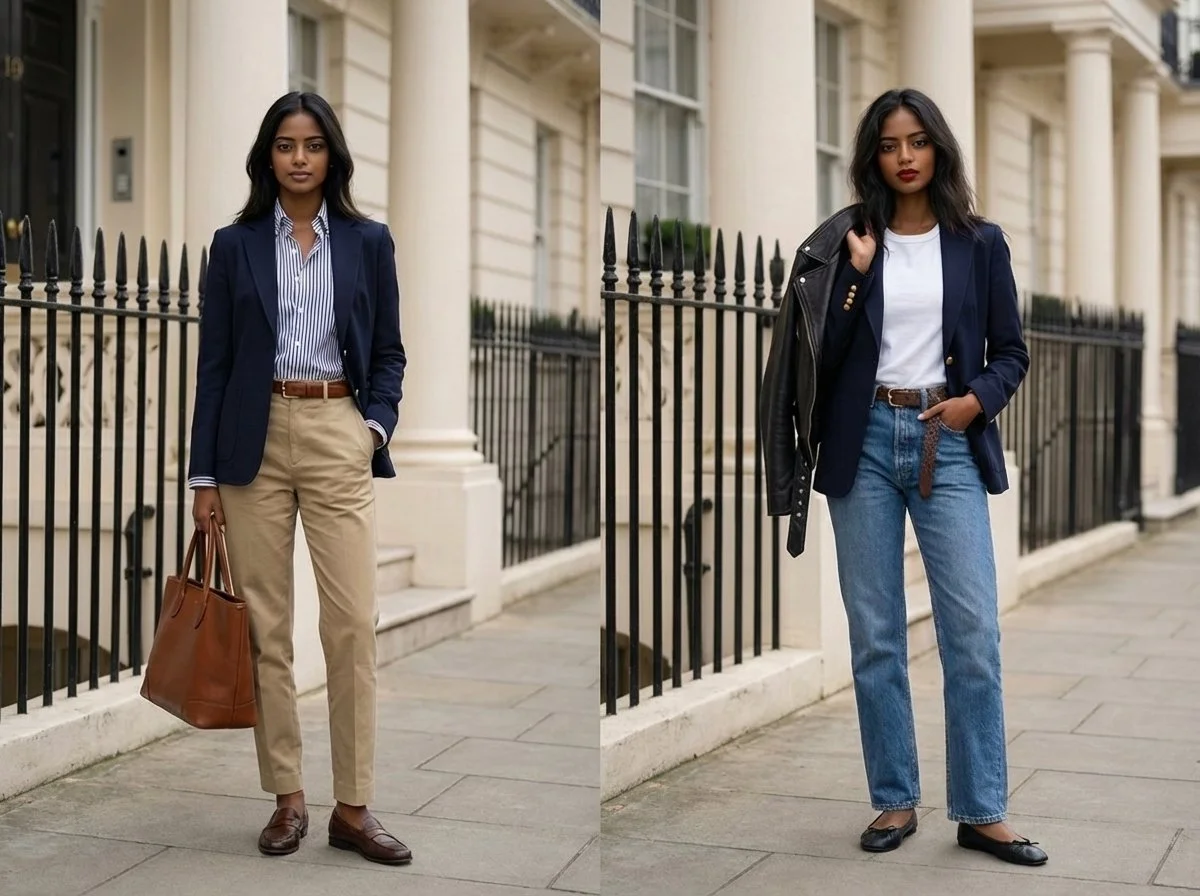
Left: American Old Money Right: French Girl
Nonchalance vs. establishment.
Both aesthetics communicate wealth without announcing it. Both treat understatement as confidence. Both would rather be caught dead than caught in a logo tee.
Old Money is American. Northeastern WASP, East Coast establishment, the prep school and country club codes that signal not just wealth but the variety of wealth that predates the need to prove itself. The worn Barbour. The scuffed boat shoes. The khakis that have been through a summer and show it. The message: we have so much that we don't need to try.
French girl's nonchalance is not that of inheritence, but of self-possession. The French girl may or may not have money. The message is not "I have things." The message is "I know who I am."
Old Money wears the broken-in blazer because it was her grandmother’s and replacing it would be crass. French girl wears the broken-in leather jacket because it has been everywhere with her.
Both look like they didn't try. The reasons are completely different.
Wear Old Money when: You want the American establishment codes, the preppy heritage, the freedom someone who summers as a verb.
Wear French Girl when: You want self-possession over inheritance, personal history over institutional lineage, Parisian cool over East Coast establishment.
French Girl vs. Clean Girl
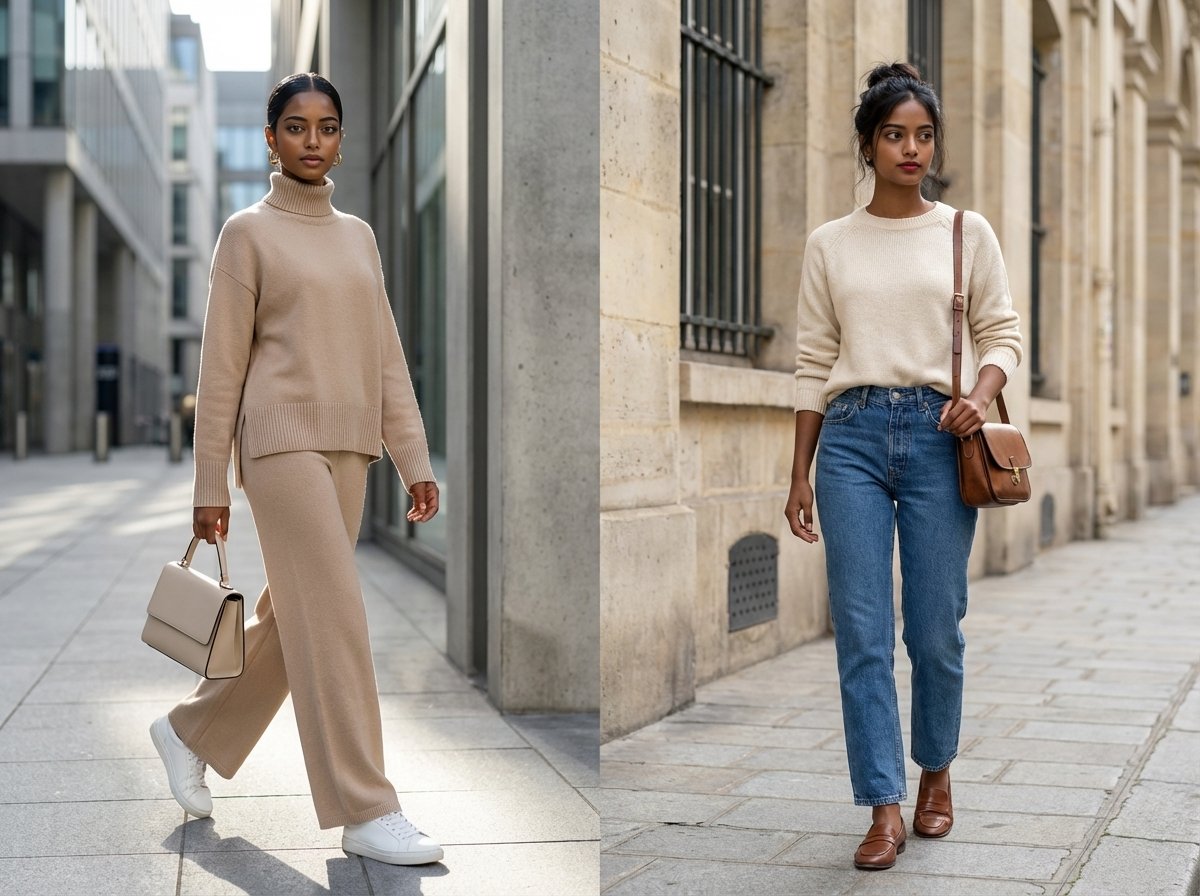
Left: Clean Girl Right: French Girl
Natural vs. polished natural.
These two get confused constantly, and that’s understandable. Both aesthetics center effortless, healthy, unadorned beauty.
The difference is in the direction of the effort.
Clean Girl is polished. The slicked bun is perfect. The skin is glowing in a product-assisted way. The wardrobe is matching neutrals and coordinated basics. Clean Girl highly curated.
French girl is disheveled. The chignon has escaped. The skin looks good because she has taken care of it for years, not because she applied three serums this morning, or maybe she did, and you'll never know. The wardrobe has personality: a vintage piece, a scarf that goes with nothing and everything, the one interesting thing she found at a market.
Clean Girl is contemporary. French girl is timeless. Clean Girl photographs beautifully. French girl will look the same in twenty years because it looked the same twenty years ago.
Clean Girl wears no-makeup makeup French girl wears actual no-makeup makeup.
Wear Clean Girl when: You want the contemporary, social-media-native version of effortless. The aesthetic that reads immediately and photographs consistently.
Wear French Girl when: You want the look that rewards being seen in person rather than photographed, improves with proximity, and looks better at sixty than at twenty-six.
French Girl vs. Quiet Luxury
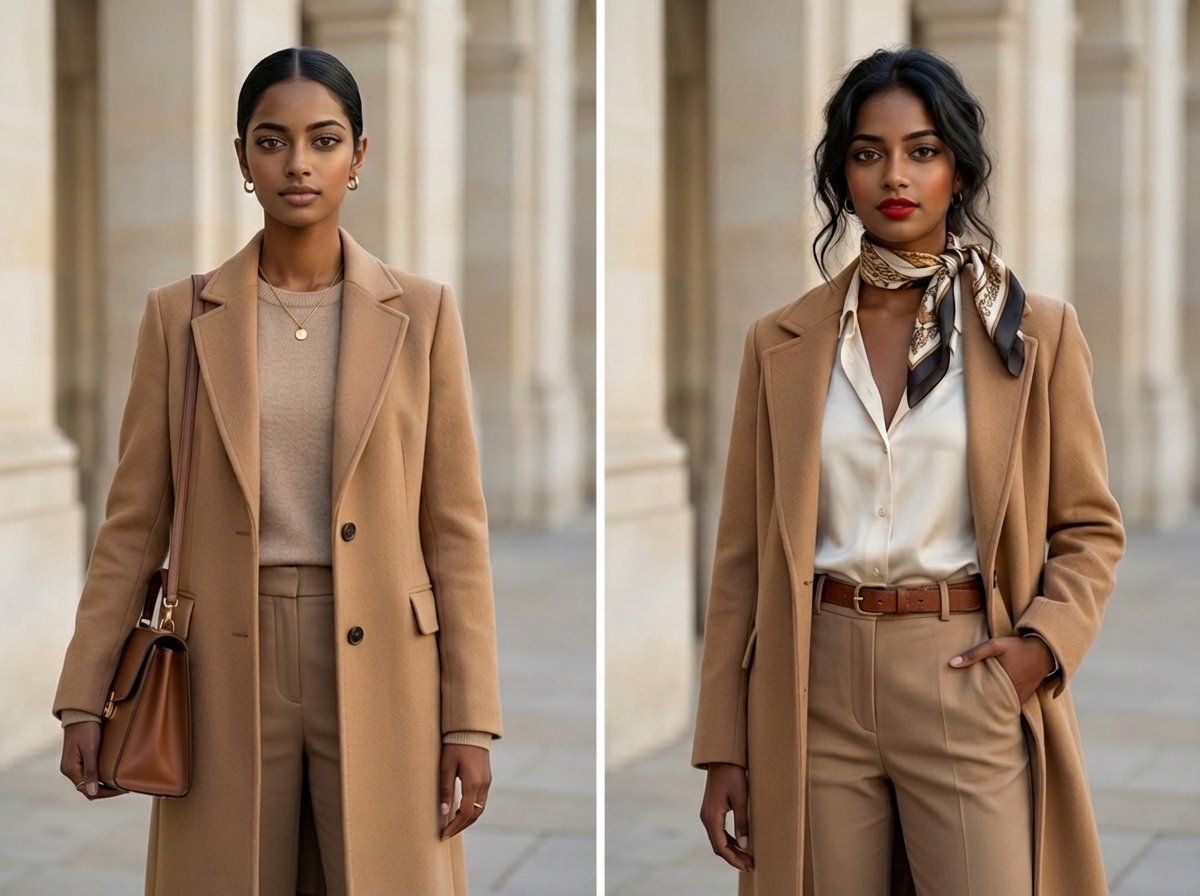
Left: Quiet luxury Right: French Girl
Personality vs. restraint.
Quiet luxury arrived as a reaction to logomania. Its visual language, muted tones, excellent cashmere, clean tailoring, describes much of the same territory as French girl, which is how the confusion started.
Here is the essential distinction: quiet luxury is defined by what it removes. French girl is defined by what it keeps.
In quiet luxury, the goal is visual minimalism and implied status. Every piece looks like it was selected by someone with excellent taste and no personality, which is either the height of sophistication or a mild concern, depending on your perspective.
French girl keeps the personality. The vintage find. The interesting fragrance. The red lip. French girl is restrained but not blank.
Quiet luxury is mood board. French girl is the person who would find the mood board exhausting.
The second distinction is cultural specificity. Quiet luxury can be worn anywhere and by anyone. It translates globally because it has no specific cultural roots. French girl has geography, history, and cultural philosophy.
Wear Quiet Luxury when: You want the clean lines without the codes, the restrained palette without the cultural backstory. The aesthetic that travels without explaining itself.
Wear French Girl when: You want the whole thing…the philosophy, the cultural depth, the personality that quiet luxury edited out.
French Girl vs. Boho
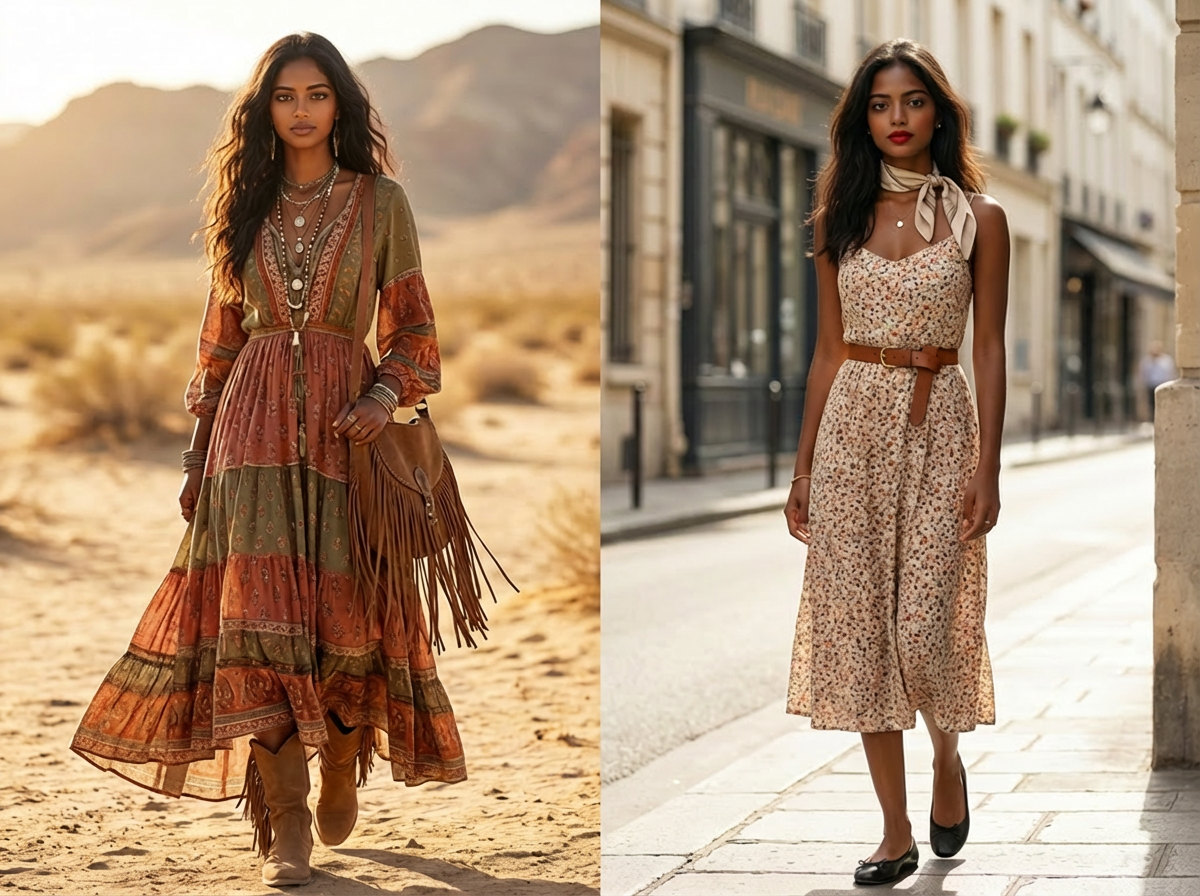
Artful undone vs. intentional undone.
At first glance, these aesthetics share a lot. Both embrace the undone, the imperfect, the appearance of having better things to do than coordinate an outfit.
The difference is in the attitude.
Boho leans into the soft, the layered, the textured, the spiritual-adjacent. The palette is warm and earthy but rich — ochre, terracotta, deep turquoise, the colors of markets in Marrakech and festival fields in August. The silhouettes are loose and layered, prints are present and bold, and the overall effect is lush in a way that French girl never is.
The second distinction: Boho is maximalist. It wants you to see the personality. French girl would prefer you sense it. Boho announces. French girl withholds.
Both have a relationship with self-expression. They are extroverted and introverted versions of the same underlying impulse: I want my clothes to say something about me. Boho says it generously. French girl says it quietly, over time.
Wear Boho when: You want richness, layering, color, and the maximally personal wardrobe.
Wear French Girl when: You want restraint as self-expression, the look that gets better the longer someone looks at it.
The Honest Answer
These aesthetics communicate different things about different values, and the best wardrobe is the one built around the ones you hold.
French girl is the most demanding of this group. Not financially, not really in effort, but in self-knowledge. It requires knowing what you like and wear and editing everything else away. It requires being interesting to yourself before being interesting to anyone else.
Which is either the most elegant philosophy in this entire family tree.
Or a very sophisticated way of justifying the fact that she was always going to wear the turtleneck and the straight-leg jeans.
French girl would accept both interpretations, and not explain herself.
How to Know If You're Ready for French Girl
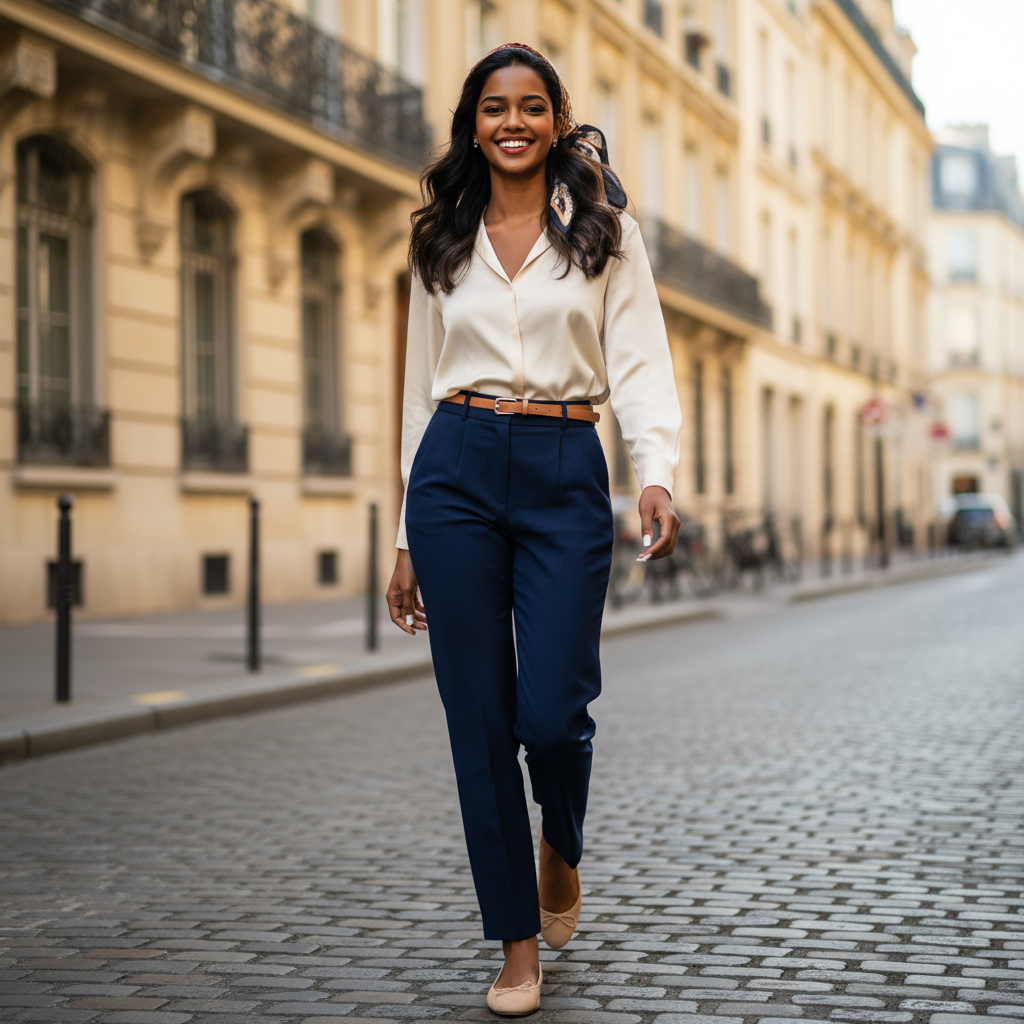
French girl is not hard in the way trends are hard.
It doesn't require a shopping list, a flight to Paris or a working knowledge of French cinema, though that last one doesn't hurt.
What it requires is something quieter, and for many people, more difficult.
The following questions are not a checklist. They are an honest diagnostic. Some people arrive at French girl at twenty-three. Some circle back after exhausting every look on the internet and find it waiting, patient and unchanged, exactly where they left it. Some never arrive at all, which is fine; there are other aesthetics better suited to what they're after.
But if you've read this far and something has been resonating, these are the real questions.
Are you comfortable with imperfection?
Not philosophically comfortable, actually comfortable.
French girl requires a tolerance for things unfinished. The undone is intentional, which means that the impulse to fix, smooth, and correct must be resisted rather than followed.
If you straighten your collar reflexively every time you pass a reflective surface, French girl will give you anxiety.
Reach the point where imperfection is personality.
Do you own one thing you love, or ten things that are fine?
Is there one item that you reach for because it is yours in some special way?
Or does your wardrobe consist of things that just…work?
French girl is built on one excellent thing at a time and accumulated slowly until you only own what you truly care about. Ten things that are fine will never produce the French girl effect. The thing you truly love, worn with the right pair of jeans and the right shoes and nothing else, will get there immediately.
Are you dressing for yourself?
Be honest.
Are you dressing for the room? The photograph?
French girl dresses for herself. Not as a statement, but because self-possession is the aesthetic. She wears her clothes because she likes them and they’re comfortable.
This doesn’t mean carelessness or neglect, just that your primary audience is yourself. Otherwise, French girl will leave you unsatisfied.
French girl doesn’t depend on outside validation. It rewards your internal standard. Building that standard takes time, practice, and the security to not get compliments and be okay with that.
The Honest Answer
You are ready for French girl when you’re not depending on your clothes for external validation.
Not when you own the right pieces. Not when you have mastered the undone chignon or found the perfect red lip. Those things are useful, but they aren’t the goal.
French girl is the aesthetic you arrive at when you have made a quiet, private peace with who you are.
It is a relationship with yourself that produces a specific, recognizable finished product.
Some people arrive at it at twenty-three. Some arrive at forty-five after a decade of trying everything else.
French girl is not the beginning of a style journey. It's what happens when you've had one dnd decided, finally, that you already know enough to just get dressed.
