
The Boho Aesthetic: When Your Wardrobe Has a Wanderlust Problem
When Vanessa Hudgens posted her 2024 Coachella outfit (stacked turquoise, leather vest worth four months' rent), the comments agreed on one word: boho. But what they were actually naming was the corpse of counterculture, dressed up and ready for sponsored content.
Today, what most people imagine to be Boho is cosplaying a 1960s folk singer who somehow has a Sephora rewards card and an Anthropologie credit line. Between the fringe kimono and jade roller lies the promise of looking ethereal while secretly being high-maintainance.
The Cultural Origins of Bohemian Style: A Complete History
When Roma people began arriving in Western Europe in the 15th century, the French assumed they had come from Bohemia — the region that is now the Czech Republic — and called them bohémiens.
The assumption was wrong. The name stuck anyway.
Over the next few centuries, bohémien became a label for anyone who refused to play by bourgeois rules.
-
Bohemian style is an eclectic approach to dressing that draws on global textiles, natural materials, and folk traditions.
Where Bohemian Style Began: The 19th-Century Origins
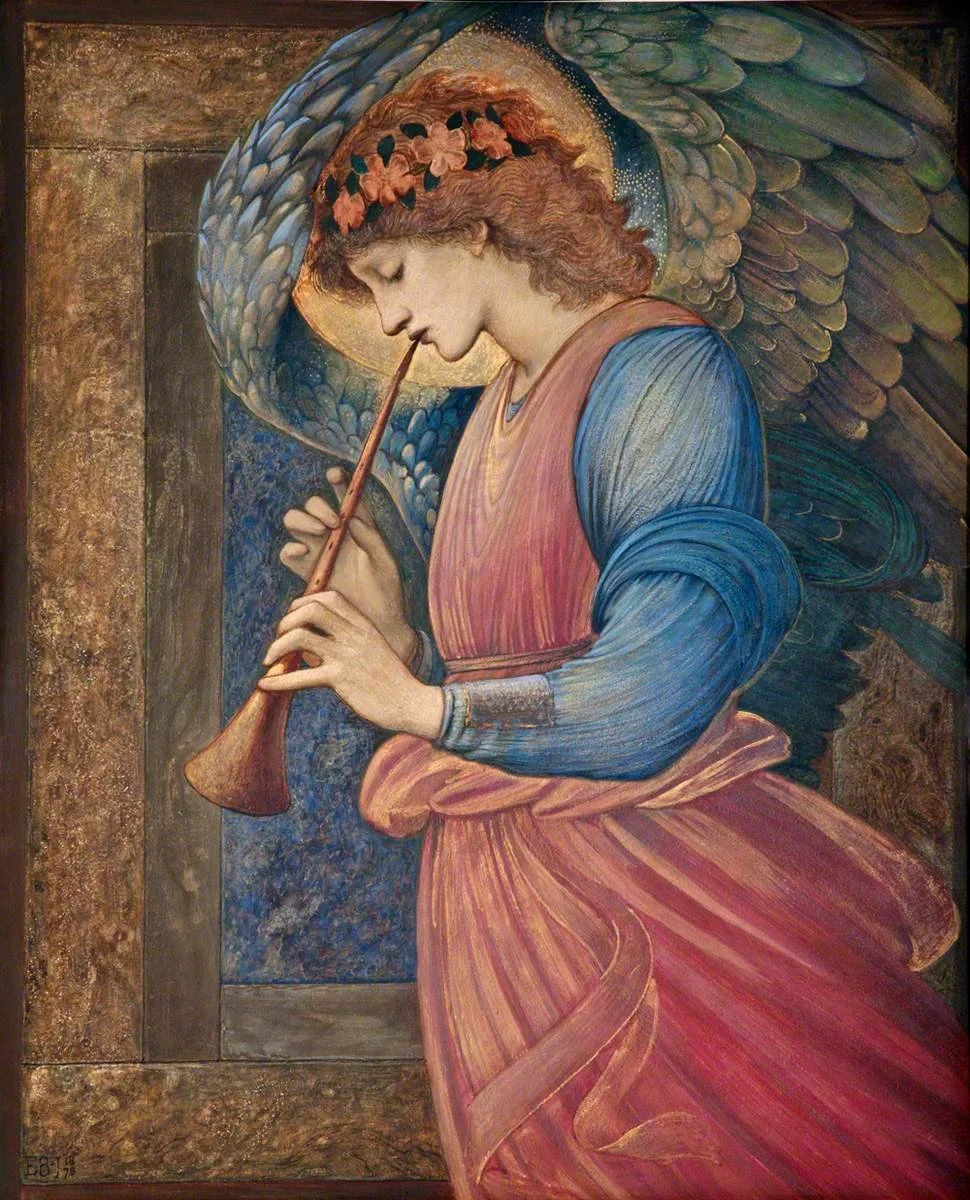
Edward Burne-Jones (1833-1898) - Angel Playing a Flageolet
In 1840s Paris, artists and writers clustering around the Left Bank developed a look that was, by the standards of bourgeois France, disheveled: loose shirts, old velvet jackets, cloaks, berets. The original bohemians dressed the way they did because they couldn't afford to dress otherwise.
Henri Murger's Scènes de la Vie de Bohème — published in 1851 and later adapted into Puccini's La Bohème — romanticized this existence and sent it into the cultural bloodstream of Europe.
Across the Channel, the Pre-Raphaelites made similar arguments in paint and in dress. Their models wore loose gowns in jewel tones and medieval silhouettes.
Bohemian dress has always been a costume of refusal. Against the corset. Against the office. Against the algorithm. The garments changed but the philosophy didn't.
-
The word bohemian derives from the French bohémien, originally used to describe Roma people who were mistakenly believed to have come from Bohemia (modern-day Czech Republic).
Over time it evolved to describe artists and writers living outside mainstream society, and eventually became synonymous with a free-spirited, eclectic approach to dress and lifestyle.
1960s–70s Bohemian Fashion: How the Visual Language Was Built
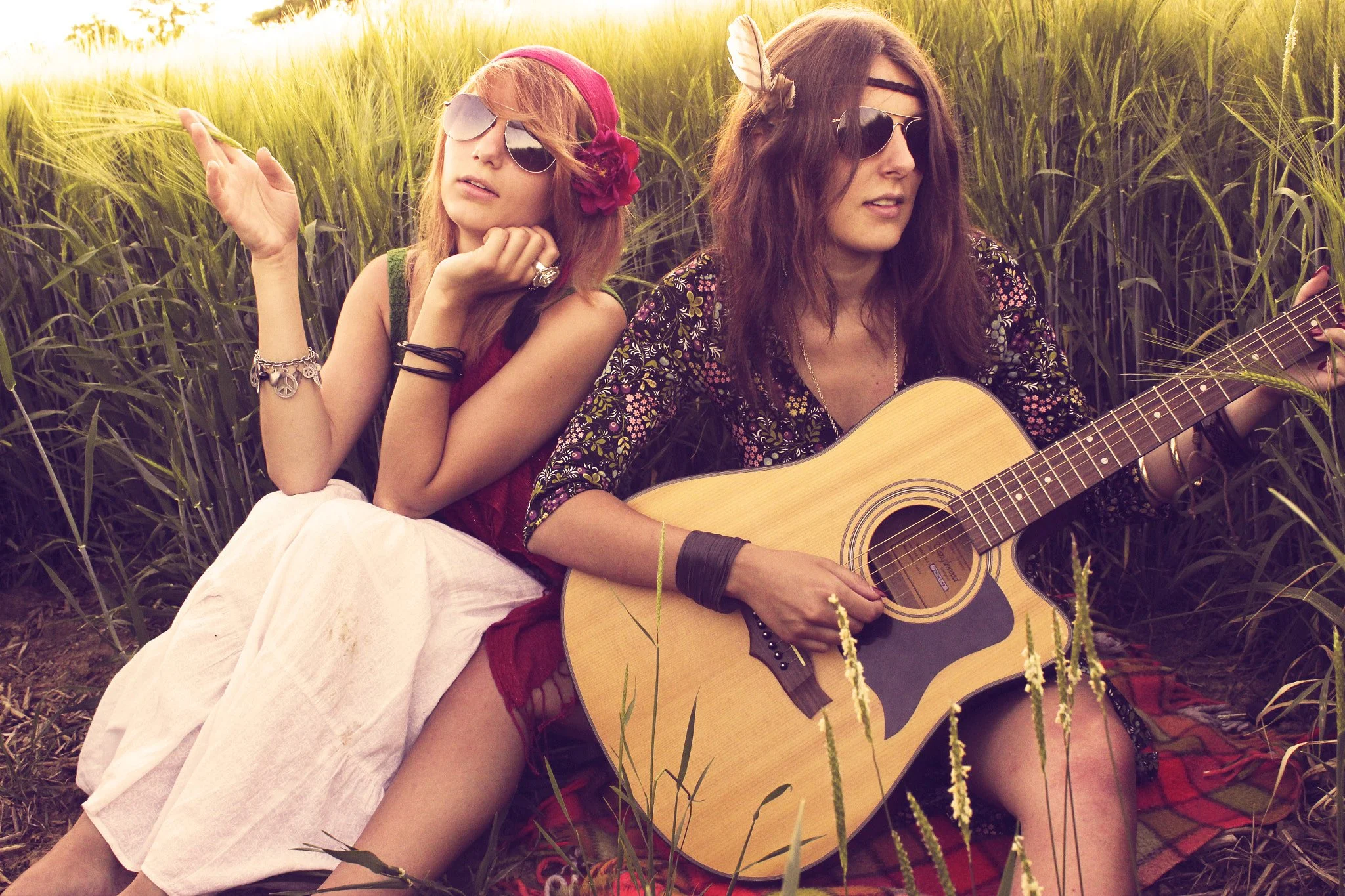
Gina B. 500px provided description: Hippie Sister
The counterculture built its wardrobe from army surplus (cheap and symbolic), thrifted clothing, and imported textiles from India, Morocco, and Afghanistan.
Woodstock gave boho its origin story. Coachella gives it its content calendar.
Woodstock in 1969 functioned as boho's cultural shorthand in the same way Coachella does now. The difference? Woodstock gave boho its origin story. Coachella gives it its content calendar.
But the icons refined it.
Janis Joplin took velvet and fur and Victorian lace and made them speak a language fashion hadn't heard before.
Stevie Nicks built an entire, mystical persona out of chiffon layers, platform boots, and a shawl worn as if it were a second skin.
Talitha Getty, photographed by Patrick Lichfield on a Marrakech rooftop in 1969 in a kaftan and wide-leg trousers, produced the image that fashion editors turn to fifty years later for a bohemian reference.
-
Boho chic was popularized in the early 2000s primarily by Sienna Miller and Kate Moss, who were frequently photographed at Glastonbury and other British cultural events wearing vintage pieces, layered jewelry, and eclectic combinations.
Stylist Rachel Zoe and the Olsen twins simultaneously developed a parallel American version of the aesthetic.
The Boho Chic Era: How the 2000s Commercialized the Aesthetic
Bohemian style went underground for thirty years. When it resurfaced, it had a trust fund.
The Glastonbury Festival that had run since the 1970s hit its cultural peak in the early 2000s. This produced a new version of bohemian that was more glamorous…and expensive. In other words: boho chic.
Sienna Miller at Glastonbury in 2004 sold more vintage jewelry than any marketing campaign. The Olsen twins developed their avant-garde version with oversized pieces. Rachel Zoe styled Hollywood clients in flowing gowns and stacked bangles.
Free People launched in 2002 and built an entire brand identity around a commercialized bohemianism. Anthropologie did the same, slightly upmarket. Urban Outfitters colonized the student-budget end. Spell & the Gypsy Collective in Australia built a cult following around limited-edition boho pieces.
Boho Style Today: Coachella, the Algorithm, and What Comes Next
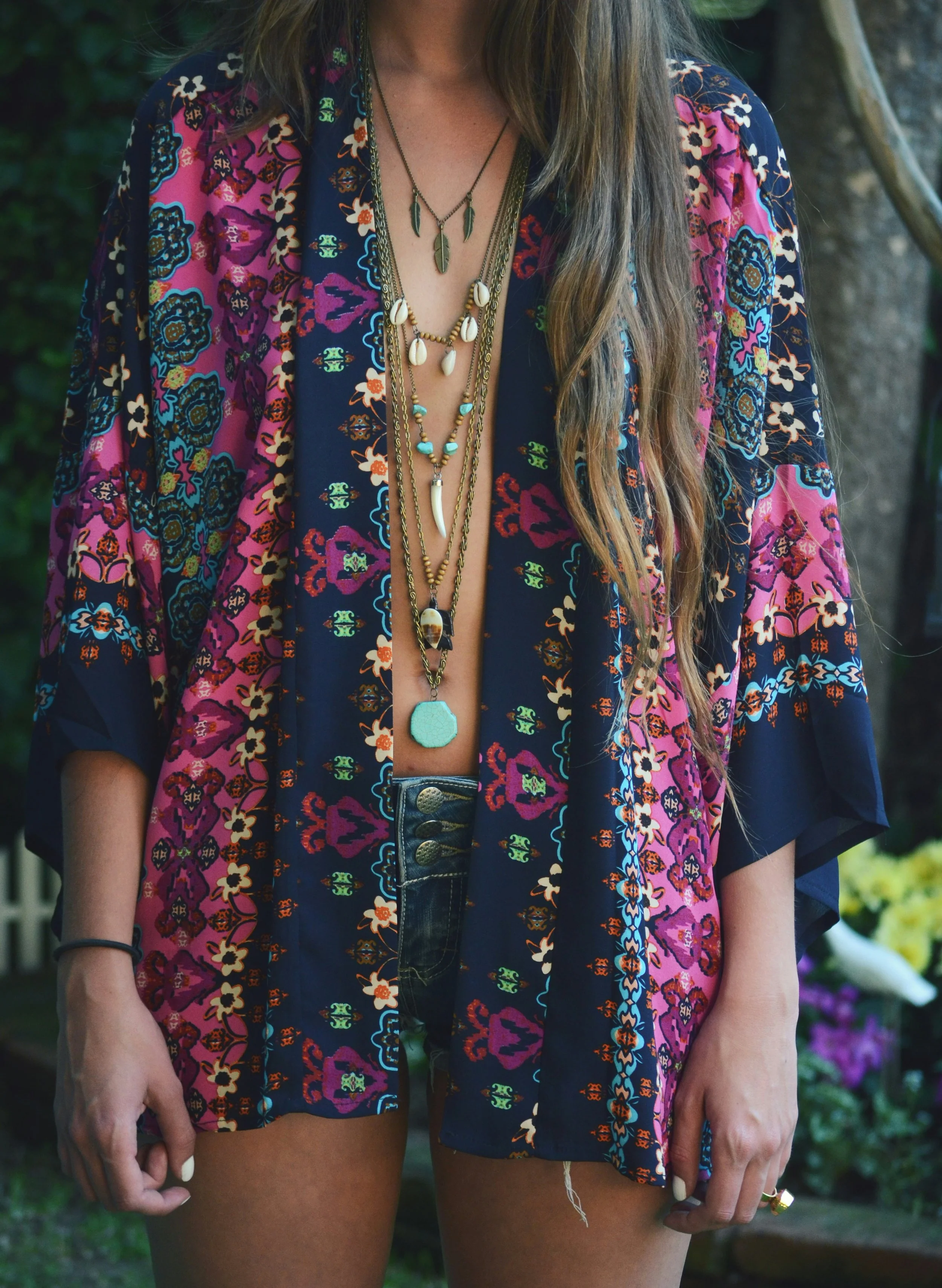
Photo by Nicol Castillo on Unsplash
Every April, search interest in "boho outfit," "festival fashion," and "bohemian style" spikes to its annual peak, then recedes. Pinterest saves of boho content follow the same pattern. The aesthetic is now, in part, a seasonal content event, largely thanks to Coachella.
But the more interesting story is what happened to boho between the Coachella spikes.
The aesthetic has fractured into a family of sub-aesthetics like Desert Boho, Coastal Boho, Boho Minimalist, Bohemian Romantic, and Global Boho, to name a few.
There's also a sustainability argument that has given modern boho renewed cultural legitimacy. The aesthetic's longstanding preference for natural fibers, vintage and secondhand pieces, handmade goods, and locally produced crafts aligns with the values of the slow fashion movement.
Boho was thrifting before thrifting was a content category.
The counterculture is now the algorithm. But the algorithm, it turns out, has good taste in some things.
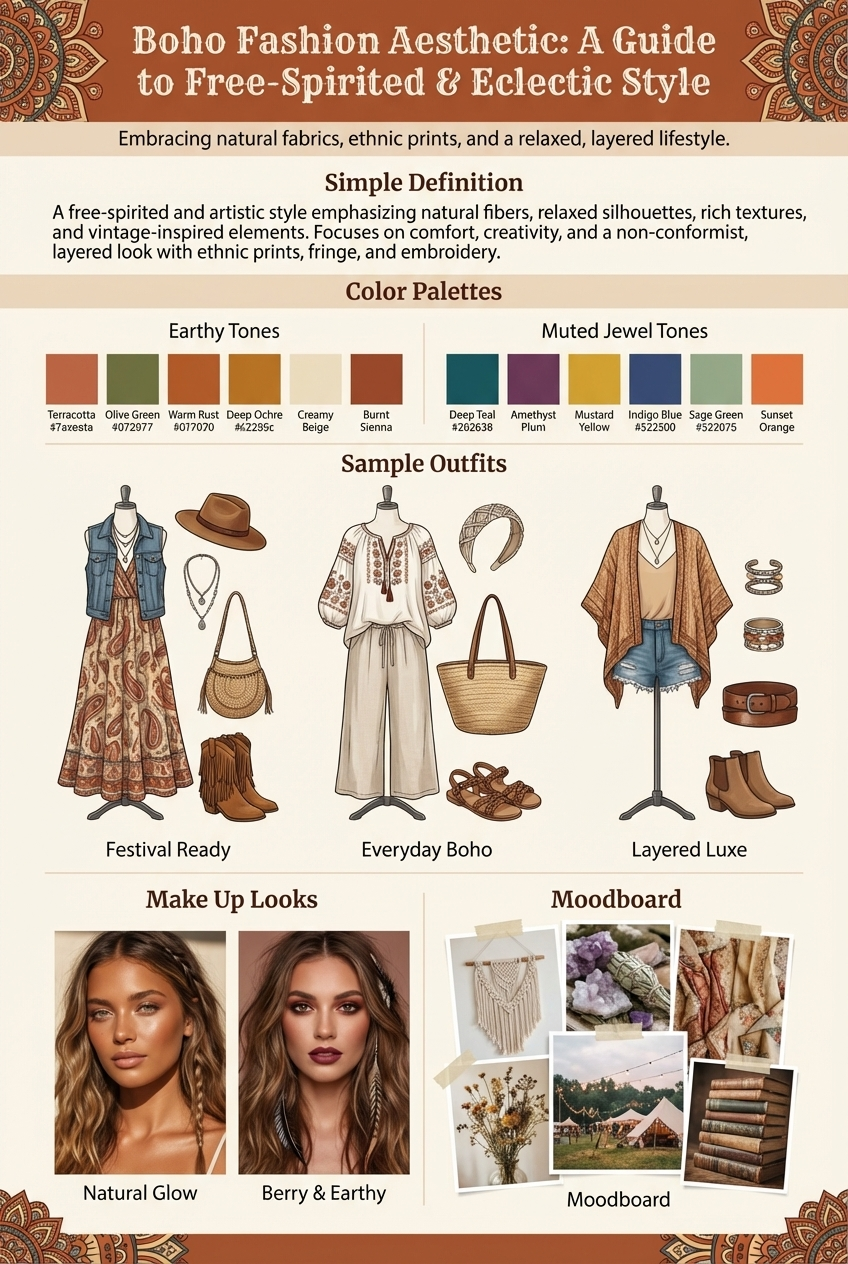
The Bohemian Aesthetic: What Boho Style Stands For
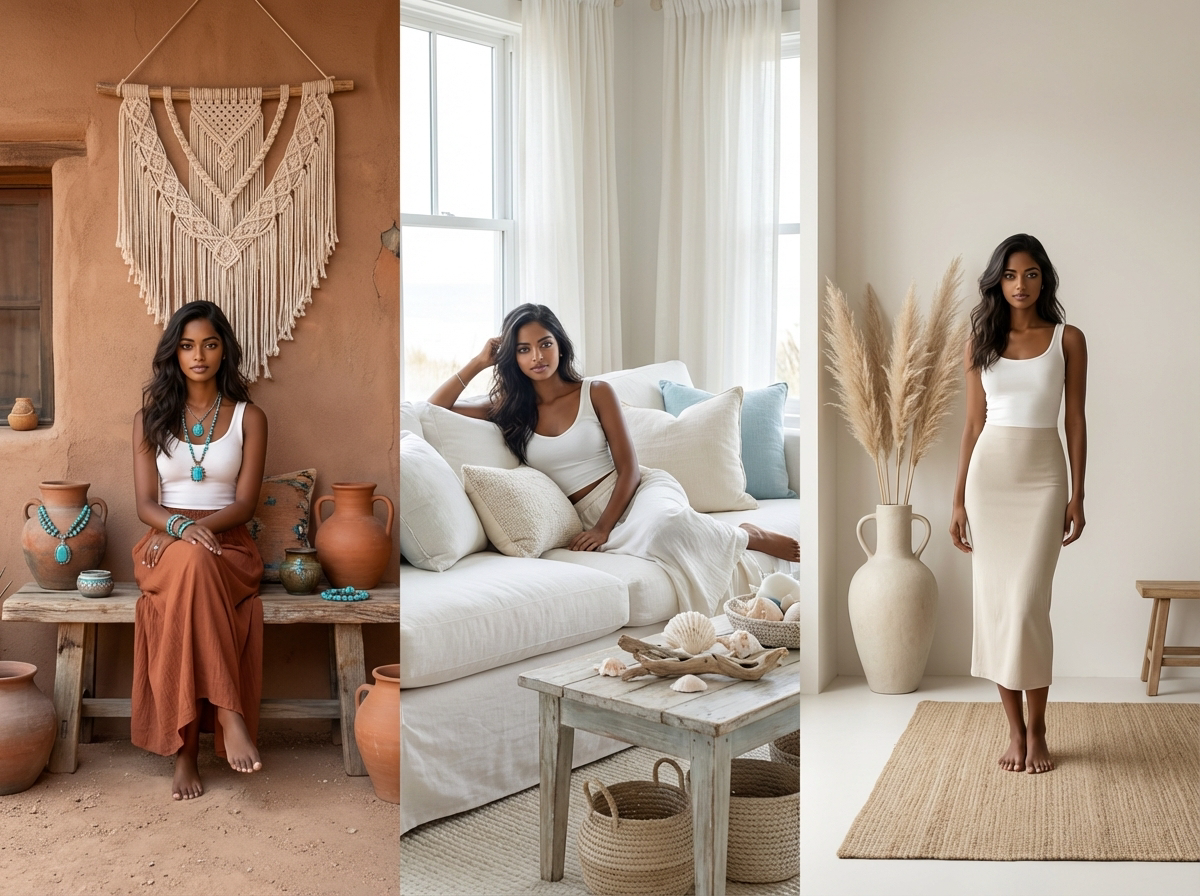
Boho isn't one thing anymore. Desert Boho, Coastal Boho, Boho Minimalist
I received an ad from Free People for an eyelet peasant blouse for $425.
The description said, “hand faded” and “distressed”. Natural fibers and “up-cycled vintage”.
It will be on sale in six weeks. By next spring, it will be in a landfill or a donation bin, which raises the question about what "bohemian" means when you can buy it on a payment plan.
Why Eclecticism Is the Foundation of Bohemian Style
Bohemian style represents a rejection of mainstream fashion conventions in favor of eclecticism, natural materials, handcrafted goods, and a wardrobe built on personal history rather than seasonal trends.
The defining move of bohemian dressing is mixing things that don’t go together. A Victorian lace blouse with broken-in denim. A Moroccan-inspired print with a vintage American belt. A silk slip dress with a hand-knit cardigan.
Why Bohemian Style Favors Handmade Over Mass-Produced
Bohemian style has a longstanding preference for things made by hand. This has roots in the Arts and Crafts Movement of the late 19th century, which was a reaction against industrial mass production.
Irregularities in a handwoven textile or a unique artisan jewelry piece. Call those flaws if you want, but they're the entire argument against buying boho at H&M.
This is also where the aesthetic finds its best argument against fast fashion. Mass-produced "boho" is a category error. The aesthetic is opposed to the conditions that produce it.
-
Bohemian style is one of the more sustainable mainstream aesthetics because its core values (quality over quantity, vintage and secondhand over new, handmade over mass-produced) resist disposable fashion.
However, a commercialized boho market also exists, and navigating the difference between the philosophy and the product is part of engaging with the aesthetic.
How Travel Shapes the Bohemian Wardrobe
Someone who has been somewhere is bohemian style. The aesthetic already has the aspiration in it.
This travel-like quality is part of what gives boho its visual richness. A wardrobe of items from different cultural backgrounds looks richer than one from a single aesthetic, even a sophisticated one.
For a long time, Bohemian style has used other cultures as inspiration. A white woman in a Navajo-print kimono at Coachella is shopping, not exchanging culture. The difference matters, and boho's track record on this is bad enough that pretending otherwise would be dishonest.
Why Boho Rejects the Trend Cycle
Even though that Shein duster and the fifteen-year-old one from the estate sale look the same, the estate sale one has more value. One has a story. The other has a barcode.
This is also why boho ages so well. Things chosen for quality and character rather than trend-relevance date differently. The 1970s boho photographs still look great today because the women wore things they loved, not just because they were in season.
In this sense, boho is one of the more sustainable aesthetics because its core values don’t support fast fashion.
The Boho Paradox: Can You Buy a Non-Consumerist Aesthetic?
Free People charges $400 for the look of not caring about money (even though they clearly do). Spell & the Gypsy Collective sells the look of accumulated travel. The boho economy is large, profitable, and directly against the boho philosophy.
You can buy the aesthetic without the philosophy. Most people do.
But if you're going to claim the philosophy, then buying a $400 mass-produced peasant blouse and calling it bohemian is just expensive cognitive dissonance with good lighting.
-
Yes. In fact the most authentic version of boho dressing prioritizes secondhand, vintage, and thrifted pieces over new purchases.
Boho’s original practitioners dressed from necessity and made it a virtue.
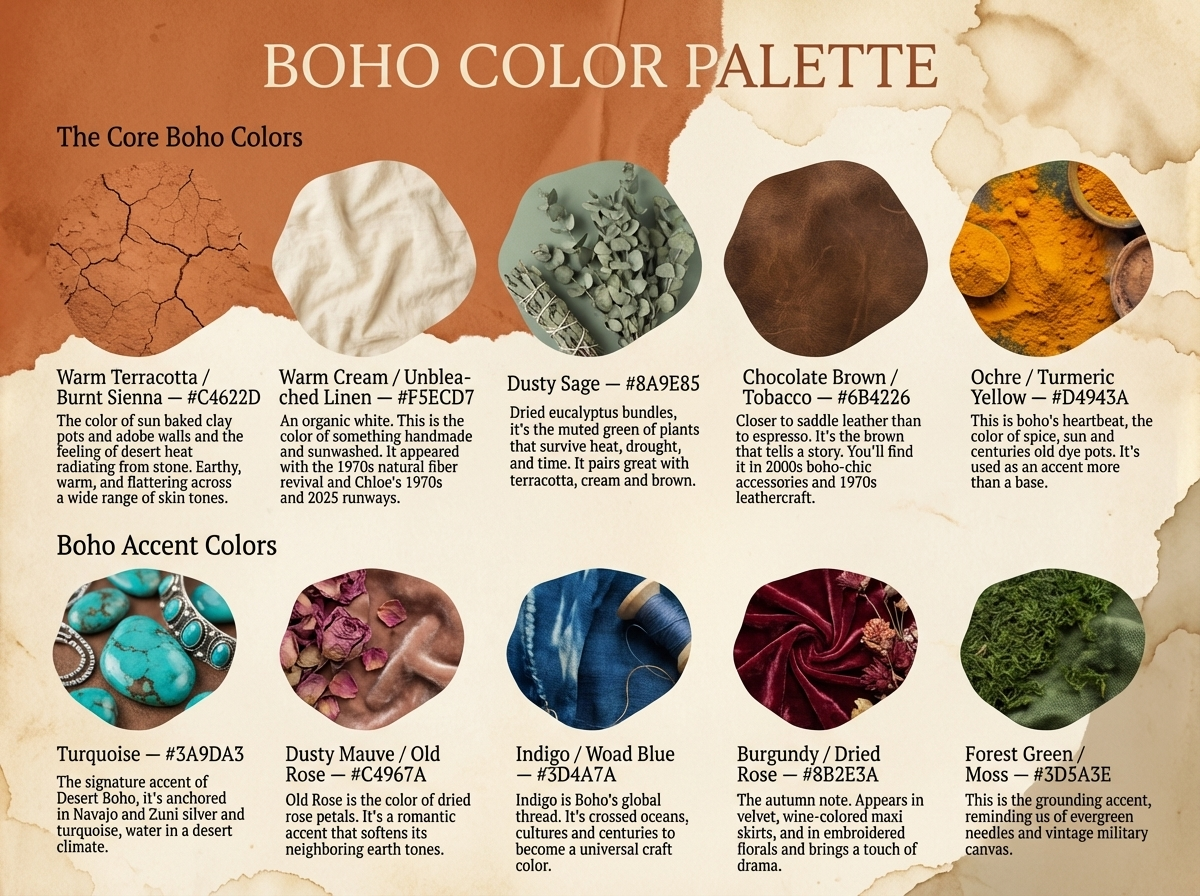
The Bohemian Color Palette: Every Color, Hex Code, and Combination
Patrick Litchfield’s 1969 photo of Talitha Getty is the blueprint for modern boho fashion. Getty wore a colorful Marrakech Caftan with burnt orange, saffron yellow and deep red with gold embroidery. Her setting on the sand-toned Moroccan roof completed the aesthetic. It made “earth-toned” glamour inspiration that showed in both fashion and decorating.
The Core Boho Colors
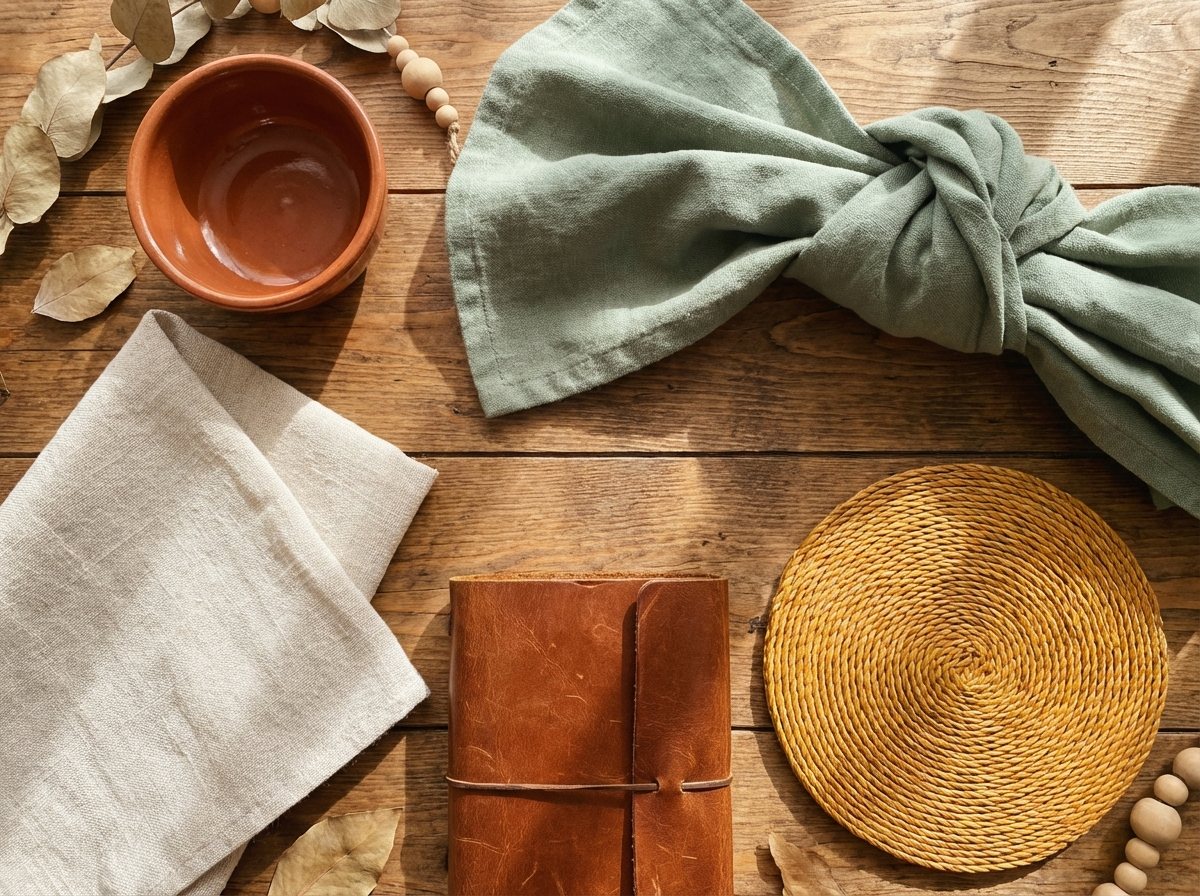
Warm Terracotta / Burnt Sienna — #C4622D The color of sun baked clay pots and adobe walls and the feeling of desert heat radiating from stone. Earthy, warm, and flattering across a wide range of skin tones.
Warm Cream / Unbleached Linen — #F5ECD7 An organic white. This is the color of something handmade and sunwashed. It appeared with the 1970s natural fiber revival and Chloe’s 1970s and 2025 runways.
Dusty Sage — #8A9E85 Dried eucalyptus bundles, it’s the muted green of plants that survive heat, drought, and time. It pairs great with terracotta, cream and brown.
Chocolate Brown / Tobacco — #6B4226 Closer to saddle leather than to espresso. It’s the brown that tells a story. You’ll find it in 2000s boho-chic accessories and 1970s leathercraft.
Ochre / Turmeric Yellow — #D4943A This is boho’s heartbeat, the color of spice, sun and centuries old dye pots. It’s used as an accent more than a base.
Boho Accent Colors: How to Add Depth and Sub-Aesthetic Signals
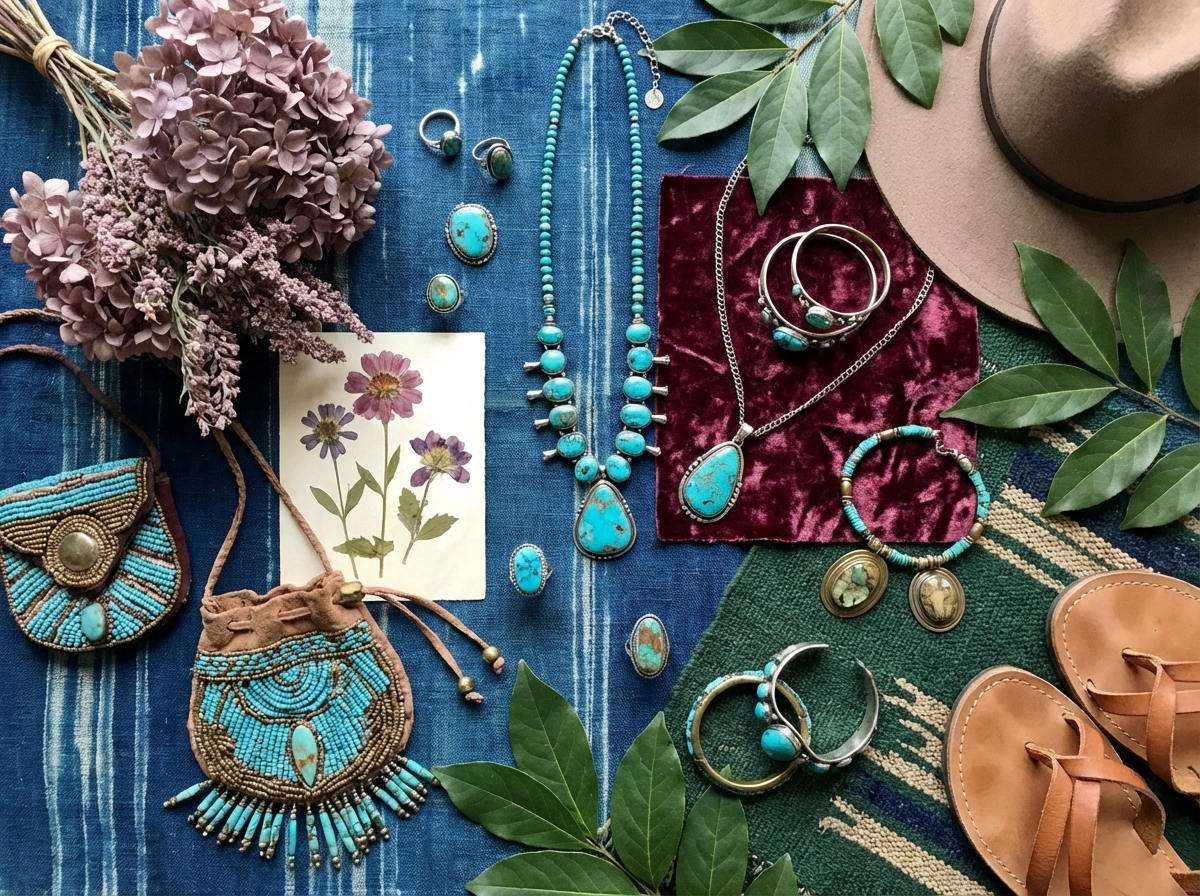
Turquoise — #3A9DA3 The signature accent of Desert Boho, it’s anchored in Navajo and Zuni silver and turquoise, water in a desert climate.
Dusty Mauve / Old Rose — #C4967A Old Rose is the color of dried rose petals. It’s a romantic accent that softens its neighboring earth tones.
Indigo / Woad Blue — #3D4A7A Indigo is Boho’s global thread. It’s crossed oceans, cultures and centuries to become a universal craft color.
Burgundy / Dried Rose — #8B2E3A The autumn note. Appears in velvet, wine-colored maxi skirts, and in embroidered florals and brings a touch of drama.
Forest Green / Moss — #3D5A3E This is the grounding accent, reminding us of evergreen needles and vintage military canvas.
Colors That Are Never Boho
Cool-toned neutrals. Grey, cool taupe, and icy white read as minimalist or Scandinavian. A grey linen dress is Clean Girl. A cream linen dress is boho. The difference is twelve degrees of color temperature.
Stark black. Black appears in boho wardrobes, but it is not a boho signature. (Unless you’re going for Dark Boho, which is another topic). Black in Boho is usually a ground for embroidery or print color, not standalone.
Neon and high-saturation brights. Neon reads as Y2K or streetwear. High-saturation primary colors read as maximalist or art-girl.
Pastels. Pale pink, baby blue, lavender, and mint are closer to the Coquette, Soft Girl, and Romantic aesthetics. Dusty rose is boho-adjacent. Baby pink is not.
The Boho Palette by Season: How the Colors Shift Year-Round
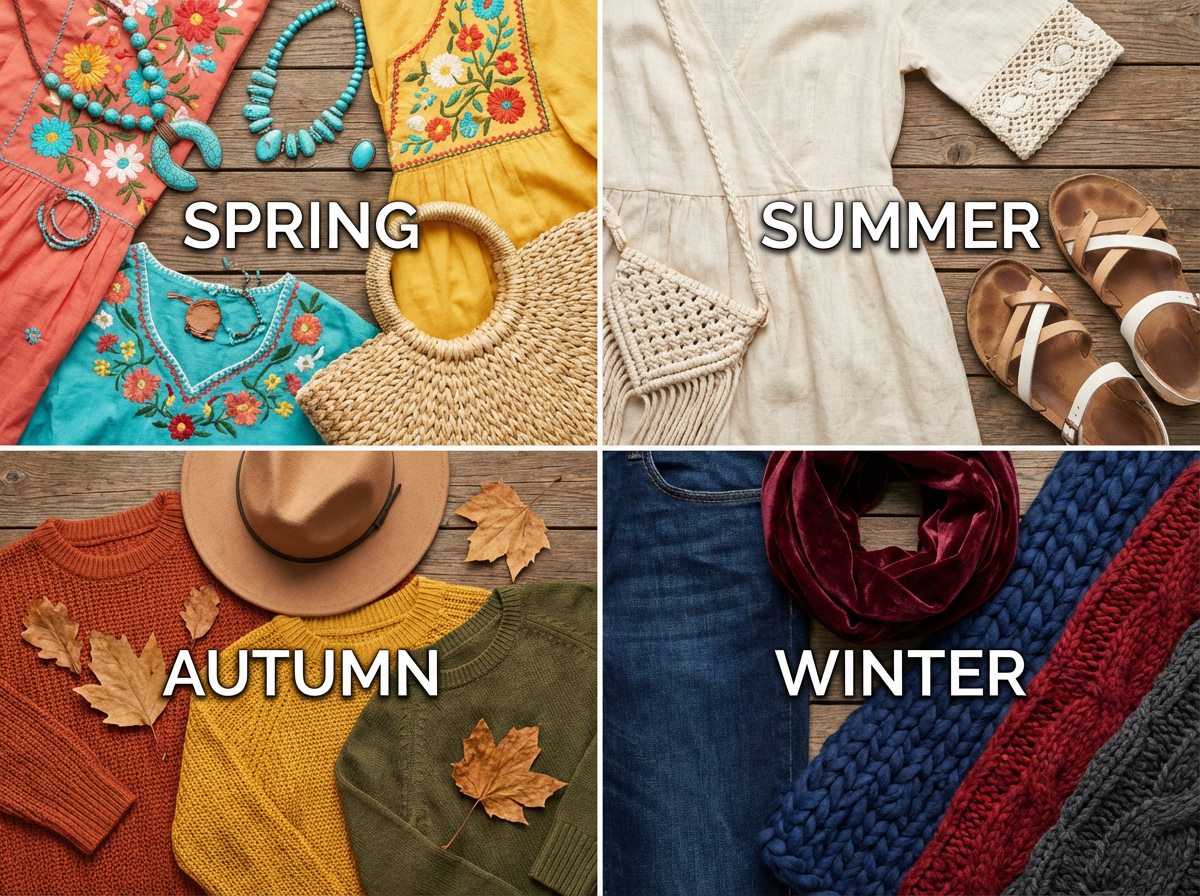
The boho palette deepens in autumn and winter and brightens in spring and summer.
Spring / Festival Season Brighter coral over terracotta, cobalt and turquoise accents, vivid floral prints. This is the Coachella register — still warm and earthy at the base, but with more color energy.
Summer Linen-white and warm cream dominate. You’ll find fewer accent colors and more texture. Coastal Boho lives here: bleached naturals, shell tones, warm sand colors.
Autumn Terracotta deepens toward rust and brick. Ochre moves toward amber. This is when the palette most closely resembles the warm, saturated tones of its 1970s origins.
Winter Chocolate, indigo, burgundy, forest green, with cream and ochre as warmth notes.
The One Rule To Remember
Ground first, accent second. Turquoise earrings against a cream dress. Indigo embroidery on a tobacco-brown tunic.
The exception, as always, is festival season.
The Boho Wardrobe by Category
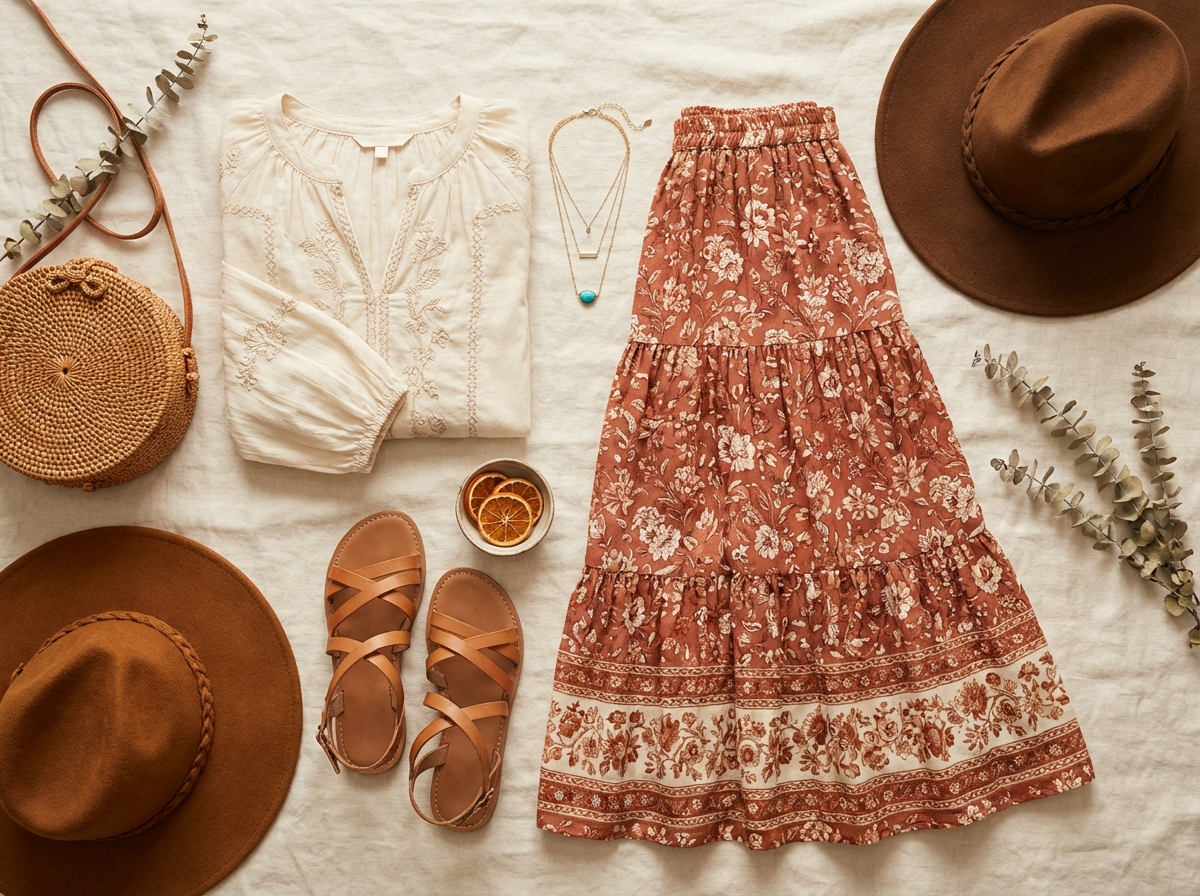
Every essential piece in the boho wardrobe — organized by category,
The essential pieces for a boho wardrobe are:
(1) a smocked or embroidered maxi dress
(2) a peasant blouse
(3) a tiered maxi skirt
(4) wide-leg linen trousers
(5) a leather strappy sandal
(6) an embroidered kimono or duster
(7) layered gold jewelry with stone accents
(8) a woven or leather fringe bag, and a wide-brim hat.
Build on natural fibers, prioritize pieces with and character, and assemble across tiers.
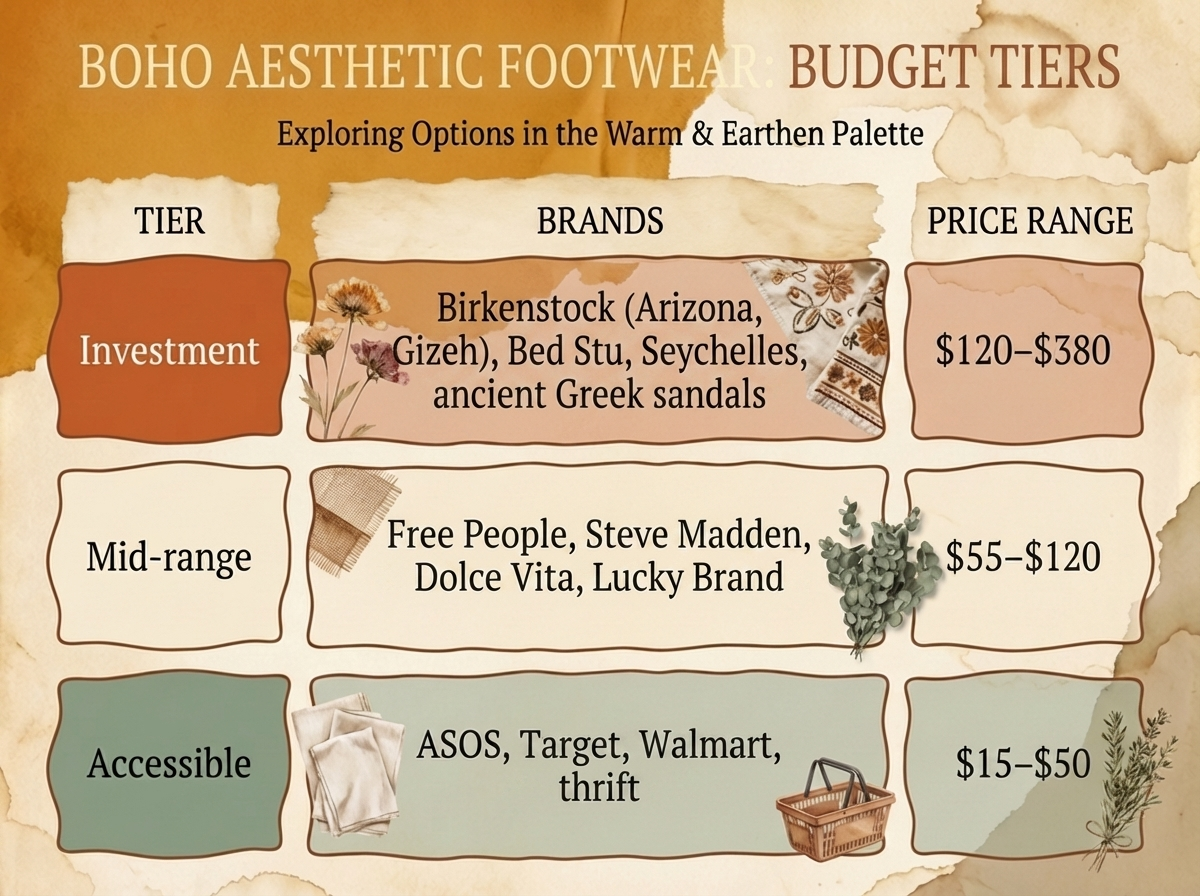
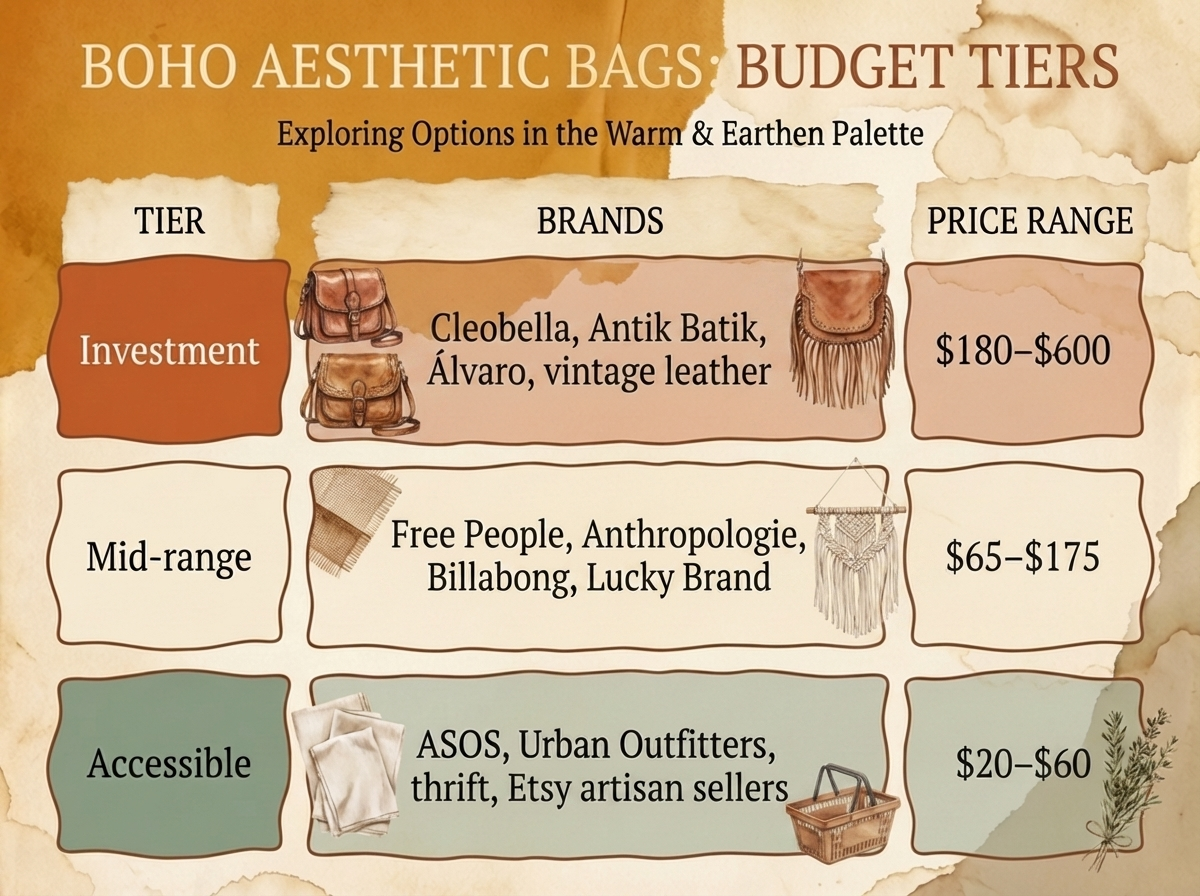
A note on the budget tiers before we begin.
Investment pieces are the ones worth spending on — the items where quality of material and construction is visible
Mid-range is good quality, accessible price, broad selection.
Accessible includes high street, fast fashion, and thrift, with honest notes
The boho philosophy would prefer you buy one investment piece over five accessible ones. The boho reality is that most wardrobes are built across all three tiers.
Tops
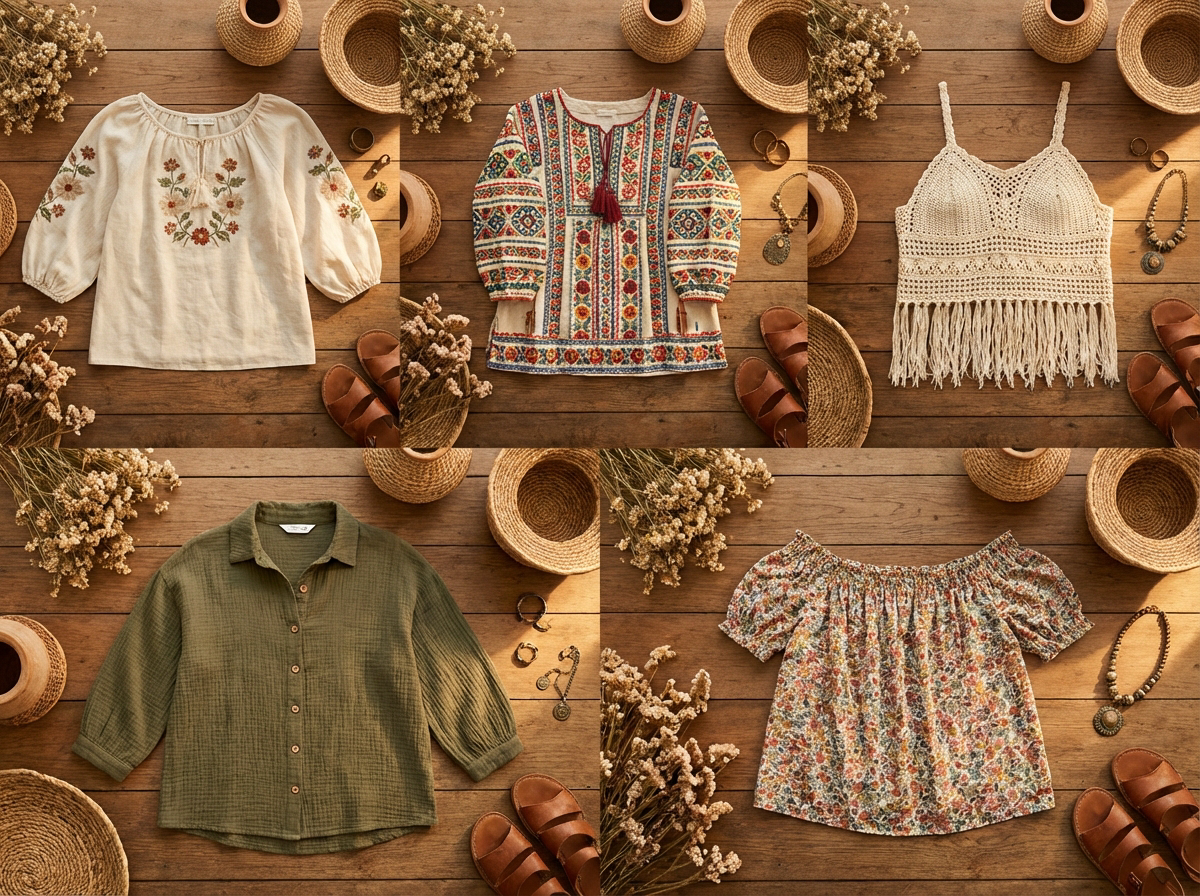
The five boho top styles worth knowing: peasant blouse, embroidered tunic, crochet top, cotton gauze shirt, off-shoulder.
The boho top is all about volume and drape.
What to look for:
Natural fibers like linen, cotton gauze, silk, rayon from natural sources
Embroidery, smocking, or crochet detail
Peasant and off-shoulder necklines that reference folk dress traditions
Billowing, bell-shaped, or three-quarter length loose sleeves
Avoid: Clingy polyester, "satin", too much structure
The essential styles:
Peasant blouse: Look for real smocking at the neckline and cuffs.
Embroidered tunic: Longer than a standard top, worn over wide-leg trousers or as a short dress over leggings. The embroidery should feel like a feature rather than an afterthought — look for chest yoke embroidery, mirror work, or folk-inspired motifs.
Crochet top: Works best in natural cotton rather than acrylic, which loses shape and reads as cheap. A crochet top in ecru or cream cotton is a good investment piece.
Cotton gauze shirt: Slightly oversized, worn open over a camisole or closed as a standalone.
Off-shoulder top: Look for elasticated necklines with enough structure to stay put.
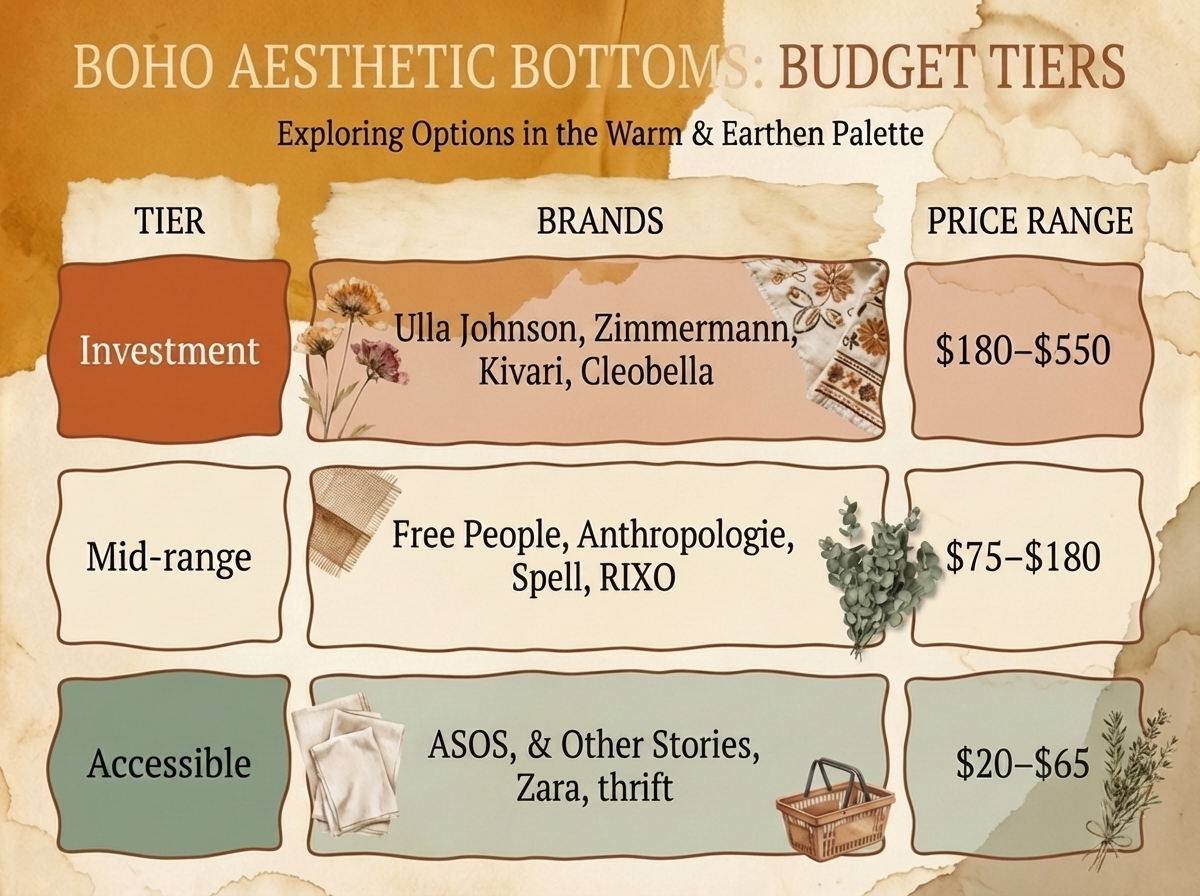
Bottoms
The boho bottom moves when you walk, it has enough fabric and enough length to create a visual rhythm.
What to look for:
Length: maxi or midi as the default; mini only in the festival sub-aesthetic context
Tiered construction
Prints: floral, paisley, ikat, ethnic-inspired geometric
Waistband options: elasticated, wrap, or wide waistband that sits at the natural waist
Avoid: bodycon, pencil, anything with a center crease
The essential styles:
Tiered maxi skirt: At least three tiers, natural fiber, and a waistband that sits at or above the natural waist. Florals, paisley, and ethnic prints are great; solid colors work but require stronger top interest to compensate.
Wrap midi skirt: Can be dressed up or down and the wrap construction flatters a wide range of body types. Look for a generous wrap overlap — skimpy wraps gap.
Wide-leg trouser: Linen is the gold standard; cotton and cotton-blend are acceptable. Look for a high rise, a full leg width (not tapered), and a length that skims the floor or breaks just above it. Embroidered or printed versions move the piece toward full boho; solid linen reads as Boho Minimalist.
Embroidered or patchwork denim: Embroidered vintage or vintage-inspired pieces. A pair of wide-leg or flared jeans with folk embroidery at the hem crosses sub-aesthetics, seasons, and occasions.
Boho mini skirt: Suede or faux-suede, crochet, or embroidered denim in a short length reads as festival boho. The key: the fabric and detail must carry the boho signal, since the length removes the volume-and-movement argument.
Dresses
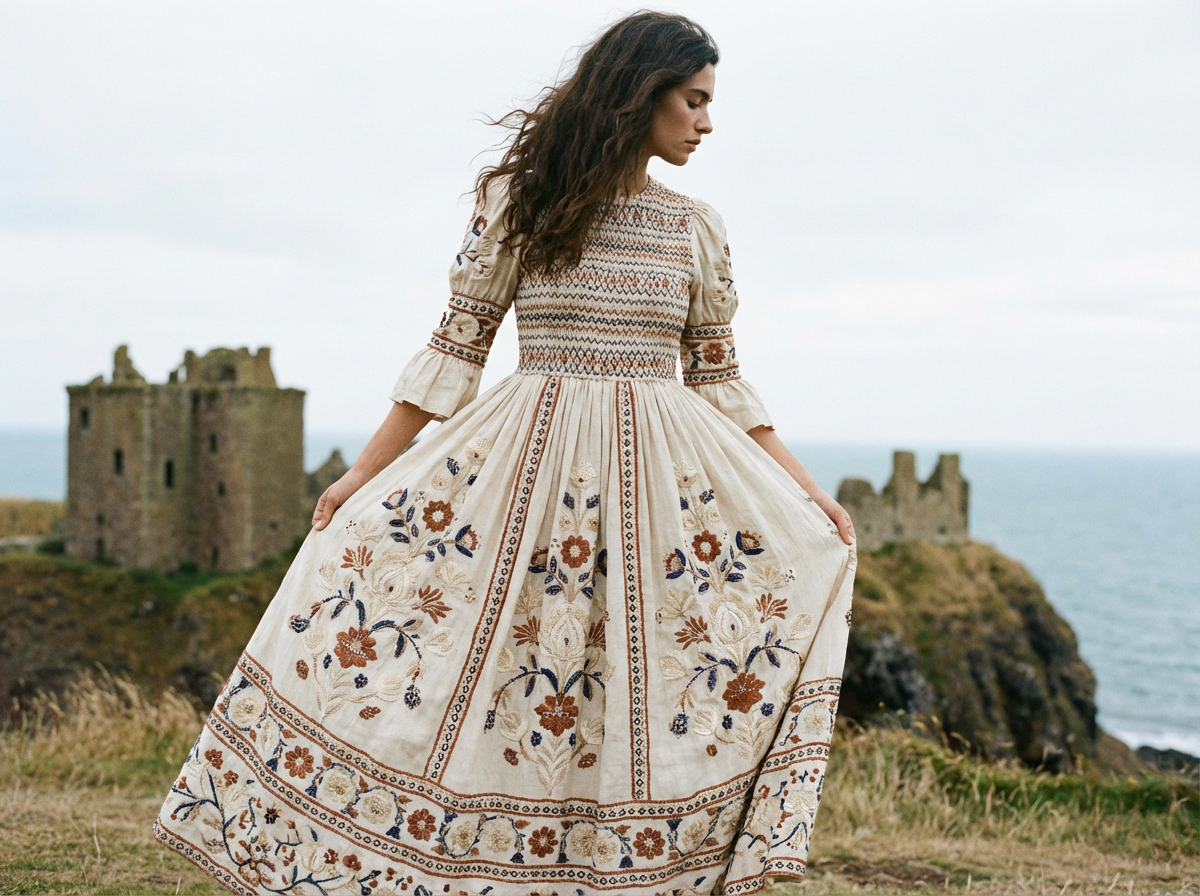
The smocked maxi dress is the single most versatile piece in the boho wardrobe.
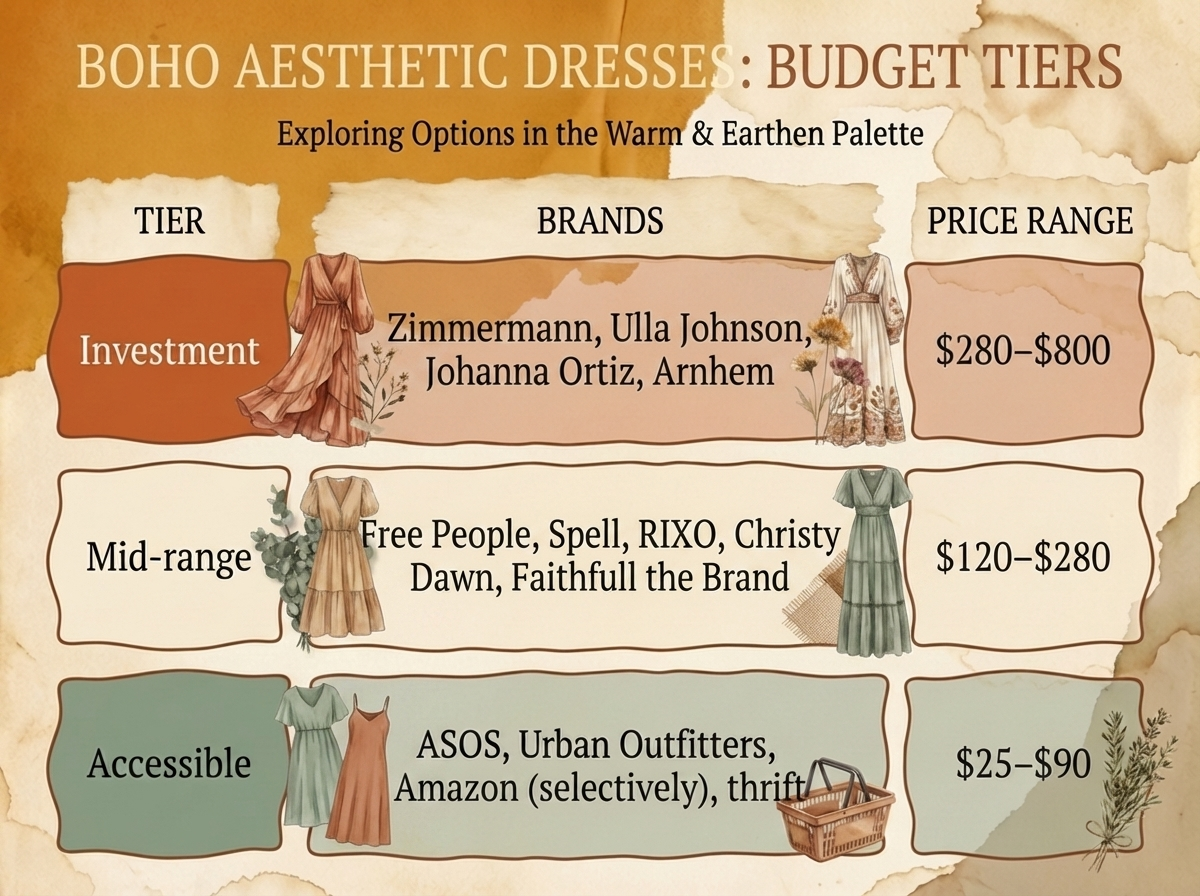
The dress is the single most searched, saved, and purchased boho item across every platform and budget tier. A well-chosen boho dress is a complete outfit in one piece, which is both its primary appeal and the reason it dominates the category.
What to look for:
Silhouette: maxi as default; midi as a strong second; mini only in festival context
Fabric: cotton, linen, cotton gauze, silk, or rayon — anything that moves
Construction details: smocking, embroidery, crochet panels, tiered skirt, wrap bodice
Print: floral, paisley, ethnic-inspired, or botanical. Solid colors are fine if you go bigger on accessories
Avoid: structured bodices, boning, heavy interfacing
The essential styles:
Smocked maxi dress: Smocking at the bodice is the most authentic boho detail. Go for chest and back smocking rather than waist-only.
Wrap maxi: The wrap construction crosses from Modern Boho to Bohemian Romantic depending on the print and fabric. It works at a wedding, at a dinner, at a farmers market, or a festival
Embroidered dress: The embroidery should be the focus, which means the silhouette can be simple. Mexican and Eastern European folk embroidery traditions are the primary reference points.
Cotton gauze kaftan: Worn loose and long, often with a belt. The kaftan spans Persian, North African, and West African dress traditions.
Slip dress with layers: is the Boho Minimalist dress option. A simple bias-cut slip in silk or satin-feel fabric worn over a fitted long-sleeve top or under a sheer embroidered layer.
-
Linen, cotton gauze, silk, and natural-source rayon all natural fibers that drape rather than cling.
Embroidered cotton, handwoven textiles, and suede are also strongly associated with the aesthetic.
Polyester and synthetic fabrics undermine the boho aesthetic both visually and philosophically.
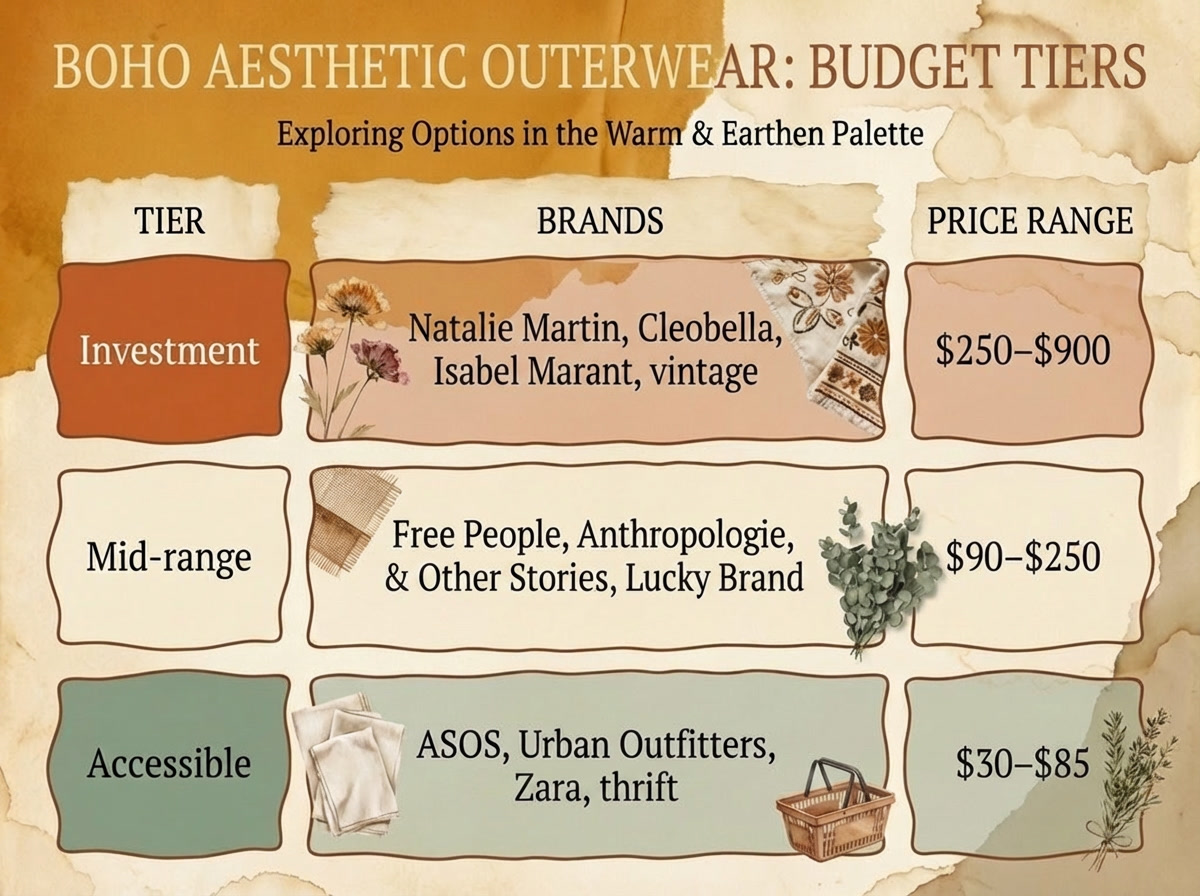
Outerwear
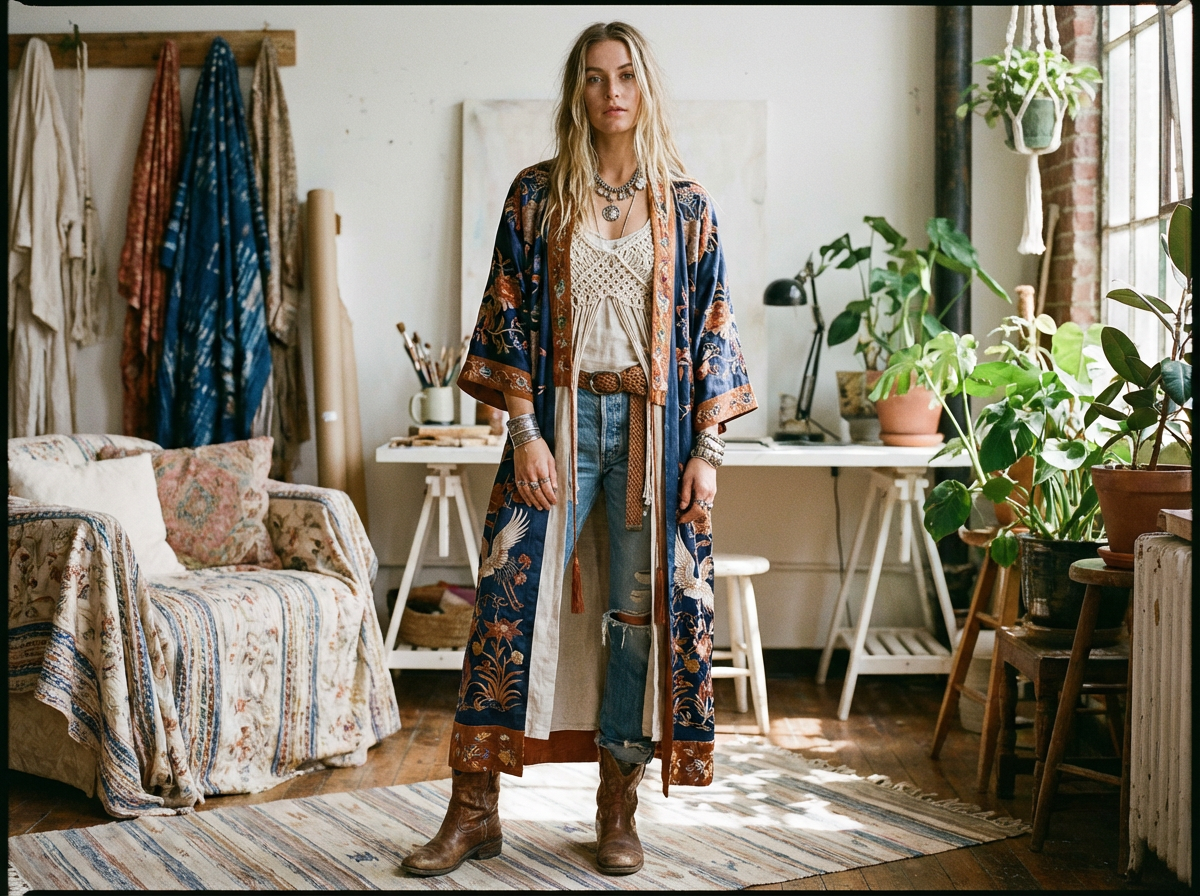
The embroidered kimono functions as jacket, cover-up, accessory, and statement piece simultaneously
Boho outerwear emphasizes character over conformity. The boho jacket or coat should look like it has been somewhere, even if it hasn't.
What to look for:
Texture and surface detail like embroidery, fringe, patchwork, tooling
Natural materials: leather, suede, wool, cotton canvas
Silhouettes that layer over volume: longline, oversized, open-front
Avoid: technical fabrics, structured blazers, anything reading as workwear or athleisure
The essential styles:
Embroidered kimono / duster: Functions as a jacket, a cover-up, a layer over a dress, and an accessory. The longer the duster, the more dramatic the effect.
Suede fringe jacket: A well-made suede fringe jacket in tobacco or tan is one of the most recognizable boho garments in existence. It requires almost nothing else to make an outfit read.
Oversized linen blazer: the Boho Minimalist outerwear option. Worn open, slightly oversized, in cream or sand, over a simple camisole and wide-leg trouser. Bridges boho and work contexts better than any other outerwear option.
Shearling or faux-shearling vest: the Desert Boho outerwear signature. Worn over a peasant blouse or embroidered tunic, adds texture and warmth.
Patchwork or quilted jacket: the Global Boho outerwear piece. These are best sourced from secondhand or directly from artisan producers.
Footwear
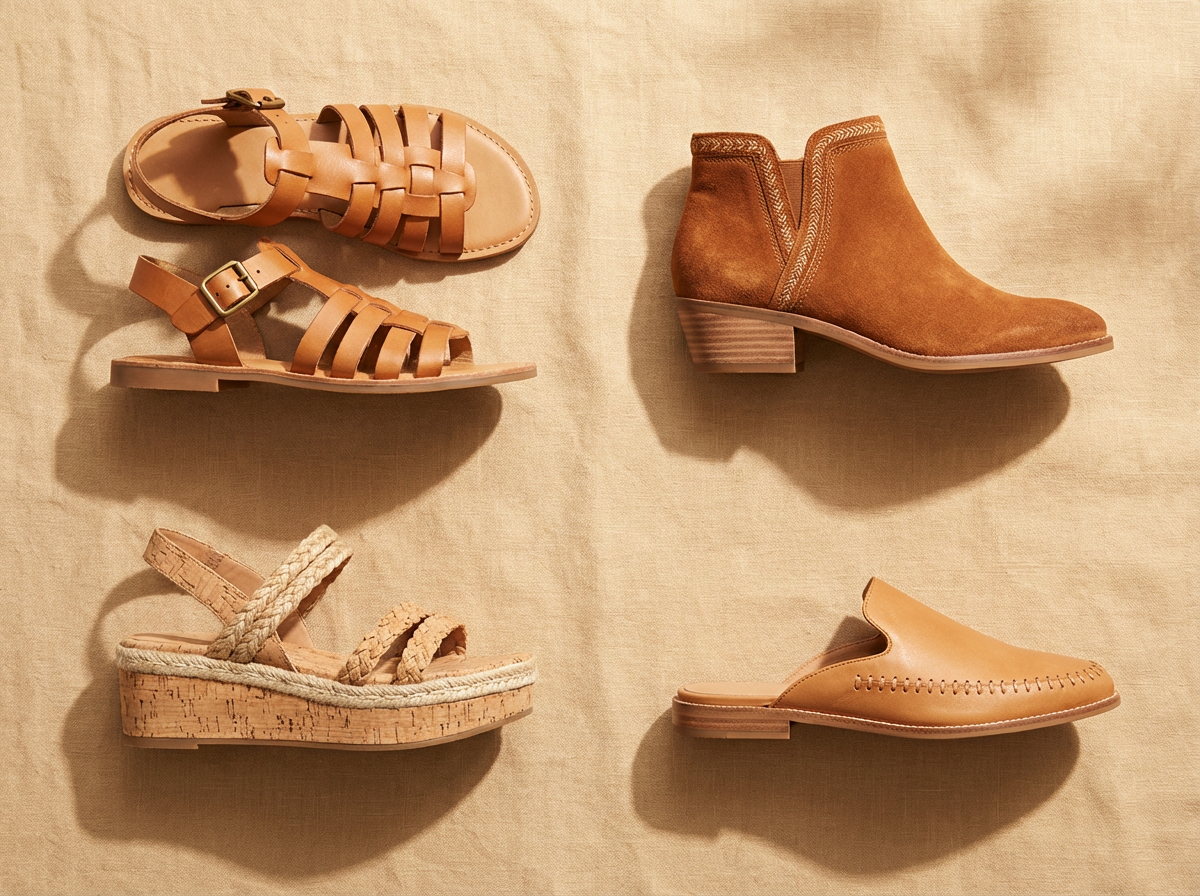
The boho footwear hierarchy: leather strappy sandal for everyday, ankle boot for autumn, platform sandal for festival.
The foot should feel connected to the ground. Flat or low-heeled, natural materials, minimal construction. The platform sandal is the one exception.
What to look for:
Natural materials: leather, suede, cork, jute, wood
Construction: strappy, minimal, hand-finished where possible
Avoid: synthetic upper materials, stilettos, heavily constructed athletic silhouettes, prominent branding
The essential styles:
Leather strappy sandal: This is the everyday foundation piece. Flat or with a very low heel, multiple straps, natural leather in tan, tobacco, or cognac.
Ankle boot: Low heel, leather or suede, in tobacco, tan, or black as a last resort.
Platform sandal: The platform sandal in the boho context is explicitly referencing 1970s footwear, and it works best when worn with that awareness. Pairs with mini and midi lengths; slightly incongruous with a floor-length maxi.
Mule / slip-on: the Boho Minimalist footwear option. A leather or suede mule in a neutral tone adds a neutral polish. The footwear version of the linen blazer: bridges contexts without abandoning the aesthetic.
Huarache sandal: Handwoven leather sandals with Mexican craft origins, great for the Global Boho aesthetic. Worth sourcing from artisan producers where possible.
Bags
The most versatile boho bag is a woven or leather fringe crossbody in a natural material. It carries the full bohemian signal while functioning across seasons, sub-aesthetics, and occasions.
What to look for:
Texture: woven, macramé, tooled leather, embroidered, beaded
Natural materials: leather, straw, jute, cotton, wool
Scale: medium to large; boho does not favor the micro-bag
Hardware: antique brass, oxidized gold; never polished chrome or silver
Avoid: structured top-handle bags, logo-forward, nylon or synthetic materials
The essential styles:
Woven or rattan bag: the summer and festival signature. A structured rattan circle bag or a soft woven straw tote carries the full boho signal in a single accessory.
Leather fringe bag: A crossbody or shoulder bag in natural leather with fringe detail.
Macramé bag: Knotted cotton or jute in a natural or bleached finish. More casual than leather. Best in summer and festival contexts.
Embroidered or kilim bag: the Global Boho bag. Textile-covered bags in folk embroidery, kilim, or ikat print.
Vintage leather satchel: the Boho Minimalist bag. A worn, soft leather satchel or shoulder bag in tobacco or cognac.
Jewelry
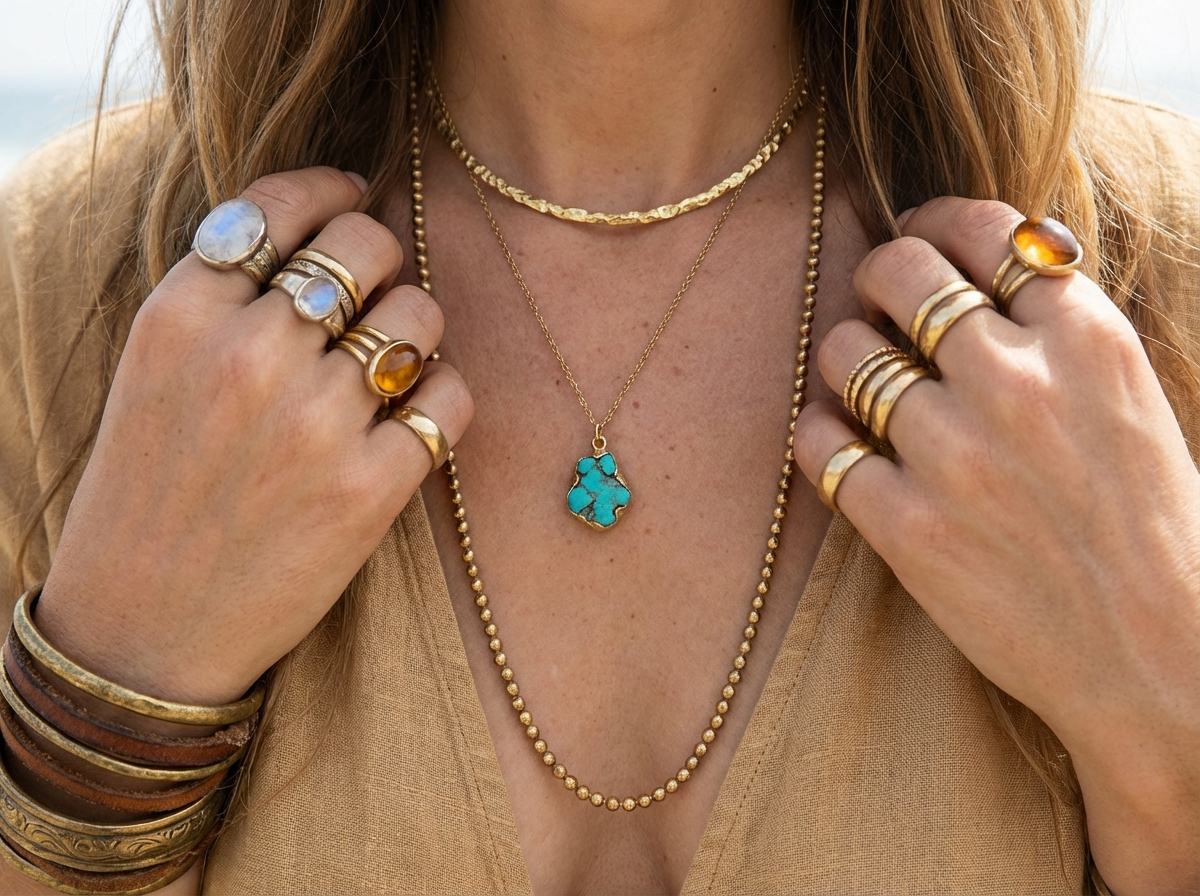
Boho jewelry is all about layering.
More is more when it comes to boho jewelry. Layer, layer, layer. Handcrafted shines most in the boho aesthetic.
What to look for:
Metal: gold as the default — warm, antique, oxidized, or hammered finishes over polished
Stone: turquoise, moonstone, amber, malachite, labradorite, carnelian, tiger's eye
Construction: artisan-made, irregular, hand-finished
Scale: mix of fine and statement pieces within the same look
Avoid: polished silver, geometric minimalist designs, logos
Layering principles by category:
Necklaces: A minimum of three necklaces at different lengths: a choker or collar-length piece, a mid-length pendant, and a longer layering chain. The pieces should be related by metal tone but varied in scale, texture, and stone.
Rings: Feel free to stack stack across multiple fingers rather than placing one statement ring. Mix metals sparingly. Stone rings (turquoise, moonstone, amber) provide color interest; plain bands and hammered metals provide the foundation.
Earrings: A statement piece in one ear with a small stud or hoop in a second hole creates the right asymmetric quality.
Bracelets and bangles: Wear more than you think you should, then add one more. Stack bangles of varying width, mix beaded strands with metal cuffs, add a leather wrap bracelet as a grounding note.
-
To layer boho jewelry:
(1) Start with three necklaces at different lengths. Choker, mid-length pendant, and a longer chain.
(2) Stack rings across multiple fingers, mixing stone and metal pieces.
(3) Curate rather than match earrings. A statement piece in one ear with smaller studs creates the right asymmetric quality.
(4) Stack bangles and bracelets. Mix metal cuffs, beaded strands, and leather wraps. The wrist should make a sound when you move.
Belts and Accessories
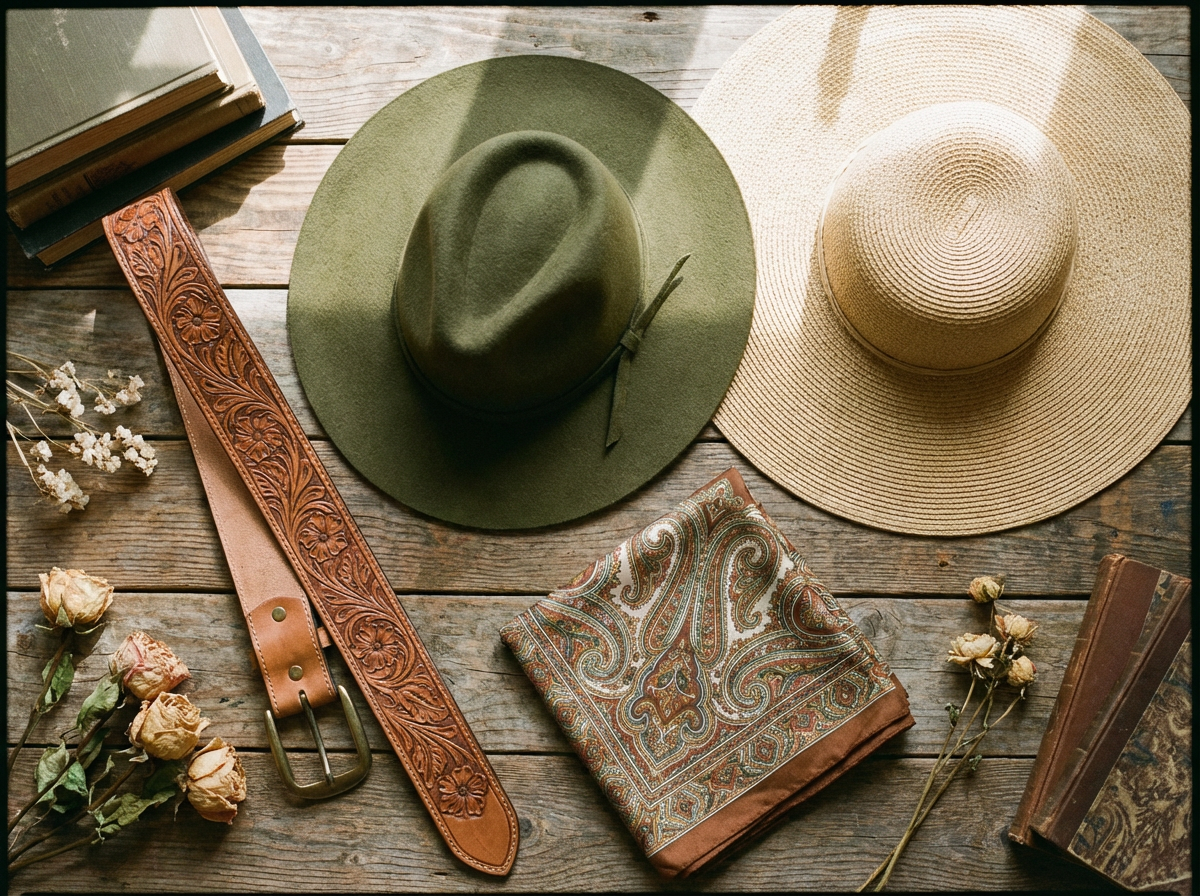
The accessories that finish a boho outfit: wide tooled belt, floppy felt hat, wide-brim straw, printed scarf.
Belts:
Wide tooled leather belt: Worn over a maxi dress, a tunic, or a kimono at the natural waist, it provides structure and definition while adding the surface detail of the tooling.
Concho belt: the Desert Boho signature. Silver or silver-and-turquoise conchos on a leather strap, worn at the hip over wide-leg trousers or a maxi skirt.
Wrap belt / obi belt: a wide fabric or leather belt that wraps and ties rather than buckles. More versatile than a tooled belt in outfit compatibility; slightly less character-forward.
Hats:
Floppy felt hat: Wide brim, unstructured, in tobacco, black, or natural. The silhouette adds drama to any boho outfit and photographs well.
Wide-brim straw hat: Natural straw, wide brim, minimal or no embellishment. Pairs with every summer boho outfit.
Panama hat: the Boho Minimalist hat option. Works in smart-casual contexts where the full-volume boho hat would read as costume.
Scarves:
A silk or cotton scarf in a boho print functions as a hair accessory, a bag tie, a belt, and a layering piece.
-
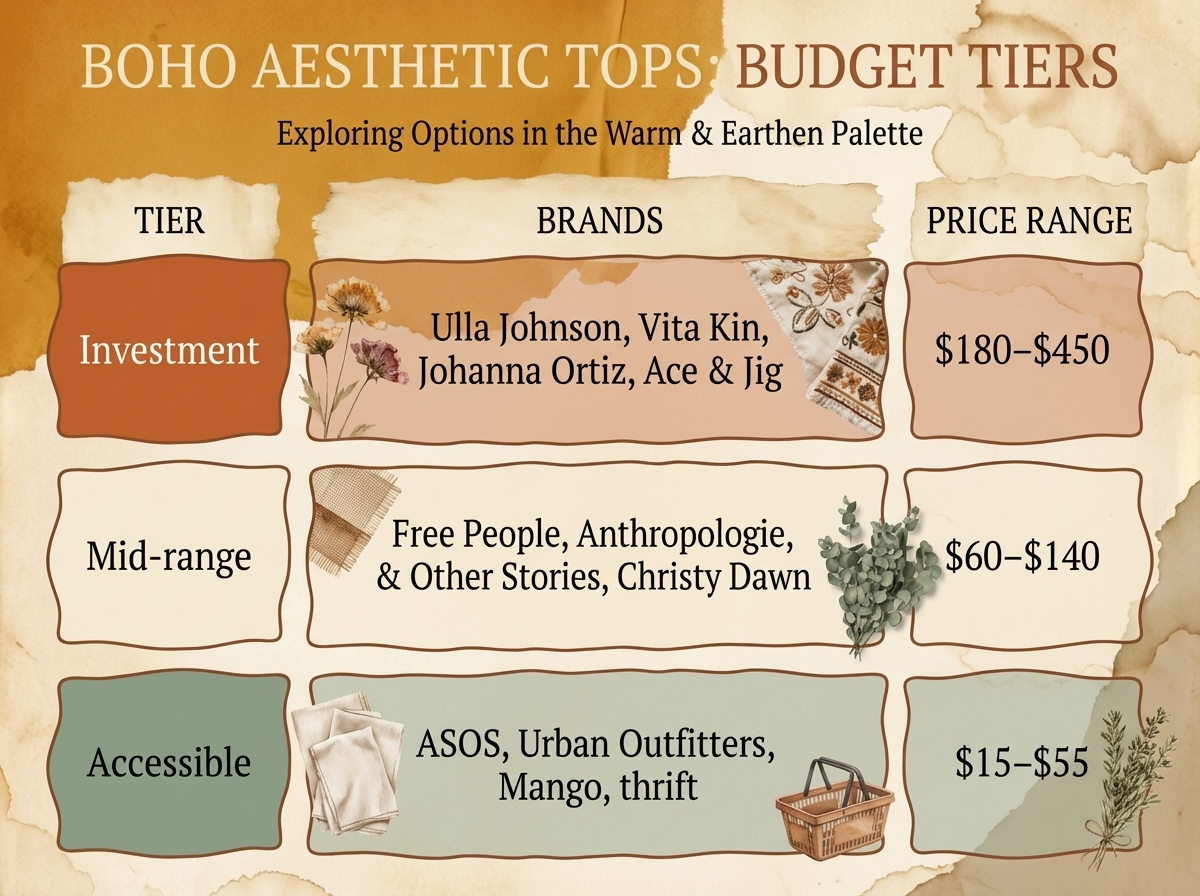
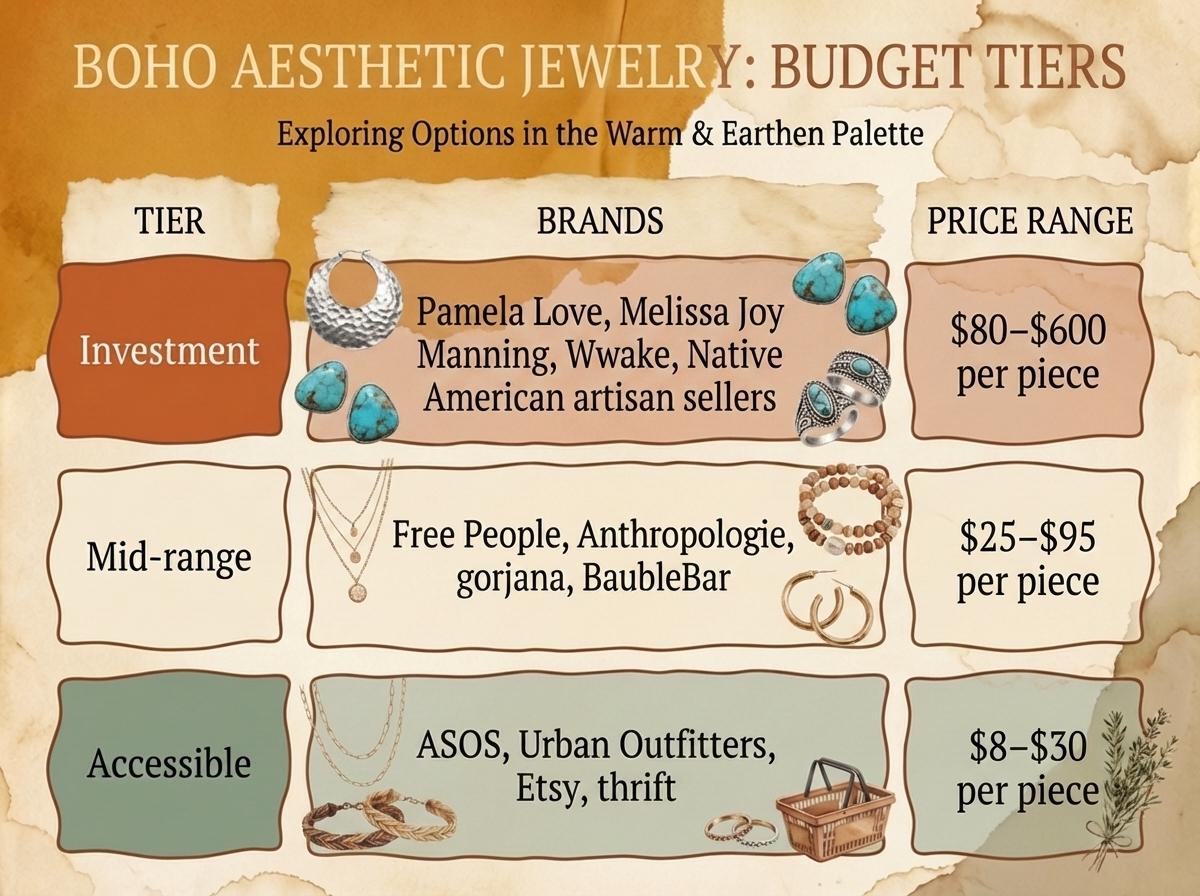
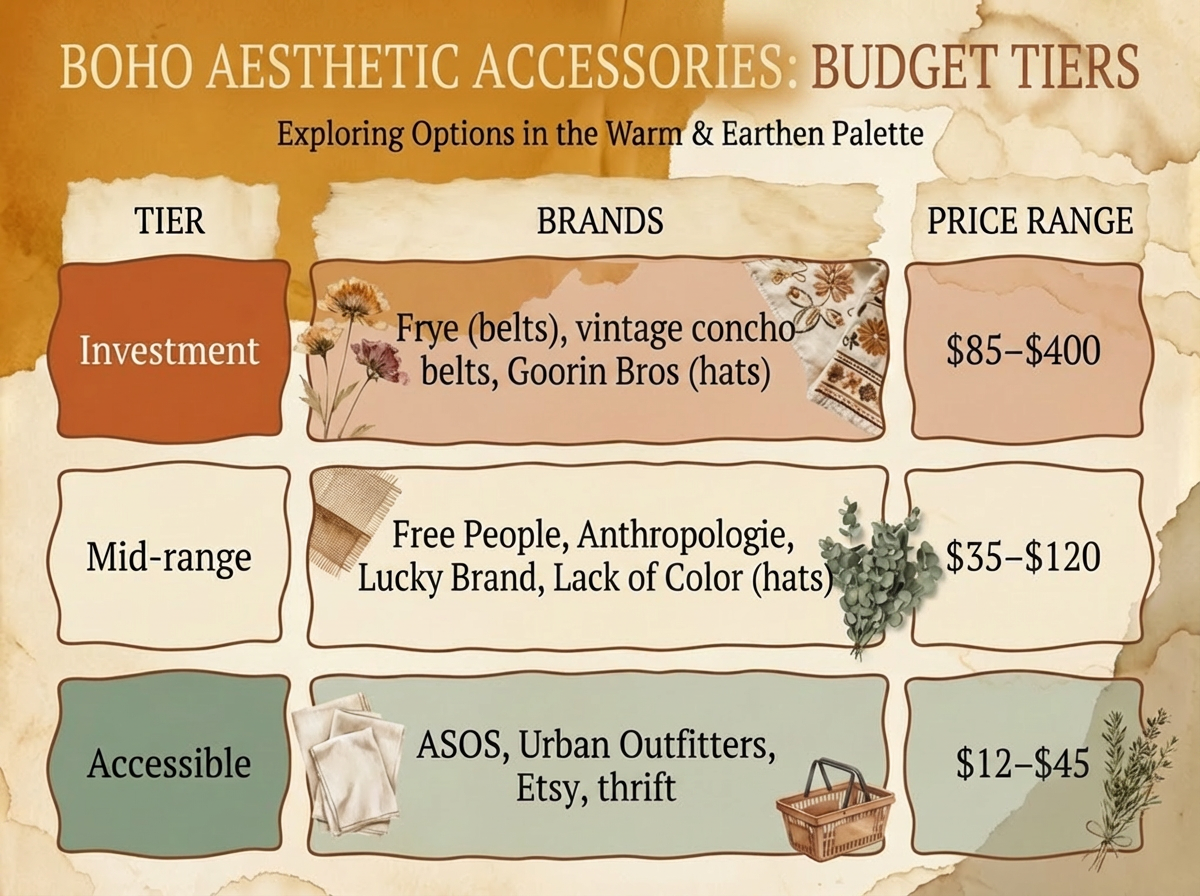
Investment Tier: Zimmermann, Ulla Johnson, Johanna Ortiz, Arnhem, Cleobella, Isabel Marant, Pamela Love, Natalie Martin
Mid-Range Tier: Free People, Anthropologie, Spell & the Gypsy Collective, RIXO, Christy Dawn, Faithfull the Brand, & Other Stories, gorjana
Accessible Tier: ASOS, Urban Outfitters, Mango, Zara, Lucky Brand, thrift and vintage (always on-brand at any budget)
Boho Beauty: The Complete Hair, Makeup, and Fragrance Guide
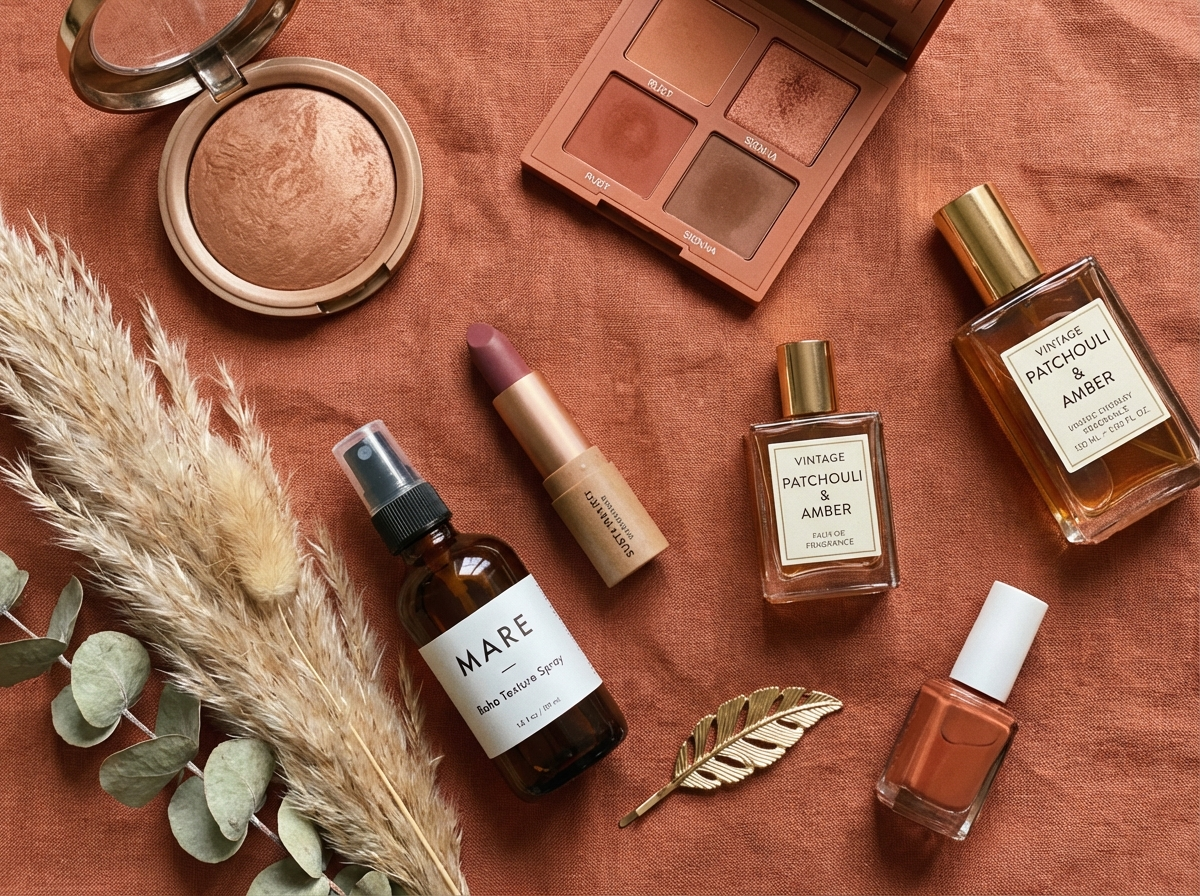
The complete boho beauty edit — skin, eyes, lips, hair, fragrance, nails.
Boho Skin: How to Get the Sun-Kissed, Dewy Complexion
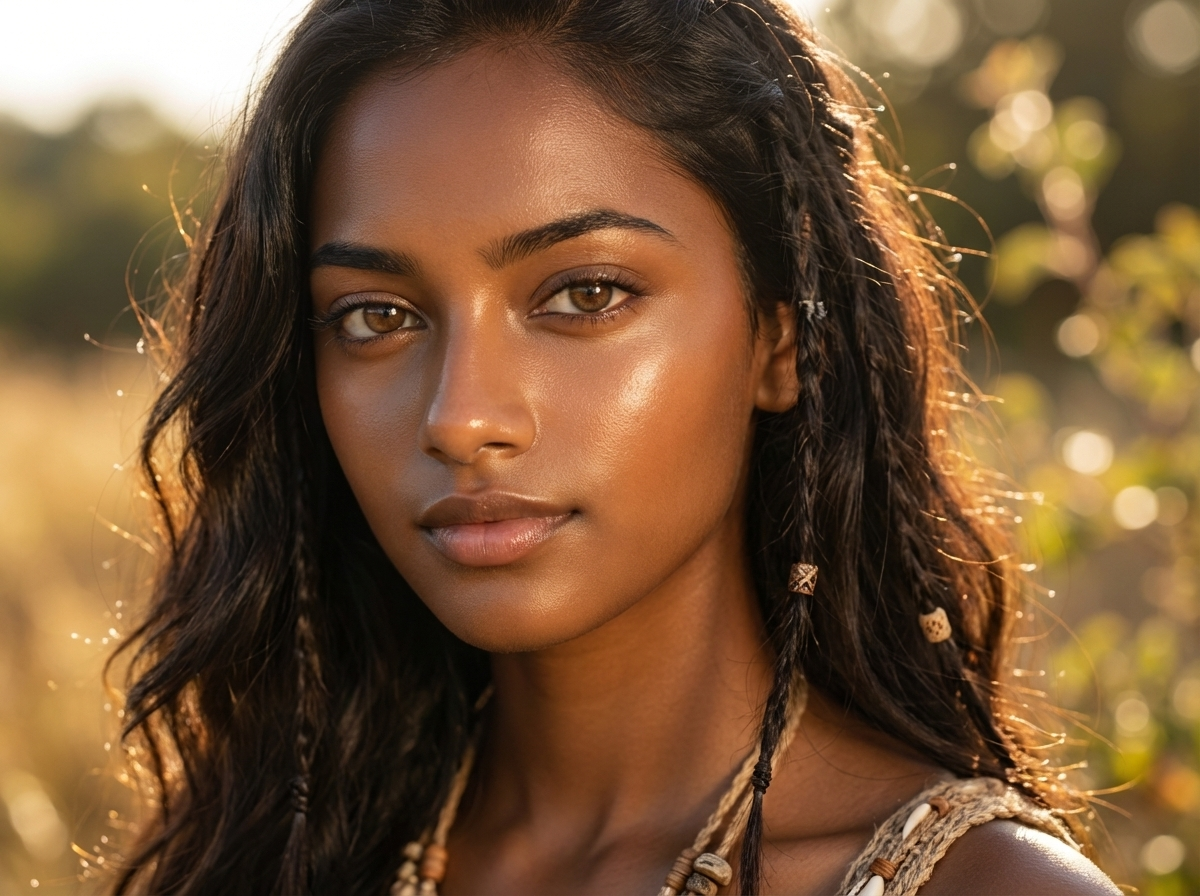
Boho skin is outdoor skin — bronzed, dewy, and warm.
Boho skin is achieved with a lightweight base (tinted moisturizer or skin tint), generous matte bronzer applied on sun-kissed areas, warm-toned cream blush high on the cheekbones, subtle gold highlight on the high points, and a setting spray finish. The goal is sun-warmed skin rather than full coverage.
Base: A tinted moisturizer, a skin tint, or a sheer foundation. Skin first, product second.
Bronzer: The most important product in your make up bag. Apply generously to the forehead, cheekbones, nose and chin. Use a matte or very lightly shimmer bronzer rather than a glitter-forward one.
Blush: Terracotta, peach, and coral over pink and berry. Apply high on the cheekbones and slightly toward the temples. A cream blush layered under a powder bronzer creates the most convincing outdoor-skin effect.
Highlight: A soft gold or champagne highlight on the top of the cheekbones, brow bone and cupid’s bow.
Setting: Boho skin should remain dewy throughout the day so finish with a light setting spray.
Boho Eye Makeup: Earthy, Warm, and Undone
Boho eye makeup is warm and earthy — drawn from the same color story as the wardrobe.
Everyday: Warm neutral eyeshadow in terracotta, rust, bronze, or warm brown. A smudged pencil liner in brown or bronze. Mascara on the upper lashes only, or with a light application on the lower lashes.
Festival: Terracotta and burnt orange shadow blended into the crease and lower lash line. A copper or bronze metallic on the lid. Smudged kohl along both lash lines for a slightly undone, slightly smoky quality. Individual lash clusters rather than a full strip lash.
The liner note: Brown liner consistently outperforms black in the boho context. If black is your liner of choice, apply it and then immediately soften it with a small brush or your fingertip.
Brows: Full, natural, and brushed rather than drawn. A brow gel in a natural shade to set the shape, a light pencil fill where needed. Stop before you think you're done.
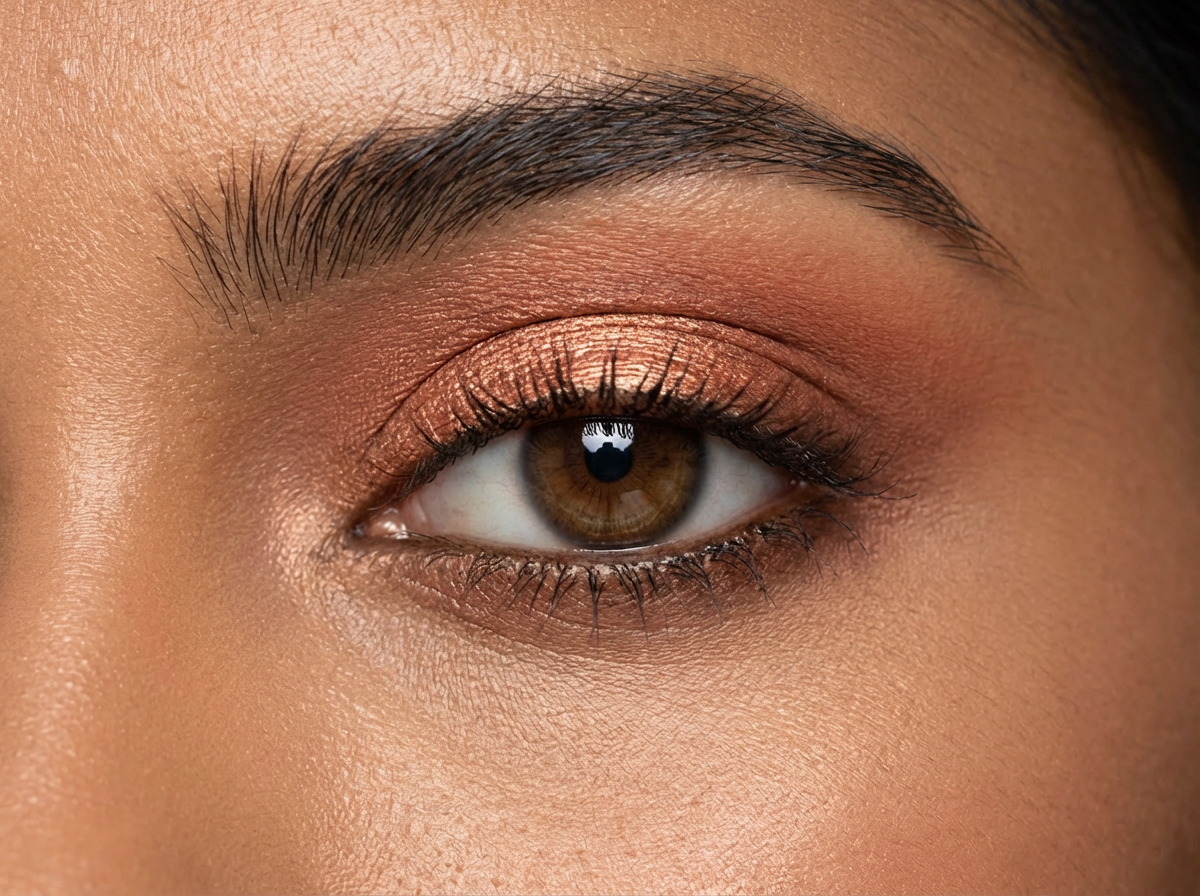
The boho eye: warm terracotta shadow, smudged brown liner, natural lashes, unfussy brows.
Boho Lip Colors: From Everyday Nude to Statement Berry
The boho lip palette runs from nude to berry, always on the warm side of the color wheel.
Everyday: A warm nude or MLBB (my lips but better) shade — not pale beige, which reads as 1990s minimalism, but a nudge above your natural lip color in a warm peachy or rose direction. Applied as a balm or a sheer lipstick.
Statement: Berry and wine tones like dusty rose, dried rose, burgundy and terracotta. A lip stain with a gloss over the top creates the right balance of color intensity and casualness.
Avoid: Cool pinks, hot coral, anything with a blue undertone, and anything drawing too much attention.
Boho Hair: Waves, Braids, and the Art of Looking Effortless
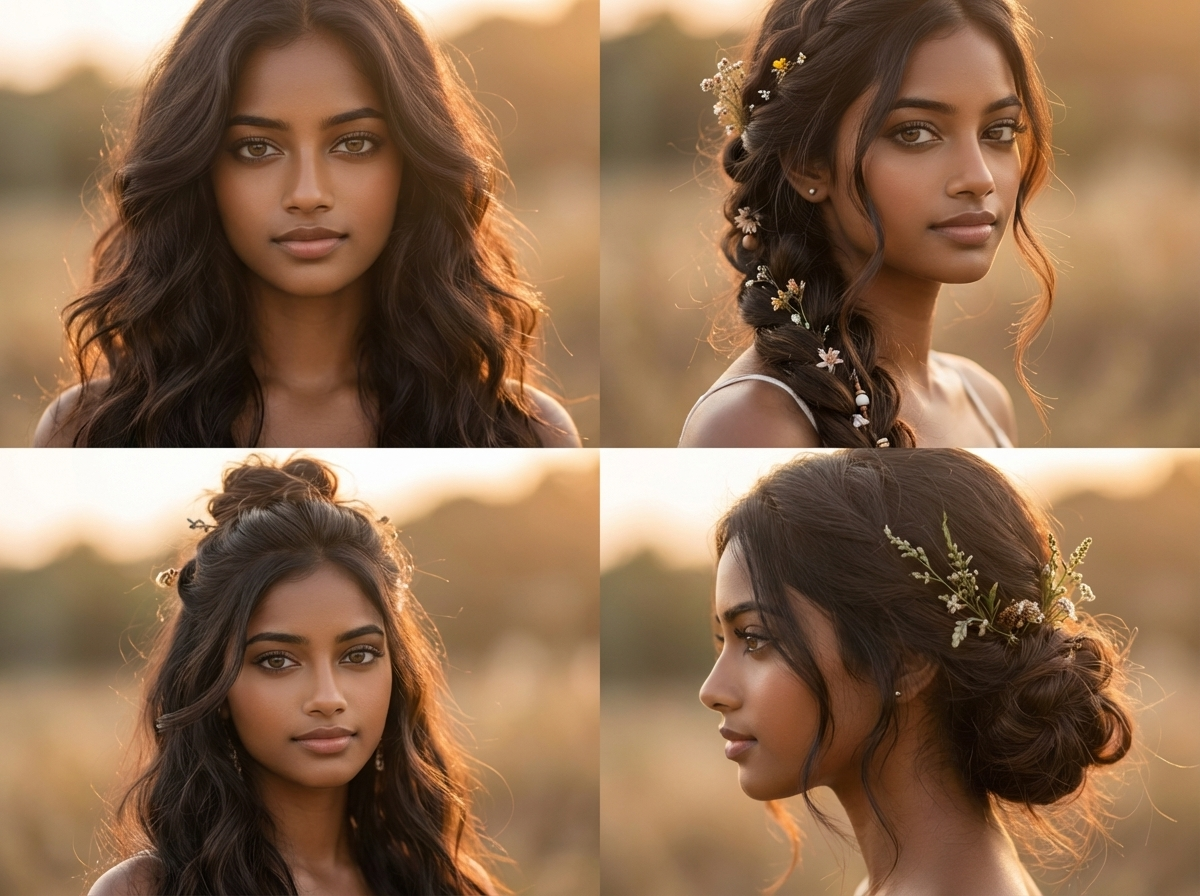
Loose waves, the half-up, the loose braid, the undone updo.
If there is one single beauty element that carries the most boho signal, it is the hair. Specifically: undone hair.
The texture principle: Boho hair has texture. You want movement, volume, and the suggestion of natural wave, not flyaways and humidity damage. A sea salt spray on damp hair, scrunched and air-dried, produces the best result for most hair types. A curling wand used on one-inch sections with a finger-combed finish produces it for straighter hair.
The styles:
Loose waves: Should look like hair that has been in a low bun and let down, or dried in the open air.
Braids: A single loose side braid, a half-up braid with pieces pulled free at the face, a crown braid worn with face-framing pieces left loose.
The half-up, half-down: Takes thirty seconds, photographs well, and works with every face shape. Pull the top section loosely, secure it with a scrunchie or a hair claw, and pull a few pieces free at the face.
Long and loose: Add a scarf, a headband, or a hair pin as the single styling element.
The effortless updo: a loose bun or twisted updo with significant pieces left down around the face.
Hair accessories: A printed silk scarf tied as a headband or woven through a braid. A leather or suede headband. Decorative hair pins in gold or shell. A wooden or resin hair claw.
-
To get boho waves:
(1) Apply sea salt spray to damp hair.
(2) Scrunch sections upward and allow to air dry, or diffuse on low heat.
(3) For straighter hair, use a one-inch curling wand on irregular sections with varied timing.
(4) Finger-comb to break up any uniform wave pattern.
(5) Apply a small amount of lightweight oil to the ends for separation and shine.
Boho Fragrance: Patchouli, Sandalwood, Amber, and What They Mean
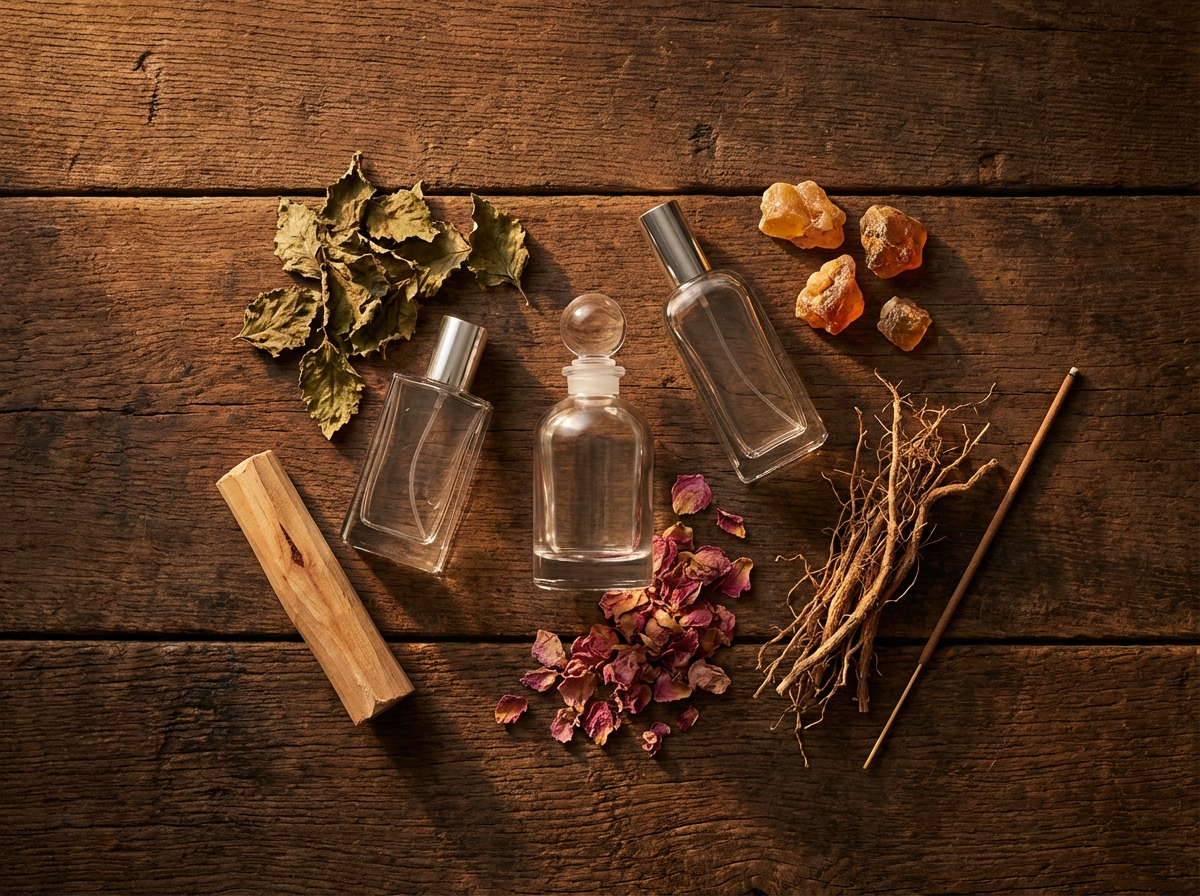
Boho fragrance smells like natural materials — patchouli, sandalwood, amber, vetiver, dusty rose.
Fragrance is the beauty element that most directly expresses the boho value system.
The boho fragrance family: Warm, earthy, resinous, and slightly smoky. The reference points are the smell of patchouli in a Moroccan souk, sandalwood incense in a South Asian textile shop, amber resin in a vintage market, dried roses in an old book.
Key notes:
Patchouli: Worn alone it can read as retro-hippie shorthand; blended it anchors a fragrance.
Sandalwood: warm, creamy, and slightly sweet. One of the most versatile boho fragrance notes because it works as a subtle background note.
Amber: resinous, warm, and long-lasting.
Vetiver: Earthy, slightly smoky, green-rooty. Worn alone it is striking; blended it adds depth.
Rose — specifically dusty, vintage, or Bulgarian rose rather than fresh-cut rose, which reads as conventional feminine fragrance rather than boho.
Oud: Woody, animalic, resinous. It has roots in Middle Eastern and South Asian perfume traditions.
Fragrance application: Wrists, neck, and hair. Do not spray fragrance directly onto fine or color-treated hair; apply to a brush and run it through the ends instead.
-
Boho fragrances center on warm, earthy, resinous notes drawn from natural materials: patchouli, sandalwood, amber, vetiver, dusty rose, and oud.
The best boho perfumes smell like natural materials—incense, resin, dried botanicals, and warm wood.
Boho Nails: Earth Tones, Natural Finish, and Festival Art
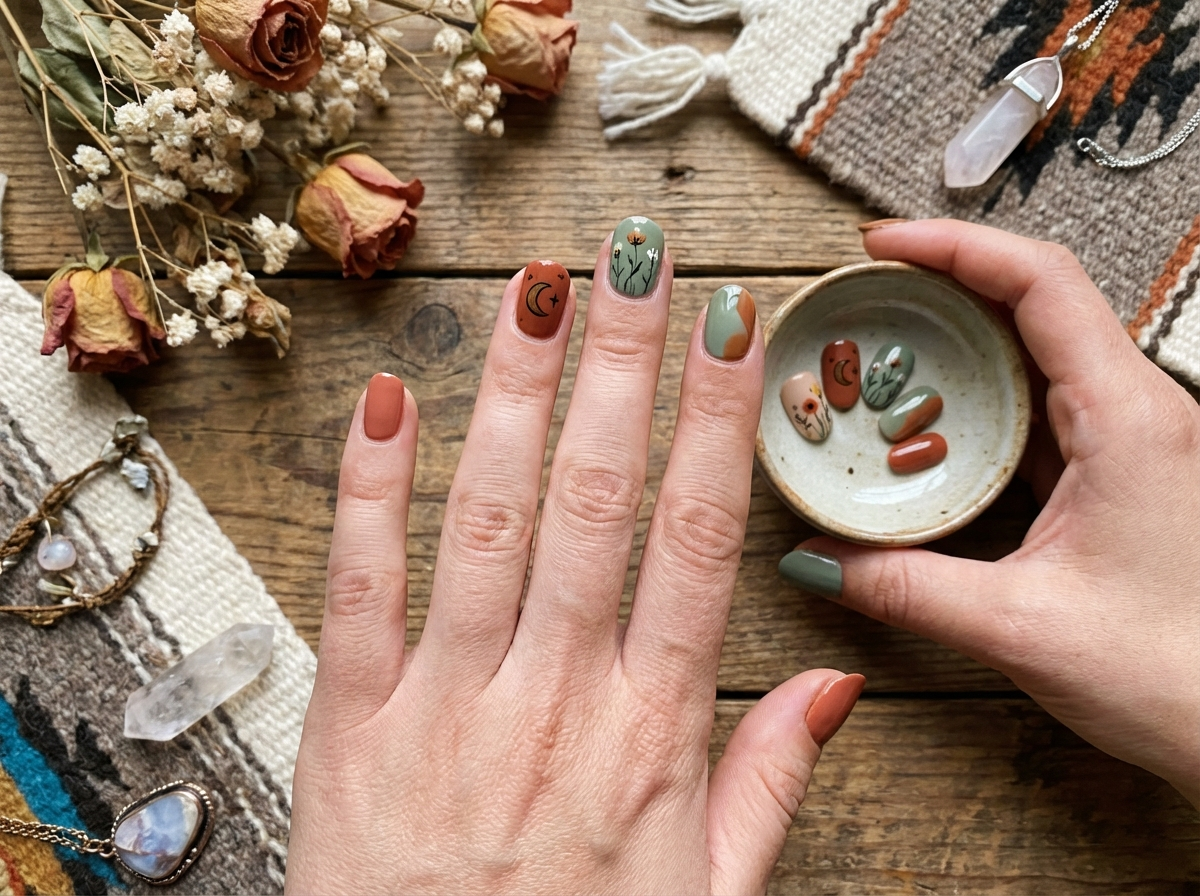
Boho fragrance smells like natural materials — patchouli, sandalwood, amber, vetiver, dusty rose
Boho nails should look neat without looking overdone.
The everyday palette: Earth tones and neutrals like terracotta, rust, tobacco brown, warm nude, sage green, dusty mauve. A natural or slightly glossy finish rather than high-gloss or matte.
The natural finish: A well-buffed, clear-coated natural nail is entirely on-brand for boho. The aesthetic preference is for the nail to look healthy.
Nail art (when): Florals, celestial motifs (moons, stars, botanicals), and organic abstract designs in the boho color palette are great for festivals or if you want more expression. The design should look hand-painted and slightly imperfect. French manicure is not boho.
Length and shape: Medium length or shorter. Oval or rounded.
The Boho Beauty Edit: A Quick Reference guide
Boho makeup centers on warm, earthy tones and an undone finish: lightweight skin with generous bronzer, earthy eyeshadow in terracotta and rust, smudged brown liner, warm nude or dusty berry lips, and full natural brows. The goal is outdoor skin rather than polished coverage.
Skin: Lightweight base, generous bronzer, warm blush, subtle gold highlight, dewy finish
Eyes: Warm earthy shadow, smudged brown liner, natural lashes, full unfussy brows
Lips: Warm nude daily, dusty berry or terracotta for a statement
Hair: Textured waves, loose braids, half-up with pieces down, accessories over precision
Fragrance: Patchouli, sandalwood, amber, vetiver, dusty rose — warm, earthy, resinous
Nails: Earth tones, natural finish, oval shape, hand-painted florals for festival
Boho Sub-Aesthetics and Variations
Bohemian style has always been a mixed bag, assembled of influences from different places, references, and people, based on the same philosophy. Now, those variations are names and distinct enough for their own mood boards.
The sub-aesthetics share a grammar but they speak it differently. A Desert Boho and a Coastal Boho wardrobe can contain almost none of the same pieces while being equally bohemian.
1. Modern Boho / Boho Chic
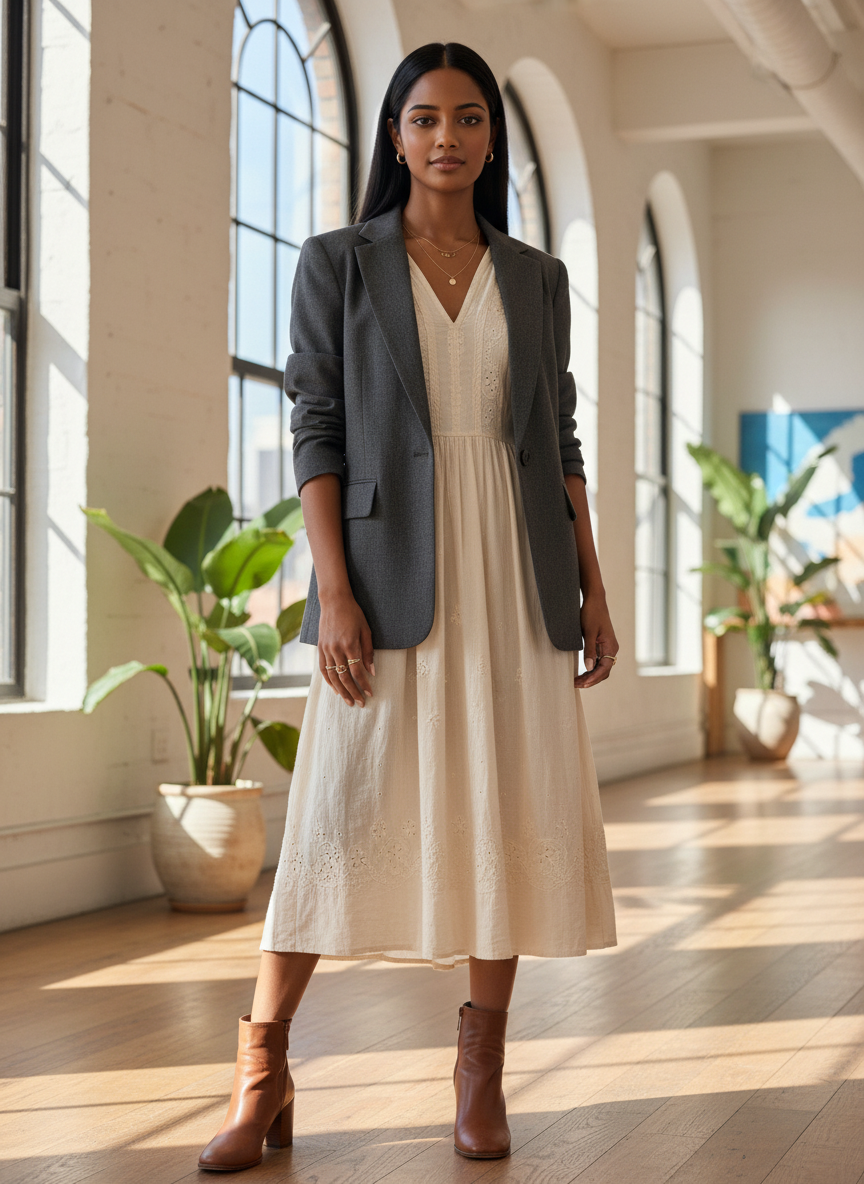
What it is: Modern Boho is the version that lives in Free People lookbooks and Anthropologie windows.
The key distinction: Where classic boho assembles, Modern Boho edits. The same impulse is expressed through fewer, cleaner pieces rather than more, layered ones. A Modern Boho outfit might be a single embroidered midi dress with leather sandals and minimal jewelry.
Visual identifiers:
Smocked and embroidered dresses in muted, sophisticated colorways
Wide-leg linen trousers with a simple tucked top
Leather accessories in tan and cognac rather than maximalist fringe
Jewelry that layers but doesn't overwhelm — two necklaces rather than five
A neutral palette with one warm accent rather than the full boho color story
Who it's for: The reader who resonates with boho values but whose lifestyle, maybe professional needs, requires some translation.
The risk: Editing too aggressively until the boho aesthetic disappears. To keep the boho feel maintain something like embroidery, natural fibers, or the global textile references. Without at least one of these anchors, Modern Boho is just a neutral outfit.
2. Festival Boho
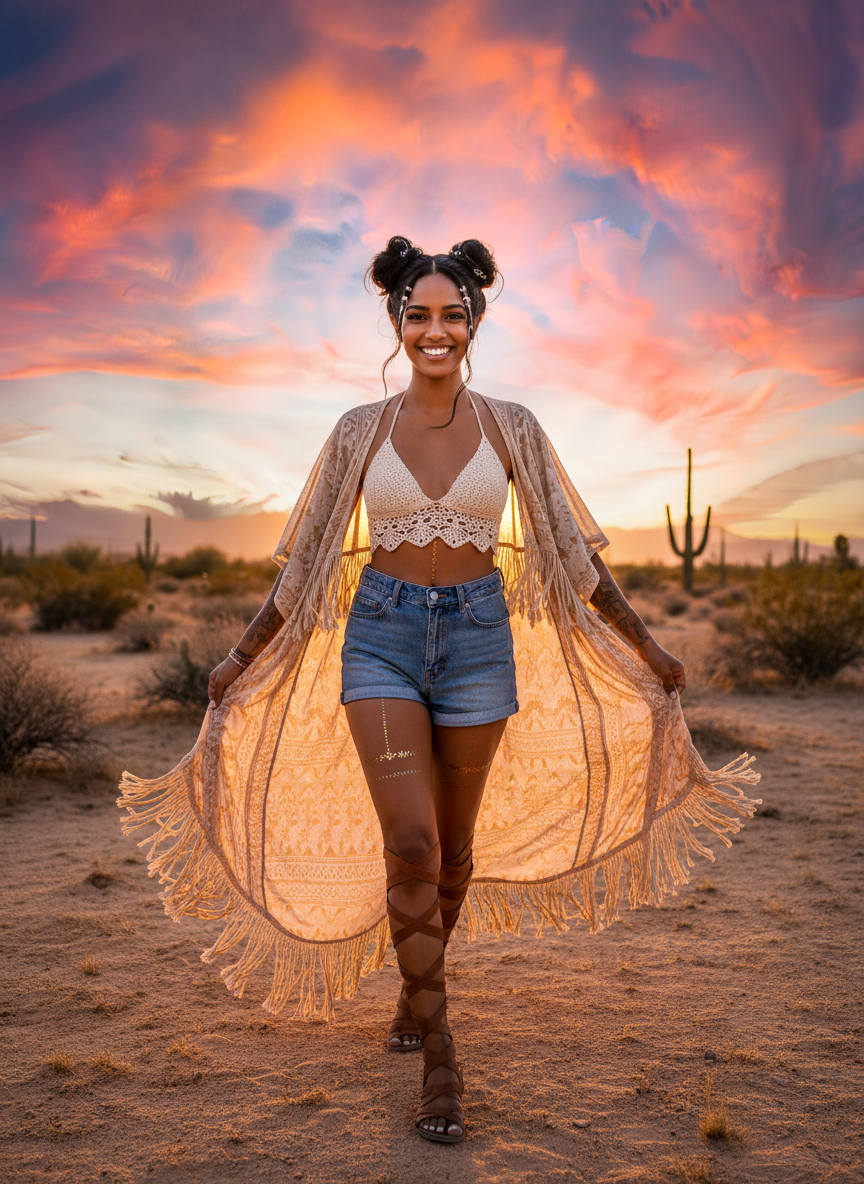
What it is: Festival Boho is the version that Coachella made famous. It’s what most of gen-z pictures when they hear “boho” and is the most visible version of the aesthetic. It’s designed for festivals and outdoor events.
The key distinction: Festival Boho is performative and there is nothing wrong with that. It is dressing for an audience and Instagram.
Visual identifiers:
Crochet tops, cutout details, and midriff-baring silhouettes
Body jewelry
Platform sandals or chunky boots
Maximum jewelry layering
Face gems, glitter, and decorative elements
Short hemlines in contrast to the maxi-dominant everyday boho wardrobe
Hats at their most dramatic: enormous brims, embellished crowns, feather details
Who it's for: Anyone, seasonally. It is also the entry point for those who find boho through Coachella content and will eventually move toward the quieter sub-aesthetics.
The risk: The Halloween problem; too many festival elements give costume rather than outfit. Choose two or three festival-forward pieces.
3. Desert Boho
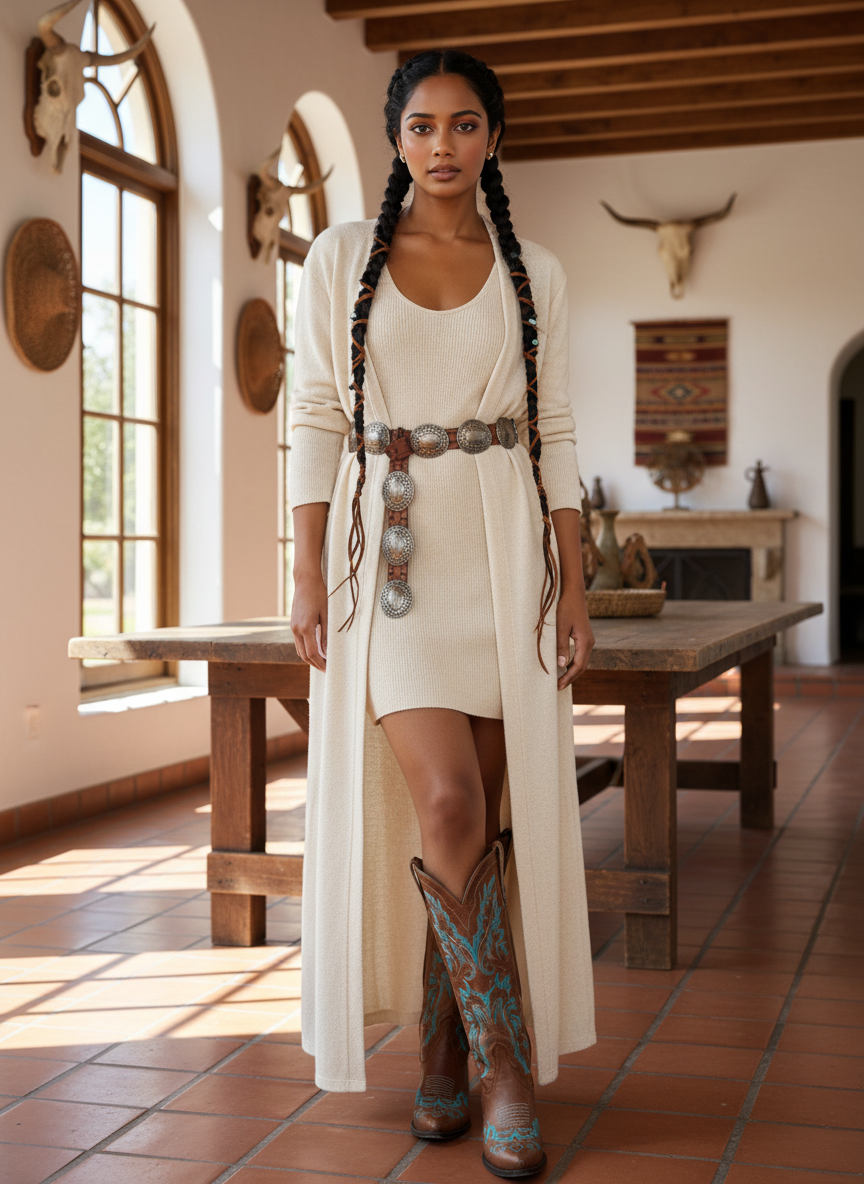
What it is: Desert Boho is the Southwestern iteration. It’s rooted in the landscapes and color palette of the American Southwest and northern Mexico. It is warmer, earthier, and more specifically American than the global eclecticism of classic boho.
The key distinction: Where classic boho is global eclectic, Desert Boho is geographical. The references are Southwestern, the palette is terracotta-and-turquoise, and the craft traditions originate from the American Southwest and Mexico.
Visual identifiers:
Terracotta, rust, sand, and turquoise
Concho belts and turquoise jewelry
Fringe in leather and suede
Western boot as the footwear signature
Woven textiles in geometric patterns referencing Navajo and Zapotec weaving traditions
Linen and cotton in warm, sun-bleached colorways
Cacti, adobe, and Southwestern landscape as the visual context
Who it's for: Readers drawn to American craft traditions. Desert Boho has a strong regional identity that makes it feel more grounded than classic boho.
The cultural sensitivity note: Desert Boho engages directly with Native American and Mexican craft traditions. Turquoise jewelry has a legal protection framework in the United States under the Indian Arts and Crafts Act. Buying from verified Native American artisans is not just ethically preferable; purchasing items falsely marketed as Native American-made is illegal.
Use The Indian Arts and Crafts Association directory.
4. Coastal Boho
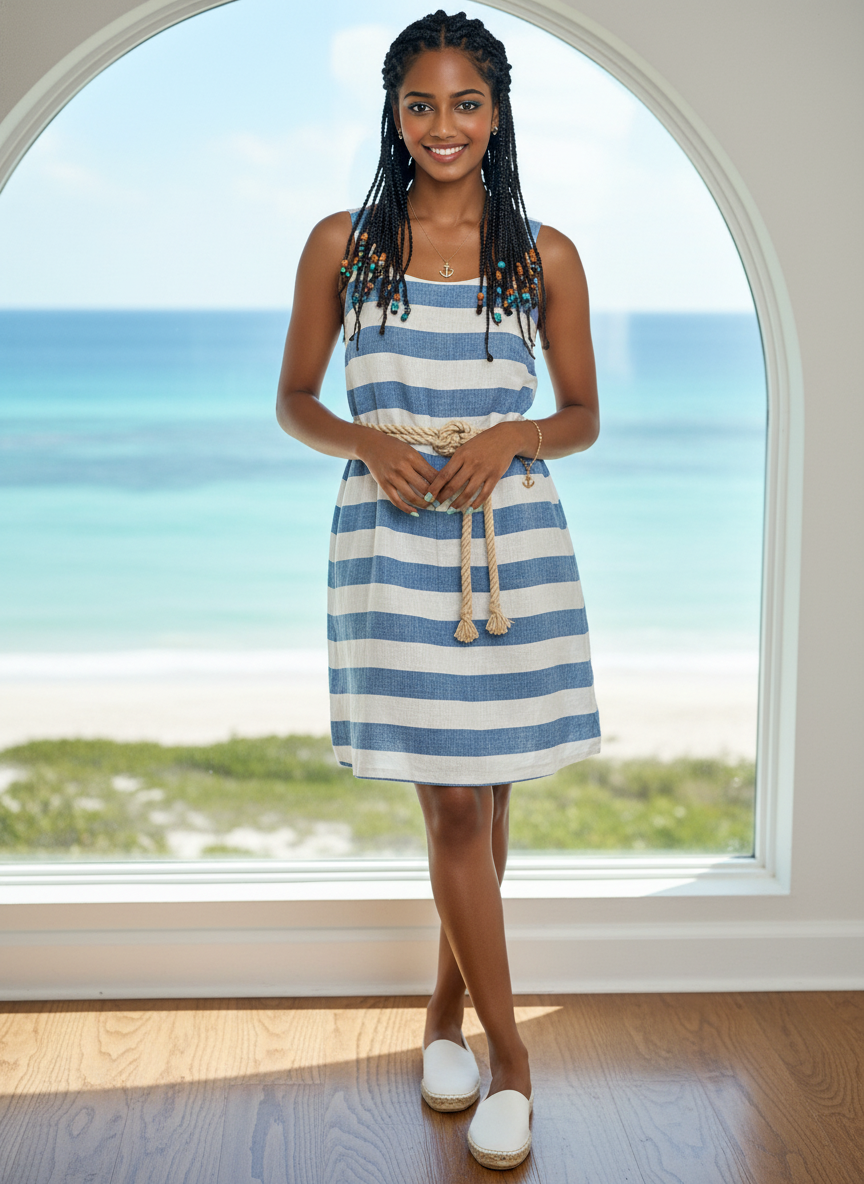
What it is: Coastal Boho is the lightest, airiest version of the aesthetic. The palette contracts to warm whites, cream, sand, and shell tones. The fabrics go lighter, like linen, cotton voile, gauze. The jewelry leans toward shell, coral, and natural pearl.
The key distinction: Coastal Boho is closest related to Coastal Grandmother. It will appeal those who find boho maximalism overwhelming but desire more character than minimalism offers.
Visual identifiers:
White, cream, and warm sand as the dominant palette
Linen as the primary fabric
Shell jewelry — pendant necklaces, earrings, hair accessories
Natural pearl, coral, and sea glass as stone alternatives to turquoise and amber
Woven straw and rattan bags and hats
Flat leather sandals or bare feet
Macramé as the craft reference — wall hangings translated into bags, jewelry, and accessories
Bleached, sun-warmed textures
Who it's for: Someone who lives near water or wants to. Coastal Boho is also great for the reader who dresses boho in summer and pivots elsewhere in winter.
The risk: Losing the boho signal in favor of generic beach casual. Keep the folk-craft reference; like macramé bag or shell jewelry, as an anchor. Without it, Coastal Boho becomes a linen outfit near water.
5. Bohemian Romantic
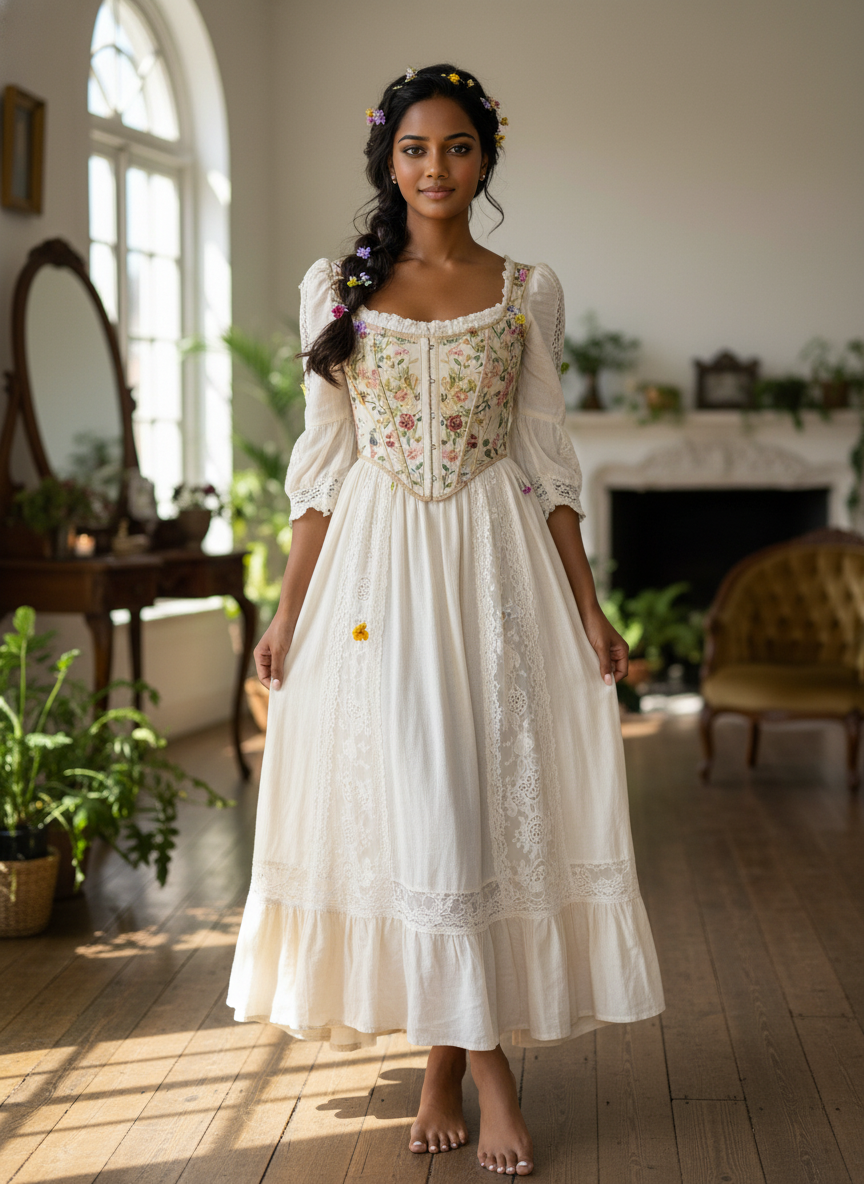
What it is: Bohemian Romantic is the most feminine sub-aesthetic in the family. It is the intersection of boho's natural materials and global references with the Romantic aesthetic's florals, lace, soft light, and prettiness.
The key distinction: Where classic boho leans earthy and eclectic, Bohemian Romantic leans floral and soft. The color palette shifts from terracotta and ochre toward dusty rose, mauve, blush, and wine. The silhouettes hold more ruffle and lace.
Visual identifiers:
Floral prints at maximum
Lace as a recurring surface detail
Dusty rose, mauve, blush, wine, and cream as the dominant palette
Ruffles at sleeves, hems, and necklines
Vintage-inspired silhouettes
Candle-lit color quality
Layered jewelry in delicate gold rather than statement pieces
Who it's for: The reader who loves the Romantic Aesthetic but finds it too precious, or who loves classic boho but finds it too earthy.
Read more about the Romantic Aesthetic here.
6. Boho Minimalist
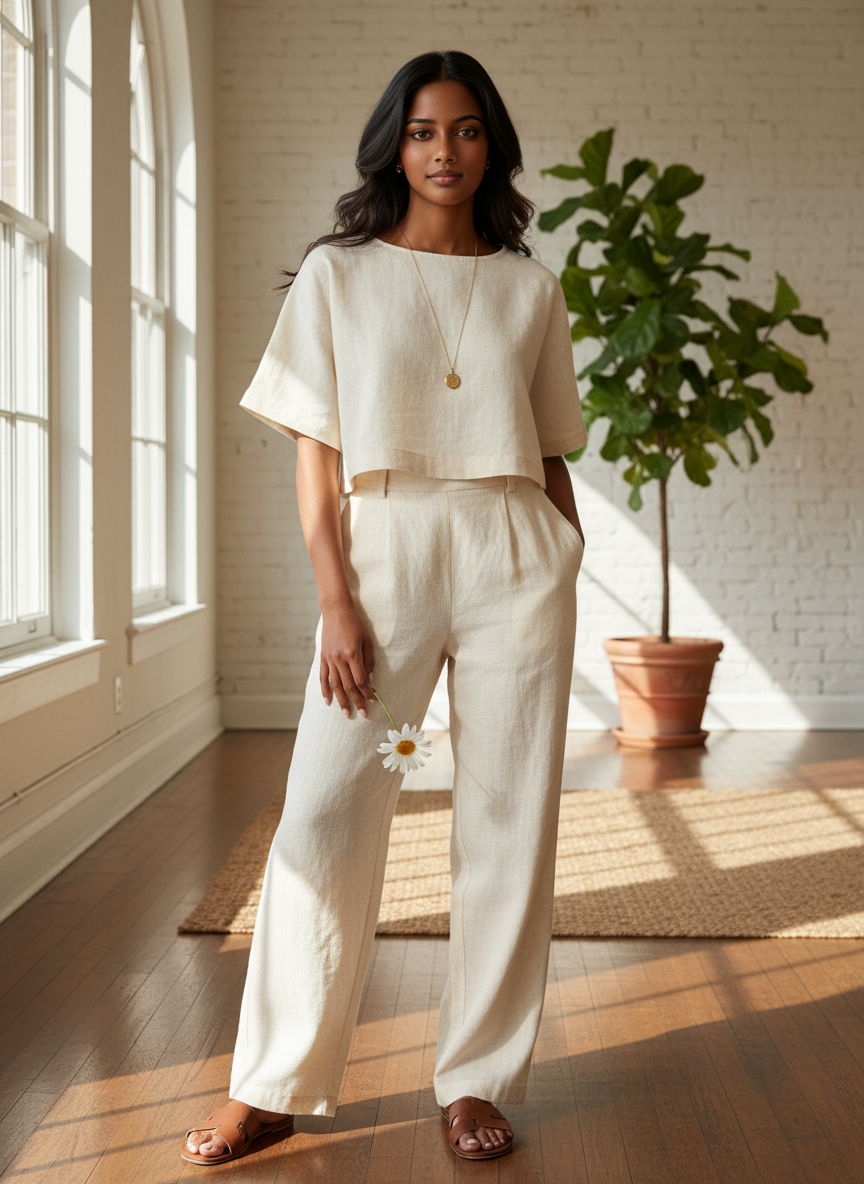
What it is: Boho Minimalist is bohemian style that applies the philosophy completely with restraint.
The key distinction: You can buy vintage, invest in natural fibers, and refuse the trend cycle while looking clean and understated.
Visual identifiers:
A tightly edited palette of two or three colors from the primary boho range, like cream, linen, or tobacco with a single accent
One statement piece per outfit maximum
Clean silhouettes in natural fibers
Minimal jewelry
Quality as the primary visual signal rather than quantity
Negative space as a design element
Who it's for: The reader who loves the boho philosophy but may work in a professional environment or desires to be less flashy. It could be the entry point for readers coming from Minimalism or Clean Girl who want more character and warmth without committing to full bohemian maximalism.
The risk: Losing the boho signal. A cream linen dress with tan sandals is minimalism, not Boho Minimalist. Chose a (one) statement piece like jewelry or an eye-catching bag to set it apart.
7. Global Boho
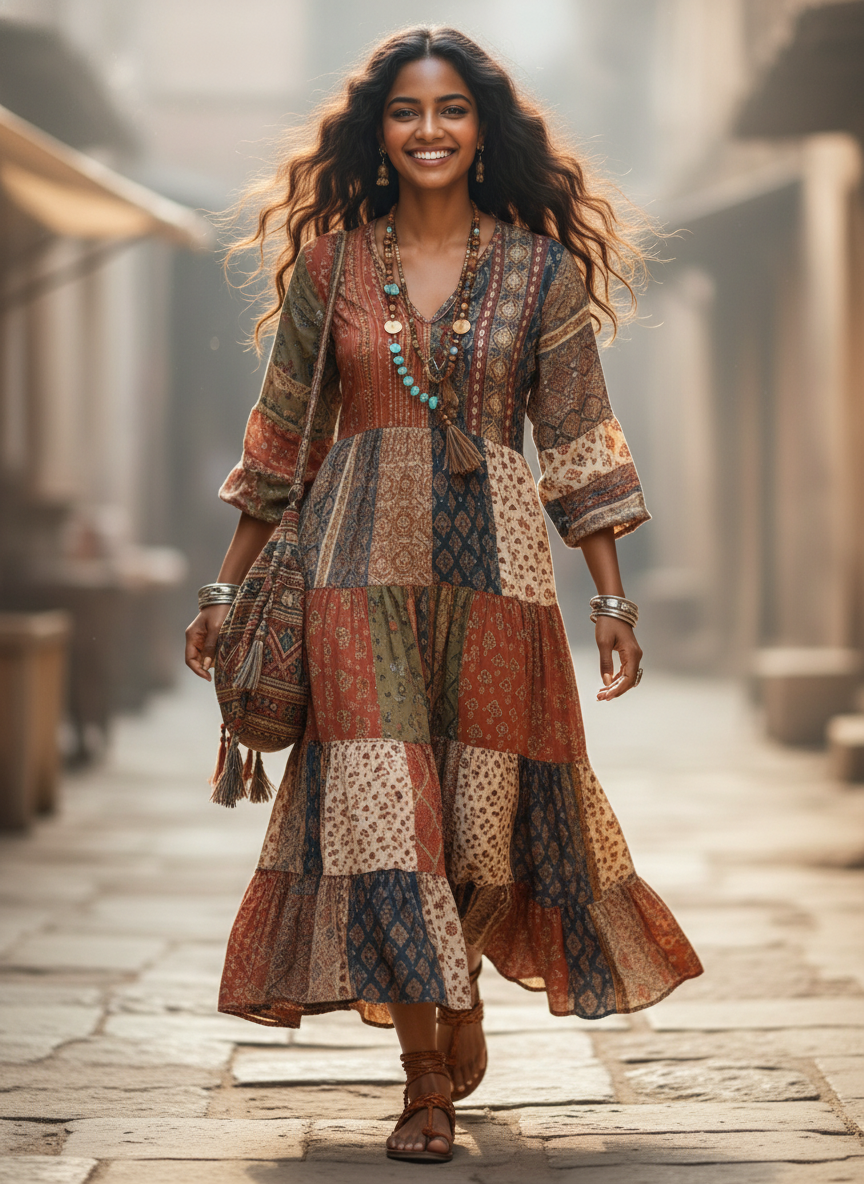
What it is: Global Boho is the most culturally rich and most culturally complex sub-aesthetic in the family. It has the deepest connection to the original bohemian travel-as-identity philosophy.
The key distinction: Global Boho is about engagement with the textile and craft traditions of other cultures. The difference between Global Boho and cultural appropriation is knowledge and sourcing pieces directly from their original communities wherever possible.
Visual identifiers:
Kilim, ikat, and block-print textiles as statement pieces
Folk embroidery like Mexican bordado, Indian kantha, Eastern European
Kaftans and caftans in regional silhouettes and fabrics
Indigo-dyed textiles like Japanese shibori, West African adire, and Indian resist-dyed cotton
Handwoven accessories like Guatemalan huipil-inspired pieces, Moroccan leather goods, Balinese silver jewelry
Color palettes draw from a specific textile tradition rather than a generic earthy boho range
Layered pieces from different cultural contexts
Who it's for: Anyone who loves to travel or who buys from artisans and markets.
The cultural responsibility note: Wearing a kilim print purchased from a verified Turkish artisan co-operative is a different act from wearing a mass-produced kilim-print dress from a fast fashion retailer. The former supports the tradition; the latter extracts from it.
Finding Your Dialect
Most boho wardrobes are not pure expressions of a single sub-aesthetic. A Coastal Boho allows herself Festival Boho for specific occasions or a Boho Minimalist owns one maximalist Global Boho statement piece.
It’s up to you to find your unique mix.
Boho vs. Related Aesthetics
Bohemian style shares visual territory with lots of adjacent aesthetics. Readers frequently find themselves standing at the intersection of two aesthetics wondering which one they inhabit.
Four aesthetics share enough DNA with boho to warrant a direct comparison. Each one illuminates a different facet of the distinct boho style.
Boho vs. Cottagecore
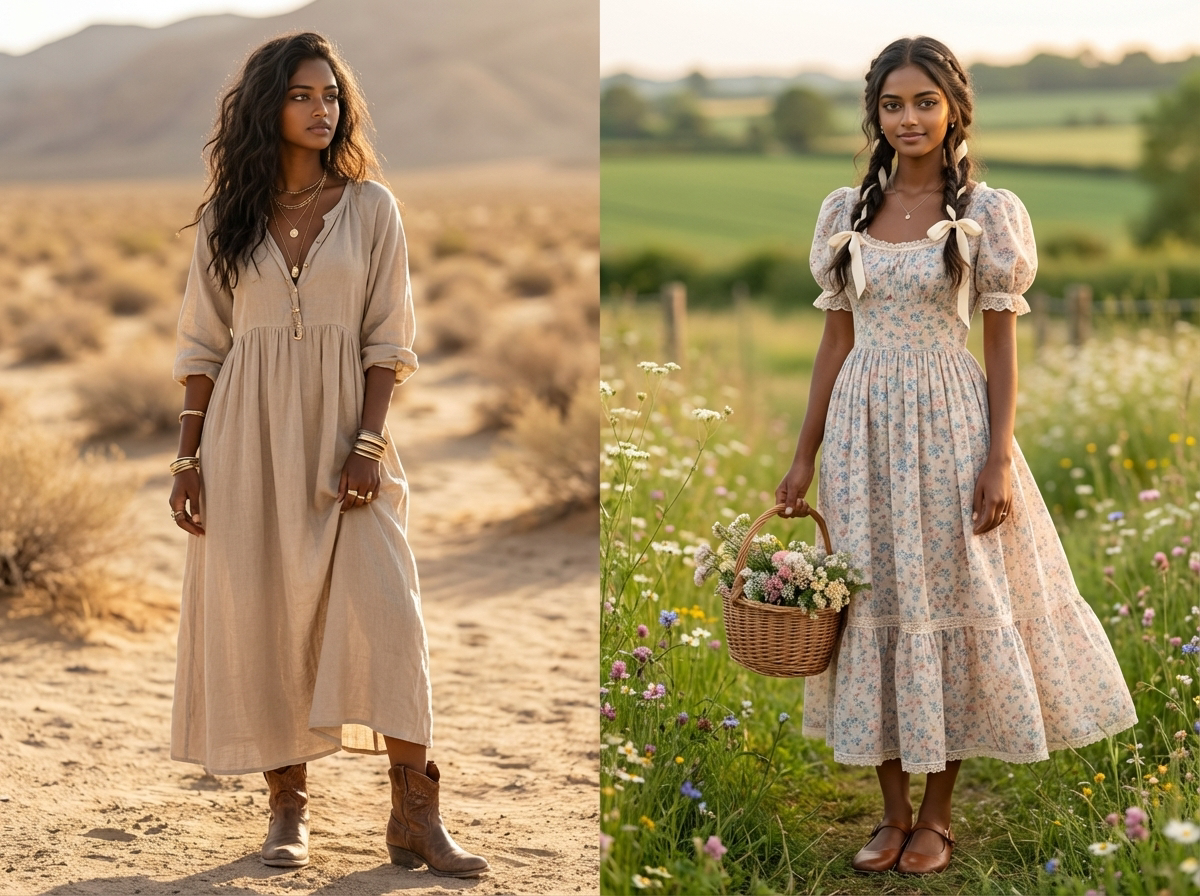
Boho vs. Cottagecore: A rooftop in Marrakech vs. a kitchen garden in Devon.
Cottagecore is the one most confused with boho. Both love florals and natural fibers. Both reject fast fashion. A woman in a floral linen dress picking herbs could belong to either one.
Cottagecore looks to the domestic, the local, the pastoral. It romanticizes the cottage, kitchen garden, and handmade jam.
Boho looks outward and far; to the market in Marrakech, the festival in the desert, or the textile bought from a weaver in Oaxaca.
Where they meet: Boho + Cottagecore = Bohemian Romantic
🌿 Boho vs Cottagecore
Boho: Global, layered, slightly messy
Cottagecore: Local, soft, storybook-perfect
👉 Boho travels. Cottagecore stays home.
Boho vs. Coastal Grandmother
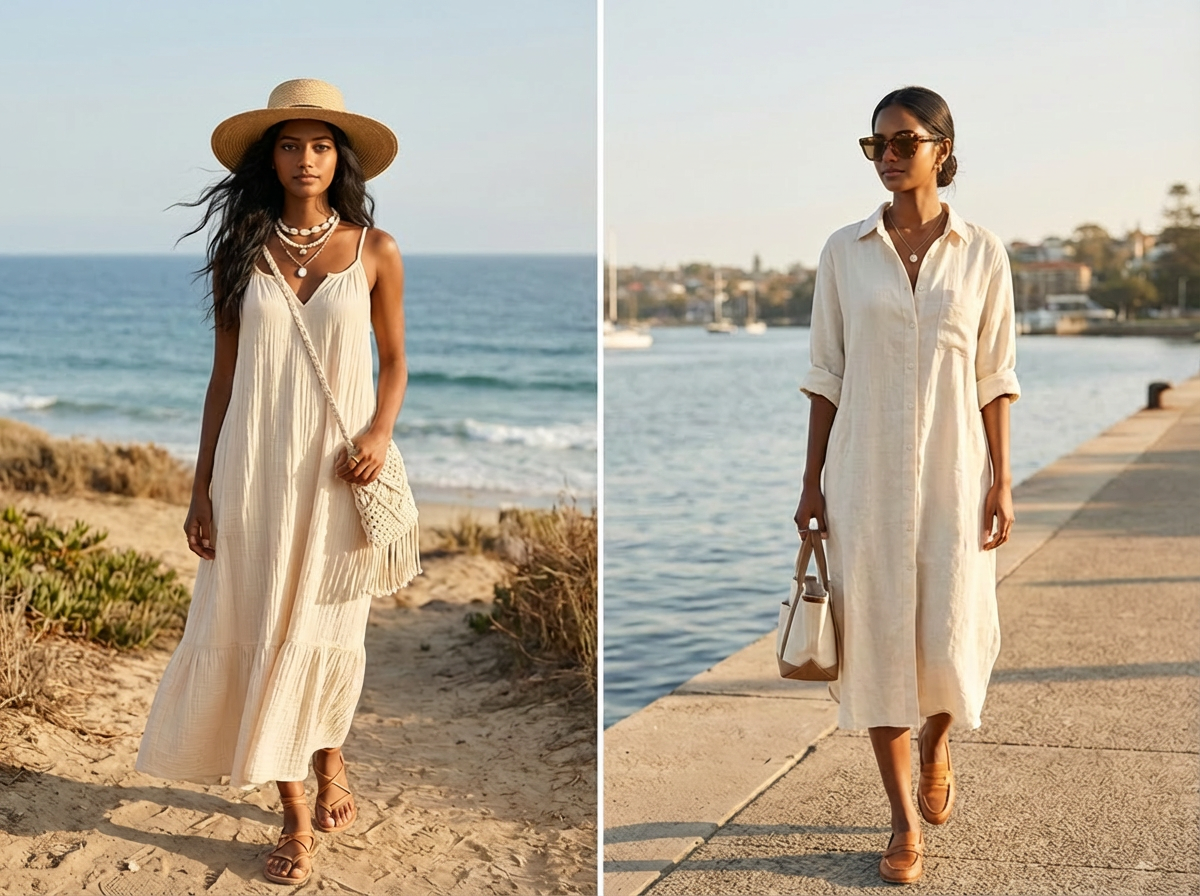
Boho vs. Coastal Grandmother: The macramé bag vs. the leather loafer.
Coastal Grandmother and Coastal Boho are close enough that a single accessory can move an outfit from one to the other.
Both are built on linen. Both reach for warm neutrals and resist the trend cycle.
However, Coastal Grandmother does not require a craft reference or need a folk tradition.
Without the craft reference Coastal Boho becomes a linen outfit near water.
Where they meet: A quality linen dress worn with flat leather sandals and a woven tote is the exact point of overlap. Add a macramé detail or shell jewelry and it tips toward Coastal Boho. Add a cashmere layer and leather loafers and it tips toward Coastal Grandmother.
If you want to look like you know where the good fish restaurant is, you're Coastal Grandmother. If you want to look like you walked here from somewhere with better light, you're Coastal Boho.
🌊 Boho vs Coastal Grandmother
Boho: Unstructured, expressive, mixed
Coastal Grandmother: Relaxed, cohesive
👉 Boho adds more. Coastal grandmother takes away.
Boho vs. Hippie
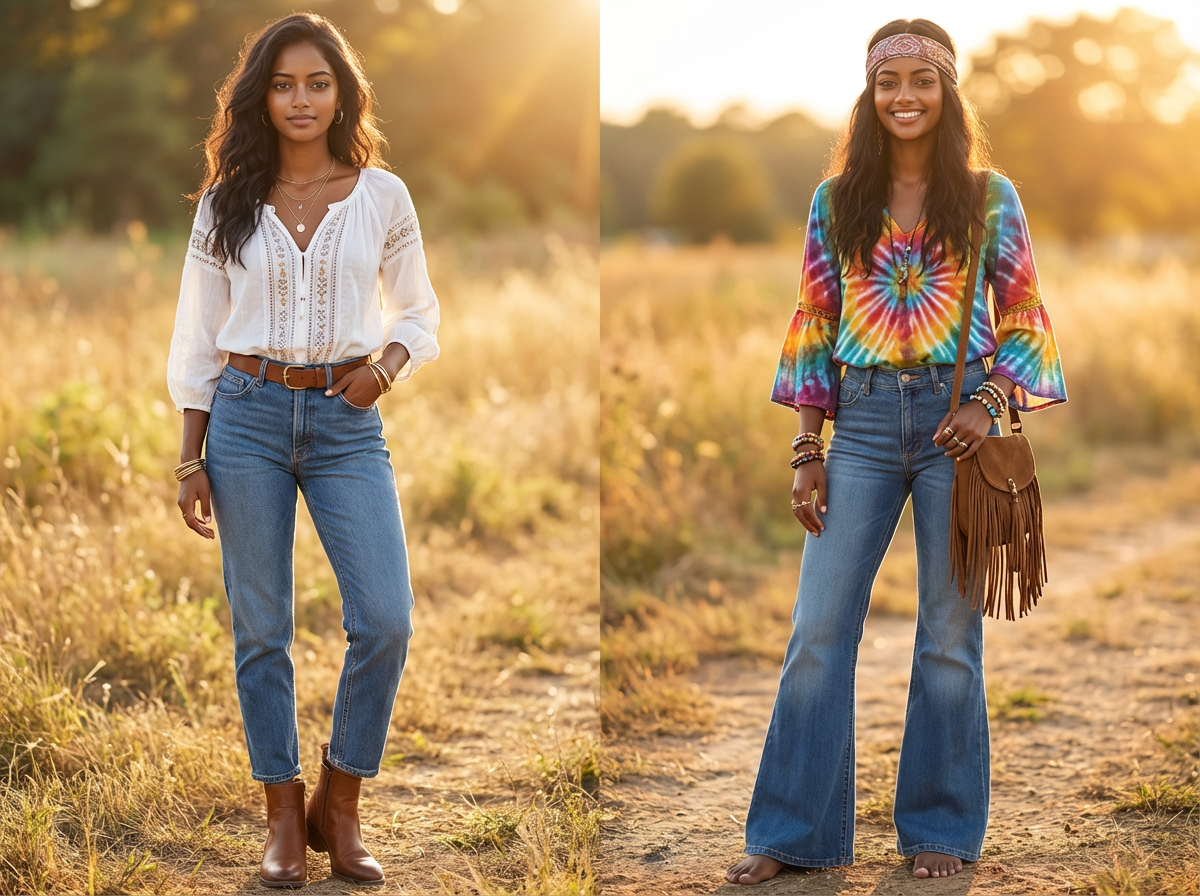
Hippie was a movement that produced an aesthetic. Boho is an aesthetic that references a movement.
Hippie is Boho’s political ancestor. It emerged from the American counterculture of the 1960s and early 1970s, the anti-war movement, the civil rights movement, and the communal living experiment. The clothes were a political statement rather than an aesthetic choice.
Modern boho inherits the visual language of hippie without the politics.
Where they meet: The 1970s boho revival sits closest to the original hippie vision. Festival Boho, particularly in its most maximalist expression, also references hippie directly.
The reader navigation: If you're drawn to dressing as a form of resistance as well as expression, it may be fun to research the origins. If you love the look without the political weight, you're in boho's territory.
☮️ Boho vs Hippie
Boho: Inspired by the past
Hippie: Is the past (or directly referencing it)
👉 Boho edits. Hippie preserves.
Boho vs. Maximalist
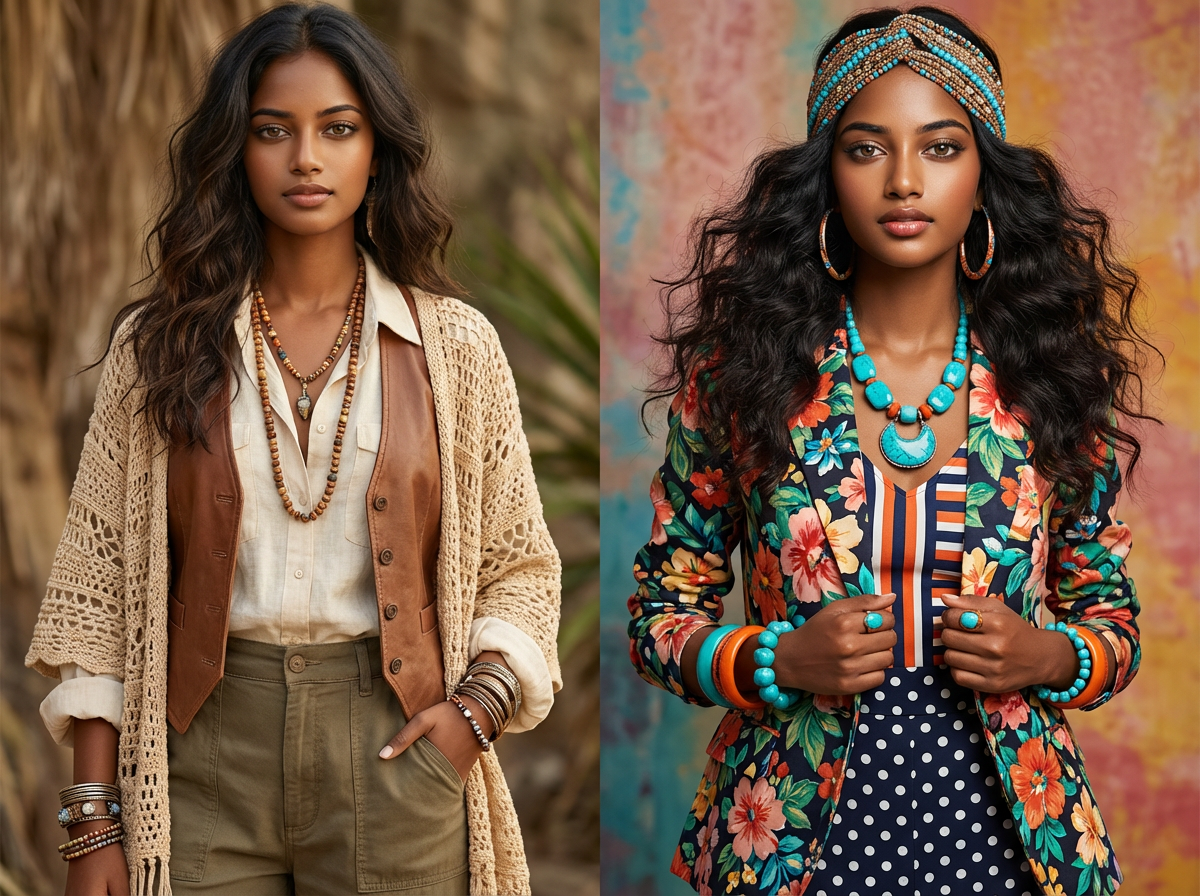
Boho vs. Maximalist: Complexity organized by cultural and material principles vs. complexity organized by personal creative instinct.
At first glance, the most maximalist expressions of boho look no different from the Maximalist or Art Girl aesthetic.
Maximalism is about more. More color. More pattern. More statement. More everything.
Boho values natural materials, folk craft traditions, and global references. The five necklaces are layered because layering is a boho jewelry principle, not because five necklaces are more interesting than one.
Where they meet: The Global Boho sub-aesthetic could operate in both registers. It is the far end of the boho spectrum, where the dial has been turned all the way up.
The reader navigation: If you like something because of what it's made of or where it came from you're thinking like a boho dresser. If you like a piece because of how it combines with other things you own you're thinking like a maximalist.
🎨 Boho vs Maximalist
Boho: Grounded eclecticism (nature-based)
Maximalist: Visual abundance (no anchor required)
👉 Boho has a palette. Maximalist has a point of view.
How to Dress Boho: Outfit Formulas
You can know the color palette, the sub-aesthetic variations, and the comparison tables. Yet you’re still in front of a wardrobe with no idea where to start.
Outfit formulas solve that problem. These are proven combinations that work. Each formula below is named for its context, built from specific piece descriptions, and annotated with the one or two decisions that make it boho.
Formula 1: The Coachella Opener
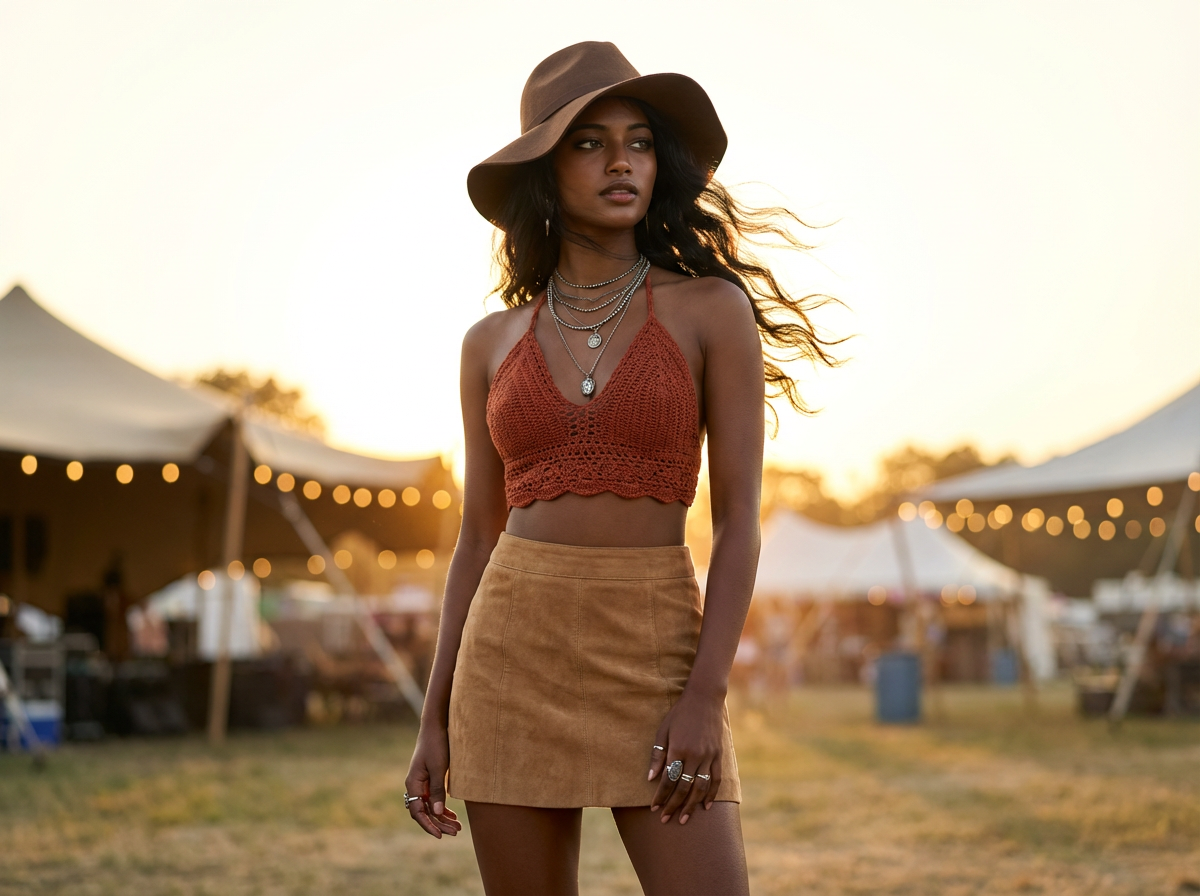
The context: Festival, outdoor event, the social permission of a warm-weather occasion.
The formula:
Crochet top or embroidered crop in ecru, cream, or warm white
Micro shorts or tiered mini skirt in denim, suede, or a warm print
Platform sandal or chunky ankle boot in tan or tobacco
Belly chain or layered body jewelry as the statement layer
Minimum five necklaces at varying lengths
Floppy embellished hat or floral crown
The boho decision: The natural fiber and the handcraft signal carry the aesthetic even when the hemline is short and the platform is high.
The one adjustment: In the heat of a festival afternoon, the hat provides shade and simultaneous aesthetic completion.
Sub-aesthetic: Festival Boho — the full-volume register.
Formula 2: The Farmers Market Regular
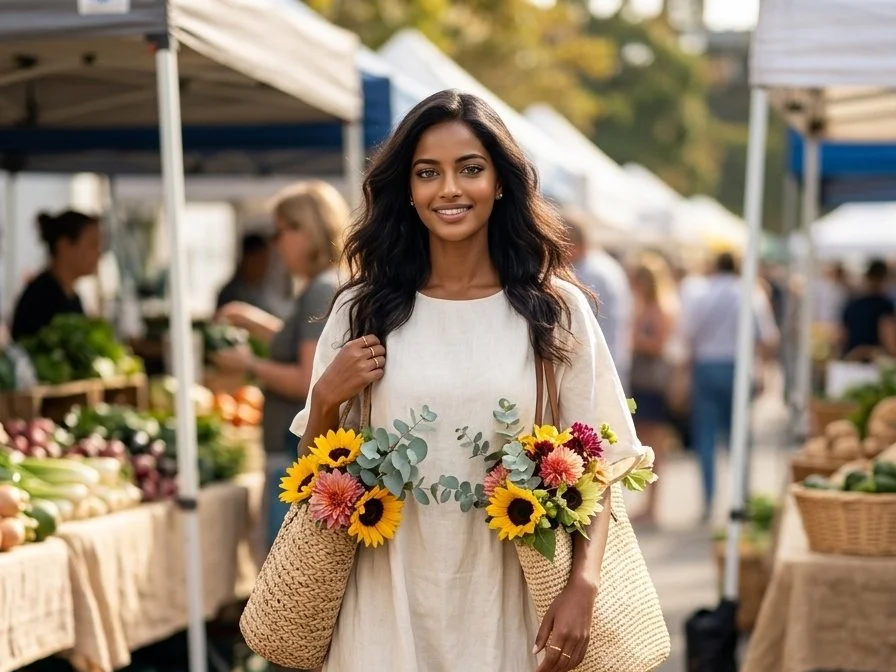
The context: Weekend morning or the outdoor market.
The formula:
Linen maxi dress in warm cream, dusty sage, or a subtle floral
Flat leather sandal in tan or cognac
Large woven or rattan tote
Single stacked ring set across two or three fingers
Minimal gold necklace
No-makeup makeup: bronzer, brown mascara, warm lip balm
The boho decision: The linen maxi dress does almost all of the work here. Smocked or wrap construction carry the full boho signal without too many accessories.
The one adjustment: The tote is load-bearing here. It should be woven or rattan rather than a printed approximation.
Sub-aesthetic: Modern Boho — the everyday, accessible register of the aesthetic.
Formula 3: The Wedding Guest
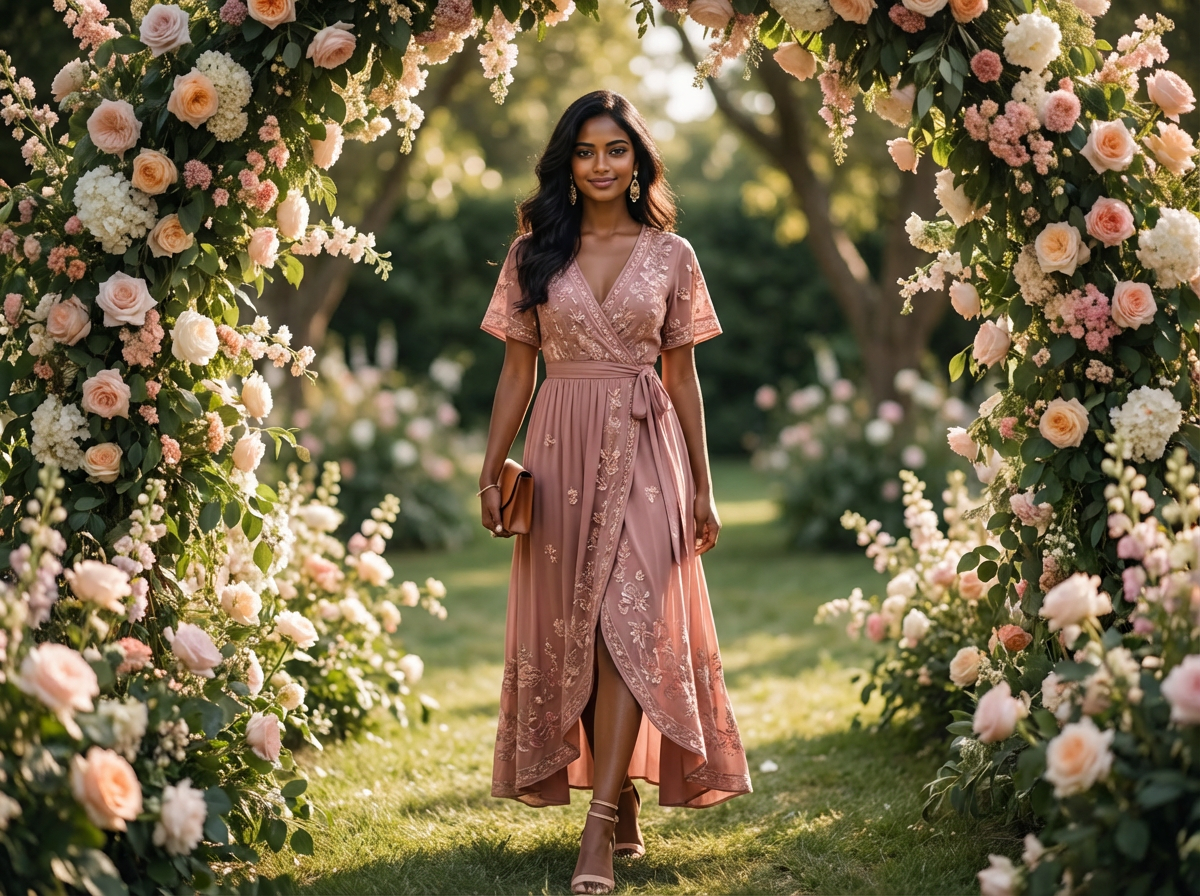
The context: An outdoor or garden wedding, a summer celebration, any occasion that requires dressing up without dressing formally.
The formula:
Wrap maxi dress or embroidered maxi in silk, silk-feel, or quality cotton — floral, paisley, or solid in a deep boho accent color (wine, dusty rose, forest green)
Strappy heeled sandal in nude, gold, or cognac leather
Small embroidered or beaded clutch
Gold drop earrings — the statement piece of the jewelry edit
Two fine layered necklaces, shorter lengths to balance the drop earrings
Hair half-up with pieces down, a decorative pin as the single hair accessory
The boho decision: The embroidery or the print on the dress. Folk textile reference or the botanical print is what anchors the outfit in the aesthetic.
The one adjustment: The drop earrings and the layered necklaces should not compete. Scale one down if the other is strong.
Sub-aesthetic: Bohemian Romantic — the most occasion-appropriate expression
Formula 4: The Work-From-Anywhere
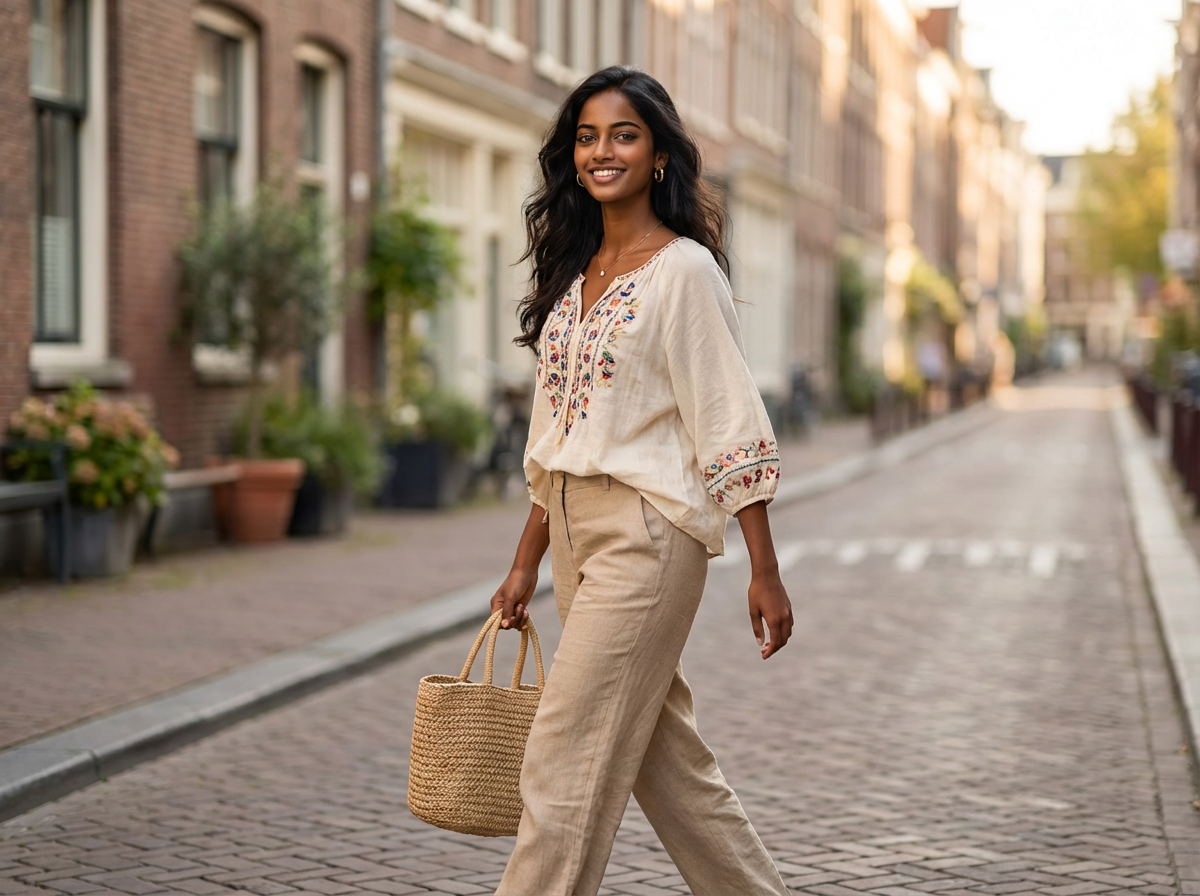
The context: The home office, the café, the co-working space, someone whose professional context is flexible enough to accommodate personal style.
The formula:
Wide-leg linen trousers in cream, tobacco, or dusty sage
Embroidered or printed loose-fit button-front shirt — tucked loosely at the front only
Leather mule or slip-on in tan or cognac
Statement ring — turquoise, moonstone, or amber in a gold setting
Woven leather or suede crossbody bag — structured enough for a laptop or notebook
Reading glasses if applicable: tortoiseshell or warm acetate frames
The boho decision: The embroidery or print on the shirt, and the stone ring. The embroidered detail on the shirt and the stone ring introduce the folk craft reference that makes the outfit specifically boho.
The one adjustment: A fully tucked shirt reads as more formal and less boho; an untucked shirt reads as too casual. The half-tuck hits the exact register this outfit needs.
Sub-aesthetic: Boho Minimalist — the professional translation of the aesthetic.
Formula 5: The Boho Minimalist Edit
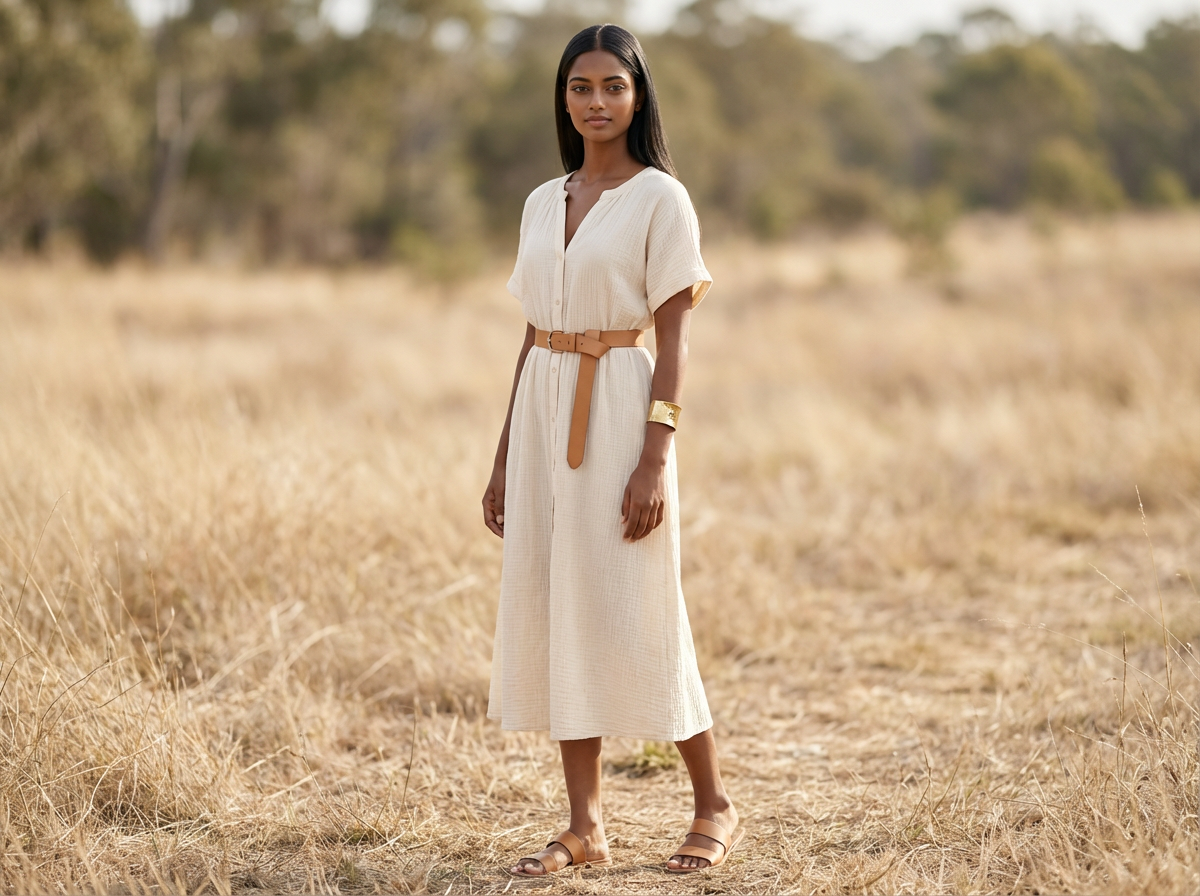
The context: Any occasion that requires the aesthetic to work quietly like a smart dinner or an art opening.
The formula:
Cream or sand gauze midi dress — simple silhouette, no embroidery
Wide tan leather belt at the natural waist
Leather flat sandal or low leather mule
One hammered gold cuff — the only jewelry piece in this outfit
Natural leather or suede clutch or small crossbody
Hair: loose waves or a simple low bun, no accessories
The boho decision: The belt and the cuff. The wide leather belt introduces the artisan reference, and the hammered gold cuff introduces the handcraft signal.
The one adjustment: The gauze fabric is non-negotiable in this formula. The whole point Boho Minimalist register is that the material does the work that the detail cannot.
Sub-aesthetic: Boho Minimalist — the restraint register
Formula 6: The Golden Hour
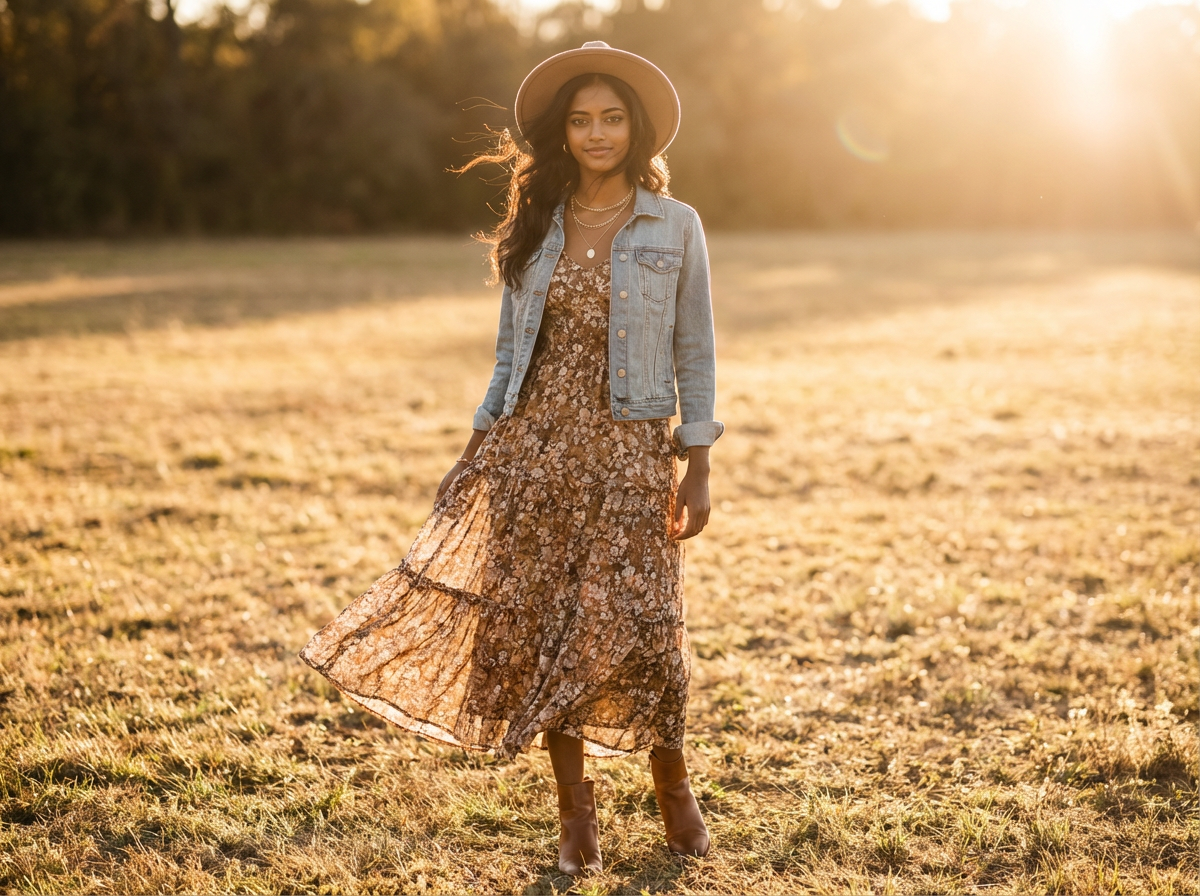
The context: An evening out, a summer dinner, a sunset occasion.
The formula:
Tiered floral maxi skirt in deep terracotta, wine, or a warm botanical print
Simple fitted camisole or fine-knit top in cream or warm gold — tucked in
Denim jacket or vintage leather jacket worn open as a layer, removed as the evening warms
Ankle boot in tobacco suede or leather — low heel preferred
Layered gold chains — three lengths, one with a small pendant or charm
Small hoop earrings in hammered gold
Lip color: a deeper, warmer berry or wine lip is specifically boho
The boho decision: The tiered maxi skirt creates the bohemian movement and volume; straight maxi skirt in the same print reads as Romantic or even maximalist.
The one adjustment: The jacket layer manages the transition between afternoon and evening while adding the casual, worn-in quality.
Sub-aesthetic: Modern Boho — the evening version.
Formula 7: The Desert Road Trip
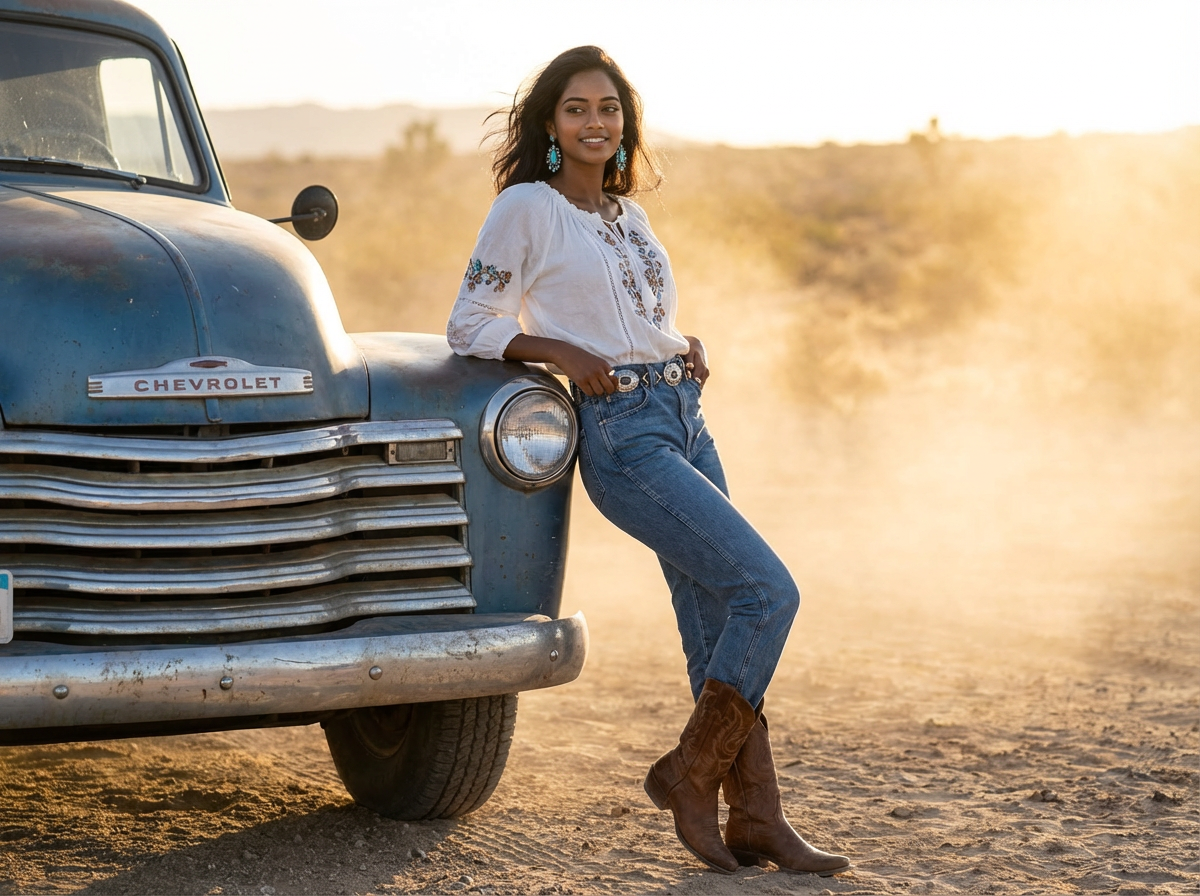
The context: A travel day or an outdoor adventure.
The formula:
High-rise wide-leg or straight-leg denim — vintage wash, no distressing
Embroidered or printed peasant blouse in cream or warm white — untucked
Wide concho belt or tooled leather belt worn over the blouse at the hip
Western ankle boot in tan or tobacco leather
Turquoise earrings
Woven textile bag or vintage leather satchel with Southwestern detail
Floppy felt hat in tobacco or natural
The boho decision: The concho belt and the turquoise earrings produce Desert Boho. Without them, the denim and peasant blouse formula reads as generic casual or even contemporary hippie.
The one adjustment: In the Desert Boho context specifically, the provenance of the turquoise matters both culturally and aesthetically.
Sub-aesthetic: Desert Boho — the Southwestern version
Reading the Formulas
A few observations worth making before moving on.
First: The formula can be adapted, substituted, and personalized in almost every other element, but the boho aesthetic cannot be removed.
Second: You do not need to commit to Festival Boho to wear Formula 1, or to Boho Minimalist to wear Formula 5. The sub-aesthetic label is useful shorthand. The formula is for anyone.
Third: The reader who takes Formula 2 and swaps the linen maxi for a tiered floral skirt and a peasant blouse has not broken the formula, she has made it her own.
The Boho Lifestyle: Home, Travel, Social Calendar, and Career
The boho lifestyle extends the bohemian aesthetic beyond the wardrobe into every area of lif; the home, social calendar, travel, and even career. It is one of the few fashion aesthetics with a comprehensive lifestyle philosophy attached.
The Boho Home: Organized Chaos
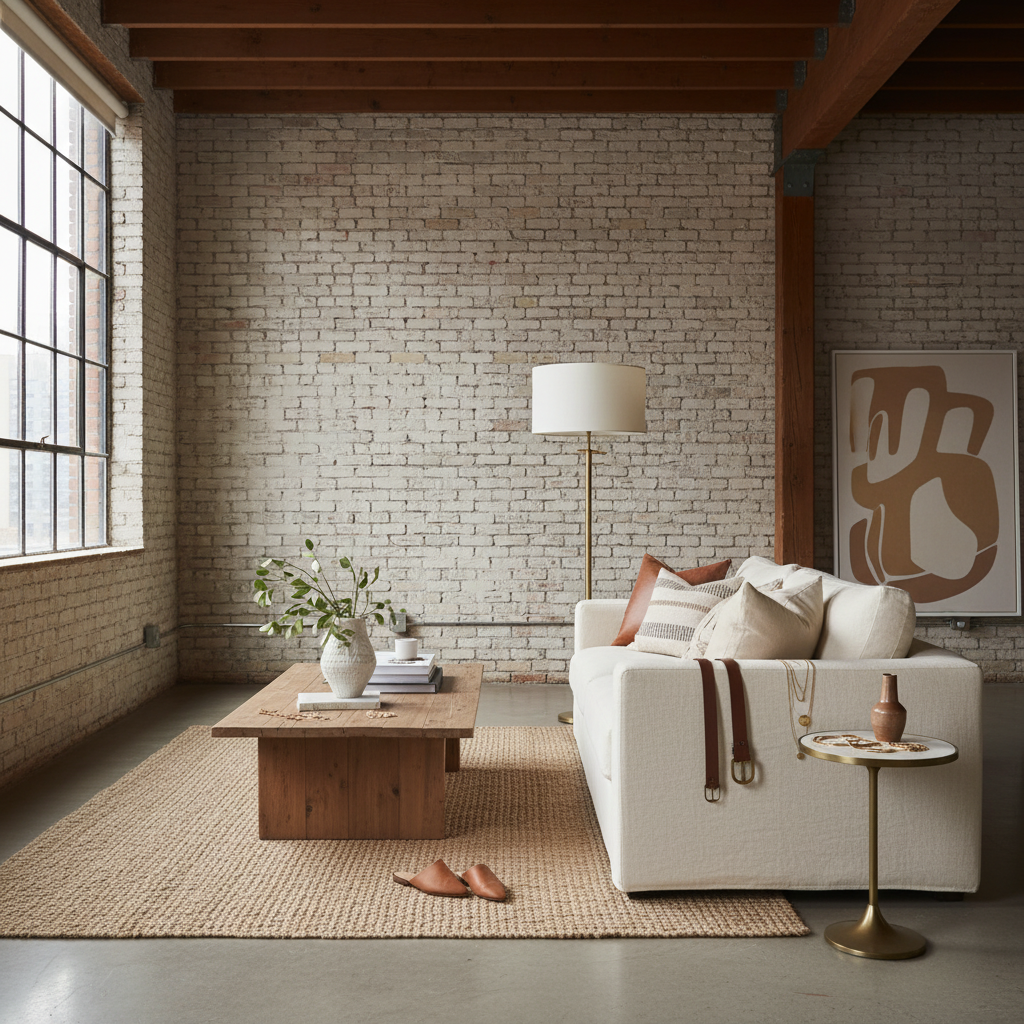
In a boho home, textiles are infrastructure. Layered woven rugs on the floor. Embroidered cushions piled on a rattan sofa. A kantha quilt draped over a chair.
In boho interiors the plants are personality tests. A collection of trailing pothos, slightly dramatic monsteras, and a fiddle-leaf fig tell you something about the inhabitant that no amount of styling could.
Candles occupy every horizontal surface at levels that would concern a fire marshal. The boho home is lit from below and from the side, never from above.
The boho home also has plenty of crystals. You’ll find a geode on the windowsill or a rose quartz on the bedside table. Whether you believe the crystals actually do anything is another matter, but they perfectly fit the boho aesthetic.
The color palette is the same as the wardrobe. Picture terracotta walls or whitewashed plaster, linen curtains, rattan and wood furniture punctuated by jewel tones in textiles and found objects.
The whole effect is a space that looks assembled over years. When it doesn't work, it looks like a Restoration Hardware catalogue and an Etsy shop had a disagreement.
-
To decorate a boho home:
(1) Layer textiles everywhere; woven rugs, embroidered cushions, kantha quilts, macramé wall hangings.
(2) Add plants as structural elements; trailing pothos, dramatic monsteras, a fiddle-leaf fig.
(3) Light with candles at every level never overhead lighting alone.
(4) Introduce jewel tone accents through textiles and found objects against a warm neutral base.
(5) Casually Ppace crystals and artisan objects.
(6) String lights year-round.
(7) Edit ruthlessly. The difference between organized chaos and actual chaos is knowing what to put away.
The Boho Social Calendar: Festivals, Markets, and Full Moon Ceremonies
The Circuit:
Music festivals: Planning year-round
Farmer's markets: Weekend ritual
Yoga retreats: Vacation goals
Art shows: Supporting friends
Full moon ceremonies: Seriously
Drum circles: Ironically?
Burning Man: Bucket list
Boho Travel Destinations: Where the Aesthetic Goes
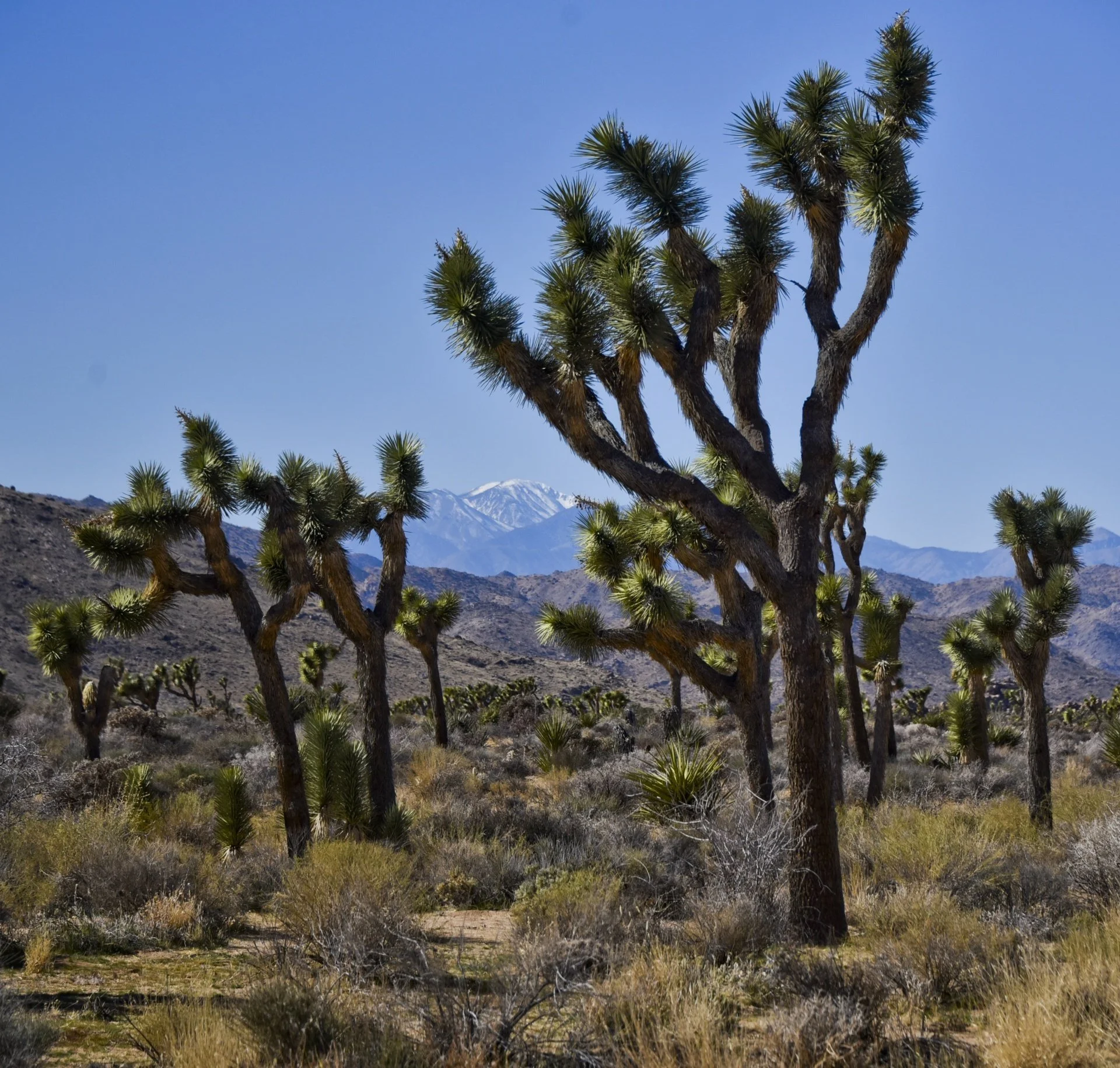
Joshua Tree. Photo credit: Circe Denyer
Bali (spiritual journey)
Tulum (before it was ruined)
Morocco (riad goals)
India (finding yourself)
Peru (ayahuasca optional)
California (Joshua Tree)
Anywhere with hostels (boutique ones)
Boho Career Paths: What the Aesthetic Does for a Living
Boho career paths lean toward the creative, the self-directed, and the spiritual: jewelry designer, ceramicist, vintage curator, yoga instructor, herbalist, retreat facilitator, photographer, writer, blogger, content creator, stylist, and life coach. Common threads are self-direction, creative work, and a blurred line between personal lifestyle and professional identity.
Acceptable Professions:
Jewelry designer
Yoga instructor
Life coach
Artist (various)
Vintage curator
Herbalist
Photographer
Writer/blogger
Influencer
Trust fund recipient
The Values Beneath the Boho Lifestyle
Strip away the macramé and the festival wristbands, and what the boho lifestyle is organized around a special set of values.
Experience over accumulation. A commitment to taking time in a culture obsessed with speed. Beauty is a value in itself which is what the Pre-Raphaelites articulated in 1850.
The boho lifestyle doesn’t always match its stated values. No lifestyle is. The question is whether the boho values are worth organizing a life around. For a lot of people, the answer is yes.
One False Move
One False Move… and you’re telling fortunes.
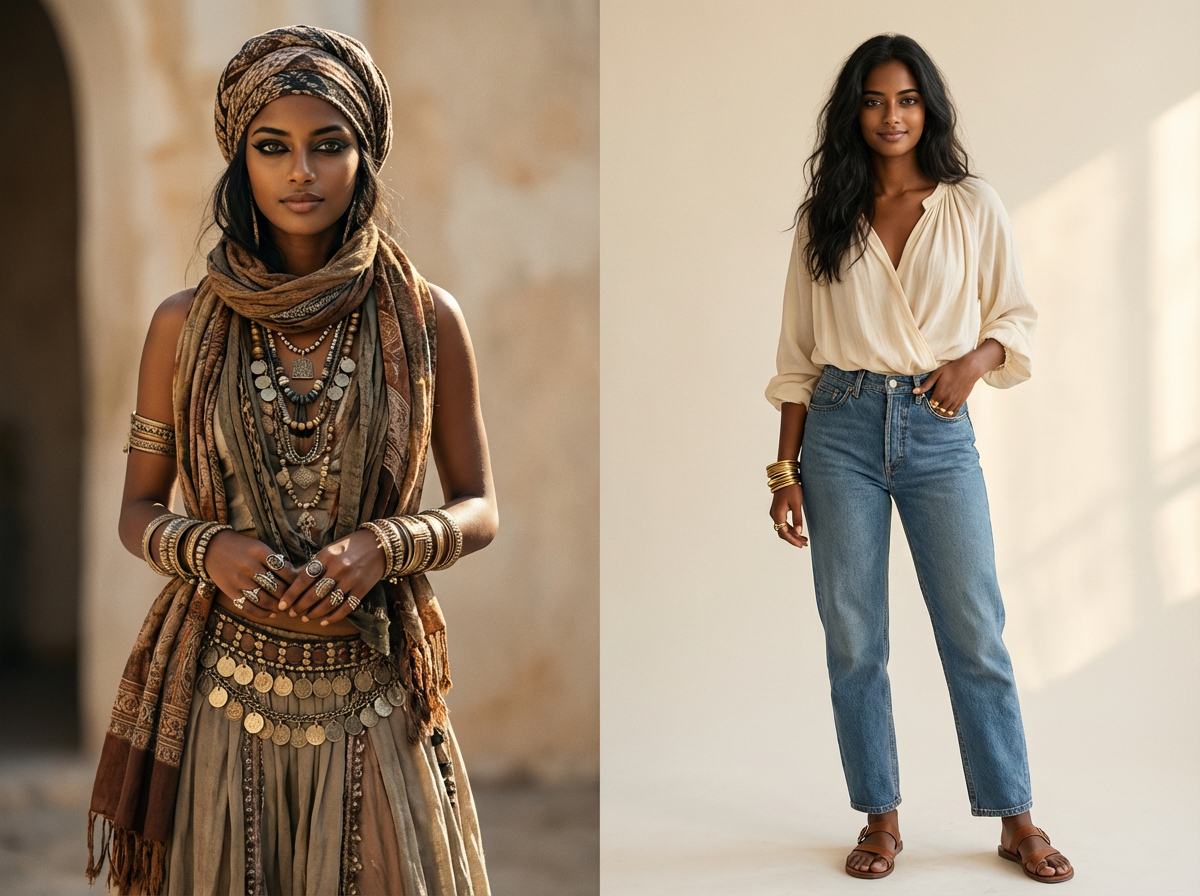
Wrong:
Head-to-toe maximalism—coin belt, jingling bangles, layered scarves, heavy eyeliner, head wrap, embroidered everything, plus fringe.
Why it fails:
You crossed from “bohemian” into theatrical archetype. It reads costume, not personal style.
Fix it:
Pick one statement category:
Keep the jewelry → simplify the outfit
Or keep the outfit → strip the accessories down
Right:
Flowy maxi dress + sandals + one stack of jewelry + loose hair
One False Move… and you learned to crochet yesterday and got excited.
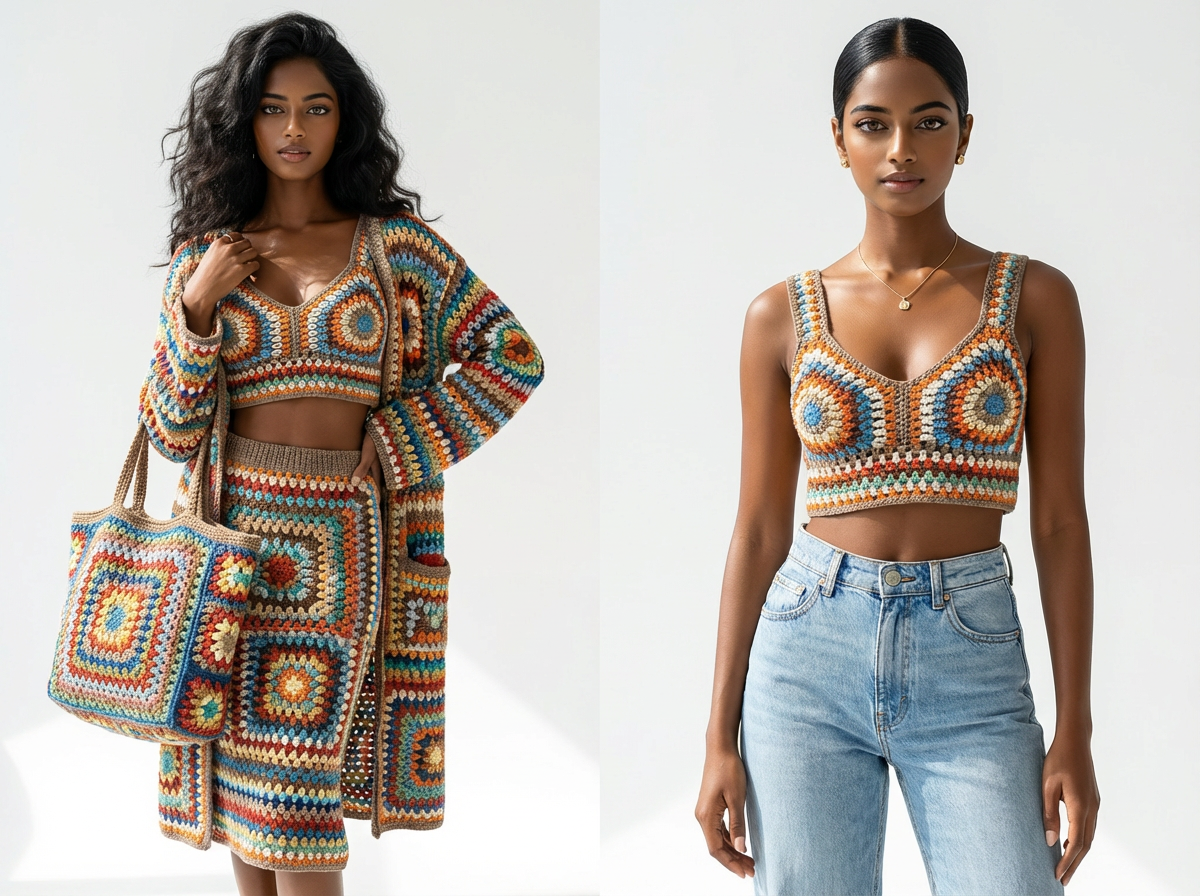
Wrong:
Crochet top + crochet skirt + crochet bag + crochet cardigan
Why it fails:
Texture overload = visual noise.
Fix it:
Treat crochet like a feature, not a theme.
Right:
Crochet top + clean denim + minimal accessories
One False Move… and HR needs to have a conversation.
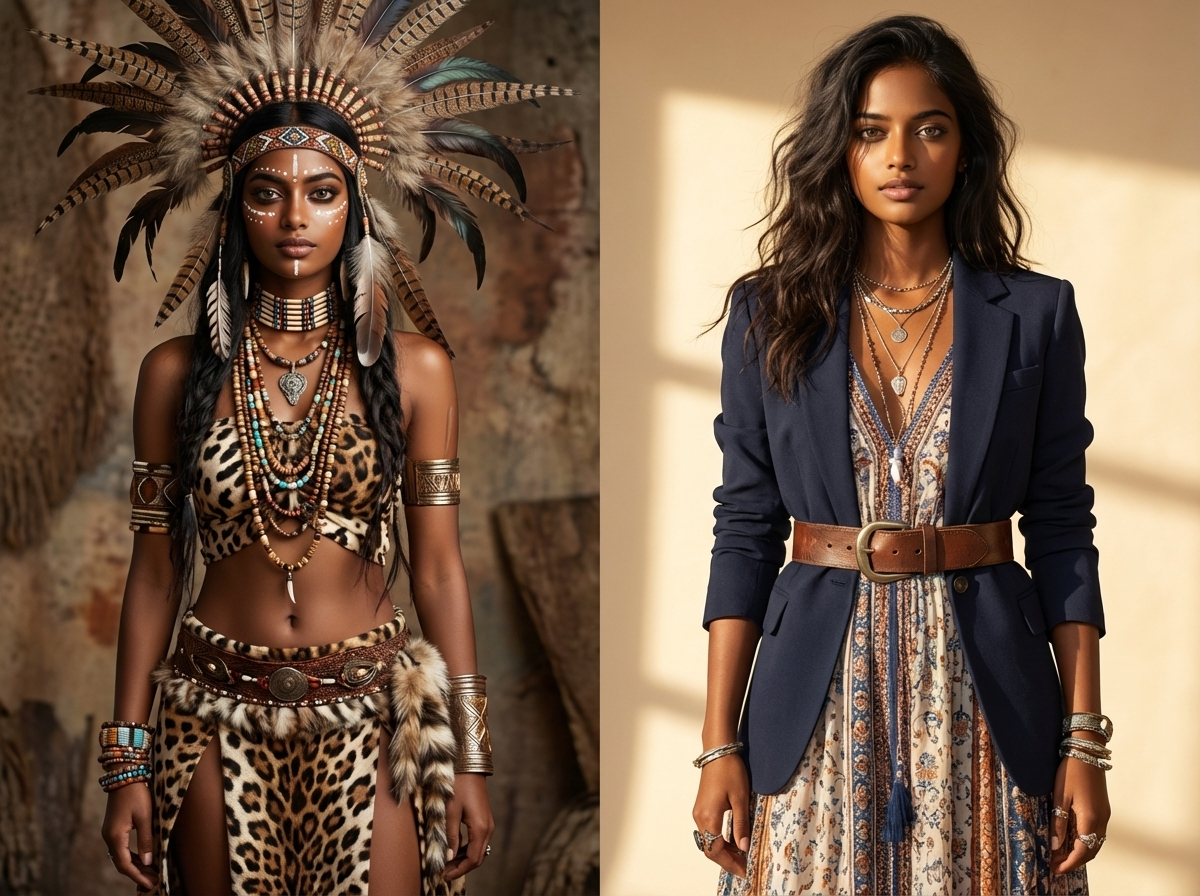
Wrong:
Sacred or culturally specific elements worn as accessories (headdresses, bindis, ceremonial pieces)
Why it fails:
This isn’t just stylistic—it’s cultural misuse.
Fix it:
Shift from appropriation to appreciation:
Choose artisan-made pieces
Stick to globally inspired, not culturally sacred items
Right:
Handcrafted jewelry + natural textiles + respectful sourcing
Are You Actually Boho?
The spectrum is wider than most people assume.
You're boho once a year if you own one or two boho pieces and you wear them for approximately four days in April and then put them away until next year.
You're boho-adjacent if you reach for the linen maxi dress when the occasion allows but you're equally at home in something from a different register.
You're functionally boho if you find yourself in vintage markets more than department stores. The philosophy is operating, even if you've never called yourself boho.
You're fully boho if you have opinions about which farmers market has the best ceramics vendor and which riad in Marrakech has the best light. If the macramé wall hanging was not a purchase but a decision. You already knew this. The quiz was a formality.
A note before you decide:
You do not need to be fully boho to wear boho. You do not need to adopt the lifestyle, the travel itinerary, the social calendar, or the career to put on an embroidered dress and have it be the correct choice. It doesn’t require a philosophy exam at the door.
The only question worth answering is which version is yours — because dressing in a way that is consistent and how you live is the smartest personal style.
